If you play chess online, you know the feeling. You hit a hot streak, your rating spikes to a new all-time high, and you feel like you have finally "leveled up." Then, almost inevitably, the collapse begins. You lose five games in a row, drop 50 points, and find yourself right back where you started. It feels like the platform is rigged against you, forcing a 50% win rate to keep you addicted.
But is it rigged? Or is there a mathematical reality behind the "variance trap"?
To answer this, we analyzed over 38,000 Rapid games from 352 players, alongside aggregate data from over 465,000 Lichess Rapid games [1]. We tracked rating trajectories, measured the exact impact of win and loss streaks, and quantified the statistical variance that defines the online chess experience.
This guide is designed to help players in the Chess.com 800 to 1500 rating range understand the math behind their rating swings, recognize the psychological traps of streaks, and build a data-driven roadmap for climbing the ladder.
(Note: All data was collected from Lichess. To make this actionable for the majority of players, rating labels in charts and text have been converted to their approximate Chess.com Rapid equivalents, which are typically 200-300 points lower than Lichess Rapid ratings [2].)
The Illusion of Momentum: Streaks Don't Change Your Odds
The most common misconception in online chess is that a winning streak means you are playing better, and a losing streak means you are playing worse. Our data shows that this "hot hand" feeling is largely an illusion.
We looked at players across all rating bands and asked a simple question: If you just won three games in a row, what are the odds you win the next one?
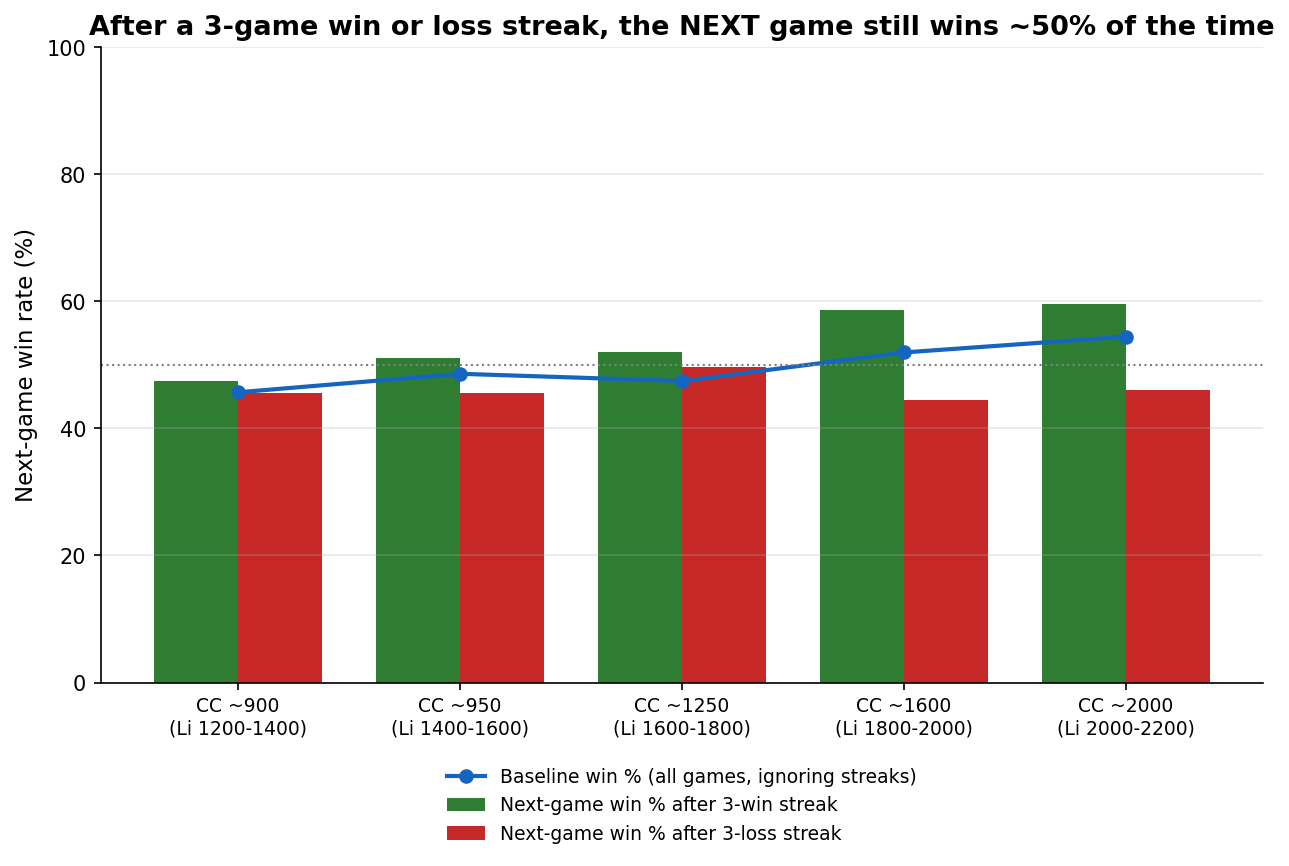
The results are striking. After a 3-game win streak, your odds of winning the next game hover between 47% and 53% for most rating bands. After a 3-game loss streak, your odds of winning the next game are almost identical, sitting between 45% and 49%.
The baseline win rate for these players (ignoring streaks) is around 50%. This means that momentum does not exist in the matchmaking pool. Whether you are on a hot streak or a cold streak, the next game is essentially a coin flip.
Why Does It Feel Like Momentum Exists?
If the math says streaks don't matter, why do they feel so real? The answer lies in the matchmaking algorithm.
When you go on a winning streak, your rating increases. The algorithm immediately begins pairing you with stronger opponents to keep your expected win rate near 50%.
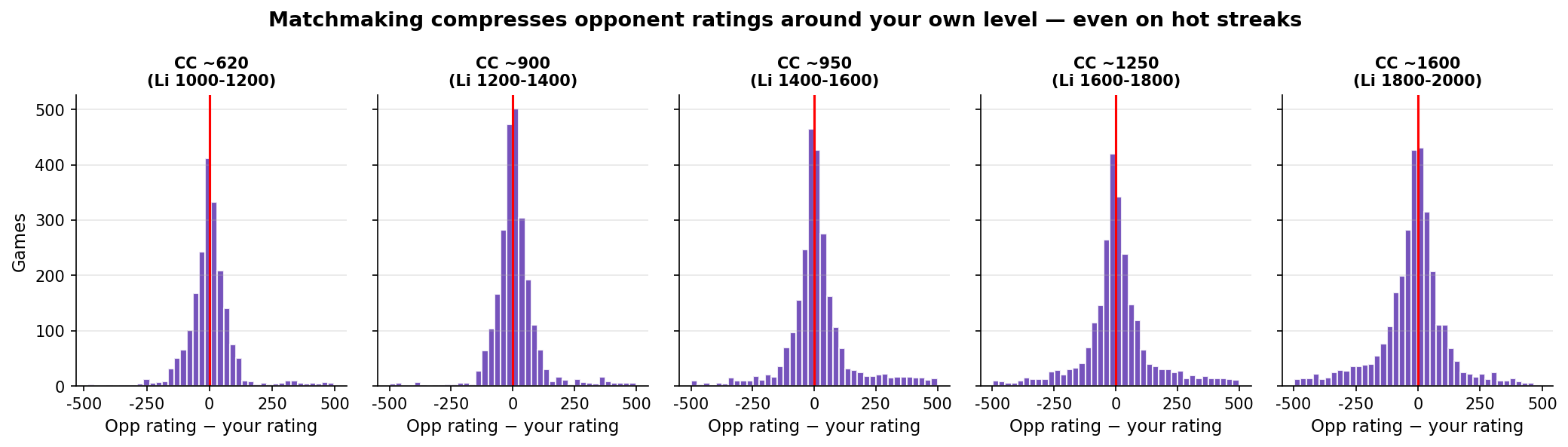
As the histograms above show, the matchmaking system is incredibly efficient. For players around Chess.com 900 (Lichess 1200-1400), 84.8% of games are played against opponents within 100 points of their own rating. When your rating spikes, the difficulty of your opponents spikes with it. You aren't losing because your momentum ran out; you are losing because you are suddenly playing harder opponents.
The Variance Trap: Why 50% Win Rates Create Wild Swings
If every game is a coin flip, you might expect your rating to stay perfectly flat. But that is not how probability works. True randomness creates clusters, and those clusters are what we experience as "swings."
To visualize this, we broke player histories into 100-game blocks and counted the number of wins in each block.
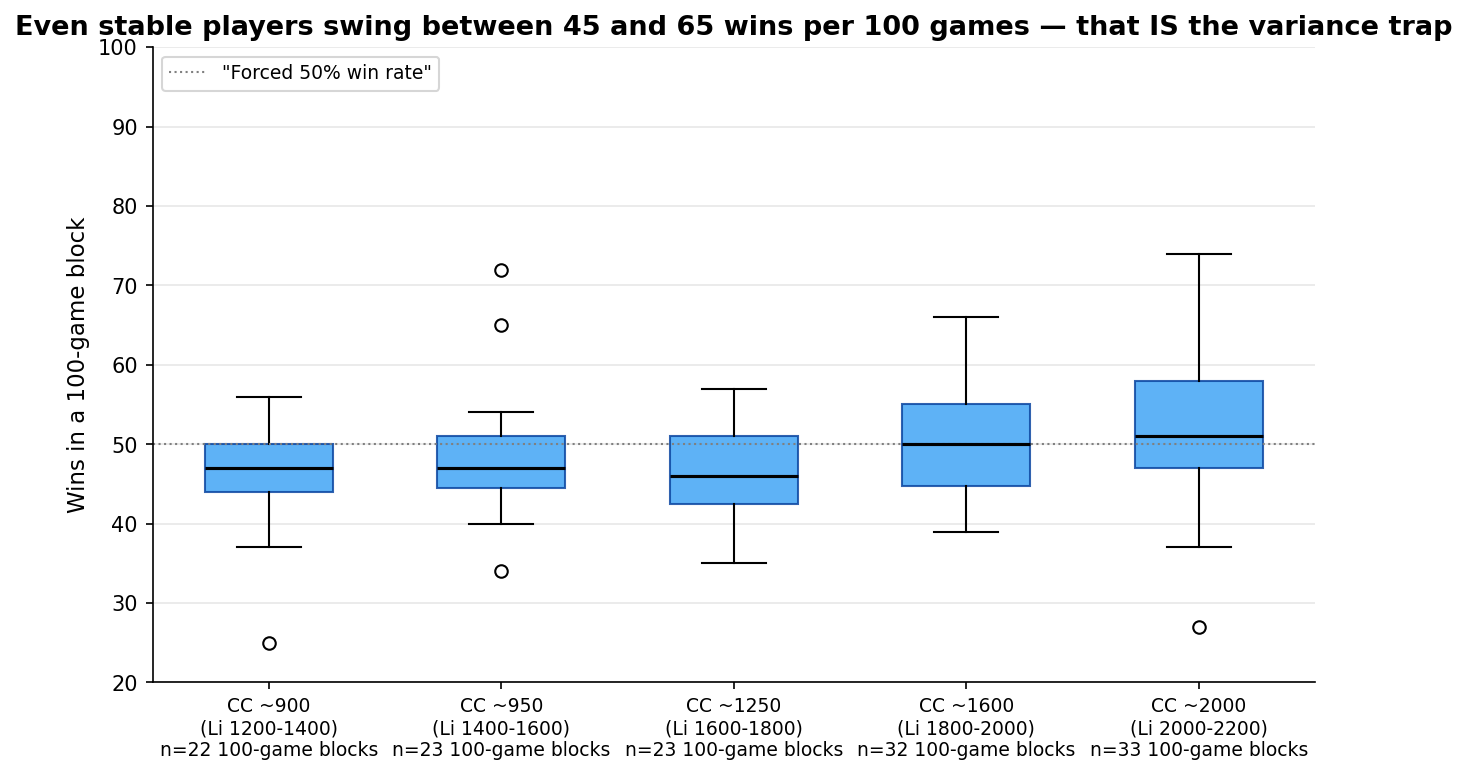
Even for players whose overall rating is completely stable, the number of wins in a 100-game block swings wildly. The median is exactly where you would expect—around 50 wins. But the interquartile range (the middle 50% of outcomes) spans from 45 to 55 wins.
This means that a perfectly stable player, who has not improved or declined in skill, will regularly experience 100-game stretches where they win 55 games (a massive rating gain) and other stretches where they win only 45 games (a massive rating loss).
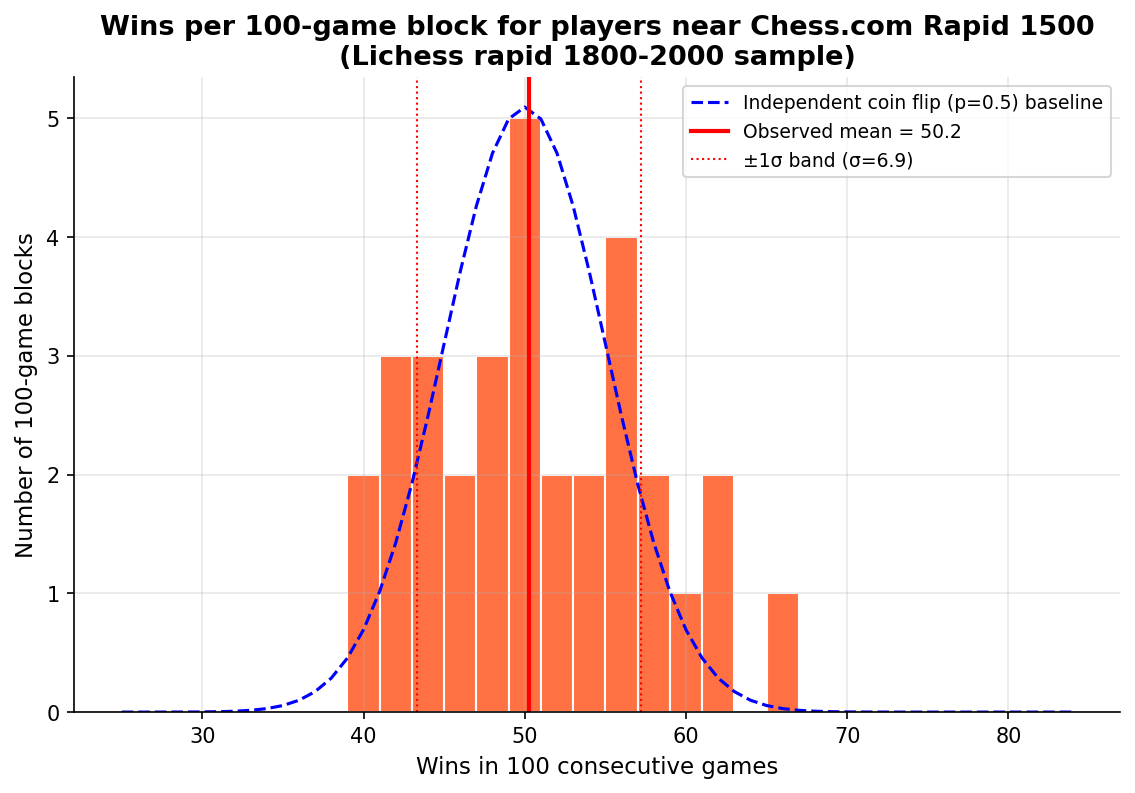
When we look specifically at players near Chess.com 1500 (Lichess 1800-2000), the distribution of wins per 100 games almost perfectly matches the theoretical curve of an independent coin flip. The observed standard deviation is 6.9 wins.
This is the Variance Trap. You experience a natural upward swing of variance, gain 50 points, and believe you have improved. Then, the variance swings back, you lose 50 points, and you believe you are tilting or that the system is punishing you. In reality, you are just experiencing the normal distribution of a 50% win rate.
Mean Reversion: The Gravity of Your True Rating
What happens after you hit one of those positive variance spikes? We tracked players who experienced a sudden "+30 point spike" within a 10-game window, and then looked at what happened to their rating over the next 10, 20, and 50 games.
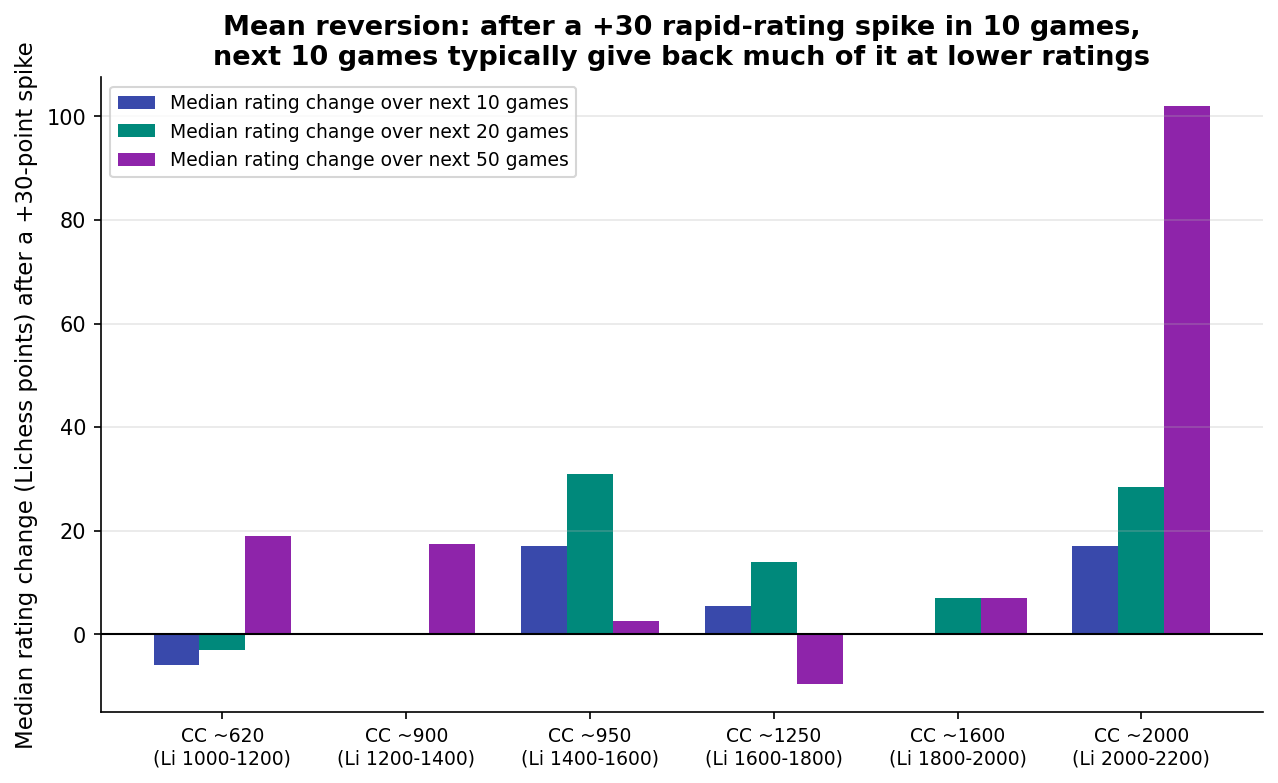
The data shows a clear pattern of mean reversion. For players in the Chess.com 500-735 range, the median rating change over the 10 games immediately following a spike is negative. They immediately start giving the points back.
For higher rating bands, the reversion takes a bit longer, but the trend is the same. A sudden spike in rating is rarely durable. Unless the spike was caused by a genuine, permanent improvement in skill (which takes months, not days), the gravity of your true rating will pull you back down.
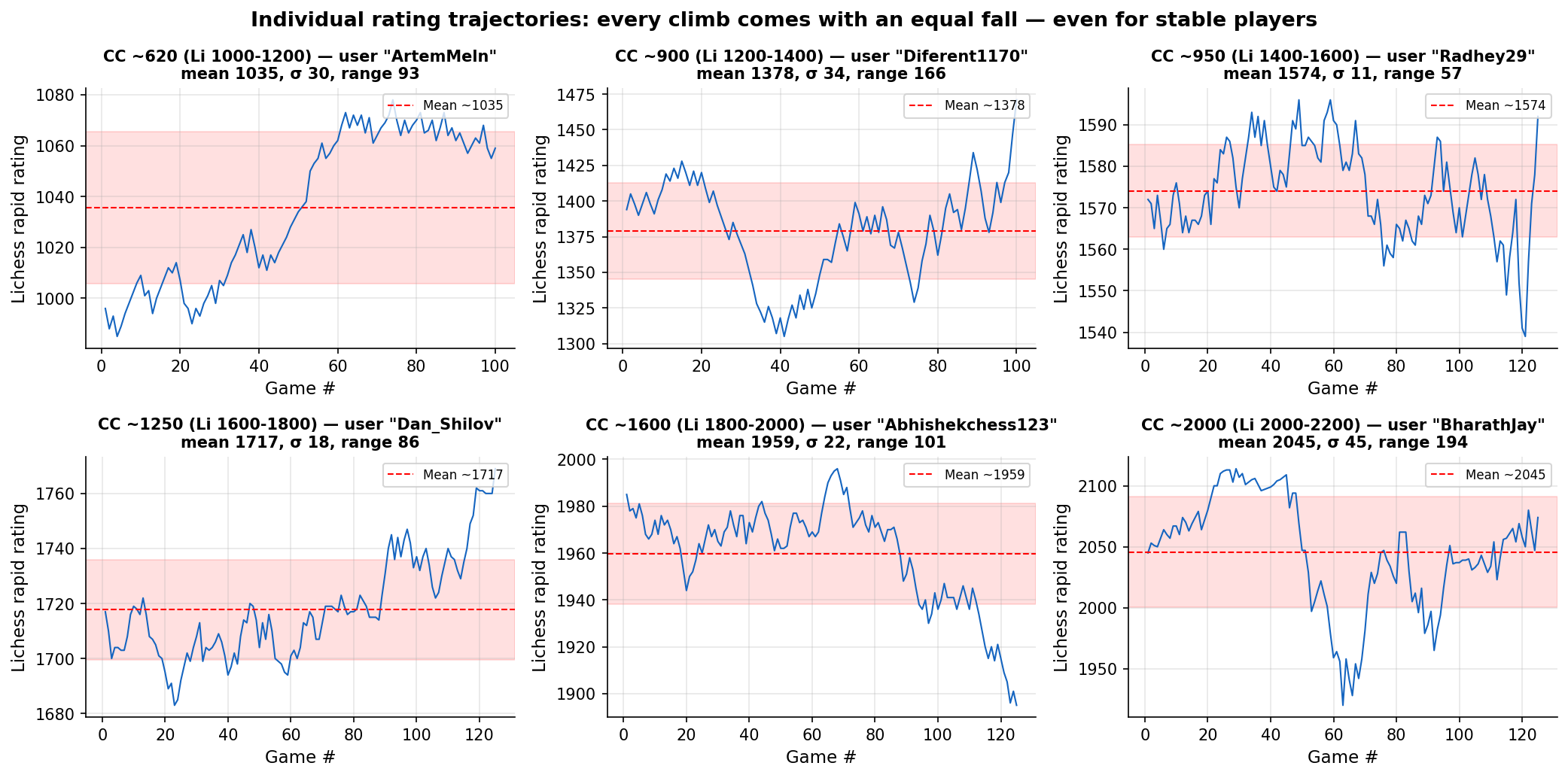
Looking at individual rating trajectories over 120 games, the pattern is undeniable. Every player experiences sharp climbs followed by equally sharp falls. The player at Chess.com ~1250 (bottom left) swings across an 86-point range, despite their true skill level remaining relatively constant.
The Real Danger of Streaks: Tilt and Centipawn Loss
If streaks don't change your win probability, do they matter at all? Yes, but not in the way you think. Streaks don't change the math of the matchmaking system, but they do change how you play.
Using aggregate data from the Grandmaster Guide API, we looked at how a player's Average Centipawn Loss (CPL)—a measure of how accurately they play compared to a top engine—changes after a streak.
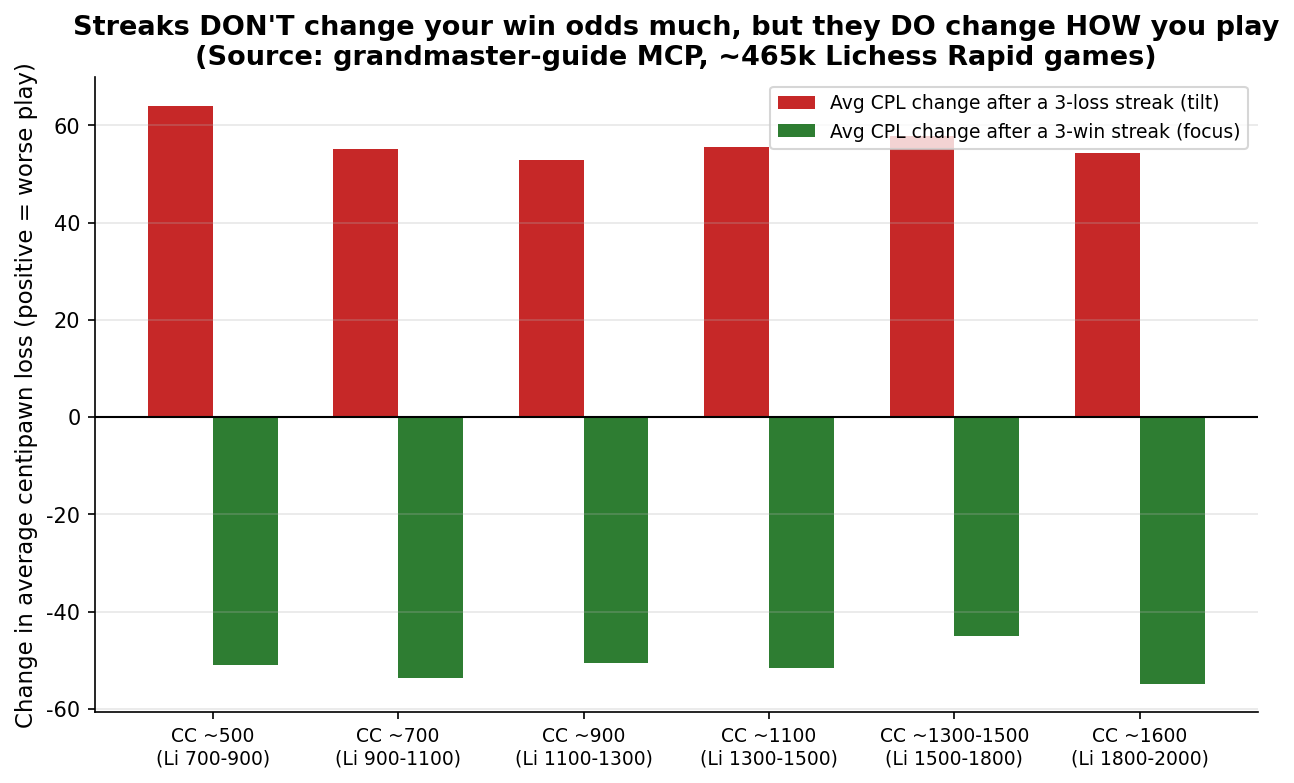
This is where the psychological impact of streaks becomes visible in the data. After a 3-game losing streak, players across all rating bands play significantly worse. Their Average Centipawn Loss increases by 50 to 70 points. They make more inaccuracies, miss more tactics, and play lower-quality chess. This is the statistical signature of "tilt."
Conversely, after a 3-game winning streak, players play better. Their CPL drops by 45 to 55 points. They are focused, confident, and calculating more accurately.
Visualizing Tilt
To understand what this looks like on the board, consider this position from a real game between 1200-rated players.
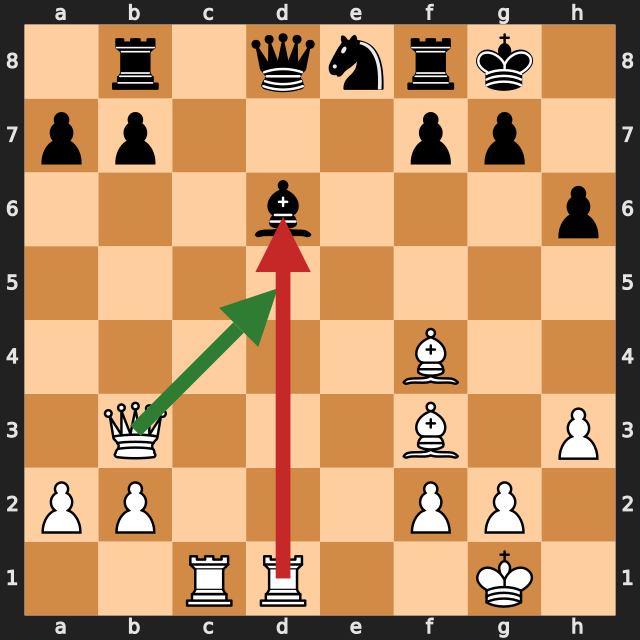
White is completely winning. The engine evaluation is +5.0. The best move is the calm, centralizing Qd5 (green arrow), which dominates the board and prepares to exploit Black's weak back rank.
Instead, a tilting player, perhaps frustrated from a previous loss or rushing to convert a won position, plays the impulsive Rxd6 (red arrow). This exchange sacrifice achieves nothing, throws away the advantage, and allows Black back into the game. Tilt doesn't just make you lose; it makes you throw away winning positions.
Actionable Advice for Climbing the Ranks
Understanding the math of variance and mean reversion is the first step to escaping the trap. Here is how you can apply this data to your own climb, broken down by rating band.
For Chess.com 800 - 1100 (Lichess 1400 - 1600)
- The Data: Your variance swings are wide, and your CPL spikes dramatically after losses.
- The Action: Implement a strict "two-loss rule." If you lose two Rapid games in a row, stop playing rated games for the day. The data shows your accuracy plummets after consecutive losses. Do puzzles or play unrated games instead.
For Chess.com 1100 - 1400 (Lichess 1600 - 1800)
- The Data: You are entering the range where matchmaking becomes incredibly tight (65% of opponents within 100 points).
- The Action: Stop looking at your rating after every game. You are going to experience 50-point swings purely due to variance. Focus on 30-day moving averages rather than daily highs and lows. If your 30-day average is rising, you are improving, regardless of what happened today.
For Chess.com 1400 - 1500+ (Lichess 1800 - 2000+)
- The Data: Mean reversion is strong here. Spikes are almost always followed by corrections.
- The Action: When you hit a new all-time high, expect resistance. You are now playing a new tier of opponents. Do not tilt when your win rate drops back to 50%—that means you belong at this new rating. Consolidate your gains by reviewing your games against these stronger opponents to find the subtle positional errors you are now being punished for.
Conclusion
The feeling that the platform is forcing a 50% win rate is not a conspiracy; it is the mathematical reality of an Elo-based matchmaking system. You lose more after you win because you are playing harder opponents, and because natural variance guarantees that every hot streak will eventually be balanced by a cold streak.
By accepting variance, managing tilt, and focusing on long-term accuracy rather than short-term rating spikes, you can break out of the cycle and start a genuine, durable climb.
Chess Coach
April 17, 2026
Data and Methodology
This analysis was conducted using a dataset of 38,197 Rapid games from 352 Lichess users, collected via the Lichess API. Additional aggregate analytics (CPL, streak effects, matchmaking distributions) were sourced from the Grandmaster Guide MCP server, covering over 465,000 Lichess Rapid games.
The underlying data files generated during this research are attached for review:
streak_reversion.csv: Next-game outcomes following streaks of various lengths.spike_reversion_summary.csv: Rating changes following a +30 point spike.matchmaking_oppdiff_summary.csv: Distribution of opponent rating differences.variance_100game_summary.csv: Win distributions across 100-game blocks.
References
[1] Grandmaster Guide MCP API Analytics Dataset (465k+ Rapid Games)
[2] Chess.com to Lichess Rating Conversion Mapping (Project Standard)