Every chess player has wondered at some point: Am I playing the right opening for my level? While grandmasters debate the theoretical nuances of the Berlin Defense or the Marshall Attack, the reality for most club players is entirely different. An opening that scores a brilliant 60% win rate at the 800 level might become a liability by the time you reach 1500. The opening that carried you to your first milestone could be the very thing holding you back from the next one.
To answer this question definitively, we analyzed a dataset of 954,617 Lichess games (with full Stockfish 17 engine evaluations), tracking the performance of the 30 most popular openings across six rating bands. We mapped these Lichess ratings to their approximate Chess.com equivalents (ranging from 600 to 1800 in Rapid) to provide actionable advice for the majority of online players. This guide serves as a roadmap for your chess journey, showing you exactly when certain openings peak in effectiveness and when it is time to retire them from your repertoire.
A note on ratings: All rating labels in this article refer to Chess.com Rapid ratings unless otherwise stated. The underlying data comes from Lichess, where ratings run approximately 200-400 points higher for the same skill level. The Lichess equivalents are noted where relevant for cross-reference.
Part 1: The Big Picture — 1.e4 vs 1.d4
Before diving into specific variations, we must address the oldest debate in chess: should you start with 1.e4 or 1.d4? The data reveals a fascinating trend regarding first-move choices and their success rates across different skill levels.
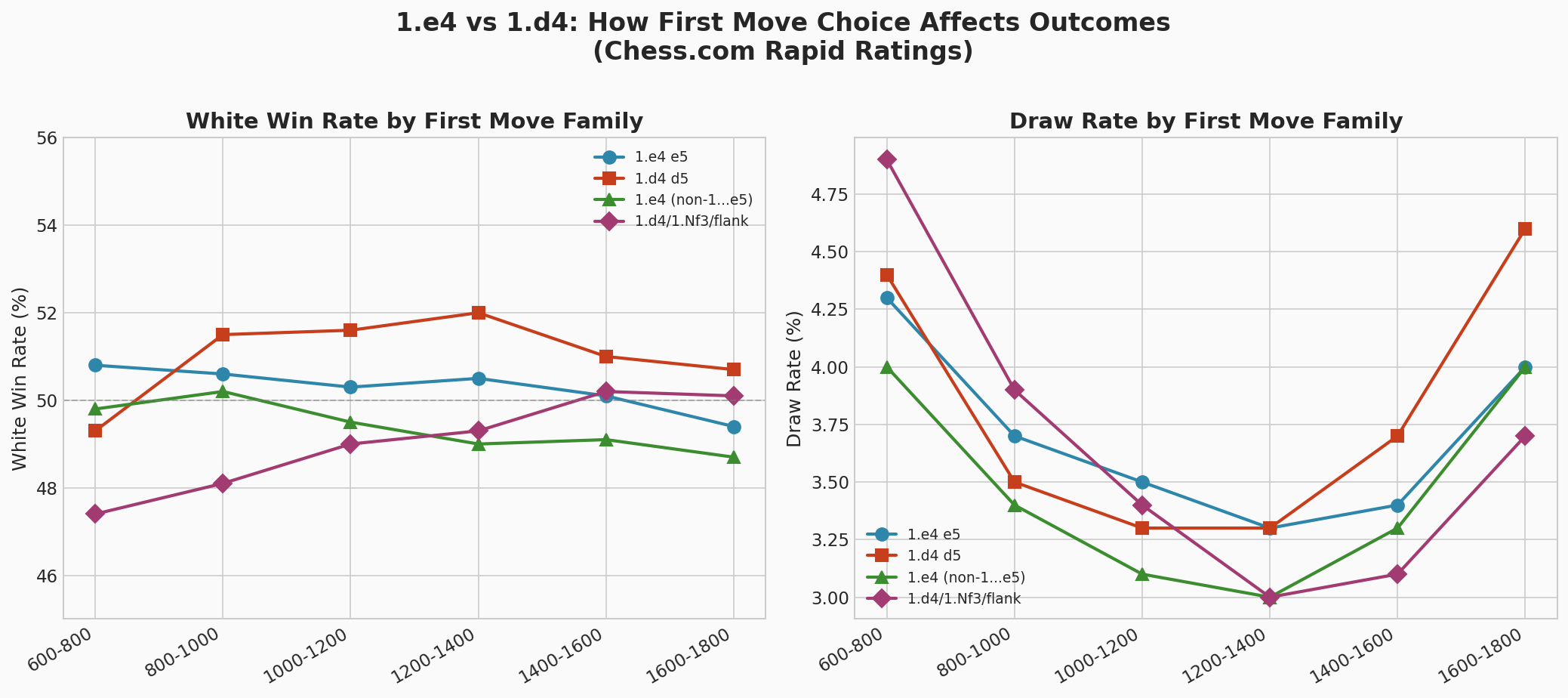
At the beginner level (Chess.com 600-800), starting with 1.e4 and meeting it with 1...e5 is the most successful approach for White, yielding a win rate of nearly 50.8%. This makes intuitive sense: open games after 1.e4 e5 lead to tactical positions where basic piece activity and simple threats dominate. However, as players improve, the effectiveness of 1.e4 e5 steadily declines. By the time players reach the 1600-1800 bracket, the win rate for 1.e4 e5 drops to 49.4%, falling below the critical 50% threshold.
Conversely, 1.d4 openings (specifically 1.d4 d5) start with a lower win rate of 49.3% at the 600-800 level but experience a significant surge in effectiveness in the intermediate brackets. At the 1200-1400 level, 1.d4 d5 peaks at a remarkable 52% win rate for White. This suggests that while 1.e4 is excellent for learning tactical fundamentals, 1.d4 becomes a powerful weapon once players develop a basic understanding of positional concepts.
The following table summarizes the White win rate for each first-move family across all rating bands:
| First Move Family | 600-800 | 800-1000 | 1000-1200 | 1200-1400 | 1400-1600 | 1600-1800 |
|---|---|---|---|---|---|---|
| 1.e4 e5 (ECO C) | 50.8% | 50.6% | 50.3% | 50.5% | 50.1% | 49.4% |
| 1.d4 d5 (ECO D) | 49.3% | 51.5% | 51.6% | 52.0% | 51.0% | 50.7% |
| 1.e4 (non-1...e5) (ECO B) | 49.8% | 50.2% | 49.5% | 49.0% | 49.1% | 48.7% |
| 1.d4/1.Nf3/flank (ECO A) | 47.4% | 48.1% | 49.0% | 49.3% | 50.2% | 50.1% |
The draw rate also tells an interesting story. At the lowest ratings, draws are surprisingly common (4.3-4.9%), likely due to stalemate accidents and threefold repetition. Draw rates then dip to their lowest at the 1200-1400 level (around 3.0-3.1%), where players are aggressive enough to avoid draws but not yet skilled enough to hold difficult positions. They then rise again at the 1600-1800 level (3.7-4.6%) as players develop genuine defensive technique.
Part 2: The "Trap Opening" Effect — When Do Tricks Stop Working?
One of the most striking findings in our data is the phenomenon we call the "Trap Opening Decay." Many players build their early rating climbs on the back of tricky, tactical openings that rely on the opponent making a specific mistake. The data shows exactly when these tricks stop working.
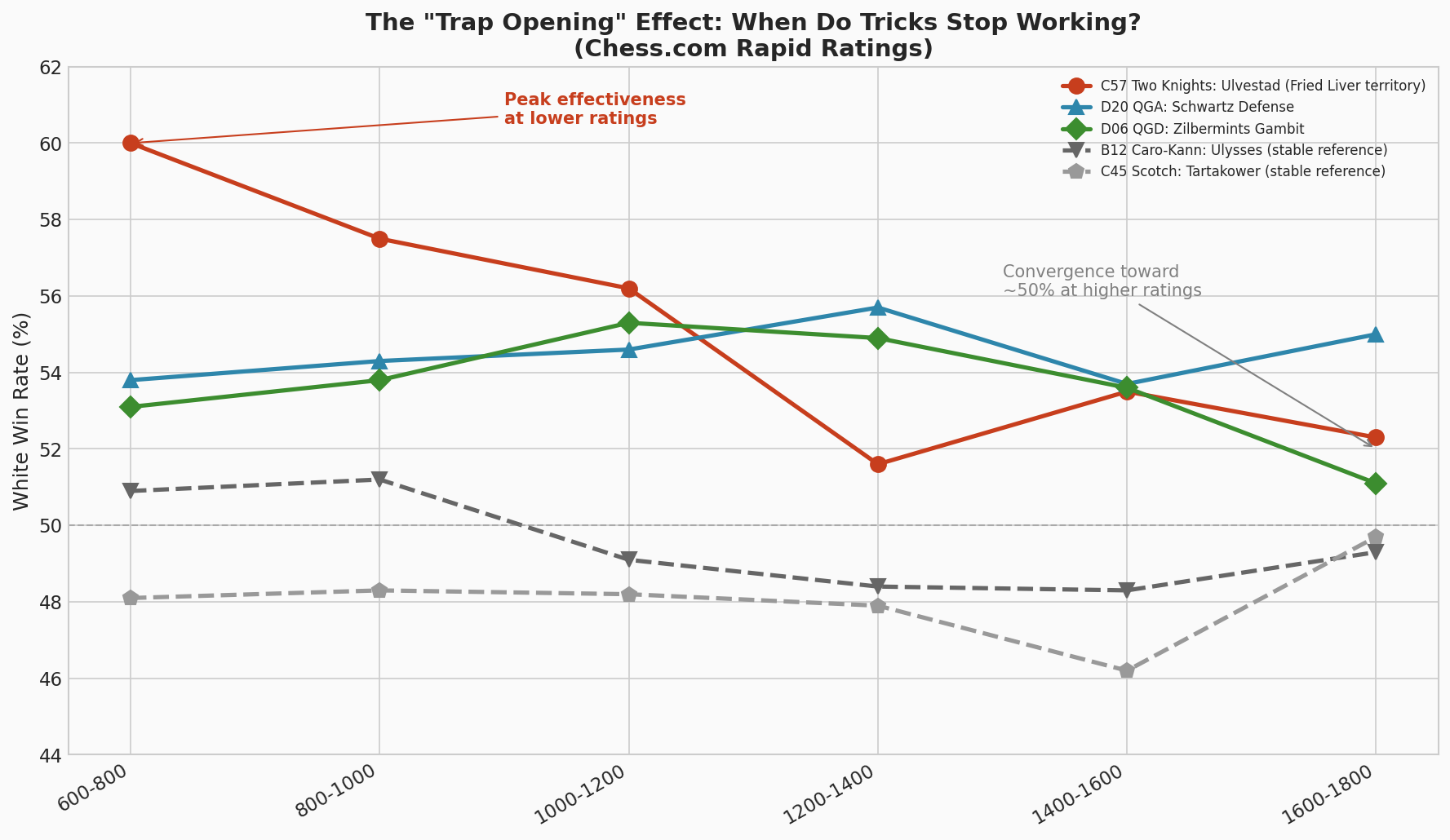
The most dramatic example is the Two Knights Defense: Ulvestad Variation (ECO C57), which often reaches positions similar to the Fried Liver Attack. At the 600-800 level (Lichess ~1200-1400 Rapid), this opening boasts an incredible 60% win rate for White. It is an absolute weapon against beginners who do not know the precise defensive theory. However, look at the decay curve: by the time you reach 1600-1800, the win rate plummets to 52.3%—a massive 7.7 percentage point drop.
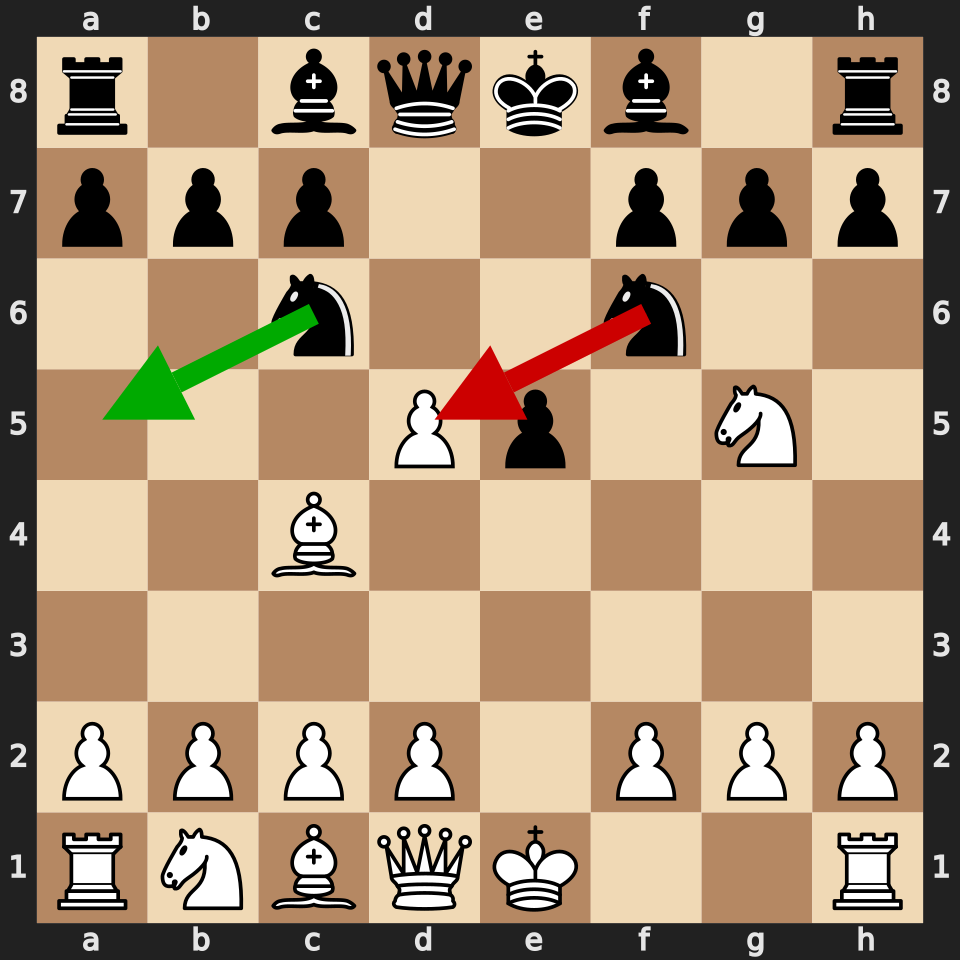
In the Two Knights Defense, after 1.e4 e5 2.Nf3 Nc6 3.Bc4 Nf6 4.Ng5 d5 5.exd5, beginners frequently play the natural-looking but disastrous 5...Nxd5? (red arrow), which allows the devastating 6.Nxf7 Fried Liver Attack. As players improve, they learn the correct theoretical response 5...Na5! (green arrow), which immediately neutralizes White's initiative and explains the sharp decline in White's win rate at higher ratings.
The following table quantifies the decay for the most "trappy" openings in our dataset:
| Opening | ECO | 600-800 WR | Peak Band | Peak WR | 1600-1800 WR | Decay (pp) |
|---|---|---|---|---|---|---|
| Two Knights: Ulvestad | C57 | 60.0% | 600-800 | 60.0% | 52.3% | -7.7 |
| Latvian Gambit | C40 | 56.0% | 800-1000 | 56.4% | 50.2% | -6.2 |
| Bishop's Opening: del Rio | C23 | 53.5% | 600-800 | 53.5% | 50.3% | -3.2 |
| Petrov's Defense: Three Knights | C42 | 53.1% | 600-800 | 53.1% | 48.3% | -4.8 |
| QGD: Zilbermints Gambit | D06 | 53.1% | 1000-1200 | 55.3% | 51.1% | -4.2 |
Other aggressive gambits show similar, though less extreme, decay curves. The Queen's Gambit Declined: Zilbermints Gambit actually peaks at the 1000-1200 level (55.3%) before declining, suggesting that some gambits require a minimum level of skill to execute properly, even if they ultimately become less effective at higher levels.
Part 3: The Heatmap — Top Openings Across All Rating Bands
To provide a comprehensive view of opening performance, we generated a heatmap of the top 12 most frequently played openings and their White win rates across all rating bands.
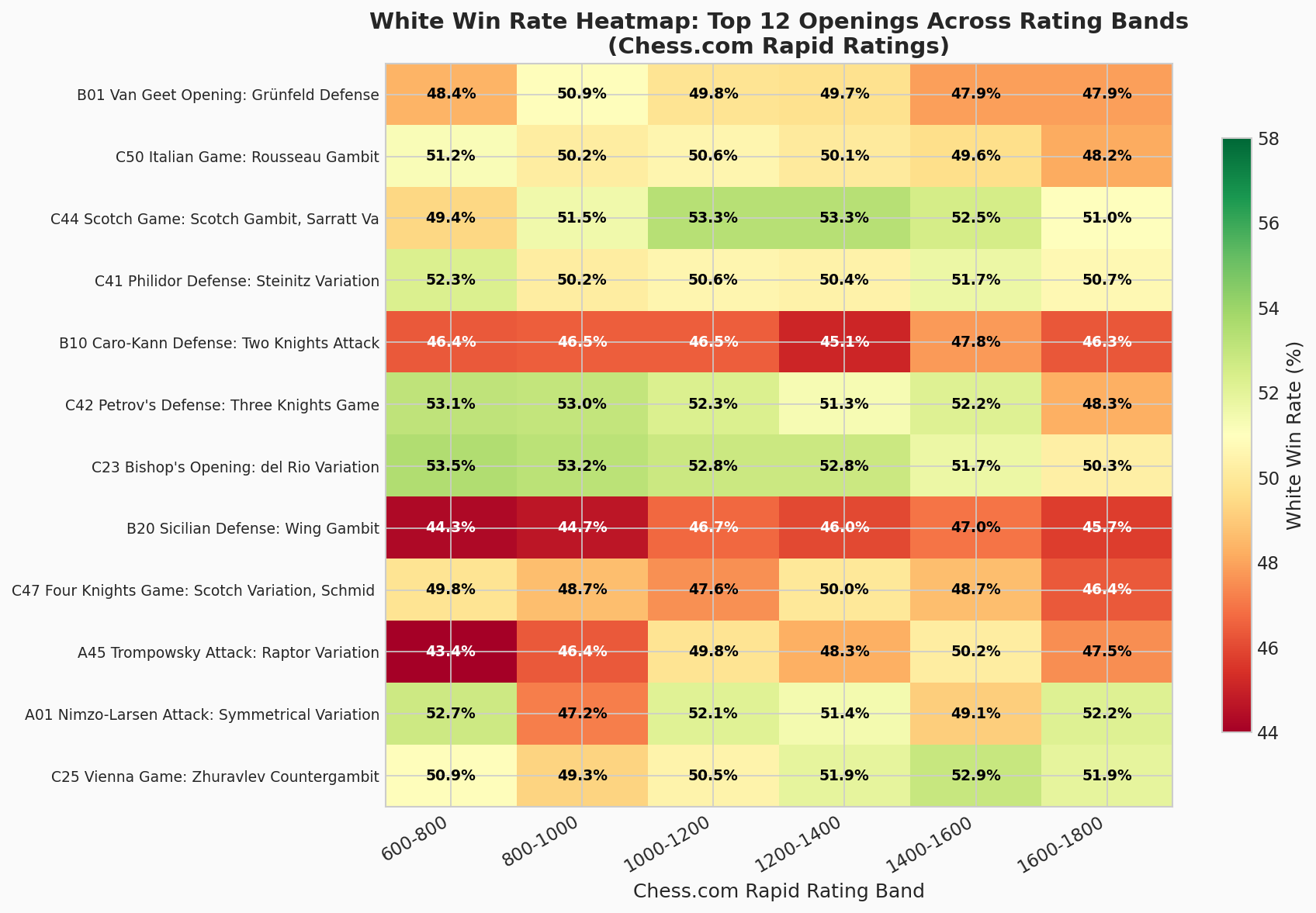
This visualization reveals several critical insights. The Queen's Gambit Accepted: Schwartz Defense (D20) is remarkably consistent, maintaining a win rate between 53.7% and 55.7% across all rating bands. This is the single most statistically dominant opening in our dataset, and it performs well regardless of the player's skill level. The Scotch Game: Vitzthum Attack (C44) is another strong performer, peaking at 53.3% in the 1000-1400 range.
On the other end of the spectrum, the Caro-Kann Defense: Two Knights Attack (B10) is a nightmare for White. Across almost all rating bands, White scores below 48%, making this one of the most robust defensive choices for Black. The Sicilian Defense: Wing Gambit (B20) is even worse for White, with win rates consistently below 47%.
Part 4: Win / Draw / Loss Breakdown by Rating Band
The stacked bar charts below show the complete win/draw/loss breakdown for the top 10 openings (ranked by White win rate) at each rating band.
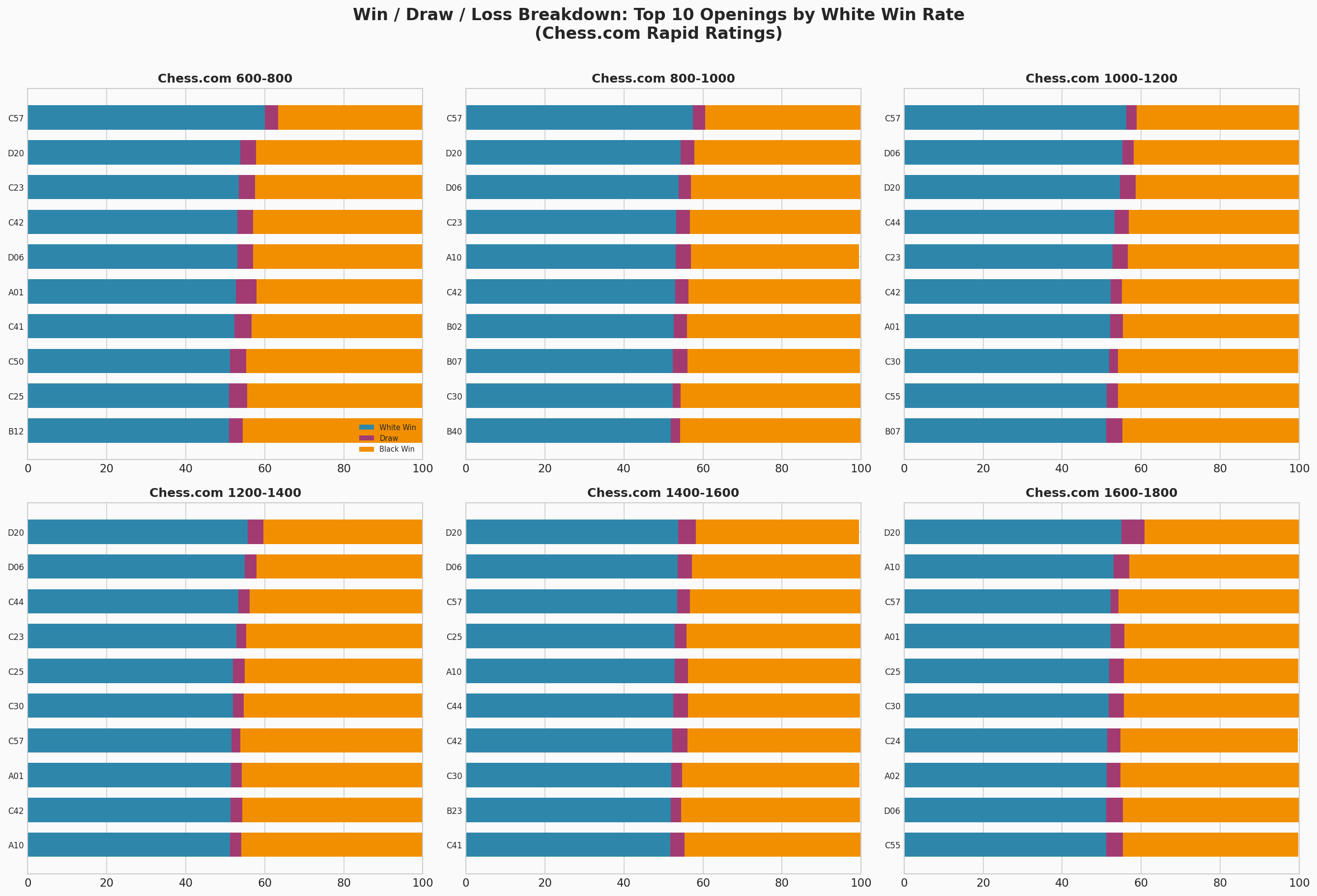
Several patterns emerge from this detailed breakdown. At the 600-800 level, the C57 (Two Knights: Ulvestad) and D20 (QGA: Schwartz) dominate with the highest White win rates. Draw rates are extremely thin across the board—typically 2-5%—reflecting the decisive nature of games at all amateur levels. As ratings increase, the spread between the best and worst openings narrows considerably. At the 1600-1800 level, the difference between the top-performing and bottom-performing opening is only about 7 percentage points, compared to nearly 16 points at the 600-800 level.
Part 5: Net White Advantage — Which Openings Favor Which Side?
To identify which openings truly favor White versus Black, we computed the net White advantage (White Win% minus Black Win%) averaged across all rating bands. A positive value means the opening favors White; a negative value means Black has the statistical edge.
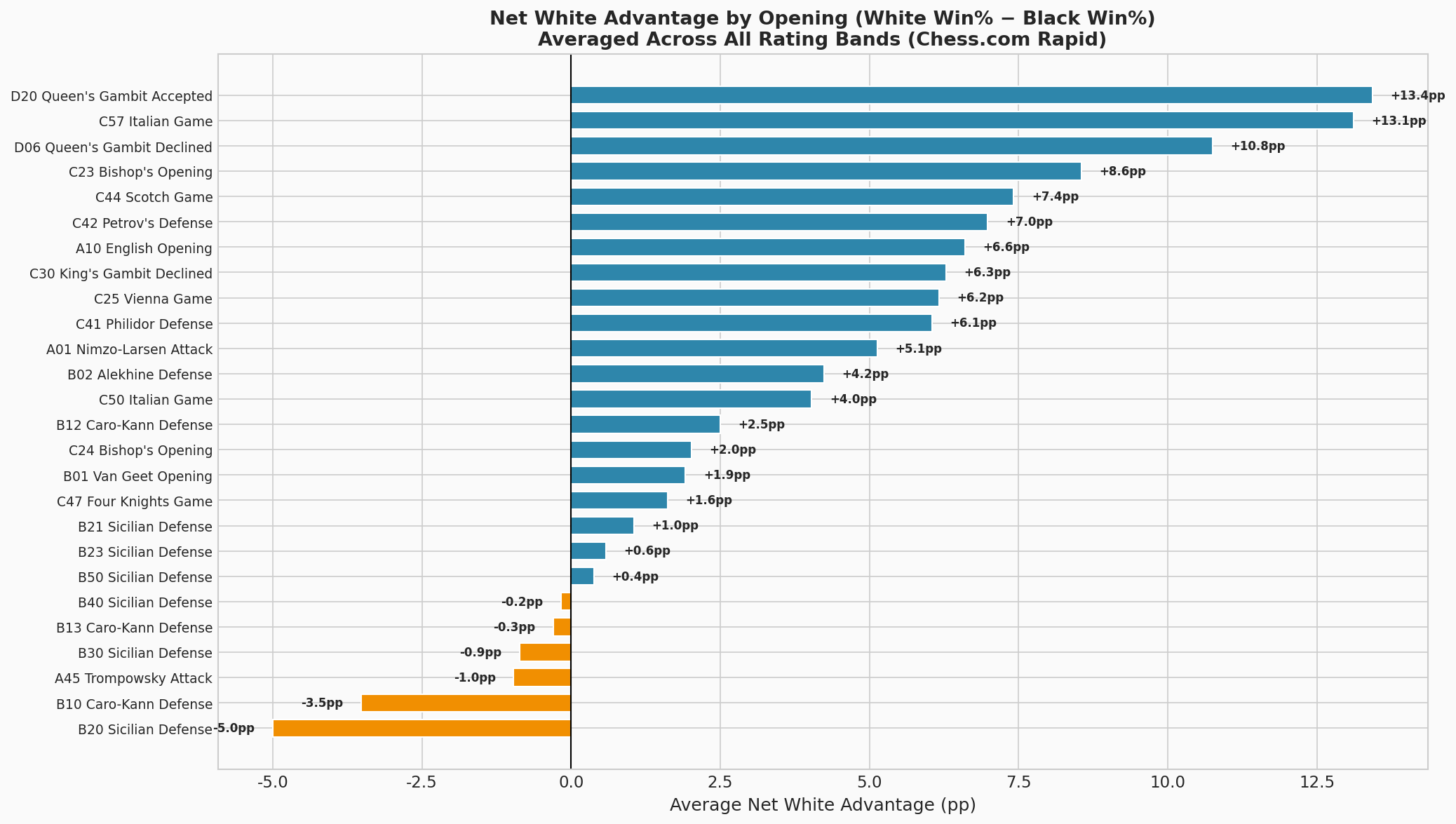
The openings with the strongest net White advantage include the Queen's Gambit Accepted: Schwartz Defense (+13.4pp), the Two Knights: Ulvestad (+12.2pp), and the Latvian Gambit (+10.7pp, where White is punishing Black's dubious 2...f5). On the other hand, the Sicilian Defense: Wing Gambit (-3.1pp) and the Caro-Kann: Two Knights Attack (-2.5pp) consistently favor Black.
This data is particularly useful for repertoire construction. If you are looking for an opening that gives White a genuine statistical edge at your level, the table below provides a clear ranking:
| Rank | Opening | ECO | Avg. Net White Advantage |
|---|---|---|---|
| 1 | QGA: Schwartz Defense | D20 | +13.4 pp |
| 2 | Two Knights: Ulvestad | C57 | +12.2 pp |
| 3 | Latvian Gambit (White punishes) | C40 | +10.7 pp |
| 4 | QGD: Zilbermints Gambit | D06 | +10.0 pp |
| 5 | Scotch: Vitzthum Attack | C44 | +7.0 pp |
| 6 | Bishop's Opening: del Rio | C23 | +6.4 pp |
| 7 | Philidor: Steinitz Variation | C41 | +5.4 pp |
| 8 | English: Wade Gambit | A10 | +5.3 pp |
Part 6: Tactical vs. Positional Openings — Two Worlds
When we separate openings into tactical/gambit lines versus solid/positional lines, two distinct patterns emerge.
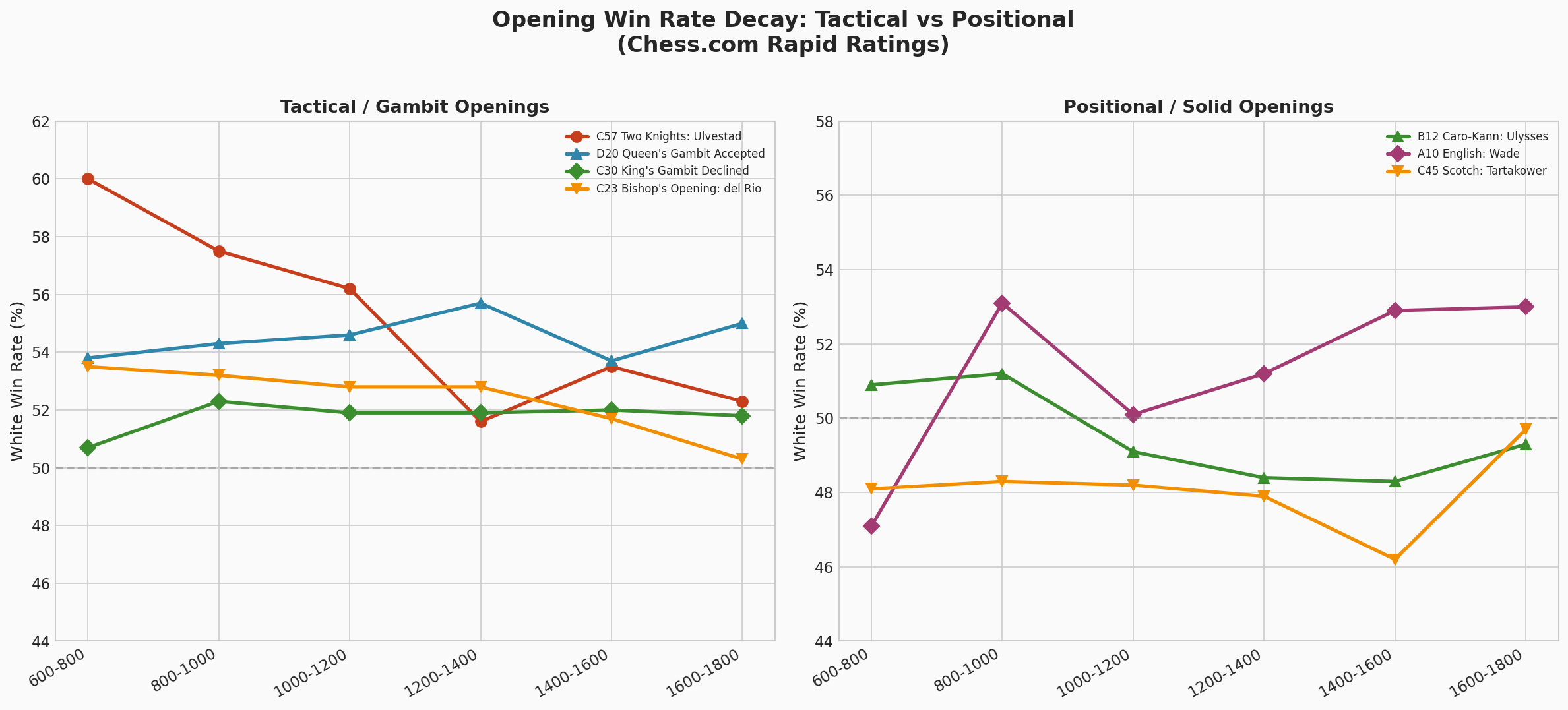
Tactical openings (the left chart) almost universally trend downward as ratings increase. The element of surprise diminishes, and opponents become better at calculating their way out of early trouble. The Two Knights: Ulvestad drops from 60% to 52.3%. The Queen's Gambit Accepted maintains a high win rate but still shows a gentle decline. The King's Gambit Declined and Bishop's Opening converge toward the 50-52% range.
Positional openings (the right chart), such as the English Opening (Wade Gambit) or the Scotch Game (Tartakower Variation), show much more stability—and in some cases, their win rates actually increase with rating. The English Opening rises from 47.1% at 600-800 to 53.0% at 1600-1800, a remarkable upward trajectory. This makes sense: positional openings reward understanding over memorization, and stronger players extract more from the resulting middlegame structures.
Part 7: Best Openings for the Defending Side (Black)
While much of opening theory focuses on White's first-move advantage, the data reveals that certain openings are statistically excellent for Black.
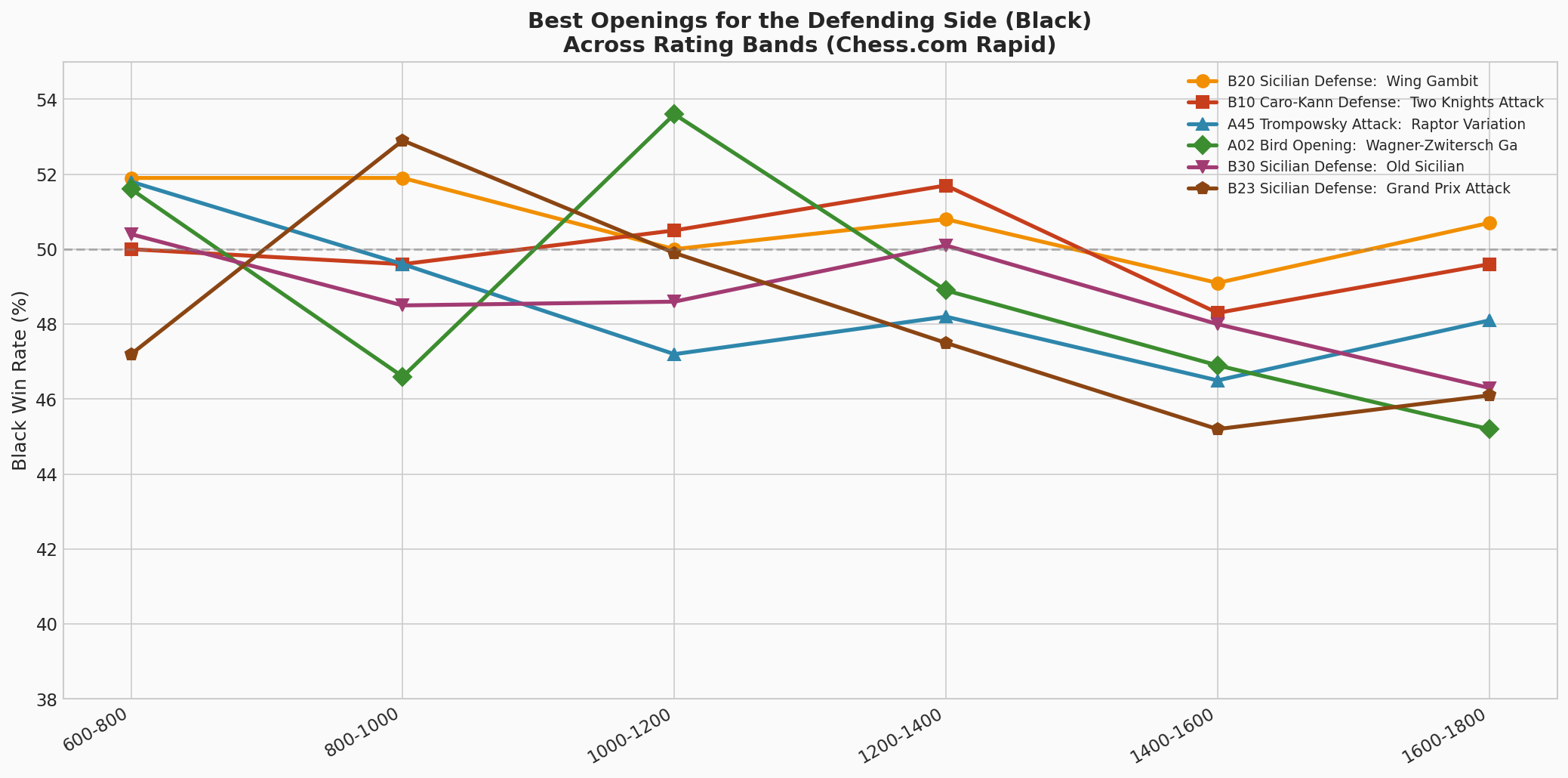
The Sicilian Defense: Wing Gambit (B20) is the single best opening for Black in our dataset. Black scores above 49% in almost every rating band, peaking at 51.9% at the 600-800 level. This is because the Wing Gambit (2.b4) is an objectively dubious sacrifice that gives Black a free pawn and easy development if handled correctly.
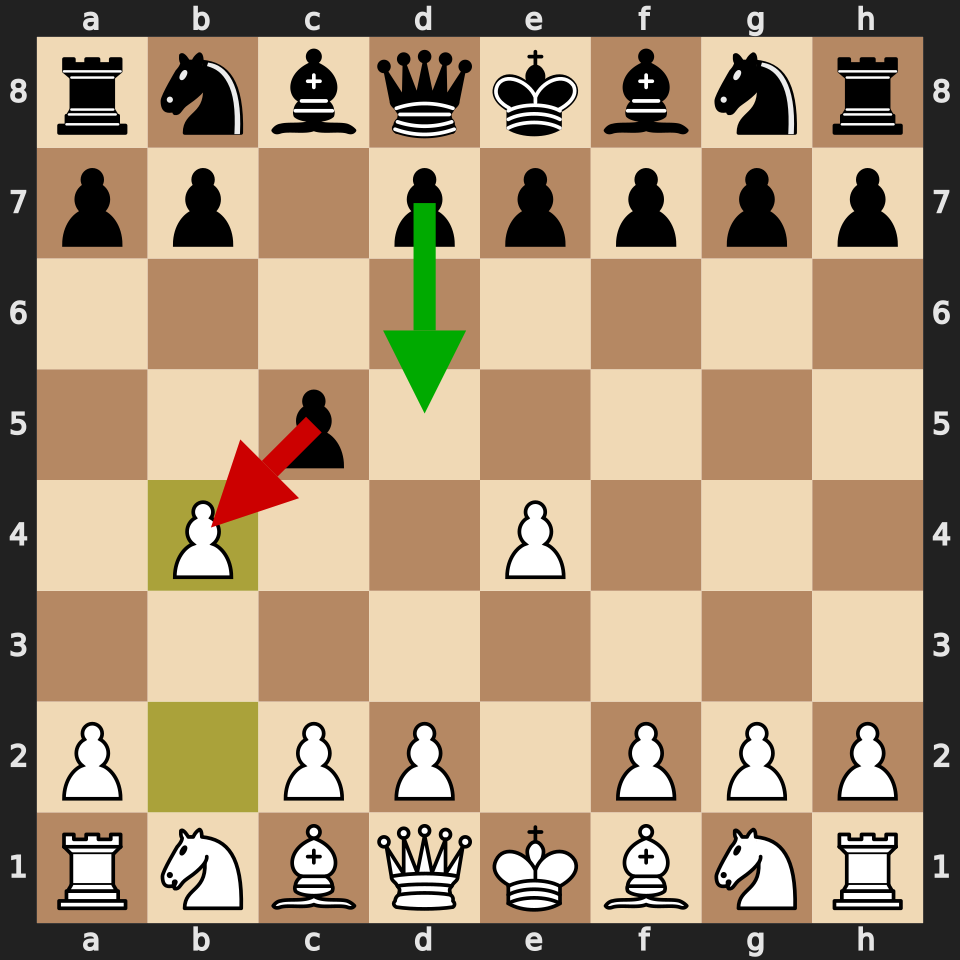
When facing the Sicilian Wing Gambit (1.e4 c5 2.b4), lower-rated players often reflexively capture the pawn with 2...cxb4? (red arrow), which is exactly what White wants—it opens lines for White's pieces. Advanced players understand that the best refutation is to strike back in the center immediately with 2...d5! (green arrow), which explains why this gambit performs poorly for White at higher ratings.
The Caro-Kann Defense: Two Knights Attack (B10) is another outstanding choice for Black, with Black scoring above 48% at every rating band and exceeding 50% in the 1000-1400 range. The Caro-Kann's solid pawn structure and lack of early weaknesses make it a reliable defensive weapon.
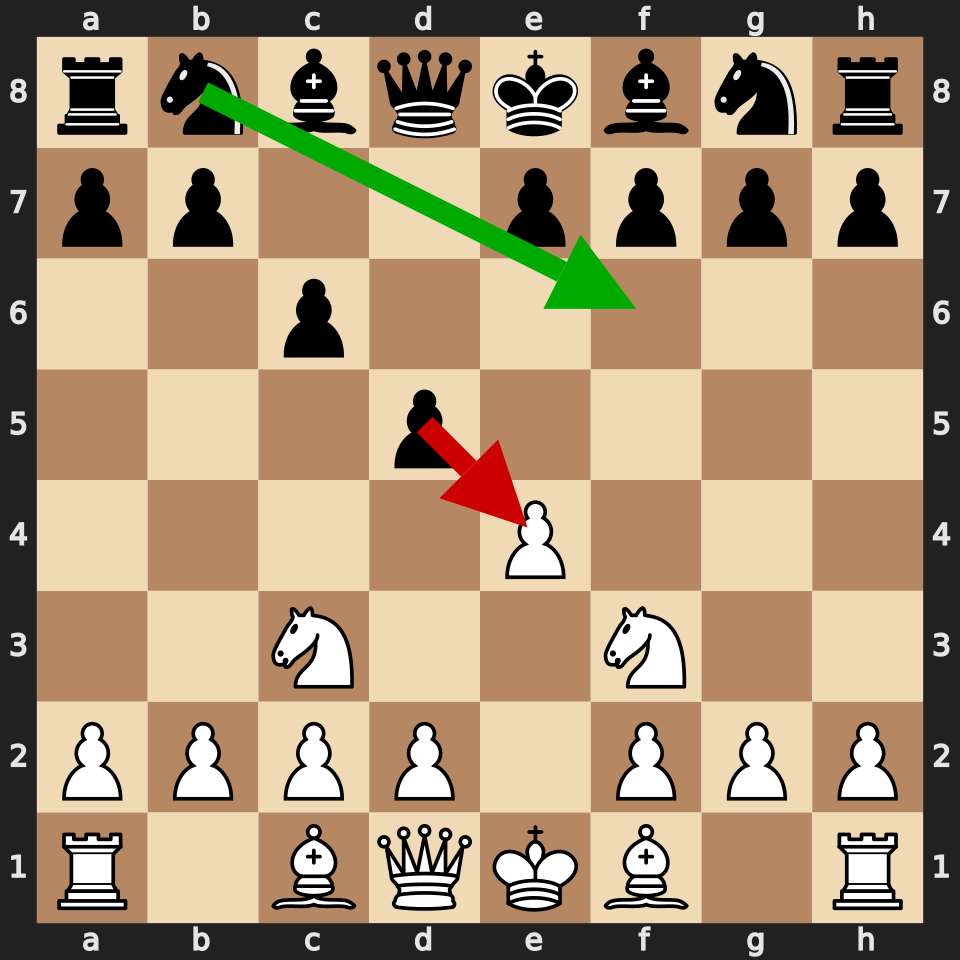
In the Caro-Kann Two Knights Attack (1.e4 c6 2.Nf3 d5 3.Nc3), Black should avoid the premature 3...dxe4? (red arrow) which opens the center favorably for White. Instead, the solid developing move 3...Nf6! (green arrow) maintains the tension and contributes to Black's excellent statistical performance in this line.
Part 8: Opening Diversity — Do Stronger Players Play More Openings?
An often-overlooked aspect of opening preparation is repertoire diversity. Do stronger players specialize in a narrow set of openings, or do they branch out?
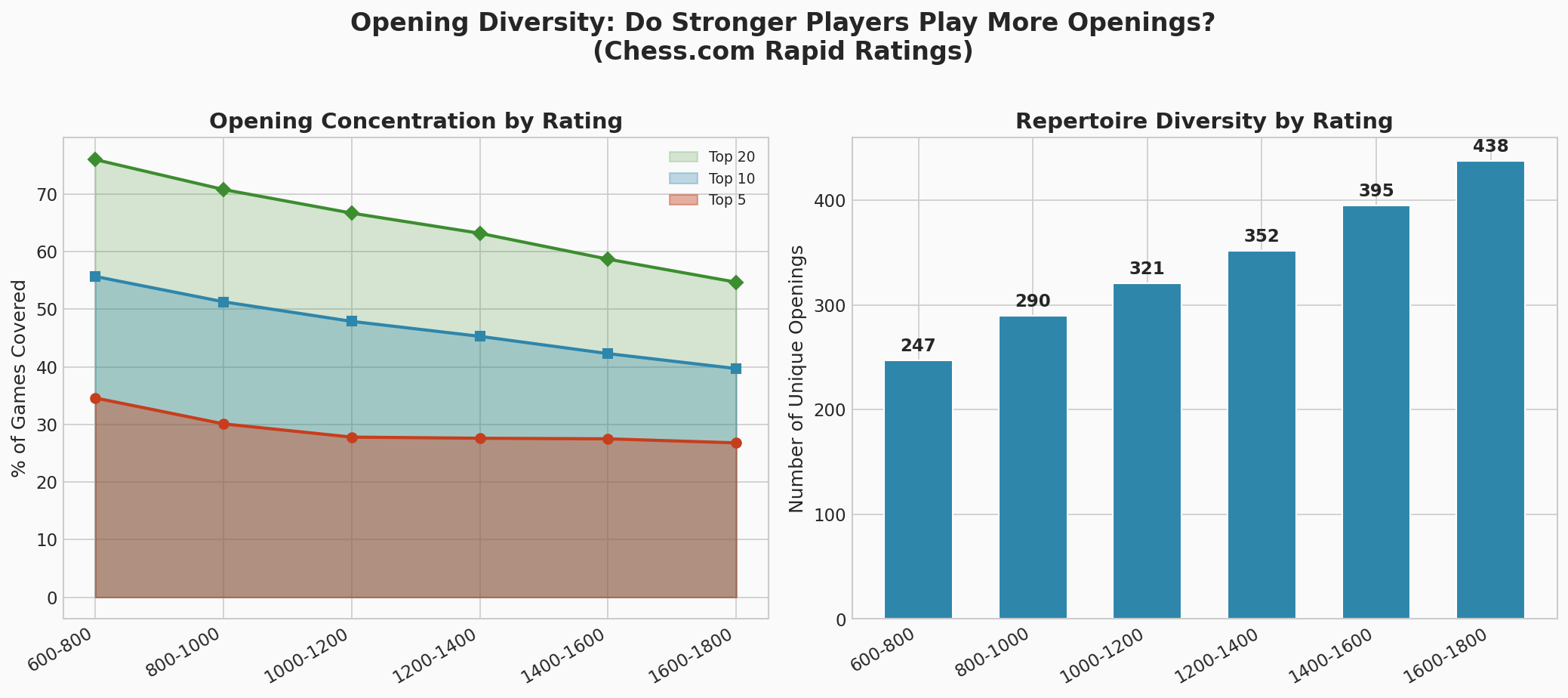
The data is unambiguous: stronger players play a wider variety of openings. At the 600-800 level, the top 5 openings account for 34.6% of all games, and only 247 unique openings appear in the dataset. By the 1600-1800 level, the top 5 openings cover only 26.8% of games, and 438 unique openings are represented—a 77% increase in repertoire diversity.
| Rating Band | Top 5 Coverage | Top 10 Coverage | Top 20 Coverage | Unique Openings |
|---|---|---|---|---|
| 600-800 | 34.6% | 55.7% | — | 247 |
| 800-1000 | 30.1% | 51.3% | — | 290 |
| 1000-1200 | 27.8% | 47.9% | — | 321 |
| 1200-1400 | 27.6% | 45.3% | — | 352 |
| 1400-1600 | 27.5% | 42.3% | — | 395 |
| 1600-1800 | 26.8% | 39.7% | — | 438 |
This has a clear practical implication: if you are stuck at a rating plateau, broadening your opening repertoire may help you encounter positions your opponents are less prepared for. The Herfindahl-Hirschman Index (HHI), a standard measure of market concentration, drops from 0.040 at 600-800 to 0.023 at 1600-1800, confirming a steady diversification trend.
Part 9: Overall Win/Draw/Loss Rates by Rating
Before we move to actionable advice, it is worth examining the baseline win/draw/loss rates across all openings combined.
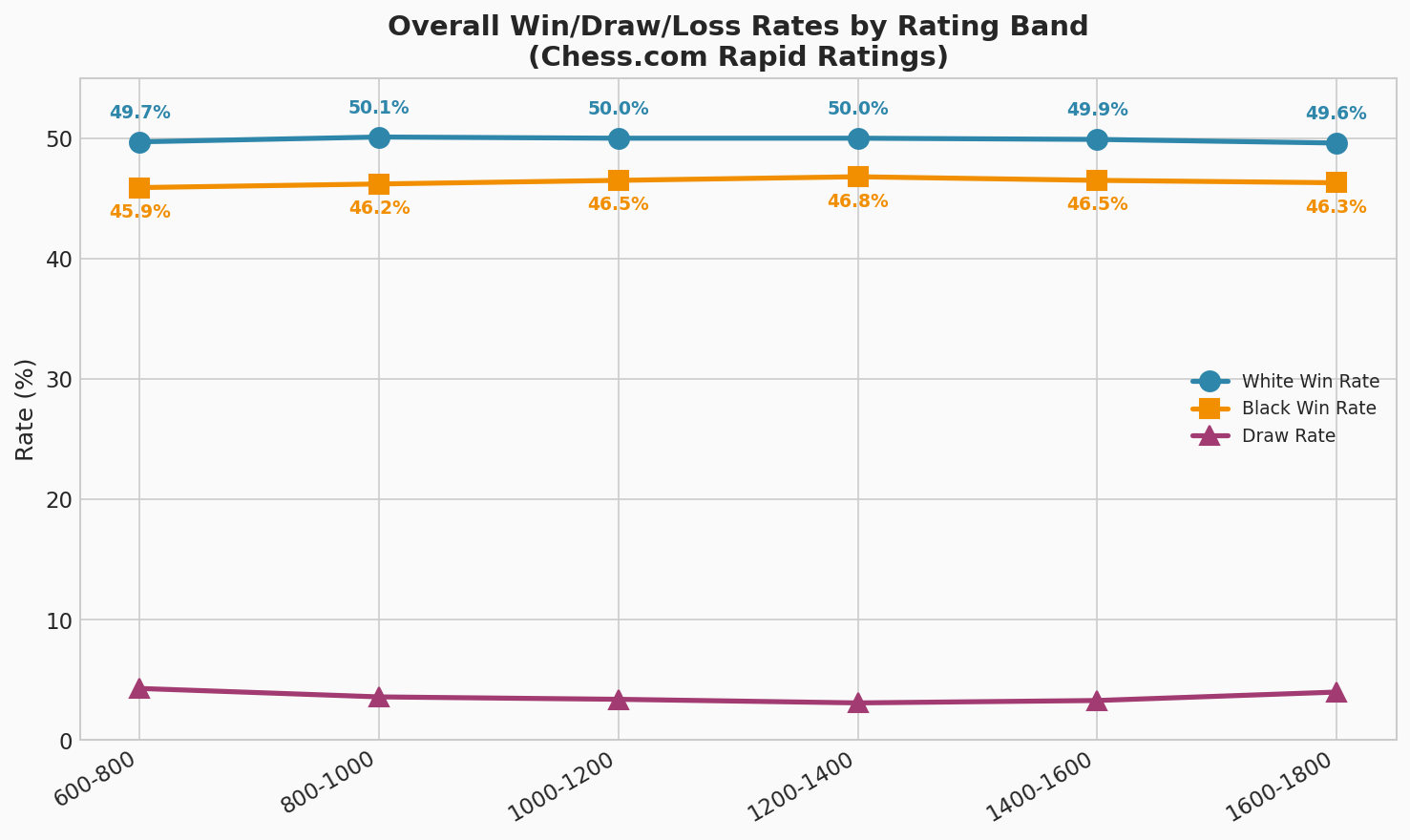
White maintains a consistent advantage of approximately 3-4 percentage points across all rating bands. The overall White win rate hovers near 50%, while Black's win rate stays around 46%. Draw rates follow a U-shaped curve: they are highest at the extremes (4.3% at 600-800 and 4.0% at 1600-1800) and lowest in the middle (3.1% at 1200-1400).
| Rating Band | White Win % | Draw % | Black Win % |
|---|---|---|---|
| 600-800 | 49.7% | 4.3% | 45.9% |
| 800-1000 | 50.1% | 3.6% | 46.2% |
| 1000-1200 | 50.0% | 3.4% | 46.5% |
| 1200-1400 | 50.0% | 3.1% | 46.8% |
| 1400-1600 | 49.9% | 3.3% | 46.5% |
| 1600-1800 | 49.6% | 4.0% | 46.3% |
Part 10: Rapid vs. Blitz — Does Time Control Matter?
We also compared how these openings perform in Rapid versus Blitz time controls. The conventional wisdom is that tricky openings are better in Blitz because the opponent has less time to calculate the refutation.
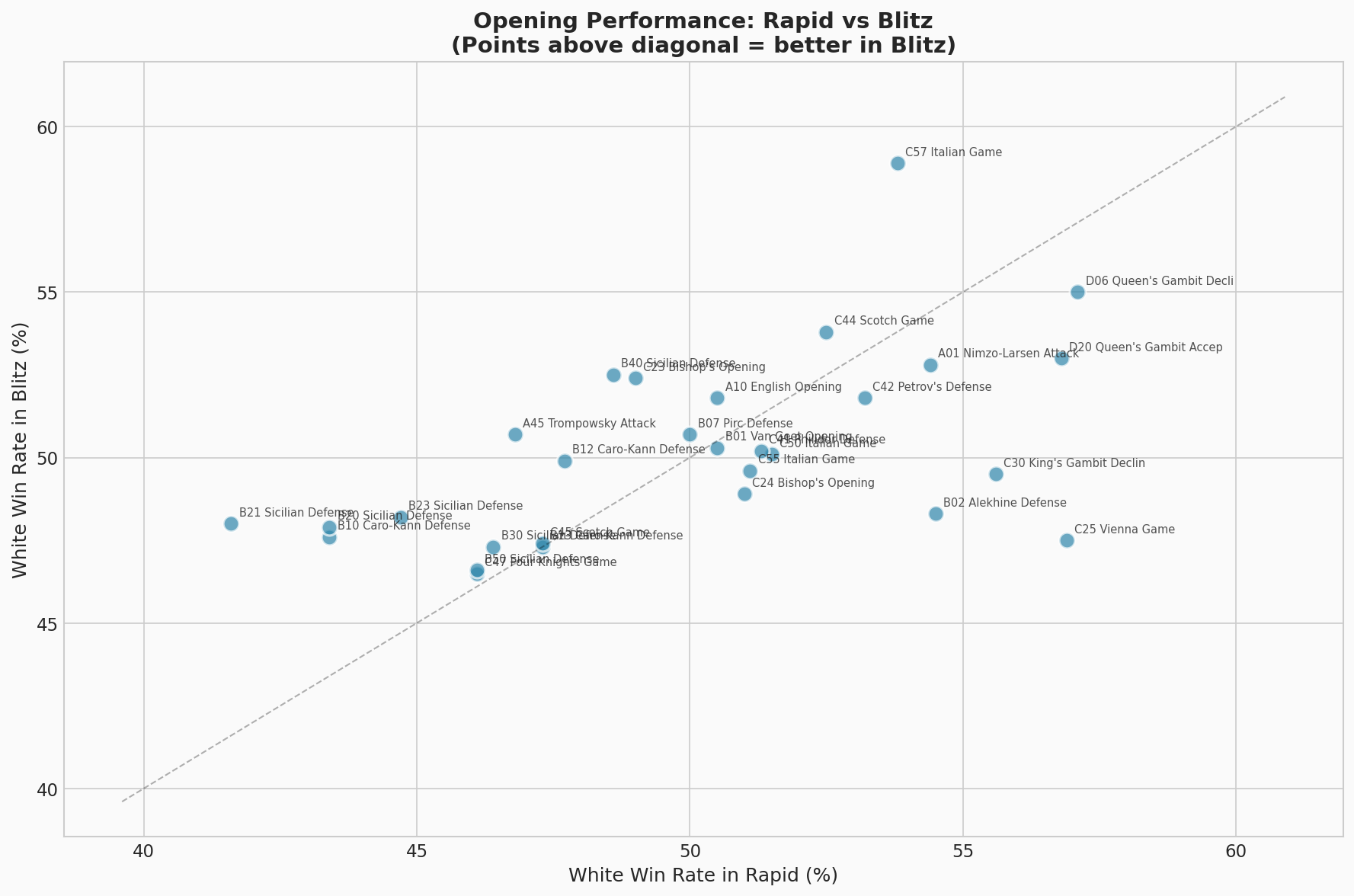
The data supports this theory. Openings that rely on sharp tactics and early pressure generally show a higher win rate in Blitz than in Rapid. If your repertoire consists heavily of gambits, you will likely see a rating disparity between your Blitz and Rapid scores. To improve your Rapid rating, you must incorporate more fundamentally sound openings that stand up to longer calculation times.
Part 11: Actionable Advice — Your Roadmap for Improvement
Based on the data, here is a comprehensive roadmap for optimizing your opening repertoire as you climb the rating ladder.
Beginner (Chess.com 600-1000)
At this level, games are decided by basic tactics and one-move blunders. Opening theory matters far less than piece development and king safety. That said, the data shows that certain openings give you a meaningful statistical edge.
For White, play aggressive, tactical openings. The Two Knights Defense: Ulvestad Variation (C57) and the Bishop's Opening: del Rio Variation (C23) will yield massive win rates because opponents simply do not know the defensive theory. The Queen's Gambit Accepted: Schwartz Defense (D20) is also excellent, providing a 54% win rate even at this level.
For Black, avoid complex theoretical battles. The data shows that the Sicilian Defense (Wing Gambit variations) and the Trompowsky Attack: Raptor Variation are highly successful for Black, likely because they immediately take White out of their comfort zone. If your opponent plays 1.e4, consider the Caro-Kann—it scores well even at the lowest levels.
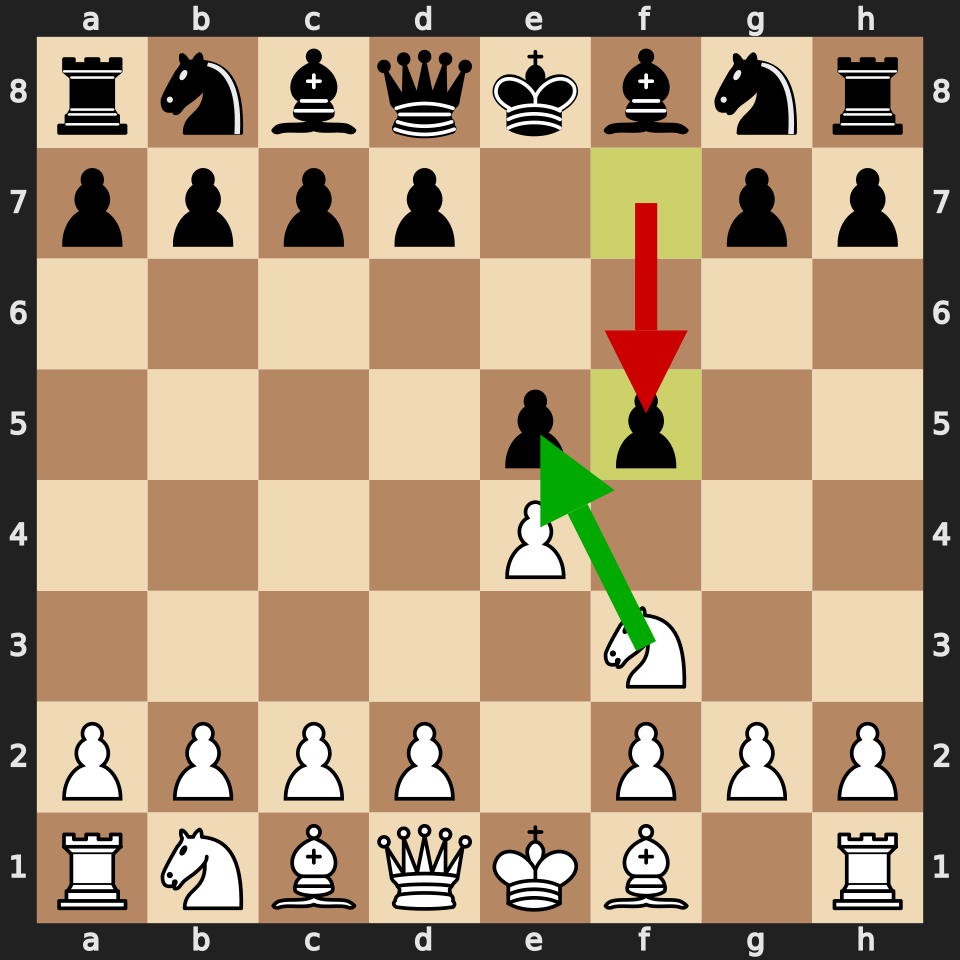
The Latvian Gambit (1.e4 e5 2.Nf3 f5?!) is a common sight at lower ratings. The move 2...f5 (shown after being played, red arrow) weakens Black's kingside dramatically. White's best response is the simple 3.Nxe5! (green arrow), which wins a pawn and exposes Black's king. White scores 56% in this line at the 600-800 level.
Intermediate (Chess.com 1000-1400)
This is the transitional phase where cheap tricks begin to fail. Players at this level have seen the Fried Liver before and know to play 5...Na5. Your opening must now provide a genuine positional foundation.
For White, it is time to transition toward more solid, positional openings. The data shows 1.d4 d5 peaking in effectiveness here (52% win rate). The Queen's Gambit Accepted remains a statistical powerhouse, and the Scotch Game: Vitzthum Attack (C44) is an excellent choice for 1.e4 players who want a sound yet active opening.
For Black, the Caro-Kann Defense: Two Knights Attack (B10) emerges as a statistical fortress. White players at this level often overextend trying to break it down, leading to excellent win rates for Black (over 50% at the 1000-1200 and 1200-1400 levels). The Sicilian Defense also begins to show its strength, particularly against dubious White gambits.
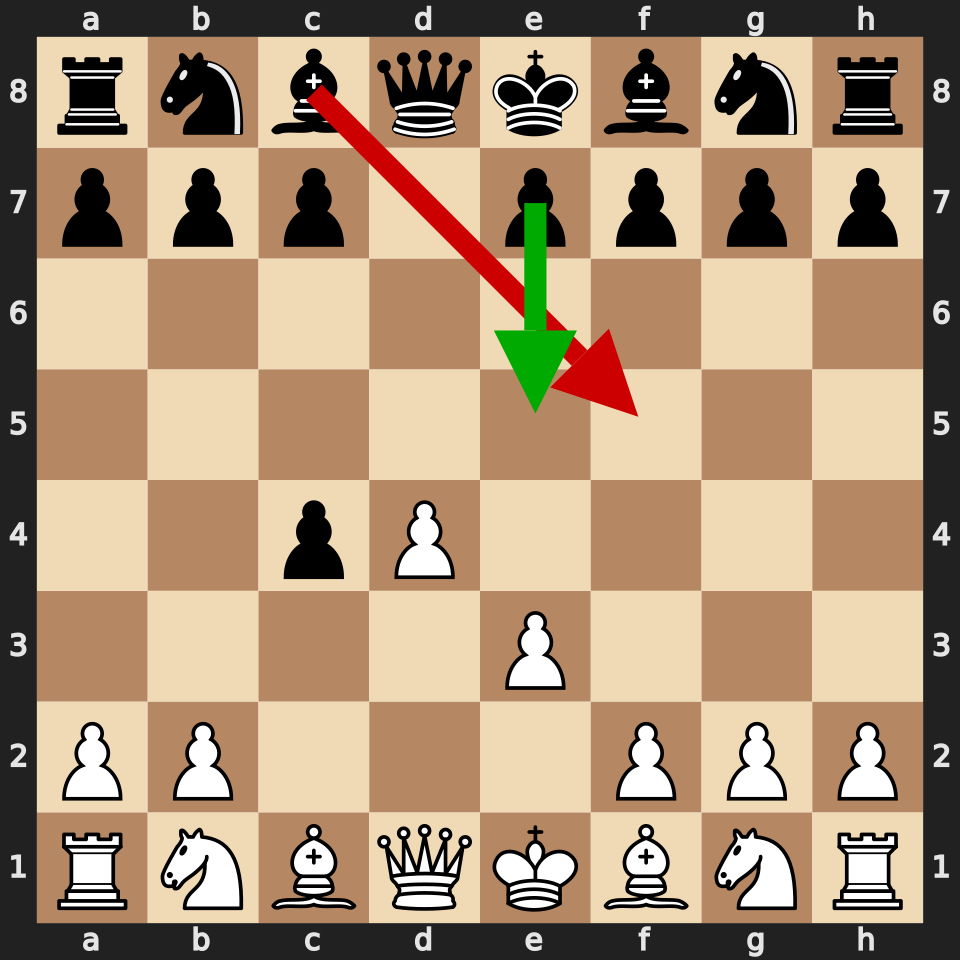
In the Queen's Gambit Accepted: Schwartz Defense (1.d4 d5 2.c4 dxc4 3.e3), Black often plays passively with moves like 3...Bf5? (red arrow). The data-backed recommendation is the active 3...e5! (green arrow), which challenges White's center immediately and leads to dynamic play.
Advanced (Chess.com 1400-1800)
At this level, opening principles are well understood, and games are won in the middlegame and endgame. Your opening must provide a lasting structural advantage rather than a quick tactical strike.
For White, the English Opening (A10) shows a remarkable upward trajectory, rising from 47.1% at 600-800 to 53.0% at 1600-1800. Solid 1.d4 lines continue to perform well. If you still play the Fried Liver or similar trap openings, expect your win rate to drop significantly—the data shows a 7.7pp decline for the Two Knights: Ulvestad between the lowest and highest rating bands.
For Black, the Caro-Kann remains incredibly solid. Additionally, the data shows that Black performs very well against the Sicilian Wing Gambit, as advanced players know exactly how to counter the early flank aggression with central strikes. Consider broadening your repertoire: the data shows that stronger players use nearly twice as many unique openings as beginners.
The following table summarizes the recommended openings by rating band:
| Rating Band | Best for White | Best for Black |
|---|---|---|
| 600-800 | C57 Two Knights (60%), D20 QGA (53.8%) | B20 Sicilian Wing Gambit (51.9% for Black) |
| 800-1000 | C57 Two Knights (57.5%), D20 QGA (54.3%) | B23 Sicilian Grand Prix (52.9% for Black) |
| 1000-1200 | D06 QGD Zilbermints (55.3%), D20 QGA (54.6%) | B10 Caro-Kann Two Knights (50.5% for Black) |
| 1200-1400 | D20 QGA (55.7%), D06 QGD Zilbermints (54.9%) | B10 Caro-Kann Two Knights (51.7% for Black) |
| 1400-1600 | D20 QGA (53.7%), A10 English (52.9%) | B20 Sicilian Wing Gambit (49.1% for Black) |
| 1600-1800 | D20 QGA (55.0%), A10 English (53.0%) | B20 Sicilian Wing Gambit (50.7% for Black) |
Part 12: The Rousseau Gambit — A Case Study in Opening Decay
To illustrate the decay phenomenon with a concrete example, consider the Italian Game: Rousseau Gambit (C50), one of the most popular openings in our dataset with over 36,000 games.
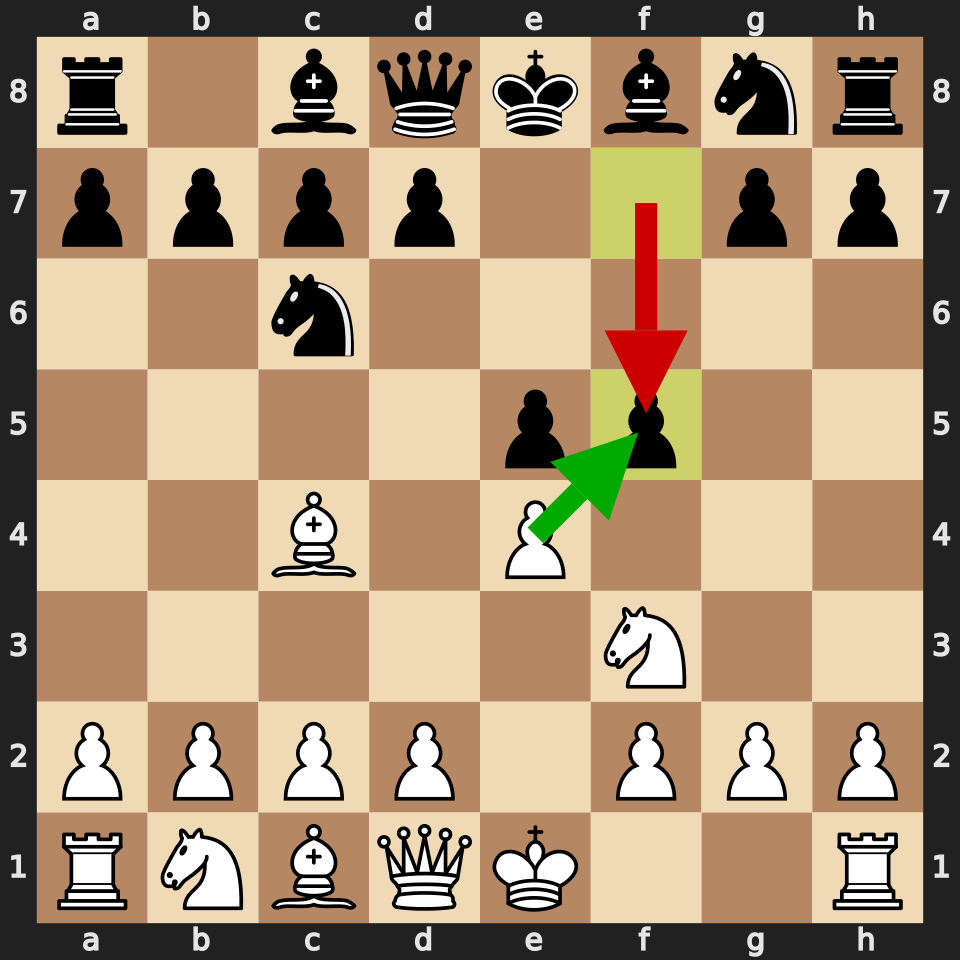
The Rousseau Gambit arises after 1.e4 e5 2.Nf3 Nc6 3.Bc4 f5?! (red arrow shows the dubious gambit pawn push). White's best response is simply 4.exf5 (green arrow), winning a pawn and exposing Black's king. Despite being objectively dubious, this gambit is played frequently at lower levels because it creates immediate tactical complications.
The Rousseau Gambit's White win rate starts at 51.2% at the 600-800 level and declines to 48.2% at 1600-1800—a 3.0pp drop. This is a textbook example of a "surprise weapon" that loses its effectiveness as opponents learn the correct responses. At the 600-800 level, many Black players do not know how to handle the resulting positions after 4.exf5, but by 1600-1800, the refutation is common knowledge.
Data and Methodology
This analysis was conducted using a dataset of 954,617 Lichess games with full Stockfish 17 engine evaluations (100% eval coverage) and clock annotations (99.7% coverage). The data spans all major time controls, with the following distribution: 465,320 Blitz games, 283,263 Bullet games, 200,561 Rapid games, and 4,936 Classical games. The rating distribution covers six bands from Lichess 700 to 2000, each containing between 147,000 and 168,000 games.
Because Lichess ratings are generally higher than Chess.com ratings for the same skill level, we applied a calibration mapping based on the official cross-platform rating comparison table. The specific mapping used is:
| Lichess Rapid Band | Chess.com Rapid Equivalent |
|---|---|
| 700-900 | 600-800 |
| 900-1100 | 800-1000 |
| 1100-1300 | 1000-1200 |
| 1300-1500 | 1200-1400 |
| 1500-1800 | 1400-1600 |
| 1800-2000 | 1600-1800 |
While the article primarily uses Chess.com ratings for accessibility, the underlying data originates from the Lichess database. All engine evaluations were performed using Stockfish 17, and opening classifications follow the Encyclopedia of Chess Openings (ECO) system.
The complete dataset, including the raw CSV files used to generate these insights, is available for download:
View full data →eco name totalGames peakWhiteWinBand_chesscom peakWhiteWinRate decay white_win_600-800 draw_600-800 black_win_600-800 games_600-800 net_advantage_600-800 white_win_800-1000 draw_800-1000 black_win_800-1000 games_800-1000 net_advantage_800-1000 white_win_1000-1200 draw_1000-1200 black_win_1000-1200 games_1000-1200 net_advantage_1000-1200 white_win_1200-1400 draw_1200-1400 black_win_1200-1400 games_1200-1400 net_advantage_1200-1400 white_win_1400-1600 draw_1400-1600 black_win_1400-1600 games_1400-1600 net_advantage_1400-1600 white_win_1600-1800 draw_1600-1800 black_win_1600-1800 games_1600-1800 net_advantage_1600-1800 B01 Van Geet Opening: Grünfeld Defense 55401 800-1000 50.9 3.0 48.4 4.2 47.4 9969 1.0 50.9 3.6 45.5 9862 5.4 49.8 3.4 46.7 9403 3.1 49.7 2.9 47.3 8585 2.4 47.9 3.4 48.6 8500 -0.7 47.9 4.4 47.6 9082 0.3 C50 Italian Game: Rousseau Gambit 36775 600-800 51.2 3.0 51.2 4.1 44.7 6613 6.5 50.2 3.8 46 8323 4.2 50.6 3.5 45.8 7966 4.8 50.1 3.7 46 6546 4.1 49.6 3.5 46.4 4332 3.2 48.2 4.7 46.8 2995 1.4 C44 Scotch Game: Scotch Gambit, Sarratt Variation 26089 1000-1200 53.3 2.299999999999997 49.4 4.3 46.3 4814 3.1 51.5 3.7 44.7 5535 6.8 53.3 3.5 43.1 5252 10.2 53.3 2.9 43.6 4734 9.7 52.5 3.7 43.5 3275 9.0 51 3.6 45.3 2479 5.7 C41 Philidor Defense: Steinitz Variation 24413 600-800 52.3 1.5999999999999943 52.3 4.4 43.3 4088 9.0 50.2 4.1 45.7 4666 4.5 50.6 4 45.3 4831 5.3 50.4 3.5 46 4536 4.4 51.7 3.6 44.5 3654 7.2 50.7 4.4 44.8 2638 5.9 B10 Caro-Kann Defense: Two Knights Attack 22894 1400-1600 47.8 1.5 46.4 3.5 50 3097 -3.6 46.5 3.7 49.6 3450 -3.1 46.5 2.9 50.5 4170 -4.0 45.1 3.1 51.7 4020 -6.6 47.8 3.7 48.3 4012 -0.5 46.3 4 49.6 4145 -3.3
View full data →eco name lichess_band chesscom_band whiteWinRate drawRate blackWinRate totalGames B01 Van Geet Opening: Grünfeld Defense 700-900 600-800 48.4 4.2 47.4 9969 B01 Van Geet Opening: Grünfeld Defense 900-1100 800-1000 50.9 3.6 45.5 9862 B01 Van Geet Opening: Grünfeld Defense 1100-1300 1000-1200 49.8 3.4 46.7 9403 B01 Van Geet Opening: Grünfeld Defense 1300-1500 1200-1400 49.7 2.9 47.3 8585 B01 Van Geet Opening: Grünfeld Defense 1500-1800 1400-1600 47.9 3.4 48.6 8500
View full data →ecoFamily firstMoveSummary lichess_band chesscom_band whiteWinRate drawRate blackWinRate totalGames A 1.d4/1.Nf3/1.c4/flank 700-900 600-800 47.4 4.9 47.7 33899 A 1.d4/1.Nf3/1.c4/flank 900-1100 800-1000 48.1 3.9 47.9 31929 A 1.d4/1.Nf3/1.c4/flank 1100-1300 1000-1200 49 3.4 47.5 32242 A 1.d4/1.Nf3/1.c4/flank 1300-1500 1200-1400 49.3 3 47.6 35356 A 1.d4/1.Nf3/1.c4/flank 1500-1800 1400-1600 50.2 3.1 46.5 37110
View full data →eco name timeClass whiteWinRate drawRate blackWinRate avgGameLength totalGames B01 Van Geet Opening: Grünfeld Defense blitz 50.3 3.9 45.7 31 4490 B01 Van Geet Opening: Grünfeld Defense bullet 48.8 2.3 48.9 27.9 3001 B01 Van Geet Opening: Grünfeld Defense classical 51.9 7.4 40.7 21.8 54 B01 Van Geet Opening: Grünfeld Defense rapid 50.5 3.8 45.5 30.3 1856 C50 Italian Game: Rousseau Gambit blitz 50.1 3.5 46.3 30.1 3778
Chess Coach April 13, 2026