A Data-Driven Guide to Endgame Study Priorities for Chess.com Players (800-1500)
Chess coaches universally advise their students to "study endgames," but the sheer volume of endgame theory can be overwhelming. Should you spend hours memorizing the Philidor position, or are you better off practicing Queen endgames? To answer this, we analyzed a massive dataset of Lichess Rapid games, mapping the results to Chess.com Rapid ratings (800-1500) to provide a concrete, data-backed roadmap for your endgame study.
This article breaks down exactly which endgames you will face, how often they occur, and what you need to know to convert them into wins.
The Big Picture: Do You Even Reach the Endgame?
Before diving into specific endgame types, it is essential to understand how often games actually reach the endgame phase. Our analysis of game length distribution reveals a clear trend: as your rating improves, you are significantly more likely to play endgames.
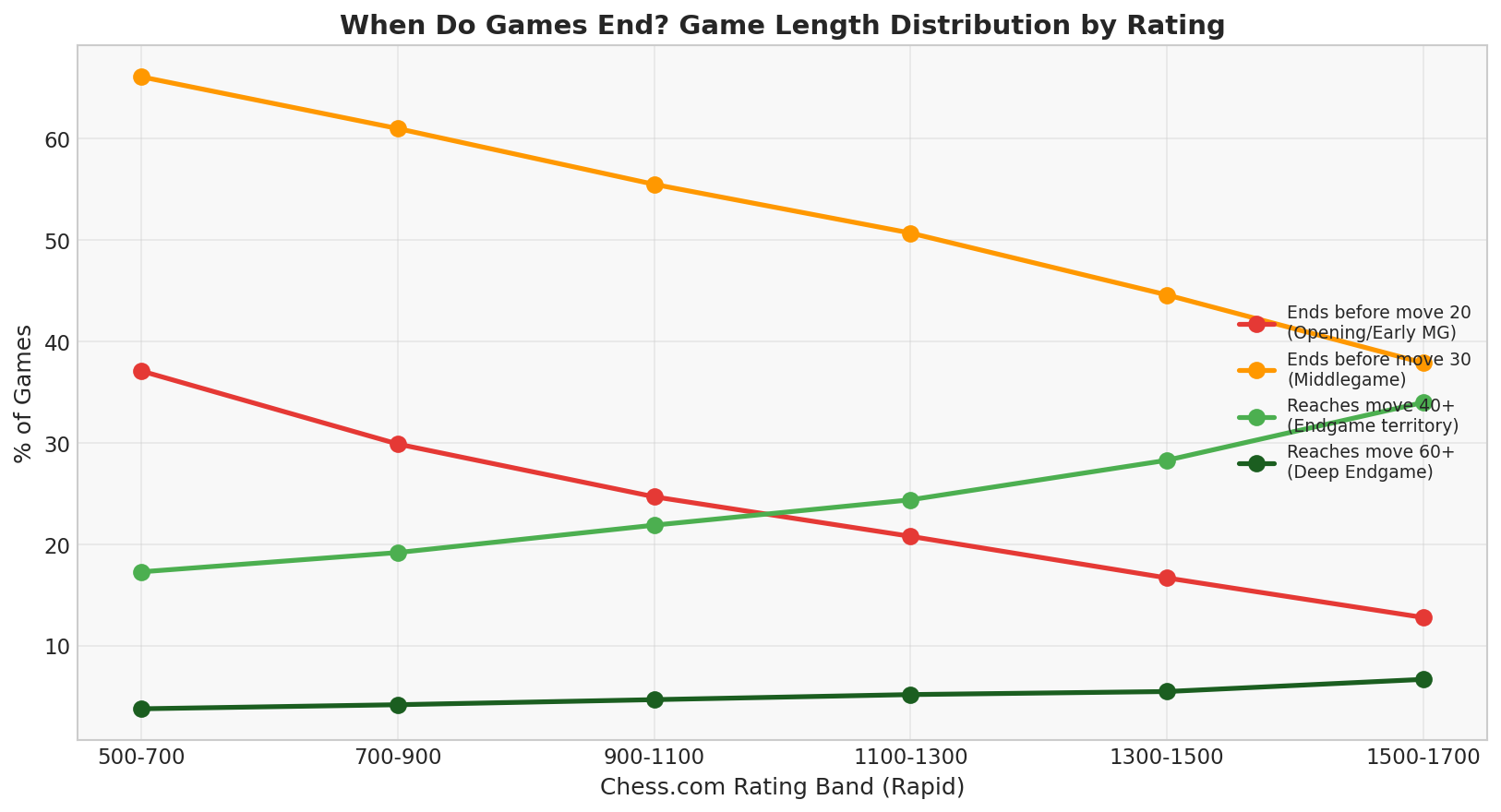
At the 700-900 level, nearly 40% of games end before move 30, often due to early blunders or quick checkmates. However, by the time you reach the 1300-1500 bracket, over 24% of games extend past move 40, entering deep endgame territory. This data confirms that endgame study becomes increasingly critical as you climb the rating ladder. If you want to break through the 1200 plateau, you must be prepared to grind out long games.
The Hierarchy of Endgames: What to Study First
The data unequivocally confirms the old chess adage: Rook endgames are the most common. However, the sheer dominance of Rook endgames might surprise you.
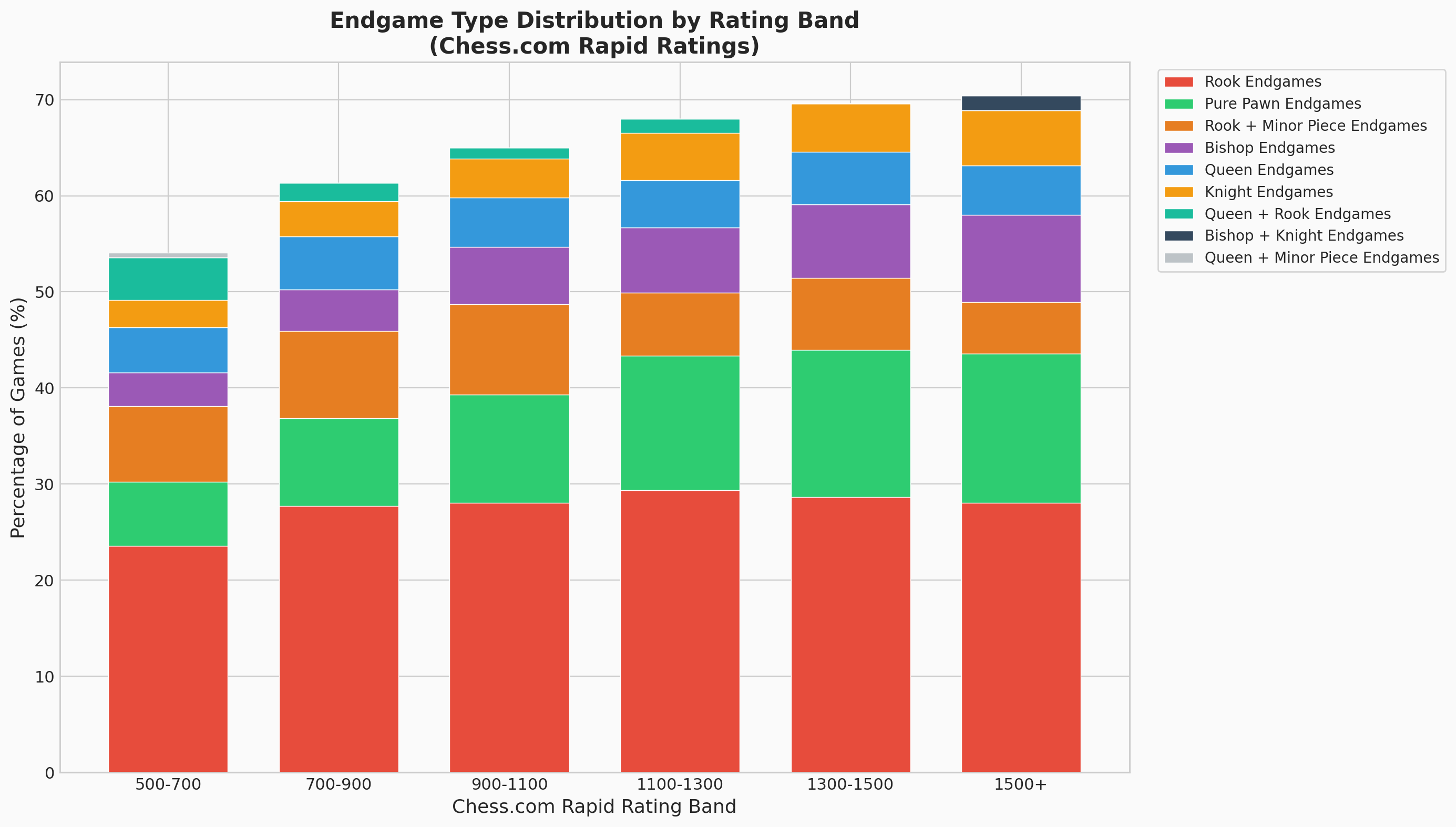
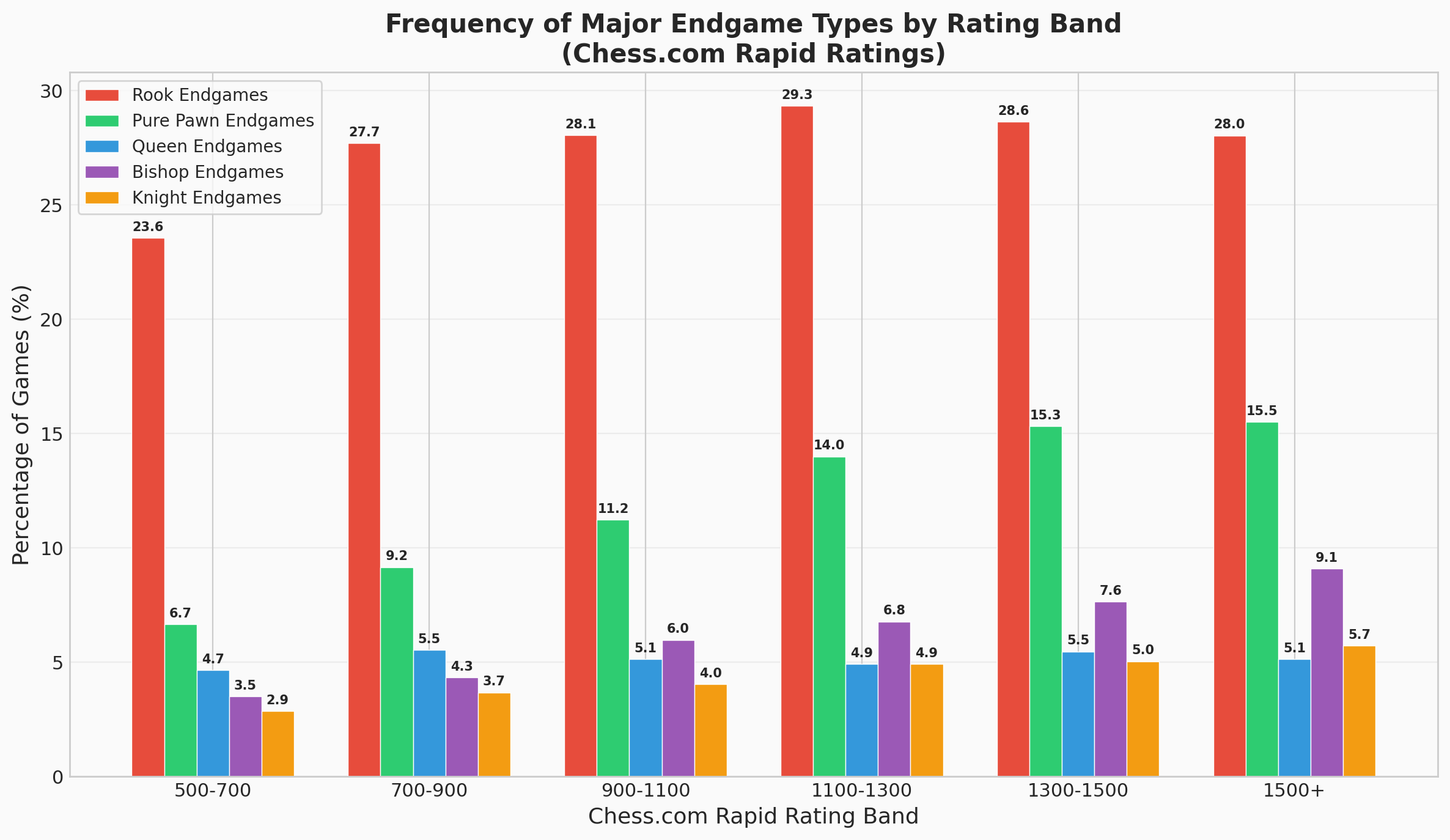
Across all rating bands from 800 to 1500, Rook endgames account for roughly 28% to 29% of all endgames played. This is nearly double the frequency of the next most common category, Pure Pawn endgames.
1. Rook Endgames (The Undisputed King)
Rook endgames are not just common; they are ubiquitous. The specific endgame of Rook + Pawns vs Rook + Pawns (often denoted as KRPPKRP or similar variations) is the single most frequently occurring endgame type across all intermediate rating bands.
Actionable Advice (800-1200): Focus on the absolute basics. Learn the Lucena position (how to win with a passed pawn) and the Philidor position (how to draw when defending). These two patterns are the foundation of all Rook endgame theory.
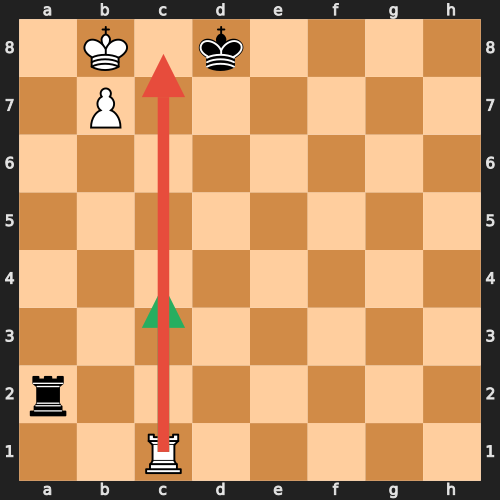 The Lucena Position: White wins by building a "bridge" with Rc4, shielding the King from checks.
Actionable Advice (1200-1500): Understand the principle of the "Active Rook." In Rook endgames, piece activity is often more important than a one-pawn material advantage. A passive Rook tied to defending a pawn will usually lead to a loss, even if you are materially equal.
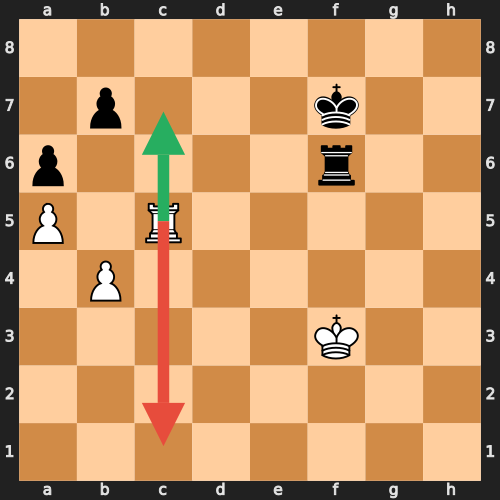 Active Rook Principle: White's Rook belongs behind the passed pawn (Rc7), not passively defending it from below.
2. Pure Pawn Endgames (The Foundation)
Pure Pawn endgames (King and Pawns vs King and Pawns) are the second most common category, steadily increasing in frequency from 9.2% at the 700-900 level to over 15% at the 1500+ level. These endgames are highly concrete; they are usually mathematically won or drawn, with very little margin for error.
Actionable Advice (800-1500): Master the concept of "Opposition." This is the fundamental building block of all Pawn endgames. If you do not understand how to take the opposition to outflank your opponent's King, you will routinely draw winning positions and lose drawn ones.
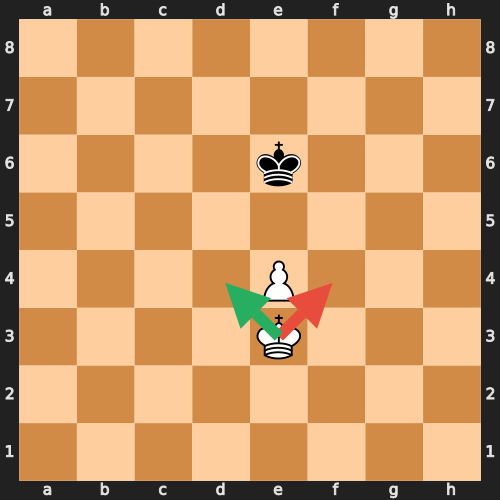 Opposition: White must play Kd4 to take the opposition. Playing Kf4 allows Black to take the opposition with Ke6, drawing the game.
3. Bishop and Knight Endgames (The Minor Pieces)
Bishop endgames (including opposite-colored Bishops) and Knight endgames occur less frequently, hovering around 4% to 9% of games. Interestingly, Bishop endgames become slightly more common as ratings increase, likely because higher-rated players are better at trading down into favorable minor piece endings.
Actionable Advice (1000-1500): For Knight endgames, remember that Knights are short-range pieces. Centralization is paramount. A centralized Knight controls the board, while a Knight on the edge is easily dominated.
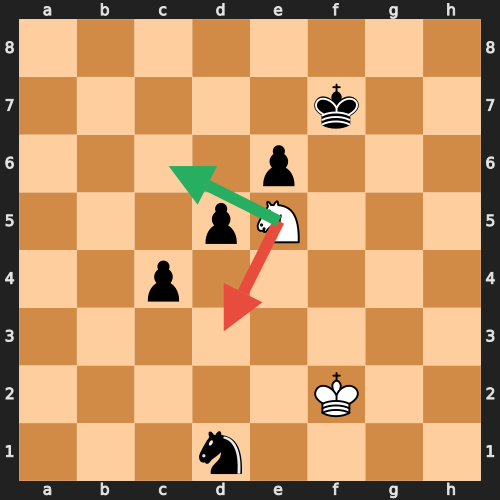 Knight Centralization: White's Knight must move to c6 to control key squares, rather than retreating passively.
For Bishop endgames, the most critical concept is the drawing tendency of Opposite-Colored Bishops. Even if you are up a pawn or two, these endgames are notoriously difficult to win if the defending side can set up a blockade on the color complex their Bishop controls.
4. Queen Endgames (The Danger Zone)
Queen endgames occur in roughly 5% of games across all rating bands. While less common than Rook or Pawn endgames, they are incredibly complex and prone to sudden reversals of fortune.
Actionable Advice (1000-1500): The defining characteristic of Queen endgames is the constant threat of perpetual check. When you are winning a Queen endgame, your primary focus must be King safety. Do not rush to push your passed pawn if it exposes your King to a barrage of checks.
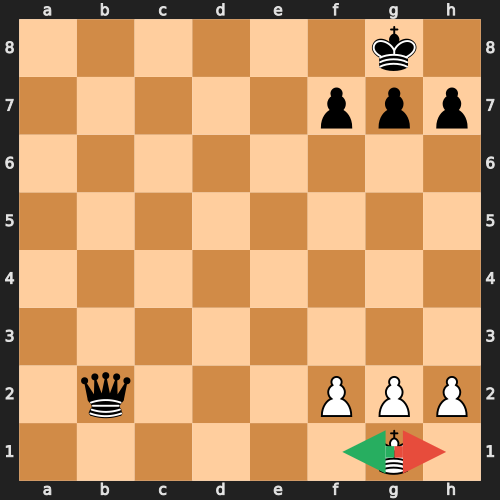 Perpetual Check: White must play Kf1 to escape the checks. Playing Kh1 allows Black to draw by perpetual check starting with Qb1+.
Conversion and Draw Rates: Where Do Players Struggle?
Understanding which endgames occur is only half the battle; you also need to know how well players convert them. Our analysis of draw rates by endgame type reveals significant differences in difficulty.
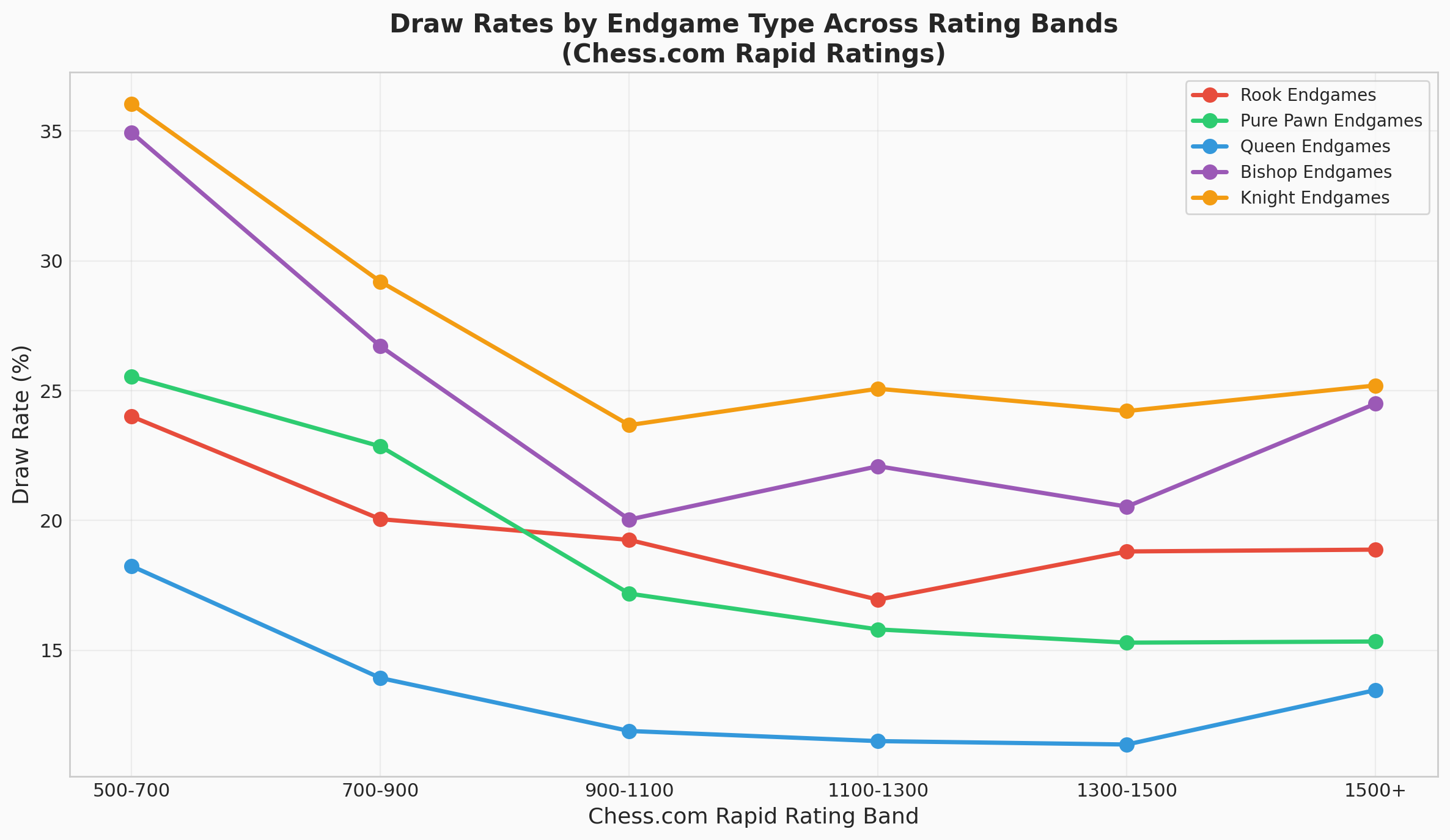
Rook endgames have surprisingly high draw rates, hovering around 20% across the 800-1500 rating bands. This reinforces the idea that Rook endgames are complex and often drawn even when one side has a slight advantage.
Conversely, Queen endgames have the lowest draw rates (around 11-14%). This is because Queen endgames are highly volatile; they usually end decisively, either through a successful pawn promotion or a sudden checkmating attack.
The Opposite-Colored Bishop Phenomenon
Our data confirms the notorious reputation of Opposite-Colored Bishop endgames. When analyzing all Bishop endgames, the draw rate is consistently high, ranging from 20% to 26%. This is significantly higher than the draw rate for Knight endgames (around 15-16%). If you are defending a worse position, trading down into an Opposite-Colored Bishop endgame is one of the most effective drawing strategies at the club level.
Endgame Accuracy: The Cost of Mistakes
Finally, we looked at move quality (measured in Centipawn Loss, or CPL) across different game phases.
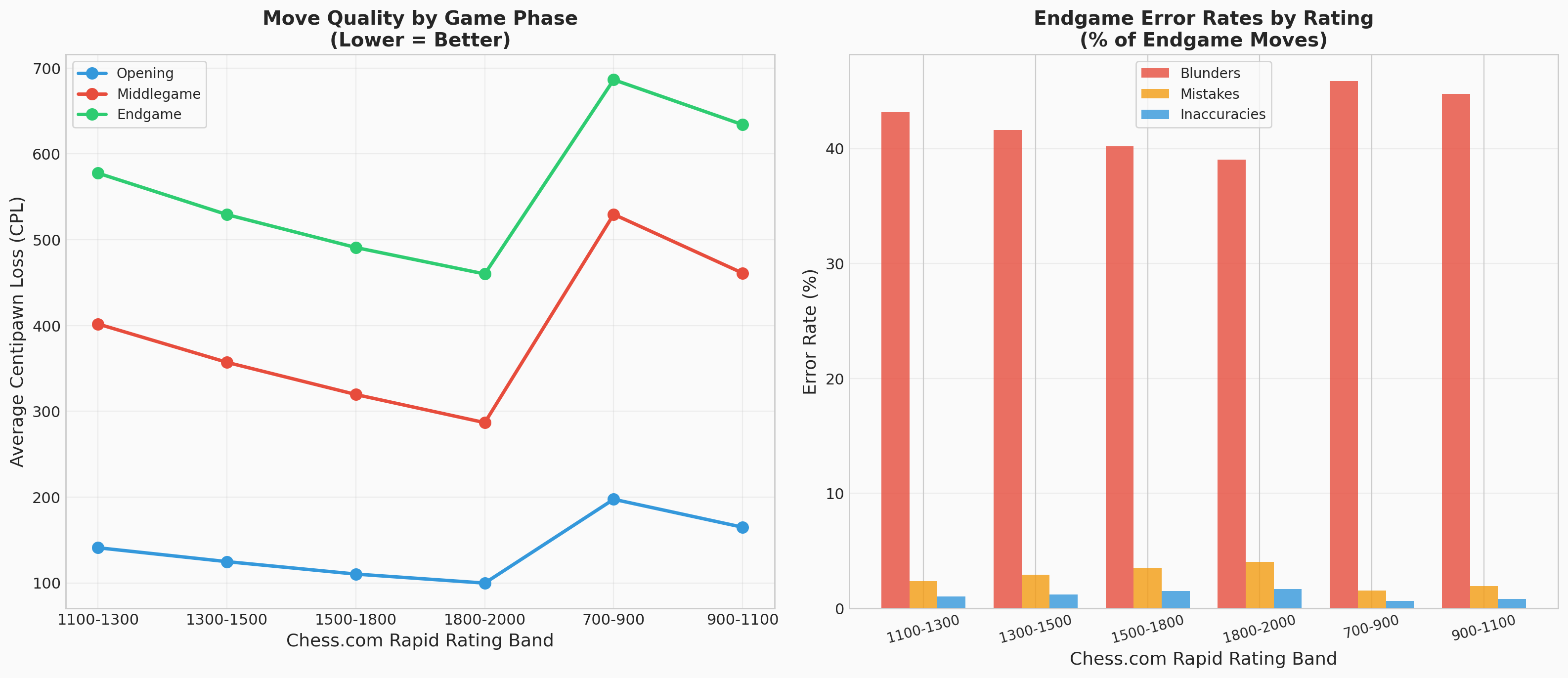
The data shows that players at all levels are significantly less accurate in the endgame compared to the opening or middlegame. At the 1100-1300 level, the average CPL in the endgame is nearly double that of the opening. Furthermore, blunder rates (moves losing 300+ centipawns) remain stubbornly high in the endgame, accounting for over 40% of endgame errors at the 1100-1300 level.
This presents a massive opportunity. Because your opponents are likely to play inaccurately in the endgame, improving your own endgame technique is one of the most efficient ways to gain rating points. You don't need to play perfectly; you just need to make fewer blunders than your opponent.
Summary Roadmap for Improvement
Based on the data, here is your prioritized endgame study plan:
- Priority 1: Basic Pawn Endgames (Opposition and the Square Rule). You cannot play any other endgame well if you do not understand Pawn endgames, as all other endgames eventually simplify into them.
- Priority 2: Essential Rook Endgames (Lucena and Philidor). Rook endgames are the most common by a wide margin. Knowing these two theoretical positions will save you countless half-points.
- Priority 3: The Active Rook Principle. Understand that piece activity trumps material in Rook endings.
- Priority 4: King Safety in Queen Endgames. Learn to avoid perpetual checks when winning, and how to deliver them when losing.
- Priority 5: Opposite-Colored Bishop Blockades. Learn how to set up fortresses to draw worse positions.
Stop spending all your time memorizing deep opening theory. The data shows that the endgame is where games are decided, and it is where your opponents are making the most mistakes.
Data and Methodology
This analysis is based on a large dataset of Lichess Rapid games, processed using the Grandmaster Guide analytical tools. The raw Lichess ratings were mapped to approximate Chess.com Rapid ratings using standard conversion tables to make the insights directly applicable to the Chess.com player base.
The underlying data files used for this analysis are available below:
View full data →Lichess Band Chess.com Rapid Band Endgame Category Pct of Games 1000-1200 700-900 Bishop + Knight Endgames 0 1000-1200 700-900 Bishop Endgames 4.33 1000-1200 700-900 Knight Endgames 3.68 1000-1200 700-900 Pure Pawn Endgames 9.16 1000-1200 700-900 Queen + Rook Endgames 1.9 - Endgame Draw Rates
- Game Phase Distribution
View full data →Lichess Band Chess.com Rapid Band Rank Endgame Code Category Broad Category Pct of Games Count 1000-1200 700-900 1 KRPKRPP Rook + Pawns vs Rook + Pawns Rook Endgames 4.94 753 1000-1200 700-900 2 KRPPKRP Rook + Pawns vs Rook + Pawns Rook Endgames 4.75 723 1000-1200 700-900 3 KPPKPPP Pure Pawn (K+P vs K+P) Pure Pawn Endgames 3.52 536 1000-1200 700-900 4 KPPPKPP Pure Pawn (K+P vs K+P) Pure Pawn Endgames 3.41 520 1000-1200 700-900 5 KPKRPPP Rook vs Pawns Rook Endgames 2.53 385 - Bishop and Queen Endgame Stats
Chess Coach April 17, 2026