A data-driven guide for Chess.com players rated 800-1500
For players rated between 800 and 1500 on Chess.com, the path to improvement is often clouded by conflicting advice. Some coaches insist that "beginners must study endgames," while others argue that "tactics and opening principles are all that matter until 1500." To settle this debate with data rather than opinion, we analyzed a dataset of over 460,000 Lichess Blitz games from March 2025, with every position evaluated by Stockfish 17. The result is a comprehensive map of where games are actually decided at each rating level.
This article serves as a data-driven roadmap for improvement, specifically targeting the climb from 800 to 1500 on Chess.com. By understanding the statistical realities of where blunders occur, you can optimize your training time and focus on the phases of the game that actually decide your results.
A note on ratings: All data was collected from Lichess. Throughout this article, we report ratings in Chess.com Blitz equivalents using established conversion tables (e.g., Lichess Blitz 1200 ≈ Chess.com 800; Lichess Blitz 1780 ≈ Chess.com 1500). Where precision matters, we note the Lichess equivalent in parentheses.
Section 1: The Blunder Curve — When Do Mistakes Happen?
The most fundamental question in chess improvement is identifying where games are lost. Our analysis of centipawn loss (CPL) and blunder rates across game phases reveals a striking pattern: the endgame is consistently the most error-prone phase of chess, regardless of rating.
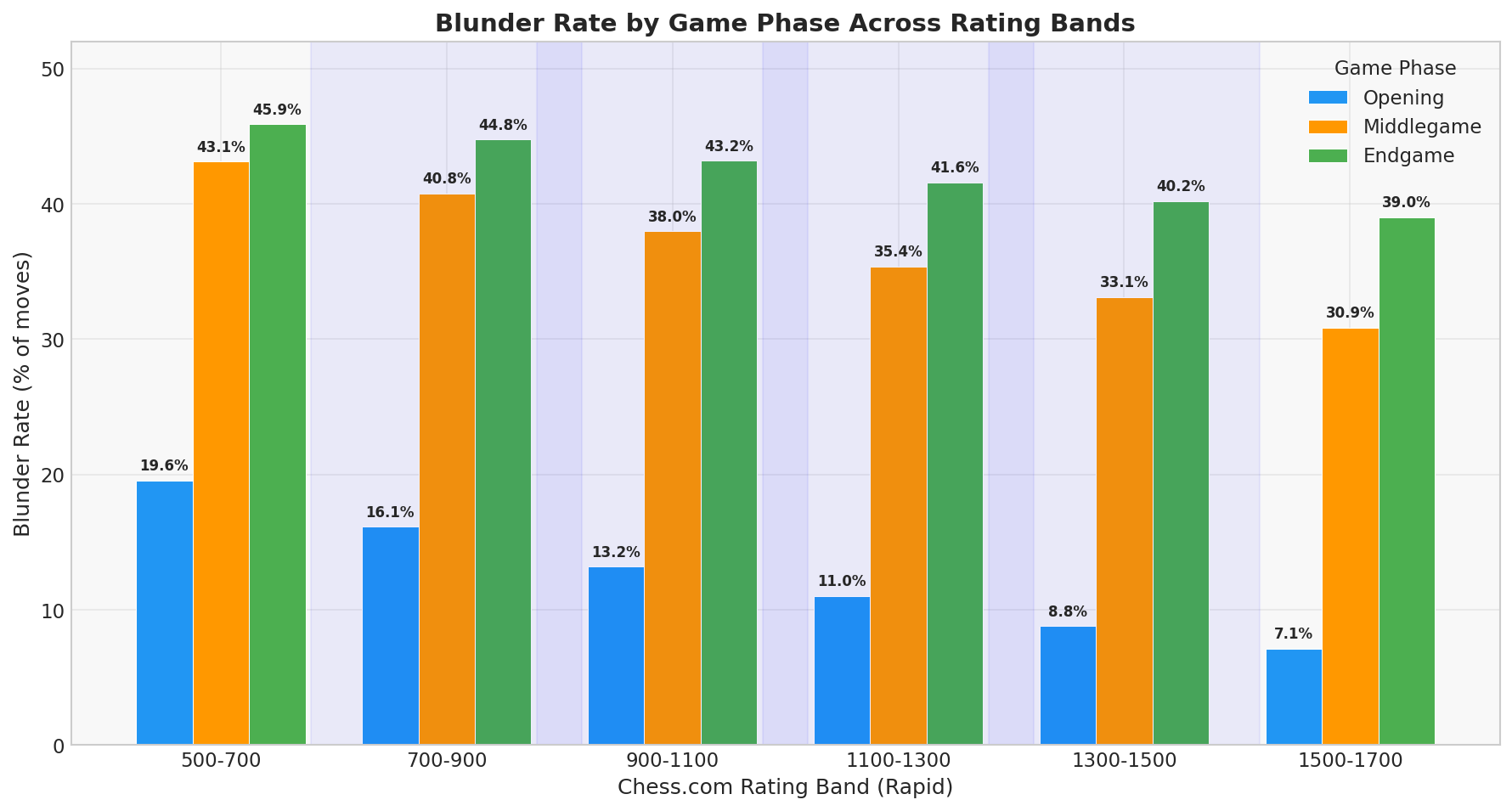
The chart above shows the blunder rate (defined as a move resulting in an evaluation drop of 300 centipawns or more) broken down by game phase and rating band. The endgame dominates the blunder landscape at every level. However, the gap between opening accuracy and endgame accuracy widens significantly as players improve, revealing that opening knowledge improves faster than endgame technique.
The following table summarizes the blunder rate data for the three target rating bands:
| Chess.com Rating Band | Opening Blunder Rate | Middlegame Blunder Rate | Endgame Blunder Rate | Opening CPL | Middlegame CPL | Endgame CPL |
|---|---|---|---|---|---|---|
| 800-1000 (Lichess 1100-1300) | 13.2% | 38.0% | 43.2% | 141 | 402 | 578 |
| 1000-1200 (Lichess 1300-1500) | 11.0% | 35.4% | 41.6% | 125 | 357 | 529 |
| 1200-1500 (Lichess 1500-1800) | 8.8% | 33.1% | 40.2% | 110 | 320 | 491 |
At the 800-1000 Chess.com level, players blunder on 13.2% of their opening moves and 43.2% of their endgame moves. By the time they reach the 1200-1500 bracket, opening blunders drop to just 8.8%, but endgame blunders remain stubbornly high at 40.2%. This suggests that players are successfully absorbing opening principles but failing to develop corresponding endgame technique. The middlegame blunder rate also declines, but at a slower pace than the opening improvement.
The heatmap below provides a visual summary of this pattern across all rating bands:
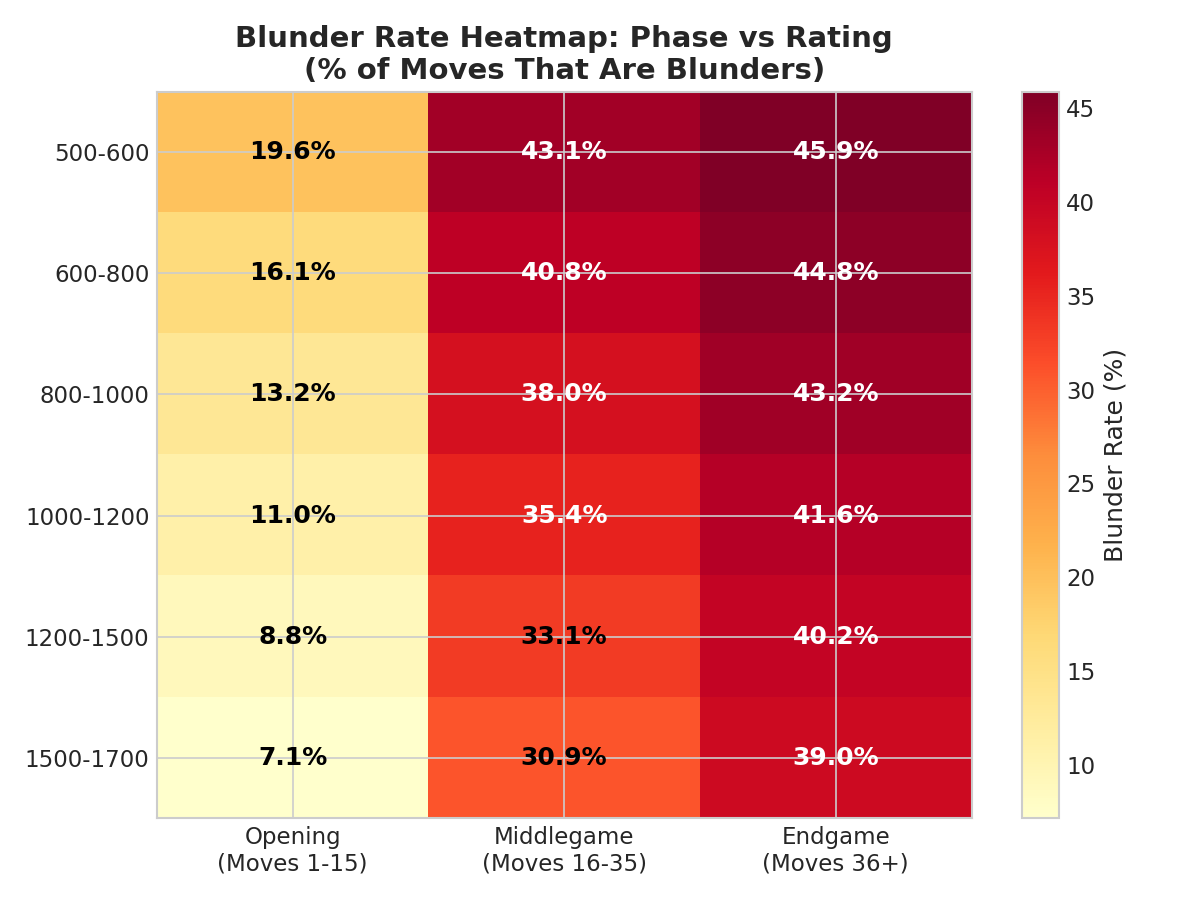
The gradient from light yellow (low blunder rate) to deep red (high blunder rate) makes the pattern unmistakable: the endgame column is consistently the darkest across every row, and the opening column is consistently the lightest. The improvement from 800 to 1500 is most visible in the opening column, where the rate drops from 13.2% to 8.8%.
Section 2: The Timing of the First Blunder
While endgames feature the highest rate of blunders per move, most games are effectively decided much earlier. Our data shows that approximately 76% of all Blitz games in the 800-1500 range contain at least one major blunder (a move losing 300+ centipawns). The percentage is remarkably stable across rating bands, varying only from 74.4% to 76.3%.
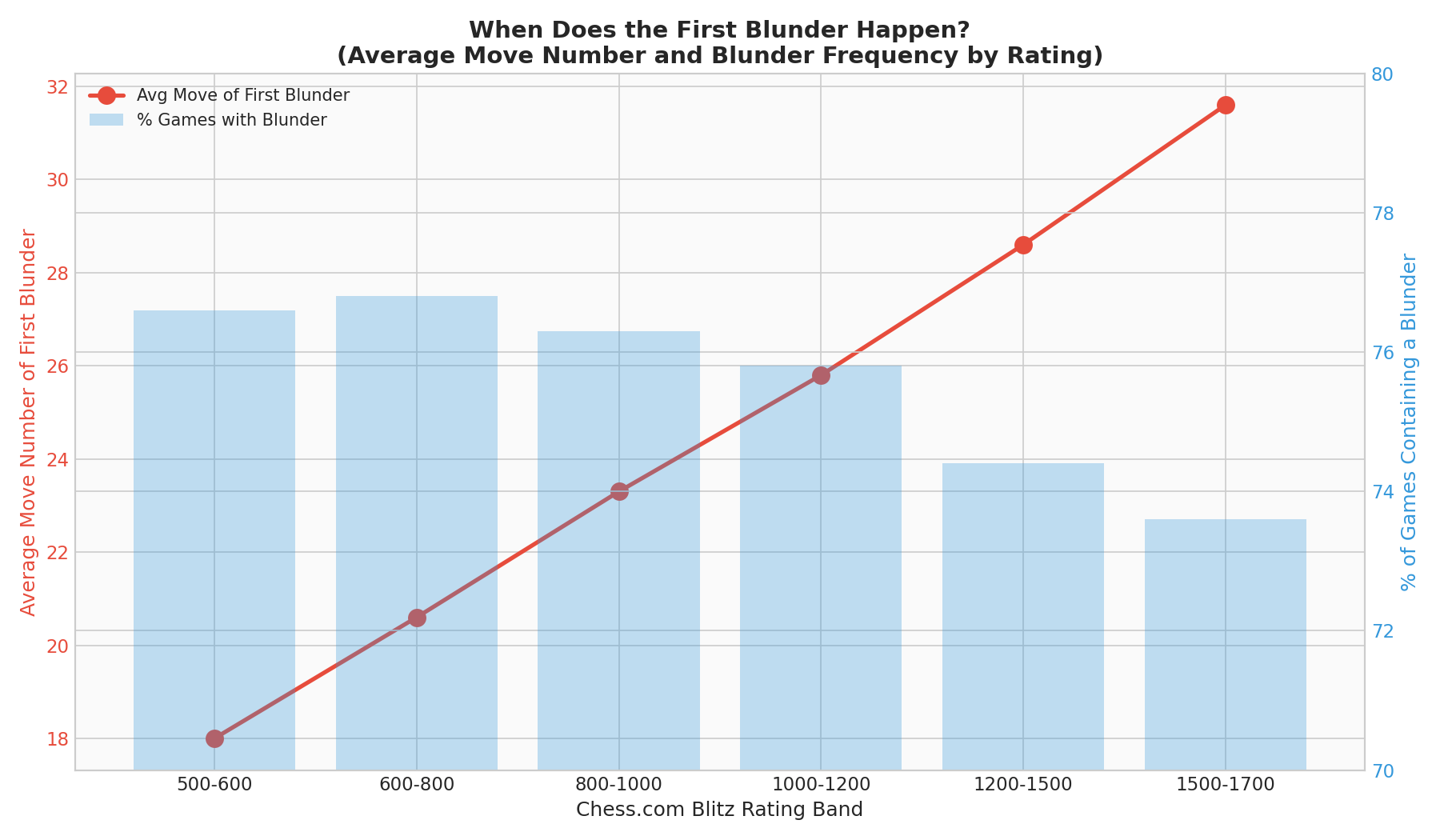
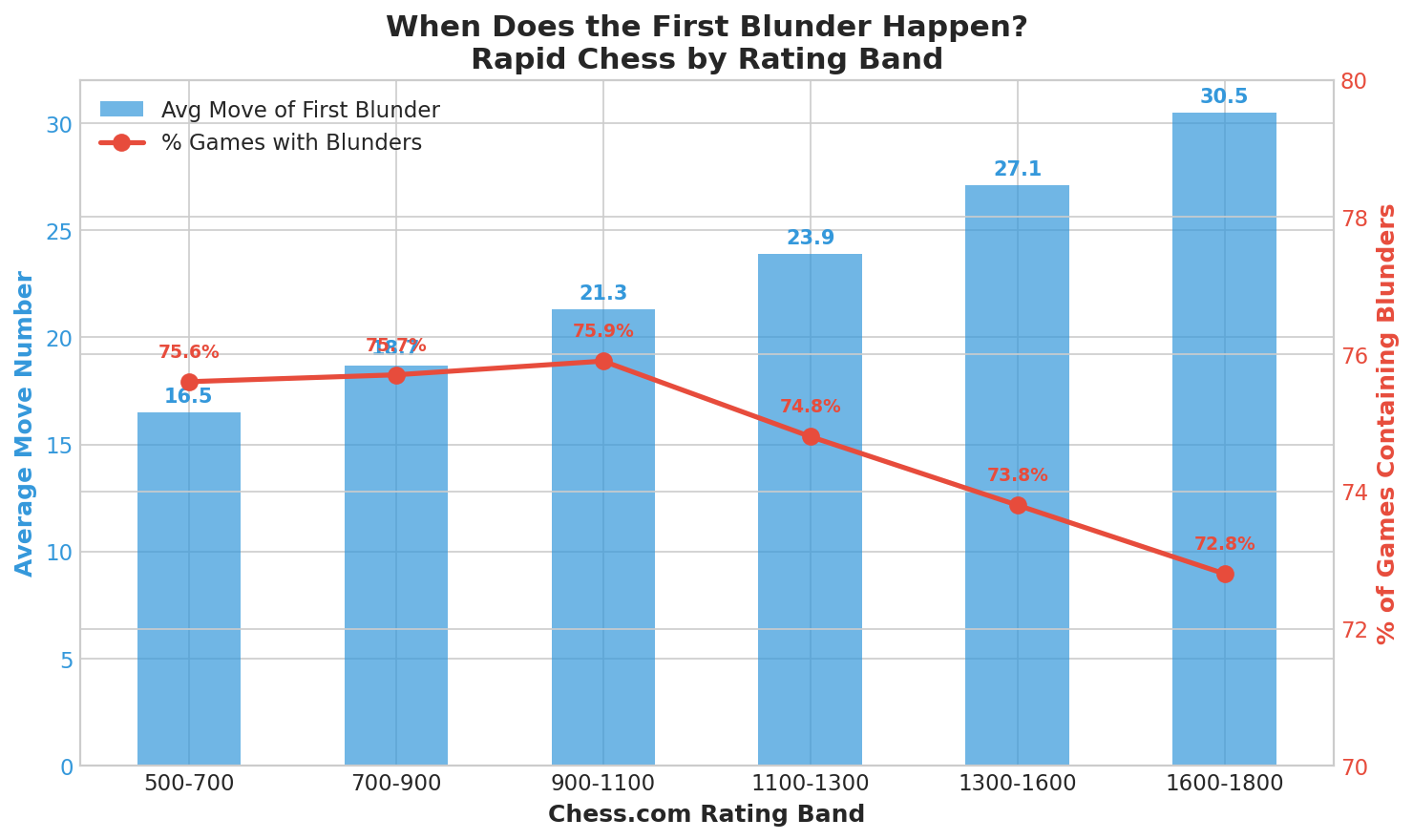
The average move number of the first blunder pushes deeper into the game as ratings increase. The table below quantifies this progression:
| Chess.com Rating Band | Avg Move of First Blunder | % Games with Blunder | Avg Blunders per Game |
|---|---|---|---|
| 800-1000 | Move 23 | 76.3% | 19.0 |
| 1000-1200 | Move 26 | 75.8% | 18.5 |
| 1200-1500 | Move 29 | 74.4% | 18.3 |
This progression indicates that improving players are extending the "equality phase" of the game, forcing their opponents to navigate more complex middlegame positions before a decisive mistake is made. The first blunder shifts from the late opening (move 23) at 800-1000 to the middlegame (move 29) at 1200-1500. This is a gain of approximately two moves per 200 rating points.
The histogram below shows the full distribution of when first blunders occur:
At the lowest rating bands, the first blunder is heavily concentrated in the opening and early middlegame (moves 1-20). As ratings increase, the distribution shifts rightward, with more first blunders occurring in the middlegame and late middlegame phases. This confirms that at the 800 level, roughly one-fifth of games are effectively decided in the first 10 moves, while at 1200-1500, the decisive moment is more likely to come in the 20-30 move range.
Section 3: Game Length — Do Beginners Even Reach the Endgame?
A common argument against studying endgames at lower ratings is that "games are decided before the endgame is reached." The data partially supports this claim, but the reality is more nuanced than the conventional wisdom suggests.
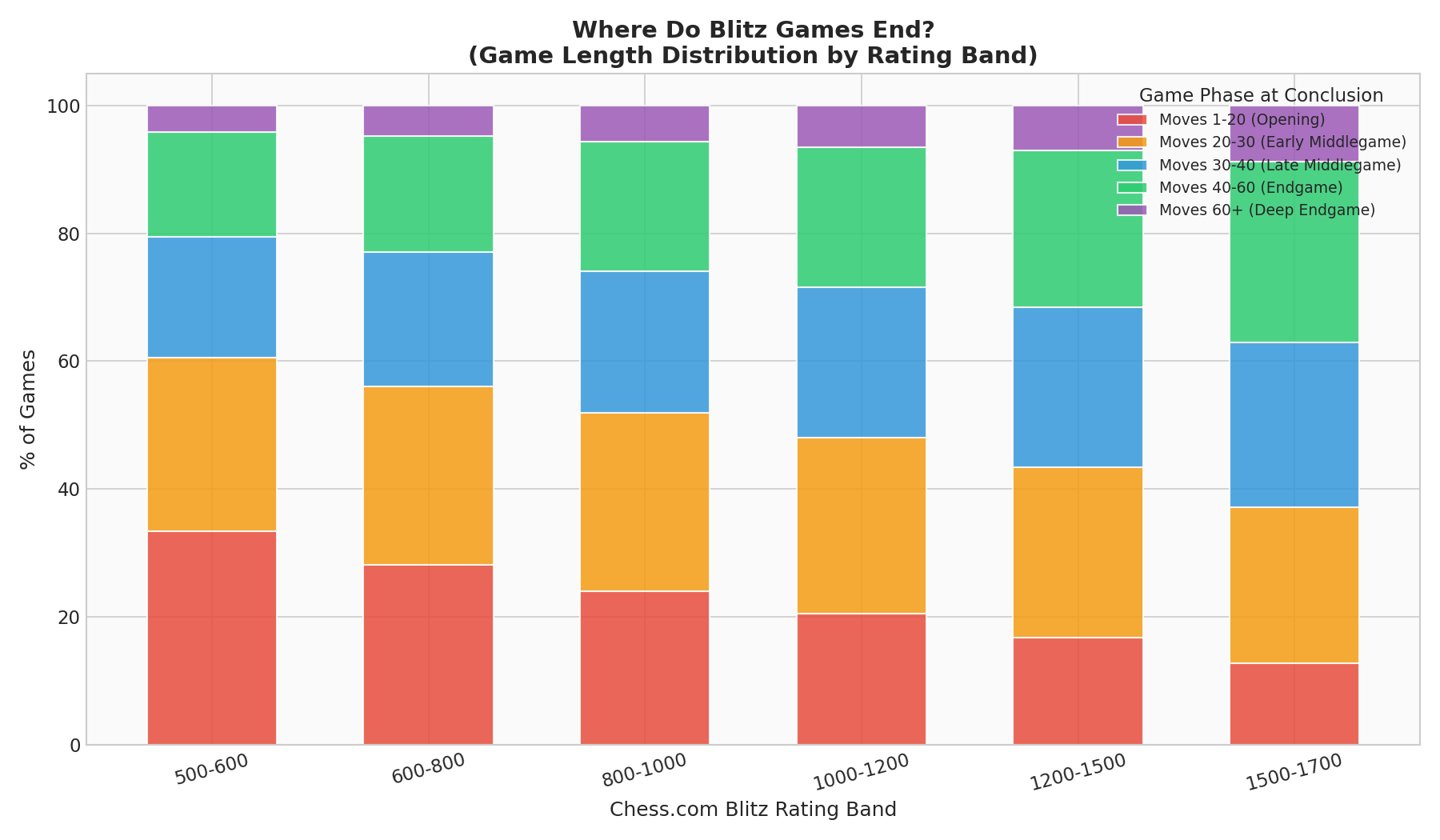
The stacked bar chart above shows the distribution of game lengths by rating band. The red segment (games ending before move 20) shrinks dramatically as ratings increase, while the green and purple segments (games reaching moves 40-60 and 60+) grow steadily.
| Chess.com Rating Band | Games Ending < 20 Moves | Games Ending < 30 Moves | Games Reaching 40+ Moves | Games Reaching 60+ Moves | Avg Game Length |
|---|---|---|---|---|---|
| 800-1000 | 24.0% | 51.9% | 25.9% | 5.7% | 31.2 moves |
| 1000-1200 | 20.5% | 48.0% | 28.4% | 6.5% | 32.5 moves |
| 1200-1500 | 16.8% | 43.4% | 31.6% | 7.1% | 34.1 moves |
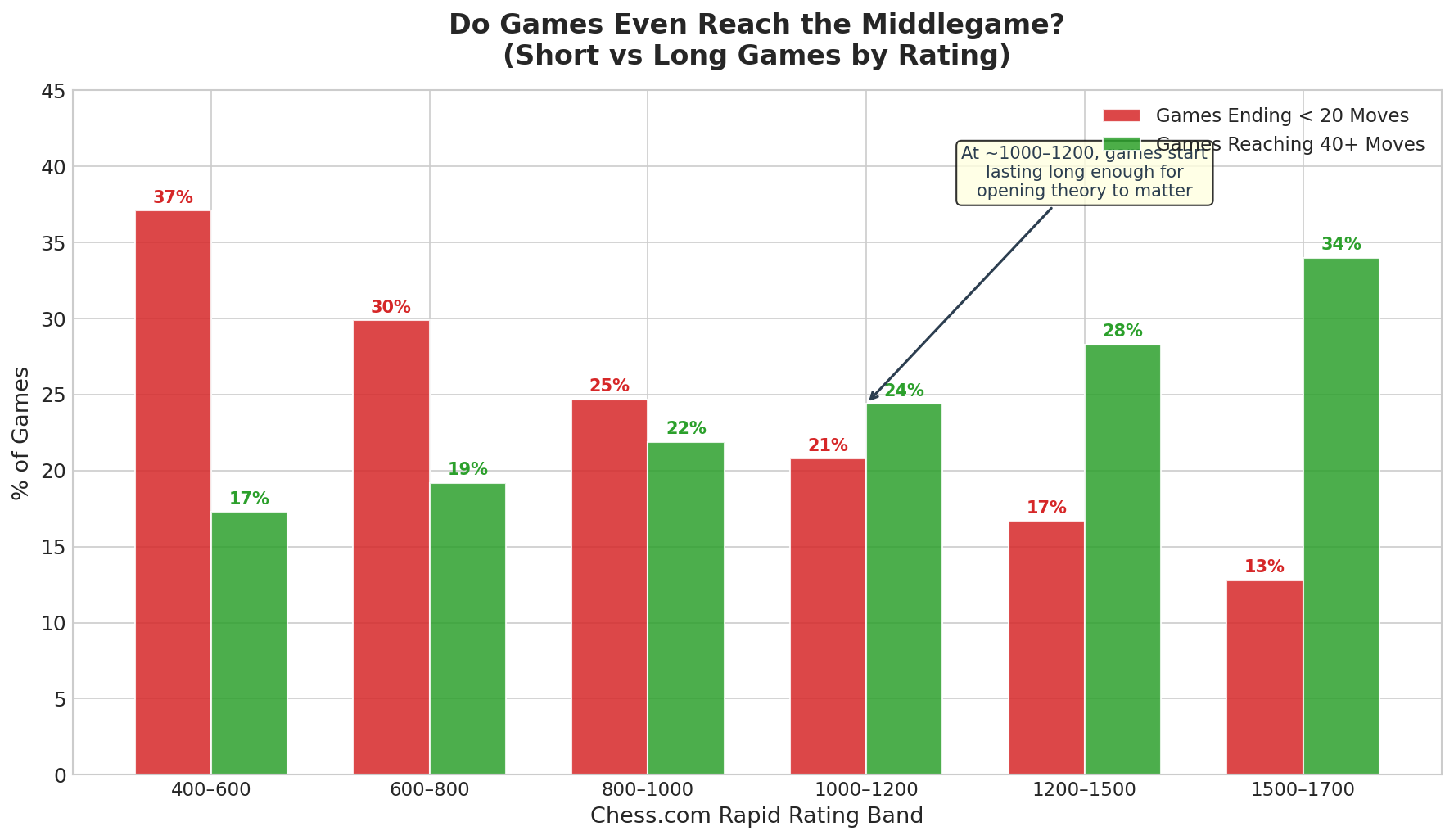
At the 800-1000 level, nearly a quarter of games end before move 20 — typically due to opening traps, early tactical oversights, or resignations after losing a piece. However, even at this level, more than one in four games reaches move 40, which is well into endgame territory. As players progress to the 1200-1500 bracket, the percentage of short games drops to 16.8%, while nearly a third of games reach move 40+.
This means that as you improve, you will inevitably face more endgames. If your endgame technique remains stagnant while your opponents' defensive skills improve, you will struggle to convert advantages and break through rating plateaus.
Section 4: How Quickly Do Games Become Lopsided?
Another way to understand where games are decided is to examine the average engine evaluation at each phase. A higher absolute evaluation indicates a more lopsided position — one side has a clear advantage.
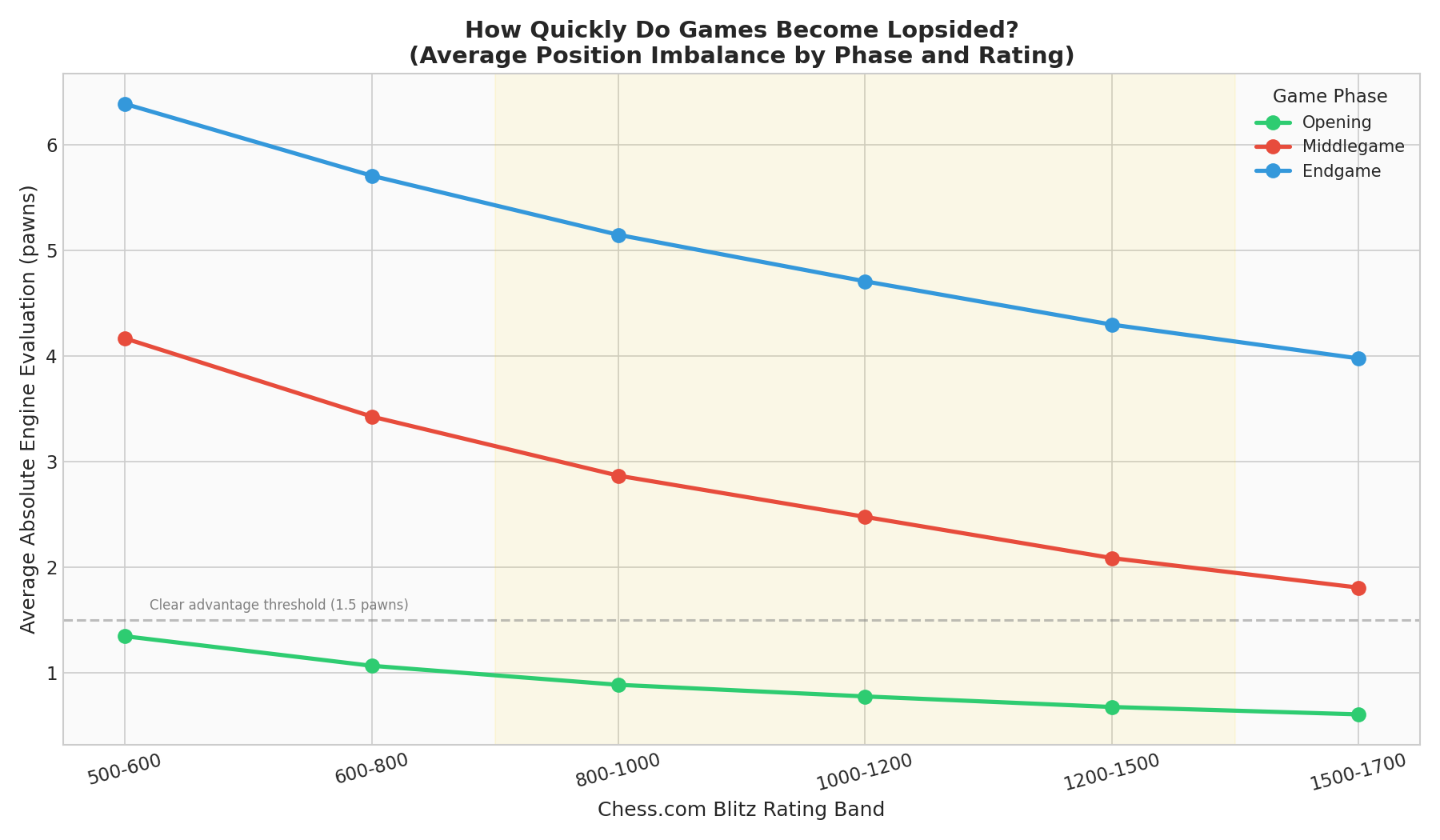
The chart above reveals a clear pattern: positions become increasingly lopsided as the game progresses, and this effect is dramatically more pronounced at lower ratings. At the 800-1000 level, the average absolute evaluation is already 0.89 pawns in the opening, balloons to 2.87 pawns in the middlegame, and reaches a staggering 5.15 pawns in the endgame. By contrast, at the 1200-1500 level, the opening evaluation is a much tighter 0.68 pawns, the middlegame is 2.09 pawns, and the endgame is 4.30 pawns.
| Chess.com Rating Band | Opening Avg Eval (pawns) | Middlegame Avg Eval (pawns) | Endgame Avg Eval (pawns) |
|---|---|---|---|
| 800-1000 | 0.89 | 2.87 | 5.15 |
| 1000-1200 | 0.78 | 2.48 | 4.71 |
| 1200-1500 | 0.68 | 2.09 | 4.30 |
The key insight here is that at the 800 level, the average game is already clearly decided (2.87 pawns) by the middlegame. The dashed line at 1.5 pawns represents the threshold for a "clear advantage" — and lower-rated games cross this threshold much earlier. This confirms that while endgames have the highest blunder rate per move, the cumulative effect of middlegame errors is what creates the decisive advantages.
Section 5: The Anatomy of a Blunder
Perhaps the most surprising finding in our analysis is when players are most likely to blunder, measured not by move number but by the position type at the moment of the blunder.
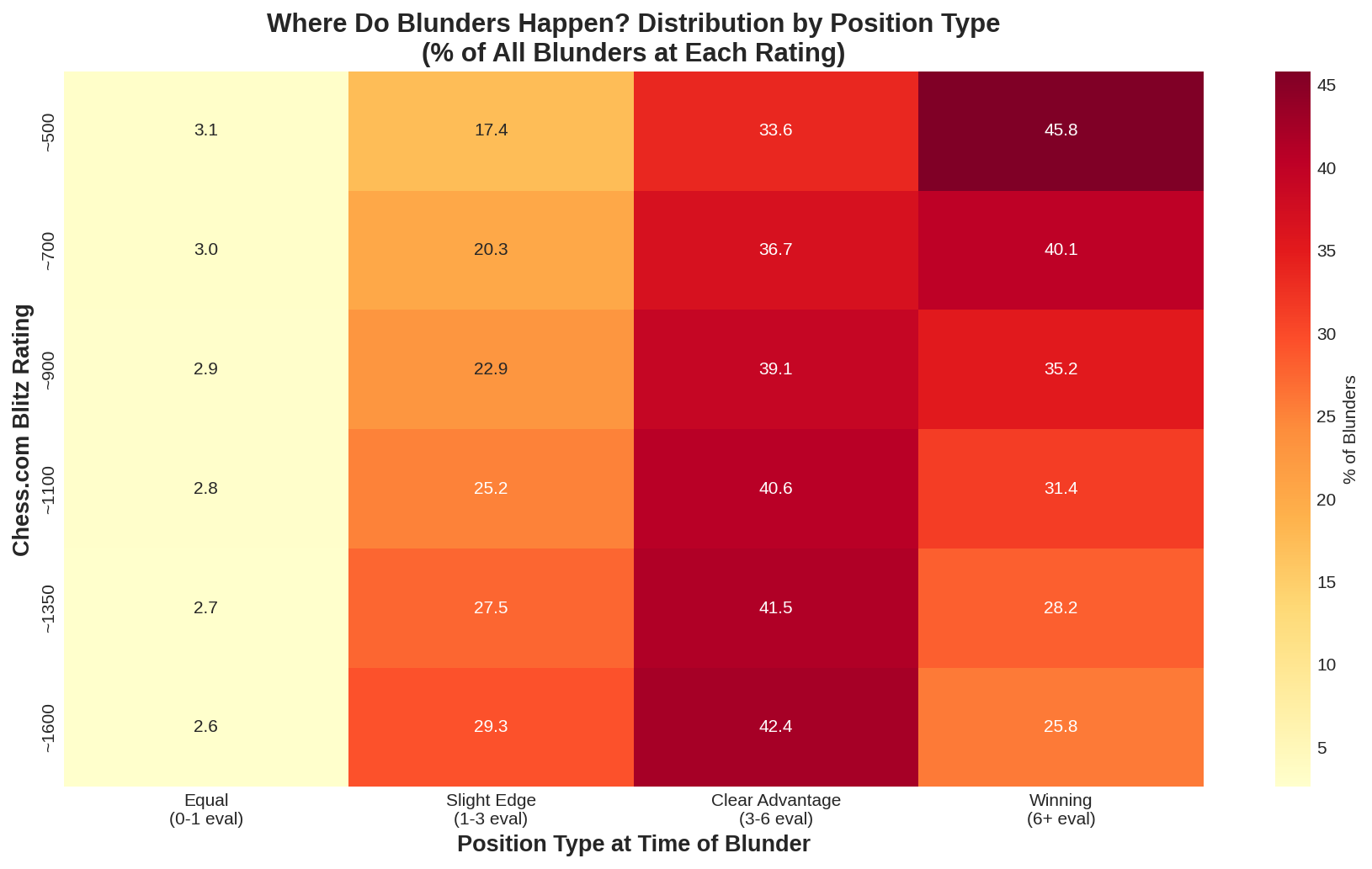
Counterintuitively, players are least likely to blunder in equal positions (0-1 pawn evaluation difference), accounting for only ~3% of all blunders. The vast majority of blunders occur when a player is already "Winning" (6+ pawns advantage) or has a "Clear advantage" (3-6 pawns).
| Position Type at Blunder | 800-1000 Chess.com | 1000-1200 Chess.com | 1200-1500 Chess.com |
|---|---|---|---|
| Equal (0-1 eval) | 2.9% | 2.9% | 2.8% |
| Slight edge (1-3 eval) | 22.9% | 24.2% | 25.4% |
| Clear advantage (3-6 eval) | 39.1% | 40.2% | 41.0% |
| Winning (6+ eval) | 35.2% | 32.7% | 30.8% |
This phenomenon, often referred to as "winning position syndrome," highlights a critical psychological weakness: players relax their calculation and defensive awareness once they achieve a significant advantage, leading to catastrophic blunders that throw away the game. The data also shows that as players improve, the proportion of blunders in "Winning" positions decreases (from 35.2% to 30.8%), suggesting that higher-rated players are slightly better at maintaining focus when ahead — but the problem persists at all levels.
Section 6: How Do Blitz Games End?
Understanding how games terminate provides additional context for where improvement efforts should be directed.
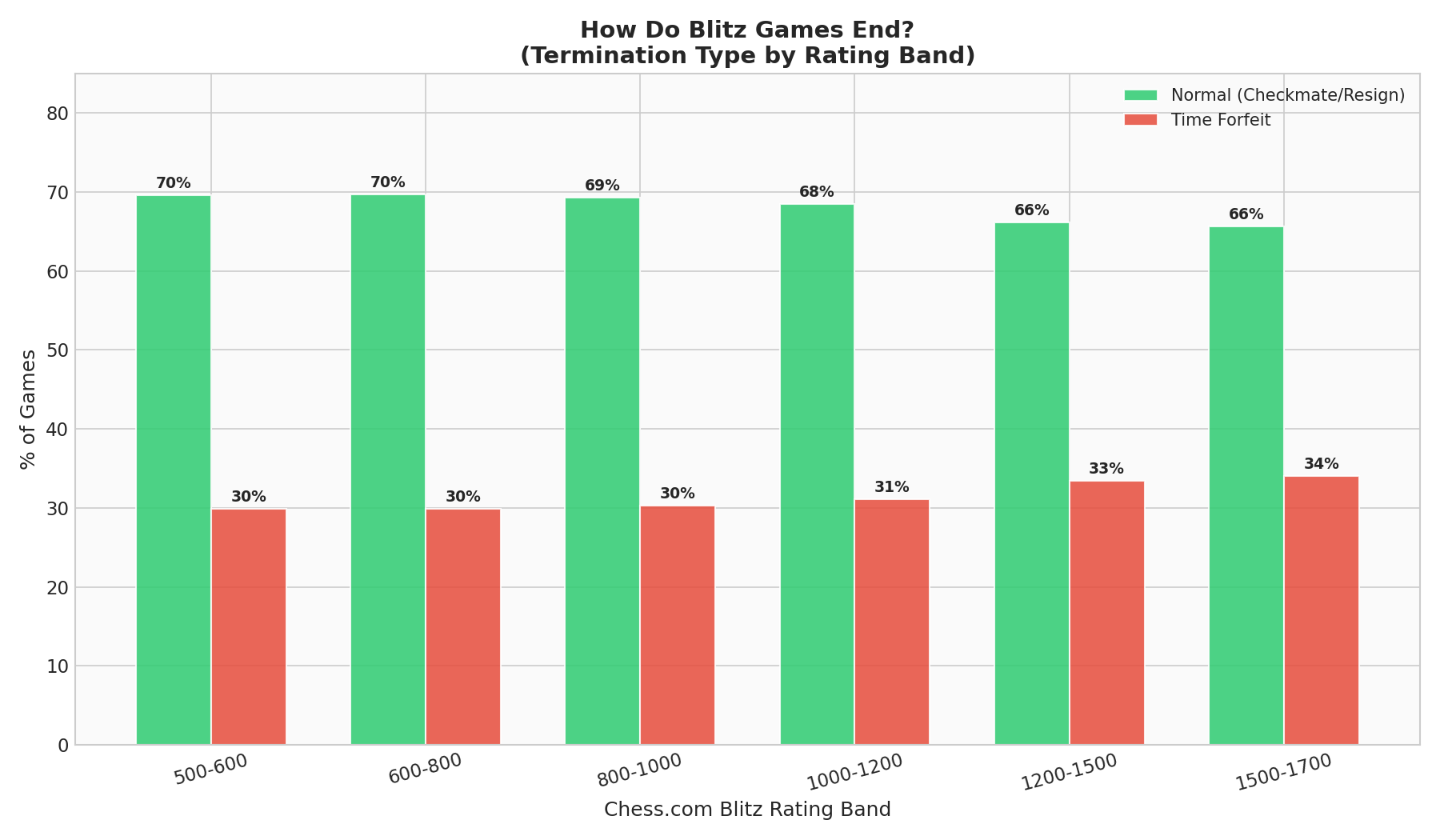
Across all rating bands in the 800-1500 range, approximately 23-25% of Blitz games end in time forfeits rather than checkmate or resignation. This is a significant finding: it means that roughly one in four games is decided not by chess skill but by clock management. The time forfeit rate is remarkably stable across ratings, suggesting that time pressure is a universal challenge in Blitz chess, not one that improves naturally with rating.
| Chess.com Rating Band | Normal Termination | Time Forfeit | Avg Game Length (Normal) | Avg Game Length (Time Forfeit) |
|---|---|---|---|---|
| 800-1000 | 76.9% | 22.9% | 29.3 | ~35 |
| 1000-1200 | 76.8% | 23.0% | 31.8 | ~35 |
| 1200-1500 | 74.7% | 24.9% | 33.3 | ~35 |
Section 7: Visualizing the Mistakes
To make these statistics concrete, let us examine typical blunders at different rating levels, complete with engine evaluations. In each diagram, the red arrow indicates the move played (the blunder), and the green arrow indicates the engine's recommended move.
The 800-1000 Level: Opening Oversights
At this level, games are frequently decided by early tactical oversights or falling for known traps. Our data shows that 24% of games end before move 20 at this rating.
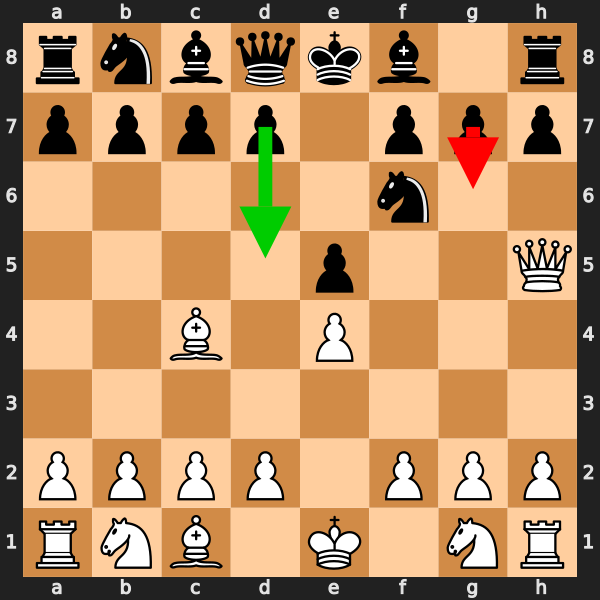
Black to move in the Scholar's Mate setup. The common beginner mistake is ...g6?? (red arrow), which walks directly into Qxf7#. The correct defense is ...d5! (green arrow), which blocks the bishop's diagonal, counterattacks the e4 pawn, and opens lines for Black's development. This type of one-move tactical oversight accounts for a significant portion of the 13.2% opening blunder rate at this level.
The 1000-1200 Level: Middlegame Tactics
As players cross the 1000 threshold, opening blunders decrease, but middlegame complexity often leads to dropped pieces or missed intermediate moves.
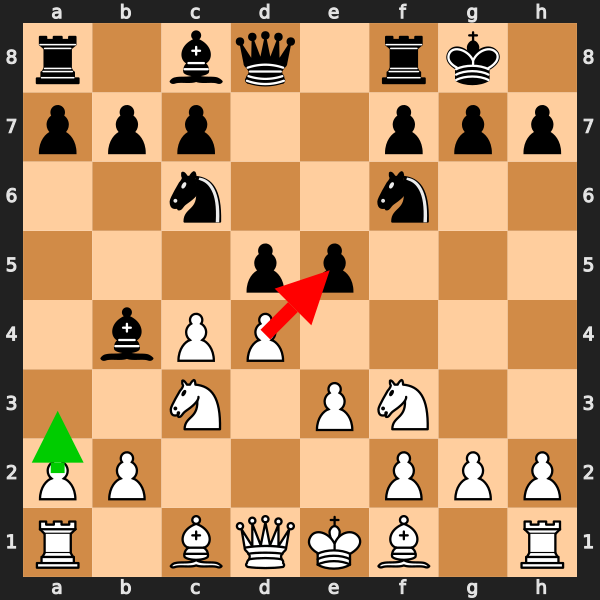
White to move. At the 1000-1200 level, 35.4% of middlegame moves are blunders. Here, the natural-looking dxe5 (red arrow) appears to win a pawn, but it loses the knight on c3 to ...Bxc3+, exploiting the pin against the king. The correct move is a3! (green arrow), first asking the bishop where it wants to go before committing in the center. This type of "looks good but loses material" blunder is the hallmark of the 1000-1200 level.
The 1200-1500 Level: Endgame Technique
By 1200-1500, players are reaching the endgame more frequently (31.6% of games reach move 40+), but their technique often fails them in critical moments.
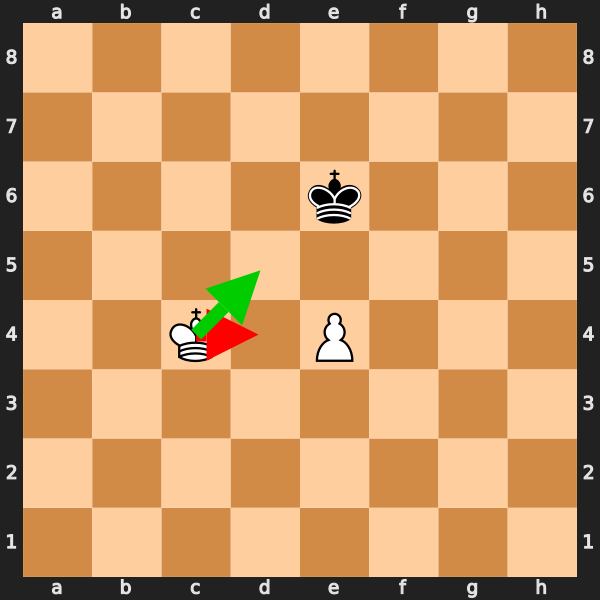
White to move in a King and Pawn endgame. At the 1200-1500 level, 40.2% of endgame moves are blunders. Here, Kd4?? (red arrow) allows Black to take the opposition with ...Kd6 and draw. The winning move is Kd5! (green arrow), seizing the opposition and ensuring the pawn promotes. This is a textbook example of the kind of endgame knowledge that separates 1200 players from 1500 players.
Section 8: Overall Move Quality by Rating
For a broader perspective, the chart below shows the average centipawn loss (CPL) across all phases for each rating band. Lower CPL indicates better overall play.
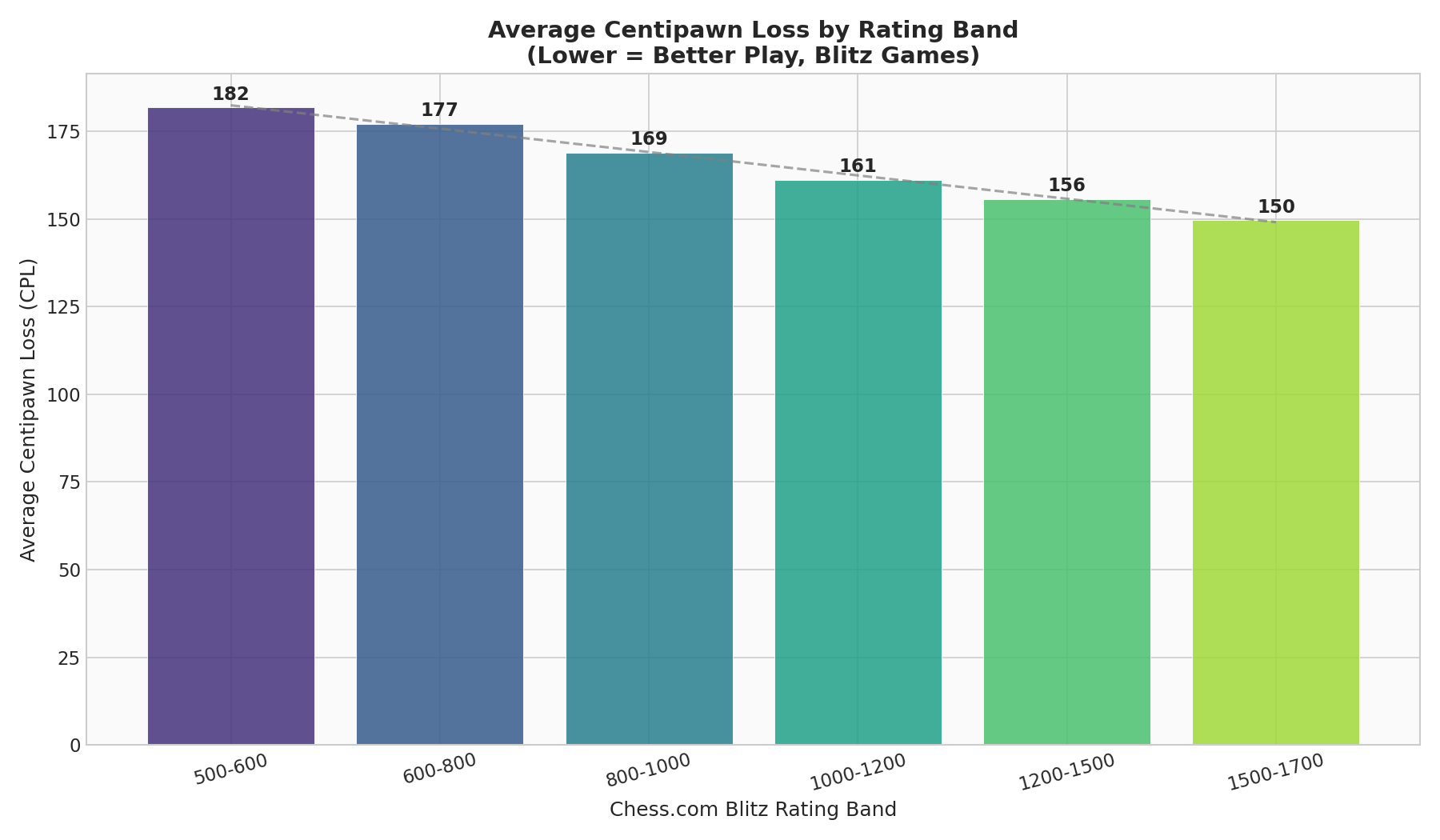
The improvement in CPL from 800-1000 (169 avg CPL) to 1200-1500 (156 avg CPL) is modest — a reduction of only 13 centipawns. This suggests that the difference between these rating bands is not primarily about making better moves on average, but about making fewer catastrophic mistakes. The path from 800 to 1500 is paved not by brilliance, but by blunder reduction.
Section 9: White vs. Black — Does Color Matter?
Our phase accuracy breakdown by color reveals whether White or Black makes more mistakes at each phase.
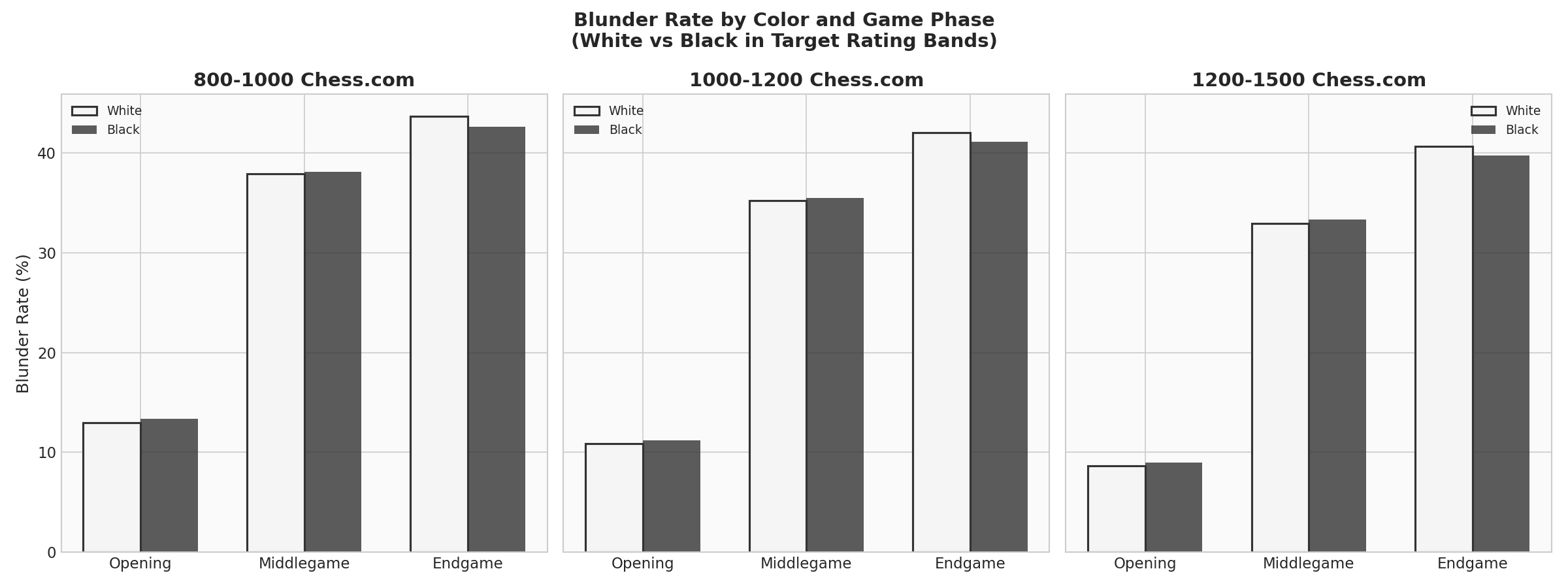
Across all three target rating bands, the differences between White and Black blunder rates are minimal (typically within 1-2 percentage points). This suggests that the first-move advantage does not translate into a significant accuracy advantage at the beginner-to-intermediate level. Both colors face similar challenges in each phase of the game.
Section 10: Actionable Advice by Rating Band
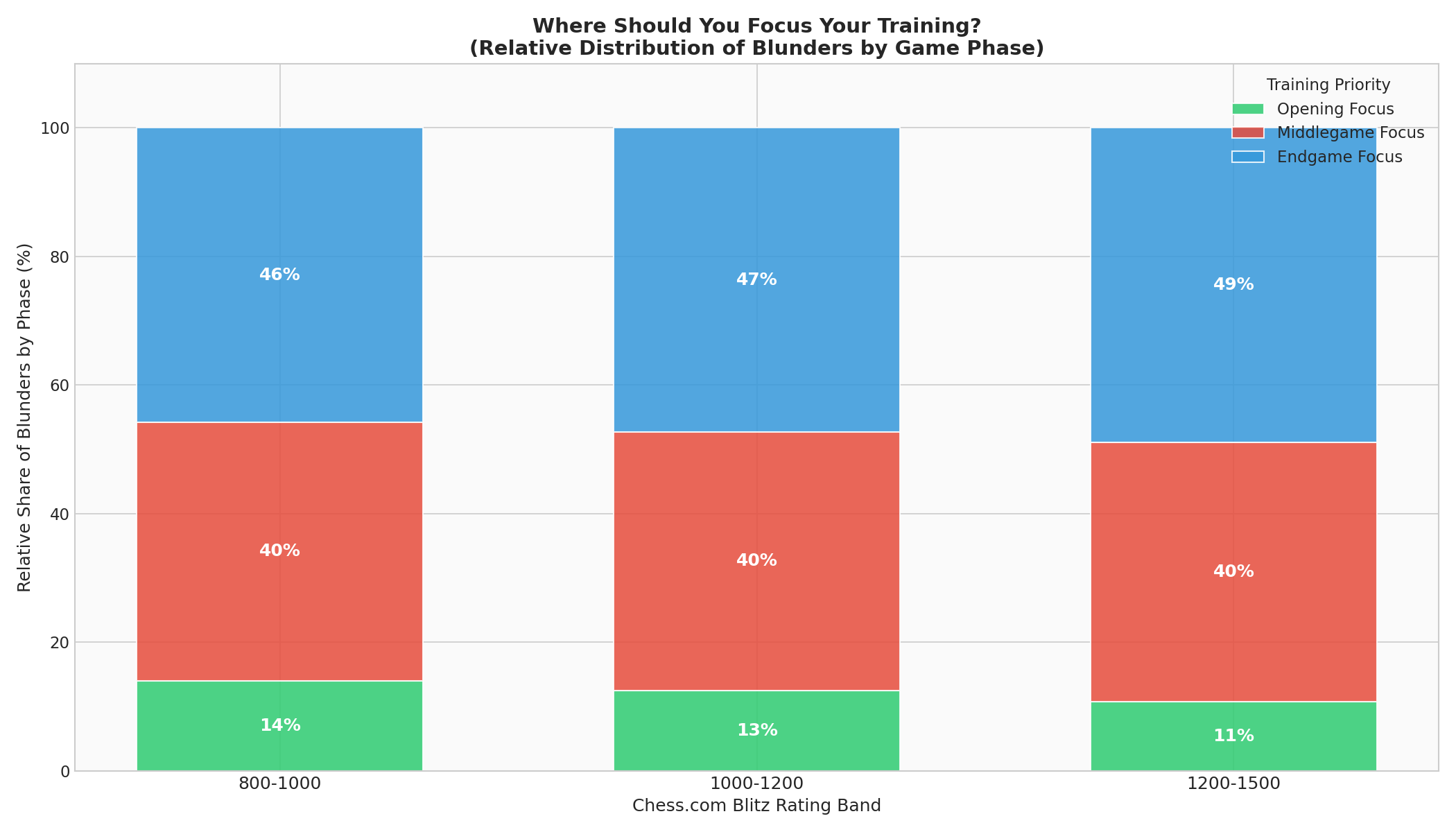
Based on the data, here is a targeted improvement roadmap for each rating band. The chart below shows the relative distribution of blunders by game phase, indicating where your training time should be allocated.
800-1000 Chess.com (Lichess Blitz ~1100-1300)
The Data: You are blundering on 13.2% of your opening moves and 38.0% of your middlegame moves. A full 24% of your games end before move 20, and your first blunder typically occurs around move 23. Your average game lasts only 31 moves.
Actionable Advice:
Your primary weakness is opening and early middlegame blunders. While your endgame blunder rate is technically higher (43.2%), most of your games never reach the endgame. Focus your training on surviving the first 20 moves.
First, master basic opening principles rather than memorizing specific lines. Control the center with pawns, develop knights and bishops before the queen, and castle early. Second, implement a blunder-checking routine: before every move, ask yourself "Does this move leave a piece undefended?" and "What is my opponent threatening?" Third, practice one-move and two-move tactical puzzles (pins, forks, skewers, and back-rank mates) for 15-20 minutes daily. At this level, pattern recognition is more valuable than deep calculation.
1000-1200 Chess.com (Lichess Blitz ~1300-1500)
The Data: Your opening accuracy has improved (11.0% blunder rate), but your middlegame (35.4%) and endgame (41.6%) blunder rates remain high. The first blunder typically occurs around move 26, and your games are lasting longer (32.5 moves average).
Actionable Advice:
Your primary weakness has shifted to the middlegame. You are surviving the opening more consistently, but you are struggling to find good plans and maintain focus in complex positions.
First, study basic middlegame plans based on pawn structures. Understand where your pieces belong after the opening phase — for example, rooks belong on open files, and knights are strongest on outpost squares. Second, work on defensive awareness. The blunder taxonomy data shows that you are most likely to blunder when you already have an advantage. Practice maintaining focus and calculating your opponent's best responses even when you are winning. Third, learn essential endgame checkmates (King and Queen vs. King, King and Rook vs. King) and basic King and Pawn endgame principles (the opposition, the rule of the square). You are starting to reach endgames more frequently, and basic technique will convert many half-points into full points.
1200-1500 Chess.com (Lichess Blitz ~1500-1800)
The Data: You are navigating the opening well (8.8% blunder rate), and your games are lasting longer (31.6% reach move 40+). However, your endgame blunder rate is a staggering 40.2%, and your middlegame blunder rate (33.1%) still has significant room for improvement. Time forfeits account for 25% of your game endings.
Actionable Advice:
This is the rating band where endgame study yields the highest return on investment. Your opening knowledge is adequate, your middlegame is improving, but your endgame technique is the bottleneck preventing further progress.
First, focus on Rook endgames, as they are the most common endgame type. Master the Lucena position (winning with a Rook and pawn vs. Rook) and the Philidor position (drawing with a Rook vs. Rook and pawn). These two patterns alone will improve your conversion rate significantly. Second, deepen your calculation ability. Move beyond simple two-move tactics and practice calculating 3-4 moves deep in complex middlegame positions. Use puzzle sets rated 1400-1600 on Chess.com or Lichess. Third, manage your clock more effectively. With 25% of games ending in time forfeits, practice spending less time in the opening (where you already play well) and saving your seconds for critical middlegame calculations and endgame execution.
Data and Methodology
This analysis was conducted using a dataset of over 460,000 Lichess Blitz games played in March 2025, sourced from the Lichess open database. The games were analyzed using Stockfish 17 to extract centipawn loss (CPL) and blunder rates per ply, with blunders defined as moves resulting in an evaluation drop of 300 centipawns or more. Game phases were defined as: opening (plies 1-15), middlegame (plies 16-35), and endgame (plies 36+).
To make the findings relevant to the target audience, Lichess Blitz ratings were mapped to approximate Chess.com Blitz ratings using the following conversion table:
| Chess.com Blitz | Lichess Blitz |
|---|---|
| 800 | 1200 |
| 900 | 1335 |
| 1000 | 1420 |
| 1100 | 1475 |
| 1200 | 1565 |
| 1300 | 1635 |
| 1400 | 1705 |
| 1500 | 1780 |
The underlying CSV data files generated for this analysis are available for download and further exploration:
| Data File | Description | ||||||||||||||||||||||||||||||||||||||||||||||||||||||||||||||||||||||||
|---|---|---|---|---|---|---|---|---|---|---|---|---|---|---|---|---|---|---|---|---|---|---|---|---|---|---|---|---|---|---|---|---|---|---|---|---|---|---|---|---|---|---|---|---|---|---|---|---|---|---|---|---|---|---|---|---|---|---|---|---|---|---|---|---|---|---|---|---|---|---|---|---|---|
|
Blunder %, mistake %, inaccuracy %, and avg CPL by game phase and rating band | ||||||||||||||||||||||||||||||||||||||||||||||||||||||||||||||||||||||||
|
Average move of first blunder, % games with blunder, avg blunders per game | ||||||||||||||||||||||||||||||||||||||||||||||||||||||||||||||||||||||||
|
% of games ending at each phase, termination types | ||||||||||||||||||||||||||||||||||||||||||||||||||||||||||||||||||||||||
|
Blunder distribution by position type (equal, slight edge, clear advantage, winning) | ||||||||||||||||||||||||||||||||||||||||||||||||||||||||||||||||||||||||
|
Average game length, short/long game percentages | ||||||||||||||||||||||||||||||||||||||||||||||||||||||||||||||||||||||||
|
Overall centipawn loss and error rates by rating band | ||||||||||||||||||||||||||||||||||||||||||||||||||||||||||||||||||||||||
|
Average absolute engine evaluation by phase and rating | ||||||||||||||||||||||||||||||||||||||||||||||||||||||||||||||||||||||||
|
Distribution of first blunder by move range | ||||||||||||||||||||||||||||||||||||||||||||||||||||||||||||||||||||||||
|
How games end (normal, time forfeit, abandoned) | ||||||||||||||||||||||||||||||||||||||||||||||||||||||||||||||||||||||||
|
Full histogram of blunder counts per game |
Chess Coach April 15, 2026