For many improving chess players, opening theory is a double-edged sword. On one hand, knowing the first ten moves of the Sicilian Najdorf or the Ruy Lopez feels empowering. On the other hand, spending hours memorizing lines only to have your opponent play 2.a3 can be incredibly frustrating. The eternal question remains: at what rating does memorizing opening theory actually start to pay off, and when is it just a distraction from learning fundamental tactics?
To answer this question definitively, we analyzed a massive dataset of Lichess Bullet games across various rating bands. We looked at opening diversity, blunder timing, centipawn loss (CPL), and the effectiveness of specific openings to determine exactly when players should shift their focus from basic principles to deep theoretical preparation.
Note: All ratings discussed in this article are approximated to Chess.com Bullet ratings for clarity, using a standard conversion from the underlying Lichess data (typically a 200-300 point adjustment).
The Opening Diversity Index: When Do Players Specialize?
One of the strongest indicators of theoretical preparation is how narrow a player's opening repertoire is. Beginners tend to play whatever comes to mind, resulting in a highly diverse set of openings across the player pool. As players improve, they begin to specialize, focusing on a few reliable systems.
We measured this using the Herfindahl-Hirschman Index (HHI), a standard economic metric for market concentration, applied here to opening choices. A lower HHI indicates a more diverse "market" of openings, while a higher HHI indicates concentration. We also looked at the percentage of games covered by the top 5, 10, and 20 most popular openings.
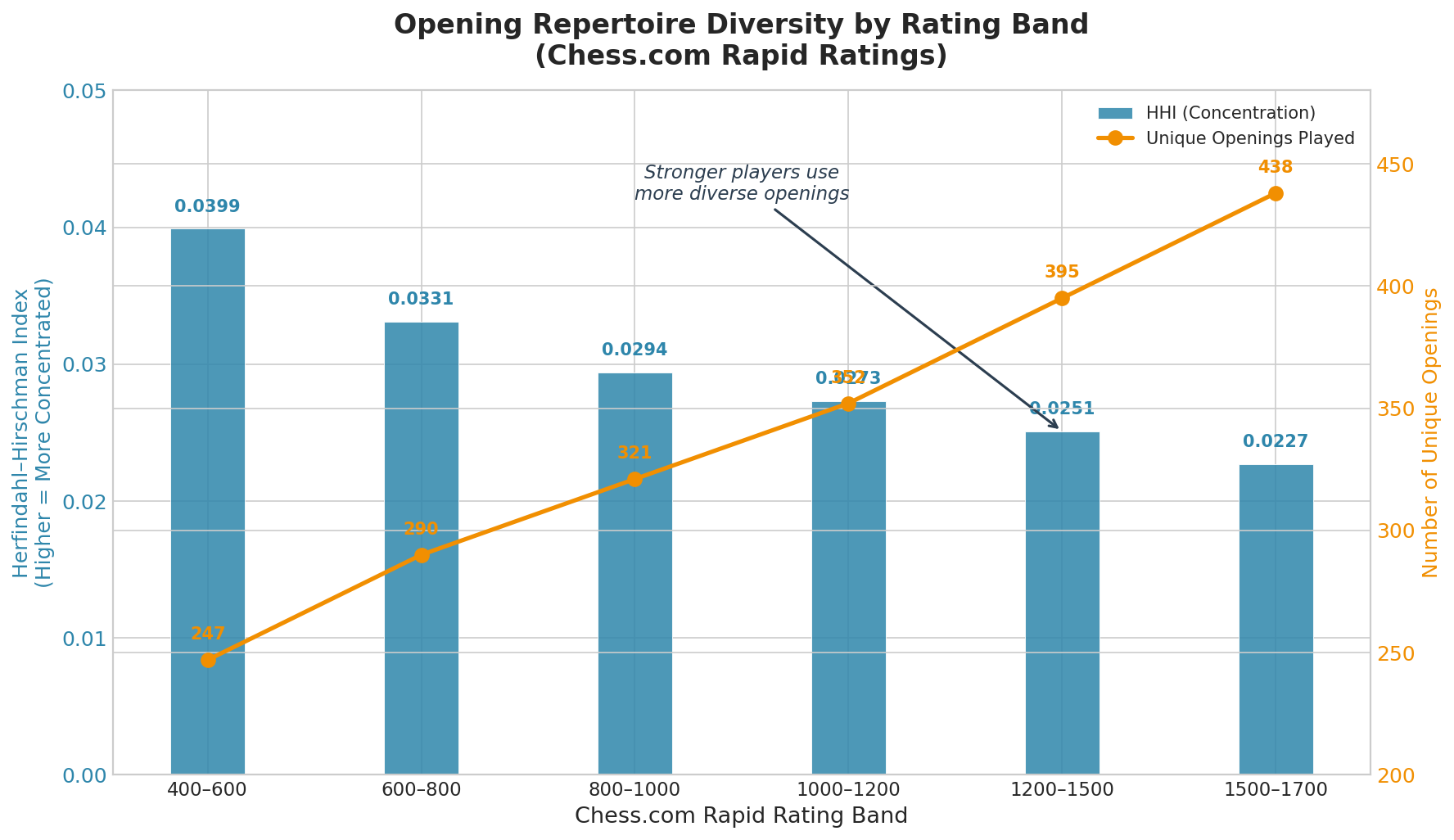
The data reveals a clear trend: as ratings increase, the overall diversity of the opening pool decreases (HHI drops from 0.0399 below 700 to 0.0227 at 1500-1700). However, the number of unique openings played actually increases. This apparent paradox means that while the player base as a whole is exploring a wider variety of obscure lines, individual players are specializing heavily in specific, theoretically dense openings.
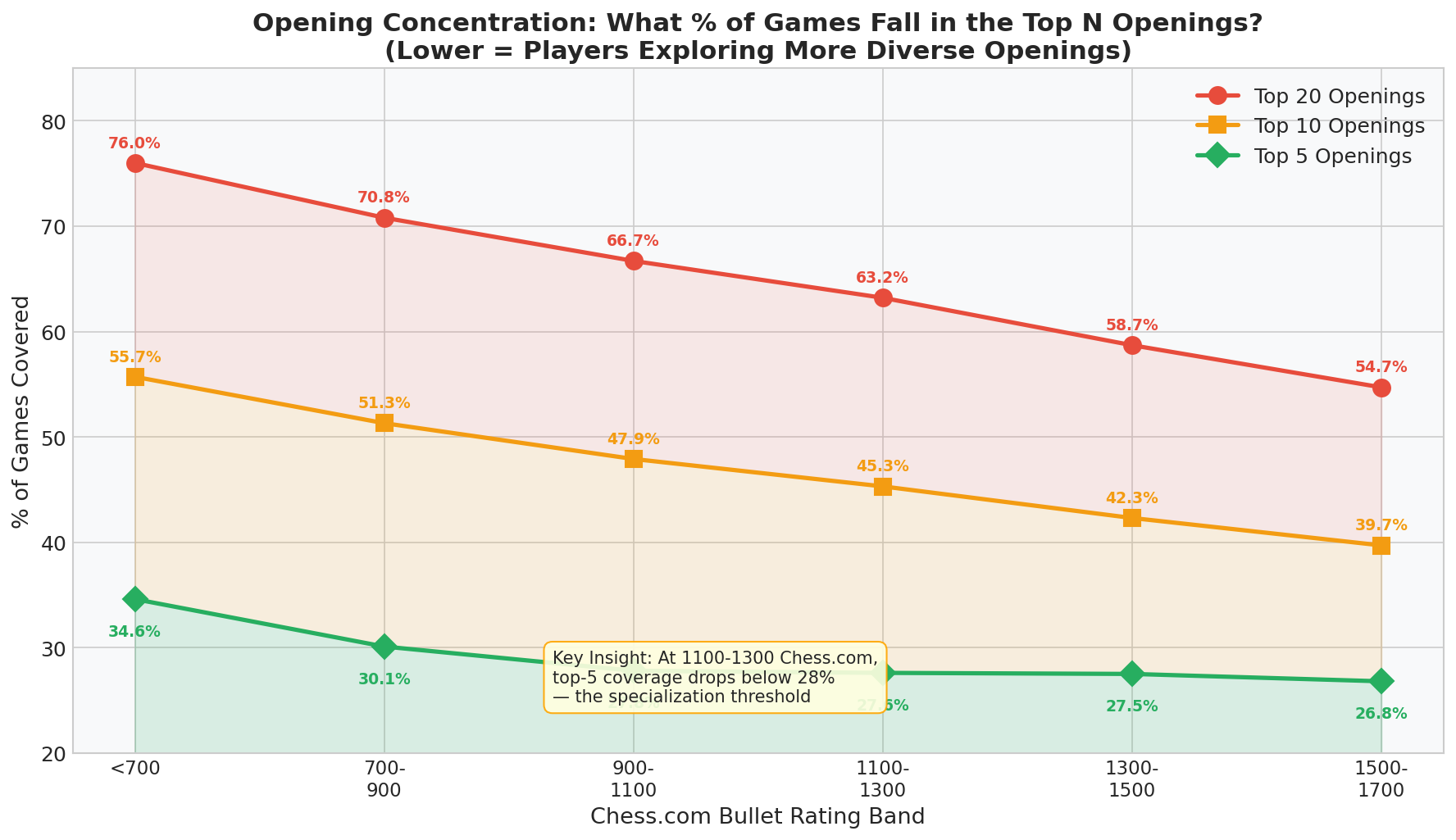
Looking at the coverage of the top openings, we see a significant shift around the 1100-1300 Chess.com rating band. Below this level, the top 5 openings account for over 30% of all games. Above 1300, this drops below 28%. This is the point where players stop relying solely on the most common beginner openings (like the Italian Game or the Wayward Queen Attack) and start branching out into specialized, theory-heavy repertoires.
The Blunder Timeline: When Do Mistakes Happen?
Memorizing theory is only useful if you can survive the opening without blundering away the game. We analyzed when the first major blunder (defined as a centipawn loss of 300 or more) typically occurs across different rating bands.

For players rated below 900 on Chess.com, the average first blunder occurs on move 17.3—often right at the end of, or even during, the opening phase. In fact, for players below 900, nearly 20% of games feature a game-losing blunder within the first 10 moves.
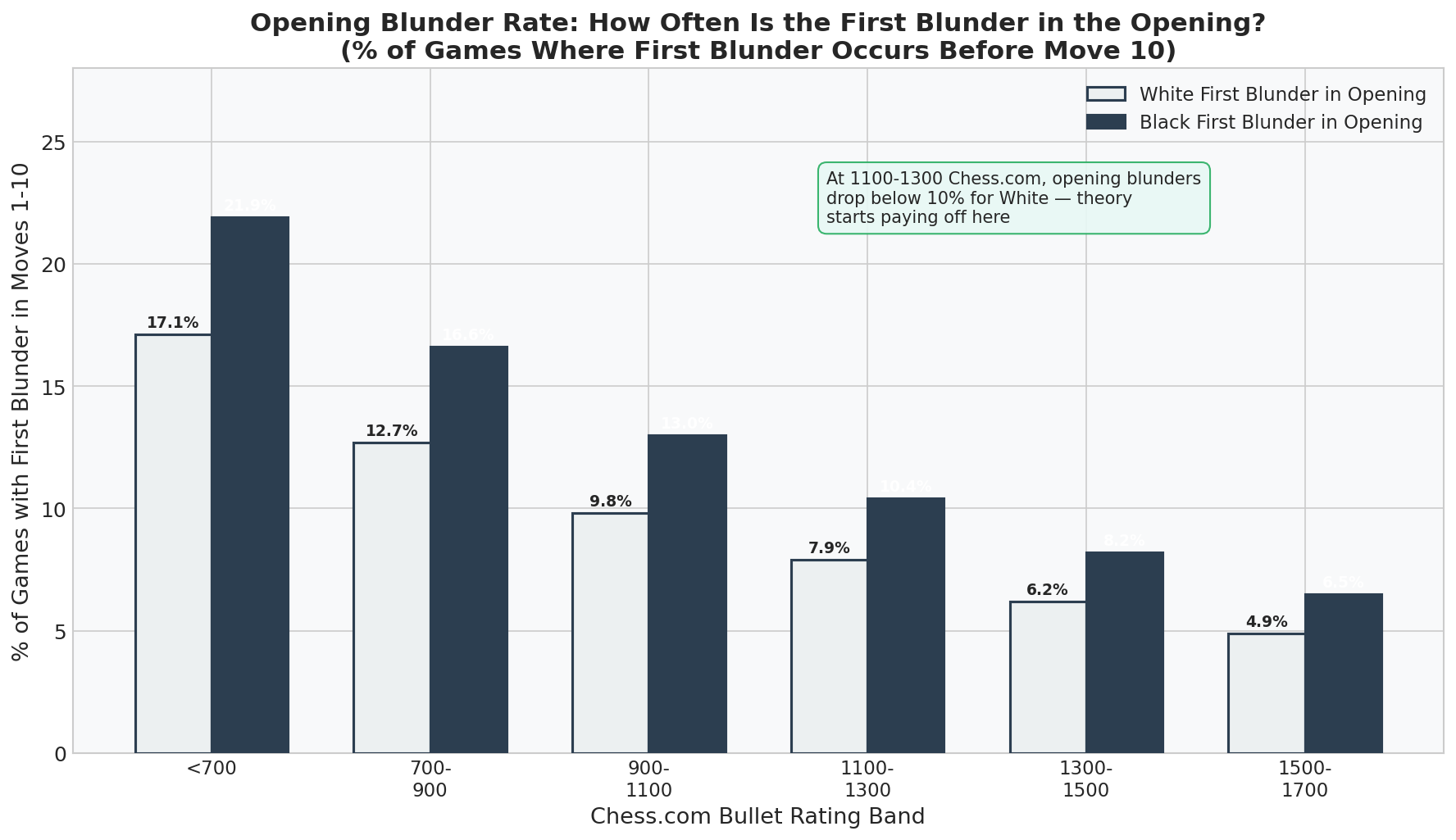
As players improve, the first blunder is pushed further back into the middlegame. By the time players reach the 1300-1500 band, the average first blunder doesn't occur until move 24.8, and the rate of opening blunders (moves 1-10) drops significantly. For White, the opening blunder rate falls below 10% at the 1100-1300 level. This is a critical threshold: if you are consistently surviving the first 10 moves without blundering, theoretical knowledge becomes the differentiating factor.
Visualizing the Mistakes
To understand what these early blunders look like, let's examine some typical errors at different rating levels.
Below 700: The Premature Attack At the lowest rating bands, games are often decided by simple one-move blunders or premature, unsupported attacks. A classic example is bringing the Queen out too early, hoping for a quick Scholar's Mate, only to have it chased around the board.
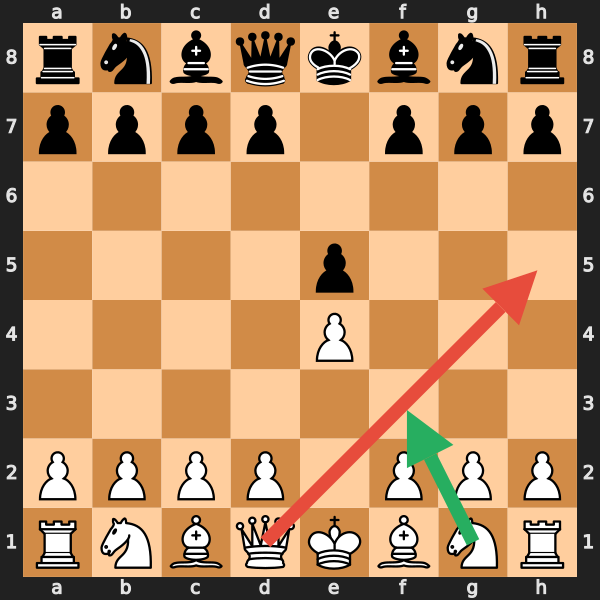 Instead of developing the Knight (green arrow), White plays Qh5 (red arrow), a common but easily refuted beginner mistake.
1100-1300: Missing the Nuance As players reach the intermediate levels, the blunders become less about hanging pieces and more about misunderstanding the specific requirements of an opening. In complex openings like the Sicilian Najdorf, a slow or passive move can hand the initiative to the opponent.
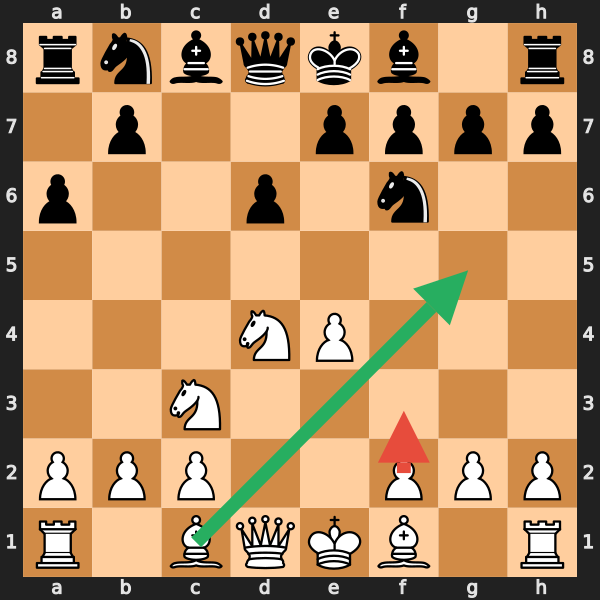 In this Najdorf position, White plays the slow f3 (red arrow) instead of the critical main-line move Bg5 (green arrow), allowing Black to equalize easily.
The Theory Payoff: System Openings vs. Traps
Not all opening theory is created equal. Some openings, like the London System, rely on understanding general setups and piece placements rather than memorizing sharp, forcing lines. Others, like the Stafford Gambit, are highly tactical and rely on the opponent falling into specific traps.
We compared the performance of these two types of openings across rating bands to see how their effectiveness changes as opponents become stronger.
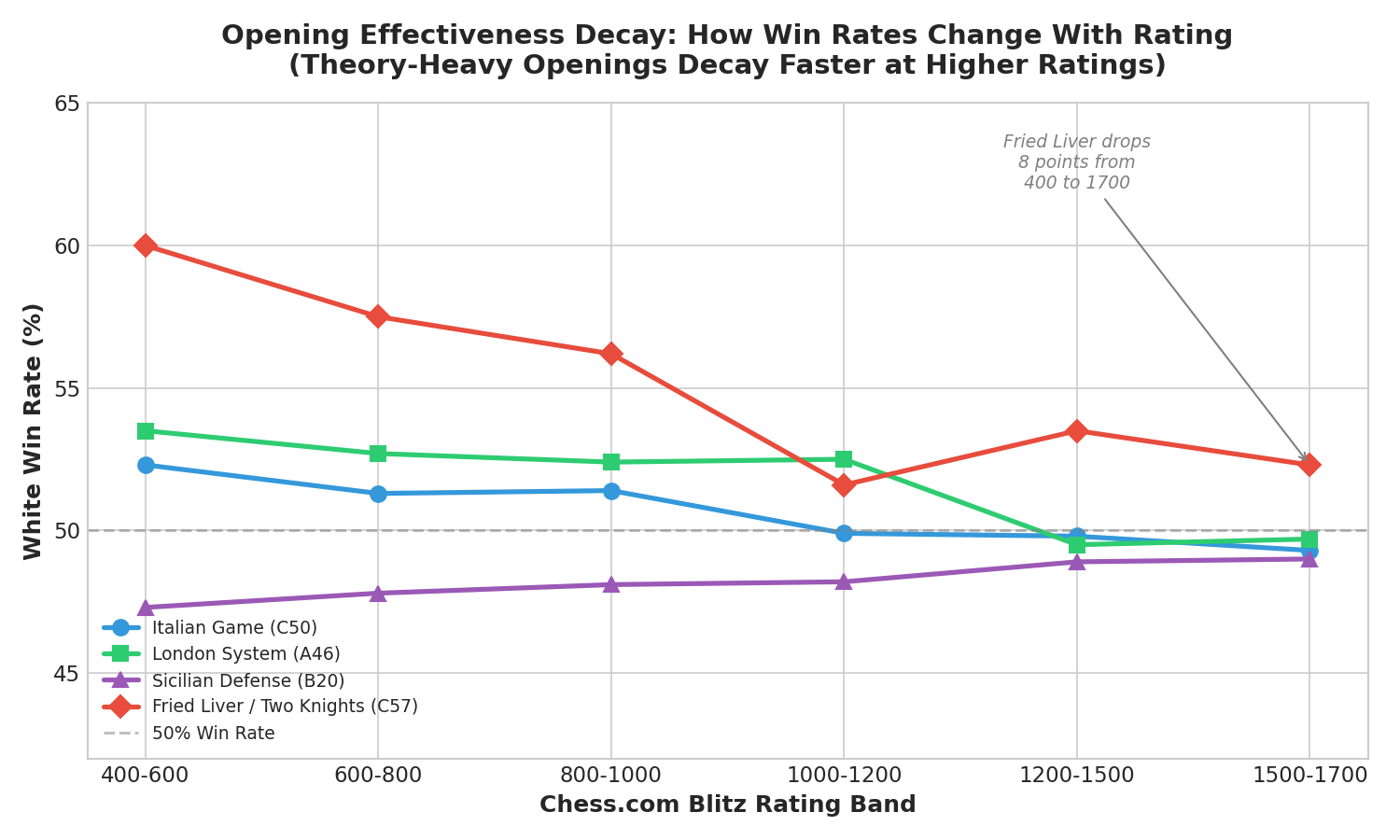
The London System maintains a remarkably stable win rate for White across all rating bands, hovering around 50-53%. Because it is a "system" opening, it doesn't require deep memorization to play passably well, and it doesn't rely on the opponent making specific mistakes.
The Stafford Gambit, however, tells a different story. It is highly effective at lower ratings, peaking at a 56.1% win rate for Black in the 1100-1300 band. But as players cross the 1300 threshold, its effectiveness plummets. Higher-rated players know the refutations, and the traps no longer work. This perfectly illustrates the danger of relying on "trick" openings: they can boost your rating temporarily, but they will eventually become a liability.
The Heatmap: Synthesizing the Data
To provide a clear answer to our initial question, we normalized several key metrics—opening blunder rate, opening CPL, first blunder timing, and opening evaluation trajectory—into a single "Theory Payoff Heatmap."
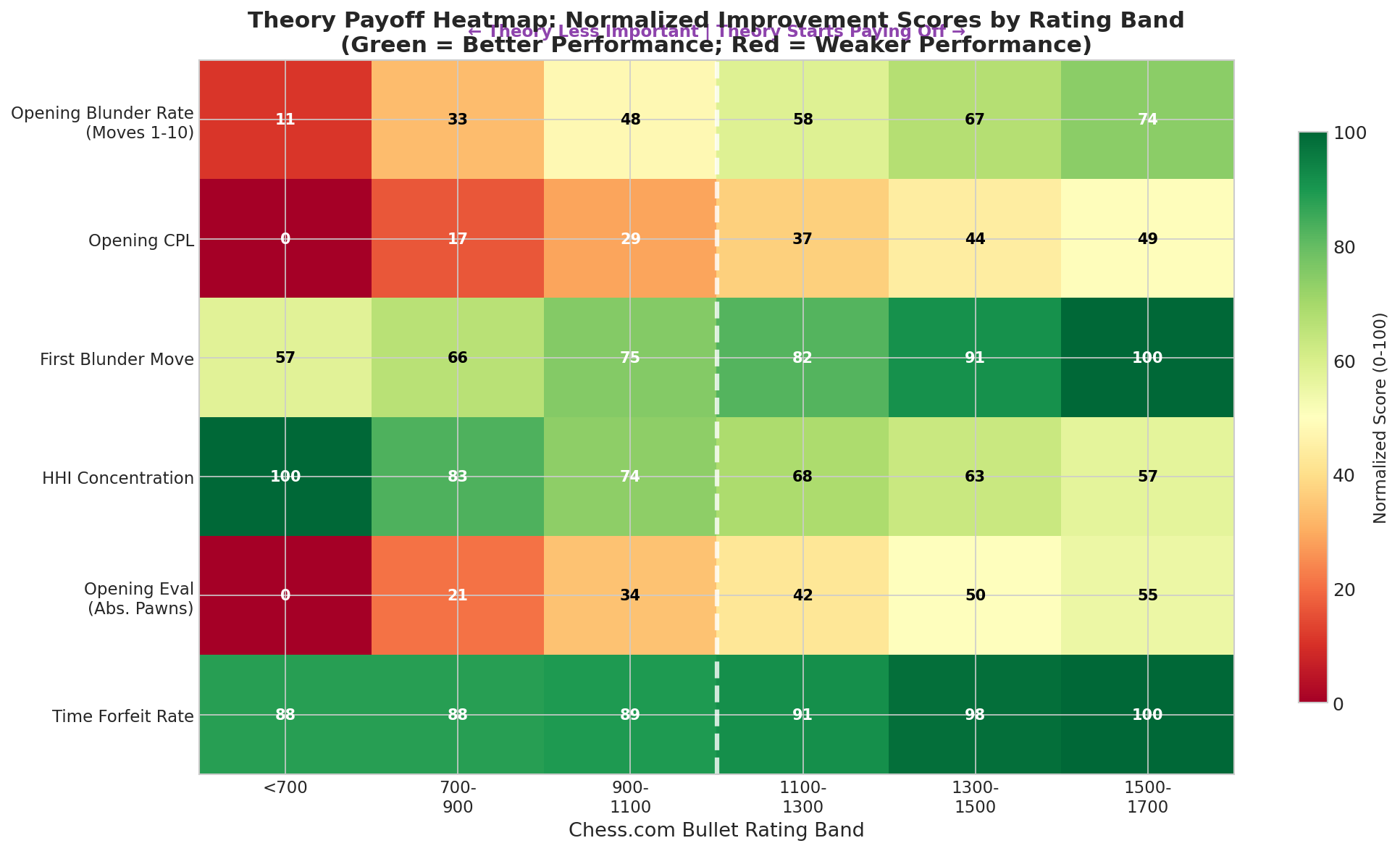
The heatmap clearly shows a dividing line around the 1100-1300 Chess.com rating band.
Below 1100, the metrics are predominantly red and orange. Players are blundering early, losing significant evaluation in the opening, and failing to reach the middlegame with a playable position. In this range, memorizing theory is largely a waste of time, as games are decided by basic tactical oversights.
Above 1300, the metrics turn green. Players are surviving the opening, maintaining balanced evaluations, and pushing the decisive mistakes deep into the middlegame. Here, a deep understanding of opening theory provides a measurable, significant advantage.
Actionable Advice by Rating Band
Based on the data, here is a roadmap for how you should approach opening study at different stages of your chess journey.
Below 900: The Tactical Foundation
At this level, the data shows that nearly 20% of games feature a massive blunder in the first 10 moves. Your opponents are not beating you with deep theory; they are beating you because pieces are being left undefended.
- Actionable Advice: Stop memorizing lines entirely. Focus 100% of your study time on basic opening principles: control the center, develop your minor pieces, and castle early. Spend your remaining time doing basic tactical puzzles to stop hanging pieces.
900-1100: The System Approach
You are starting to survive the first few moves, but the average first blunder still happens before move 20. You need a reliable way to reach a playable middlegame without burning too much clock time.
- Actionable Advice: Adopt one or two "system" openings (like the London System for White or a basic setup against 1.e4 and 1.d4 for Black). Learn the first 5-7 moves and the general plans, but do not worry about specific move-order nuances. Continue prioritizing tactics.
1100-1300: The Transition Zone
This is the critical threshold identified in our data. The opening blunder rate drops below 10%, and players begin to specialize. Trap openings like the Stafford Gambit peak in effectiveness here but will soon become liabilities.
- Actionable Advice: Begin phasing out "trick" openings and transition to solid, principled main lines. Start learning the specific ideas and common middlegame plans associated with your chosen openings. You should know what to do if your opponent deviates from the main line on move 6.
1300-1500: The Theory Payoff
The data shows that at this level, games remain balanced much longer, and the first blunder is pushed to move 25. Time management also becomes critical, with time forfeits increasing.
- Actionable Advice: This is where memorizing theory starts to yield real dividends. Knowing your openings 10-12 moves deep will save you crucial seconds on the clock and ensure you reach the middlegame with a slight edge or comfortable equality. Build a structured repertoire and study the typical pawn structures that arise from it.
1500+: The Theoretical Battlefield
At these higher rating bands, the opening evaluation trajectory is very flat, meaning players rarely lose the game in the opening. The HHI index shows high specialization.
- Actionable Advice: Deep theoretical preparation is now mandatory. You must know the main lines, the sidelines, and the specific tactical nuances of your repertoire. Study master games in your chosen openings to understand the deep strategic ideas that govern the resulting middlegames and endgames.
Conclusion
The data is clear: memorizing opening theory is not a magic bullet, nor is it entirely useless. It is a tool that becomes increasingly valuable as your foundational skills improve. If you are rated below 1100 on Chess.com, put away the opening encyclopedias and focus on not hanging your queen. But once you cross that 1100-1300 threshold, a well-prepared repertoire becomes the engine that will drive your continued improvement.
Chess Coach April 15, 2026
Data and Methodology
This analysis was conducted using a dataset of Lichess Bullet games, accessed via the Grandmaster Guide API. The raw data was aggregated and analyzed to produce the insights presented above.
The underlying CSV data files used to generate the charts in this article are available for download:
View full data →lichessRatingBand chesscomRatingBand herfindahlIndex top5CoveragePct top10CoveragePct top20CoveragePct uniqueOpenings totalGames 700-900 Below 700 0.0399 34.6 55.7 76.0 247 164236 900-1100 700-900 0.0331 30.1 51.3 70.8 290 161828 1100-1300 900-1100 0.0294 27.8 47.9 66.7 321 158895 1300-1500 1100-1300 0.0273 27.6 45.3 63.2 352 155151 1500-1800 1300-1500 0.0251 27.5 42.3 58.7 395 147088
View full data →lichessRatingBand chesscomRatingBand phase avgCpl blunderPct mistakePct inaccuracyPct sampleMoves 700-900 Below 700 opening 197.5 19.57 17.01 14.71 2513055 700-900 Below 700 middlegame 529.6 43.15 5.06 1.5 3276179 700-900 Below 700 endgame 686.5 45.89 1.54 0.66 1295246 900-1100 700-900 opening 164.9 16.15 19.03 16.77 2565446 900-1100 700-900 middlegame 461.1 40.79 6.63 2.11 3656537
View full data →lichessRatingBand chesscomRatingBand avgFirstBlunderMove gamesWithBlunderPct avgBlundersPerGame sampleGames 700-900 Below 700 17.3 75.1 17.88 139780 900-1100 700-900 19.9 75.5 18.21 139826 1100-1300 900-1100 22.6 75.4 18.23 139127 1300-1500 1100-1300 24.8 74.8 17.99 137768 1500-1800 1300-1500 27.4 74.2 18.06 133403
View full data →lichessRatingBand chesscomRatingBand phase avgEvalAbsolute 700-900 Below 700 opening 1.35 700-900 Below 700 middlegame 4.17 700-900 Below 700 endgame 6.39 900-1100 700-900 opening 1.07 900-1100 700-900 middlegame 3.43
View full data →lichessRatingBand chesscomRatingBand variant avgPlateauMonths pctPlayersPlateauing samplePlayers 700-900 Below 700 blitz 4.2 12.5 9017 900-1100 700-900 blitz 4.2 12.5 13864 1100-1300 900-1100 blitz 4.3 11.4 15349 1300-1500 1100-1300 blitz 4.4 11.1 14538 1500-1800 1300-1500 blitz 4.8 9.5 16189
View full data →fromLichessRating toLichessRating variant avgMonths medianMonths samplePlayers 800 1000 blitz 7 4 11329 1000 1200 blitz 8.5 5 12840 1200 1500 blitz 11.6 7 11529 1500 1800 blitz 12.6 7 8771 1800 2000 blitz 14.4 10 4112
View full data →lichessRatingBand chesscomRatingBand avgCpl blunderRatePerGame mistakeRatePerGame inaccuracyRatePerGame sampleGames 700-900 Below 700 180.7 17.88 4.39 3.05 139780 900-1100 700-900 175.8 18.21 5.42 3.71 139826 1100-1300 900-1100 169.3 18.23 6.38 4.28 139127 1300-1500 1100-1300 162.8 17.99 7.16 4.67 137768 1500-1800 1300-1500 158.2 18.06 8.12 5.22 133403
View full data →lichessRatingBand chesscomRatingBand whiteWinRate drawRate blackWinRate totalGames 700-900 Below 700 53.5 4.0 42.4 3677 900-1100 700-900 52.7 3.5 43.8 4330 1100-1300 900-1100 52.4 3.2 44.2 4630 1300-1500 1100-1300 52.5 3.1 44.4 4560 1500-1800 1300-1500 49.5 3.7 46.5 3776
View full data →lichessRatingBand chesscomRatingBand whiteWinRate drawRate blackWinRate totalGames 700-900 Below 700 54.1 2.9 42.4 205 900-1100 700-900 47.8 1.3 50.9 228 1100-1300 900-1100 45.0 2.4 52.2 291 1300-1500 1100-1300 41.1 2.8 56.1 321 1500-1800 1300-1500 41.9 4.0 53.7 227
View full data →lichessRatingBand chesscomRatingBand blackBlunderInOpening whiteBlunderInOpening avgBlunderInOpening 700-900 Below 700 21.9 17.1 19.5 900-1100 700-900 16.6 12.7 14.7 1100-1300 900-1100 13.0 9.8 11.4 1300-1500 1100-1300 10.4 7.9 9.2 1500-1800 1300-1500 8.2 6.2 7.2
View full data →lichessRatingBand chesscomRatingBand normalPct timeForfeitPct 700-900 Below 700 69.6 29.9 900-1100 700-900 69.7 29.9 1100-1300 900-1100 69.3 30.3 1300-1500 1100-1300 68.5 31.1 1500-1800 1300-1500 66.1 33.4