One of the most debated topics among improving chess players is the question of resignation. Some players adhere strictly to the "never resign" philosophy, hoping for a blunder or a stalemate, while others throw in the towel the moment they drop a piece, believing that playing on is a waste of time. But who is actually right?
To settle this debate, we analyzed a dataset of 6,900 Rapid games played on Lichess, mapped to their Chess.com equivalents across five rating bands (from 600 to 1600). By evaluating the engine score at every ply and tracking the final outcomes, we can finally answer: At what engine evaluation threshold does the comeback probability drop below 5%? How often do players resign prematurely? And does the "never resign" philosophy actually yield a statistically significant number of saved points?
This guide serves as a roadmap for improvement, providing data-backed, actionable advice for each rating segment to help you climb the ranks.
The Anatomy of a Rapid Game
Before diving into resignation thresholds, it is helpful to understand how games actually end at different rating levels. As players improve, the frequency of checkmates and time forfeits decreases, while the rate of resignations rises dramatically.
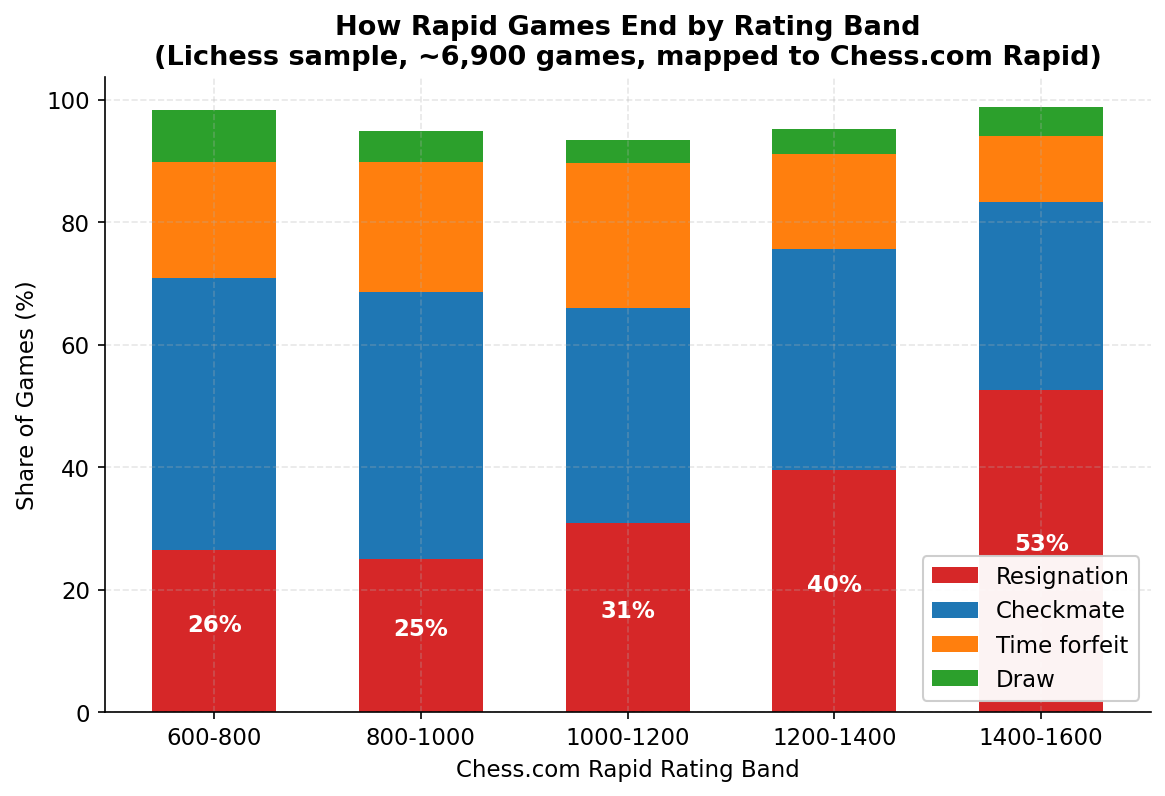
At the 600-800 level, only 26% of games end in resignation, with the vast majority concluding via checkmate (44%) or time forfeit (19%). By the time players reach the 1400-1600 bracket, resignation becomes the dominant outcome, accounting for 53% of all game terminations. This shift reflects a growing respect for the opponent's ability to convert an advantage, but as the data will show, this respect is sometimes misplaced.
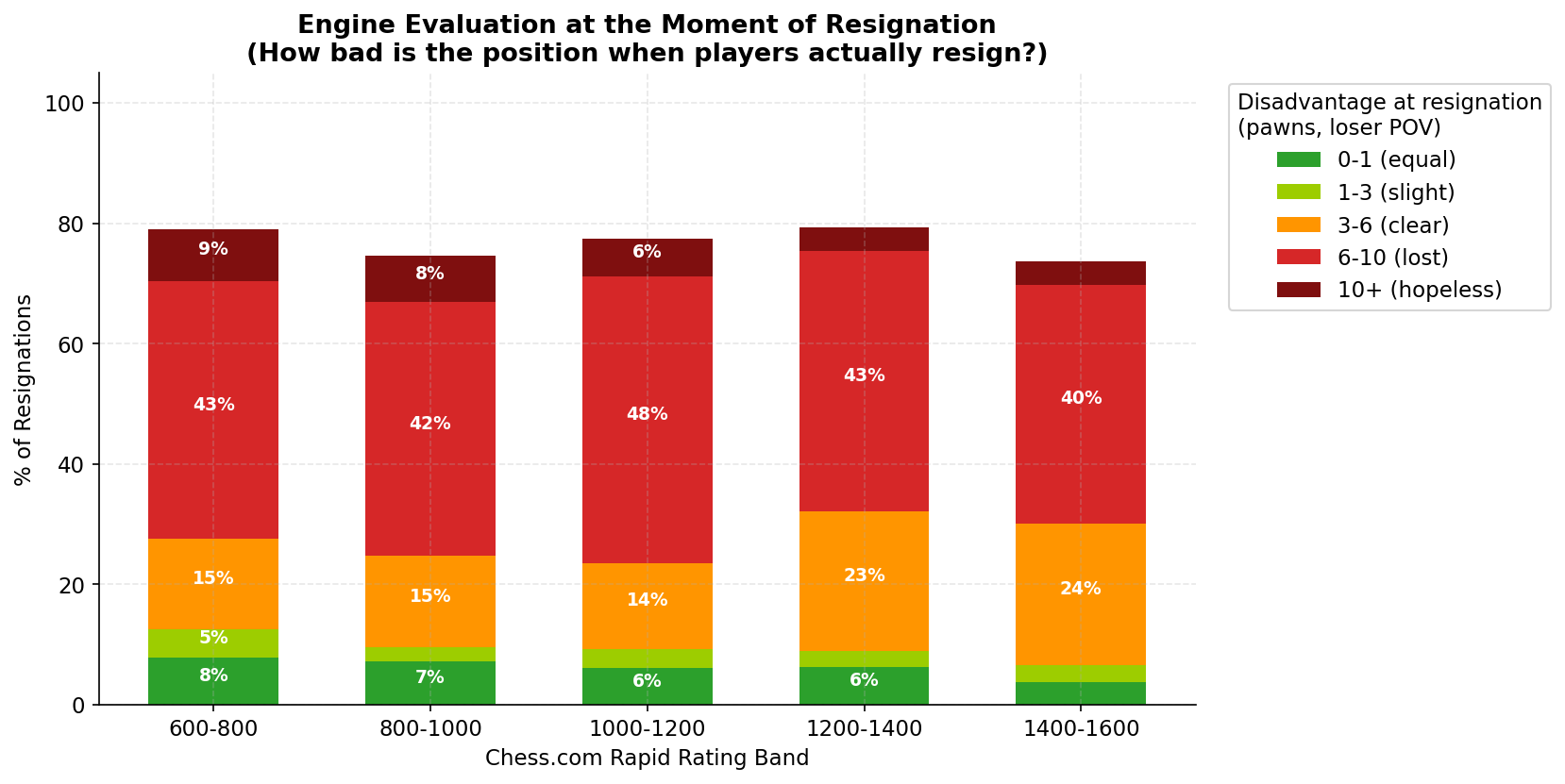
When players do resign, how bad is their position? The data reveals that across all rating bands, the vast majority of resignations occur in objectively lost positions (engine evaluation of -3 pawns or worse). However, a notable percentage of players resign prematurely.
The "Never Resign" Audit: Comeback Probabilities
The core of the resignation debate lies in the probability of a comeback. If you are down a full piece (roughly -3 pawns), what are your actual chances of saving the game (either drawing or winning)?
We tracked the peak disadvantage faced by the eventual winner or drawing player in our dataset. The results demonstrate a clear relationship between rating and the ability to convert an advantage.
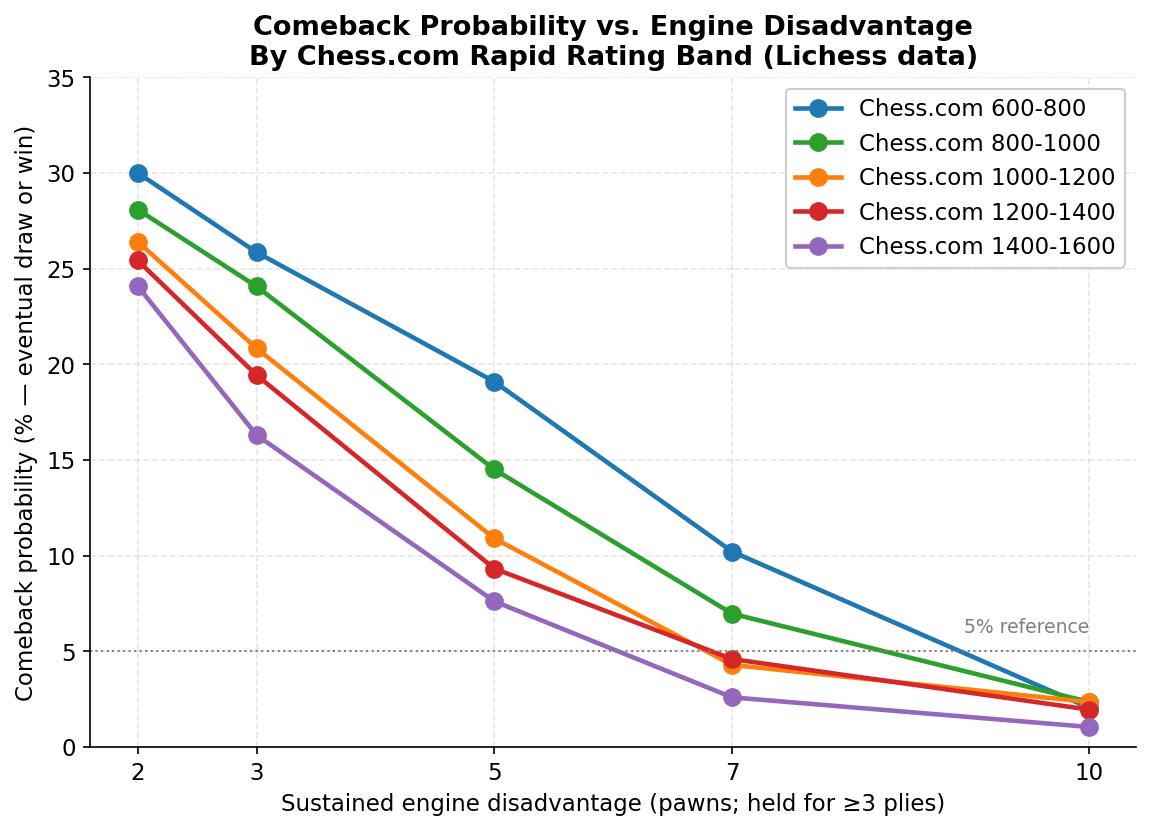
For a player in the 600-800 band, being down 5 pawns (e.g., a full rook) still leaves a staggering 19.1% chance of a comeback. Even at a 7-pawn disadvantage, these players save the game 10.2% of the time. Contrast this with the 1400-1600 band, where a 5-pawn disadvantage reduces comeback chances to just 7.6%, and a 7-pawn deficit leaves only a 2.6% chance of survival.
Converting the Advantage
To further illustrate this point, we examined how often players successfully convert a sustained advantage (held for at least 3 plies) after move 20.
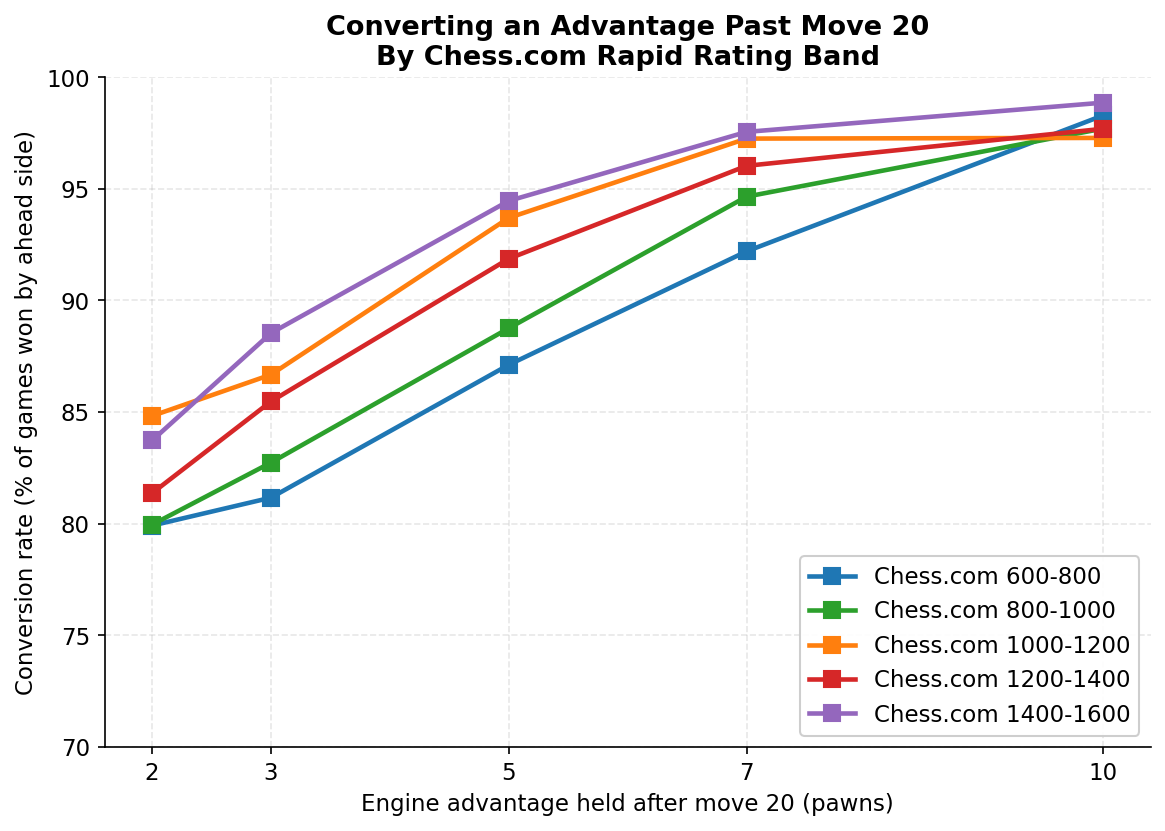
The data confirms that higher-rated players are significantly more ruthless in the endgame. A 5-pawn advantage after move 20 is converted into a win 94.5% of the time by 1400-1600 players, compared to just 87.1% by 600-800 players.
Premature Resignations: Throwing Away Points
A "premature resignation" is defined as resigning when the engine evaluation is better than -3 pawns (i.e., the position is equal, slightly worse, or even winning). How often do players throw away perfectly playable games?
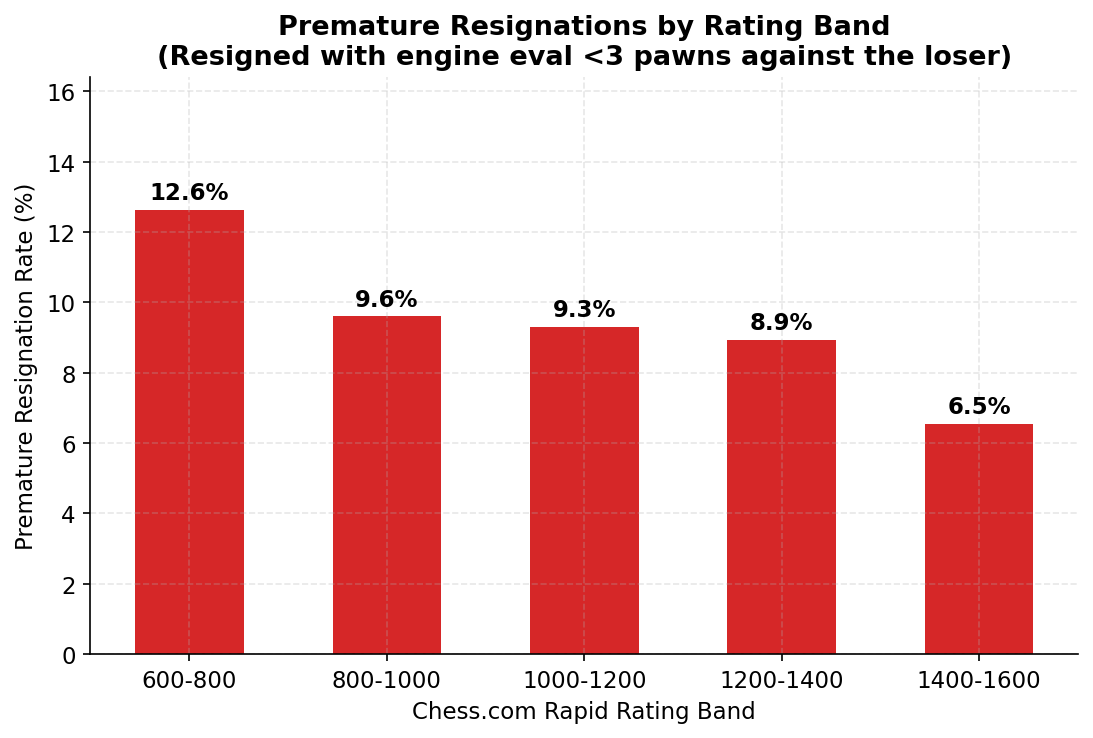
The premature resignation rate is highest among beginners, with 12.6% of resignations in the 600-800 band occurring in positions that are far from lost. This rate steadily declines as ratings increase, dropping to 6.5% in the 1400-1600 band.
When we compare the premature resignation rate to the actual comeback probability when down 5 or more pawns, a fascinating picture emerges.
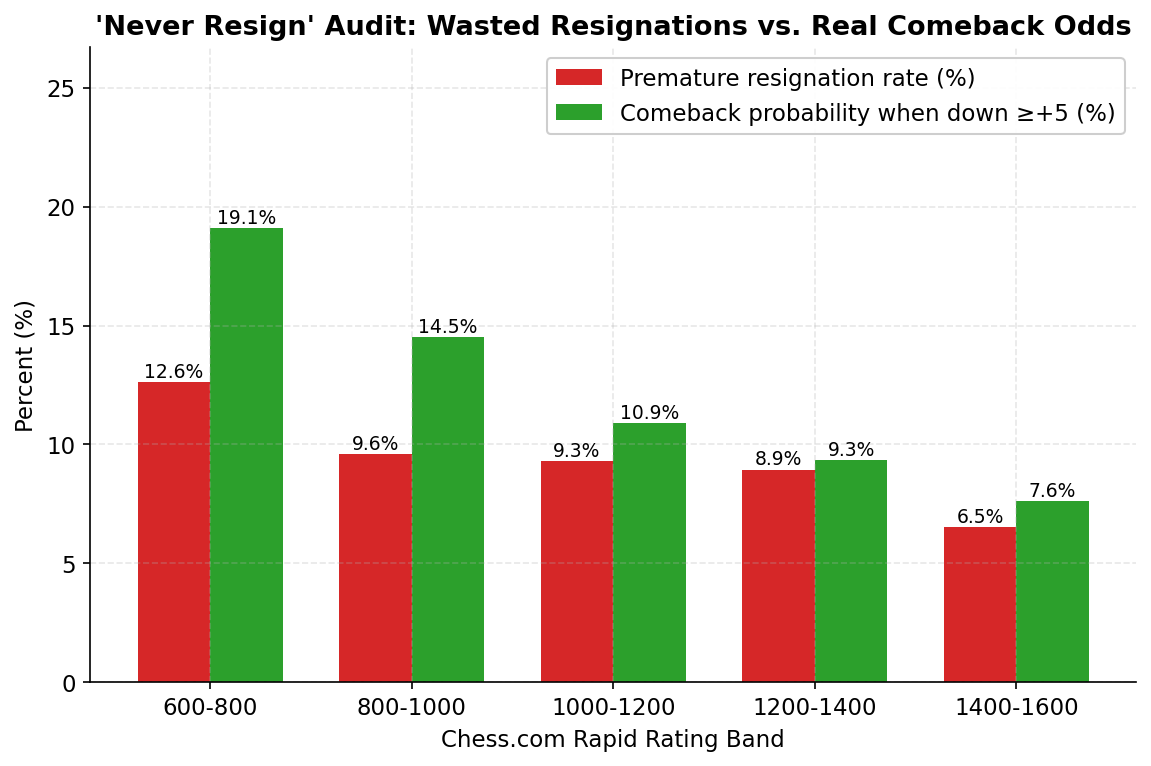
In the lower rating bands, players are not only resigning prematurely more often, but they are also facing opponents who are highly likely to blunder away massive advantages. The "never resign" philosophy is mathematically sound advice for players below 1000.
Visual Evidence: The Good, the Bad, and the Blunders
To ground these statistics in reality, let's examine three actual positions from our dataset that highlight the pitfalls of premature resignation and the reality of massive blunders.
1. The Premature Resignation (1000-1200 Band)
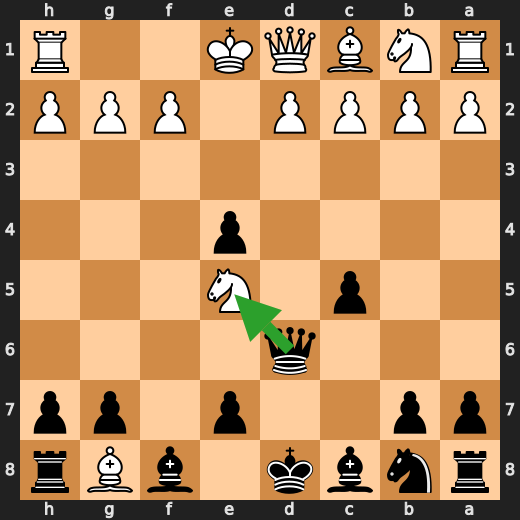
In this position, White has just played Bxg8, capturing Black's rook. Believing the material loss to be fatal, Black resigned. However, the engine evaluates this position at only -0.74 from Black's perspective. The green arrow indicates the engine's recommended move, Qxe5, which forks the white knight and creates immediate counterplay. Black threw away a perfectly viable game.
2. The Successful Comeback (800-1000 Band)
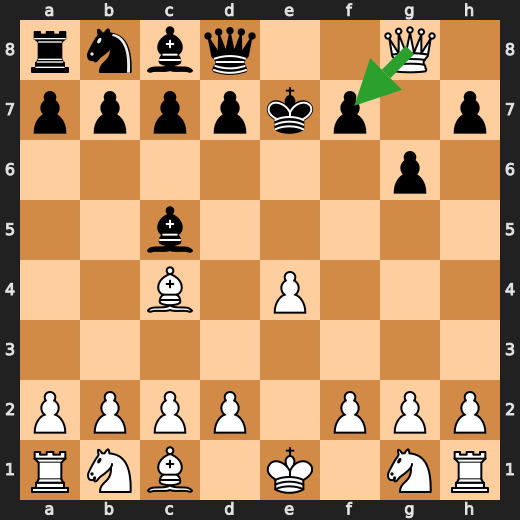
Here, White has just played Qxg8, winning a rook and preparing a devastating attack. The engine evaluates the position at +13.8 for White, with the best continuation being Qxf7+ (green arrow). Despite this overwhelming disadvantage, Black played on and eventually won the game. This is a stark reminder that at lower ratings, no advantage is safe until checkmate is delivered.
3. The Decisive Blunder (1200-1400 Band)
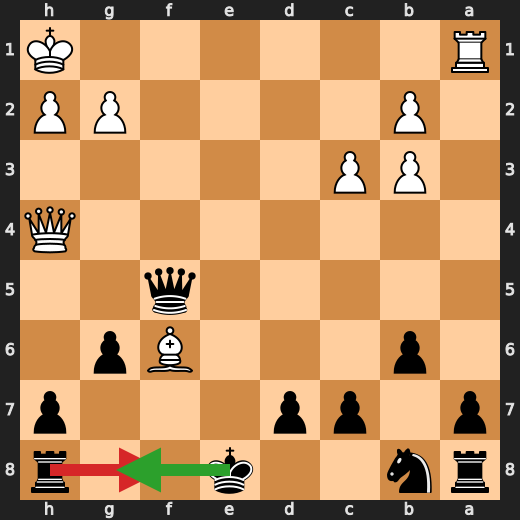
Black is completely winning here, with an evaluation of -6.3. The simple and safe move is to castle (O-O, green arrow). Instead, Black played Rf8 (red arrow), a catastrophic blunder that swung the evaluation by 14.4 pawns, instantly handing White a +8.1 advantage and the win. Even intermediate players are capable of game-losing blunders in winning positions.
Actionable Advice by Rating Band
Based on the data, we can establish clear, mathematically sound resignation thresholds for each rating band. We define the "Resignation Threshold" as the point at which the comeback probability drops below 5%.
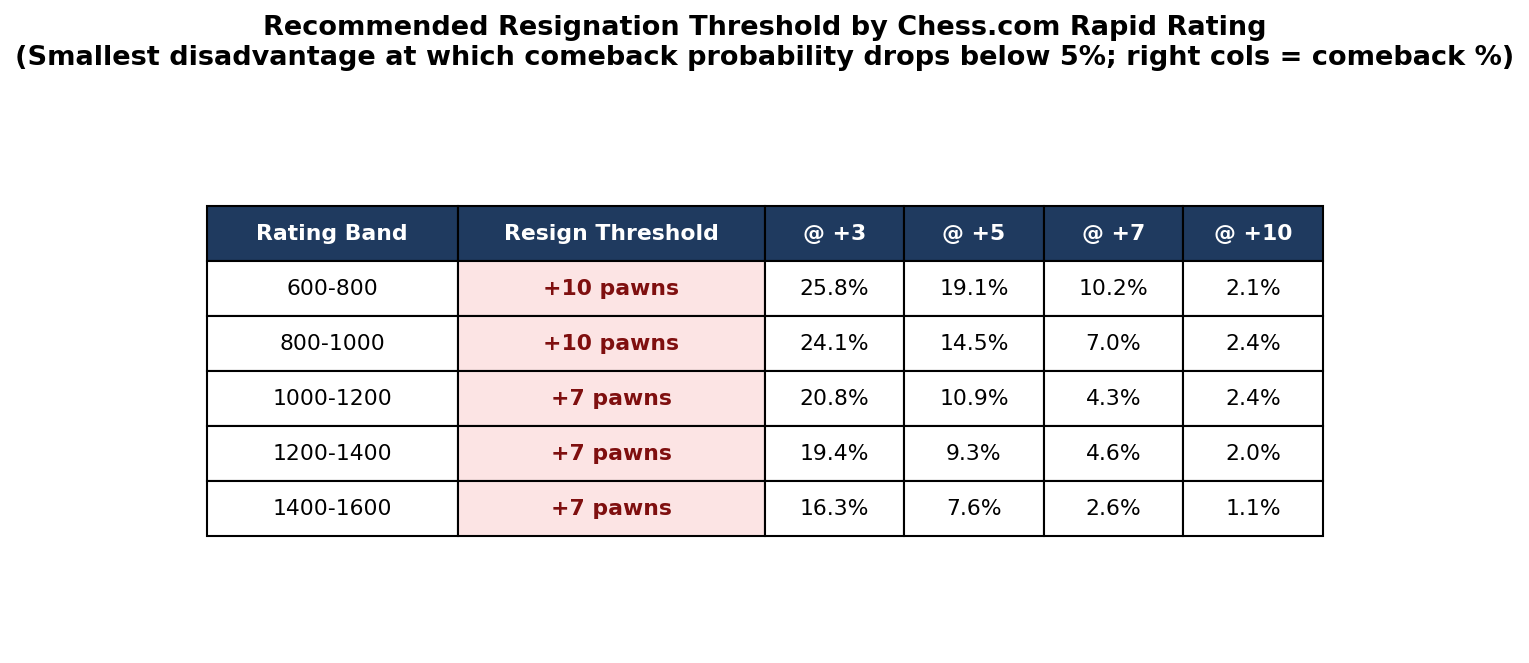
Chess.com 600-1000 (Lichess 700-1100)
- The Data: Comeback probabilities remain above 7% even when down 7 pawns. Premature resignation rates are high (10-13%).
- Actionable Advice: Never resign. Your opponents lack the technique to consistently convert advantages and are highly prone to massive blunders. Play on, create complications, and wait for them to hang a piece or stalemate you. Only consider resigning if you are down a full Queen (10+ pawns) and the opponent is clearly simplifying into a trivial endgame.
Chess.com 1000-1400 (Lichess 1100-1500)
- The Data: Comeback probabilities drop below 5% when down 7 pawns. Conversion rates after move 20 improve significantly.
- Actionable Advice: Resign at -7 pawns. If you lose a full piece early, play on—your comeback chances are still around 10-20%. However, if you find yourself down a full Rook and a couple of pawns (-7) with no clear counterplay, it is time to resign. Your opponents are now competent enough to convert these massive advantages reliably.
Chess.com 1400-1600 (Lichess 1500-1800)
- The Data: Comeback probabilities drop to 2.6% when down 7 pawns, and conversion rates for a 5-pawn advantage exceed 94%.
- Actionable Advice: Resign at -5 to -7 pawns. Respect your opponent's technique. If you blunder a full piece (-3) without compensation, your chances of saving the game are only 16%. If you drop a Rook (-5) in a quiet position, the game is effectively over. Focus your energy on the next game rather than dragging out a lost cause.
Data and Methodology
This analysis was conducted using a sample of 6,900 Rapid games sourced from the Lichess database via the Grandmaster Guide API. The games were categorized into five Lichess rating bands (700-900, 900-1100, 1100-1300, 1300-1500, 1500-1800) and mapped to their approximate Chess.com Rapid equivalents.
Engine evaluations were extracted for every ply using Stockfish 12 at depth 18. A "comeback" was defined as a game where a player faced a sustained disadvantage (held for at least 3 plies) but eventually secured a draw or a win.
The underlying CSV data files generated during this research are attached for further review:
summary_by_band.csv: Overall termination and premature resignation statistics.comeback_probability.csv: Comeback rates at various evaluation thresholds.advantage_conversion_after_move20.csv: Conversion rates for advantages held in the endgame.resignation_eval_distribution.csv: Distribution of engine evaluations at the exact moment of resignation.
Chess Coach April 17, 2026