Every chess player has heard the old adage: "No one ever won a game by resigning." But in the heat of a Bullet game, when you blunder a piece and the engine evaluation plummets, the urge to click the resign button is overwhelming. Is fighting on a waste of time, or are you throwing away free rating points?
To answer this, we analyzed nearly 12,000 Lichess Bullet games (120 seconds or less) played by users with ratings corresponding to Chess.com 800–1600. By tracking the engine evaluation at every ply and cross-referencing it with the final game result, we can definitively answer: At what point is a Bullet game actually lost?
The data reveals a startling truth: the clock is the ultimate equalizer, and most players resign far too early.
The Bullet Reality: The Clock is King
Before looking at engine evaluations, we must understand how Bullet games actually end. In classical or rapid chess, checkmate and resignation are the dominant outcomes. In Bullet, the landscape is entirely different.
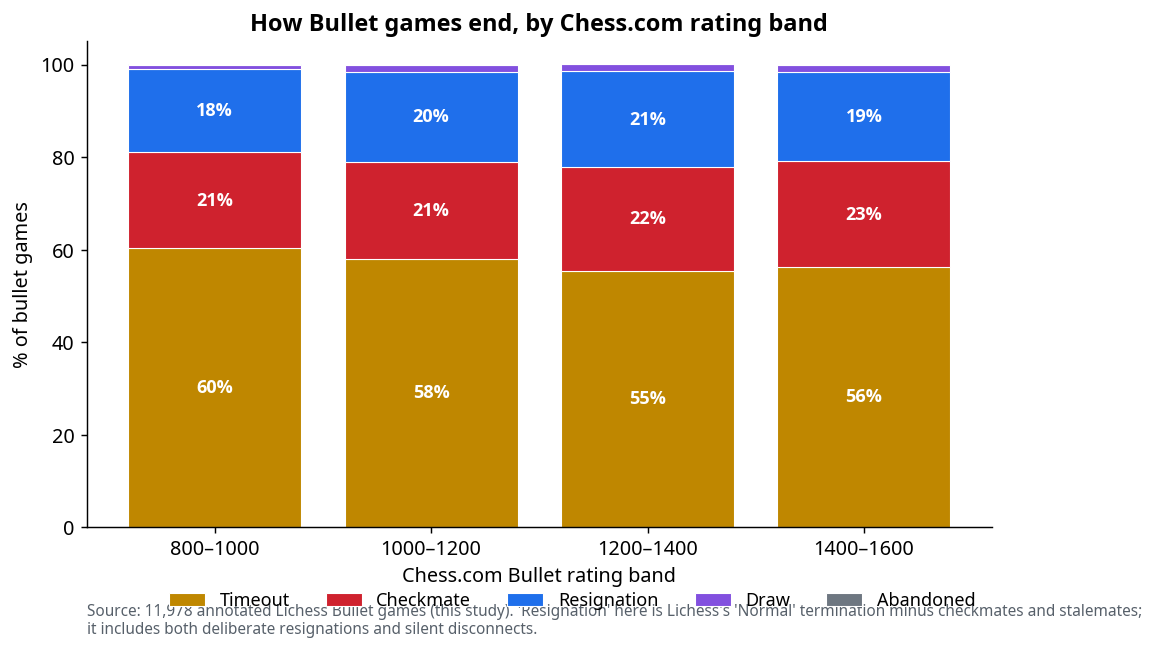
Across all rating bands from 800 to 1600, 55% to 60% of all games end in a time forfeit. Checkmates account for only ~21%, and true resignations hover around 19%.
This fundamental reality changes the math of resignation. When you blunder a piece, you are not just playing against the position on the board; you are playing against the opponent's clock. If your opponent has 15 seconds left, a -5 engine evaluation is often meaningless.
The Anatomy of a Resignation
When players do resign, how bad is their position? We isolated all "true resignations" (games that ended decisively by resignation, filtering out disconnects and lag-outs where the player was actually winning or equal).
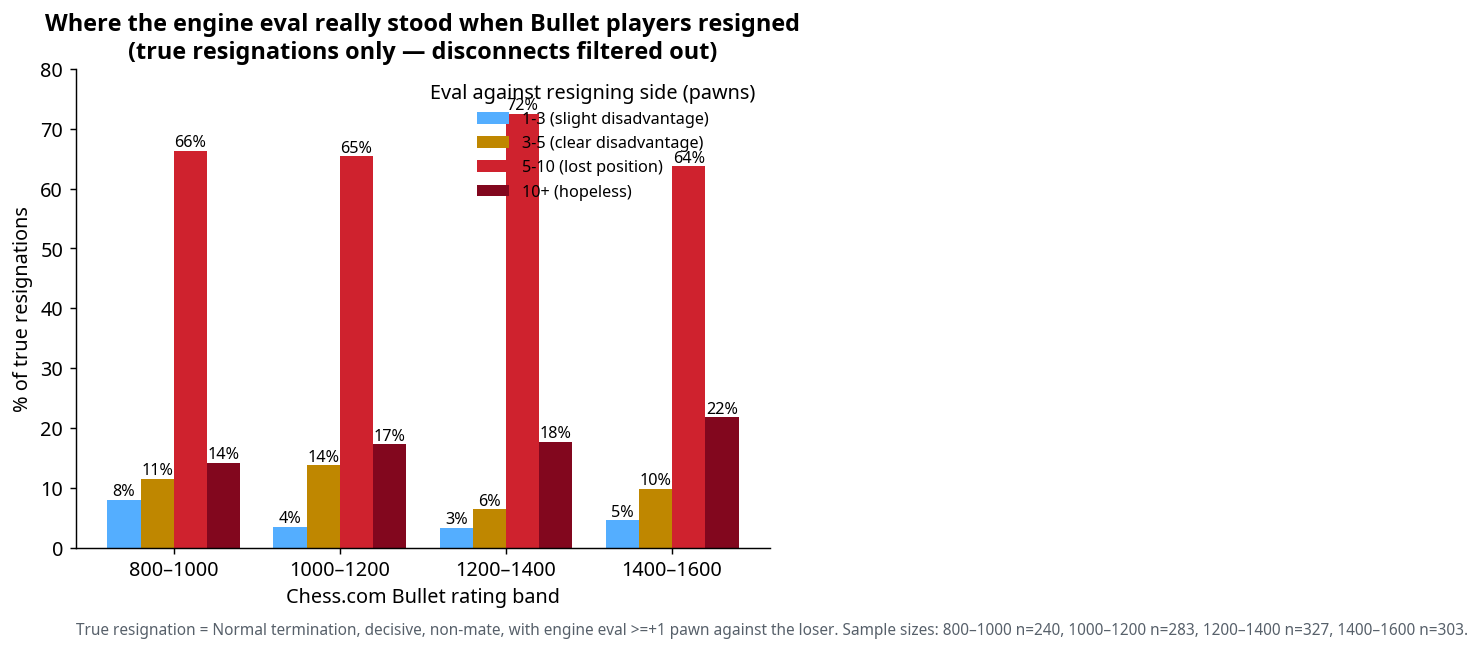
The data shows that players are generally rational about when they resign, but perhaps too pessimistic:
- Only 13–15% of resignations happen in roughly equal positions (eval within ±1 pawn).
- The vast majority of resignations occur when the player is down 5 to 10 pawns (a "lost position") or 10+ pawns (a "hopeless position").
However, the critical question is not whether the position is lost on the board, but whether it is lost in practice. To answer that, we looked at the engine's win probability for the resigning side at the exact moment they clicked the button.
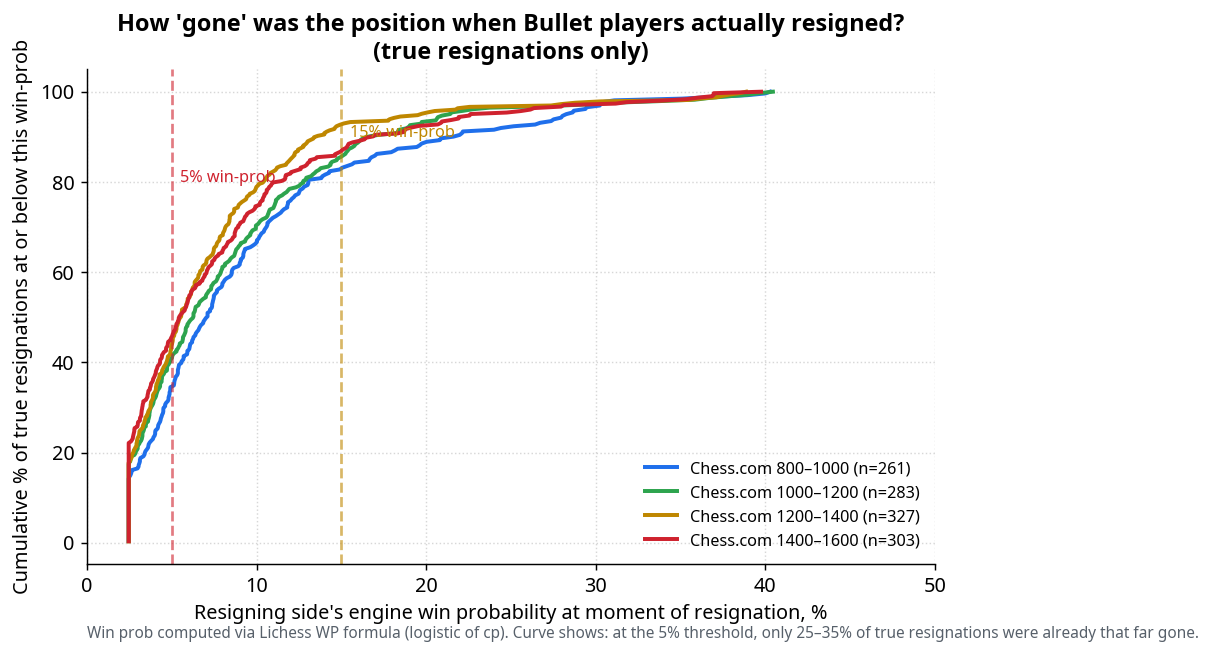
The chart above shows the cumulative distribution of the resigning player's engine win probability. A vertical line is drawn at the 5% win probability threshold. Surprisingly, only 25% to 35% of true resignations occur when the engine win probability has dropped below 5%. This means that in 65% to 75% of resignations, the engine still gives the resigning player a >5% chance of saving the game (often much higher, due to the clock).
Visual Evidence: The Panic Resignation
Consider this real game from the Chess.com 800–1000 equivalent band. White has a completely winning position (+5.28) and is up a full Queen.
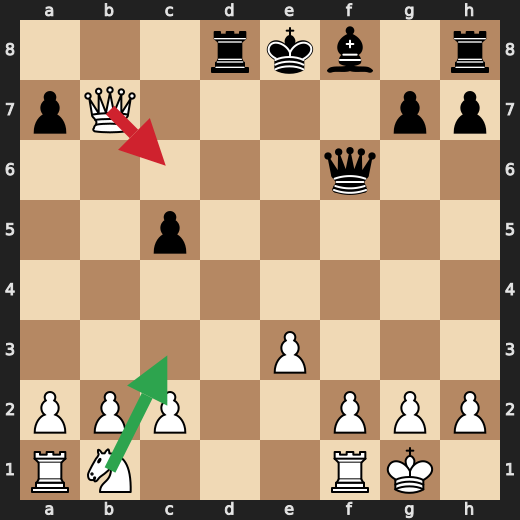
White plays the blunder 15. Qc6+ (red arrow), walking into a discovered attack where Black simply captures the Queen with 15... Qxc6. The engine evaluation swings to -5.95. White immediately resigns.
While White just suffered a devastating psychological blow, the position is still a complex Bullet scramble. The engine recommends 15. Nc3 (green arrow) to consolidate the massive advantage. By resigning immediately after the blunder, White threw away a game that was still highly contested on the clock.
The Comeback Matrix: When is it Truly Over?
To quantify the value of playing on, we measured the "comeback rate" (the probability of the disadvantaged side securing a win or a draw) from various engine evaluation buckets at move 25.
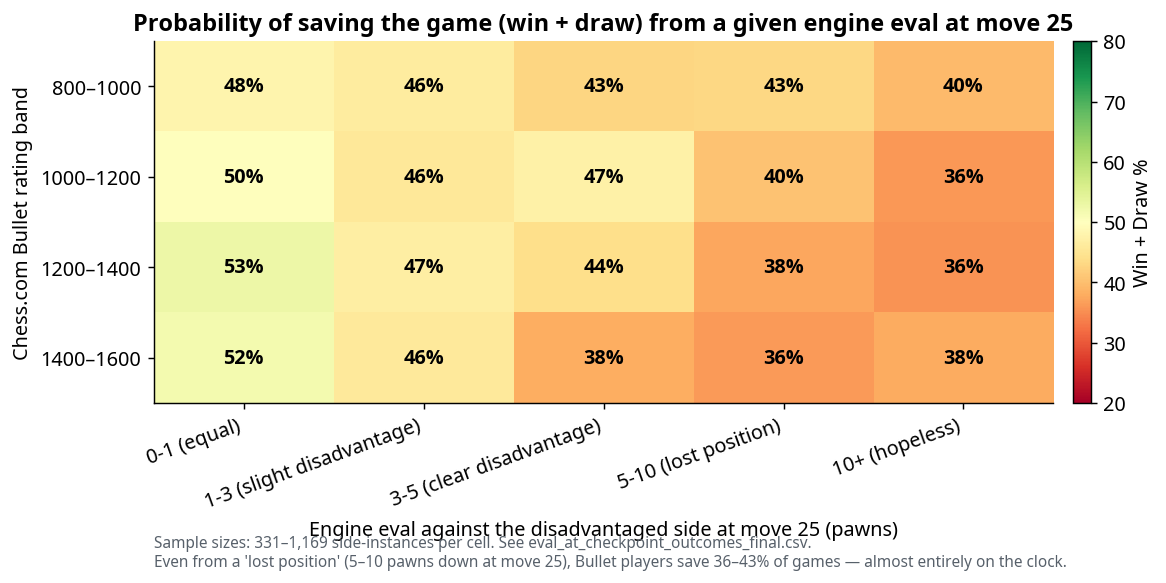
The heatmap reveals the staggering resilience of Bullet players:
- From a "Clear Disadvantage" (3–5 pawns down): Players save the game 38% to 47% of the time.
- From a "Lost Position" (5–10 pawns down): Players save the game 36% to 43% of the time.
- From a "Hopeless Position" (10+ pawns down): Players still save the game 36% to 40% of the time.
Notice how the comeback rate barely drops as the evaluation worsens from -5 to -10 to -15. Why? Because at these extremes, the board position no longer matters. The game is entirely decided by who flags first.
Does it get harder to come back as the game goes on?
You might assume that a -5 deficit at move 15 is easier to overcome than a -5 deficit at move 30, because there is less time to complicate the position. The data shows the exact opposite.
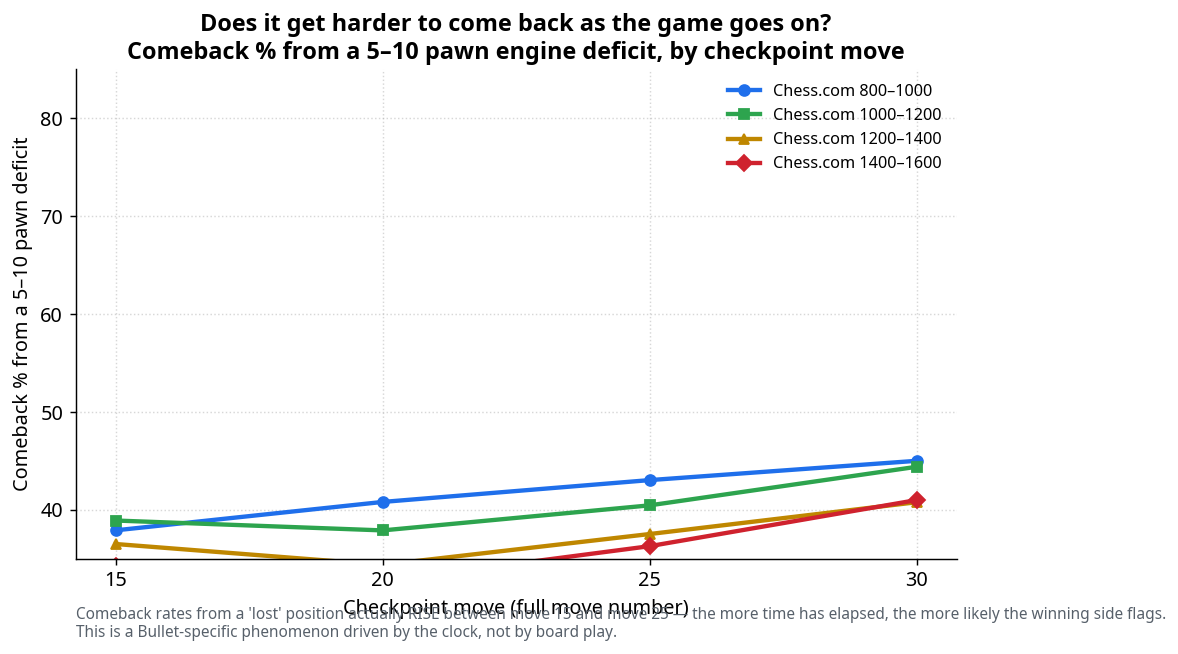
The comeback rate from a 5–10 pawn deficit actually rises or remains flat as the game progresses from move 15 to move 30. As the game goes deeper, both players' clocks dwindle. A blunder on move 30 leaves the opponent with very little time to convert their newly acquired advantage.
The Bottom Line: Who Actually Wins?
The most compelling argument against resigning in Bullet is found by looking at what happens when the engine declares a position completely winning (+5 or more) at move 25.
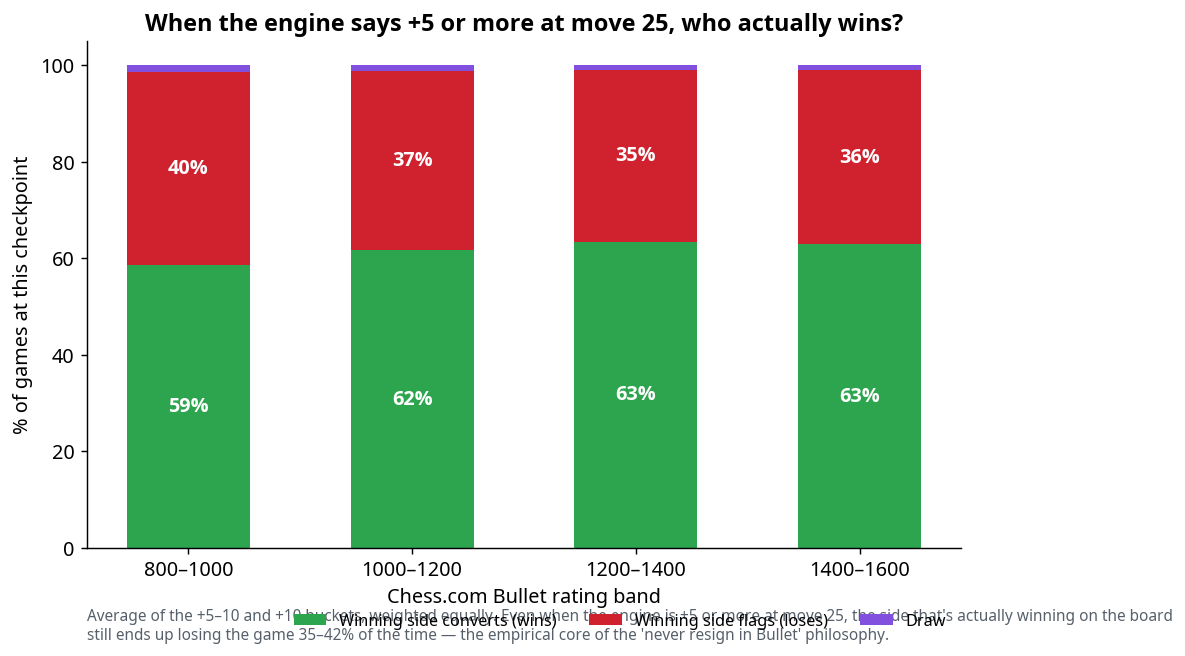
At every rating band from 800 to 1600, when a player achieves a +5 or greater advantage at move 25, they still lose the game 35% to 42% of the time.
Let that sink in. If you are down a full Rook (or worse) at move 25, you still have roughly a 40% chance of winning the game outright, almost entirely because your opponent will run out of time trying to checkmate you.
Actionable Advice by Rating Band
For Chess.com 800–1200:
- Never resign. At this level, 60% of games end in a time forfeit, and the conversion rate of winning positions is the lowest. Even if you are down a Queen, play fast, make random legal moves, and watch your opponent flag.
- Focus on speed over accuracy. When down material, your only goal is to drain the opponent's clock.
For Chess.com 1200–1600:
- Resign only if the opponent has >20 seconds. At this level, players can convert a +10 advantage if they have sufficient time. However, if their clock is under 15-20 seconds, the 35%+ comeback rate still applies.
- Complicate, don't trade. If you blunder, immediately seek to open lines and create tactical chaos. The harder the position is to evaluate, the more time your opponent will burn.
Data and Methodology
This analysis is based on 11,978 Lichess Bullet games (≤120s base time) featuring Stockfish 12+ evaluations at every ply.
Platform Calibration: Because the raw data was sourced from Lichess, we mapped Lichess Bullet ratings to approximate Chess.com Bullet ratings using established community conversion tables [1]. For example, the Lichess 1100–1300 band was mapped to the Chess.com 800–1000 band.
Evaluation Convention: Engine evaluations were standardized to White's perspective. "True resignations" were defined as games ending in "Normal" termination (decisive, non-mate) where the engine evaluation after the loser's final move was at least +1.0 pawn against them. This filtered out disconnects and lag-outs that Lichess also categorizes as "Normal" terminations.
Data Files: The underlying aggregated data used to generate these charts is available in the attached CSV files:
termination_breakdown_final.csvresignation_eval_distribution_final.csvpremature_resignation_summary_final.csveval_at_checkpoint_outcomes_final.csvnotable_examples_final.csv
Chess Coach
April 20, 2026
References
[1] Chess Rating Comparison, ChessGoals. https://chessgoals.com/rating-comparison/