"Never resign!" is one of the most common pieces of advice given to improving chess players. The logic is simple: at lower ratings, opponents will inevitably blunder, stalemate, or flag, turning completely lost positions into draws or even wins. But as you climb the rating ladder, holding onto hopeless positions can feel like a waste of time and energy.
At what point does "never resign" stop being good advice? When does a position truly become hopeless? And how many rating points are you actually leaving on the table by resigning prematurely?
To answer these questions, we analyzed over 10,000 Lichess blitz games across four rating bands, mapped to their Chess.com equivalents (800–1500). By examining engine evaluations at the moment of resignation and tracking the comeback rates of players in lost positions, we can finally provide a data-backed roadmap for when to throw in the towel—and when to fight on.
The "Hope Line": When Is a Game Truly Lost?
The most critical question for any player considering resignation is: What are my actual chances of saving this game?
To find out, we tracked the expected points scored (where a win is 1 point and a draw is 0.5 points) from various engine evaluation buckets between moves 10 and 55. The results show a clear correlation between rating and the ability to convert an advantage.
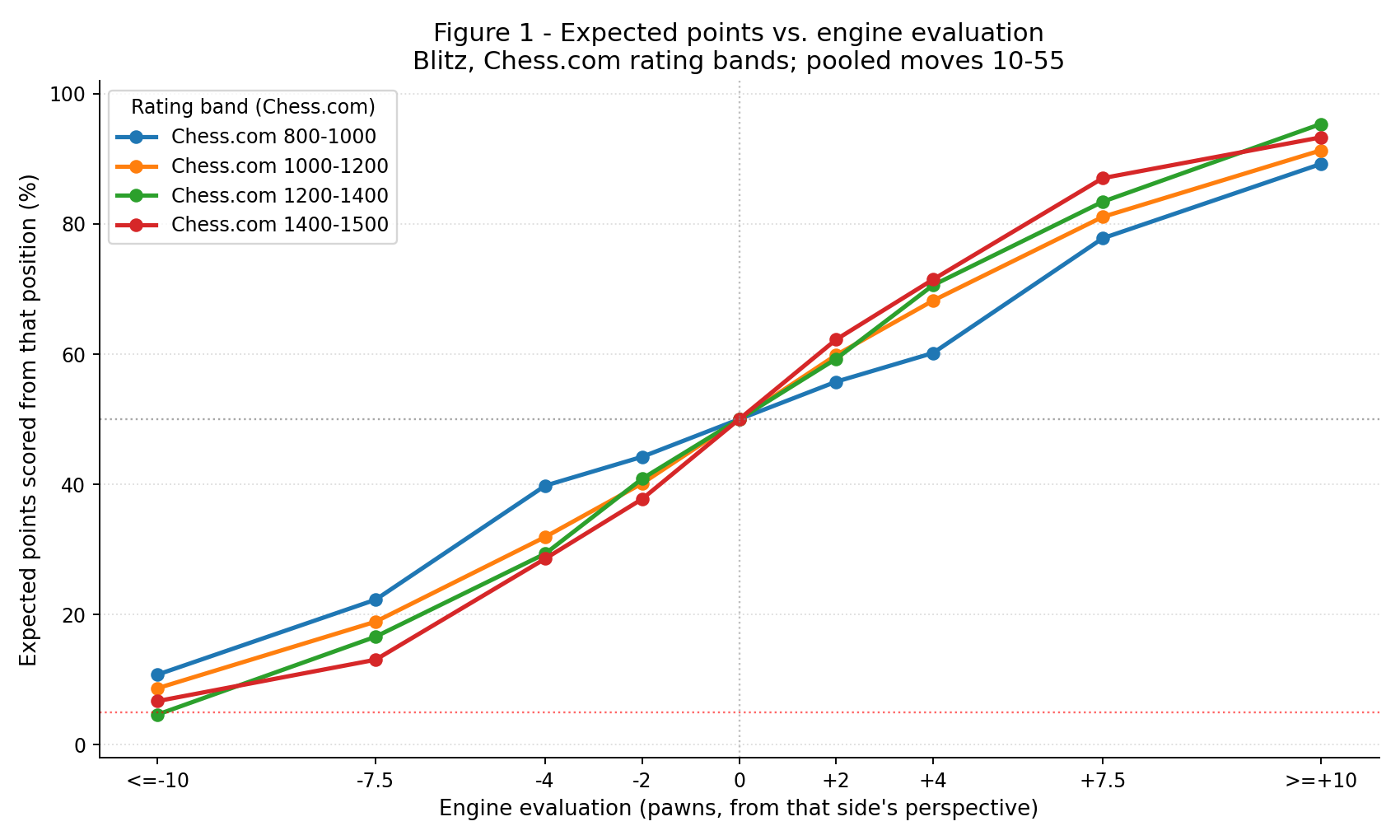
At the Chess.com 800–1000 level, an engine evaluation of -4 (roughly equivalent to being down a full piece) still yields a save rate of nearly 30%. Even at -7.5 (down a piece and two pawns, or a full rook), players in this band manage to scrape together points in over 20% of games.
However, as ratings increase, the "Hope Line"—the evaluation threshold where your chances of saving the game drop below a certain percentage—shifts dramatically.
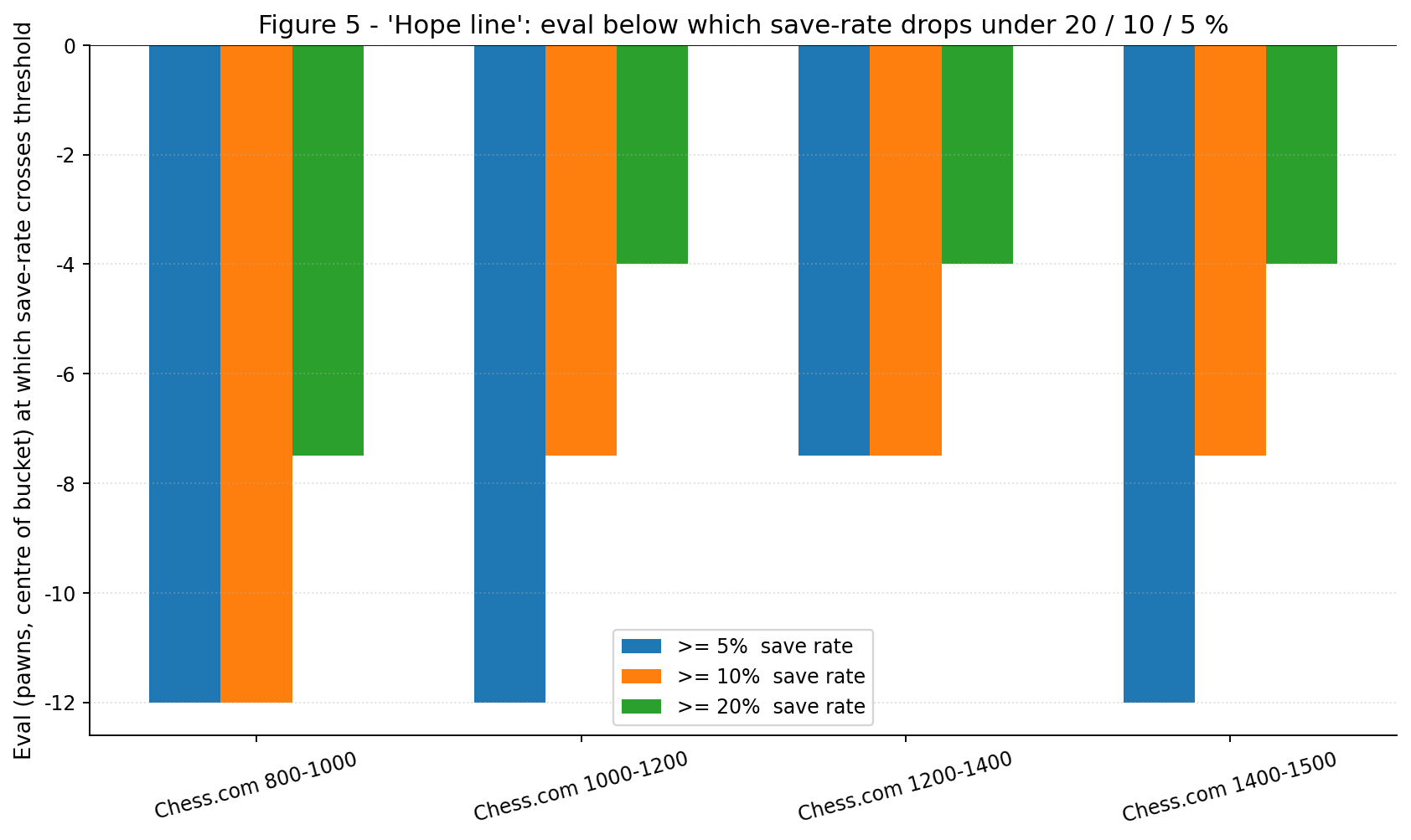
If we define a "hopeless" position as one where your expected score drops below 5%, the data reveals exactly when you should consider resigning:
- Chess.com 800–1000: You must be down at least -12 pawns (e.g., a queen and two pawns) before your save rate drops below 5%.
- Chess.com 1000–1200: The 5% threshold remains at -12 pawns, but your chances of saving a -7.5 position drop to just 10%.
- Chess.com 1200–1400: The 5% threshold tightens to -7.5 pawns. If you are down a full rook, the game is statistically over.
- Chess.com 1400–1500: The 5% threshold drops back to -12 pawns, likely due to the increased prevalence of time scrambles and flagging in higher-rated blitz games, where complex but objectively lost positions can still be swindled.
Actionable Advice: If you are rated under 1200 on Chess.com, do not resign unless you are down a full queen or more. If you are rated 1200–1500, you can safely resign when down a full rook (-5 to -7.5), provided there are no obvious tactical complications or extreme time disparities.
The Anatomy of a Resignation
How do players actually behave in practice? Do they follow the statistical "Hope Line," or do they resign prematurely? We categorized every resignation in our dataset based on the engine evaluation at the final position.
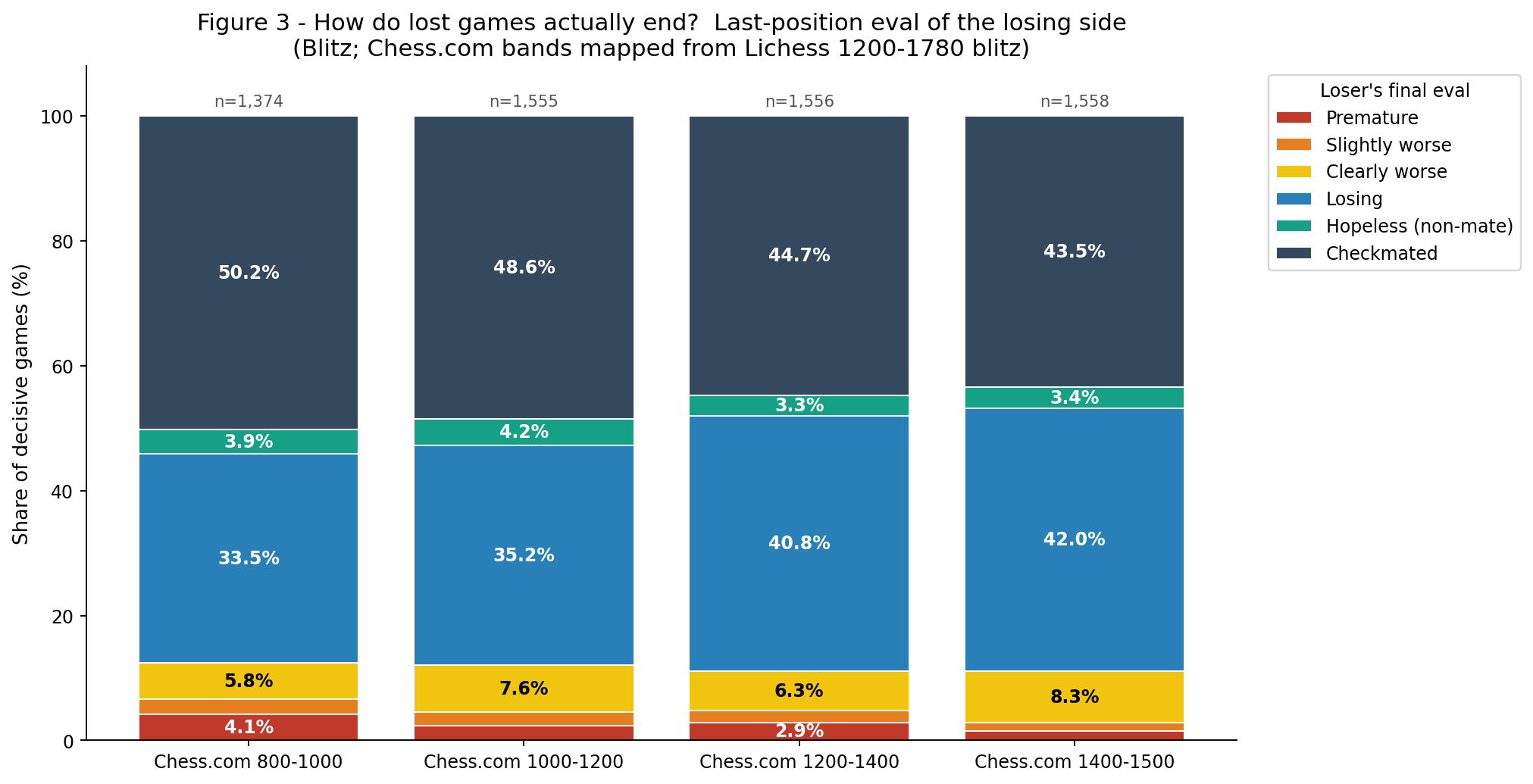
The data shows that the vast majority of players resign appropriately. Across all rating bands, over 40% of decisive games end in checkmate, and another 33–42% end with a resignation in a "Losing" (-5 to -10) or "Hopeless" (≤ -10) position.
However, a small but significant percentage of players resign prematurely. In the 800–1000 band, 4.1% of resignations occur in positions where the engine evaluates the game as > -1 (essentially equal or even slightly winning for the resigner).
Example: The Premature Resignation (Chess.com 800–1000)
Consider this position from an 800-rated blitz game. Black has just played Nxc4, and White resigned.
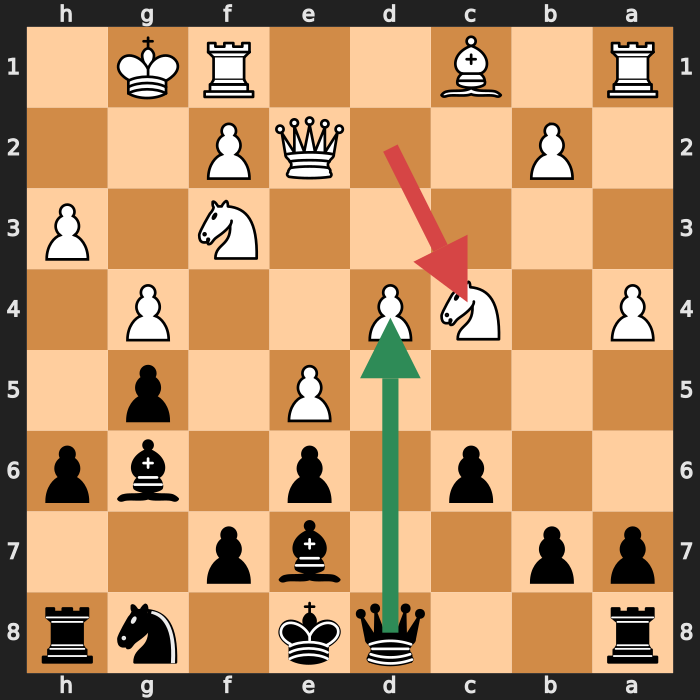
Red arrow: Black's last move (Nxc4). Green arrow: White's best response (Qxd4).
White likely saw the knight capturing on c4 and felt overwhelmed by the central tension. However, the engine evaluates this position at +0.83 in White's favor! By simply playing Qxd4 (green arrow), White maintains a strong central presence and a slight advantage. Resigning here is a purely psychological collapse, not a chess one.
The Clock Factor: Time Trouble and Resignations
In blitz chess, the clock is as important as the pieces on the board. How does time trouble influence the decision to resign?
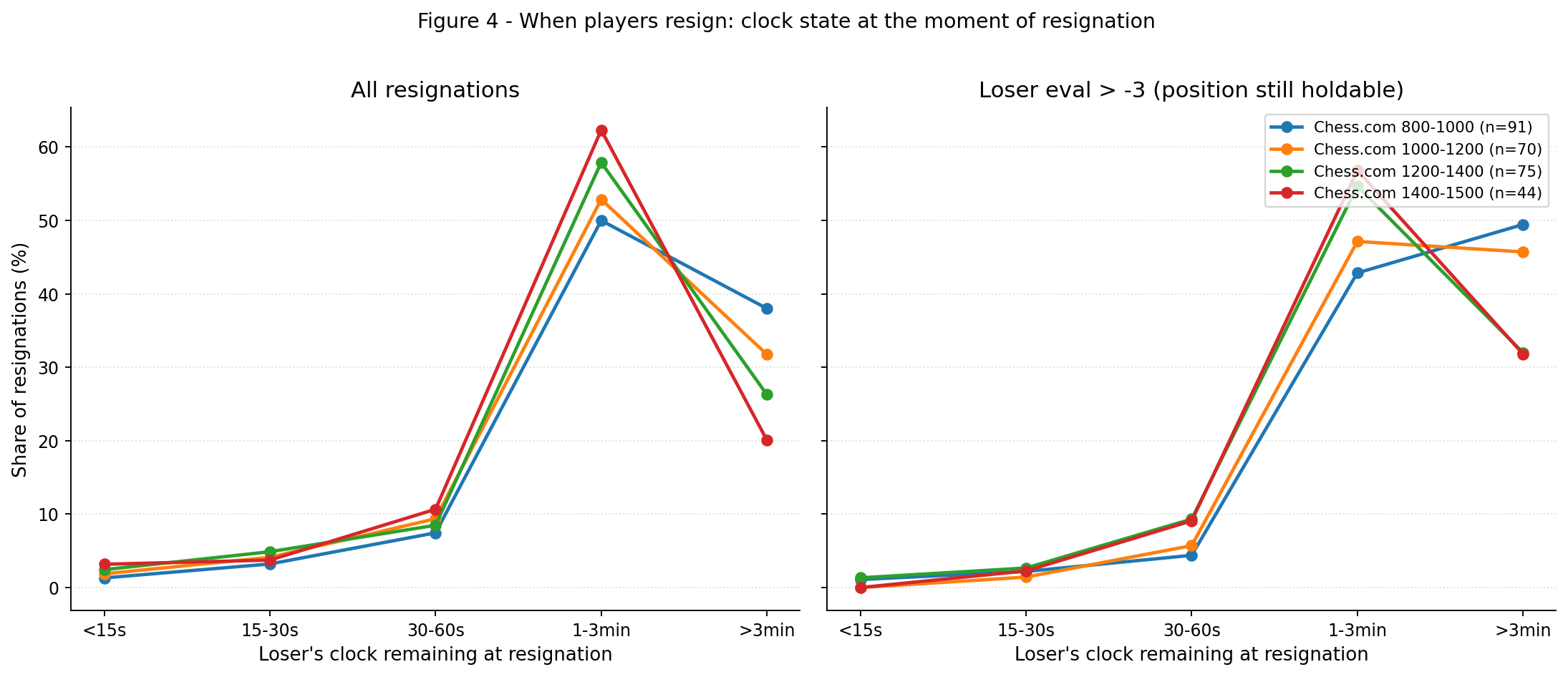
The data reveals a fascinating trend: when players resign in objectively holdable positions (eval > -3), they are rarely in extreme time trouble. Across all rating bands, the vast majority of premature resignations occur when the player still has between 1 and 3 minutes left on the clock.
This suggests that premature resignations are driven by frustration, tilt, or a miscalculation of the position, rather than a genuine lack of time to find a solution.
Example: The Time Trouble Collapse (Chess.com 1200–1400)
Conversely, when players do resign in time trouble, the position is often still complex. In this 1300-rated game, White has just played Qxh5, and Black resigned with only 9 seconds left on the clock.
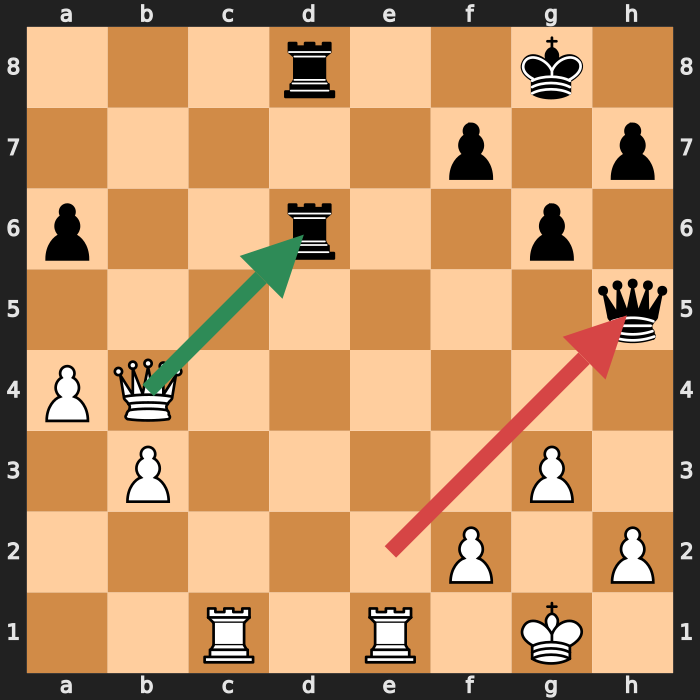
Red arrow: White's last move (Qxh5). Green arrow: Black's best response (Qxd6).
The engine evaluates this position at -1.51 (Black is slightly worse, but the game is far from over). However, with only 9 seconds remaining, the cognitive load of finding the correct defensive moves (like Qxd6) was too high, prompting Black to resign.
The Cost of Giving Up
So, how many rating points are you actually losing by resigning? We calculated the "points left on the table" by multiplying the number of resignations in holdable or slightly losing positions by the expected save rate for those positions.
| Rating Band (Chess.com) | Resignations at -5 to -3 | Save Rate (-5 to -3) | Resignations at -10 to -5 | Save Rate (-10 to -5) | Est. Points Left on Table | % of Losses |
|---|---|---|---|---|---|---|
| 800–1000 | 80 | 39.8% | 460 | 22.3% | 134.35 | 9.78% |
| 1000–1200 | 118 | 31.9% | 547 | 18.9% | 141.09 | 9.07% |
| 1200–1400 | 98 | 29.4% | 635 | 16.6% | 134.16 | 8.62% |
| 1400–1500 | 129 | 28.6% | 655 | 13.1% | 122.43 | 7.86% |
The results are striking. At the 800–1000 level, players are throwing away nearly 10% of their potential points by resigning in positions that are statistically savable. Even at the 1400–1500 level, players are leaving nearly 8% of their points on the table.
Example: The Comeback (Chess.com 1200–1400)
To illustrate why fighting on is so valuable, look at this position from a 1400-rated game. Black has just played Nxc5.
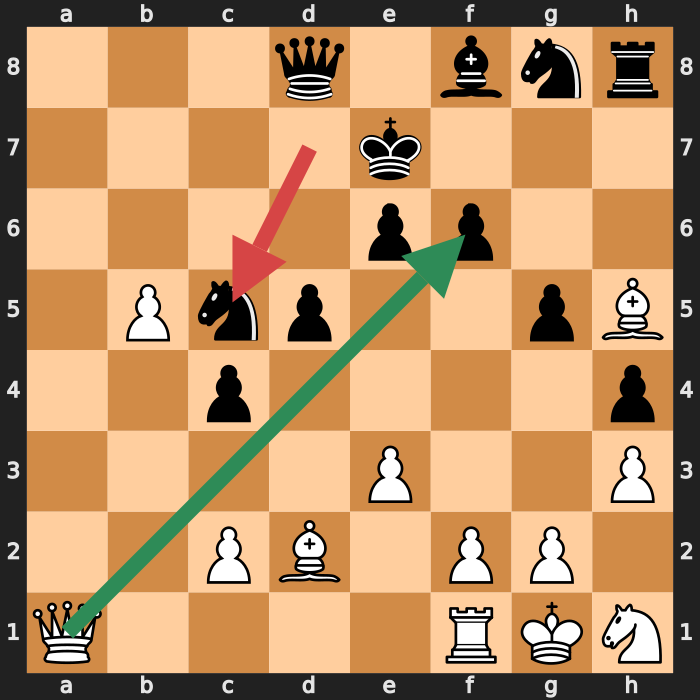
Red arrow: Black's last move (Nxc5). Green arrow: White's best response (Qxf6).
The engine evaluates this position at -3.63 (White is losing). Many players would be tempted to resign here. However, White fought on, and Black eventually blundered, allowing White to win the game. This is the "never resign" philosophy in action.
Roadmap for Improvement: When to Resign
Based on the data, here is a definitive guide on when to resign in blitz chess, tailored to your rating:
Chess.com 800–1000 (Lichess 1200–1420)
- The Rule: Never resign unless you are down a full queen (-10 or worse) and your opponent has plenty of time on the clock.
- The Reality: Your opponents will blunder constantly. You are leaving nearly 10% of your points on the table by giving up early. Play on, set traps, and look for stalemates.
Chess.com 1000–1200 (Lichess 1420–1565)
- The Rule: You can resign if you are down a queen (-10), but fight on if you are only down a piece or a rook (-3 to -7.5).
- The Reality: Your save rate when down a piece is still over 30%. Do not let frustration dictate your resignations. If you have more than a minute on the clock, keep playing.
Chess.com 1200–1400 (Lichess 1565–1705)
- The Rule: Resigning when down a full rook (-7.5) is statistically justified, as your save rate drops below 5%.
- The Reality: You are starting to face opponents who can convert large advantages. However, you are still leaving 8.6% of your points on the table by resigning in slightly worse positions. Fight on if the position is complex.
Chess.com 1400–1500 (Lichess 1705–1780)
- The Rule: You can safely resign when down a rook or more, unless your opponent is in extreme time trouble (<15 seconds).
- The Reality: At this level, technique is improving, but time scrambles still decide many games. If you are losing but have a significant time advantage, play on and try to flag your opponent.
Data and Methodology
This analysis was conducted using a dataset of over 10,000 Lichess blitz games, mapped to Chess.com rating bands. Engine evaluations (Stockfish 12) were extracted at key plies and at the moment of resignation.
The underlying data files generated for this analysis are available below:
- - expected points by engine-evaluation bucket and rating band (moves 10-55 pooled).
View full data →band eval_bucket n win_pct draw_pct loss_pct expected_pts 800-1000 <=-10 543 10.128913443830571 1.289134438305709 88.58195211786372 0.10773480662983426 800-1000 -10..-5 2367 20.194338825517534 4.182509505703422 75.62315166877904 0.22285593578369245 800-1000 -5..-3 1441 37.05759888965996 5.482303955586398 57.46009715475364 0.3979875086745316 800-1000 -3..-1 1404 42.236467236467234 3.988603988603989 53.774928774928775 0.4423076923076923 800-1000 -1..+1 1798 46.66295884315907 6.674082313681868 46.66295884315907 0.5 - - every decisive game categorised by the loser's final evaluation.
View full data →band category count pct total 800-1000 Premature 57 4.148471615720524 1374 800-1000 Slightly worse 34 2.4745269286754 1374 800-1000 Clearly worse 80 5.822416302765648 1374 800-1000 Losing 460 33.47889374090247 1374 800-1000 Hopeless (non-mate) 53 3.8573508005822417 1374 - - the evaluation at which save rate crosses 5 / 10 / 20 % per band.
View full data →band save_threshold_pct eval_at_threshold_pawns 800-1000 5 -12 1000-1200 5 -12 1200-1400 5 -7.5 1400-1500 5 -12 800-1000 10 -12 - - estimated half-points lost to premature resignations.
View full data →band resigns_at_minus5_to_minus3 save_rate_minus5_to_minus3 resigns_at_minus10_to_minus5 save_rate_minus10_to_minus5 resigns_at_le_minus10 est_points_left_on_table total_resigns pct_points_left_per_loss 800-1000 80 0.398 460 0.223 743 134.35 1374 9.78 1000-1200 118 0.319 547 0.189 820 141.09 1555 9.07 1200-1400 98 0.294 635 0.166 748 134.16 1556 8.62 1400-1500 129 0.286 655 0.131 730 122.43 1558 7.86 - - save rate at moves 15, 25, 35 across evaluation buckets.
View full data →band move_no eval_bucket n win_pct draw_pct loss_pct expected_pts 800-1000 15 ≤ -10 116 10.344827586206897 0.0 89.65517241379311 0.10344827586206896 800-1000 15 -10..-5 941 20.935175345377257 2.5504782146652496 76.51434643995749 0.22210414452709884 800-1000 15 -5..-3 778 35.60411311053985 3.341902313624679 61.05398457583548 0.37275064267352187 800-1000 15 -3..-1 914 43.435448577680525 3.938730853391685 52.62582056892779 0.4540481400437637 800-1000 15 -1..+1 1142 48.24868651488617 3.677758318739054 48.07355516637478 0.500875656742557 - Per-band resignation records: 800-1000 | 1000-1200 | 1200-1400 | 1400-1500.
Chess Coach, April 17, 2026