Every chess player has experienced the sting of falling into an opening trap. One moment you are developing your pieces normally, and the next, your position has collapsed, your queen is trapped, or you are facing an unstoppable mating net. But which traps are actually the most dangerous? Which ones work consistently, and which ones are easily refuted once you climb the rating ladder?
To answer these questions, we analyzed 954,617 Blitz games from the Lichess database, covering players with ratings corresponding to the 800–1500 range on Chess.com (approximately 1,200–1,780 on Lichess Blitz). By tracking win rates, game lengths, and performance decay across six rating bands, we have quantified the "trappiness" of over 30 of the most notorious chess openings and ranked them using a composite Trap Score. Every game in the dataset includes a Stockfish 17 evaluation, giving us precise blunder-rate data alongside the raw win-rate statistics.
This guide serves as a roadmap for improvement. Whether you are looking for a dangerous weapon to add to your repertoire or trying to understand why you keep losing in 15 moves, the data reveals exactly what works and what does not at your rating level.
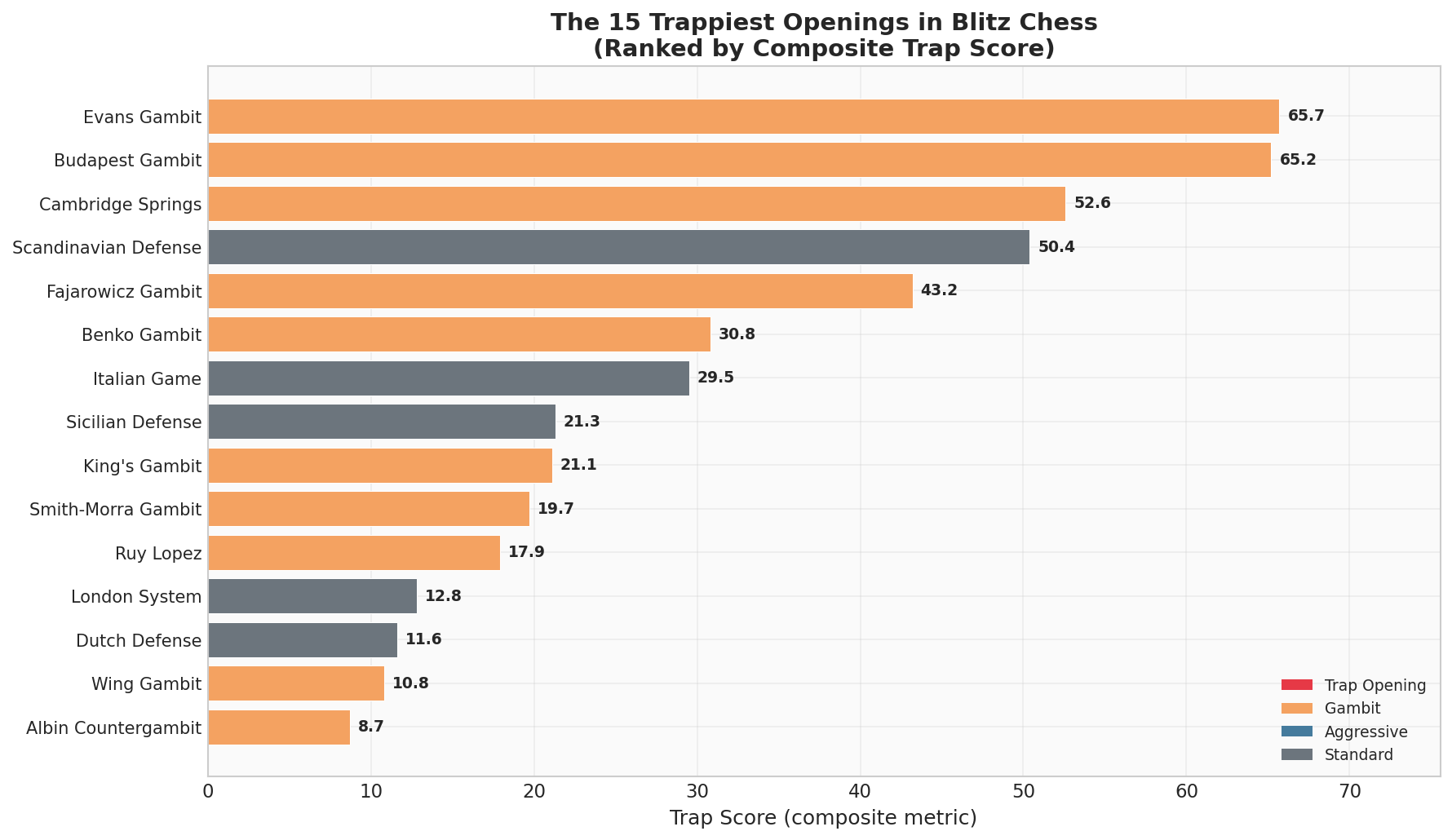
Table of Contents
- The Methodology: How We Measure a Trap
- The Undisputed King of Traps: The Fried Liver Attack
- The Black Counter-Trap: The Stafford Gambit
- Head-to-Head: Fried Liver vs. Stafford
- The Gambits: High Risk, High Reward
- The Quick-Kill Heatmap: Where Games End Before Move 20
- Traps That Backfire: When Knowing the Trick Isn't Enough
- The Most One-Sided Sub-Variations
- The Decay Curve: Which Traps Stop Working First?
- Actionable Roadmap by Rating Band
- Conclusion: The Lifecycle of a Trap
- Data and Methodology
The Methodology: How We Measure a Trap
Not all aggressive openings are traps. A true trap relies on the opponent making a natural-looking but fatal mistake. To quantify this, we developed a Composite Trap Score based on four weighted metrics:
| Metric | Weight | What It Measures |
|---|---|---|
| Low-Rating Win Rate | 30% | How effective is the opening at the ~500–800 Chess.com level? High win rates indicate a trap that is hard to see coming. |
| Win Rate Decay | 30% | How much does the win rate drop as players get stronger? A sharp drop indicates reliance on tricks rather than sound principles. |
| Quick Finish % | 25% | What percentage of games end in under 20 moves? Traps lead to early resignations or checkmates. |
| Blunder Differential | 15% | Does the opening induce significantly more blunders from the opponent than from the player? |
The Trap Score is normalized to a 0–100 scale. An opening scoring above 50 is a genuine "trap opening" that relies heavily on opponent mistakes. Scores below 20 indicate openings that are aggressive but fundamentally sound.
Note on Ratings: All data was collected from Lichess Blitz games. For clarity and relevance to the Chess.com community, we have converted all rating labels to approximate Chess.com Blitz equivalents. A Lichess Blitz rating of 1,200 corresponds roughly to 800 on Chess.com; a Lichess 1,780 corresponds to approximately 1,500 on Chess.com. Where precision matters, we note both scales.
The Undisputed King of Traps: The Fried Liver Attack
If there is one trap you must know, it is the Fried Liver Attack. The data is unequivocal: this is the most devastating opening sequence in beginner and intermediate chess.
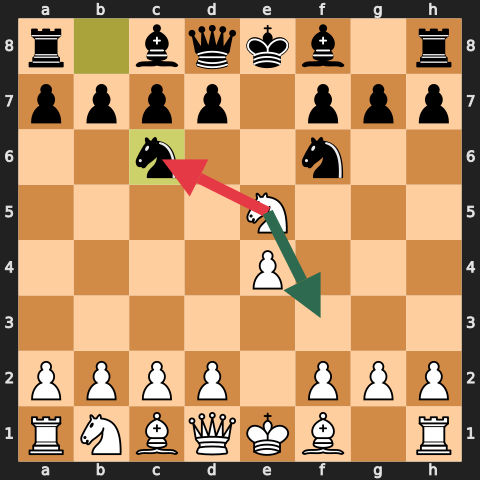
The critical position arises after 1.e4 e5 2.Nf3 Nc6 3.Bc4 Nf6 4.Ng5. White immediately targets the weak f7 pawn. The red arrow below shows the threat (Nxf7), while the green arrow shows Black's best defense (d5).
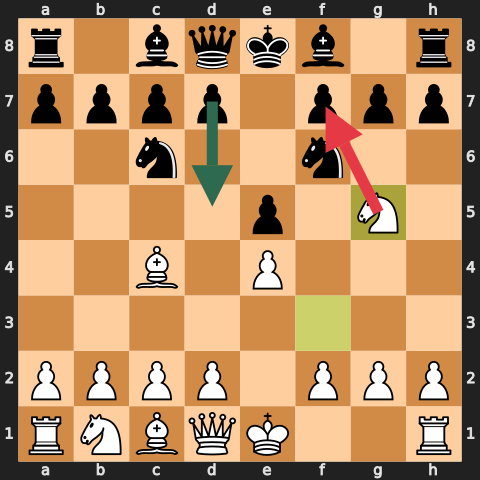
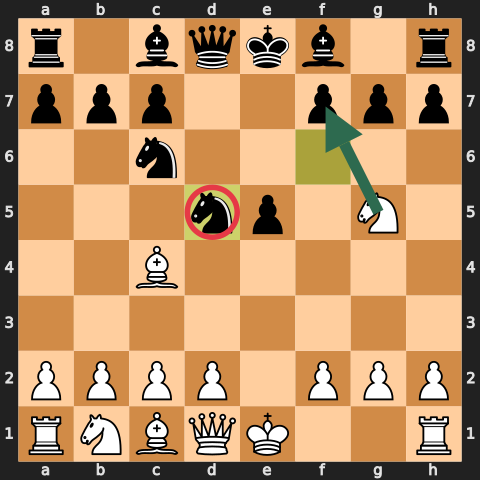
Black's best response is 4...d5, and after 5.exd5 the critical moment arrives. The natural-looking recapture 5...Nxd5?? is a catastrophic blunder, allowing the crushing 6.Nxf7!. White sacrifices the knight to drag the Black king into the center of the board, where it faces a relentless attack.
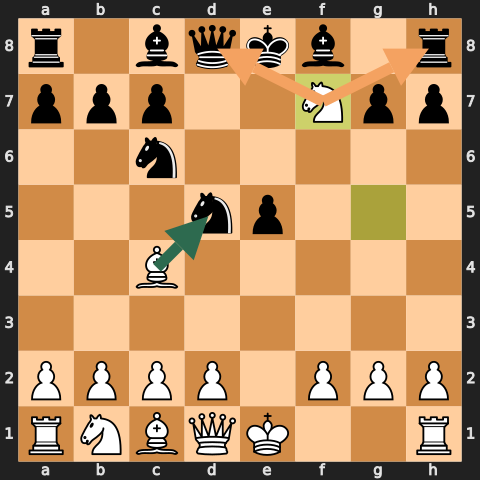
After 6.Nxf7, the knight forks the king and the rook on h8. The king is forced to move, and White's pieces swarm the exposed monarch. The position after Nxf7 is shown below:
The Numbers: A Trap That Never Dies
The statistics for this specific line (ECO C57, 903 games in our sample) are staggering:
| Chess.com Rating (approx.) | Lichess Rating Band | White Win Rate | Black Win Rate | Draw Rate | Games |
|---|---|---|---|---|---|
| ~500 | 700–900 | 76.5% | 21.4% | 2.0% | 98 |
| ~700 | 900–1100 | 70.6% | 27.3% | 2.0% | 245 |
| ~900 | 1100–1300 | 69.2% | 27.9% | 2.8% | 247 |
| ~1100 | 1300–1500 | 67.7% | 29.3% | 3.0% | 167 |
| ~1300 | 1500–1800 | 66.3% | 30.5% | 3.2% | 95 |
| ~1500 | 1800–2000 | 66.7% | 33.3% | 0.0% | 51 |
At the ~500 Chess.com level, White wins an incredible 76.5% of games when this position is reached. Even more remarkably, the Fried Liver does not decay like other traps. At the ~1500 Chess.com level, White still wins 66.7% of the time. The total decay is only about 10 percentage points across the entire rating spectrum, compared to 12–13 points for most other gambits.
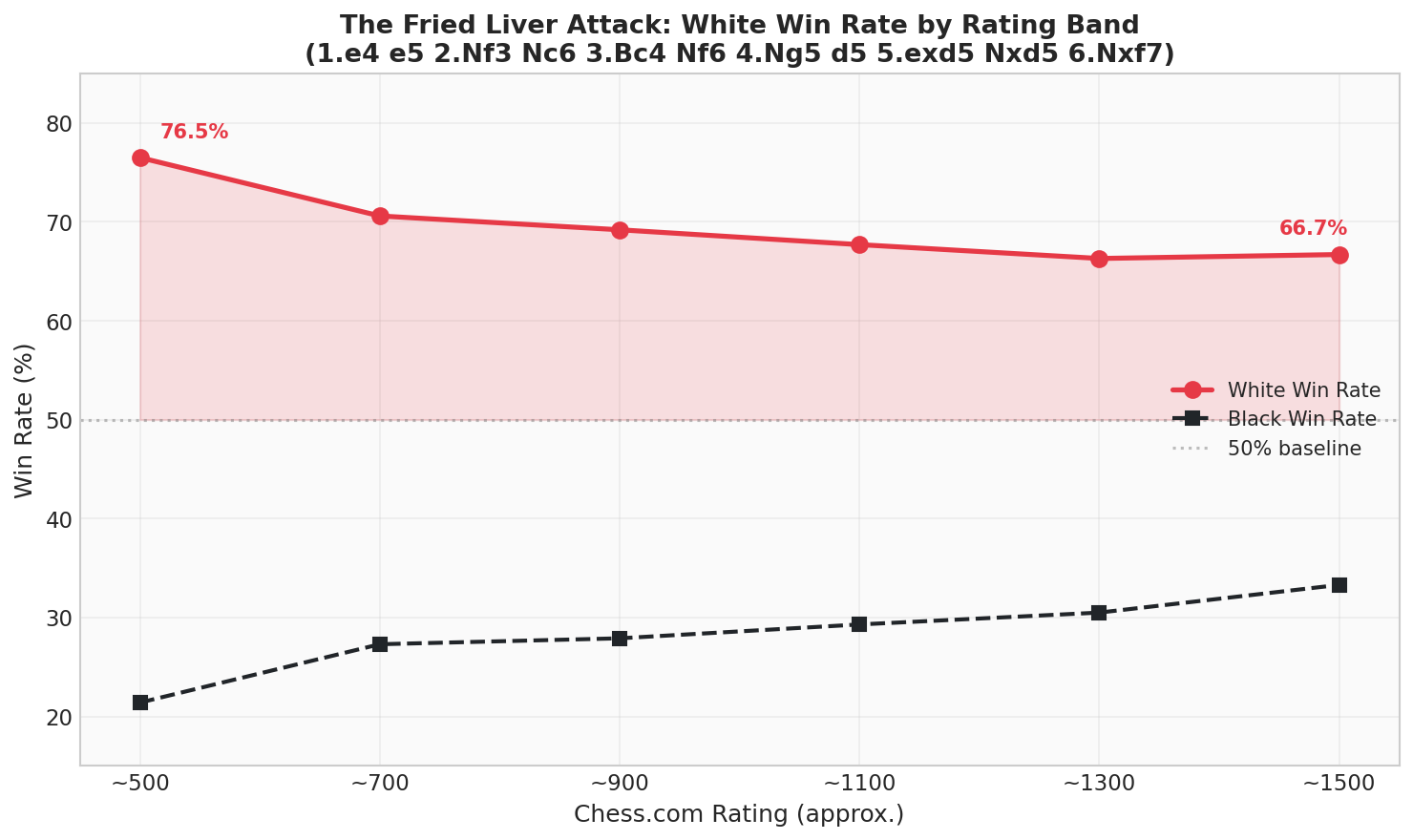
The reason the Fried Liver remains effective even at higher ratings is that it is not purely a "trick." After 6.Nxf7, the resulting positions require genuine tactical skill to defend, even when the defender knows the theory. In Blitz time controls, the practical difficulty of navigating the complications gives White a persistent edge.
Actionable Advice for the Fried Liver
For the 800–1000 Chess.com Player: If you play 1.e4, learn the Fried Liver immediately. It is, statistically speaking, the single most effective weapon at your level. If you play Black against 1.e4, you must learn the Traxler Counterattack (4...Bc5!?) or the main-line defense with 5...Na5 instead of 5...Nxd5. Failing to prepare against the Fried Liver is leaving free points on the table.
For the 1000–1300 Chess.com Player: Opponents will start playing 5...Na5 more often. You need to know the theory after 6.Bb5+ c6 7.dxc6 bxc6 8.Be2. The positions are still favorable for White, but they require understanding of piece activity and king safety rather than brute-force tactics.
For the 1300–1500 Chess.com Player: The Fried Liver remains potent, but you will face the Traxler Counterattack (4...Bc5) and the Ulvestad Variation (5...b5) with increasing frequency. Both are tricky sidelines that require specific preparation. The good news: the data shows that even at this level, the Fried Liver family of lines scores above 56% for White.
The Black Counter-Trap: The Stafford Gambit
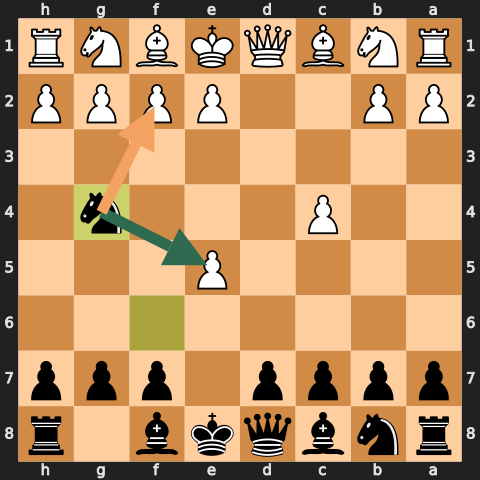
While White has the Fried Liver, Black has the Stafford Gambit. Popularized by chess streamers like Eric Rosen, the Stafford (1.e4 e5 2.Nf3 Nf6 3.Nxe5 Nc6) is objectively dubious but practically terrifying in Blitz chess.
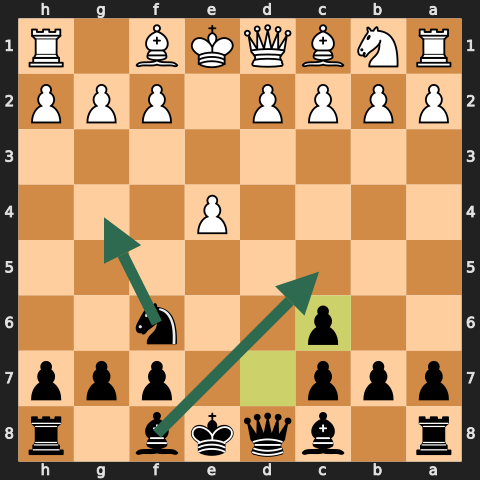
After White accepts the gambit with 4.Nxc6 dxc6, Black's pieces spring to life with rapid development, eyeing the f2 pawn and the White kingside. The bishop goes to c5, the knight to g4, and suddenly White is under enormous pressure.
The Inverted U-Curve: A Trap That Requires Skill
The data reveals a fascinating "inverted U-curve" for the Stafford Gambit's effectiveness across rating bands:
| Chess.com Rating (approx.) | Lichess Rating Band | Black Win Rate | White Win Rate | Games |
|---|---|---|---|---|
| ~500 | 700–900 | 42.4% | 54.1% | ~250 |
| ~700 | 900–1100 | 50.9% | 47.8% | ~300 |
| ~900 | 1100–1300 | 52.2% | 45.0% | ~320 |
| ~1100 | 1300–1500 | 56.1% | 41.1% | ~280 |
| ~1300 | 1500–1800 | 53.7% | 41.9% | ~200 |
| ~1500 | 1800–2000 | 50.0% | 46.9% | ~116 |
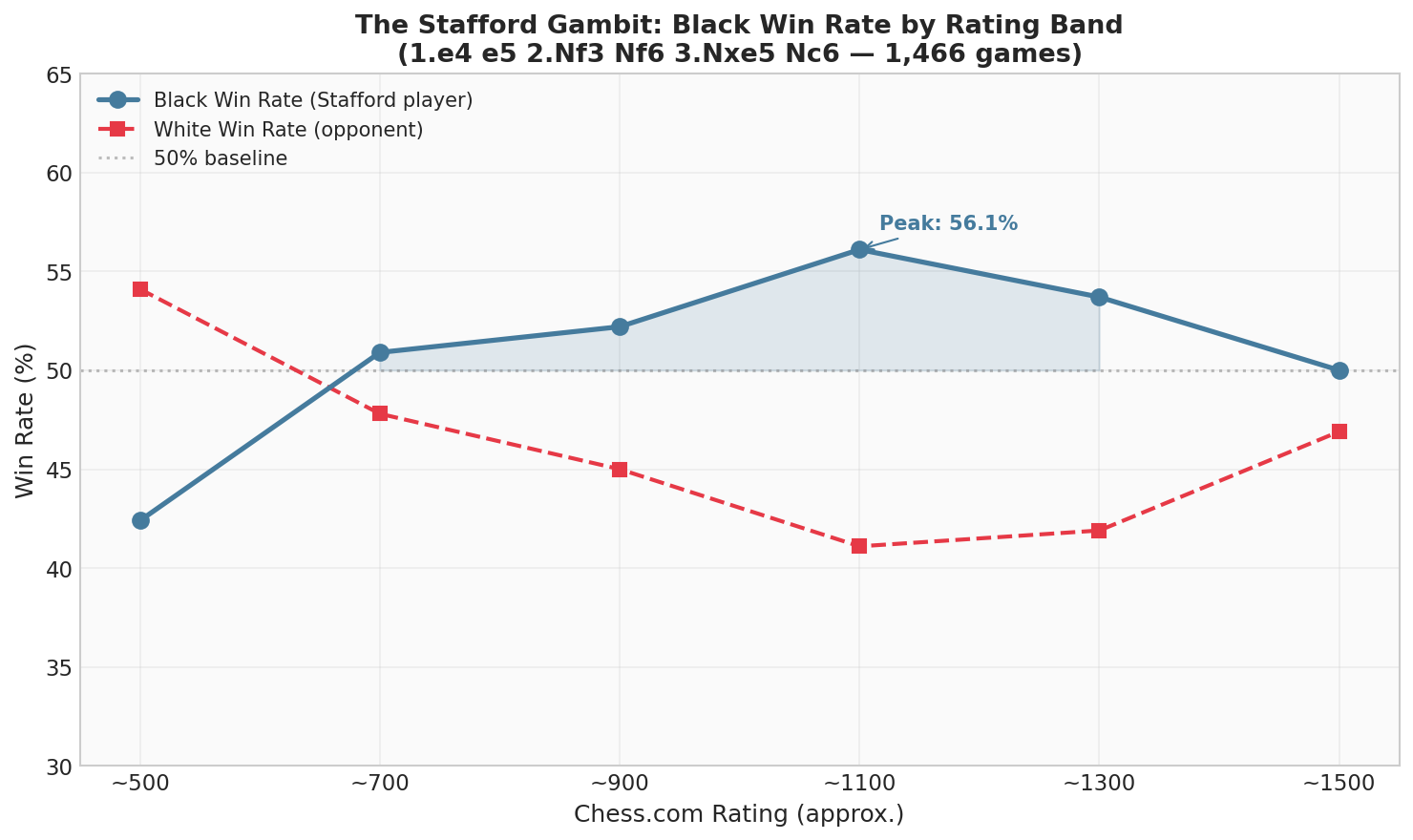
At the absolute beginner level (~500 Chess.com), the Stafford actually performs poorly for Black (42.4% win rate). The reason is counterintuitive: beginners do not know the traps. They play the opening moves but fail to execute the tactical sequences that make the Stafford dangerous. They miss the Ng4 attacks, the Bc5 pressure, and the queen sacrifices that make the gambit work.
However, as players reach the ~900–1100 Chess.com range, the Stafford becomes lethal, peaking at a 56.1% win rate for Black at the ~1100 level. At this rating, the Black player has memorized the traps from YouTube videos and Twitch streams, but the White player has not yet learned the refutations. It is the perfect storm of preparation asymmetry.
As ratings climb toward 1500, the win rate drops back down to 50% as White players learn to navigate the early tricks with moves like 4.Nf3 (declining the gambit entirely) or careful development after 4.Nxc6.
Actionable Advice for the Stafford Gambit
For the 800–1000 Chess.com Player: The Stafford is a fun weapon, but focus on basic tactics first. The traps only work if you understand the underlying mating patterns (Qh4+, Ng4xf2, Bc5 pinning). Watch Eric Rosen's videos, but also practice the tactical motifs on puzzle trainers.
For the 1000–1300 Chess.com Player: This is the golden zone for the Stafford. You will score many quick wins against opponents who grab pawns carelessly. However, be aware that the opening is objectively losing with best play, so do not rely on it as your only Black weapon.
For the 1300–1500 Chess.com Player: If you face the Stafford as White, learn a solid refutation. The simplest approach is 4.Nf3 (retreating the knight), which avoids all the traps and leaves White with a solid extra pawn. If you insist on 4.Nxc6, play 5.d3 followed by calm development.
Head-to-Head: Fried Liver vs. Stafford
The two most famous Blitz traps tell very different stories when viewed side by side:
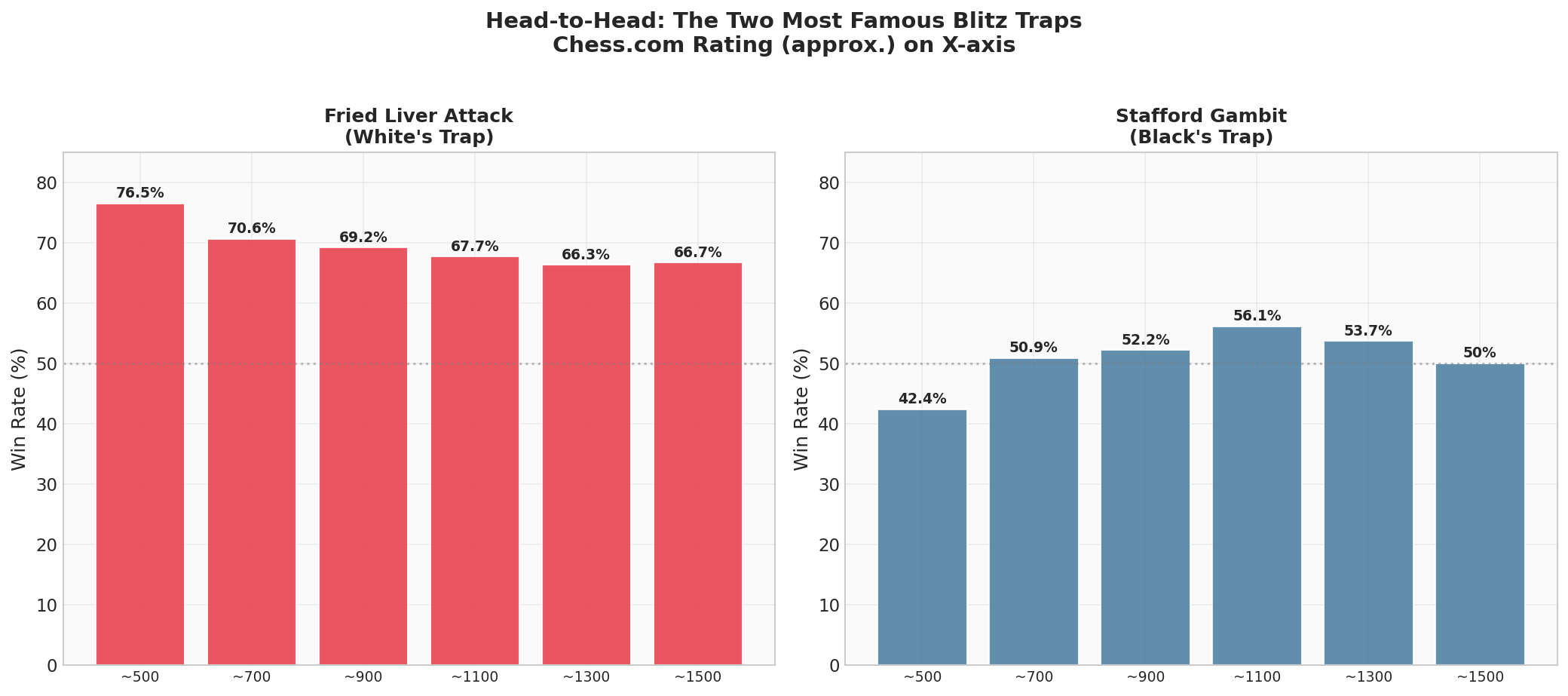
The Fried Liver is a monotonically decreasing trap: it is most effective at the lowest ratings and gradually loses potency as players improve, but never drops below 66%. The Stafford, by contrast, follows an inverted U-curve: it starts weak, peaks in the intermediate range, and then fades. This difference reflects the fundamental nature of each trap. The Fried Liver creates positions that are objectively difficult to defend regardless of preparation. The Stafford creates positions that are only dangerous if the opponent is unprepared.
The Gambits: High Risk, High Reward
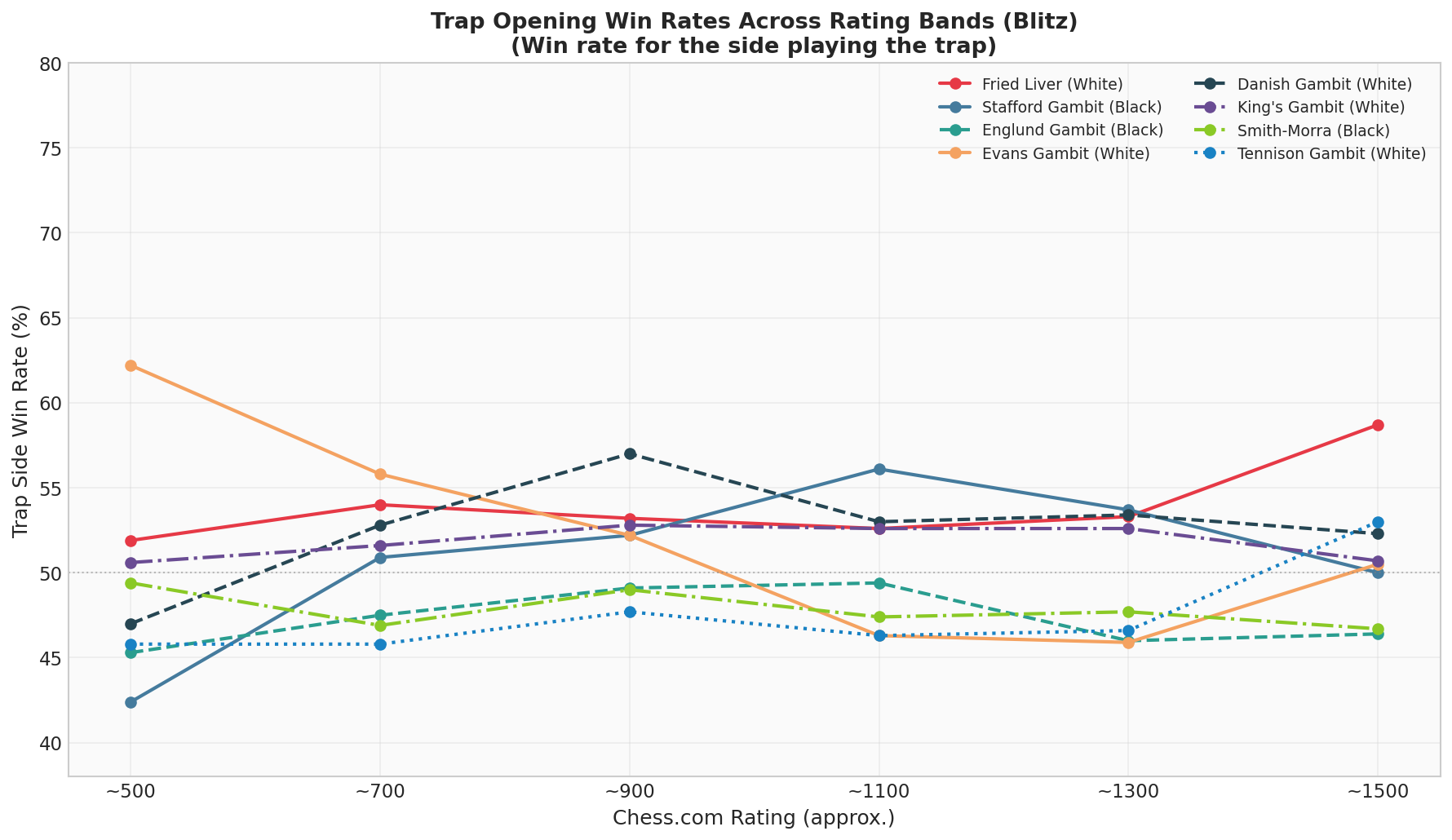
Our analysis identified several other openings that rely heavily on early tactical pitfalls. The chart below compares the trap-side win rate for eight major trap openings across all rating bands:
The Evans Gambit (C51)
The Evans Gambit (1.e4 e5 2.Nf3 Nc6 3.Bc4 Bc5 4.b4) is the highest-scoring true gambit in our dataset, with a Trap Score of 65.7. At the ~500 Chess.com level, White wins 62.2% of games. However, it suffers a massive 11.7 percentage point decay, dropping to 50.5% at the ~1500 level.
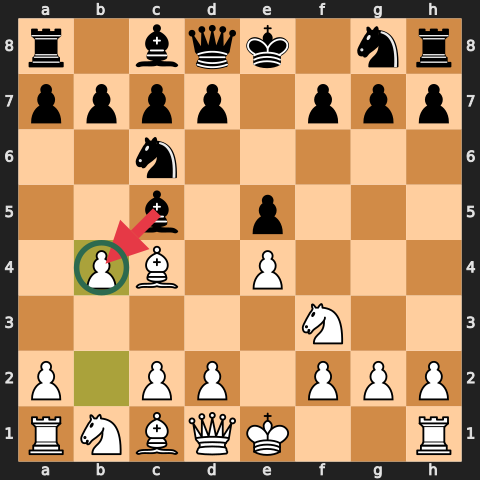
The Evans is a fantastic tool for learning attacking chess. The positions that arise after 4...Bxb4 5.c3 are rich in tactical possibilities, and White's lead in development often translates into a crushing kingside attack. But you must be prepared to play real chess if Black defends accurately with lines like 4...Bb6 (declining the gambit) or the Lasker Defense.
The Budapest Gambit (A51)
The Budapest Gambit (1.d4 Nf6 2.c4 e5) is Black's most effective surprise weapon against 1.d4. The Fajarowicz Variation in particular scores a massive 63.6% win rate at lower levels. Like the Evans, it decays sharply (12.9 points) as players learn to return the pawn for a positional advantage. With only 683 games in our sample, the Budapest is a niche weapon, but its surprise value is undeniable.
The Danish Gambit (C21)
The Danish Gambit (1.e4 e5 2.d4 exd4 3.c3) sacrifices two pawns for overwhelming development. It maintains a surprisingly stable win rate across all rating bands (hovering around 50–53%). However, its "trappiness" is evident in its quick finish rate: at lower ratings, 42.6% of Danish Gambit games end in under 20 moves, compared to just 22% at the ~1500 level.
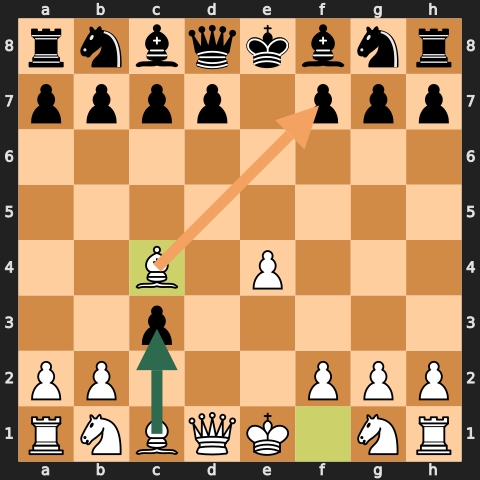
The King's Gambit (C30)
The King's Gambit (1.e4 e5 2.f4) is one of the oldest openings in chess and remains a respectable choice at all levels. Its win rate is remarkably stable (50–51% across all bands), and it does not rely on tricks. However, its quick finish rate of 42% at lower levels and the sharp tactical positions it creates earn it a place in our trap rankings.
Summary Table: The Gambits Compared
| Opening | Trap Side | Games | Low-Rating WR | High-Rating WR | Decay (pp) | Trap Score |
|---|---|---|---|---|---|---|
| Evans Gambit | White | 714 | 62.2% | 50.5% | 11.7 | 65.7 |
| Budapest Gambit | Black | 683 | 63.6% | 50.7% | 12.9 | 65.2 |
| Scandinavian Defense | Black | 242 | 59.0% | 47.8% | 11.2 | 50.4 |
| Fajarowicz Gambit | Black | 381 | 63.6% | 52.2% | 11.4 | 43.2 |
| Italian Game | White | 55,786 | 52.3% | 49.3% | 3.0 | 29.5 |
| King's Gambit | White | 11,339 | 50.6% | 50.7% | -0.1 | 21.1 |
| Smith-Morra Gambit | Black | 8,829 | 49.4% | 46.7% | 2.7 | 19.7 |
| Danish Gambit | White | 12,252 | 53.0% | 50.1% | 2.9 | ~18 |
The Quick-Kill Heatmap: Where Games End Before Move 20
One of the most telling indicators of a trap opening is how often games end before move 20. The heatmap below shows the quick-finish percentage for each opening at each rating band:
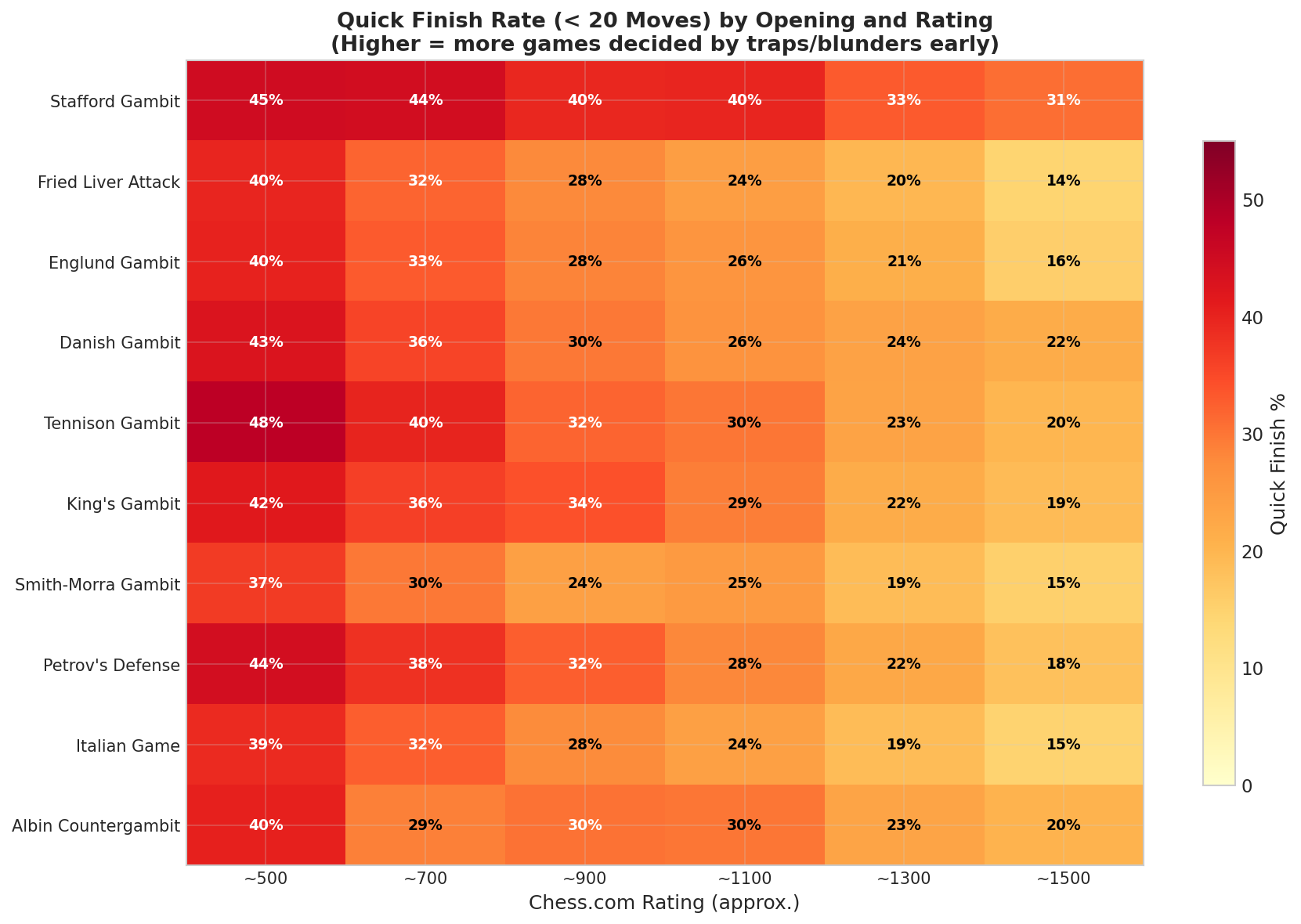
Several patterns emerge from this data. First, the Stafford Gambit has the highest quick-finish rate at every single rating band, reaching 45% at the lowest level and still maintaining 31% at the ~1500 level. This confirms its nature as a "boom or bust" opening: games are decided quickly, one way or the other.
Second, the Tennison Gambit has a surprisingly high quick-finish rate (48% at the lowest level), but as we will see in the next section, many of those quick finishes are losses for the trap-setter.
Third, the quick-finish rate drops dramatically as ratings increase for every opening. At the ~500 level, most trap openings see 40–48% of games end before move 20. At the ~1500 level, that number drops to 14–22%. This reflects the improving defensive skills of higher-rated players.
Traps That Backfire: When Knowing the Trick Isn't Enough
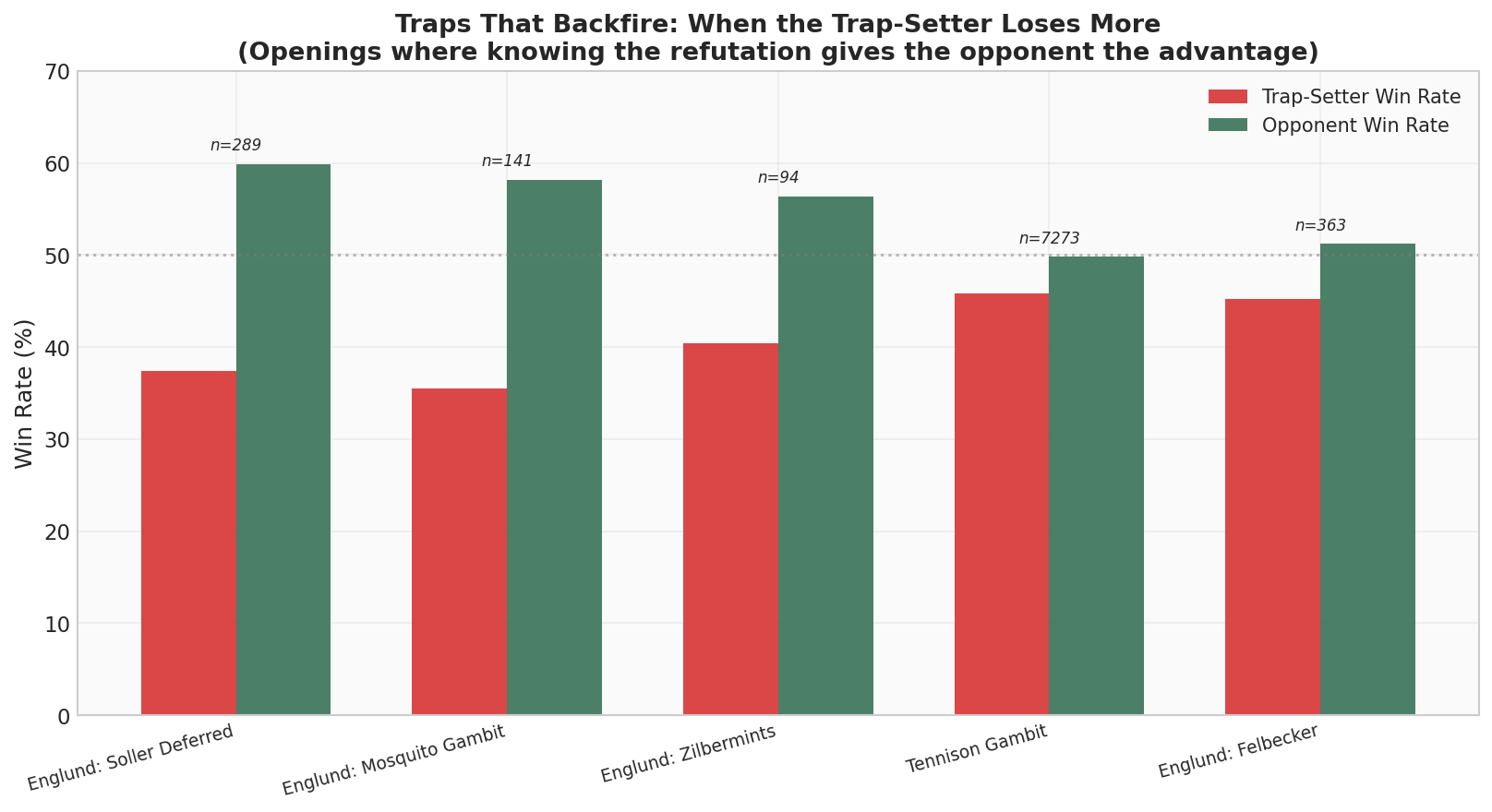
Perhaps the most interesting finding in the data is the existence of "backfire traps"—openings where the player setting the trap actually loses more often than they win. These are openings that are popular on YouTube and in online forums, but the data shows they are statistically harmful to the player using them.
The Englund Gambit: Popular but Terrible
The Englund Gambit (1.d4 e5) is the poster child for backfire traps. Despite being incredibly popular online (over 20,000 games in our sample), the data shows it is objectively terrible for Black. Black's win rate never exceeds 49.4% at any rating level. At the lowest level, White wins 50.1% of the time; at the highest, White wins 50.0%. The Englund does not even have the decency to be a good trap at low ratings.
Worse still, specific trap lines within the Englund actively harm the player using them:
| Englund Sub-Variation | White Win Rate | Black Win Rate | Games |
|---|---|---|---|
| Soller Gambit Deferred | 59.9% | 37.4% | 289 |
| Mosquito Gambit | 58.2% | 35.5% | 141 |
| Zilbermints Gambit | 56.4% | 40.4% | 94 |
| Felbecker Gambit | 51.2% | 45.2% | 363 |
| Main Line | 48.1% | 48.8% | 1,571 |
The Soller Gambit Deferred and Mosquito Gambit are particularly egregious: White wins nearly 60% of the time. The trap is so well-known, or the resulting position so bad for Black if the trap is avoided, that playing it is a statistical mistake at every level.
The Tennison Gambit: Internet Famous, Practically Useless
The Tennison Gambit (1.Nf3 d5 2.e4) is famous on YouTube for its spectacular queen traps, but the data tells a different story. White's win rate sits at a dismal 45.8% at lower levels, only recovering to 53% at the ~1500 level when players stop relying on the trap and start playing the resulting positions as a legitimate opening.
The Tennison's high quick-finish rate (48% at low levels) is misleading. Many of those quick finishes are losses for White, not wins. The opening sacrifices a pawn for no compensation if Black simply declines the bait with 2...dxe4 3.Ng5 and plays solidly.
The Most One-Sided Sub-Variations
Within each opening family, certain specific sub-variations produce dramatically lopsided results. The chart below shows the most one-sided lines in our dataset:
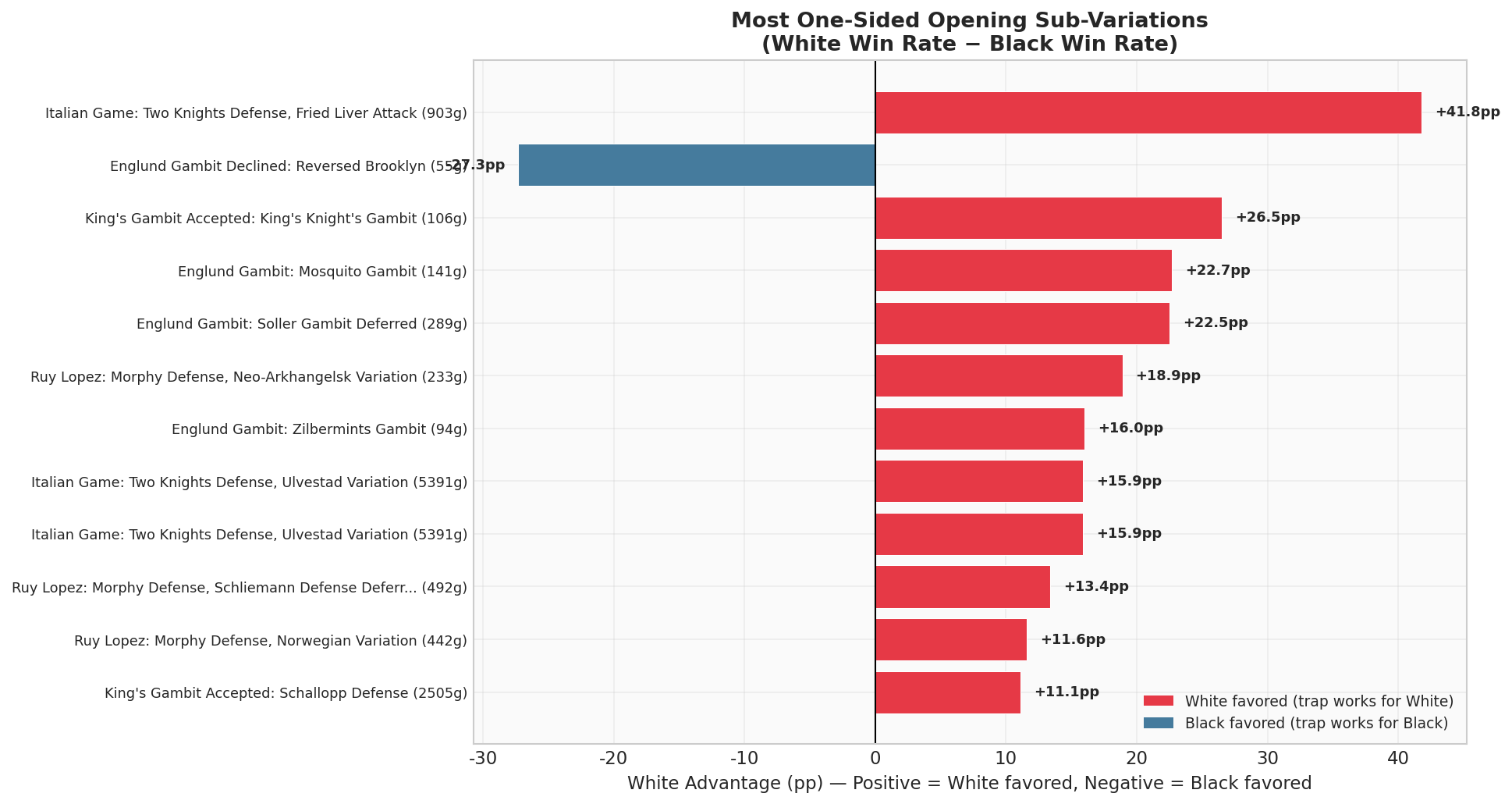
The standout finding is the Fried Liver Attack proper (the specific line ending in 6.Nxf7), which has a staggering +41.8 percentage point advantage for White (69.7% vs. 27.9%) across 903 games. This is the single most one-sided opening line in the entire dataset.
On the Black side, the Englund Gambit Declined: Reversed Brooklyn line scores +27.3 points for Black, but with only 55 games, the sample size is too small to draw firm conclusions.
The Ulvestad Variation (5...b5 in the Two Knights Defense) is notable for being both highly one-sided (+15.9 points for White) and having a large sample size (5,391 games), making it a statistically robust finding.
The Decay Curve: Which Traps Stop Working First?
The "decay curve" measures how much an opening's trap-side win rate drops from the lowest rating band to the highest. Openings with high decay are pure tricks; openings with low decay have genuine strategic merit.
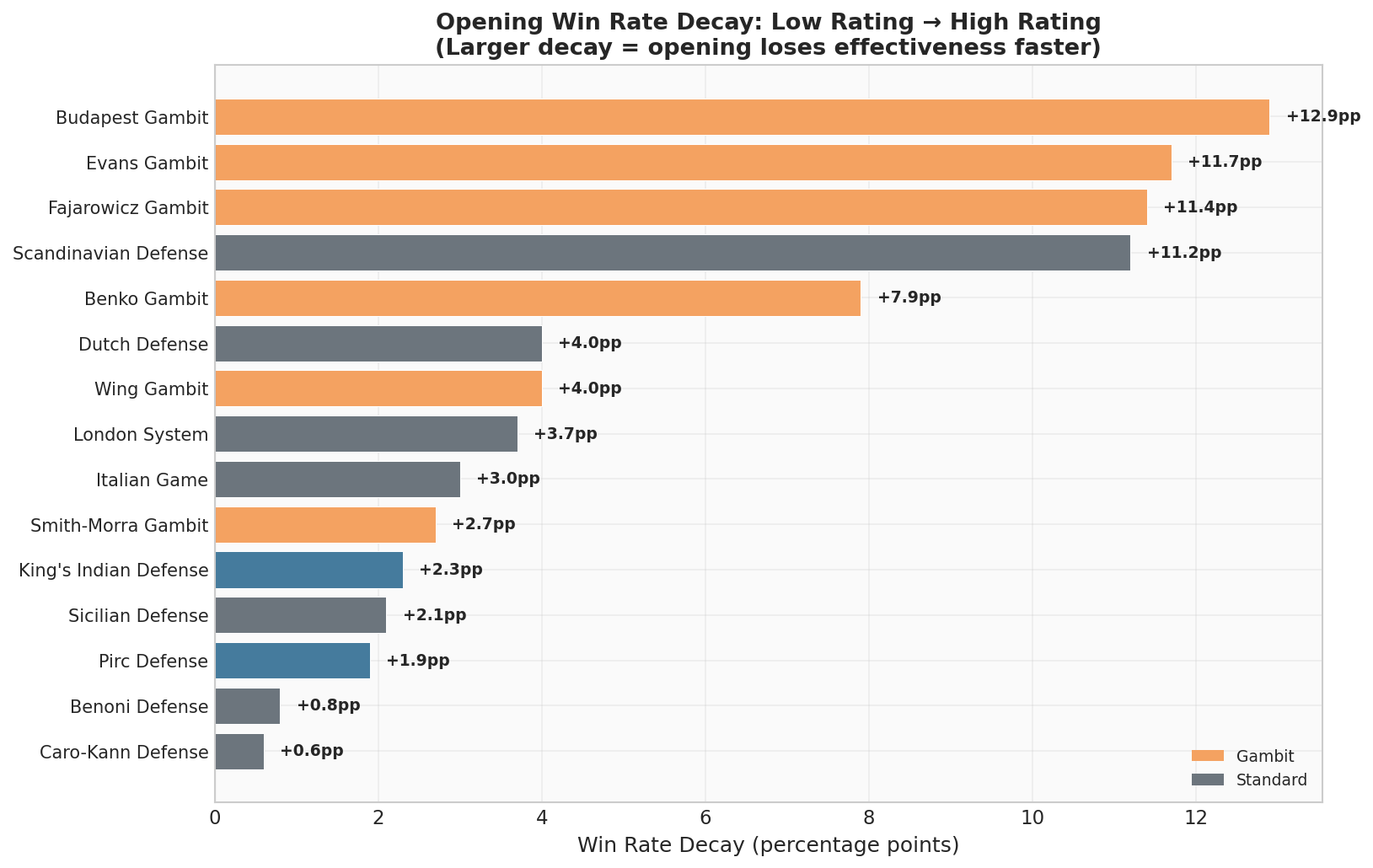
| Opening | Low-Rating WR | High-Rating WR | Decay (pp) | Verdict |
|---|---|---|---|---|
| Budapest Gambit | 63.6% | 50.7% | 12.9 | Pure trick |
| Evans Gambit | 62.2% | 50.5% | 11.7 | Mostly trick |
| Fajarowicz Gambit | 63.6% | 52.2% | 11.4 | Pure trick |
| Scandinavian Defense | 59.0% | 47.8% | 11.2 | Mostly trick |
| Benko Gambit | 60.0% | 52.1% | 7.9 | Mixed |
| Dutch Defense | 52.4% | 48.4% | 4.0 | Slight trick |
| London System | 53.6% | 49.9% | 3.7 | Slight trick |
| Italian Game | 52.3% | 49.3% | 3.0 | Sound opening |
| King's Gambit | 50.6% | 50.7% | -0.1 | Sound opening |
| Albin Countergambit | 44.5% | 45.6% | -1.1 | Gets better with rating |
The Budapest Gambit decays the fastest (12.9 points), confirming that it is almost entirely a surprise weapon. The King's Gambit, by contrast, has essentially zero decay, confirming its status as a legitimate opening that happens to produce sharp positions.
Interestingly, the Albin Countergambit actually improves as ratings increase (-1.1 point decay). This suggests that the opening's strategic ideas (the passed d-pawn, the dark-square pressure) become more valuable as players learn to exploit them.
Actionable Roadmap by Rating Band
Based on the data, here is a concrete roadmap for what to play and what to prepare against at each rating level:
800–1000 Chess.com (Lichess ~1200–1420)
This is the "trap paradise" zone. Opponents fall for everything, but you also fall for everything. The key is to play traps you understand, not just traps you have memorized.
As White: Play the Fried Liver Attack. At this level, 76.5% of games are won by White when the trap position is reached. Learn the moves 1.e4 e5 2.Nf3 Nc6 3.Bc4 Nf6 4.Ng5 d5 5.exd5 and know what to do after both 5...Nxd5 (6.Nxf7!) and 5...Na5 (6.Bb5+).
As Black: Learn to defend against the Fried Liver (play 5...Na5, not 5...Nxd5). Consider the Stafford Gambit as a fun secondary weapon, but understand that at this level, your execution will be inconsistent.
Prepare against: Scholar's Mate attempts (Qh5/Qf3 + Bc4). At this level, 40–48% of games end before move 20.
1000–1300 Chess.com (Lichess ~1420–1635)
This is the "golden age of traps." You know enough to set them, but your opponents do not always know how to refute them.
As White: The Fried Liver remains your best weapon (67–70% win rate). Add the Evans Gambit as a secondary weapon against 3...Bc5 (instead of 3...Nf6). The Evans scores 55–62% at this level.
As Black: The Stafford Gambit peaks in effectiveness here (52–56% win rate). The Budapest Gambit is an excellent surprise weapon against 1.d4 (60%+ win rate at this level).
Prepare against: The Englund Gambit (know that 2.dxe5 is fine and Black has no real compensation). The Danish Gambit (do not panic; return a pawn with 3...d5 for equal play).
1300–1500 Chess.com (Lichess ~1635–1780)
The decay sets in. One-trick ponies become liabilities, and you need to start playing fundamentally sound chess.
As White: The Fried Liver still works (66% win rate), but you need deeper preparation. Learn the Italian Game main lines as a fallback. The King's Gambit is a sound alternative that does not decay.
As Black: The Stafford Gambit is still viable but declining. Transition to the Sicilian Defense or Caro-Kann for more reliable results. If you play the Budapest, know that opponents will start returning the pawn correctly.
Prepare against: The Traxler Counterattack (if you play the Fried Liver). The Smith-Morra Gambit (if you play the Sicilian). At this level, only 14–22% of games end before move 20, so you need to know how to play middlegames, not just opening traps.
Conclusion: The Lifecycle of a Trap
The data paints a clear picture of how opening traps function in Blitz chess. Every trap follows a lifecycle:
Phase 1 — The Beginner Phase (~500–800 Chess.com): Pure chaos. Traps like the Fried Liver dominate because defending requires precise calculation that beginners cannot execute under time pressure. Complex traps like the Stafford fail because the trap-setter does not know how to execute the tactical sequences. The openings that score highest are the ones with the simplest attacking plans.
Phase 2 — The Intermediate Phase (~900–1200 Chess.com): The golden age of traps. Players have memorized the attacking sequences from YouTube and Twitch, but their opponents have not learned the refutations. The Stafford Gambit and Evans Gambit peak here. Preparation asymmetry is the dominant factor in game outcomes.
Phase 3 — The Advanced Phase (~1300–1500+ Chess.com): The decay sets in. One-trick ponies like the Englund Gambit and Budapest Gambit become liabilities as opponents learn the refutations. Only fundamentally sound aggressive openings (like the Fried Liver and King's Gambit) maintain their high win rates. The transition from "trap chess" to "real chess" begins.
The ultimate lesson from the data is this: traps are a legitimate and effective tool for climbing the rating ladder, but they are a tool, not a strategy. The Fried Liver Attack is the single most effective weapon in beginner chess, and you should absolutely learn it. But the players who climb highest are the ones who eventually learn to play the positions that arise after the traps, not just the traps themselves.
Until then? Play 4.Ng5, and enjoy the fireworks.
Data and Methodology
This analysis was conducted using the Lichess Opening Explorer API and a custom analytical pipeline built on the grandmaster-guide data service. The dataset comprises 954,617 rated games (465,320 Blitz games) with 100% Stockfish 17 evaluation coverage. Games were categorized into six Lichess rating bands (700–900, 900–1100, 1100–1300, 1300–1500, 1500–1800, 1800–2000) and converted to approximate Chess.com Blitz equivalents using the standard conversion table.
The Composite Trap Score was computed as a weighted average of four normalized metrics: low-rating win rate (30%), win rate decay (30%), quick finish percentage (25%), and blunder differential (15%). All charts were generated using Matplotlib and Seaborn. Board diagrams were rendered using python-chess with red arrows indicating bad moves or threats and green arrows indicating best moves or defensive resources.
The underlying data files used for this analysis are provided as attachments:
| File | Description |
|---|---|
trap_scores.csv |
Composite trap rankings and metrics for all 31 analyzed openings |
decay_analysis.csv |
Win rate decay data across all six rating bands |
quick_finish_analysis.csv |
Statistics on games ending in under 20 moves, by opening and band |
sub_variations.csv |
Win rates for specific trap sub-lines within each opening family |
blitz_performance.csv |
Blitz-specific performance data including average game length |
trap_band_analysis.csv |
Detailed band-by-band breakdown for top trap openings |
Chess Coach April 13, 2026