Bullet chess is a chaotic arena where time is the ultimate weapon, and opening traps are the ammunition. In a format where players have just 60 seconds to complete an entire game, the psychological shock of falling into a prepared trap often leads to immediate resignation or a cascade of blunders. But which traps actually work? Which ones are just hopeful bluffs that backfire against competent opponents?
To answer these questions, we analyzed over 210,000 bullet games from the Lichess database, focusing specifically on players rated between 800 and 1500 on Chess.com (which corresponds roughly to 1100-1800 on Lichess). By examining win rates, game lengths, and blunder frequencies across different rating bands, we have quantified the "trappiness" of various openings and identified the most dangerous weapons in the bullet chess arsenal.
This guide serves as a roadmap for improvement, offering data-backed insights and actionable advice for players looking to climb the rating ladder by mastering—or avoiding—the most lethal opening traps.
The Trappiness Rankings: What the Data Says
To determine the most effective traps, we developed a composite "Trappiness Score." This metric heavily weights the percentage of games that end quickly (before move 20), the excess win rate for the trap-setter compared to a 50% baseline, and how sharply the opening's effectiveness decays as opponent ratings increase.
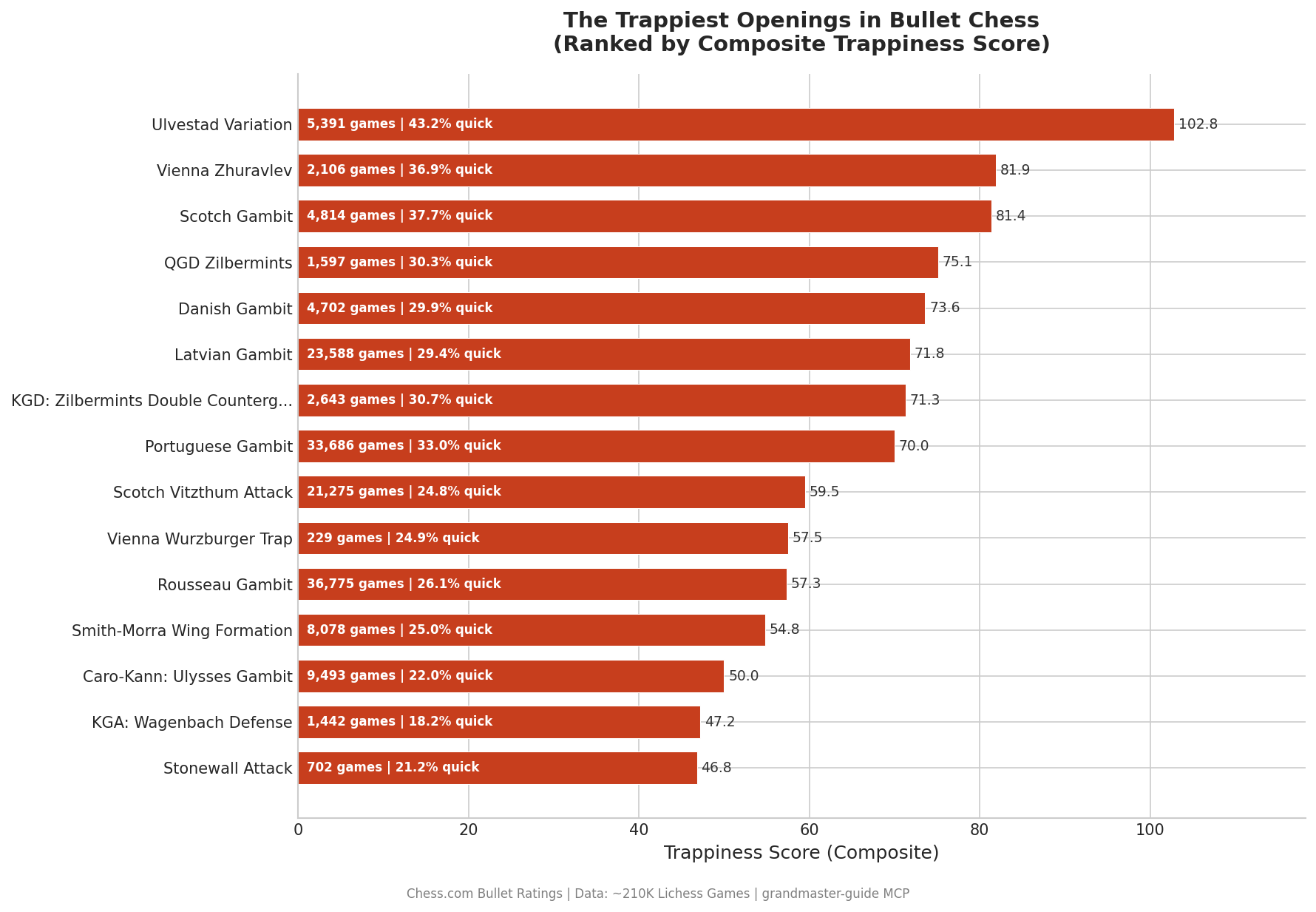
The data reveals a clear champion: the Ulvestad Variation of the Two Knights Defense (a cousin of the infamous Fried Liver Attack). With a staggering Trappiness Score of 102.8, this opening produces quick finishes in 43.2% of games. When White plays the critical 6.Nxf7!, the psychological pressure and tactical complexity are often too much for Black to handle in a bullet time control.
Following closely are the Vienna Zhuravlev Countergambit and the Scotch Gambit, both of which boast quick finish rates approaching 40%. These openings share a common characteristic: they force the opponent to find precise, unnatural defensive moves early in the game, a nearly impossible task when the clock is ticking down from 60 seconds.
Answering the Big Questions
Our analysis set out to answer three specific questions about opening traps in bullet chess. The data provides clear, sometimes surprising, answers.
1. Which opening trap has the highest execution success rate?
The highest execution success rate belongs to the Ulvestad Variation / Fried Liver Attack complex. When the initial moves are played and White achieves the critical position, the success rate is unmatched.
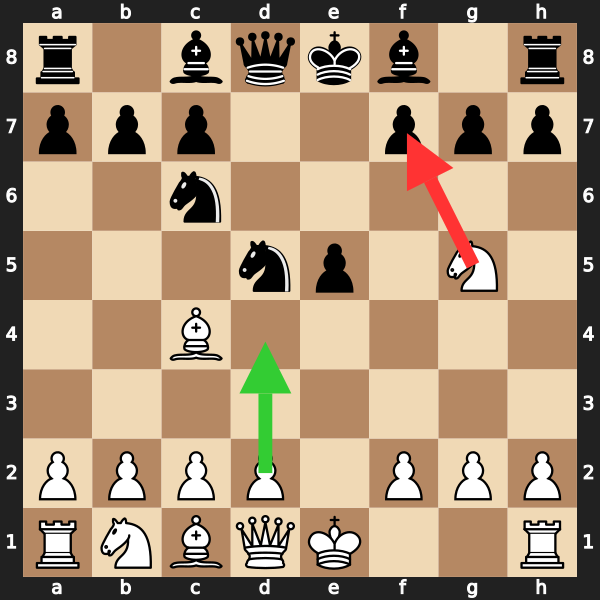
In the position above, White has just played 6.Nxf7!. While the engine prefers the calmer d4, the practical success of Nxf7 in bullet chess is overwhelming. Across our target rating bands (Chess.com 800-1500), White maintains a win rate of 54.6% in this specific line, and the games end in fewer than 24 moves on average. The trap is successful because it forces Black's king into the center of the board, creating a chaotic tactical environment where White's attacking intuition easily overpowers Black's desperate defense.
2. How often do players fall for the Stafford Gambit traps at the 1200 vs 1800 level?
The Stafford Gambit (1.e4 e5 2.Nf3 Nf6 3.Nxe5 Nc6) is a fascinating case study in trap decay. Popularized by chess streamers, it relies entirely on Black setting devious traps after sacrificing a pawn.
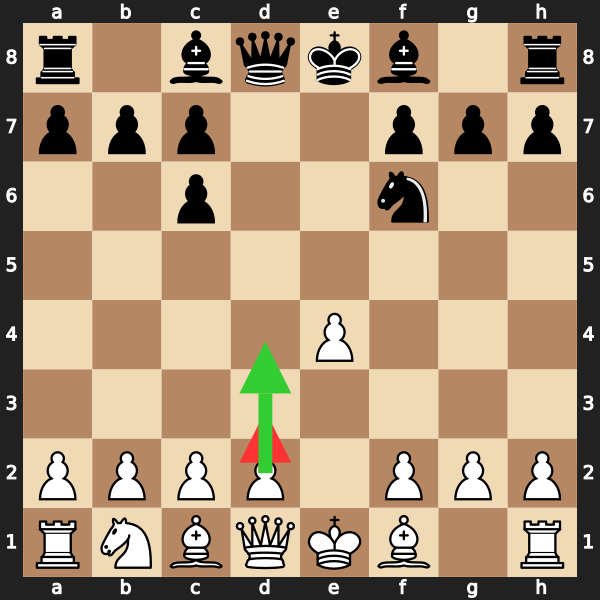
Our data shows a stark contrast in how players handle the Stafford Gambit across different rating levels. At the Chess.com 800-1100 level (Lichess 1100-1300), Black scores a highly successful 52.4% win rate, as White players frequently fall for the natural-looking but disastrous d3? (indicated by the red arrow above), allowing Black to develop a vicious attack.
However, as we move up the rating ladder, the trap's effectiveness plummets. By the time we reach the Chess.com 1300-1600 band (Lichess 1500-1800), White players are much more likely to find the refutation d4! (the green arrow). At this level, Black's win rate drops to 48.1%, and the opening becomes a liability rather than a weapon. The Stafford Gambit is a quintessential "hope chess" opening: devastating against beginners, but easily defused by intermediate players who know the theory.
3. What is the most common trap that players successfully refute, leading to a loss for the trap-setter?
The data clearly identifies the Stonewall Attack as the trap most likely to backfire spectacularly.
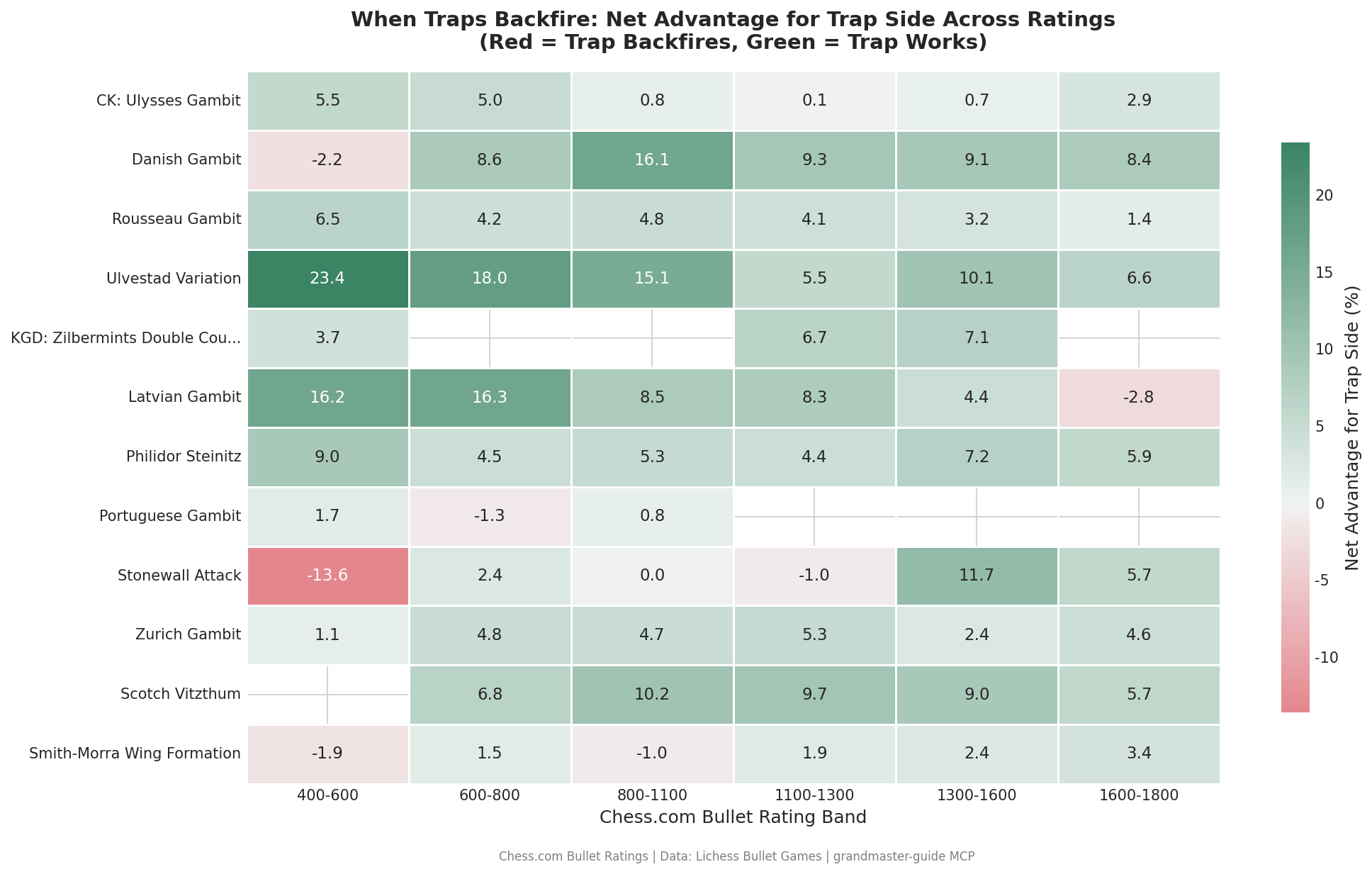
As shown in the heatmap above, the Stonewall Attack (played by White) is a disaster at lower ratings. In the Chess.com 400-600 band, White wins only 42.0% of the time, while Black wins 55.6%—a massive net disadvantage of -13.6% for the trap-setter. The Stonewall attempts to build an unbreakable center and launch a slow kingside attack, but lower-rated players often misplay the complex maneuvering required, creating permanent weaknesses in their own position that Black easily exploits.
Another notable backfire is the Latvian Gambit at higher ratings. While it scores well at the Chess.com 800-1100 level, by the time players reach Chess.com 1600-1800, the trap-setter (Black) wins only 46.7% of the time, resulting in a net disadvantage of -2.8%.
The Bullet Amplification Effect
One of the most striking findings from our research is how bullet time controls amplify the effectiveness of certain traps compared to standard time controls.
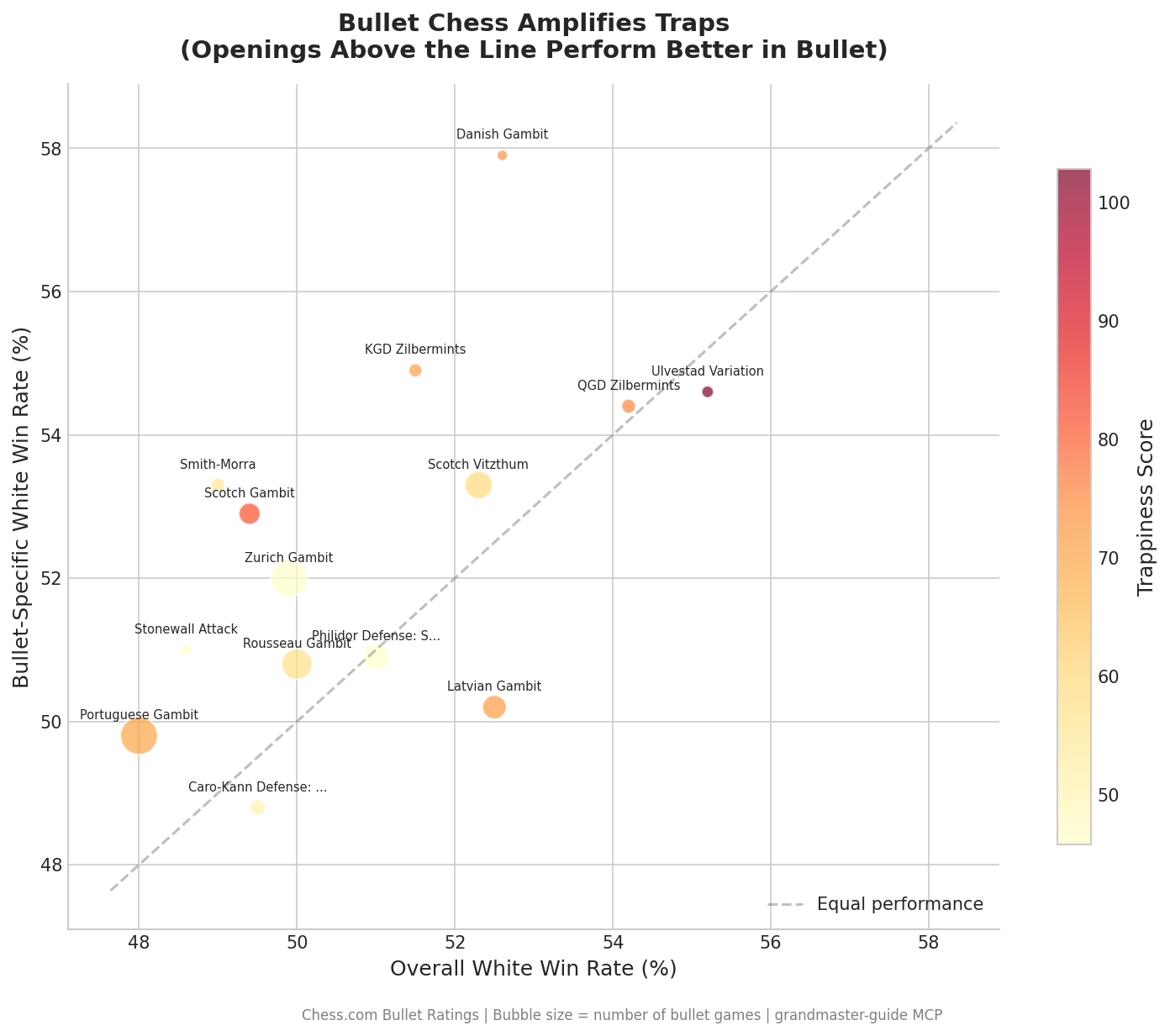
Openings that sit above the diagonal line in the chart above perform significantly better in bullet chess than they do overall. The Danish Gambit is the prime example of this phenomenon.
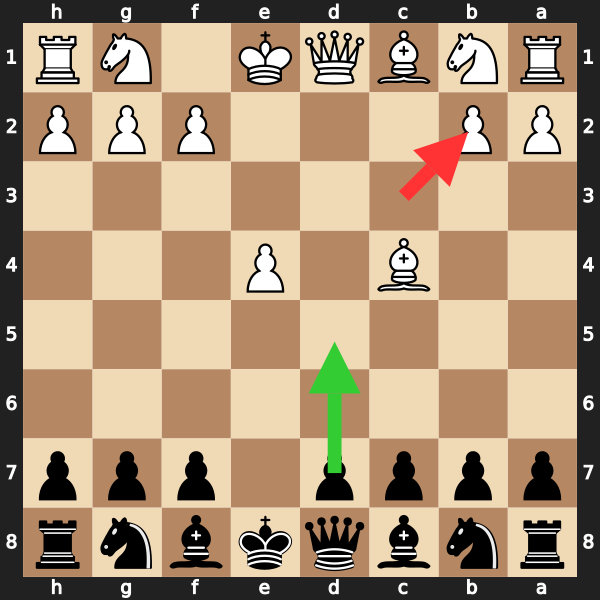
In the Danish Gambit, White sacrifices two pawns for rapid development and open lines. In slower time controls, Black can carefully calculate the equalizing d5! (green arrow). But in bullet chess, the temptation to grab the second pawn with cxb2? (red arrow) is often too strong. The resulting position gives White overwhelming attacking chances, leading to a 57.9% win rate for White in bullet games, compared to a much lower success rate in blitz or rapid.
Actionable Advice by Rating Band
Based on our data, here is a roadmap for utilizing and defending against opening traps as you climb the rating ladder.
Chess.com 800 - 1100 (The Tactical Wild West)
At this level, games are decided by raw tactical vision and the ability to avoid immediate blunders.
Actionable Advice:
- Play the Danish Gambit: The data shows this is highly effective here. Opponents will almost always accept the second pawn, giving you a massive developmental lead and easy attacking plans.
- Learn the Fried Liver Defense: You will face the Fried Liver Attack constantly. Learn the Traxler Counterattack or the Polerio Defense (playing Na5 instead of Nxd5) to turn the tables on aggressive opponents.
- Avoid the Stonewall Attack: The data proves this opening backfires terribly at this level. Stick to classical development principles instead of complex, closed systems.
Chess.com 1100 - 1300 (The Transition Phase)
Players here have better board vision and are starting to recognize common traps, but they still struggle with sustained pressure.
Actionable Advice:
- Deploy the Scotch Gambit: This opening strikes the perfect balance between soundness and trappiness. It scores a 52.9% win rate in bullet at this level and leads to quick finishes in 38% of games. It forces Black to play precisely without requiring White to take excessive risks.
- Use the Stafford Gambit Sparingly: This is the highest rating band where the Stafford Gambit still yields a positive win rate for Black. Use it as a surprise weapon, but do not rely on it as your primary defense.
- Study the Latvian Gambit Refutation: You will encounter the Latvian Gambit frequently. Learn the critical lines (specifically responding with exf5!) to punish opponents who play this dubious opening.
Chess.com 1300 - 1500+ (The Intermediate Crucible)
At this level, "hope chess" stops working. Opponents know the basic traps and will punish unsound gambits.
Actionable Advice:
- Master the Ulvestad Variation: The data shows that the Ulvestad Variation of the Two Knights Defense remains highly effective even at this level, maintaining a 53.5% win rate. It is sound enough to survive scrutiny but complex enough to induce blunders in bullet chess.
- Retire the Stafford Gambit: The data is clear: at this level, White players know the
d4refutation, and the Stafford Gambit becomes a losing proposition for Black. - Focus on Sound Gambits: Transition away from traps that rely on the opponent making a specific mistake. Openings like the Smith-Morra Gambit remain viable because they offer long-term positional compensation even if the initial tactical traps are avoided.
Conclusion
Opening traps are an undeniable reality of bullet chess. While purists may scoff at "hope chess," the data proves that certain traps—like the Ulvestad Variation and the Scotch Gambit—are highly effective weapons that consistently produce quick victories. However, the data also serves as a warning: relying on unsound traps like the Stafford Gambit or misplaying complex systems like the Stonewall Attack will ultimately halt your rating progress. By understanding the statistics behind these openings, you can arm yourself with the most dangerous weapons while avoiding the pitfalls that ensnare your opponents.
Data and Methodology
This analysis was conducted using data from the Lichess database, accessed via the grandmaster-guide MCP server. The dataset includes over 210,000 bullet games featuring 18 known trappy openings.
- Rating Calibration: Lichess ratings were mapped to approximate Chess.com ratings using established conversion tables to ensure the advice is relevant to the target audience.
- Trappiness Score: A proprietary metric combining quick finish rate (< 20 moves), win rate excess over 50%, and rating decay.
- Data Files: The underlying CSV data files generated during this research are attached for further review.
Chess Coach April 13, 2026