Have you ever lost a frustrating game, immediately clicked "New Game" to win your rating points back, and found yourself playing even worse? Or perhaps you won three games in a row and felt invincible, only to blunder your queen in the fourth?
Every chess player experiences streaks. But how much do these streaks actually affect our objective playing strength? Does "tilt" exist in the data, or is it just a psychological excuse for a bad day?
To answer these questions, we analyzed over 226,000 Rapid games played on Lichess, focusing on players with Chess.com ratings between 800 and 1500. By tracking the exact same players across consecutive games, we measured how their win rates and move accuracy (Centipawn Loss) changed immediately after winning or losing streaks.
The data reveals a stark reality: tilt is real, momentum is powerful, and the "revenge rematch" is almost always a terrible idea.
The Streak Advantage: Winners Keep Winning
The most fundamental question is whether the outcome of your previous games predicts the outcome of your next one. The data shows a clear divergence in performance based on recent results.
When a player enters a game on a two-game winning streak, their baseline win rate for the next game elevates above 50%. Conversely, entering a game on a two-game losing streak depresses the expected win rate below 50%.
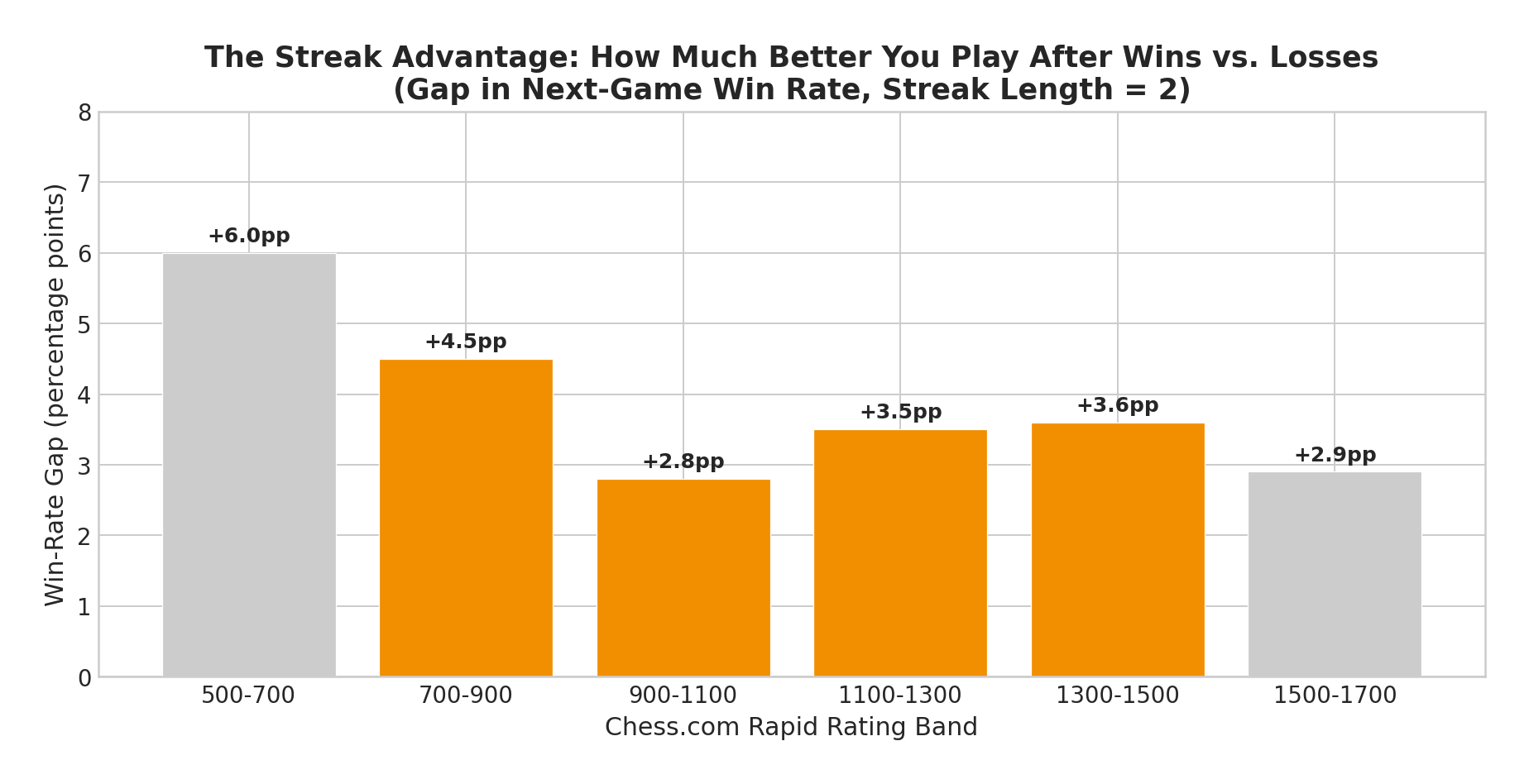
This "Win-Rate Gap" is most pronounced at lower ratings. For players in the 700-900 Chess.com range, the gap is a massive 4.5 percentage points. A player on a win streak wins 52.8% of their next games, while a player on a loss streak wins only 48.3%. As players improve toward the 1300-1500 range, the gap narrows slightly to 3.6 percentage points, suggesting that stronger players are marginally better at compartmentalizing previous results.
The Tilt Curve: The Danger of the "One More Game" Mentality
While a two-game losing streak is damaging, the real danger lies in the compounding effect of continuous losses. We mapped the "Tilt Curve" to show how win rates collapse as a losing streak extends from two games to five games.
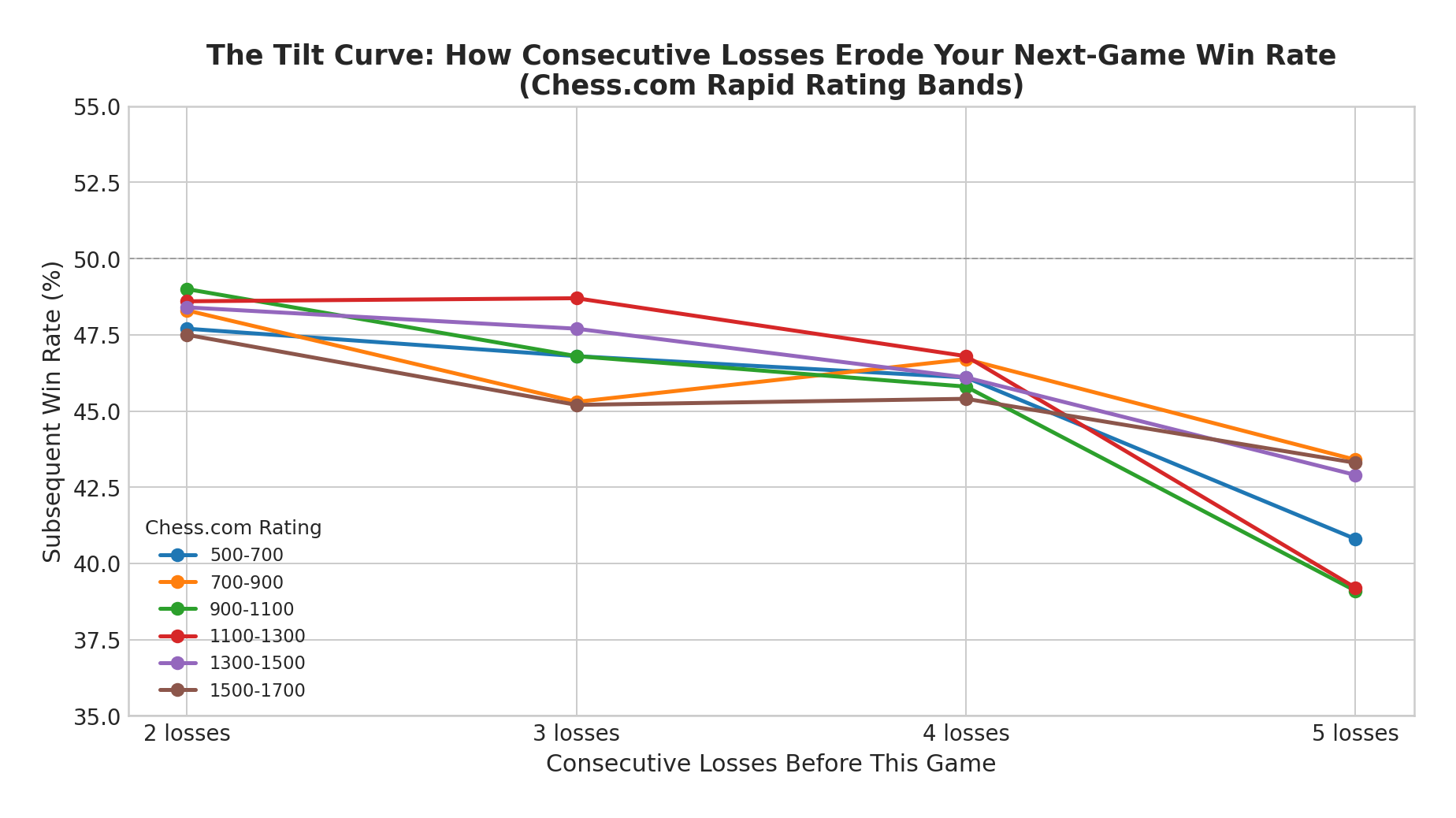
The collapse is dramatic. For a player rated 900-1100 on Chess.com, their win rate drops from 49.0% after two losses to a dismal 39.1% after five consecutive losses. This 9.9 percentage point drop represents a complete breakdown in playing strength. The 1100-1300 bracket suffers a similarly severe 9.4 point drop.
Interestingly, players in the 1500-1700 bracket show more resilience, with their win rate only dropping by 4.2 points after five losses. This indicates that emotional regulation and tilt management are measurable skills that improve alongside tactical vision and positional understanding.
Momentum: Riding the Wave
If losing streaks drag you down, do winning streaks lift you up? The data confirms that momentum is a powerful force in Rapid chess.
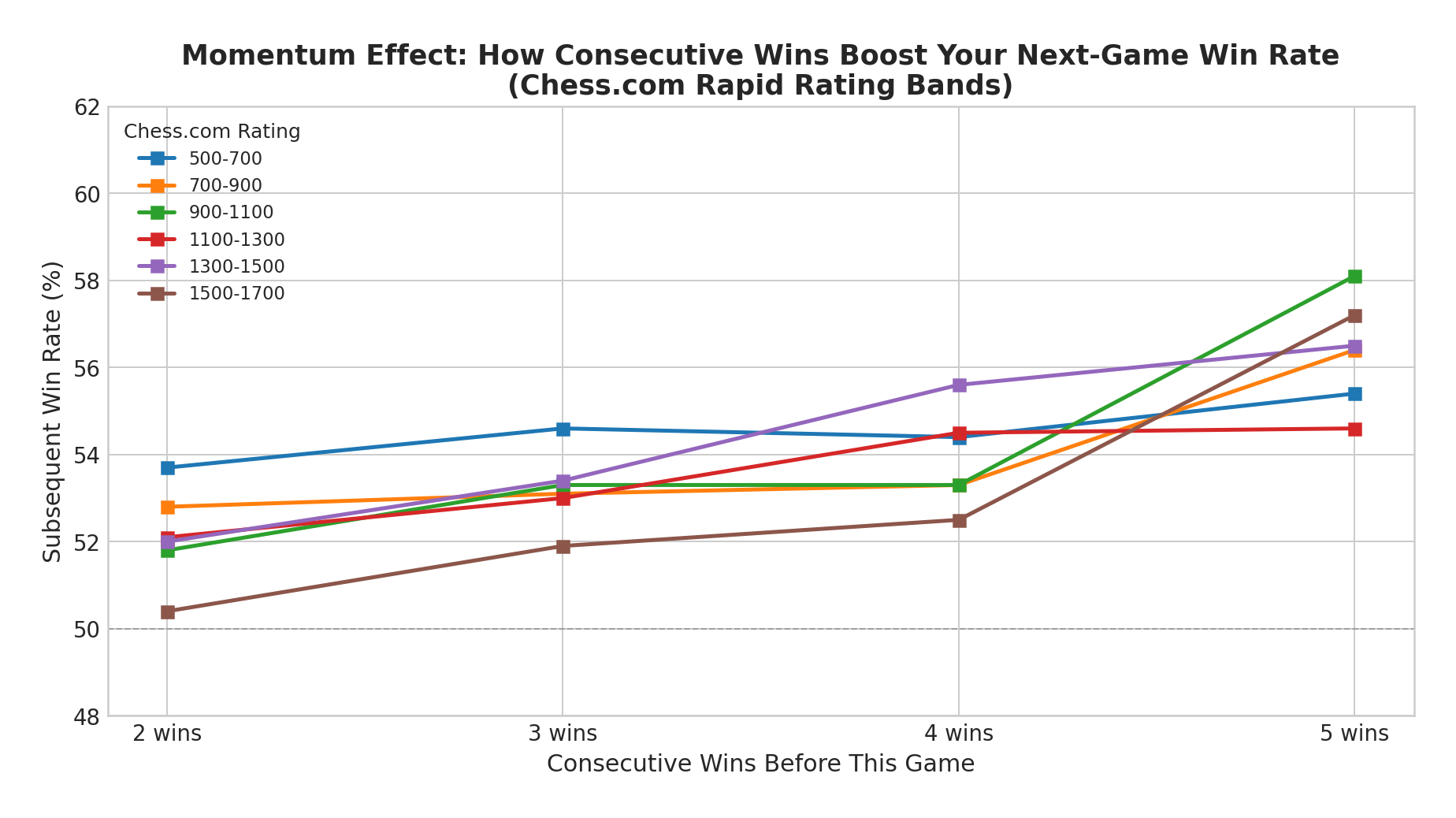
Unlike the Tilt Curve, which accelerates downward, the Momentum Curve shows a steady climb. Players who string together four or five wins consistently perform above a 54% win rate in their subsequent games. The confidence gained from recent victories translates directly into better over-the-board performance.
The Anatomy of Tilt: Why Do We Play Worse?
To understand why win rates diverge so sharply, we must look at move quality. Using Stockfish 17 evaluations, we measured the average Centipawn Loss (CPL) change for players entering games on streaks.
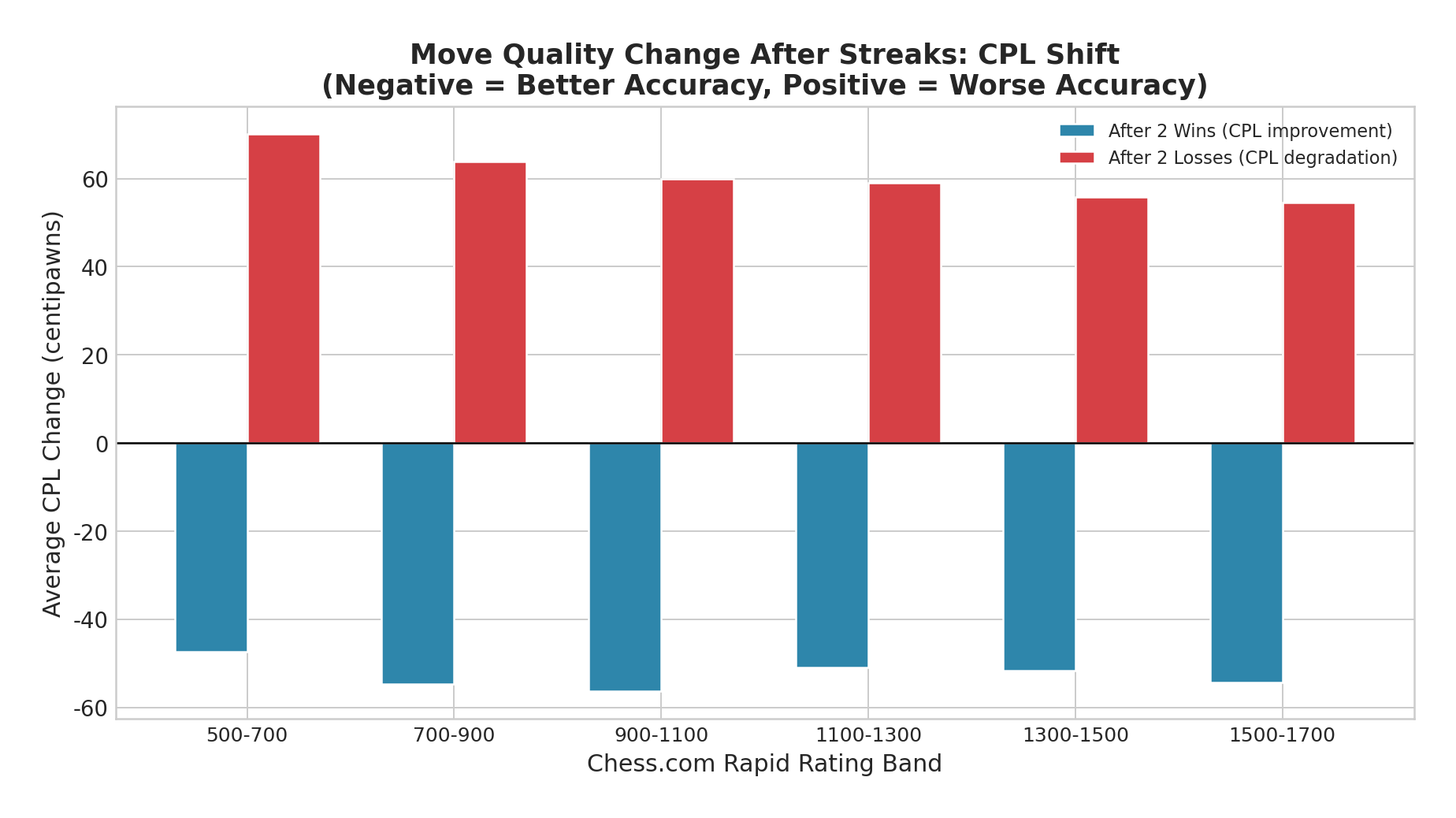
The engine evaluations confirm what we feel intuitively. After two consecutive losses, players play significantly worse, bleeding an additional 55 to 70 centipawns per move compared to their baseline. This is the equivalent of making an extra inaccuracy every single move.
Conversely, after two wins, players play with heightened accuracy, improving their CPL by 47 to 56 points. The total swing in move quality between a "winning mindset" and a "losing mindset" is over 100 centipawns—a massive difference that easily explains the diverging win rates.
Visualizing Tilt vs. Momentum
What does this 100-centipawn swing look like on the board? It often manifests in how players handle tension and calculate forcing variations.
The Tilt Blunder (Premature Attack) A tilted player is often impatient, seeking a quick knockout to avenge their previous losses. In this common scenario, White lashes out with an unsupported knight jump, ignoring development and king safety.
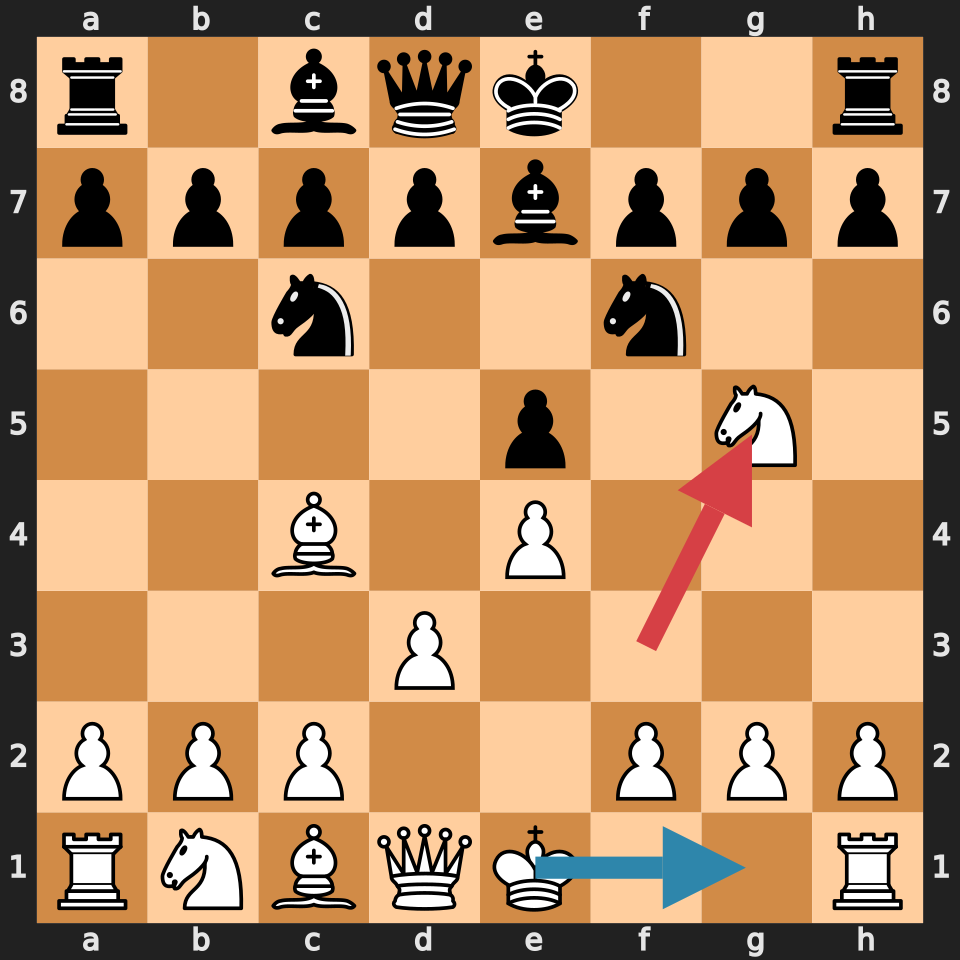 Instead of the solid castling move (blue arrow), the tilted player lunges forward with Ng5 (red arrow), a premature attack that will be easily repelled.
The Momentum Move (Calm Consolidation) A player riding a win streak is more likely to trust their position and play objectively. They don't feel the need to force the issue.
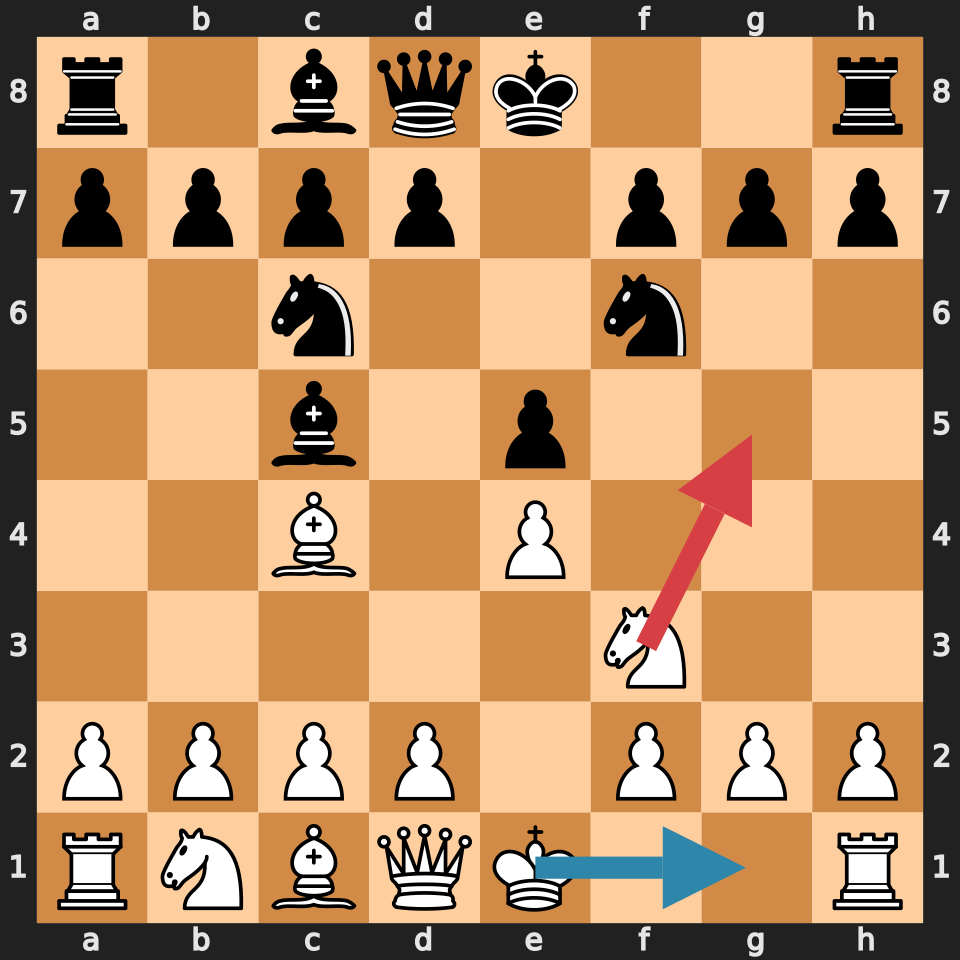 The confident player calmly castles (blue arrow), completing development and preparing for a sustained middlegame battle, rather than rushing an attack.
The Revenge Rematch: A Statistical Trap
Perhaps the most actionable finding in the entire dataset relates to immediate rematches. When you lose a game, the urge to challenge the same opponent to a rematch is overwhelming. You want to prove the loss was a fluke.
The data strongly advises against this.
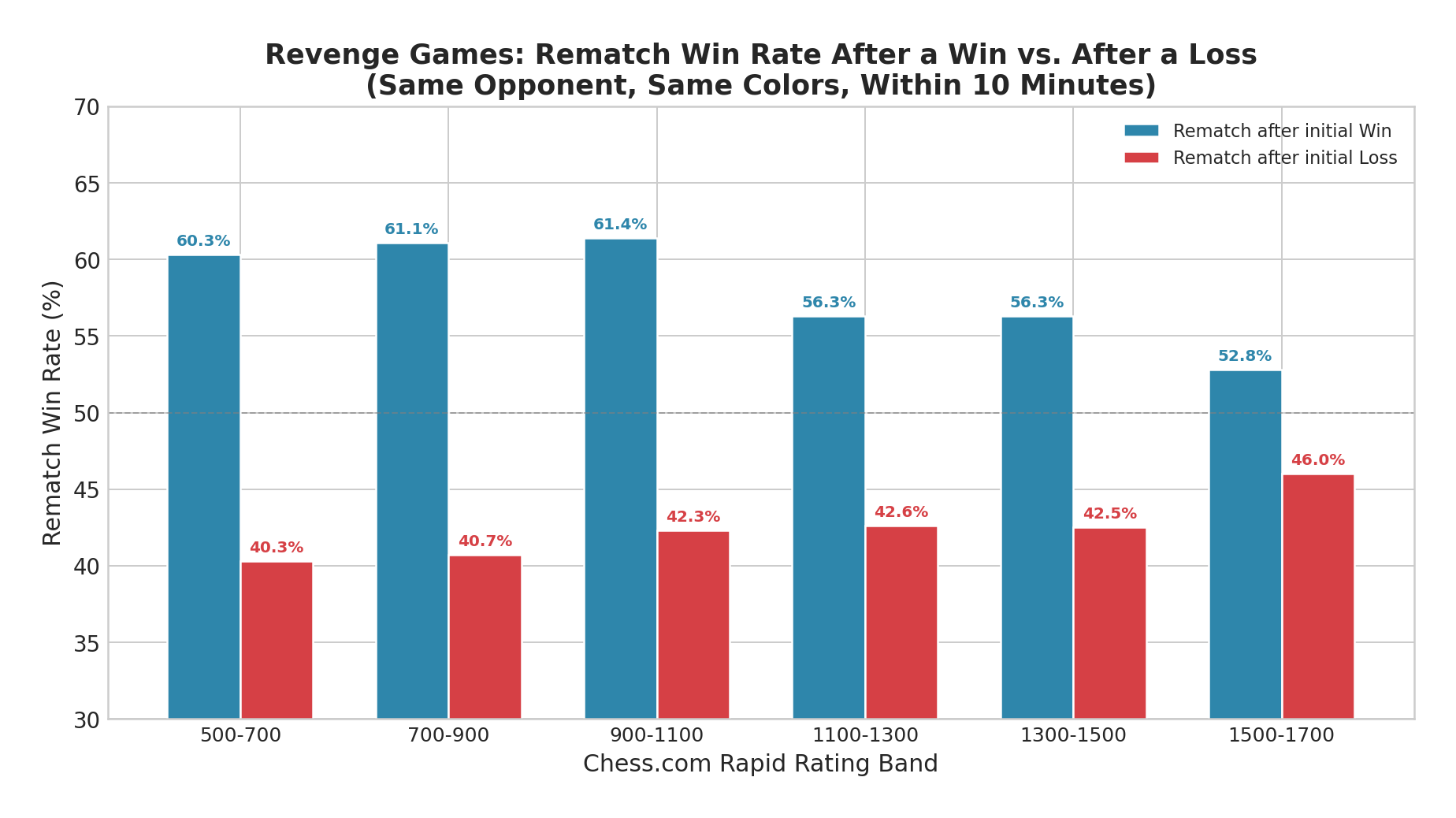
When a player loses a game and immediately plays a rematch against the same opponent, they only win the rematch between 40.3% and 46.0% of the time. The player who won the first game has a massive psychological advantage, winning the rematch over 56% of the time in most rating bands.
The "revenge game" is a statistical trap. You are entering the game tilted, against an opponent who is riding the momentum of having just beaten you.
Actionable Advice for Climbing the Ranks
Based on this analysis of over 250,000 Rapid games, here is a data-driven roadmap for managing streaks and improving your rating:
- Implement the "Two-Loss Rule": The data shows that performance degrades significantly after two consecutive losses, and collapses entirely by five losses. If you lose two Rapid games in a row, stop playing rated games for at least 30 minutes.
- Never Play the Revenge Rematch: If you lose, decline the rematch. You are statistically highly likely to lose again. If you win, accepting a rematch is statistically favorable for you.
- Ride the Wave, But Stay Humble: If you are on a winning streak, keep playing. Your accuracy is measurably higher, and your expected win rate is elevated. However, be aware that overconfidence can lead to the same premature attacks as tilt.
- Focus on Objective Evaluation: When returning from a loss, consciously remind yourself to play solid, developing moves. The data shows that tilted players bleed centipawns through impatient, suboptimal decisions.
By understanding the mathematics of momentum and tilt, you can stop bleeding rating points on your bad days and maximize your gains on your good days.
Data and Methodology
This analysis is based on a dataset of 226,165 streak-qualifying Rapid games and 29,299 immediate rematch games sourced from the Lichess database via the Grandmaster Guide MCP.
All rating bands in the charts and text have been mapped to their approximate Chess.com Rapid equivalents to provide actionable context for the target audience. The mapping adjusts Lichess ratings downward by approximately 200-300 points in this range (e.g., Lichess 1100-1300 is mapped to Chess.com 900-1100).
The underlying aggregated data used to generate these insights is available in the attached CSV files:
streak_effects_rapid.csv: Contains win/draw/loss rates and CPL changes for streaks of length 2-5 across all rating bands.rematch_outcomes_rapid.csv: Contains win/draw/loss rates for immediate rematches based on the outcome of the initial game.
Chess Coach <2026-04-14>