A data-driven guide for intermediate players (800–1500 Chess.com Bullet) on bouncing back from early tournament losses.
Every tournament player knows the feeling: you join an arena, the first pairing pops up, and within thirty seconds you’ve blundered a piece, flagged in a drawn endgame, or fallen for a cheap trap. The tournament has barely begun, but your motivation is already gone.
In Swiss-system tournaments, losing the first round to get easier pairings in subsequent rounds is jokingly called the "Swiss Gambit." But does this concept hold up in the chaotic, fast-paced world of Lichess Bullet Arenas? If you lose Round 1, what are your actual mathematical chances of recovering to finish in the top 10% of your rating cohort?
To answer this, we analyzed 45,742 player performances across 130 recent Lichess Hourly Bullet Arenas. We mapped the Lichess ratings to their Chess.com equivalents [1] and broke the data down into 200-point rating bands from 800 to 1500.
Here is what the data reveals about the Swiss Gambit—and how you can use it to climb the arena leaderboards.
1. The Myth of the Swiss Gambit at Lower Ratings
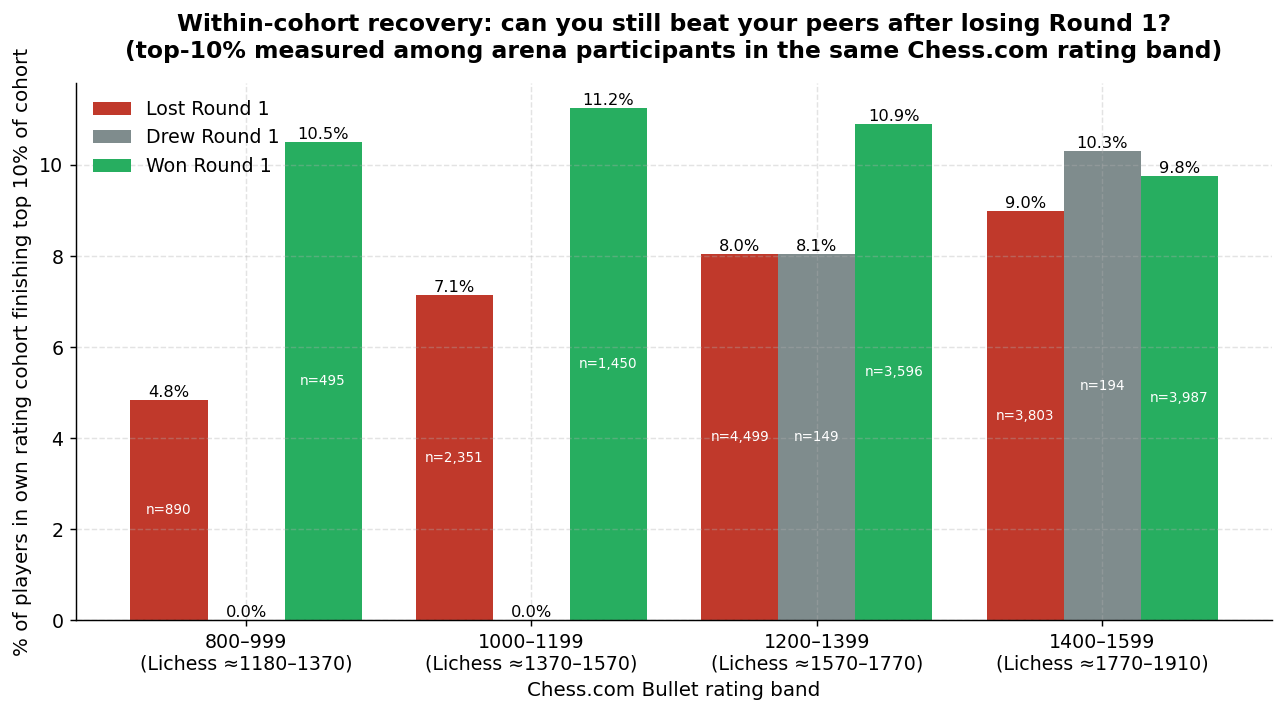
The most striking finding from the data is that the "Swiss Gambit" is largely a myth for players below 1200 Chess.com. At these levels, a Round 1 loss is highly predictive of a poor overall tournament finish.
However, as players improve, their resilience increases dramatically. By the time you reach the 1400–1599 band, the gap between Round 1 winners and losers narrows significantly.
| Chess.com Bullet Band | Top-10% Finish Rate After R1 LOSS | Top-10% Finish Rate After R1 WIN | Relative Lift (Win vs. Loss) |
|---|---|---|---|
| 800–999 | 4.8% | 10.5% | 2.17× |
| 1000–1199 | 7.1% | 11.2% | 1.57× |
| 1200–1399 | 8.0% | 10.9% | 1.35× |
| 1400–1599 | 9.0% | 9.8% | 1.08× |
(Note: "Top-10% Finish Rate" here measures the percentage of players who finished in the top 10% of their own rating cohort within the arena, ensuring a fair comparison against peers of similar strength.)
Actionable Advice by Rating Band
For the 800–1199 Player: If you are in this bracket, your primary goal in Round 1 is simply to survive. The data shows that players who win Round 1 are roughly twice as likely to finish in the top 10% of their cohort as those who lose. At this level, a Round 1 loss often triggers "tilt"—a cascade of fast, emotional play that leads to further losses. If you lose Round 1, take a deep breath, pause the arena for 30 seconds, and reset. You are fighting against a statistical headwind, but a 5–7% recovery rate means it is still entirely possible to bounce back if you regain your composure.
For the 1200–1599 Player: Welcome to the realm of true resilience. For players in the 1400–1599 band, the Swiss Gambit is almost a reality: players who lose Round 1 finish in the top 10% of their cohort 9.0% of the time, compared to 9.8% for Round 1 winners. At this level, players understand that bullet arenas are marathons, not sprints. A single loss is just a data point. Your actionable takeaway: never withdraw after a Round 1 loss. Your fundamentals are strong enough to grind back through the field.
2. The "Doom Loop": Why Round 2 is the Real Test
While Round 1 sets the tone, Round 2 is the crucible. We analyzed the combined outcomes of the first two rounds to see how consecutive results impact a player's chances of finishing in the top 25% of the entire arena field.
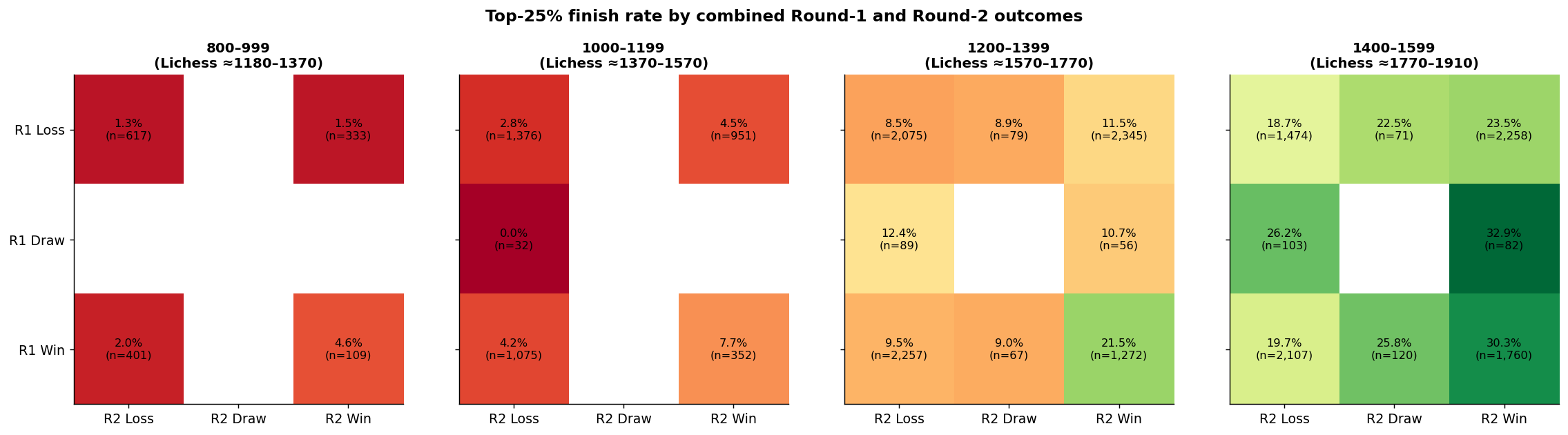
The heatmap above illustrates a brutal reality: the 0-2 start is the kiss of death. For example, in the 1400–1599 band, players who start with a Loss-Win sequence still manage to reach the top 25% of the arena an impressive 21.8% of the time. But players who start Loss-Loss? Their chances plummet to 16.2%. In the lower bands, a Loss-Loss start drops your top-25% chances to near zero.
Actionable Advice: The "Round 2 Reset"
If you lose Round 1, treat Round 2 as the most important game of the tournament. Play slightly more solidly. Avoid dubious gambits. Your goal is to stop the bleeding and get on the scoreboard. A Loss-Win start keeps you mathematically alive; a Loss-Loss start usually means you are playing for pride.
3. Anatomy of a Recovery: A Tale of Two Boards
To understand what a successful recovery looks like in practice, we isolated the games of a 1463 Chess.com (1813 Lichess) player who suffered a disastrous start but fought back to finish in the top 1.3% of a 391-player arena.
Their tournament began with a textbook bullet disaster.
The Round 1 Blunder: Tunnel Vision
In their very first game, playing Black, our subject reached the following position. White has just played dxe5.
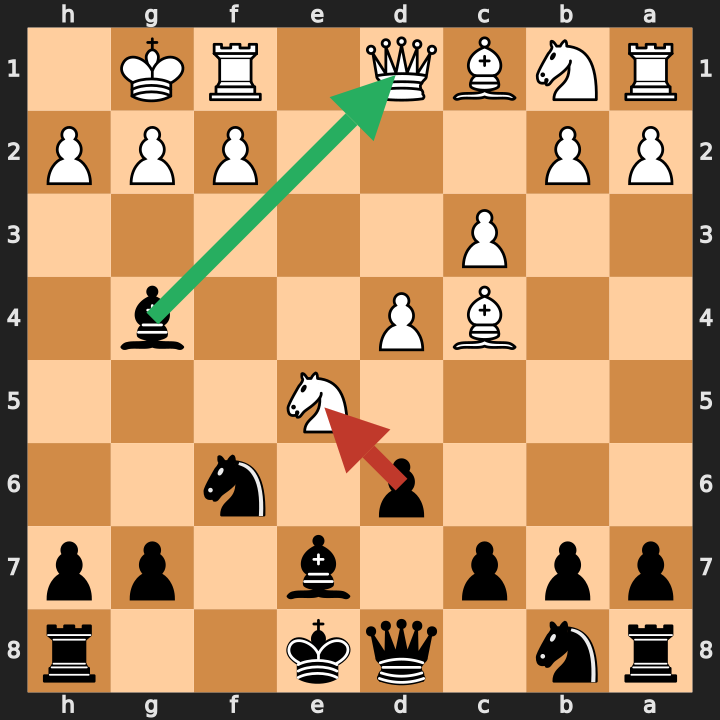
Black is already struggling (evaluation: -2.37), but the position is complicated. The engine's top choice is the forcing sequence ...Bxd1, trading queens and muddying the waters. Instead, playing quickly, Black recaptured with ...dxe5 (red arrow). This tunnel-vision recapture ignored the hanging bishop on g4, dropping the evaluation to a completely lost -7.23. Black went on to lose on time.
This player proceeded to lose their next three games, starting the arena 0-4. Most players would quit. Instead, they executed a perfect "Round 2 Reset" (in their case, a Round 5 reset).
The Recovery: Tactical Clarity
In their fifth game, the player finally found their footing. Reaching a complex endgame, they spotted a clean tactical sequence.
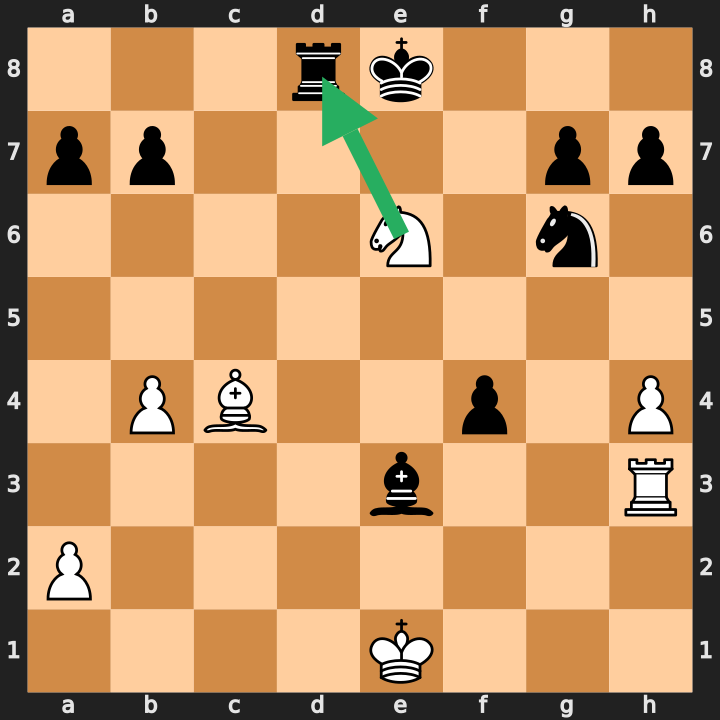
With seconds on the clock, White played Nxd8 (green arrow), executing a clean knight fork that snatched Black's rook and flipped a slight +1.05 advantage into a decisive +2.01 edge. White won the game, breaking the losing streak.
From that moment on, the player went on an absolute tear, winning 8 of their next 11 games—including a 5-game winning streak that triggered Lichess's double-point streak bonus—to finish 5th overall.
Conclusion: The Roadmap to Arena Success
The data from over 45,000 arena performances provides a clear roadmap for intermediate players looking to climb the tournament leaderboards:
- Respect the First Round (Especially if you are U1200): At lower ratings, a Round 1 loss is statistically difficult to overcome. Warm up before the arena starts to ensure you hit the ground running.
- Beware the 0-2 Doom Loop: If you lose Round 1, your primary objective in Round 2 is stabilization. Play solid, fundamental chess to get on the board.
- Embrace the Grind (If you are 1200+): As you approach the 1500 level, early losses matter less and less. Trust your fundamentals, rely on your speed, and remember that a 5-game winning streak later in the tournament can erase any early deficit.
The Swiss Gambit may not be a reliable strategy, but a Round 1 loss is never a reason to resign. Take a breath, reset the board, and play the next move.
Data and Methodology
- Data Source: 130 Lichess Hourly Bullet Arenas (Standard 1+0 time control) completed in April 2026.
- Sample Size: 45,742 competing player-tournaments.
- Rating Conversion: Lichess Bullet ratings were mapped to Chess.com Bullet ratings using the standard community conversion table [1].
- Analysis Tools: Python, Pandas, and Stockfish 14.1 for game evaluations.
Raw Data Files:
View full data →chesscom_band lichess_bullet_band round1_outcome n_player_tournaments pct_top10 pct_top25 pct_top50 avg_final_pct_rank median_final_pct_rank avg_final_score avg_n_games 800–999 1179–1366 loss 964 0.1037344398340249 1.3485477178423237 18.568464730290458 71.24301718362702 74.41311475409836 4.117219917012448 9.328838174273859 800–999 1179–1366 draw 19 0.0 0.0 5.263157894736842 70.22257917918793 77.89115646258503 2.1578947368421053 5.421052631578948 800–999 1179–1366 win 518 0.0 2.5096525096525095 28.185328185328185 58.27802799945888 59.549574871758836 5.926640926640927 9.411196911196912 1000–1199 1367–1568 loss 2351 0.04253509145044662 3.487877498936623 29.094002552105486 64.51318771003704 63.32537788385044 5.437260740110591 9.122075712462781 1000–1199 1367–1568 draw 44 0.0 0.0 20.454545454545457 63.527359840075206 62.85927584919746 3.6363636363636362 6.409090909090909
View full data →chesscom_band round1_outcome n_player_tournaments cohort_top10_pct cohort_top25_pct avg_cohort_pct 800–999 loss 890 4.831460674157303 18.202247191011235 59.60196952845326 800–999 draw 17 0.0 5.88235294117647 64.42339416763969 800–999 win 495 10.505050505050505 29.898989898989896 41.33141296732672 1000–1199 loss 2351 7.145895363675033 20.799659719268394 57.0031318293252 1000–1199 draw 44 0.0 9.090909090909092 62.396916073978566
View full data →chesscom_band round1_outcome round2_outcome n_player_tournaments pct_top10 pct_top25 avg_final_pct_rank 800–999 loss loss 617 0.0 1.2965964343598055 77.32573959866392 800–999 loss win 333 0.3003003003003003 1.5015015015015014 60.04013210421612 800–999 win loss 401 0.0 1.99501246882793 61.08032450315046 800–999 win win 109 0.0 4.587155963302752 48.29435472983305 1000–1199 loss loss 1376 0.07267441860465117 2.8343023255813953 70.66480736814532
View full data →chesscom_band n_player_tournaments pct_round1_loss pct_round1_draw pct_round1_win 800–999 1501 64.2238507661559 1.2658227848101267 34.51032644903398 1000–1199 3845 61.1443433029909 1.1443433029908971 37.711313394018205 1200–1399 8244 54.573022804463854 1.80737506065017 43.61960213488597 1400–1599 7984 47.63276553106213 2.429859719438878 49.937374749499
Chess Coach, April 20, 2026
References
[1] Project Rating Conversion Table: Mapping Lichess Bullet to Chess.com Bullet.