The Sicilian Defense (1.e4 c5) is notorious for producing some of the most complex, double-edged, and decisive games in chess. But how does this reputation hold up in the fast-paced world of Blitz? Does the Sicilian guarantee a long, grueling struggle, or is it a minefield of quick tactical blunders?
To answer this, we analyzed a dataset of over 13,000 raw Blitz games from Lichess, filtering specifically for the Sicilian Defense across various rating bands. We then calibrated these ratings to approximate Chess.com Blitz ratings (adjusting Lichess ratings down by roughly 200–300 points in this range) to provide actionable insights for players climbing from 800 to 1500.
This guide serves as a roadmap for intermediate players, highlighting what the data reveals about game lengths, common pitfalls, and how to adjust your strategy as you climb the rating ladder.
1. The Big Picture: How Long Do Sicilian Blitz Games Last?
The data reveals a clear and consistent trend: as rating increases, the average length of a Sicilian Blitz game increases.
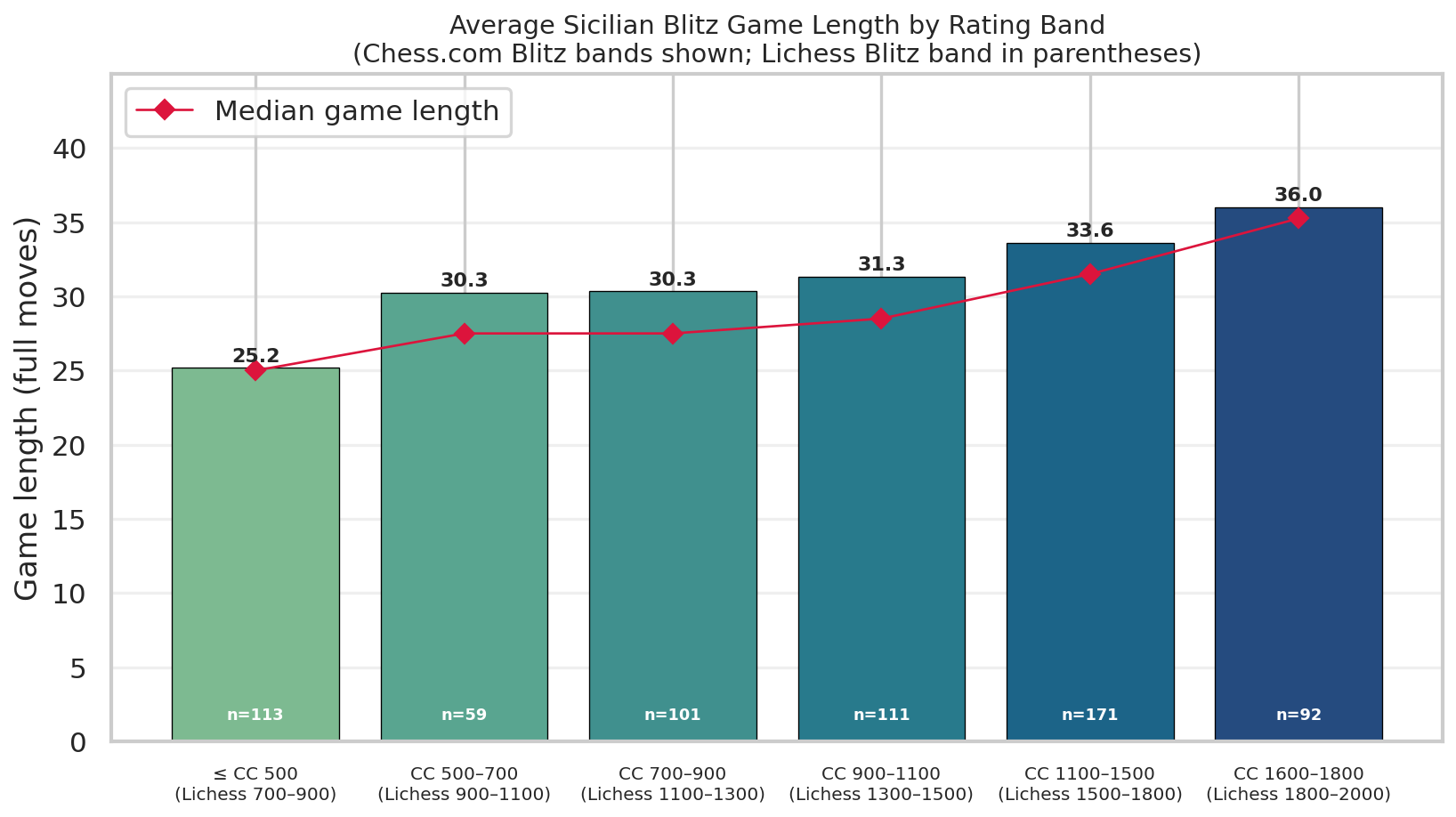
At the lowest rating bands (≤ CC 500), the average Sicilian game ends in just 25.2 full moves. However, as players improve their tactical vision and defensive resilience, the average length climbs steadily, reaching 33.6 moves in the CC 1100–1500 band and 36.0 moves in the CC 1600–1800 band.
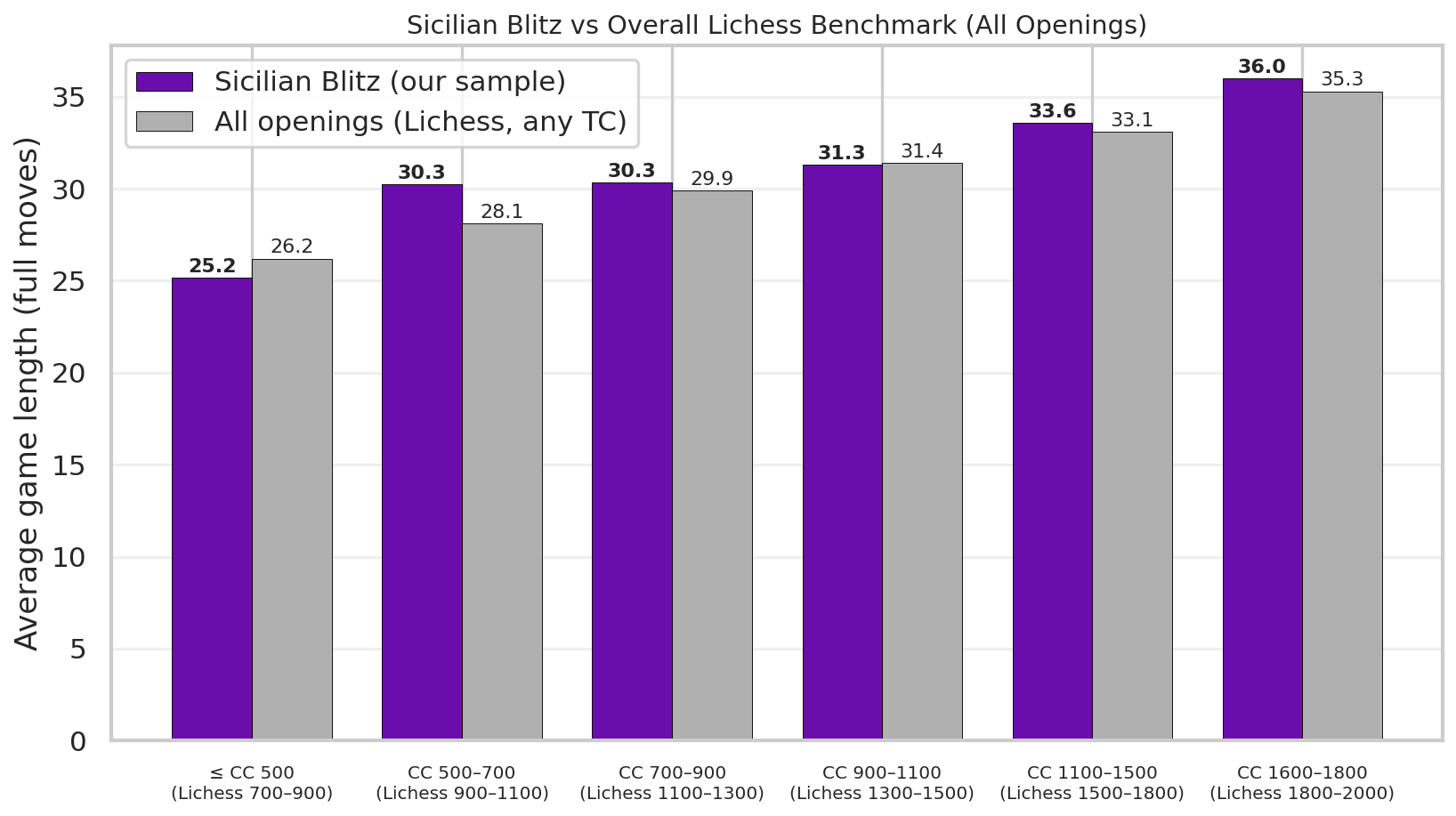
Interestingly, when compared to the overall average length of Blitz games across all openings, the Sicilian Defense consistently produces slightly longer games at the intermediate levels (CC 900 and above). This suggests that once players stop falling for immediate opening traps, the inherent complexity of the Sicilian leads to deeper middlegames and more frequent endgames.
2. The Anatomy of a Sicilian Game by Rating Band
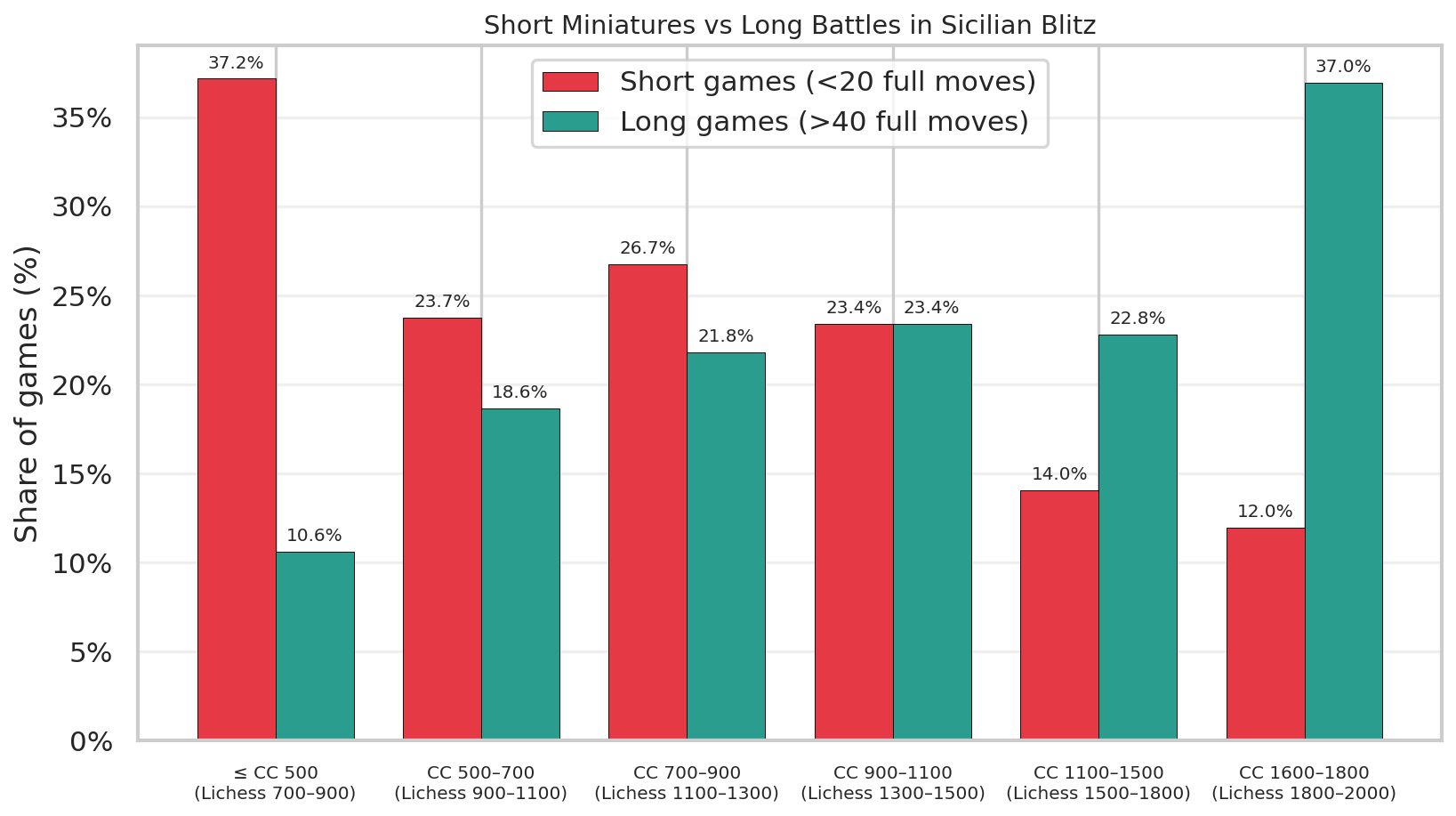
To truly understand the Sicilian experience, we must look beyond the averages and examine the distribution of game lengths. The data shows a stark contrast between "miniatures" (games ending in under 20 moves) and "long battles" (games extending past 40 moves).
The 800–1000 Band (Lichess 1200–1420)
In this band, the Sicilian is a volatile weapon. Nearly 27% of games end in under 20 moves. These miniatures are rarely the result of brilliant sacrifices; instead, they are typically decided by catastrophic blunders in the opening or early middlegame.
Actionable Advice: Prioritize opening safety and basic tactical awareness. If you play the Sicilian, focus on solid development rather than memorizing deep theory. If you face the Sicilian, be alert for early tactical opportunities, as your opponents are likely to overextend or leave pieces undefended.
The 1000–1200 Band (Lichess 1420–1565)
As players cross the 1000 threshold, the frequency of miniatures drops to around 23%, and the percentage of long games (40+ moves) rises to match it. Players here are better at surviving the opening, but they often struggle to convert advantages efficiently, leading to longer, messier games.
Actionable Advice: This is the phase where endgame skills begin to pay dividends. Since more games are extending past move 40, improving your technique in rook endgames and pawn races will give you a significant edge over opponents who only study opening traps.
The 1200–1500 Band (Lichess 1565–1780)
In this upper-intermediate range, the nature of the Sicilian shifts dramatically. Miniatures become rare (dropping to 14%), while long battles become the norm (nearly 23% of games). Players are well-versed in opening principles and can navigate the complex middlegames that the Sicilian produces.
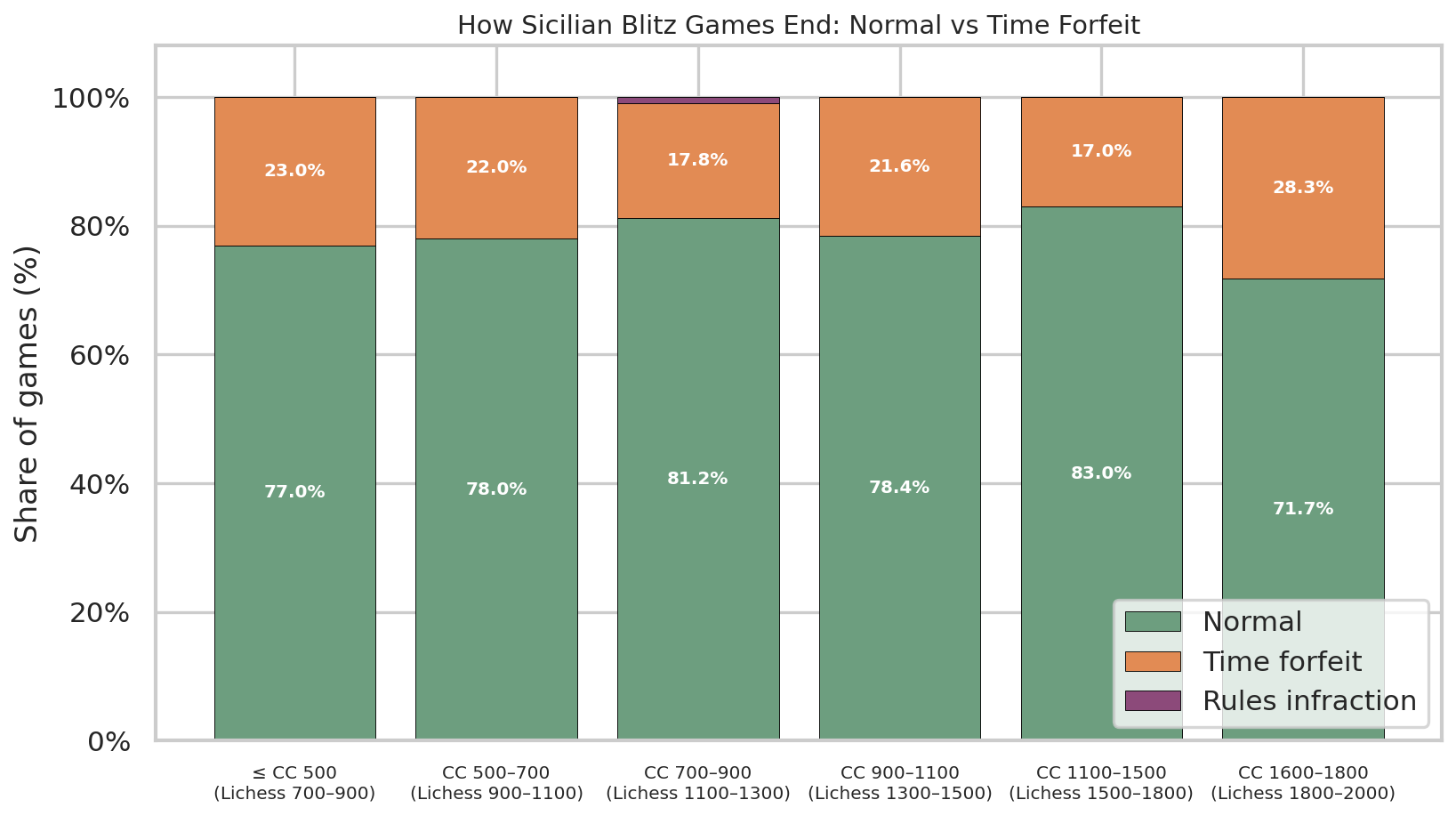
Actionable Advice: Time management becomes critical here. The data shows a significant increase in games decided by time forfeit in these longer battles. You must learn to play the opening and early middlegame efficiently to save time for the complex decisions that arise later.
3. Visualizing the Pitfalls: Miniatures vs. Grinds
To illustrate the difference between the rating bands, let's look at two typical scenarios found in our dataset.
The Early Blunder (Typical in 800–1000)
In the lower rating bands, games often end abruptly due to missed tactical patterns. A classic example is the Smith-Morra Gambit, where White sacrifices a pawn for rapid development.
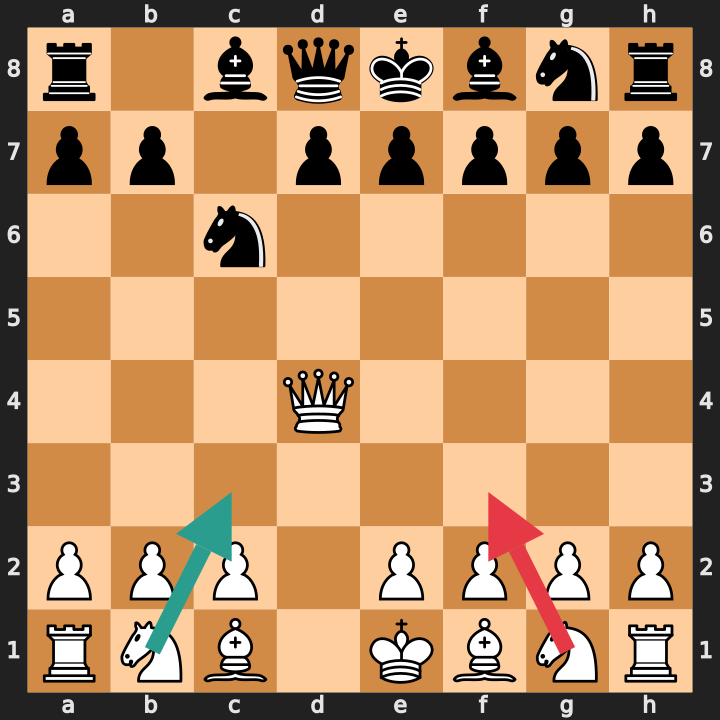
In this game from the CC 700–900 equivalent band, White played 4. Nf3??, completely missing that the Queen on d4 was under attack by the Knight on c6. Black simply played 4... Nxd4, and White resigned. The engine's preferred move, 4. Nc3, develops a piece while defending the center.
The Greed Trap (Typical in 1000–1200)
As players improve, they stop hanging queens outright but often fall victim to positional greed.
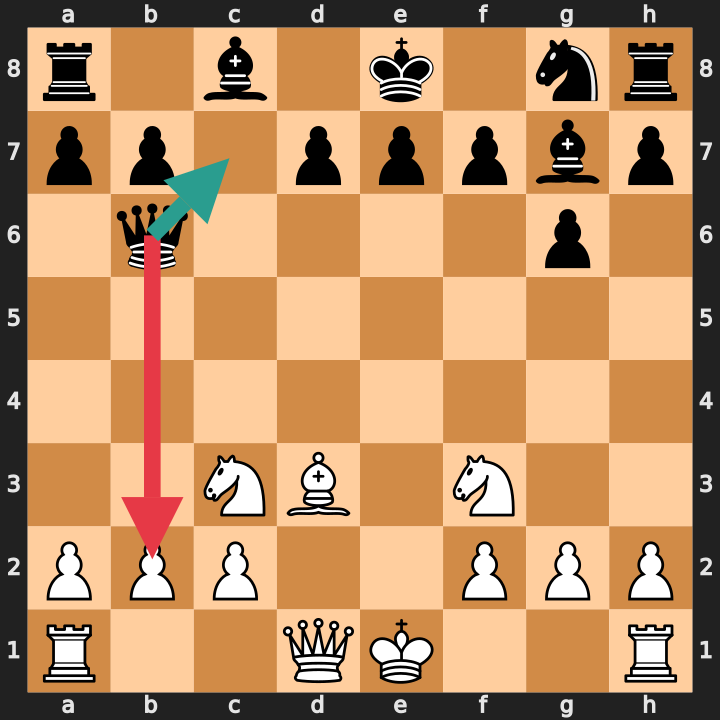
In this Hyperaccelerated Dragon game, Black played 10... Qxb2??, grabbing a poisoned pawn. While not immediately losing material, this move allows White to trap the Queen or launch a devastating attack. The engine prefers the safer retreat 10... Qc7. This type of error often leads to a long, agonizing defensive struggle that eventually ends in defeat.
4. Variation Matters: Which Sicilians Last Longest?
Not all Sicilians are created equal. Our analysis of specific variations reveals that the choice of opening significantly impacts game length.
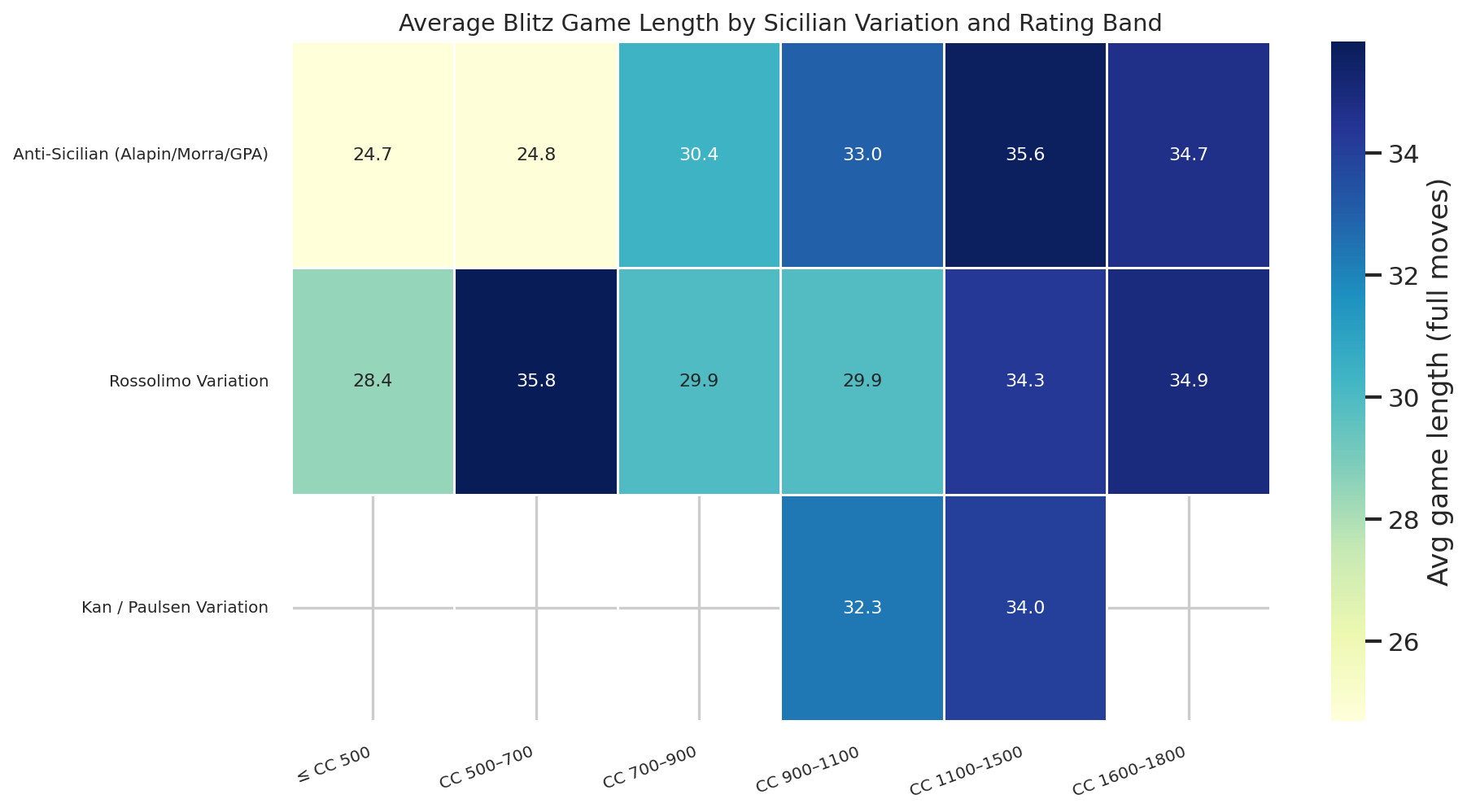
- Anti-Sicilians (Alapin, Smith-Morra, Grand Prix): These variations tend to produce slightly shorter games across all rating bands. They often lead to forcing lines and early tactical skirmishes, bypassing the slow maneuvering of the Open Sicilian.
- Rossolimo Variation: This solid, positional approach consistently produces longer games, especially in the 1100–1500 bands. It requires patience and strategic understanding rather than raw calculation.
- Kan / Paulsen Variations: These flexible setups also tend to result in longer, more maneuvering games, as the central tension is maintained for extended periods.
Actionable Advice: Choose your variation based on your strengths. If you excel in chaotic, tactical positions and want to pressure your opponent early, explore the Anti-Sicilians. If you prefer strategic maneuvering and endgame grinds, the Rossolimo or Kan might be better fits.
Data and Methodology
This analysis is based on a sample of over 13,000 raw Blitz games downloaded from the Lichess API, filtered for the Sicilian Defense (ECO B20-B99).
- Platform Calibration: Lichess ratings were mapped to approximate Chess.com Blitz ratings using a standard conversion table (e.g., Lichess 1200 ≈ CC 800; Lichess 1780 ≈ CC 1500).
- Game Length: Measured in "full moves" (plies divided by 2).
- Data Files: The underlying aggregated data used to generate these insights is available in the attached CSV files:
sicilian_blitz_band_summary.csvsicilian_blitz_variation_band.csvsicilian_blitz_termination.csvsicilian_blitz_length_histogram.csv
Chess Coach <2026-04-19>