For beginner and intermediate chess players, the "Stonewall" pawn structure—characterized by pawns locked on d4, e3, and f4 for White, or d5, e6, and f5 for Black—is a polarizing setup. It is often recommended as a "system" opening because the moves can be played almost regardless of the opponent's replies. But does this rigid, slow-developing structure actually work in the chaotic, time-scrambled environment of Bullet chess?
To answer this, we analyzed over 15,000 Lichess Bullet games across rating bands corresponding to Chess.com ratings from 600 to 1700. By tracking every game where the Stonewall structure was achieved within the opening phase, we can definitively see how the Stonewall Attack (White) and the Dutch Stonewall (Black) perform as players climb the rating ladder.
This guide serves as a roadmap for improvement, detailing the data behind the Stonewall and providing actionable advice for each rating segment.
The Data: Stonewall Win Rates by Rating
The most striking finding from the data is the massive disparity between White's Stonewall Attack and Black's Dutch Stonewall. While the pawn structures are mirrored, their practical effectiveness in Bullet chess is entirely different.
The Stonewall Attack (White)
When White successfully sets up the Stonewall Attack (pawns on d4, e3, f4), they enjoy a significant win-rate advantage over the baseline average for their rating band.
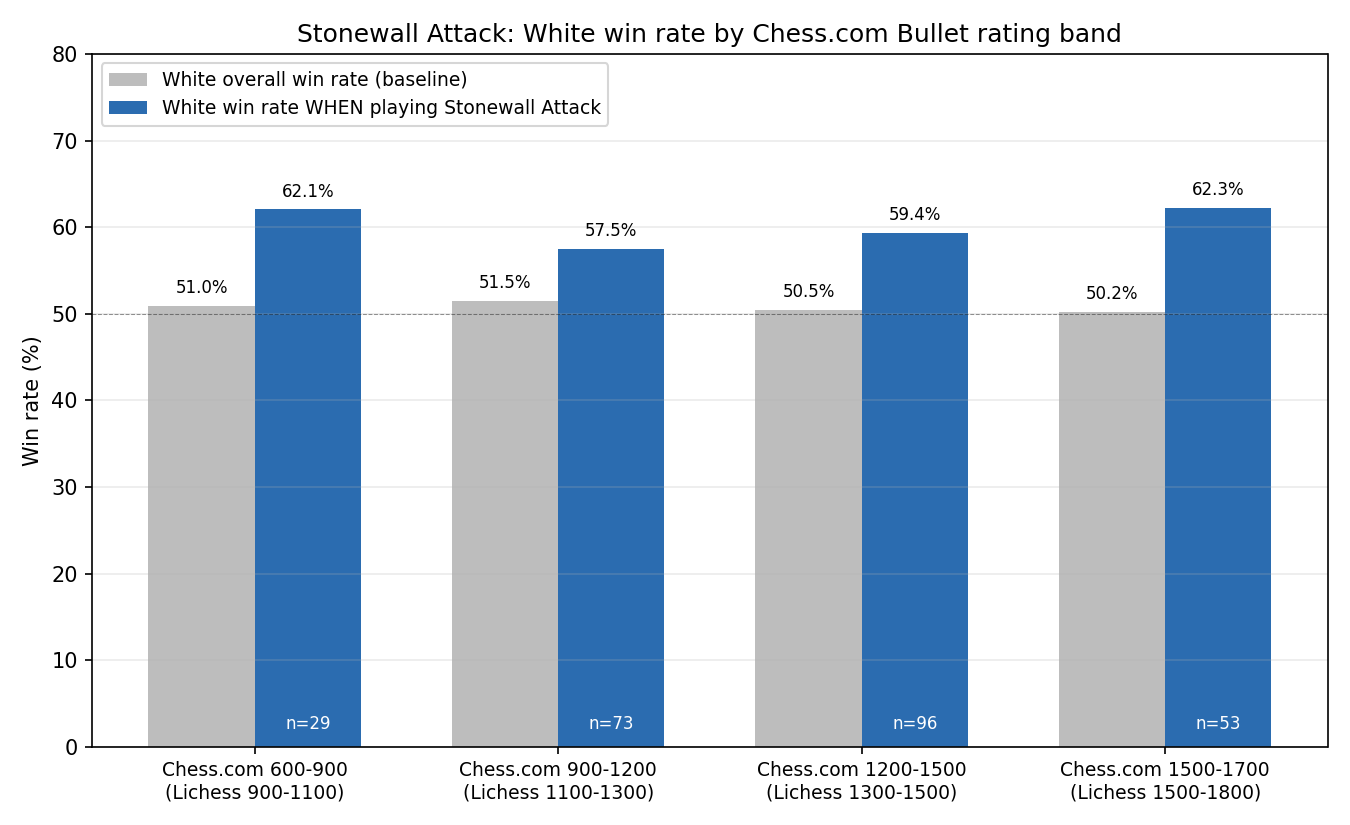
As the chart illustrates, White's win rate when playing the Stonewall Attack hovers around 60% across all beginner and intermediate bands, peaking at 62.3% in the 1500-1700 Chess.com range. This represents a massive +6 to +12 percentage point edge over the baseline White win rate.
Why is it so effective? In Bullet chess, the Stonewall Attack allows White to pre-move their opening setup safely. The resulting closed center restricts the opponent's counterplay, and White's clear, singular plan—swinging the knight to e5, lifting the rook via f3 to h3, and launching a kingside mating attack—is incredibly difficult to defend against with only seconds on the clock.
The Dutch Stonewall (Black)
Conversely, when Black attempts the mirrored setup (the Dutch Stonewall, with pawns on d5, e6, f5), the results are disastrous.
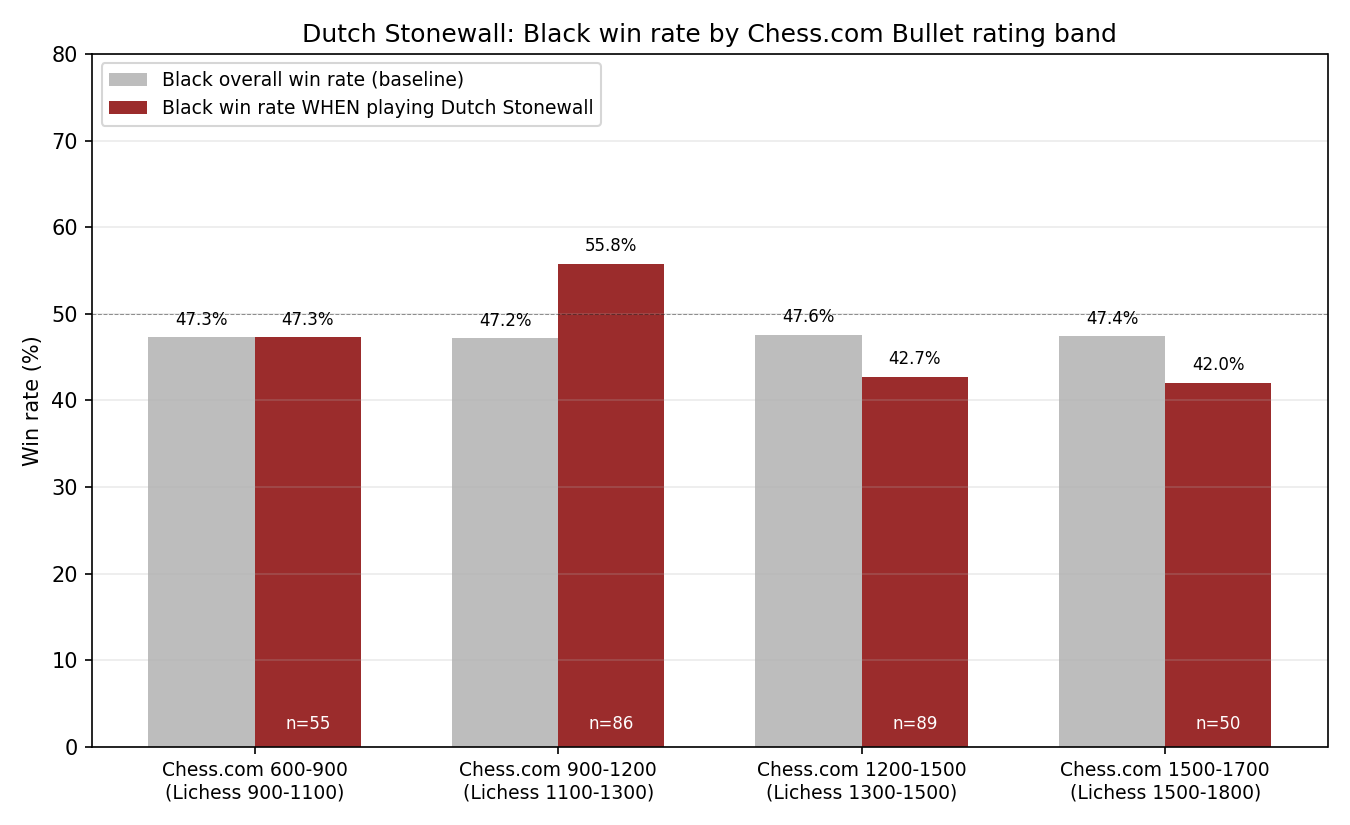
While Black manages a respectable 55.8% win rate in the 900-1200 Chess.com band, the structure completely collapses at higher ratings. By the time players reach the 1200-1500 and 1500-1700 Chess.com bands, Black's win rate with the Dutch Stonewall plummets to 42.7% and 42.0%, respectively. This is a -5 percentage point penalty compared to Black's baseline win rate.
The Dutch Stonewall fails for Black because White dictates the pace of the game. White can easily exploit the permanent weakness of the e5 square, trade off Black's "good" dark-squared bishop, and leave Black with a passive, cramped position and a notoriously "bad" light-squared bishop trapped behind its own pawns.
The Edge Over Baseline
The divergence in performance is best visualized by looking at the "edge" each structure provides over the baseline win rate for that color.
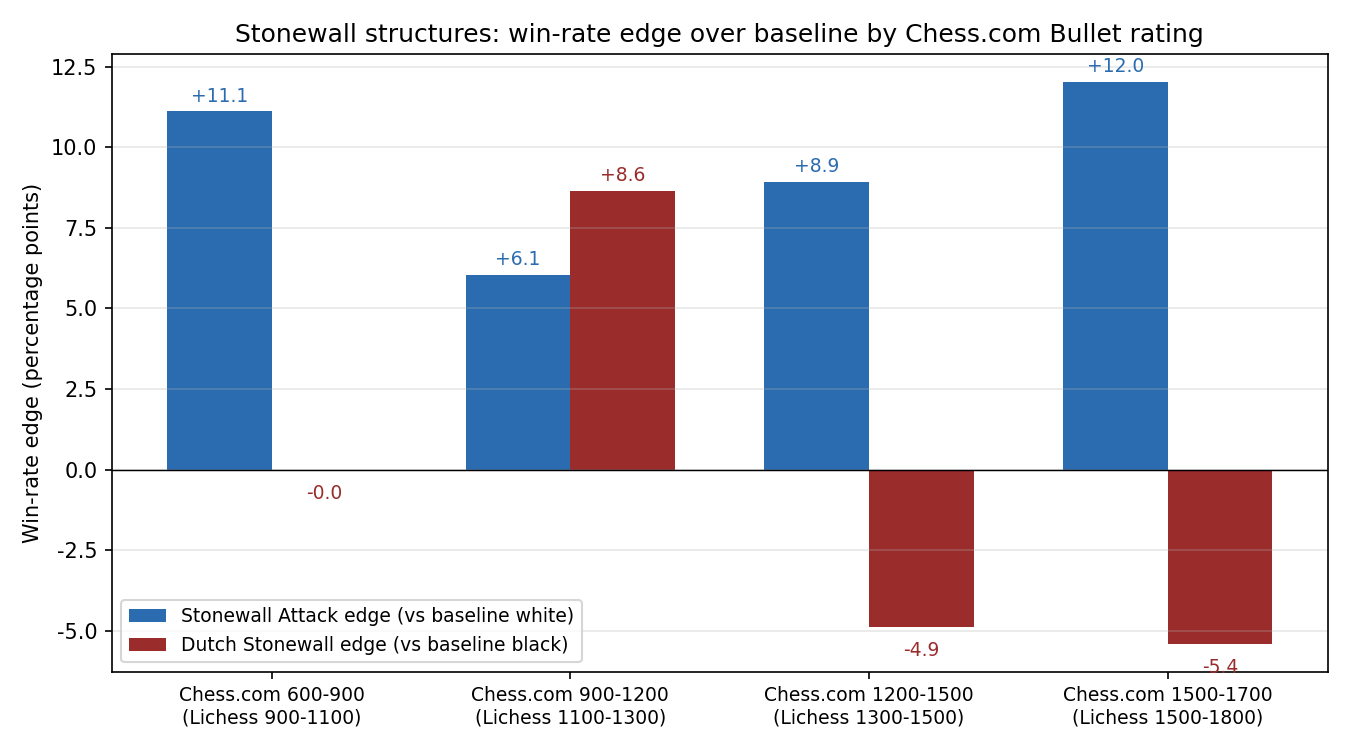
The data is clear: The Stonewall Attack is a powerful weapon for White in Bullet chess, while the Dutch Stonewall is a liability for Black as they progress beyond the absolute beginner level.
Visual Evidence: The Anatomy of the Stonewall
To understand why these statistics exist, we must look at the board.
The Canonical Stonewall Attack
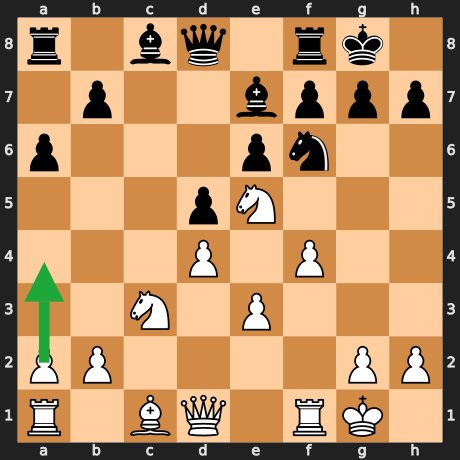
In this typical Stonewall Attack position (taken from a 1500-1700 Chess.com equivalent game), White has established the d4-e3-f4 pawn wedge. The engine's top recommendation (green arrow) is the thematic Ne5, occupying the central outpost. From here, White will often follow up with Rf3-h3, creating a devastating kingside attack. The red arrow shows a suboptimal move (a2-a4), wasting time on the queenside when the structure demands kingside action.
The Canonical Dutch Stonewall
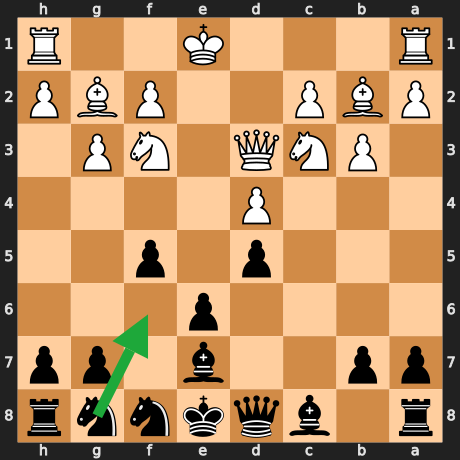
Here, Black has set up the Dutch Stonewall (d5-e6-f5). The engine recommends ...Nf6 (green arrow) to control the critical e4 square. However, notice how cramped Black's position is. The light-squared bishop on c8 is completely entombed by the e6 and d5 pawns. White has a clear target on the e5 square and can easily maneuver their pieces to exploit Black's lack of space.
The Danger of Blunders
Because the Stonewall creates a closed, maneuvering game, blunders often involve catastrophic positional misunderstandings rather than simple one-move tactical oversights.
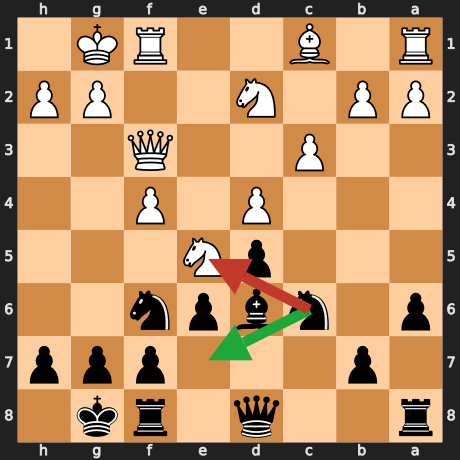
In this game from the 900-1200 Chess.com band, Black has just played ...Nxe5 (red arrow), capturing White's outpost knight. This is a massive blunder (a 367 centipawn swing). The correct move was ...Ne7 (green arrow), maintaining the tension. By capturing on e5, Black allows White to recapture with the f-pawn (fxe5), opening the f-file for the rook, kicking the f6 knight away, and supercharging White's kingside attack.
Roadmap for Improvement: Actionable Advice by Rating
Based on the data, here is how you should handle the Stonewall structure as you climb the Chess.com rating ladder.
Chess.com 600 - 900 (Lichess 900 - 1100)
- For White: Play the Stonewall Attack! It yields a massive +11.1% win-rate edge here. At this level, opponents will not know how to handle the closed center and will frequently blunder into your kingside mating net. Focus on the core plan: Bd3, Ne5, Rf3, and Rh3.
- For Black: The Dutch Stonewall is playable here (performing roughly at baseline), but it is not recommended. It teaches bad habits (like accepting a permanently bad bishop) that will punish you later. Stick to classical principles: control the center with pawns and develop your pieces actively.
Chess.com 900 - 1200 (Lichess 1100 - 1300)
- For White: The Stonewall Attack remains highly effective (+6.1% edge). However, opponents are starting to recognize the setup. You must be precise with your move order. Ensure you develop your queenside pieces (Nd2, c3) before launching the final kingside assault, or you may find yourself overextended.
- For Black: Surprisingly, the Dutch Stonewall spikes in effectiveness here (+8.6% edge). This is likely because White players at this level often play overly aggressive, premature attacks against the Dutch and overextend themselves. However, this is a temporary anomaly. Do not rely on it long-term.
Chess.com 1200 - 1500 (Lichess 1300 - 1500)
- For White: The Stonewall Attack regains its massive edge (+8.9%). At this intermediate level, players are better at defending, so your attacks must be calculated. Learn the typical sacrifices (e.g., Bxh7+) and how to transition into a favorable endgame if the attack fizzles out.
- For Black: Abandon the Dutch Stonewall. The data shows a sharp decline (-4.9% penalty). White players at this level understand how to exploit the weak e5 square and your bad light-squared bishop. Transition to more robust defenses against 1.d4, such as the Nimzo-Indian, the King's Indian, or the classical Queen's Gambit Declined.
Chess.com 1500 - 1700 (Lichess 1500 - 1800)
- For White: The Stonewall Attack is at its absolute peak effectiveness here (+12.0% edge). It is a phenomenal surprise weapon in Bullet chess. Because it is rarely seen at higher levels, opponents often spend too much time trying to remember the theoretical refutations, leading to time trouble and blunders.
- For Black: The Dutch Stonewall remains a significant liability (-5.4% penalty). If you must play the Dutch Defense, opt for the Leningrad or Classical variations, which offer more dynamic counterplay and avoid the rigid, passive structure of the Stonewall.
Data and Methodology
This research is based on a dataset of 15,558 Lichess Bullet games played in March 2025. The games were filtered to ensure the time control met the standard definition of Bullet chess (base time + 40 * increment $\le$ 179 seconds).
The games were segmented into four Lichess rating bands, which were then mapped to their approximate Chess.com Bullet equivalents for the purpose of this article.
A game was classified as featuring a Stonewall structure if the defining pawn wedge (d4-e3-f4 for White, or d5-e6-f5 for Black) was achieved within the first 12 moves (24 plies) by the respective side.
The underlying CSV data files, containing the per-game classifications and aggregated band summaries, are attached for further review.
Chess Coach — Apr 21, 2026