A Data-Driven Guide for Chess.com Players Rated 800–1500
Every chess player knows the feeling: you play a brilliant 15-minute Rapid game, finding complex tactics and grinding out a technical endgame. Then, you switch to 1-minute Bullet, and suddenly you are hanging pieces on move six. The speed versus accuracy trade-off is a fundamental reality of chess, but how exactly does the clock degrade our play? Does playing too much Bullet ruin your Rapid accuracy? At what rating do players stop blundering under time pressure?
To answer these questions, we analyzed over 150,000 games across Bullet, Blitz, Rapid, and Classical time controls. By examining engine evaluations, centipawn loss (CPL), and blunder rates, we have mapped exactly how time pressure affects players at different skill levels. This guide is designed as a roadmap for improvement, specifically targeting players looking to climb through the Chess.com 800 to 1500 rating brackets.
The Speed Penalty: Quantifying the Cost of Fast Chess
The most direct way to measure accuracy in chess is through Average Centipawn Loss (CPL). A lower CPL indicates that a player's moves closely match the top choices of a strong chess engine like Stockfish. When we compare CPL across time controls, a clear pattern emerges: speed kills accuracy, but it does so differently depending on your rating.
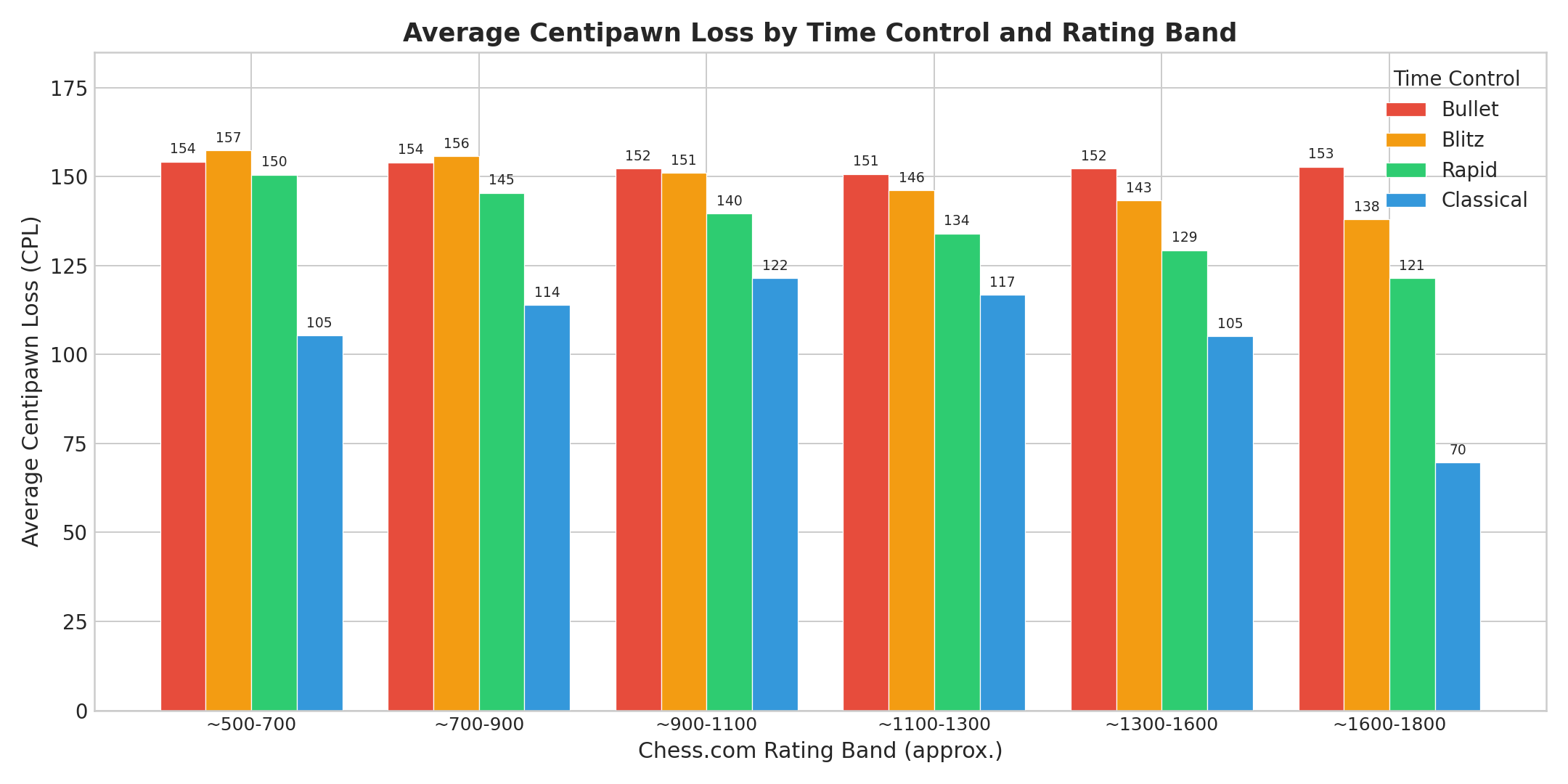
As the chart above illustrates, Classical and Rapid games consistently feature the lowest CPL (highest accuracy) across all rating bands. However, the most striking finding is the behavior of Bullet chess. While Rapid and Blitz accuracy improves steadily as players climb the rating ladder, Bullet accuracy remains stubbornly flat. A Chess.com 1400 player is significantly more accurate than an 800 player in Rapid, but in Bullet, their average CPL is nearly identical (around 152-154).
This phenomenon leads to what we call the "Speed Penalty"—the additional centipawn loss incurred when playing Bullet or Blitz compared to Rapid.
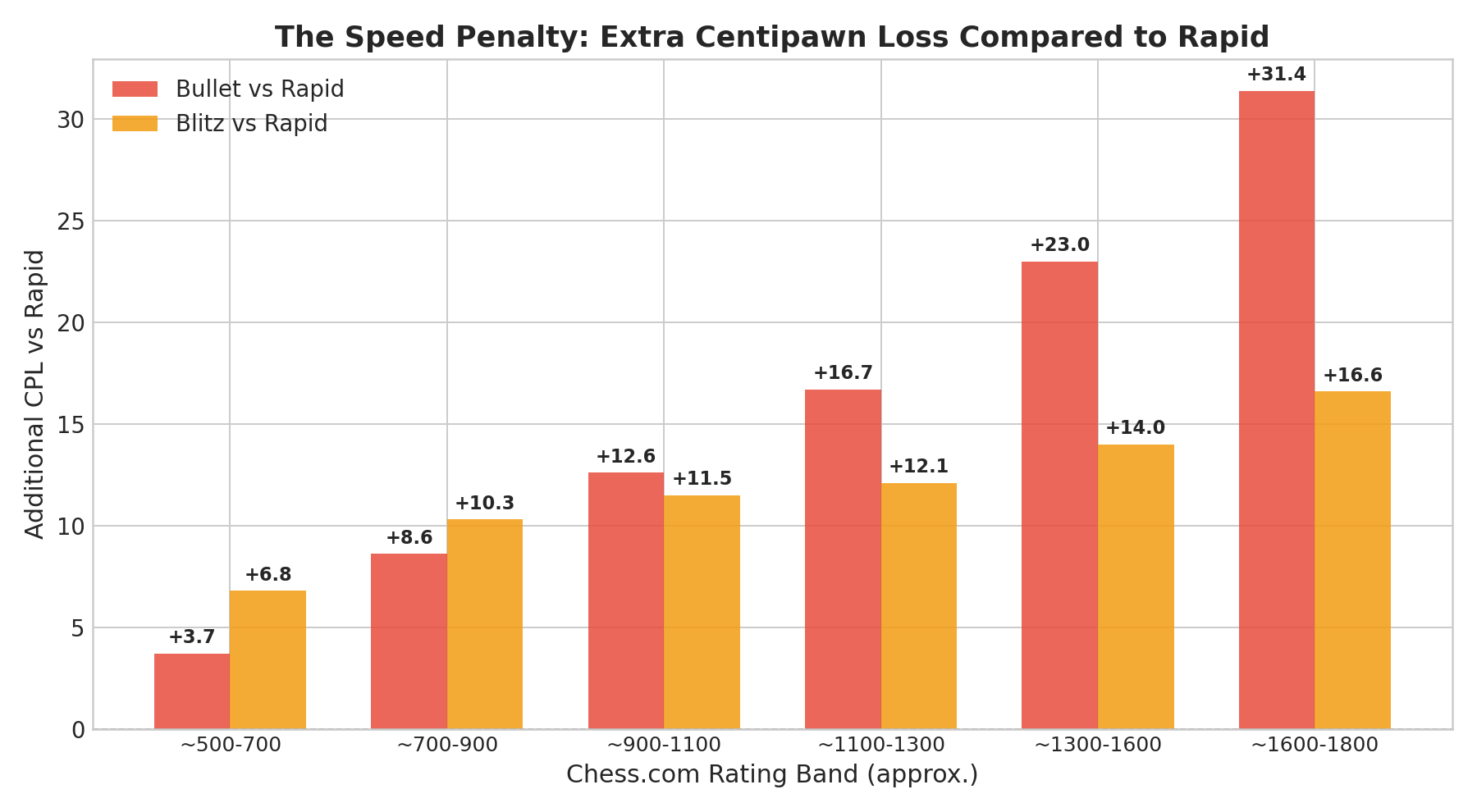
Counterintuitively, the Speed Penalty increases as you get better. For a Chess.com 600 player, the difference between Rapid and Bullet is negligible (+3.7 CPL). They are making similar mistakes regardless of the clock. However, for a Chess.com 1400 player, the penalty jumps to +23.0 CPL. Higher-rated players have more chess knowledge to access, but Bullet time controls do not allow them the seconds required to retrieve and apply that knowledge.
Actionable Advice for 800–1000 Players: At this level, your primary focus should be on board vision and basic tactics. The data shows that your accuracy in Rapid is not vastly superior to your Blitz accuracy. Playing 10-minute Rapid games is ideal; it provides enough time to double-check for hanging pieces without allowing you to overthink simple positions. Avoid Bullet entirely, as it reinforces impulsive, superficial moves.
The Anatomy of a Time-Pressure Blunder
To understand why accuracy drops so sharply in fast time controls, we must look at the types of mistakes players make. Time pressure forces players to rely on intuition and pattern recognition rather than calculation. When those patterns are flawed or incomplete, blunders occur.
Consider this common scenario in the opening. Under the pressure of a 1-minute clock, a player might rush to launch an attack, ignoring principled development.
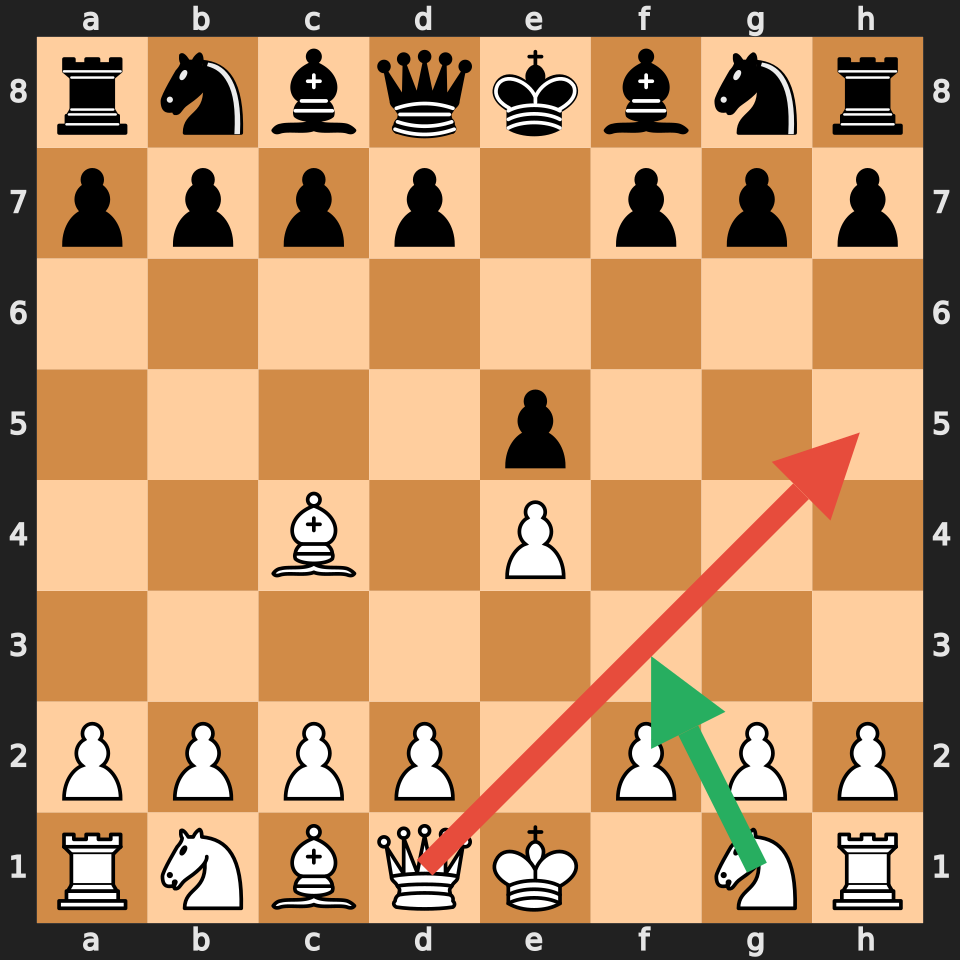 Opening: Qh5?! (bullet aggression) vs Nf3 (principled development)
In Rapid chess, a player has the time to recognize that the early Queen sortie (Qh5?!) is easily parried and violates opening principles. In Bullet, the hope that the opponent might miss a cheap trick often overrides sound positional judgment.
As games progress into the middlegame, the complexity increases, and the lack of time becomes even more punishing. Tactical sequences that require calculating two or three moves deep are frequently missed or miscalculated in Blitz.
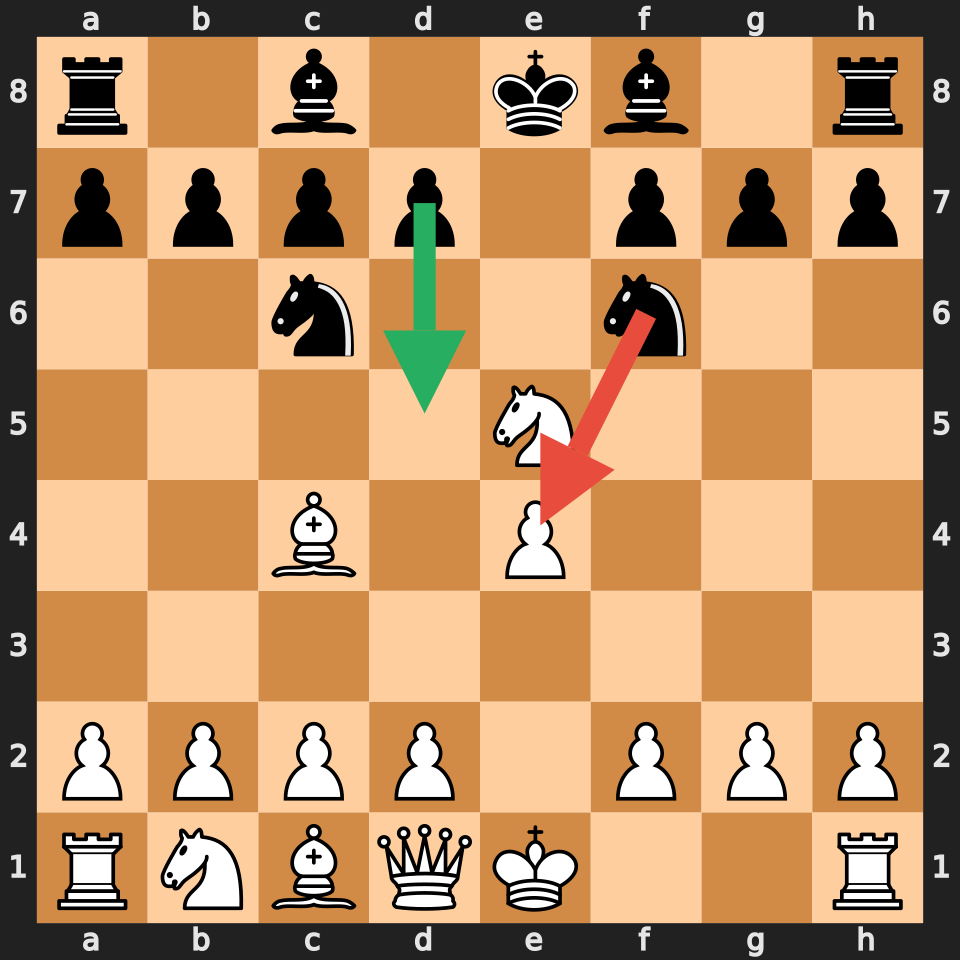 Blitz tactical miss: Nxe4?? instead of d5! in the Italian Game
Here, Black falls into a well-known trap (Nxe4??) instead of playing the correct defensive break (d5!). In a Rapid game, a 1200-rated player might pause, recognize the danger of the Fried Liver Attack setup, and find the correct response. In Blitz, the immediate temptation to grab a central pawn often leads to disaster.
Actionable Advice for 1000–1200 Players: Your tactical vision is improving, but it requires time to function correctly. The data indicates a significant jump in the Speed Penalty at this level. To climb higher, you must build a repertoire of solid, reliable opening setups that you can play quickly without deep thought. Save your clock time for the critical middlegame moments where calculation is mandatory.
The Endgame: Where Speed Destroys Technique
The endgame is perhaps the phase most sensitive to time pressure. Endgame technique relies on precise calculation, understanding of opposition, and exact pawn pushes. When the clock is ticking down to single digits, technique often goes out the window.
Our analysis of phase accuracy reveals that the endgame consistently features the highest blunder rates across all rating bands, hovering between 39% and 46%. Furthermore, players spend the least amount of time per move in the endgame (averaging 2.8 to 3.9 seconds), largely because they have burned their time in the complex middlegame.
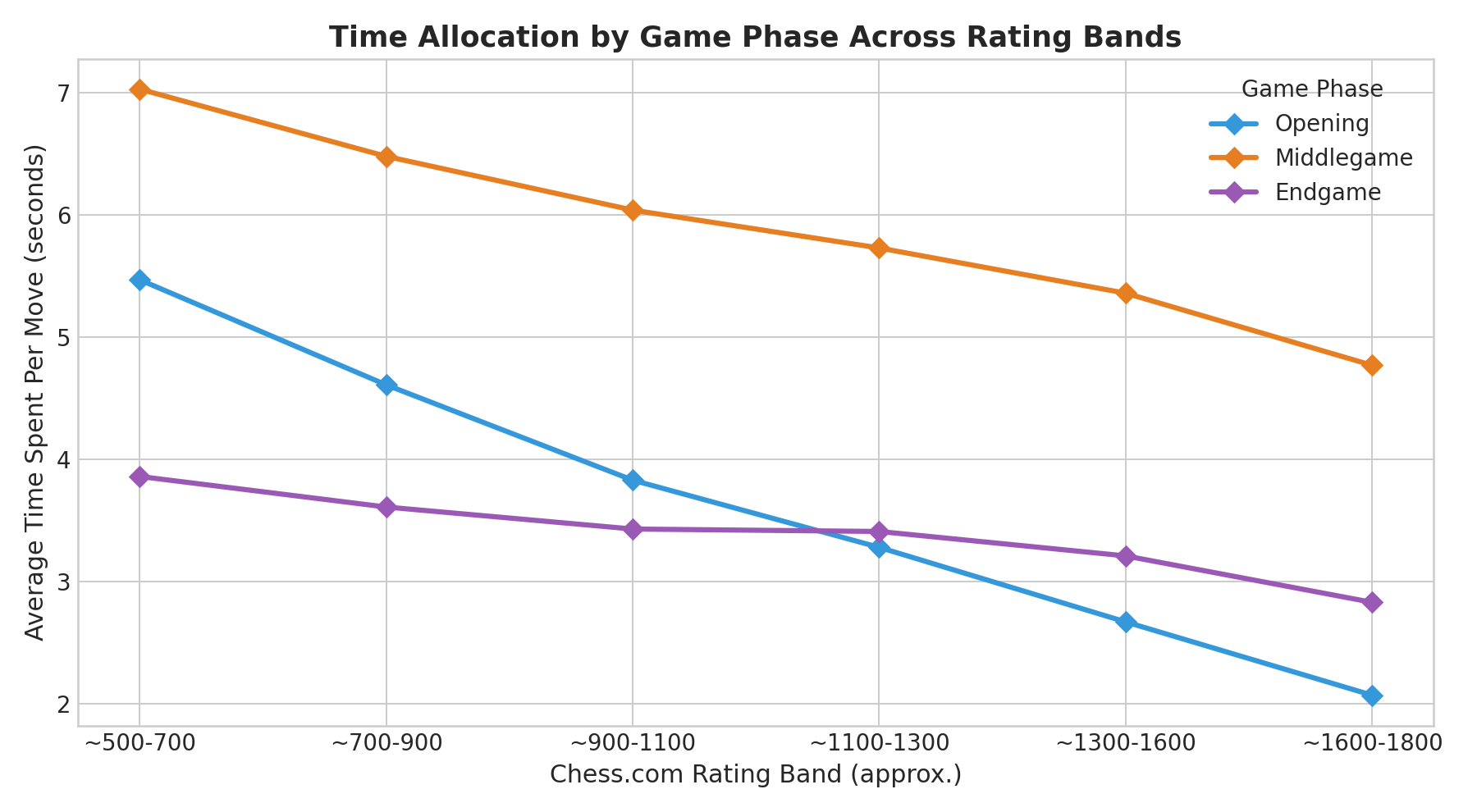
This lack of time leads to fundamental technical errors. A classic example is the King and Pawn endgame, where the concept of "opposition" is critical.
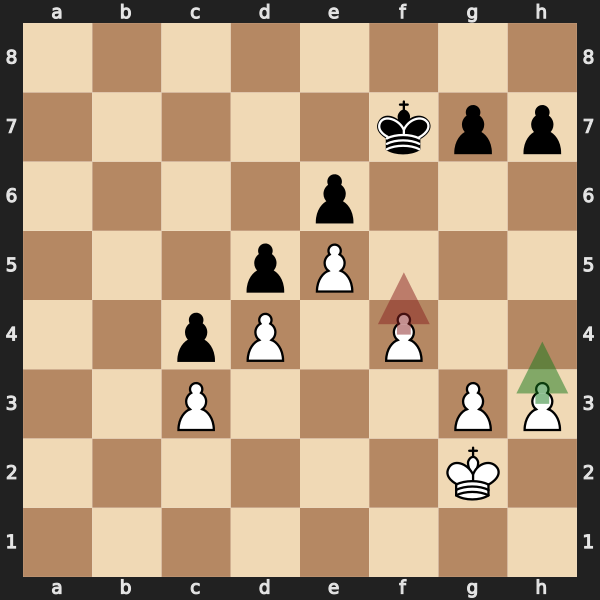 Endgame: f5+?? (bullet rush) vs Kd4! (proper technique in rapid)
In this position, pushing the pawn immediately (f5+??) is a common Bullet reflex that throws away the win by allowing the defending King to gain the opposition. The correct, patient move (Kd4!) requires a moment of calculation that Bullet simply does not afford.
Actionable Advice for 1200–1400 Players: You are reaching a level where endgame knowledge is a significant differentiator. However, that knowledge is useless if you reach move 40 with only 15 seconds left on your clock. Practice time management. Learn to play forced or obvious moves instantly in the opening and early middlegame so that you arrive at the endgame with a comfortable time cushion.
The Tilt Effect: How Bullet Ruins Your Rapid
A common question among improving players is whether playing Bullet chess negatively impacts their Rapid performance. The data suggests that the real danger lies in the psychological phenomenon known as "tilt."
We analyzed the effect of losing streaks on subsequent game performance. The results are stark: consecutive losses significantly degrade both win rates and move accuracy.
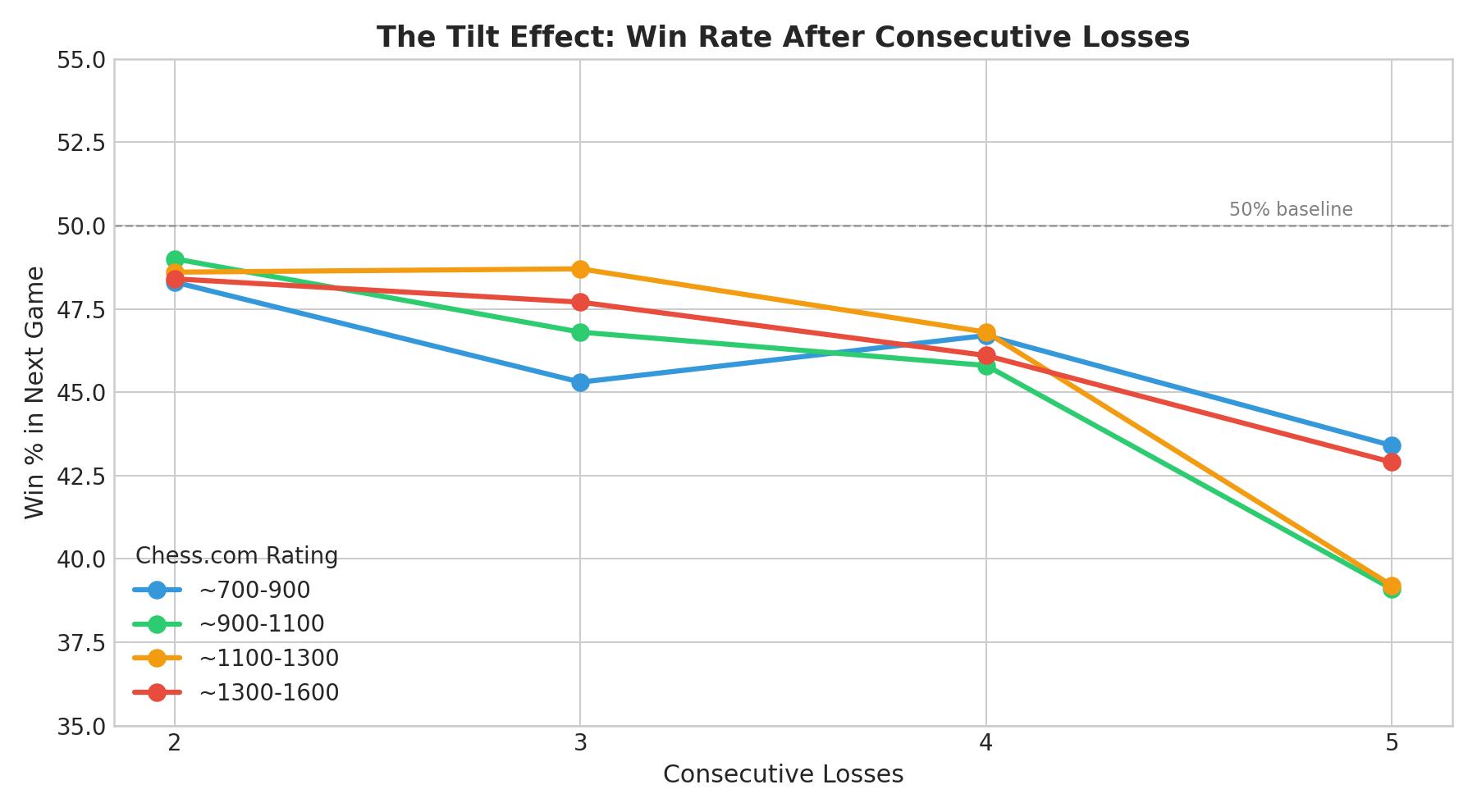
After a streak of five consecutive losses, a player's win rate in the next game plummets to around 40%, and their Average Centipawn Loss increases by 40 to 70 points. This effect is particularly pronounced in the 1100–1300 Chess.com rating band.
Bullet chess, due to its rapid-fire nature, is the perfect breeding ground for tilt. A player can easily lose five Bullet games in ten minutes, entering a state of frustration and impulsive play. If that player then switches to a Rapid game, the residual tilt—the habit of playing too fast and reacting emotionally rather than analytically—carries over, leading to poor performance.
Actionable Advice for 1400–1500 Players: At this stage, psychological control is as important as tactical skill. Recognize the signs of tilt. If you lose three games in a row, regardless of the time control, stop playing. Take a break, review your games, and reset. Never use Bullet chess as a way to "win back" rating points lost in Rapid; it will almost certainly backfire.
Conclusion: Respect the Clock
The data is unequivocal: time control fundamentally changes the nature of chess. Fast time controls compress the skill gap, masking the superior knowledge of higher-rated players by forcing them into the same impulsive errors as beginners.
To climb from 800 to 1500 on Chess.com, you must respect the clock. Play Rapid chess to build your understanding, calculation, and technique. Use Blitz sparingly to test your opening repertoire and pattern recognition under mild pressure. And treat Bullet as what it is: a fun, chaotic variant that has little to do with improving your fundamental chess ability.
By managing your time effectively, avoiding the pitfalls of tilt, and understanding where your accuracy is most vulnerable, you can navigate the speed versus accuracy trade-off and continue your upward trajectory.
Chess Coach April 15, 2026
Data and Methodology
This analysis is based on a dataset of over 150,000 games sourced from the Lichess database, utilizing Stockfish 17 engine evaluations to calculate Centipawn Loss (CPL) and blunder rates. The data was processed and aggregated using the Grandmaster Guide analytical tools.
Please note that all rating labels in the charts and text have been adjusted to approximate Chess.com ratings for relevance to the target audience. The conversion maps Lichess ratings to Chess.com equivalents (e.g., a Lichess 1500 is roughly equivalent to a Chess.com 1200-1300).
The underlying aggregated data used to generate the insights and charts in this article is available in the attached CSV files.
time_control_comparison.csv: Core metrics (CPL, draw rate, game length) across time controls and rating bands.phase_accuracy.csv: Accuracy and time spent broken down by game phase (opening, middlegame, endgame).streak_effects.csv: Analysis of win rates and CPL changes following winning and losing streaks.clock_vs_accuracy.csv: The relationship between time spent per move and resulting move quality.first_blunder_timing.csv: Statistics on the average move number of the first major blunder.termination_rates.csv: Rates of normal game conclusions versus time forfeits.eval_trajectory.csv: Average absolute engine evaluation by game phase.summary_all_metrics.csv: A comprehensive summary table of key metrics.