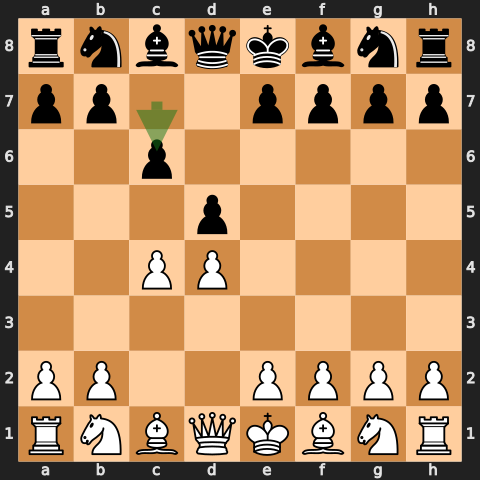
The Slav Defense (1.d4 d5 2.c4 c6) is renowned for its solidity. Played by World Champions from Botvinnik to Carlsen, it is often described as a "rock-solid" response to the Queen's Gambit. But does this reputation for solidity translate into longer, more grueling games for everyday players?
To answer this question, we analyzed 13,183 Rapid games featuring the Slav Defense from the Lichess database, comparing them against a baseline of over 847,000 games across all openings. We mapped the data to approximate Chess.com Rapid ratings (from 400 to 1700) to provide actionable insights for players looking to climb the rating ladder.
The data reveals a fascinating trend: the Slav Defense does lead to longer games, but this effect only emerges as players improve their fundamental chess understanding.
The Data: Game Length Progression by Rating
When we look at the average game length across different rating brackets, a clear progression emerges. As players improve, their games naturally get longer because they blunder less frequently and defend more tenaciously. However, the Slav Defense exaggerates this trend.
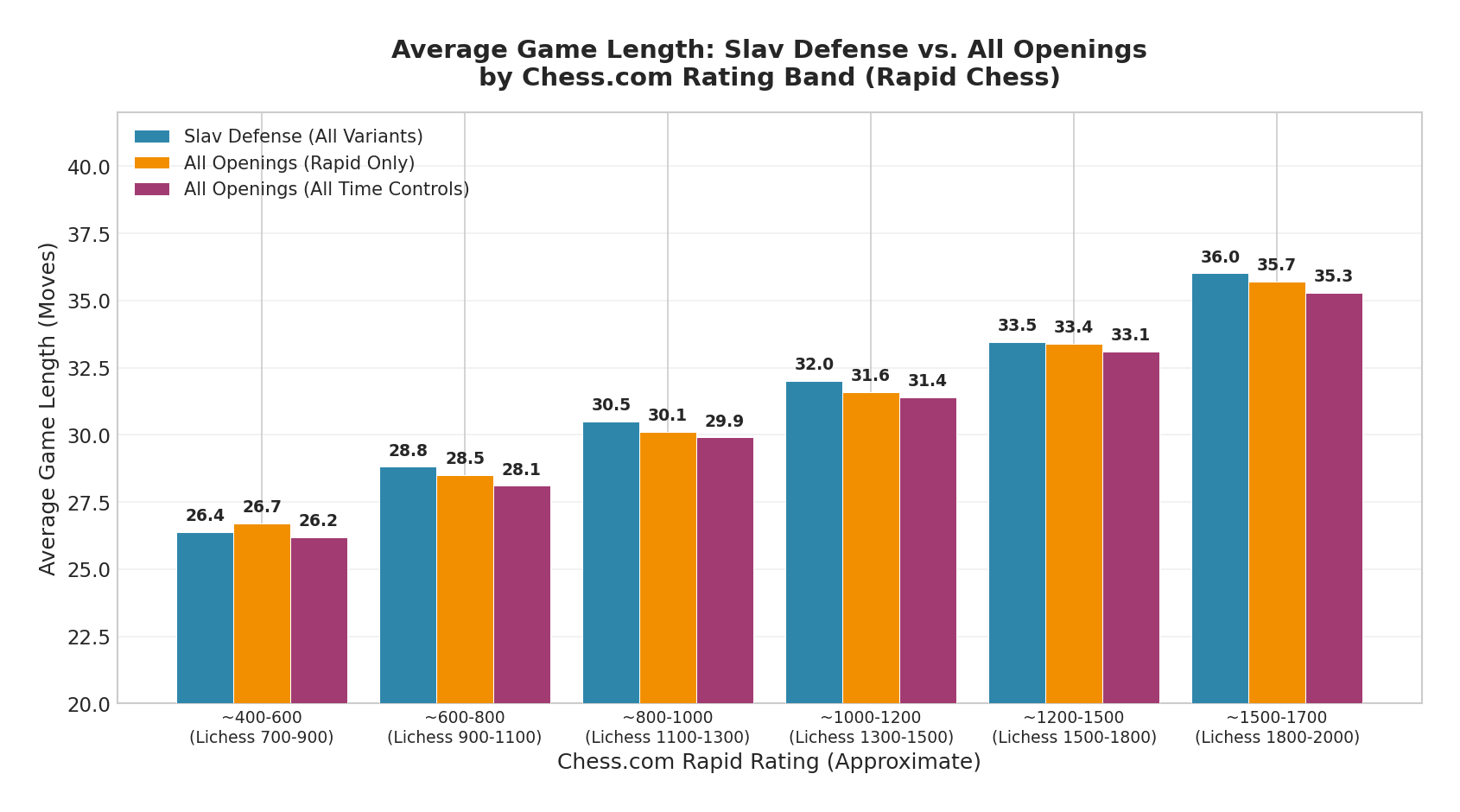
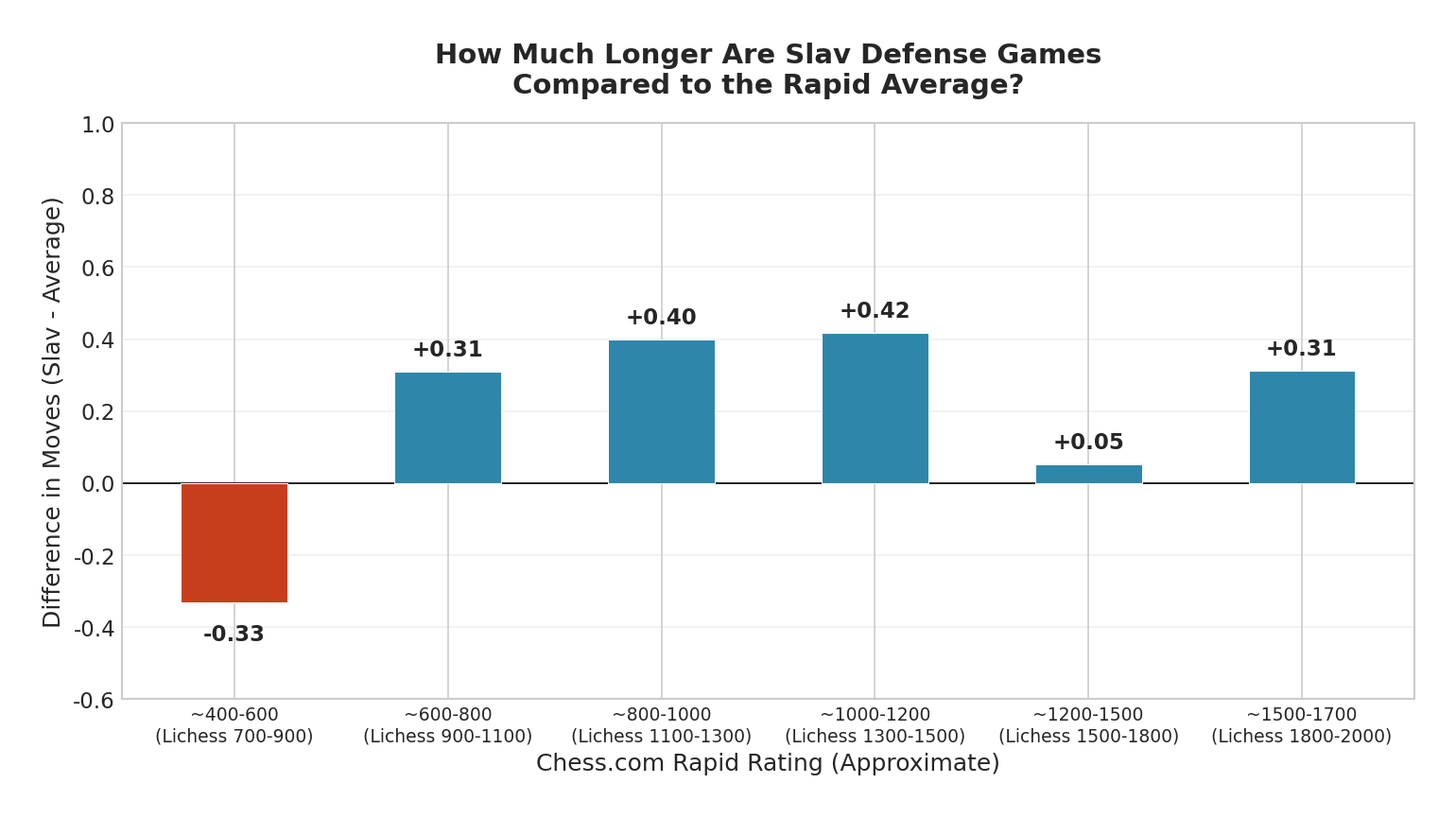
At the beginner level (Chess.com ~400-600, equivalent to Lichess 700-900), Slav Defense games actually average 26.4 moves, which is slightly shorter than the overall Rapid average of 26.7 moves.
However, as soon as players cross the 600 rating mark, the Slav begins to live up to its reputation. By the time players reach the intermediate level (Chess.com ~800-1000), Slav games average 30.5 moves compared to the Rapid average of 30.1. This gap persists through the higher rating bands, with games in the 1500-1700 range stretching to an average of 36.0 moves.
Why Are Beginner Slav Games Shorter?
The data shows that at the ~400-600 level, Slav games end quickly. This is largely due to early tactical blunders in unfamiliar structures. Beginners often misunderstand the purpose of the ...c6 pawn push and misplay the resulting positions.
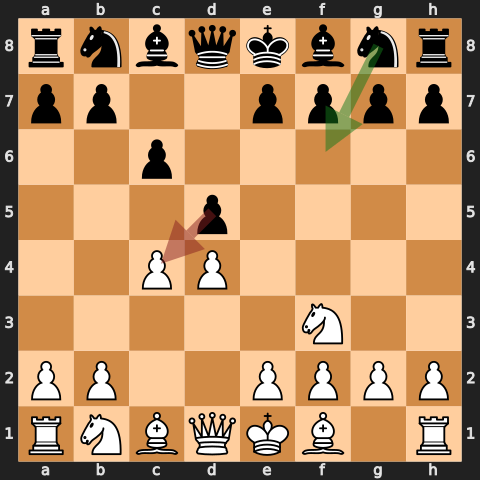 A common beginner mistake: playing ...dxc4 prematurely before developing the kingside knight. This surrenders the center too early without the typical Slav compensation.
The "Quick Finish" Metric: Surviving the Opening
One of the most telling metrics in our analysis is the "Quick Finish Percentage"—the proportion of games that end before move 20. This metric highlights how often players fall into opening traps or make catastrophic early blunders.
The data is striking: The Slav Defense consistently produces fewer quick finishes than the average opening across all rating bands.
Even at the ~400-600 level, where games are generally shorter, only 30.8% of Slav games end before move 20, compared to 37.1% for all openings. By the time players reach the 1500-1700 bracket, only 10.7% of Slav games end quickly.
This confirms the Slav's reputation as a safe, solid choice. If your goal is to survive the opening and reach a playable middlegame, the Slav Defense is statistically one of your best options.
Move Quality: Centipawn Loss and Blunders
To understand why these games go longer, we must look at move quality. Using Stockfish 17 evaluations, we analyzed the Average Centipawn Loss (CPL) and blunder rates for both White and Black.
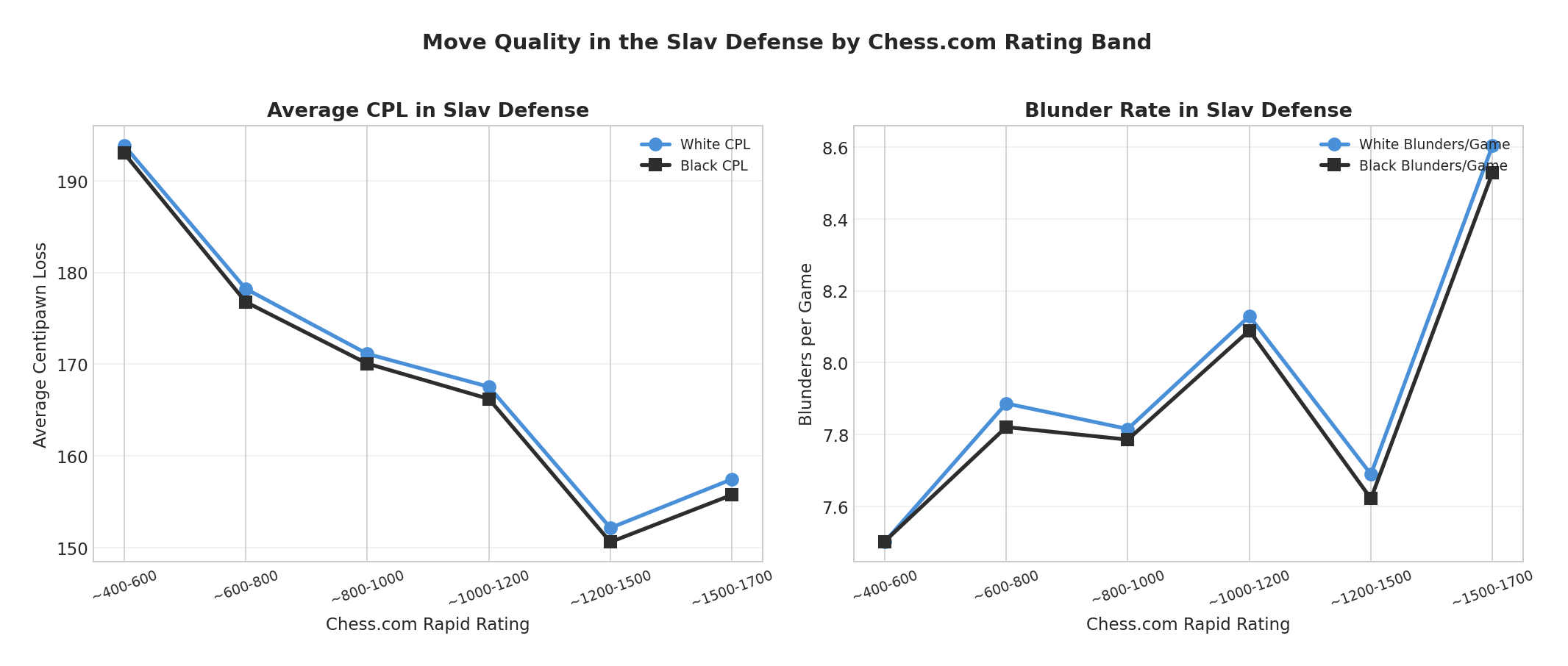
The data shows a steady improvement in move quality (lower CPL) as ratings increase. Interestingly, the blunder rate (mistakes costing 300+ centipawns) does not decrease linearly. It hovers around 7.5 blunders per game at the lowest ratings, spikes slightly in the intermediate bands, and then settles around 8.5 blunders per game at the 1500-1700 level.
This counterintuitive finding suggests that as games get longer and positions become more complex, there are simply more opportunities to make significant mistakes, even if the overall average move quality is higher.
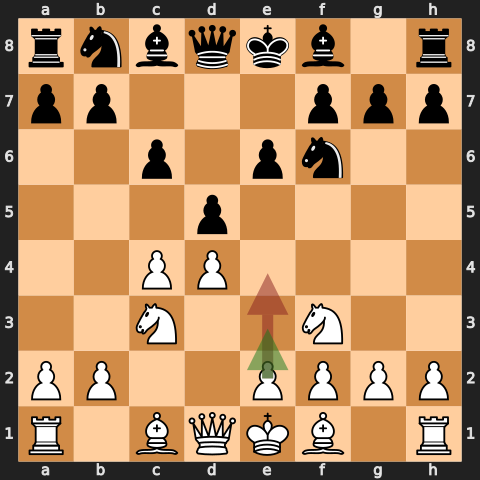 A typical Semi-Slav middlegame structure. White must choose between solid development (e3) or aggressive, often premature central breaks (e4).
Win Rates: Does the Slav Work?
The ultimate question for any opening is: does it win games? The Slav Defense proves to be a highly balanced opening, offering a fair fight for both sides.
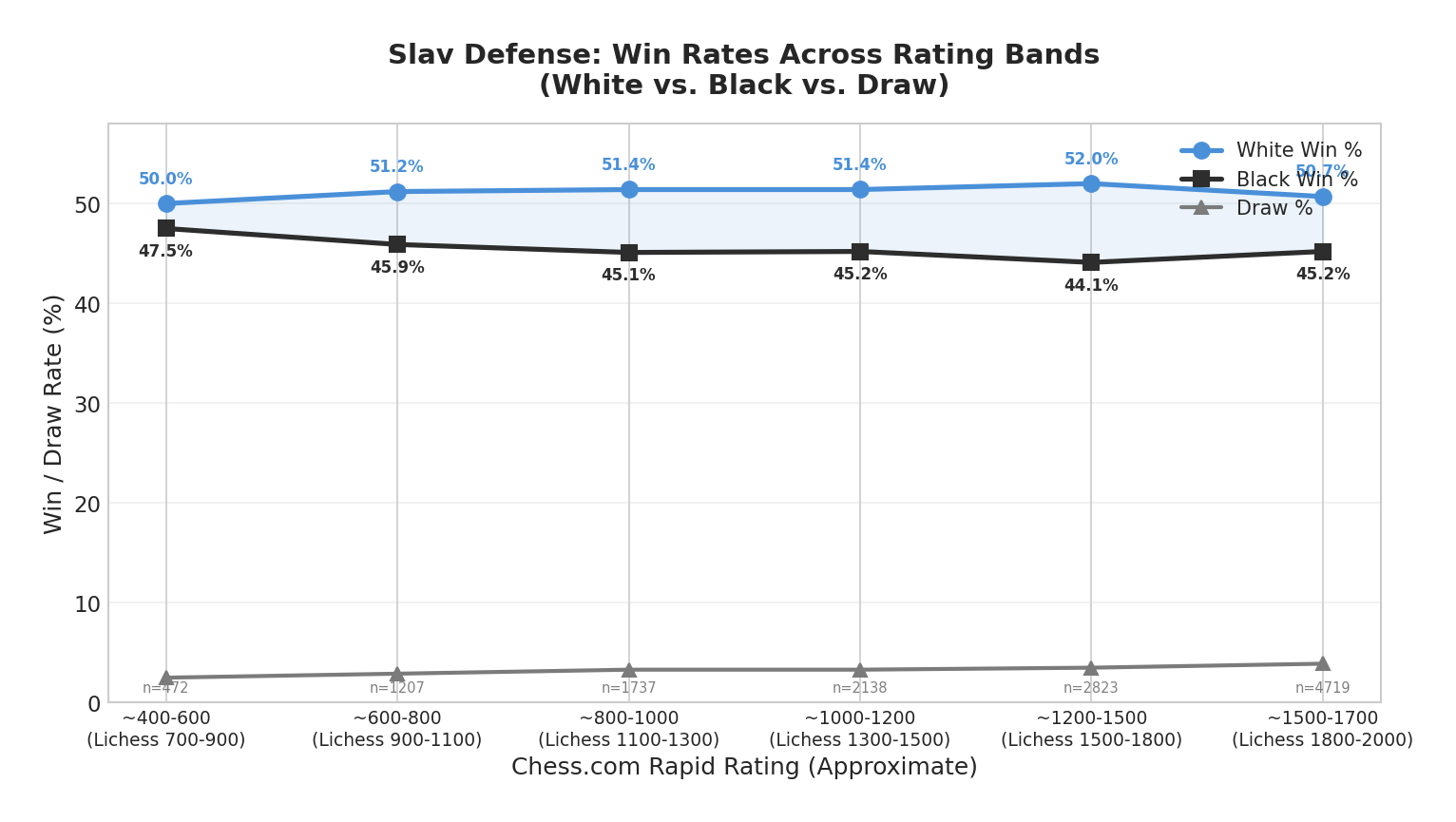
Across all rating bands, White maintains a slight, standard opening advantage, winning between 50% and 52% of games. Black's win rate hovers consistently between 44% and 47.5%.
Notably, the draw rate increases steadily as players improve, rising from 2.5% at the ~400-600 level to nearly 4% at the 1500-1700 level. This further supports the idea that the Slav leads to balanced, hard-fought games that are less likely to be decided by a single early tactic.
Actionable Advice by Rating Band
Based on the data, here is a roadmap for improving your play in the Slav Defense as you climb the rating ladder.
Beginner (Chess.com 400-800 / Lichess 700-1100)
The Data: Games are shorter than average, and 25-30% end before move 20.
Actionable Advice: Focus on basic development. Do not capture on c4 (...dxc4) until you have developed your kingside knight to f6. The ...c6 pawn is there to support ...d5, not to prepare an immediate capture. Prioritize getting your pieces out and castling safely.
Intermediate (Chess.com 800-1200 / Lichess 1100-1500)
The Data: Games start getting significantly longer than average (30-32 moves). Quick finishes drop below 20%.
Actionable Advice: You are surviving the opening, but now you must navigate complex middlegames. Learn the typical pawn breaks. For Black, the ...e5 or ...c5 breaks are crucial for freeing your position. For White, understand when to play e3 for solidity versus e4 for central expansion.
Advanced (Chess.com 1200-1700 / Lichess 1500-2000)
The Data: Games stretch to 33-36 moves. Draw rates double compared to beginner levels. Actionable Advice: Prepare for the endgame. The Slav often leads to symmetrical or slightly imbalanced pawn structures that require precise endgame technique. Study minor piece endgames and rook endgames, as these are highly common when the central tension resolves.
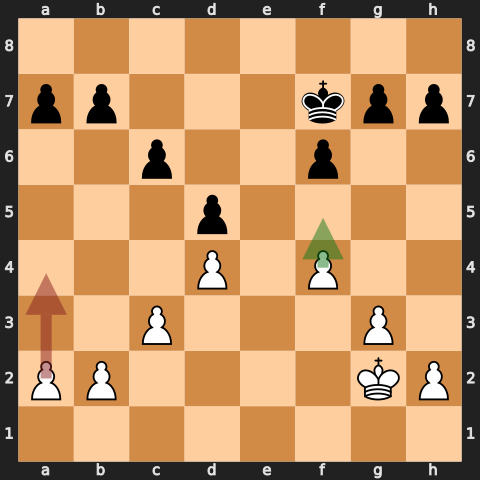 A typical simplified Slav endgame. The pawn structure remains complex, requiring patience and precise calculation—explaining why these games often go the distance.
Data and Methodology
This analysis is based on 13,183 Rapid games featuring the Slav Defense (ECO codes D10-D19), extracted from the Lichess database. Game evaluations and centipawn loss metrics were calculated using Stockfish 17.
Rating bands were mapped from Lichess average ELO to approximate Chess.com Rapid ratings using standard conversion tables to provide the most relevant context for the majority of online players.
Underlying Data Files:
Chess Coach April 14, 2026