For intermediate chess players, few things are more frustrating than playing a solid game, making one terrible move, and watching the evaluation bar plummet. The common narrative is that games at the 800–1500 level are decided by a single, catastrophic blunder. But does the data actually support this?
To find out, we analyzed over 5,000 Lichess Blitz games (mapped to Chess.com ratings 800–1500) using Stockfish 12 evaluations at every ply. We defined a "blunder" strictly as a move that drops the engine evaluation by 300 centipawns (the equivalent of three pawns) or more.
The results reveal a surprising truth about how games are actually lost at these levels—and provide a clear roadmap for climbing the rating ladder.
The Anatomy of a Blitz Loss
When you lose a game, how many blunders did you actually make? The data shows that the "single-mistake loss" is surprisingly rare.
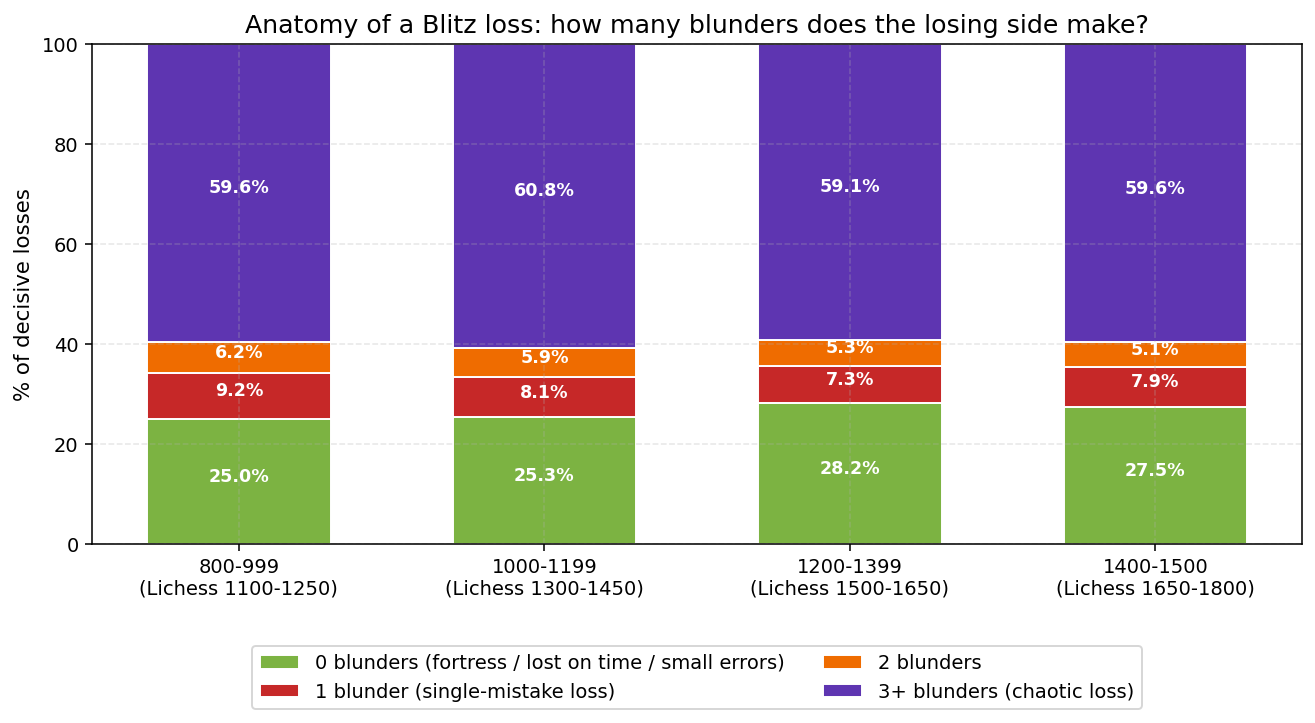
Across all rating bands from 800 to 1500, only 7% to 9% of decisive losses are caused by exactly one blunder.
Instead, the vast majority of losses (around 60%) involve the losing side making three or more blunders in the same game. Chess at this level is rarely a pristine affair ruined by a single slip; it is a chaotic struggle where both sides trade massive mistakes until one player finally capitalizes.
Interestingly, about 25% to 28% of losses feature zero 300+ centipawn blunders by the losing side. These are typically games where a player is slowly squeezed in a "fortress" position (where all moves are equally bad, so no single move registers as a massive drop), or games lost on time in relatively equal positions.
The Single-Blunder Loss Rate
If we isolate just the games where the losing side made exactly one blunder, we see a slight downward trend as ratings improve.
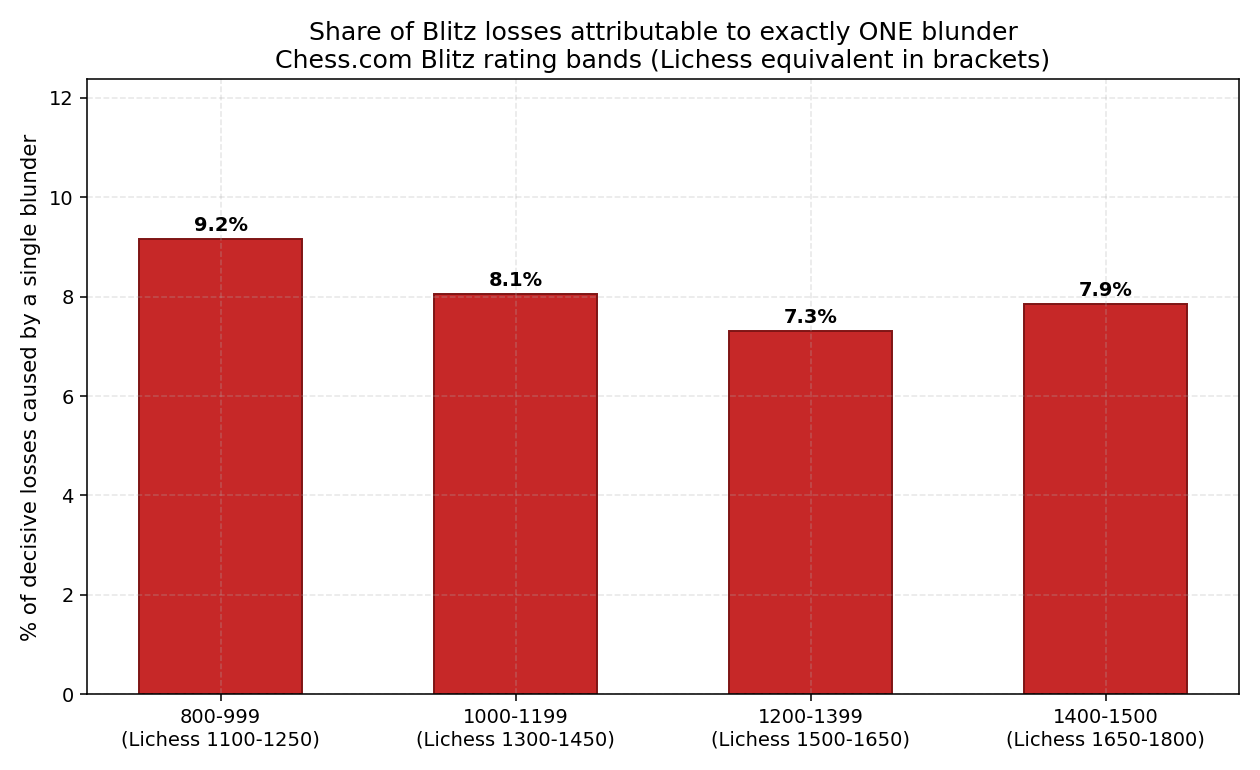
At the 800–999 level, 9.2% of losses are single-blunder affairs. By the time players reach 1400–1500, this drops to 7.9%. As players improve, they become slightly better at avoiding that one fatal mistake—but more importantly, their opponents become better at converting smaller advantages, meaning games are less reliant on massive 300+ centipawn swings to be decided.
When Do the Fatal Mistakes Happen?
If you are going to lose a game to a single blunder, when is it most likely to occur?
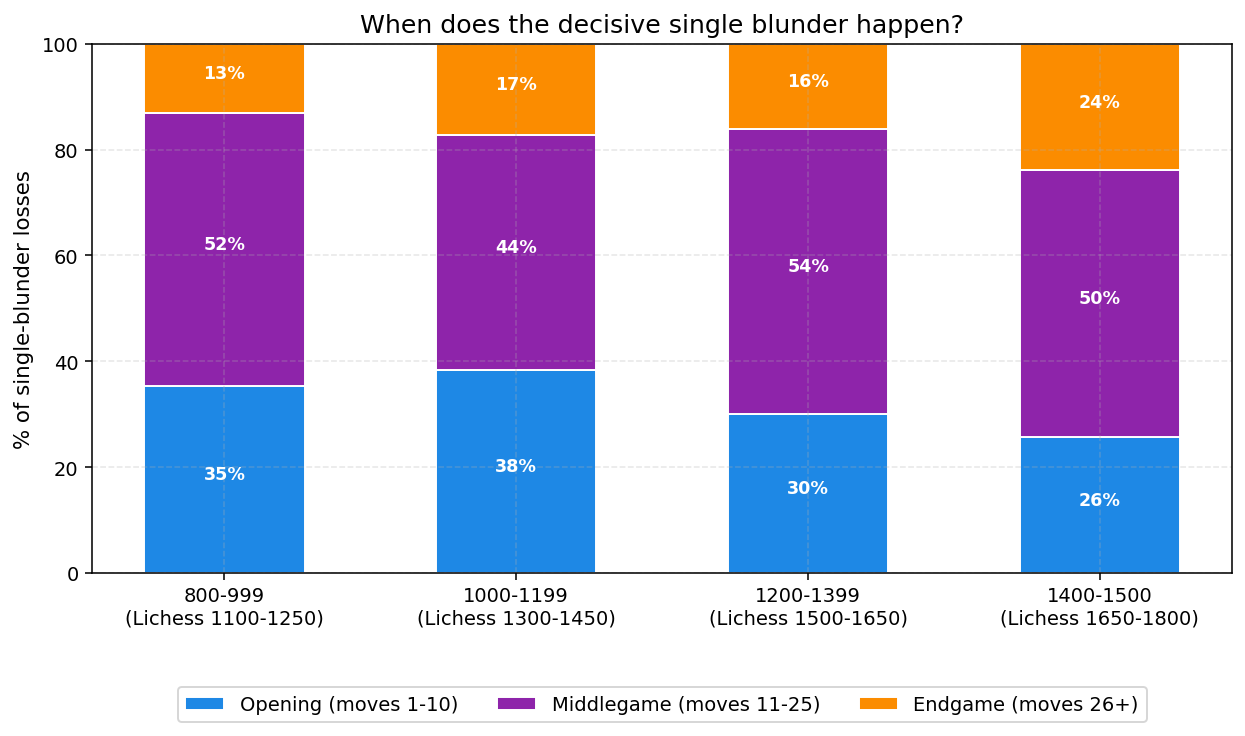
The middlegame (moves 11–25) is the primary danger zone across all ratings, accounting for roughly half of all single-blunder losses. However, a clear shift happens as players improve:
- At 800–999, 35% of fatal single blunders happen in the opening (moves 1–10). Players are frequently falling for opening traps or hanging pieces right out of the gate.
- At 1400–1500, opening blunders drop to 26%, while endgame blunders (moves 26+) nearly double to 24%. Higher-rated players survive the opening more consistently, pushing the decisive mistakes deeper into the game.
The Psychology of the Blunder: Winning Positions
Perhaps the most counterintuitive finding in the data is when players are most likely to blunder.
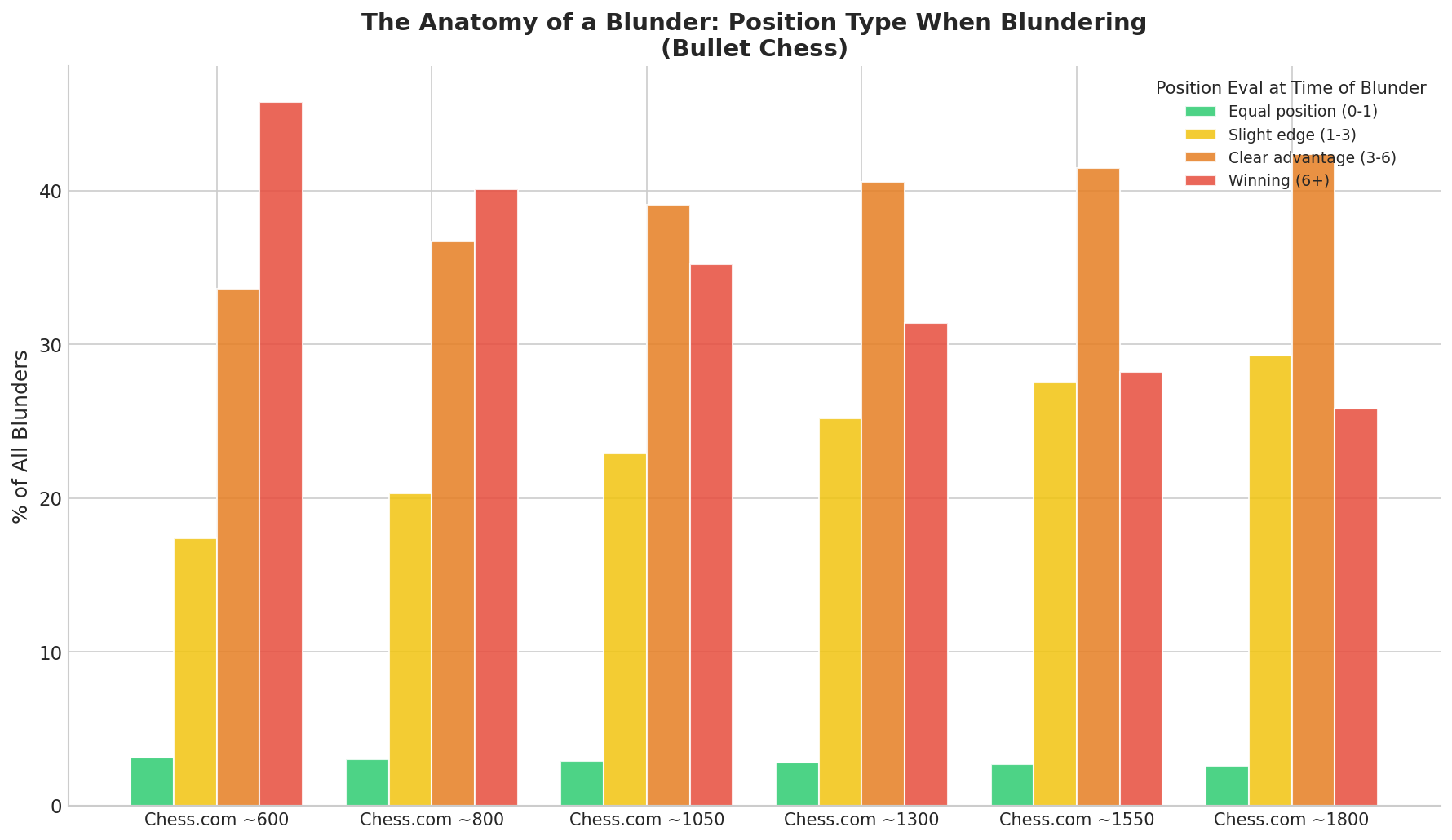
When lower-rated players blunder, they are overwhelmingly doing so in positions where they are already winning (an evaluation of +6 or better). At the 800–1050 level, 46% of all blunders occur when the player has a massive advantage.
This highlights a major psychological hurdle: players relax when they are winning, stop looking for their opponent's threats, and immediately blunder the advantage away. As ratings increase to 1200–1400, blunders in winning positions decrease, and blunders in relatively equal or slightly better positions become more common.
Real-World Examples
Let's look at actual games from our dataset where a single blunder decided the outcome.
800–999 Rating Band
In this game, White has a solid position but makes a fatal miscalculation.
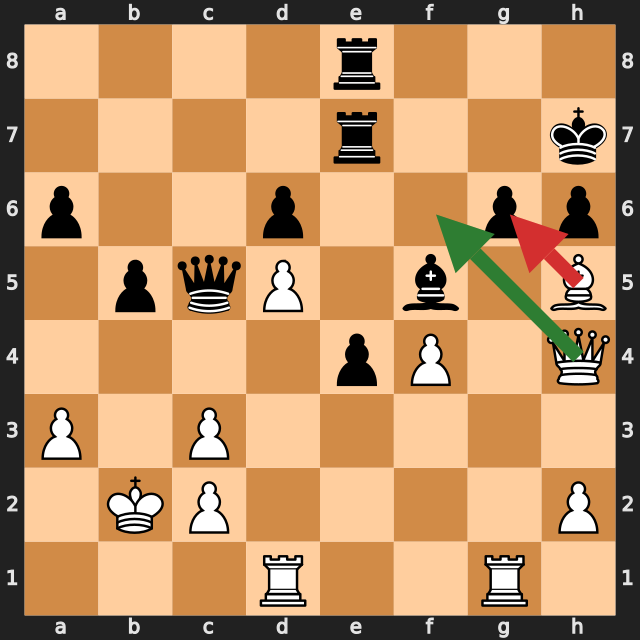
- The Position: White is slightly better (+2.78).
- The Blunder: White plays Bxg6+, sacrificing the bishop for an attack that isn't there. The evaluation plummets to -3.74 (a 652 centipawn drop).
- The Engine Best: The engine prefers the simple and centralizing Qf6.
1200–1399 Rating Band
At this level, blunders often involve missing a tactical sequence or a defensive resource.
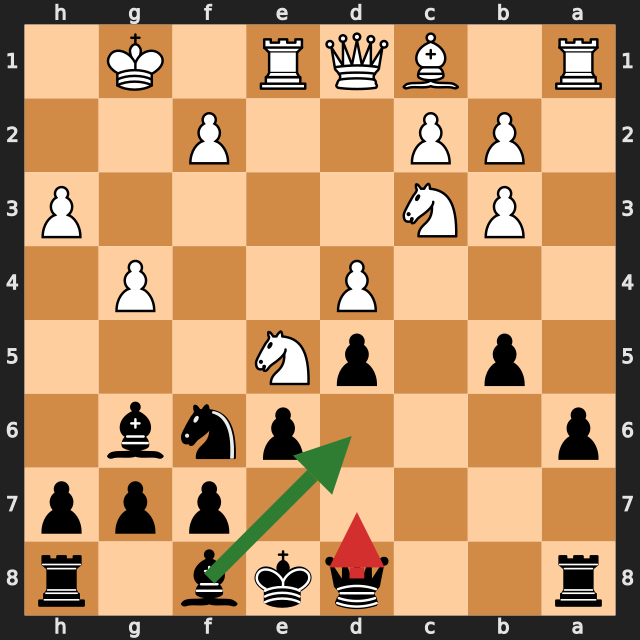
- The Position: White is completely winning (+4.17).
- The Blunder: White plays Qd7, allowing Black counterplay. The evaluation drops to -0.84 (a 501 centipawn drop).
- The Engine Best: The engine finds the crushing Bd6, maintaining the massive advantage.
Actionable Advice by Rating Band
Based on the data, here is a roadmap for improvement tailored to your current rating.
800–999: The Survival Phase
- The Data: You are losing 35% of your single-blunder games in the first 10 moves, and making 3+ blunders in 60% of your losses.
- Actionable Advice: Focus entirely on board vision and opening principles. Before every move, ask yourself: "Is my piece safe? Is my opponent threatening a check, capture, or attack?" Do not worry about deep strategy; just stop giving away pieces in the first 15 moves.
1000–1199: The Consistency Check
- The Data: Opening blunders are decreasing, but middlegame blunders still dominate. You are still making multiple blunders per game.
- Actionable Advice: You know the basic opening principles, but you lose focus when the position gets complicated. Practice basic tactics (pins, forks, skewers) daily. When you get a winning position, do not relax. The data shows this is exactly when you are most likely to blunder it away.
1200–1399: The Transition
- The Data: Single-blunder losses are dropping (7.3%), and endgame blunders are starting to rise.
- Actionable Advice: Your opponents are no longer hanging pieces for free. You need to start calculating one or two moves deeper. Begin studying basic endgames (king and pawn, basic rook endgames), as more of your games are reaching this phase before the decisive mistake is made.
1400–1500: The Squeeze
- The Data: Endgame blunders now account for nearly a quarter of your single-blunder losses. Zero-blunder losses (getting squeezed) are at their highest.
- Actionable Advice: You are surviving the opening and middlegame, but losing in the endgame due to poor technique or time trouble. Focus heavily on endgame studies and time management. Learn how to convert small advantages without needing your opponent to make a massive 300+ centipawn blunder.
Data and Methodology
This analysis was conducted using a sample of 5,238 Lichess Blitz games, filtered for time controls between 3 and 8 minutes. The games were sourced via the Lichess API and augmented with Stockfish 12 evaluations at every ply.
A "blunder" was strictly defined as a move that worsened the player's evaluation by 300 centipawns or more. Lichess ratings were mapped to Chess.com equivalents using standard community conversion tables (e.g., Chess.com 800 ≈ Lichess 1200).
The underlying data and analysis scripts are available in the attached files:
single_blunder_loss_by_band.csv: Aggregated loss statistics by rating band.selected_examples.json: The specific game data used for the board visualizations.
Chess Coach — 20 April 2026