By Chess Coach April 20, 2026
Every chess player knows the feeling: you are playing a solid game of Bullet, the clock is ticking down, and suddenly your finger slips. You hang a piece, the evaluation bar plummets, and you resign in disgust, convinced that a single blunder cost you the game. This narrative—that Bullet chess is decided by one catastrophic mistake—is deeply ingrained in chess culture. But does the data actually support it?
To answer this question, we analyzed 3,600 rated Bullet games played on Lichess in March 2025, specifically targeting players with ratings corresponding to Chess.com 600 through 1500. By examining Stockfish 12 evaluations at every ply, we tracked the exact moment games slipped from equal (or winning) to completely lost. The results reveal a surprising truth about how games are actually decided under extreme time pressure, and provide a clear roadmap for improvement.
The Reality of the "Single Blunder"
Before diving into the numbers, we must define what constitutes a "single-blunder loss." For this study, a decisive blunder is defined as a move that drops the engine evaluation by at least 3.0 pawns, taking the position from non-losing (better than -1.5) to completely lost (worse than -3.0). A game is considered lost due to a single blunder only if the losing side makes exactly one such mistake in the entire game.
The data reveals that the "single-blunder loss" is largely a myth at the beginner and intermediate levels.
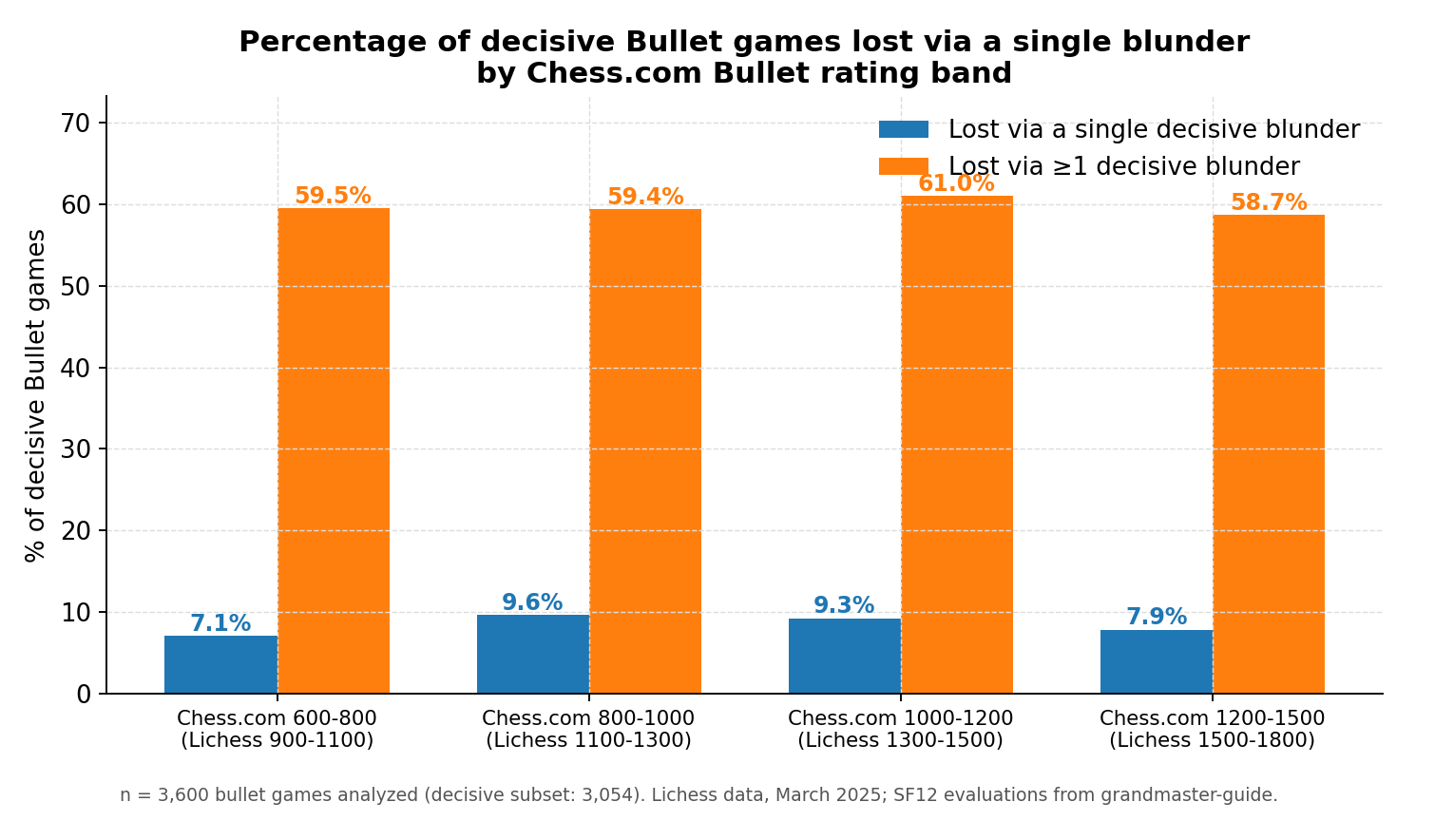
Across all rating bands from Chess.com 600 to 1500, only 7% to 10% of decisive Bullet games are lost because of a single catastrophic mistake. In contrast, roughly 60% of decisive games feature at least one decisive blunder by the losing side. This means that in the vast majority of games where a player blunders heavily, they actually blunder multiple times, or their opponent blunders back, creating a chaotic back-and-forth struggle rather than a clean, one-mistake execution.
When we look at the overall share of all Bullet games (including draws), the single-blunder loss accounts for an even smaller fraction of outcomes.
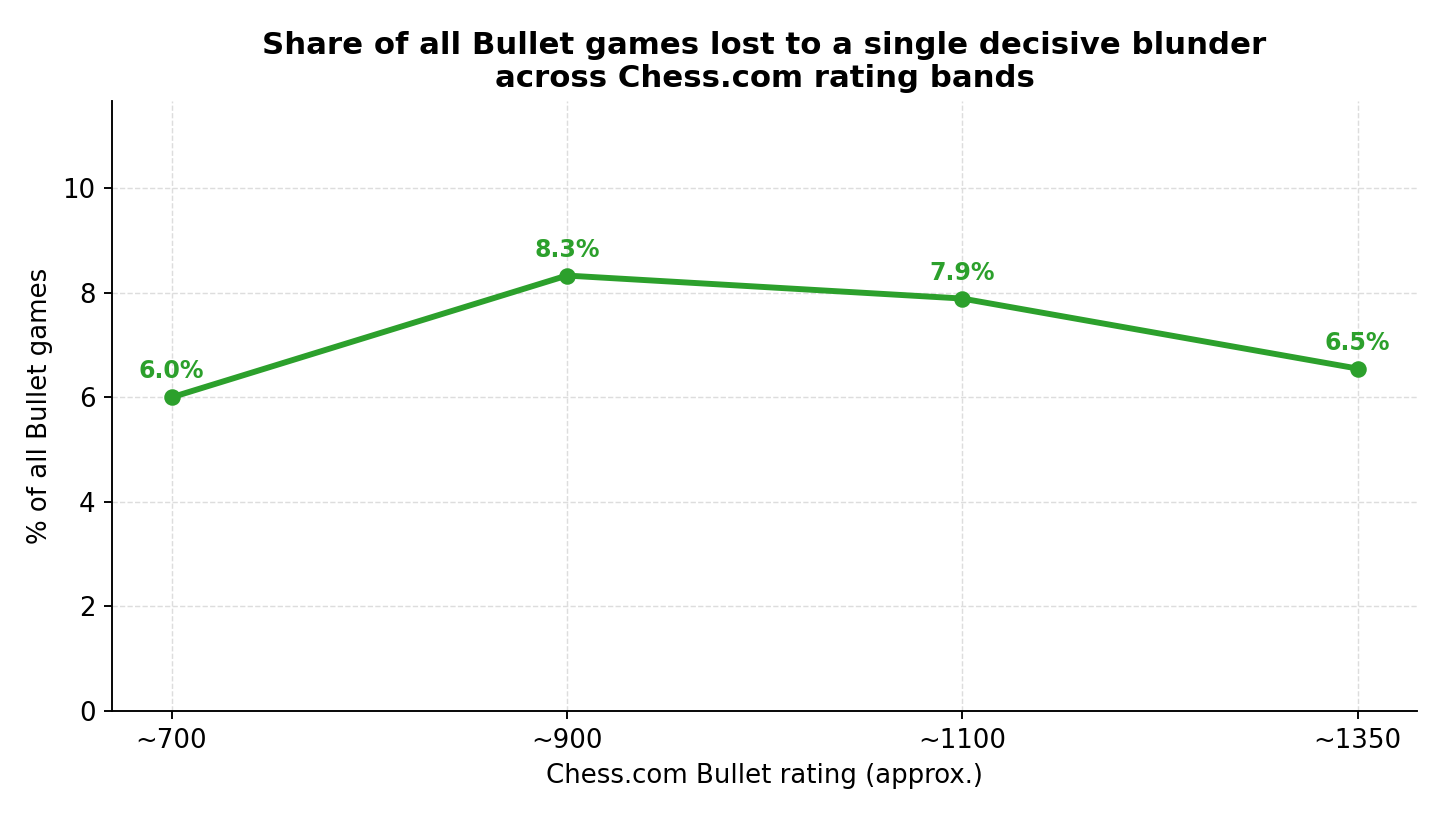
The peak of single-blunder losses occurs around the Chess.com 800-1000 range (8.3% of all games). Below this level, games are too chaotic for a single mistake to decide the outcome; above this level, players become slightly more resilient, though the rate remains remarkably flat. If you feel like you are constantly losing games to a single mouse slip, the data suggests you are likely experiencing confirmation bias. Most of your losses involve multiple significant errors.
When Do the Deciding Blunders Happen?
If single-blunder losses are rare, when do they actually occur? The timing of these fatal mistakes provides crucial insight into the psychology of Bullet chess.
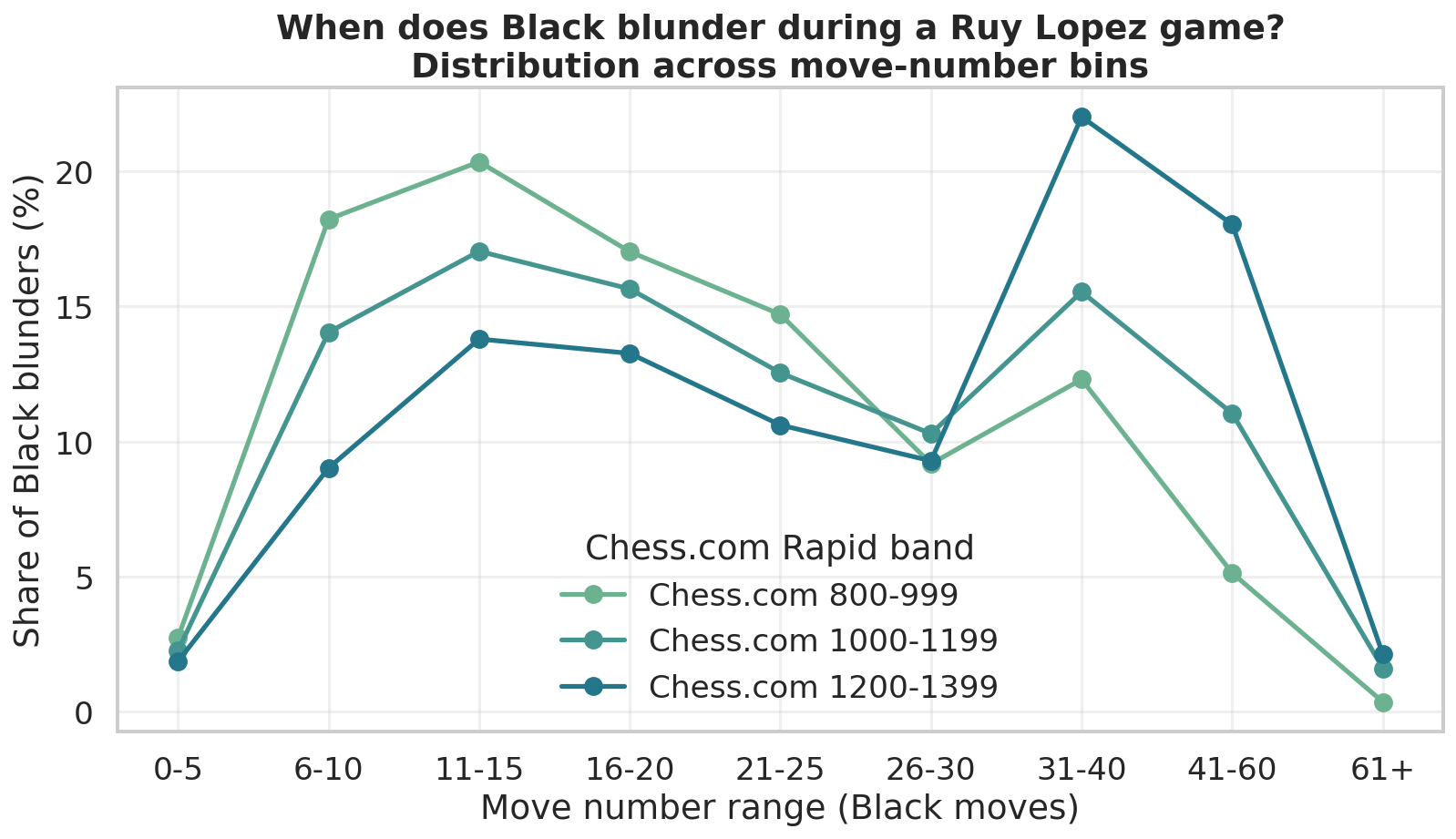
The danger zone in Bullet chess is undeniably the transition from the opening to the middlegame. Across all rating bands, the highest concentration of single deciding blunders occurs between moves 11 and 20. This is the exact moment when players leave their memorized opening preparation and must start thinking independently while managing the clock.
Interestingly, as players improve from Chess.com 600 to 1500, the distribution shifts. Lower-rated players are highly susceptible to opening traps and early tactical oversights (moves 1-10). As ratings increase, players survive the opening more consistently, pushing the deciding blunders deeper into the middlegame and endgame. By the Chess.com 1200-1500 band, endgame blunders (moves 31+) become a significant factor, accounting for 14% of single-blunder losses.
The Anatomy of a Bullet Blunder
What exactly does a game-ending blunder look like? We categorized the single decisive blunders based on material changes and game phase.
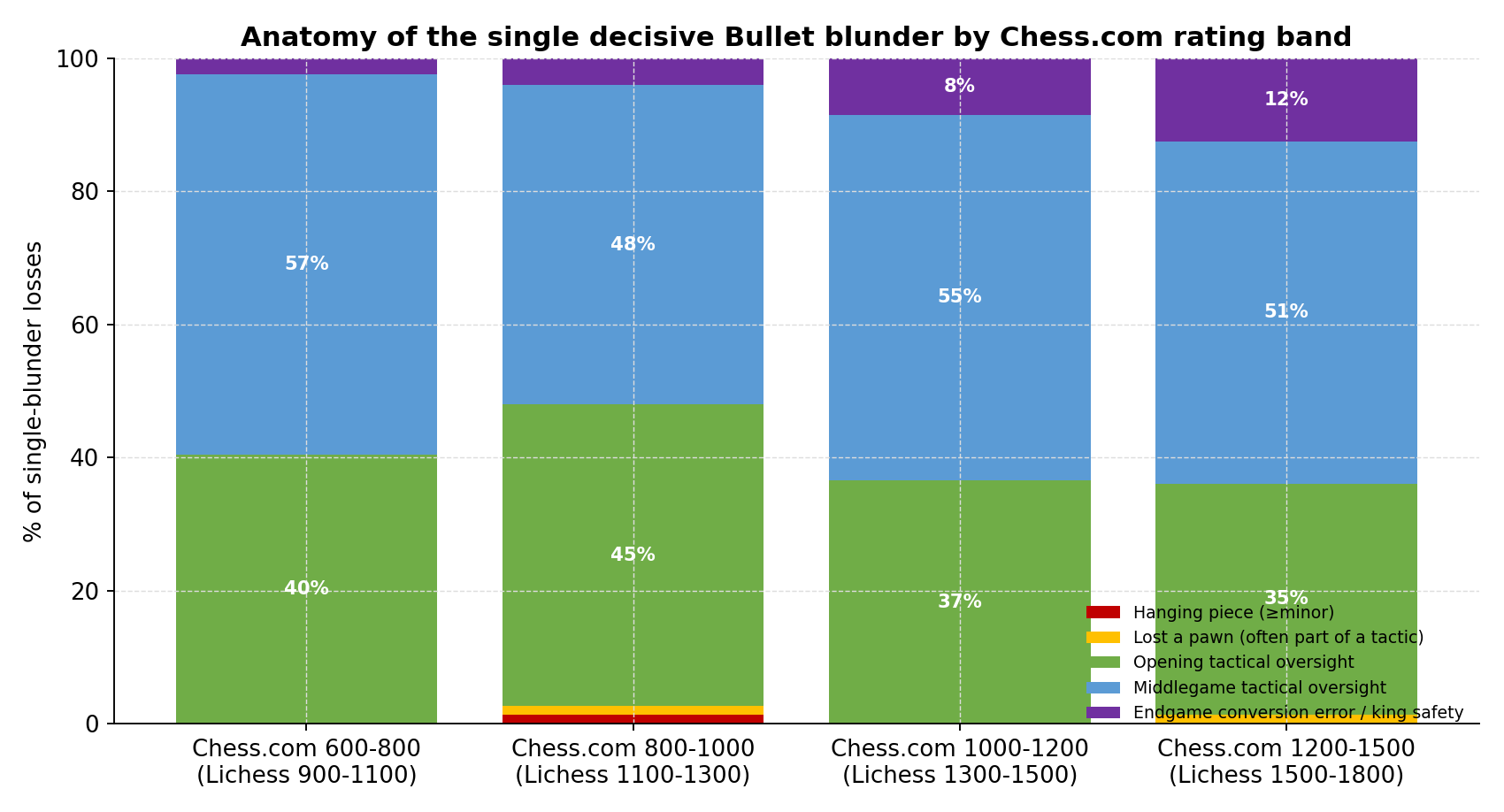
The overwhelming majority of single-blunder losses are not simple one-move piece hangs (which account for less than 2% of these specific cases). Instead, they are tactical oversights in the opening and middlegame. These are situations where a player misses a multi-move sequence, a discovered attack, or a mating net.
Visual Evidence: The 1100-1300 Danger Zone
Consider this example from a game in the Chess.com 800-1000 equivalent band. White has a solid position but rushes a tactical idea.
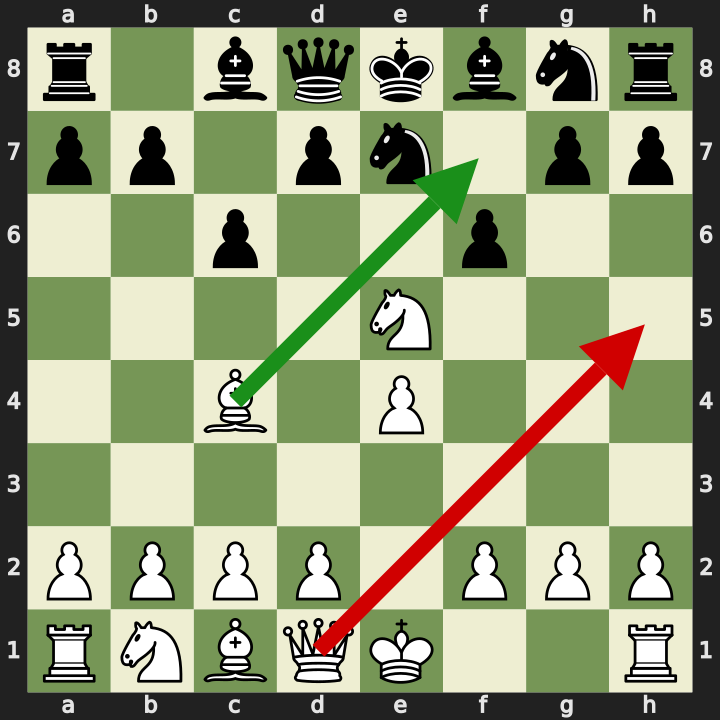
White plays the aggressive but flawed Qh5+ (red arrow), completely missing that Black is adequately defended and White's own position is overextended. The engine prefers the developing and solidifying Bc4 (green arrow).
Visual Evidence: The 1300-1500 Middlegame Collapse
As players reach the intermediate level, the blunders often involve missing subtle prophylactic moves or misjudging king safety.
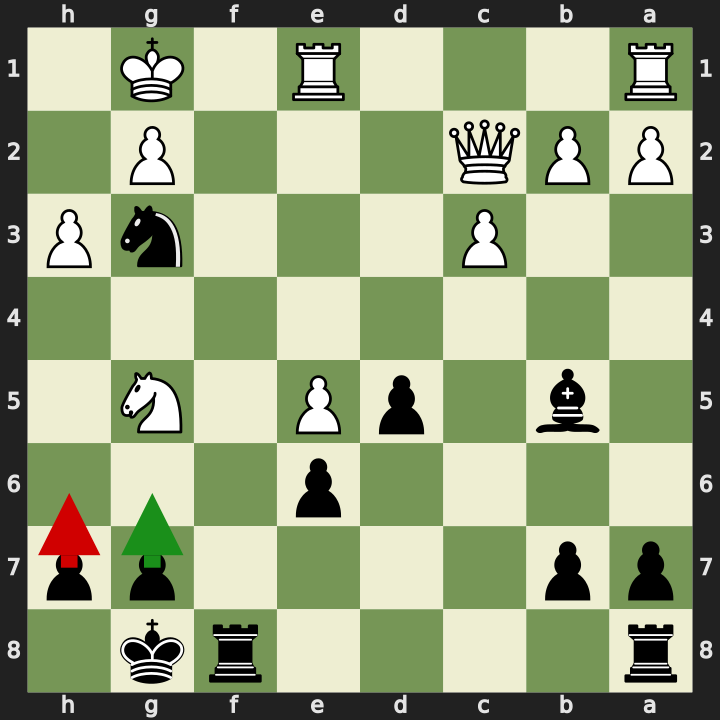
In a complex middlegame, Black plays h6 (red arrow), weakening the kingside and allowing White a devastating attack. The engine strongly prefers the solidifying g6 (green arrow), which keeps the position balanced.
Actionable Advice: A Roadmap for Improvement
Based on this data, how can you climb the rating ladder in Bullet chess? The strategy changes depending on your current level.
For Chess.com 600-800 Players
The Data: You are losing 40% of your single-blunder games in the opening phase, often before move 12. The Action: Stop playing "hope chess" in the opening. Focus on solid, principled development rather than tricky gambits. Your goal is simply to reach move 15 with an equal position and an equal clock. If you can survive the opening without a massive disadvantage, your opponent is highly likely to blunder later.
For Chess.com 800-1000 Players
The Data: This is the peak rating band for single-blunder losses (9.6% of decisive games). The transition to the middlegame (moves 11-20) is your biggest vulnerability. The Action: Practice your transition planning. When your opening preparation ends, take a brief (1-2 second) pause to evaluate the board before blitzing out moves. Focus on identifying your opponent's threats before launching your own attacks. Tactical awareness in the early middlegame is your primary bottleneck.
For Chess.com 1000-1200 Players
The Data: Middlegame tactical oversights account for 55% of your single-blunder losses. The Action: Your openings are improving, but your calculation speed under pressure is lacking. Dedicate time to solving simple tactics (mate in 1, forks, pins) quickly. Pattern recognition is more important than deep calculation in Bullet. You need to see the basic tactics instantly so you can spend your clock time on more complex decisions.
For Chess.com 1200-1500 Players
The Data: Endgame conversion errors and late-game blunders (moves 31+) jump significantly at this level, accounting for 12% of single-blunder losses. The Action: You are reaching the endgame more often, but you are throwing away drawn or winning positions due to time pressure and poor technique. Study basic endgame patterns (pawn races, rook endgames) so you can play them automatically. In Bullet, knowing the correct endgame technique without having to think is a massive competitive advantage.
Conclusion
The data is clear: the single, game-ending blunder is the exception, not the rule, in beginner and intermediate Bullet chess. Most games are messy, multi-blunder affairs. By understanding when and how these critical mistakes happen—and by focusing on solid transitions and rapid pattern recognition—you can stop beating yourself up over mouse slips and start systematically improving your game.
Data and Methodology
This analysis is based on 3,600 rated Bullet games played on Lichess in March 2025. The games were sampled across four Lichess rating bands (900-1100, 1100-1300, 1300-1500, 1500-1800) to approximate Chess.com ratings from 600 to 1500.
Engine evaluations (Stockfish 12) were extracted for every ply. A decisive blunder was defined as a move that dropped the evaluation by at least 3.0 pawns, moving the position from non-losing (eval >= -1.5) to losing (eval <= -3.0).
The underlying data files used to generate the charts and insights in this article are attached below for further review:
single_blunder_by_band.csv: Top-level summary of game outcomes and blunder frequencies.single_blunder_timing.csv: Distribution of deciding blunders by move number.single_blunder_type.csv: Categorization of deciding blunders by tactical/positional type.blunder_examples.csv: Raw data for the specific FEN examples highlighted in the text.
Chess Coach April 20, 2026