A Data-Driven Guide for Chess.com Players Rated 800–1500
The Sicilian Defense (1.e4 c5) is one of the most popular, complex, and deeply analyzed openings in chess. At the grandmaster level, theory extends well past move 20. But what happens in the trenches of online Bullet chess? How long do intermediate players actually stay "in book" before someone blunders a pawn, plays a dubious sideline, or simply forgets the theory?
To answer this, we analyzed over 1,000 recent Bullet games played on Lichess, mapping the data to approximate Chess.com rating bands between 800 and 1500. We tracked every game move-by-move against a comprehensive opening book to find exactly where—and how—players deviate from established theory within the first five moves.
This article serves as a roadmap for improvement. By understanding the common pitfalls at your current rating, you can patch the holes in your repertoire and climb to the next level.
1. The Big Picture: How Often Do We Deviate?
Our analysis focused on the first five full moves (10 plies) of the Sicilian Defense. A "deviation" is defined as any move that is not recognized as a standard theoretical continuation or a popular, playable sideline in that specific position.
The data reveals a clear trend: as ratings increase, players stay in book longer.

At the 800–999 level, nearly 30% of all Sicilian games feature a non-book move within the first five moves. By the time players reach the 1400–1599 band, this number drops to just under 11%.
Interestingly, the side responsible for the deviation also shifts as ratings climb.

In the lower bands, White is overwhelmingly the first to deviate (nearly 75% of the time at 800–999). This makes sense: Black initiates the Sicilian with 1...c5, and White players at this level often lack a prepared response, resorting to early queen attacks or passive development. However, by the 1400–1599 band, the script flips. White players generally know how to navigate the first few moves (often playing the Open Sicilian with 2.Nf3 and 3.d4), and it is Black who begins to stumble in the complex branching paths of the Najdorf, Dragon, or Paulsen variations.
2. When Does the Deviation Happen?
To understand exactly where players go wrong, we mapped the first deviation by ply (half-move).

The heatmap highlights a massive danger zone for the 800–999 band at Ply 3 (White's second move). Fully 15% of all games in this band see White immediately play a non-book move in response to 1...c5.
As players improve, the danger zone pushes deeper into the opening. For the 1000–1199 and 1200–1399 bands, the critical moments occur at Ply 6 (Black's third move). This is typically the moment after White plays 3.d4 in the Open Sicilian, forcing Black to make a crucial decision.

3. Rating Band Breakdown and Actionable Advice
Let us examine the specific mistakes players make at each level and how you can fix them.
The 800–999 Band: The Wild West
At this level, the Sicilian is often met with confusion. White players frequently try to apply principles from 1.e4 e5 games, leading to immediate inaccuracies.
Top Deviations:
- 2.Qh5 or 2.Qf3: Attempting a Scholar's Mate setup.
- 2.e5: Pushing the pawn immediately.
 After 1.e4 c5, White sometimes plays 2.e5 (red arrow). This grabs space but abandons the fight for the center and allows Black easy development. The standard move is 2.Nf3 (green arrow).
Actionable Advice:
- For White: Stop bringing your queen out early against the Sicilian. 2.Qh5 does nothing against 1...c5. Learn the basic setup of the Open Sicilian (2.Nf3 followed by 3.d4) or a simple anti-Sicilian like the Alapin (2.c3) or the Closed Sicilian (2.Nc3).
- For Black: If White plays 2.e5, do not panic. Play 2...Nc6 or 2...d6 to challenge the pawn, and enjoy your comfortable position. If White plays 2.Qh5, simply defend your pawns and develop normally (e.g., 2...Nc6).
The 1000–1199 Band: The Tension of the Open Sicilian
Players here generally know to play 2.Nf3, but the complexities of the Open Sicilian begin to overwhelm them by move 3.
Top Deviations:
- Declining the trade on d4: After 1.e4 c5 2.Nf3 Nc6 3.d4, Black frequently plays 3...d6 or 3...d5 instead of the mandatory 3...cxd4.
- Early queen sorties: 2.Qf3 and 2.Qh5 still appear occasionally.
 After 1.e4 c5 2.Nf3 Nc6 3.d4, Black must play 3...cxd4 (green arrow). Playing 3...d6 (red arrow) allows White to capture on c5 or push d5, gaining a massive advantage.
Actionable Advice:
- For Black: In the Open Sicilian, when White plays 3.d4, you must capture it with 3...cxd4. This is the entire point of playing 1...c5—you are trading a flank pawn for a central pawn. Refusing the trade leads to cramped, passive positions.
- For White: If Black refuses to capture on d4, punish them. If they play 3...d6, you can often push 4.d5 to kick their knight and claim a huge space advantage.
The 1200–1399 Band: Navigating the Sub-Variations
At this level, players are successfully reaching the main branching points of the Sicilian, but they often mix up the move orders of specific variations.
Top Deviations:
- Move order confusion in the Paulsen/Taimanov: After 1.e4 c5 2.Nf3 e6 3.d4, Black sometimes plays 3...Nc6 or 3...d5 instead of 3...cxd4.
- Sidelines against the Najdorf setup: After 1.e4 c5 2.Nf3 d6 3.d4 cxd4 4.Nxd4 Nf6, White sometimes plays 5.Bb5+ or 5.Bd3 instead of the standard 5.Nc3.
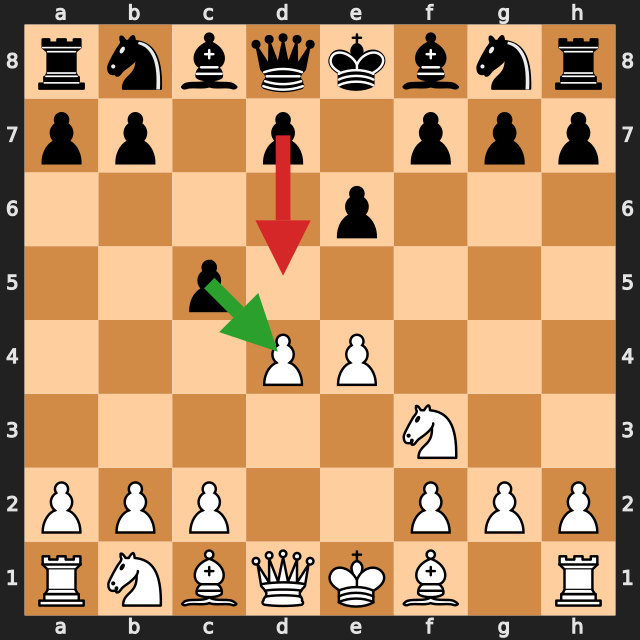 After 1.e4 c5 2.Nf3 e6 3.d4, Black must again play 3...cxd4 (green arrow). Playing 3...d5 (red arrow) allows White to push e5 or capture, disrupting Black's setup.
Actionable Advice:
- For Black: Pick one specific Sicilian variation (e.g., the Dragon, the Najdorf, or the Classical) and learn the first 5–7 moves perfectly. Mixing up the move orders of different variations is a common cause of early disadvantages.
- For White: If you play the Open Sicilian, be prepared for Black's main responses. Learn the standard setups against 2...d6, 2...Nc6, and 2...e6.
The 1400–1599 Band: Entering Deep Theory
Players in this band are highly booked up through move 5. Deviations here are rare (only 10.7% of games) and are usually conscious choices to play offbeat sidelines rather than outright blunders.
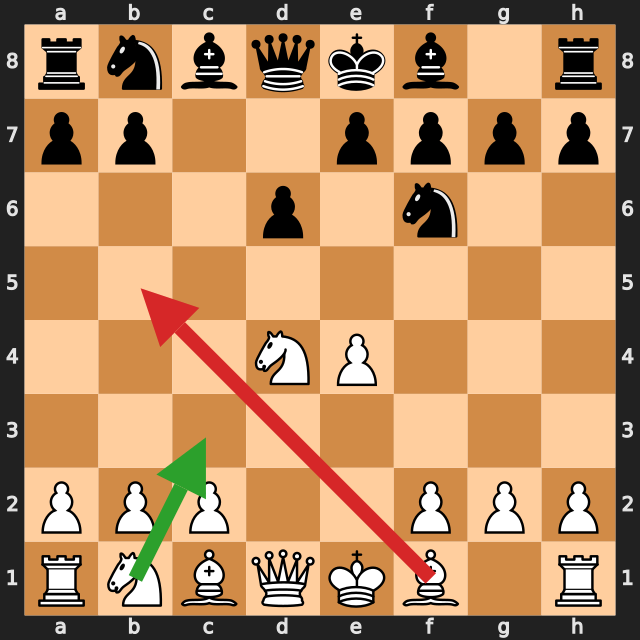 After 1.e4 c5 2.Nf3 d6 3.d4 cxd4 4.Nxd4 Nf6, White's main move is 5.Nc3. However, 5.Bb5+ (red arrow) is occasionally played as a surprise weapon to avoid deep Najdorf theory.
Actionable Advice:
- For Both Sides: At this level, games are decided deeper in the opening or in the middlegame. Focus on understanding the plans and pawn structures of your chosen variation, rather than just memorizing moves.
4. The Evolution of the Sicilian Repertoire
As players improve, the types of Sicilian variations they play also evolve.

In the lower bands, the "Other/?" category is large, reflecting the high number of early deviations and non-standard play. As ratings increase, the classic mainlines—the Najdorf (B90-B99), the Dragon (B70-B79), and the various 2...Nc6 lines (B30-B39)—begin to dominate the landscape.
Data and Methodology
This research was conducted by analyzing 1,051 Lichess Bullet games featuring the Sicilian Defense (1.e4 c5).
- Data Collection: Games were fetched using the Lichess API, filtered for the Bullet time control, and categorized into four rating bands.
- Platform Calibration: Lichess ratings were mapped to approximate Chess.com ratings using standard conversion tables (e.g., Chess.com 1000 ≈ Lichess 1295).
- Book Evaluation: Each game was evaluated against a comprehensive opening book. The book was constructed using established grandmaster theory and augmented empirically by including any move played in at least 3% of games by players in the highest rating band (1400–1599).
- Analysis: A Python script parsed the PGNs, identified the first ply where a non-book move was played, and aggregated the statistics.
Underlying Data Files:
- Per-Game Raw Data (CSV)
- Band Summary Statistics (CSV)
- Deviation by Ply (CSV)
- Top Deviating Moves (CSV)
Chess Coach April 19, 2026