For beginner and intermediate players, the Sicilian Defense (1.e4 c5) carries a reputation as a sharp, complex, and deeply theoretical opening. When the clock is ticking down in a 1-minute bullet game, many players wonder if diving into the Sicilian is a recipe for a quick disaster. Does playing the Sicilian in bullet chess lead to shorter games? Does it increase the likelihood of a quick blunder?
To answer these questions, we analyzed a dataset of over 16,000 bullet games played on Lichess, specifically focusing on the 1,215 games where the Sicilian Defense was employed. We mapped the Lichess ratings to their Chess.com bullet equivalents to provide actionable insights for players climbing from an 800 to a 1500 rating.
This guide serves as a roadmap for improvement, breaking down the data by rating band to show how the Sicilian Defense evolves as you climb the ranks, and providing actionable advice for each stage of your journey.
The Myth of the Short Sicilian
The most striking finding from the data is that the Sicilian Defense does not lead to significantly shorter bullet games compared to other openings. Across all rating bands from 600 to 1400 (Chess.com), the average length of a Sicilian bullet game is nearly identical to the baseline average of all other openings.
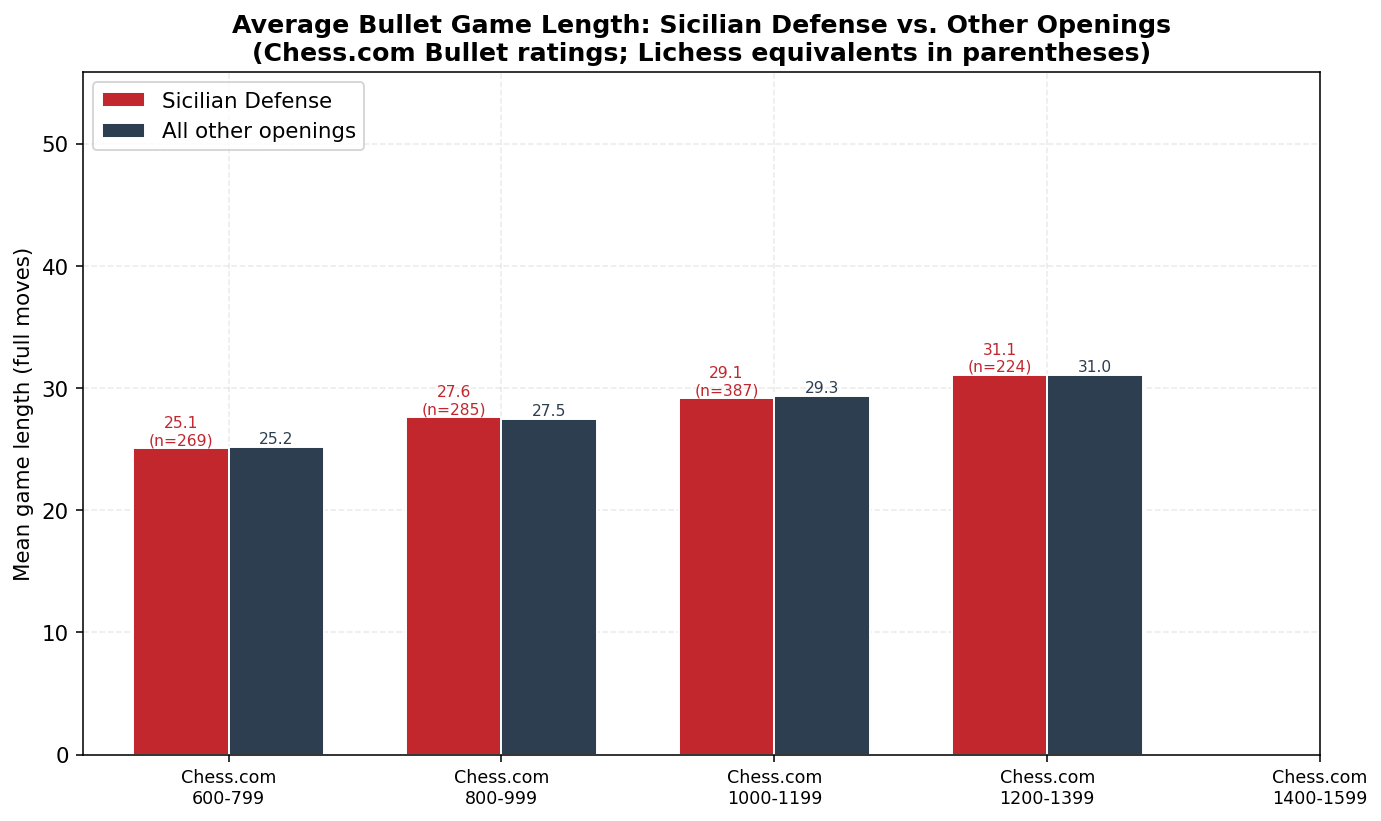
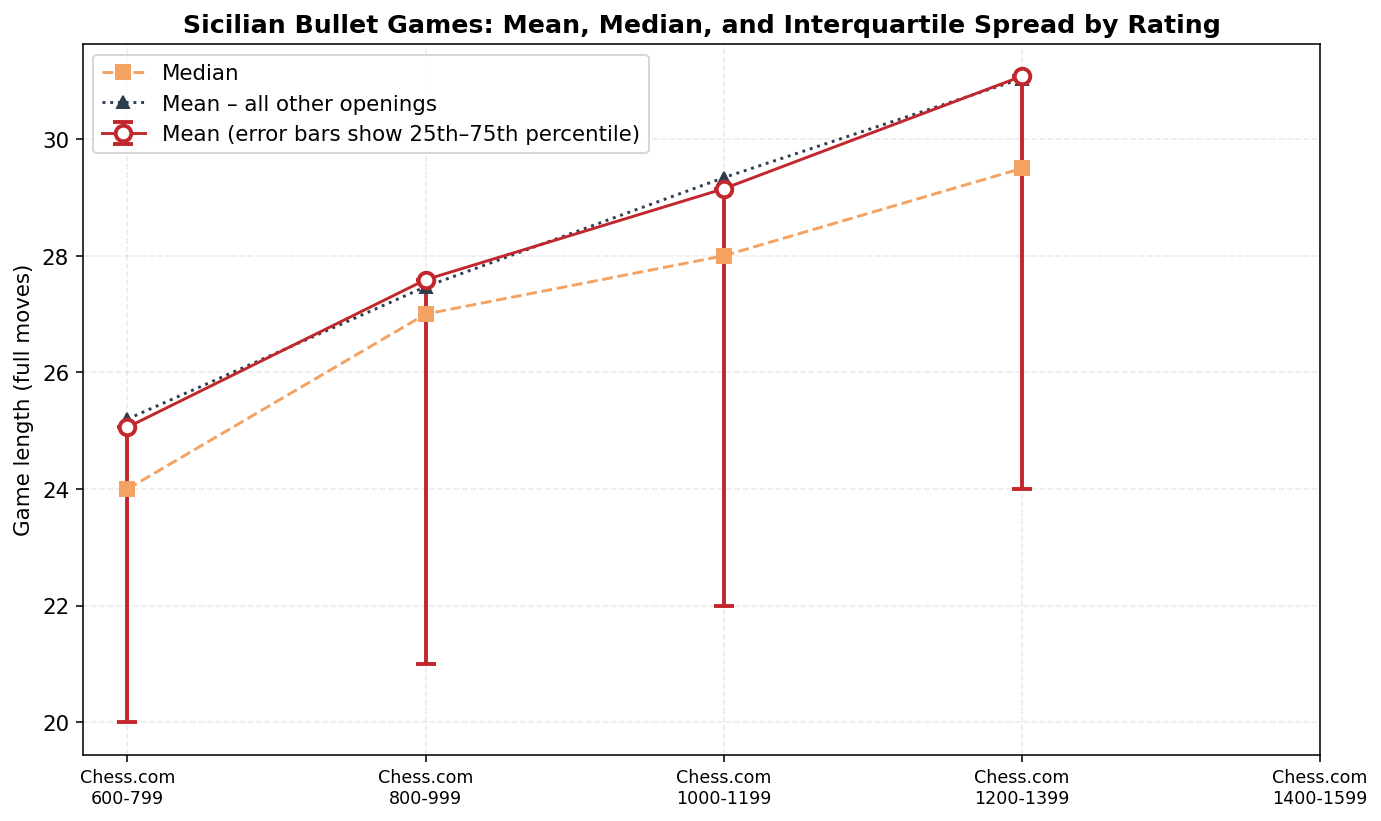
As players improve, the average game length steadily increases. At the 600-799 level, a typical Sicilian bullet game lasts about 25 moves. By the time players reach the 1200-1399 bracket, the average game extends to 31 moves. This 24% increase in game length reflects a growing ability to survive the opening and navigate into the middlegame and endgame, rather than falling victim to early traps.
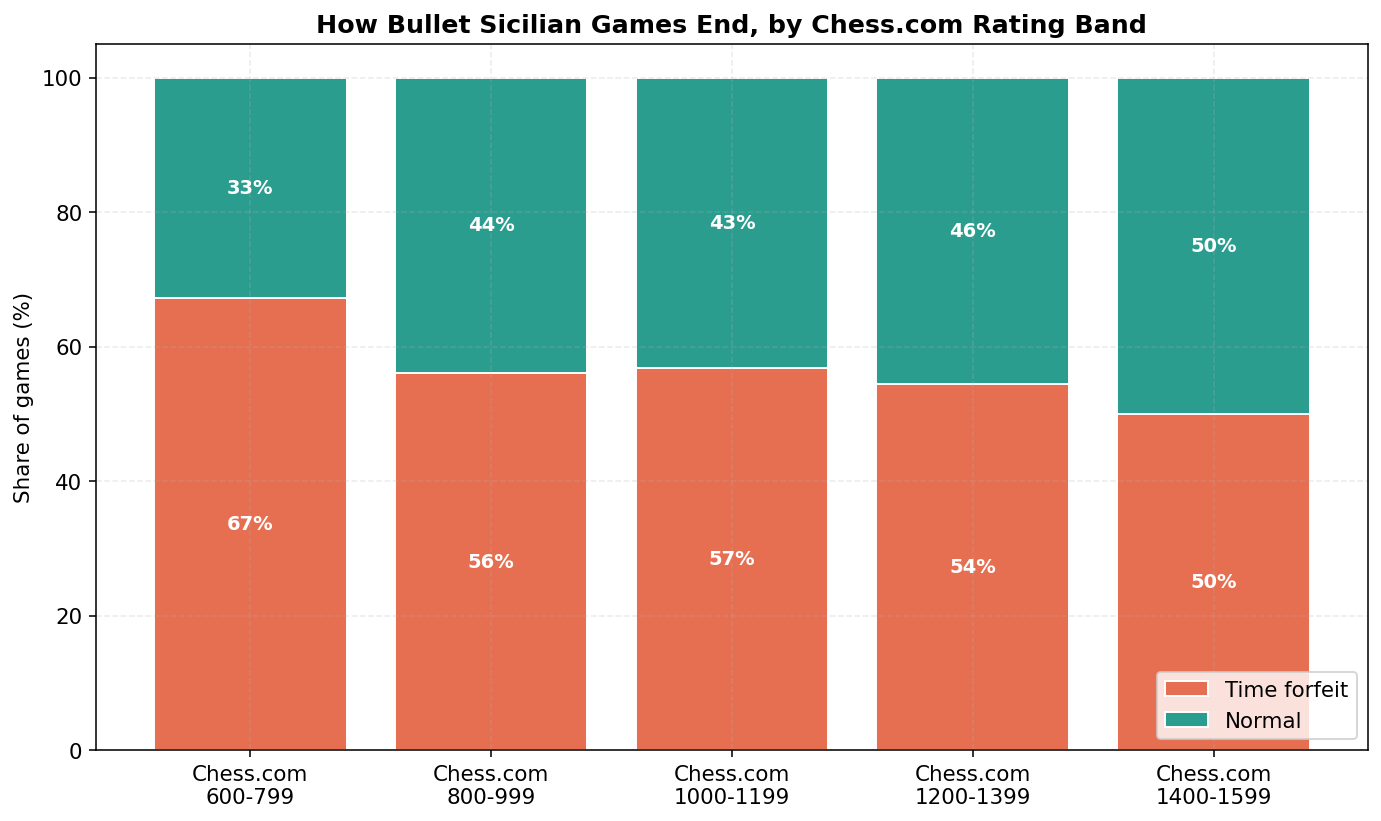
The data also reveals a significant shift in how games end. At the 600-799 level, a staggering 67% of Sicilian bullet games end in a time forfeit (flagging). As players climb the rating ladder, this percentage steadily decreases, reaching 54% in the 1200-1399 band. This indicates that lower-rated players are often overwhelmed by the complexity of the positions, burning too much time early on, whereas higher-rated players are better equipped to play on intuition and pattern recognition.
Rating Band Breakdown and Actionable Advice
The 800-999 Bracket: Surviving the Chaos
In the 800-999 Chess.com rating band (approximately 1200-1399 on Lichess), the Sicilian is characterized by early deviations and tactical skirmishes. The average game length is 27.6 moves, and nearly 20% of games end in fewer than 20 moves.
At this level, players frequently face anti-Sicilian systems like the Bowdler Attack (2.Bc4) or the Smith-Morra Gambit (2.d4 cxd4 3.c3). The data shows that the Bowdler Attack is one of the most common variations encountered, and it often leads to very short games (averaging just 25.2 moves) due to early blunders.
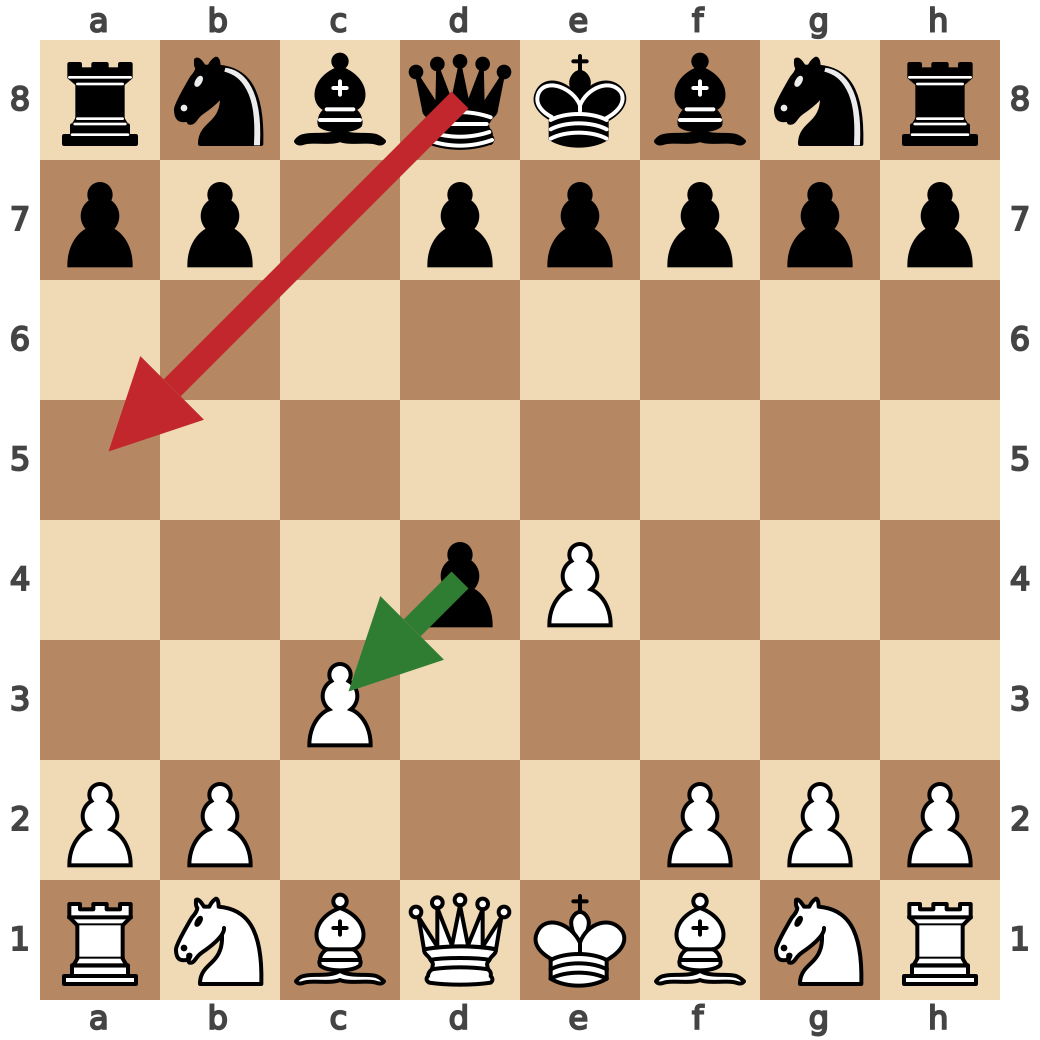
Actionable Advice for 800-999 Players: Focus on solidifying your response to early deviations. When facing the Smith-Morra Gambit, accepting the pawn with 3...dxc3 (the green arrow) is the most principled approach, challenging White to prove their compensation. Avoid premature queen sorties like 3...Qa5 (the red arrow), which waste time and expose the queen to attack. Against the Bowdler Attack (2.Bc4), prioritize developing your knights and controlling the center rather than panicking. Remember that 56% of games at this level end in a time forfeit, so prioritize practical, solid moves over finding the absolute "best" theoretical continuation.
The 1000-1199 Bracket: Transitioning to the Open Sicilian
As you cross the 1000 threshold (1400-1599 Lichess), the landscape begins to shift. The average game length increases to 29.2 moves, and the percentage of "short" games drops. Players here are more likely to encounter the Open Sicilian (2.Nf3 followed by 3.d4), leading to more complex, structured middlegames.
The data indicates that variations like the Old Sicilian (2...Nc6) and the French Variation (2...e6) become more prevalent. These lines require a better understanding of pawn structures and typical attacking plans.
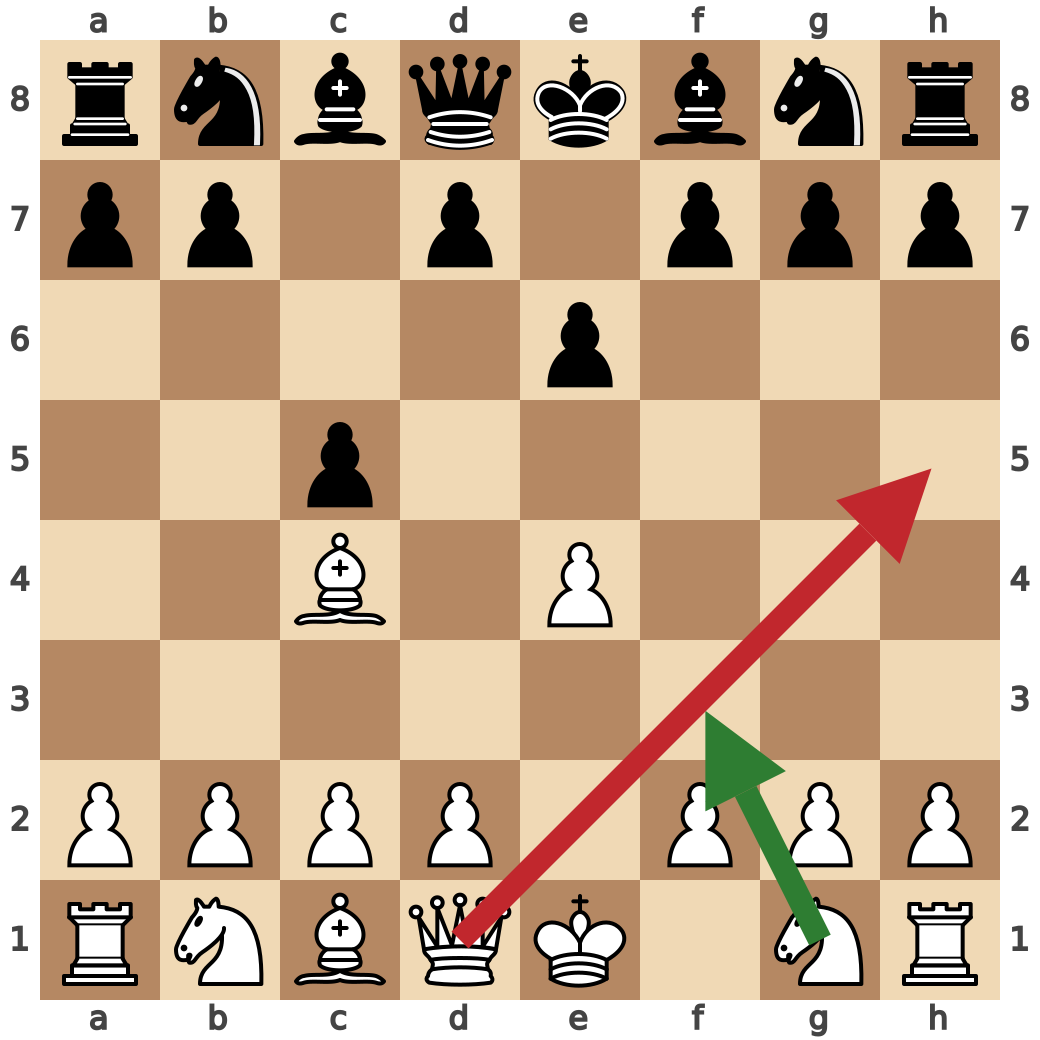
Actionable Advice for 1000-1199 Players: Begin familiarizing yourself with the typical pawn structures of the Open Sicilian. If you play 2...e6 systems, understand how to handle the d6/e6 center. If you face the Bowdler Attack (2.Bc4 e6), recognize that White's bishop is misplaced. Develop naturally with 3...Nf6 (green arrow) rather than falling for cheap traps or launching premature attacks like 3...Qh5 (red arrow). Time management remains critical, as 57% of games still end in flagging. Develop a repertoire of "automatic" developing moves for the first 5-7 moves to save precious seconds.
The 1200-1399 Bracket: Navigating Complexity
In the 1200-1399 band (1600-1799 Lichess), the Sicilian truly begins to resemble its classical form. The average game length stretches to 31.1 moves, and nearly 20% of games go beyond 40 moves. The percentage of games ending in a time forfeit drops to 54%, indicating that players are reaching the endgame more frequently.
At this level, you will face more principled play from White, including main-line Najdorf, Dragon, or Sveshnikov setups. The challenge shifts from surviving early traps to navigating complex middlegame plans and transitioning into favorable endgames.
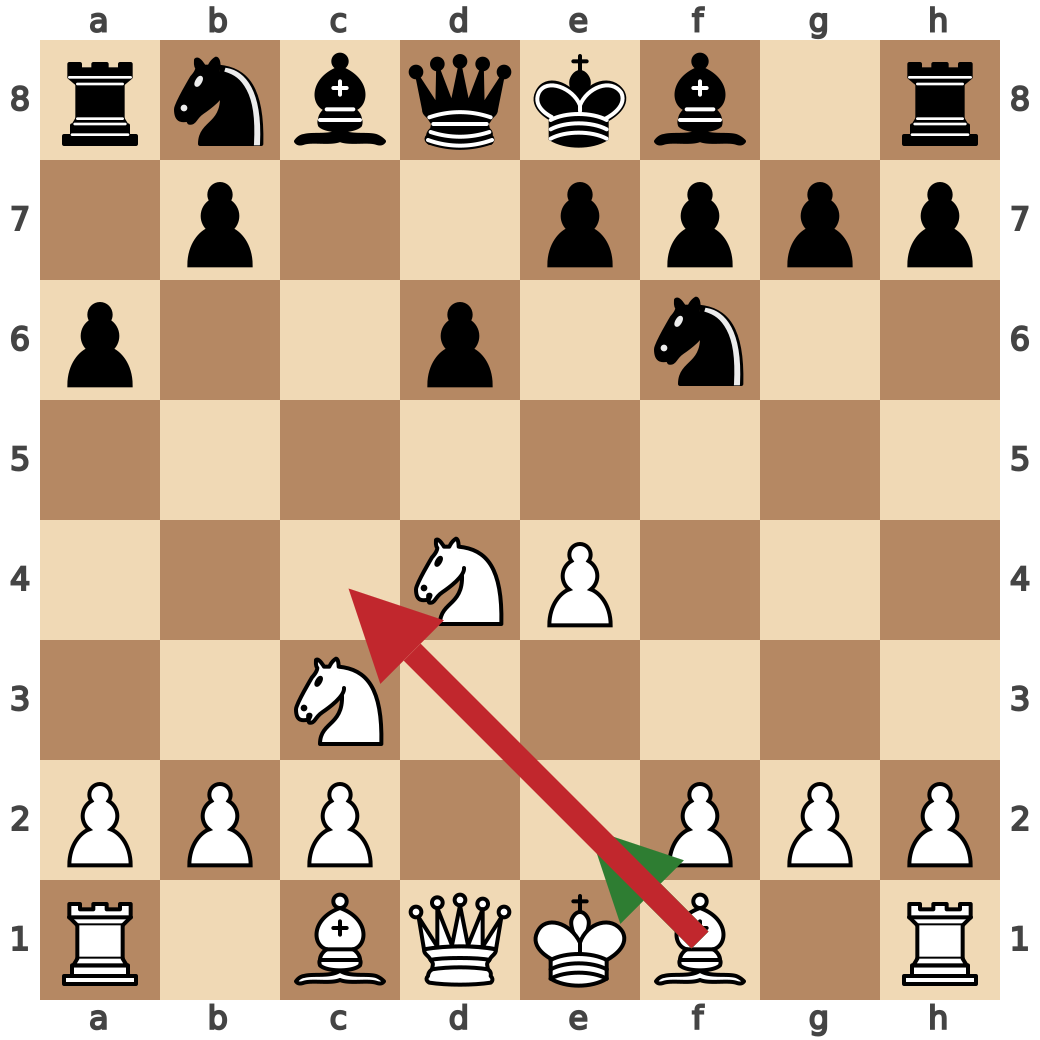
Actionable Advice for 1200-1399 Players: Deepen your understanding of your chosen Sicilian variation. In the Najdorf structure (after 5...a6), recognize that White's most principled developing moves are Be2, Be3, or Bg5 (green arrow). If White plays inaccurately with 6.Bc4 (red arrow), understand how to exploit the misplaced bishop with ...e6 and ...b5. Since a significant portion of games now reach the endgame, practice your rook endgames and king activation.
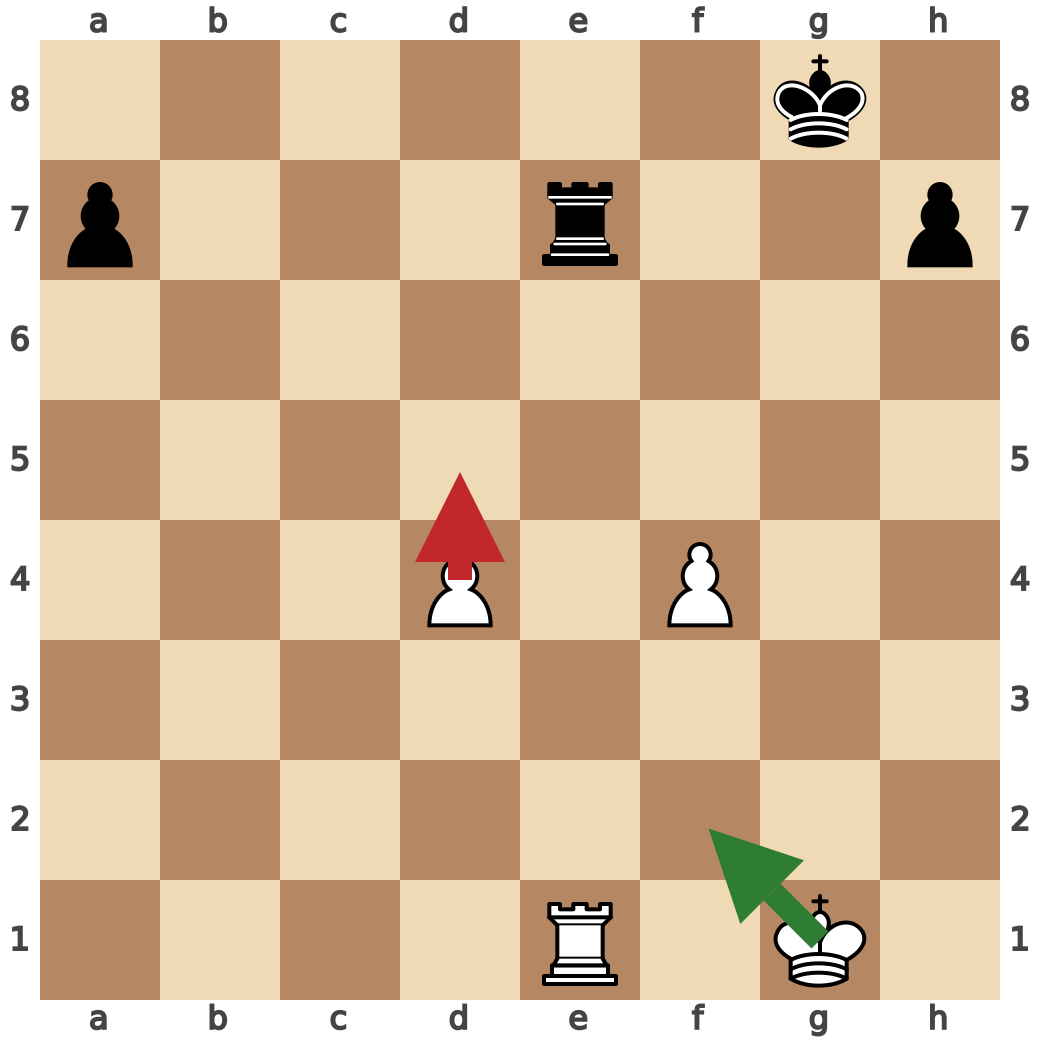
When the queens come off, prioritize activating your king (green arrow) rather than mindlessly pushing pawns (red arrow). The ability to play endgames quickly and accurately will turn many potential time forfeits into victories.
Conclusion
The data clearly shows that playing the Sicilian Defense in bullet chess does not inherently lead to shorter, more chaotic games. Instead, the length and nature of the game are dictated by the players' ratings. As you climb from 800 to 1500, your Sicilian games will naturally lengthen as you and your opponents make fewer early blunders and navigate deeper into the middlegame and endgame.
By understanding the common pitfalls at your current rating band and focusing on practical, time-efficient development, you can wield the Sicilian Defense effectively, even when the clock is ticking down.
Data and Methodology
This analysis is based on a dataset of 57,404 games collected from the Lichess database via the grandmaster-guide MCP server. The dataset was filtered to isolate 16,307 bullet games (total time < 180 seconds), of which 1,215 featured the Sicilian Defense (ECO B20-B99).
Lichess ratings were mapped to approximate Chess.com bullet ratings using the provided conversion table to ensure the insights are actionable for the target audience.
The underlying data files and charts generated for this analysis are available below:
- Combined Bullet Sicilian Games (CSV)
- Combined All Bullet Games (CSV)
- Band Statistics (CSV)
- Variation Statistics (CSV)
- ECO Statistics (CSV)
- Termination Statistics (CSV)
- Result vs Length Statistics (CSV)
Chess Coach <2026-04-19>