A Data-Driven Guide for Intermediate Players (800–1500 Chess.com)
The Sicilian Defense (1.e4 c5) is the most popular and combative response to 1.e4. Known for its sharp tactical lines and complex positional struggles, it is a favorite among grandmasters and club players alike. But for beginner to intermediate players—specifically those rated between 800 and 1500 on Chess.com—a critical question arises: Does the Sicilian perform better when you have time to think (Rapid), or when the clock is ticking (Blitz)?
To answer this, we analyzed over 72,000 Lichess games, mapped the ratings to their Chess.com equivalents, and extracted the engine evaluations to see where players are succeeding and where they are blundering. This guide serves as a roadmap for improvement, offering actionable advice tailored to your rating band.
1. The Big Picture: Black's Score in Blitz vs. Rapid
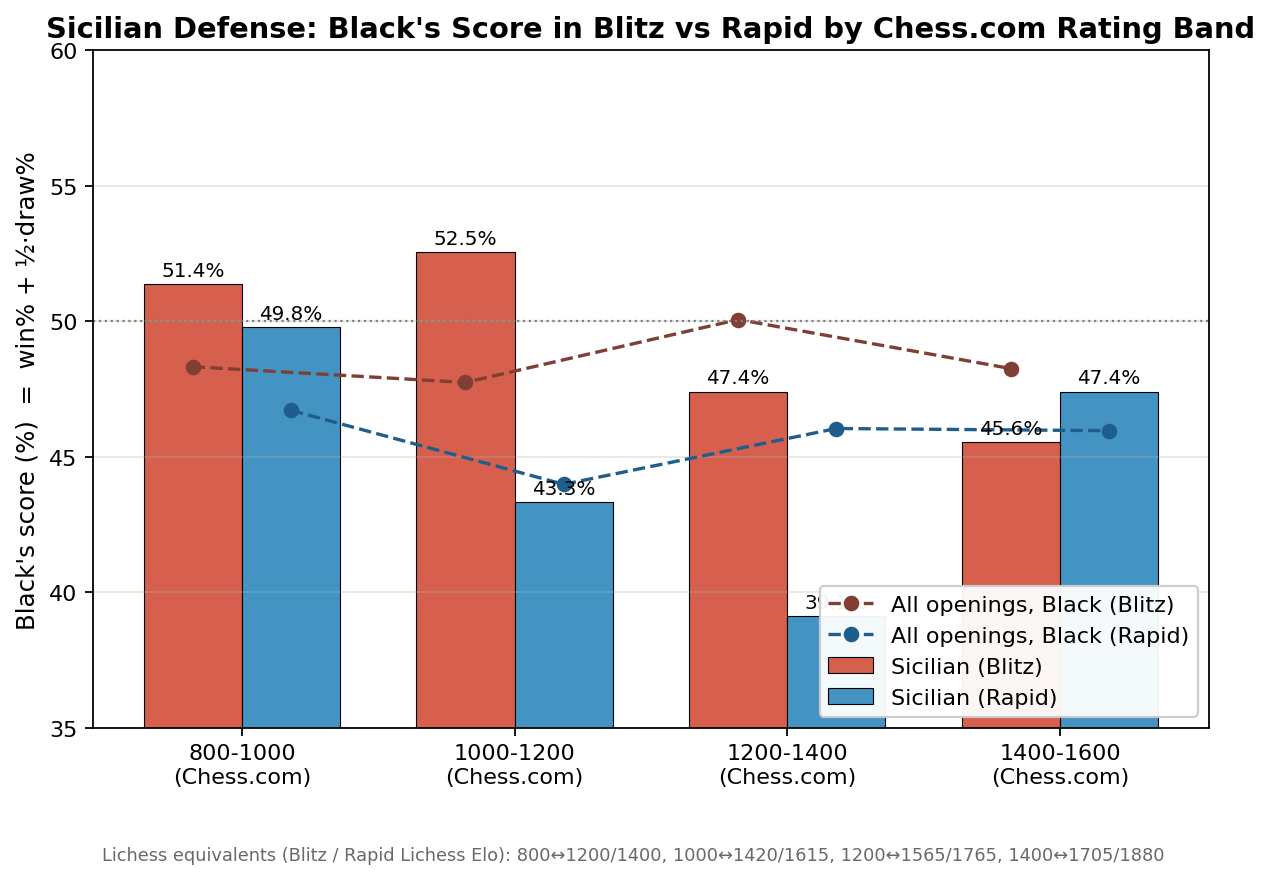
The most direct measure of an opening's success is the overall score for Black (Win% + ½ × Draw%). Our analysis reveals a fascinating trend: For players rated 800–1200, the Sicilian performs significantly better in Blitz than in Rapid. However, as players approach the 1400–1600 range, the gap narrows, and the Rapid performance begins to stabilize.
Why Does Blitz Favor the Sicilian at Lower Ratings?
In Blitz, the Sicilian's inherent complexity acts as a weapon. The opening creates asymmetrical pawn structures and sharp tactical imbalances. At lower ratings (800–1200 Chess.com), White often lacks the time to calculate the precise attacking sequences required to break through Black's defenses. The result is that White blunders more frequently under time pressure, allowing Black to score well above the baseline for all openings.
Conversely, in Rapid time controls, White has the luxury of time. The extra minutes allow White to navigate the opening traps, develop harmoniously, and launch coordinated attacks. For Black, defending the Sicilian requires precise knowledge of theory and defensive motifs—skills that are often underdeveloped in the 800–1200 range. Consequently, Black's score in Rapid drops significantly in these bands.
2. Blunders and Move Quality
To understand why the scores diverge, we must look at move quality. We measured the average number of severe blunders (defined as an evaluation swing of ≥3.0 pawns) per game.
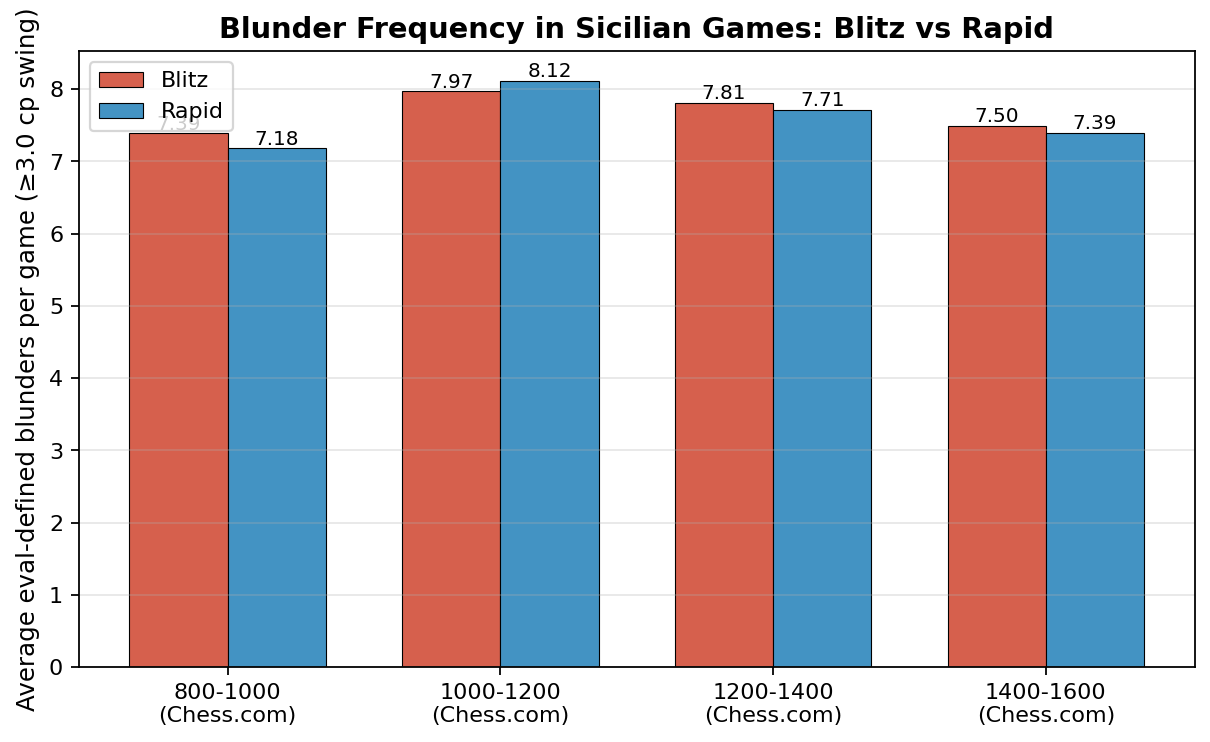
The data shows that blunders are universally higher in Blitz than in Rapid, which is expected. However, the impact of these blunders disproportionately favors Black in the Sicilian. Because the Sicilian often delays castling and invites early tension, a single blunder by White in Blitz can instantly lose the game. In Rapid, the blunder rate drops, meaning White plays more solidly and forces Black to outplay them positionally—a taller order for intermediate players.
A Tale of Two Blunders
Let's look at actual examples from our dataset to illustrate how time pressure and rating affect decision-making in the Sicilian.
Example 1: The Blitz Trap (800–1000 Chess.com)
In this Blitz game, White has launched an early attack in the French Variation of the Sicilian. Under time pressure, White plays Qxg4, a catastrophic blunder.
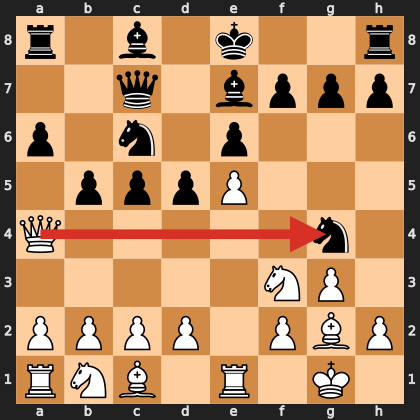 White plays Qxg4 (red arrow), completely missing that the Queen is now undefended and can be captured by the Bishop on e7 or the Knight on c6. In Blitz, these one-move tactical oversights are common and heavily reward the complex positions the Sicilian creates.
Example 2: The Positional Misstep (1400–1600 Chess.com Blitz)
As ratings increase, blunders become less about hanging pieces and more about structural or tactical misjudgments. In this mid-level Blitz game, White plays h3, attempting to kick the Knight.
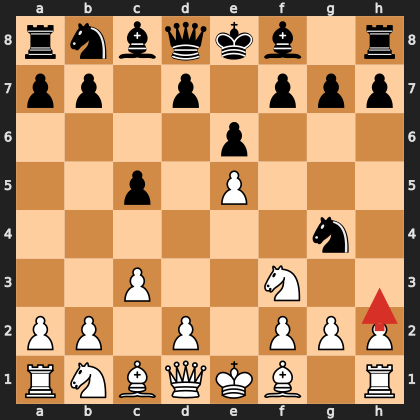 White plays h3 (red arrow). While it looks natural to challenge the Knight on g4, it weakens the kingside and ignores Black's central pressure. The engine evaluation swings from +1.32 to -1.39, handing the advantage to Black.
3. Sub-Variations: What Should You Play?
The "Sicilian" is not a single opening; it is a vast complex of variations. Our data highlights which specific lines perform best across both time controls.
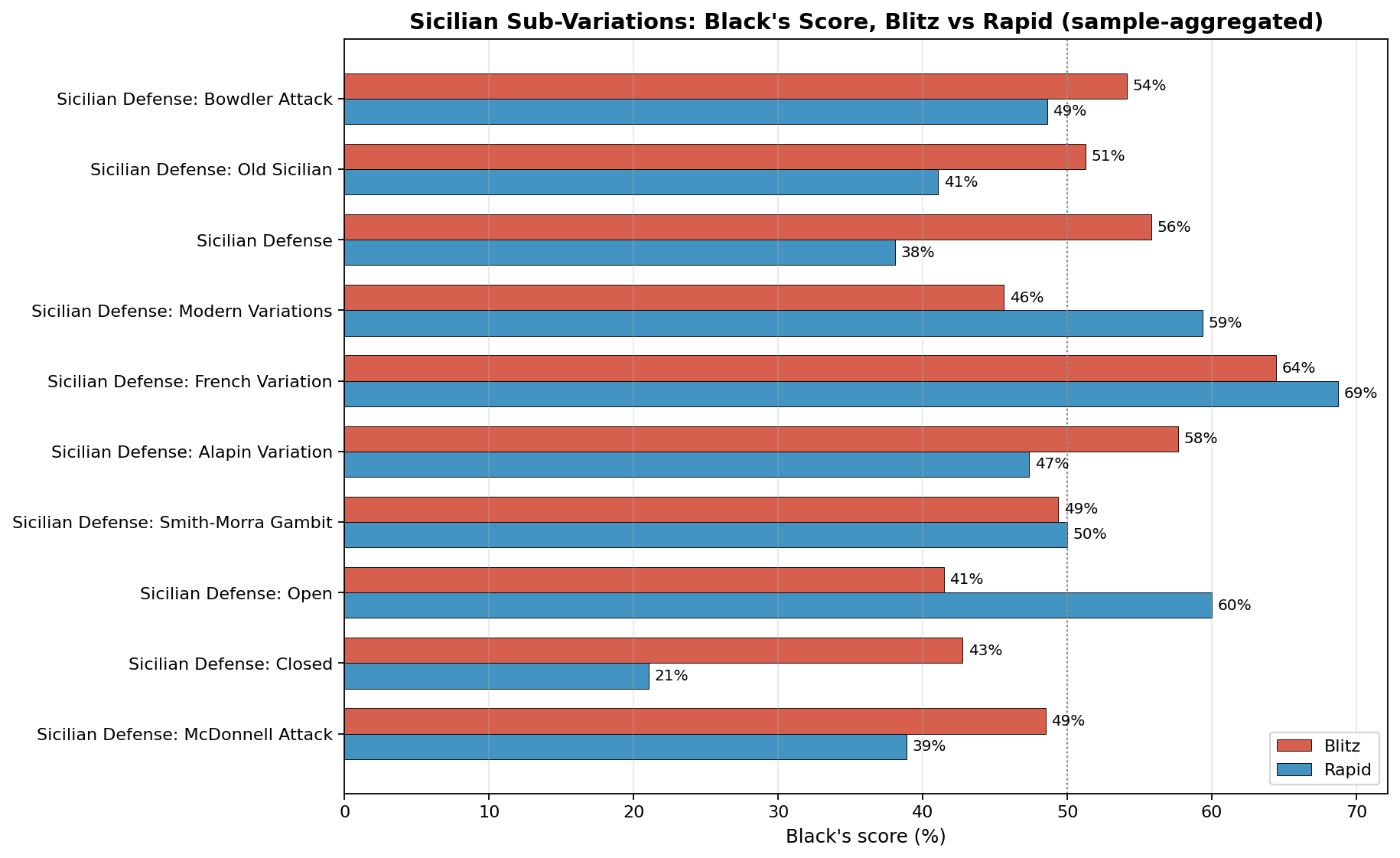
- The French Variation (e6 lines): This is the standout performer, scoring exceptionally well in both Blitz (64%) and Rapid (69%). Its solid pawn structure and delayed central confrontation make it resilient against early attacks.
- The Open Sicilian: While popular, it scores poorly for Black in Rapid (41%) compared to Blitz (60%). The Open Sicilian gives White a space advantage and attacking chances, which are easier to convert when White has time to think.
- The Bowdler Attack (2.Bc4): A common anti-Sicilian at lower levels. Black scores well against it in Blitz (54%) but struggles slightly more in Rapid (49%), as White can slowly build an attack if Black doesn't respond accurately.
4. Actionable Advice by Rating Band
Based on the data, here is your roadmap for mastering the Sicilian Defense as you climb the rating ladder.
800–1000 Chess.com (≈1200–1400 Lichess)
- In Blitz: The Sicilian is a fantastic weapon. The complexity will confuse your opponents, leading to frequent blunders. Focus on basic tactical patterns and developing your pieces quickly.
- In Rapid: Be cautious. White has time to find good attacking setups. If you play the Sicilian, stick to solid setups like the French Variation (e6) rather than hyper-aggressive lines like the Dragon.
- Actionable Step: Learn how to punish the Bowdler Attack (2.Bc4), as you will face it constantly. Playing e6 and d5 to challenge the Bishop is a reliable strategy.
1000–1200 Chess.com (≈1420–1615 Lichess)
- In Blitz: You are still scoring well, but opponents are blundering slightly less. You need to start understanding the typical pawn breaks (like d5 or b5) rather than just waiting for White to hang a piece.
- In Rapid: This is the danger zone. Black's score drops to 43.3%. You are likely getting outplayed positionally because you lack deep theoretical knowledge.
- Actionable Step: Stop playing the Open Sicilian in Rapid unless you are willing to study theory. Switch to a lower-theory system like the Alapin (c3) response or the Taimanov.
1200–1400 Chess.com (≈1565–1765 Lichess)
- In Blitz: The performance normalizes. You can no longer rely purely on the opening's complexity to win games.
- In Rapid: The data shows a severe dip here (though sample sizes are smaller). Opponents at this level know how to execute standard attacking plans (e.g., the Yugoslav Attack against the Dragon).
- Actionable Step: It is time to learn defensive motifs. Understand when to sacrifice an exchange on c3, how to defend your King, and how to counterattack on the queenside.
1400–1600 Chess.com (≈1705–1880 Lichess)
- In Blitz and Rapid: The scores begin to converge, and the Sicilian performs close to the baseline for all openings. At this level, the opening is doing its job: providing a complex, unbalanced middlegame where the better player wins.
- Actionable Step: Deepen your repertoire. Choose one main line (e.g., Najdorf, Classical, or Scheveningen) and study master games to understand the typical middlegame plans and endgame structures.
Data and Methodology
This research is based on a sample of 72,400 Lichess games played at time controls classified as Blitz and Rapid. The Lichess ratings were mapped to approximate Chess.com ratings using a standardized conversion table to ensure relevance for Chess.com users.
Engine evaluations (Stockfish) were used to identify blunders (evaluation swings of ≥3.0 pawns) and to assess move quality. The analysis focused specifically on games starting with 1.e4 c5 (ECO codes B20–B99).
The underlying data files generated for this analysis are available below:
sicilian_by_band_timeclass.csv: Aggregate statistics by rating band and time control.sicilian_subvariations.csv: Performance data for specific Sicilian variations.sicilian_sample_games.csv: Raw data for the sampled games used in the analysis.
Chess Coach April 19, 2026