By Chess Coach April 14, 2026
The Scandinavian Defense (1.e4 d5) is one of the most polarizing openings in chess. Grandmasters often dismiss it as violating opening principles by bringing the Queen out too early, yet it remains incredibly popular at the club level. But does it actually work? And more importantly, does its effectiveness change as you climb the rating ladder?
To answer these questions, we analyzed over 26,000 Blitz games featuring the Scandinavian Defense, drawn from a larger dataset of 56,000+ games across all time controls. We tracked performance across rating bands from 800 to 2000 (Chess.com Blitz equivalents) to understand exactly when and why the Scandinavian succeeds—and when it starts to fail.
This article serves as a data-driven roadmap for intermediate players looking to understand the Scandinavian Defense, complete with actionable advice for each rating bracket.
1. The Big Picture: Win Rates Across Rating Bands
The most striking finding in our data is that the Scandinavian Defense is a highly effective weapon at lower ratings, but its potency diminishes as players improve.
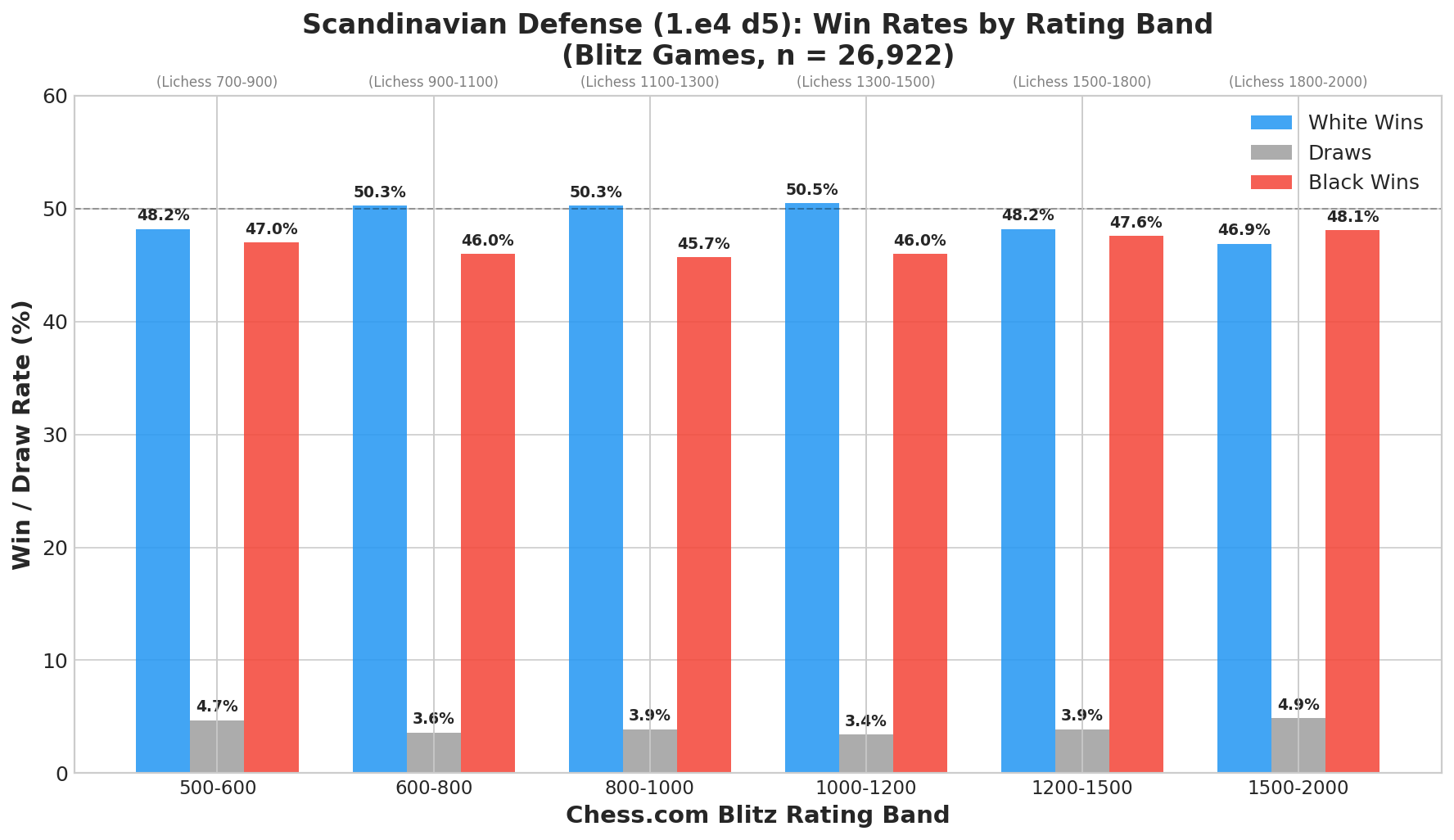
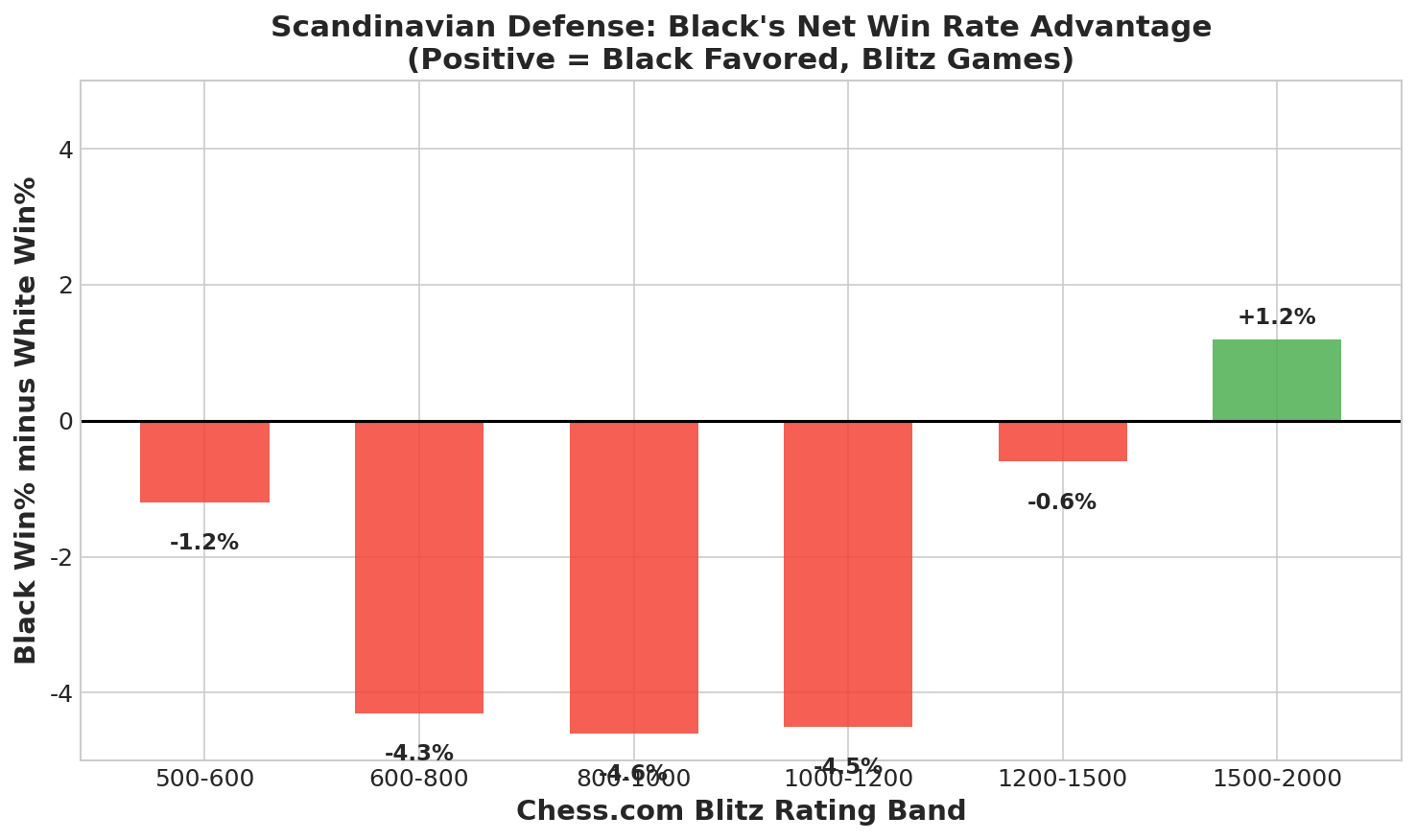
As the chart above illustrates, Black enjoys a positive net win rate with the Scandinavian Defense up until the 1200 rating mark.
Let's break down what the data tells us about the Scandinavian's performance compared to the average opening:
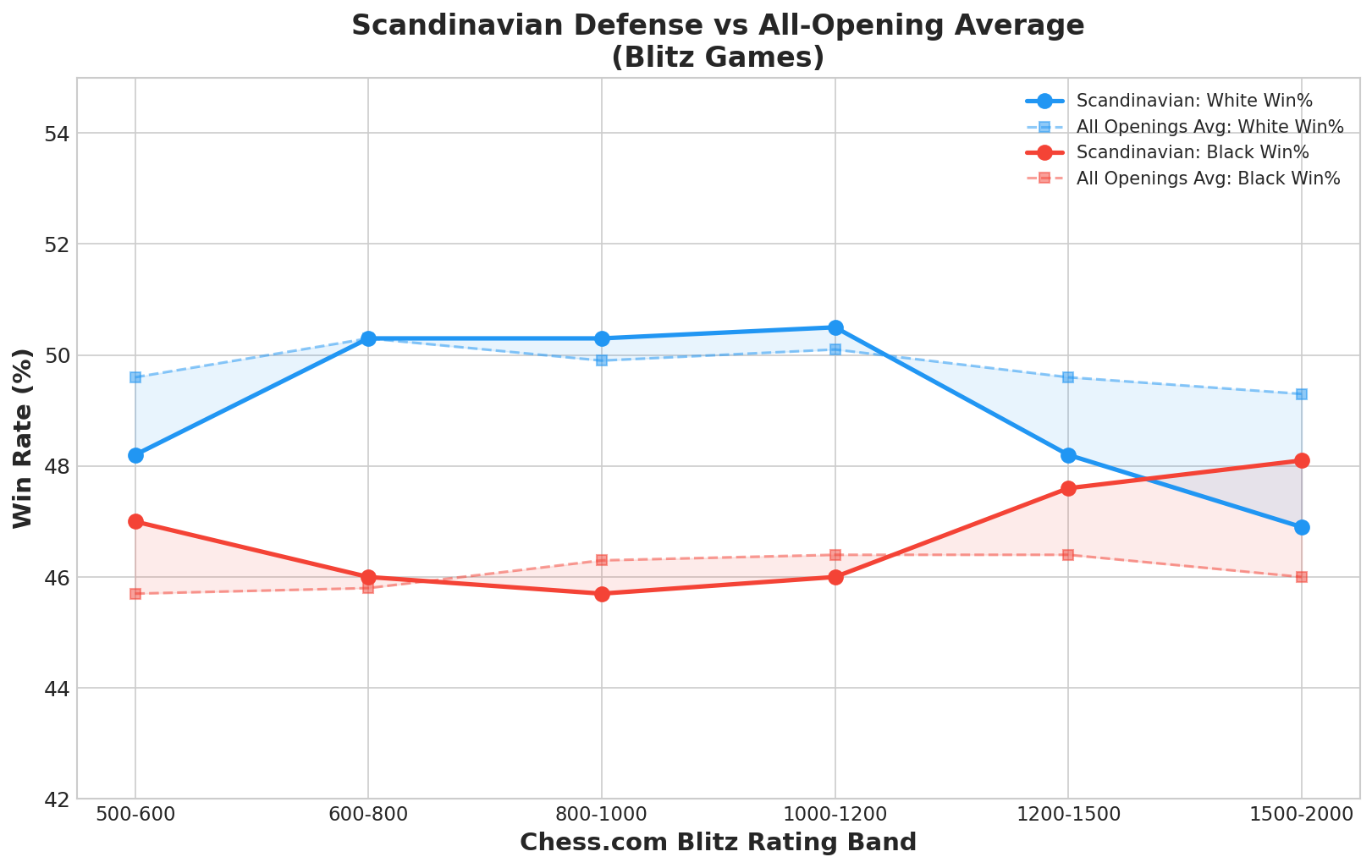
At the 800–1000 level, the Scandinavian Defense significantly outperforms the average opening for Black. However, by the time players reach the 1500–2000 bracket, the opening actually underperforms compared to the average Black response to 1.e4.
2. Why the Scandinavian Works (and Fails)
To understand these trends, we need to look at the positions the Scandinavian creates.
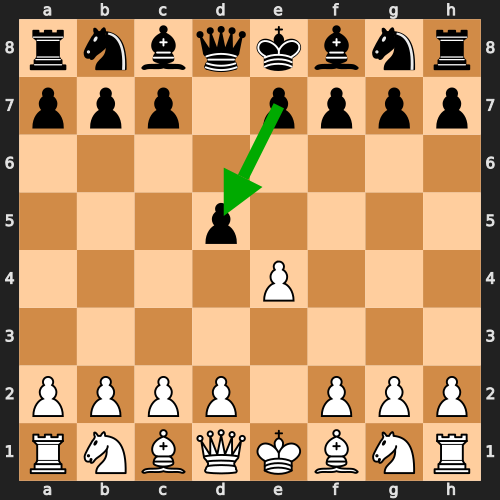 The defining move: 1...d5 immediately challenges White's center.
The Scandinavian forces immediate confrontation. White is practically compelled to play 2.exd5. After 2...Qxd5 (the Main Line), Black violates a core opening principle: don't bring the Queen out early.
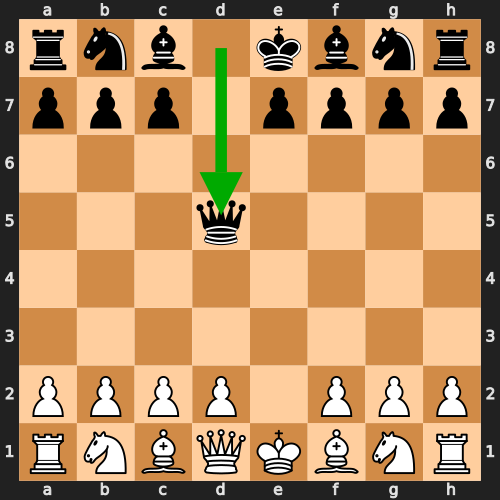 After 2.exd5 Qxd5, Black's Queen is centralized but vulnerable.
The Lower-Rated Advantage (800–1200)
At lower ratings, the Scandinavian succeeds because it dictates the flow of the game. White players are often taken out of their comfort zones (e.g., Italian or Spanish games) and must deal with immediate central tension. Furthermore, the early Queen sortie often provokes mistakes from White players who try too hard to punish it.
The Higher-Rated Decline (1500+)
As players improve, they learn how to handle the early Queen development calmly. White plays 3.Nc3, developing a piece with tempo by attacking the Queen.
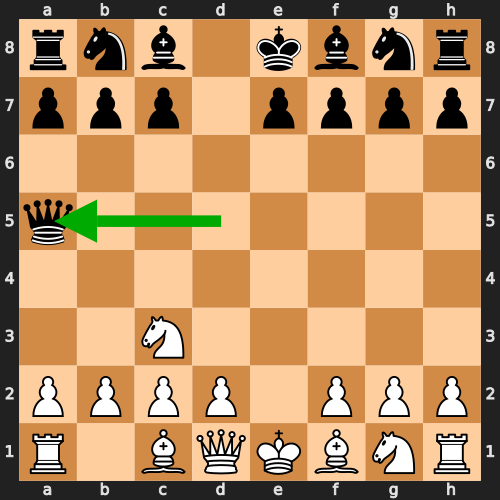 The standard Mieses-Kotroc Variation: 3...Qa5. White gains a development advantage.
Higher-rated White players use this free tempo to build a strong center and coordinate their pieces, while Black spends time shuffling the Queen to safety. Our engine analysis of the starting position confirms this: Stockfish evaluates the position after 1.e4 d5 as +0.29 for White, indicating a slight but persistent edge due to the space and development advantage White will inevitably gain.
3. Sub-Variations: What Should You Play?
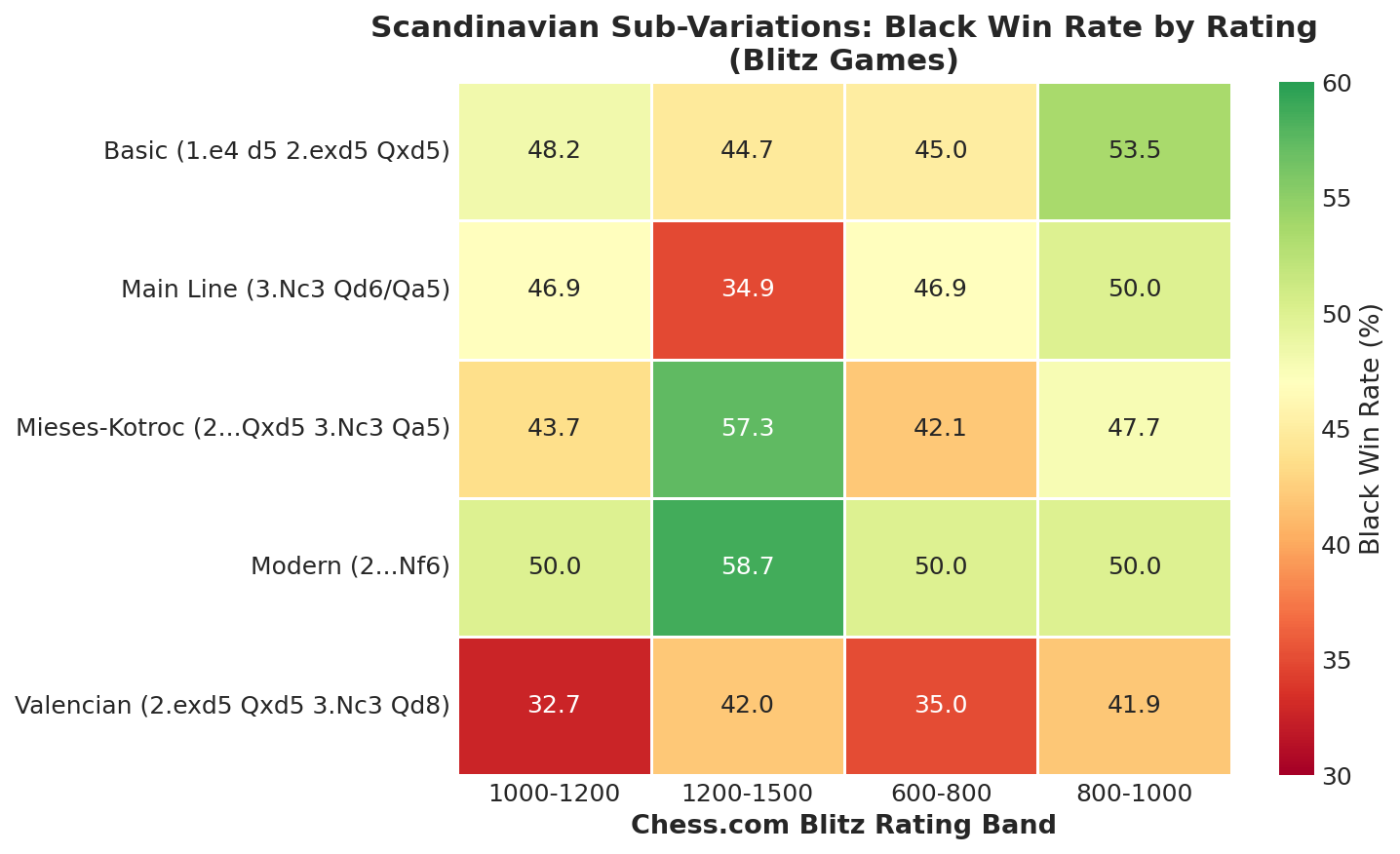
Not all Scandinavians are created equal. Our analysis of sub-variations reveals distinct performance differences based on how Black handles the opening.
The Modern Variation (2...Nf6)
Instead of recapturing immediately with the Queen, Black can play 2...Nf6, delaying the recapture and prioritizing piece development.
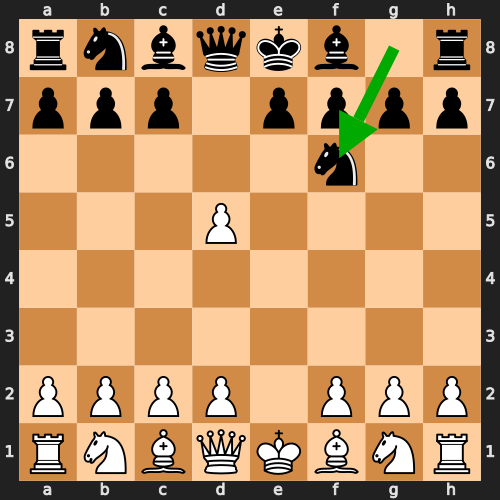 The Modern Variation: 2...Nf6. Black develops a Knight before the Queen.
The data shows that the Modern Variation is consistently one of the best-performing lines for Black across almost all rating bands. By avoiding the early Queen exposure, Black mitigates White's ability to gain free development tempos.
The Queen Retreats
If you do play 2...Qxd5 and White responds with 3.Nc3, where should the Queen go?
- 3...Qa5 (Mieses-Kotroc): The most popular and objectively best retreat. It keeps the Queen active on the 5th rank while preparing to drop back to c7 or d8 later.
- 3...Qd8 (Valencian): A solid but passive retreat. Our data shows this performs poorly at lower ratings (32.7% win rate in the 1000-1200 band) because Black simply loses too much time and space.
- 3...Qd6: A modern alternative popularized by GMs like Magnus Carlsen. It keeps the Queen centralized but requires precise knowledge to avoid tactical pitfalls.
A Common Beginner Mistake
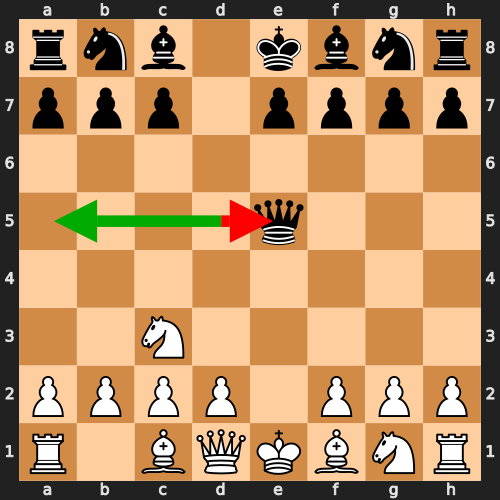 Red arrow: The tempting but flawed 3...Qe5+. Green arrow: The correct 3...Qa5.
Many beginners are tempted by 3...Qe5+, hoping to win material or disrupt White's development. However, White simply blocks with 4.Be2 or 4.Nge2, and Black's Queen remains awkwardly placed and vulnerable to further attacks (like Nf3 or d4).
4. Game Quality Metrics
Our analysis of the broader dataset (56,000+ games) reveals interesting trends in game quality when the Scandinavian is played.
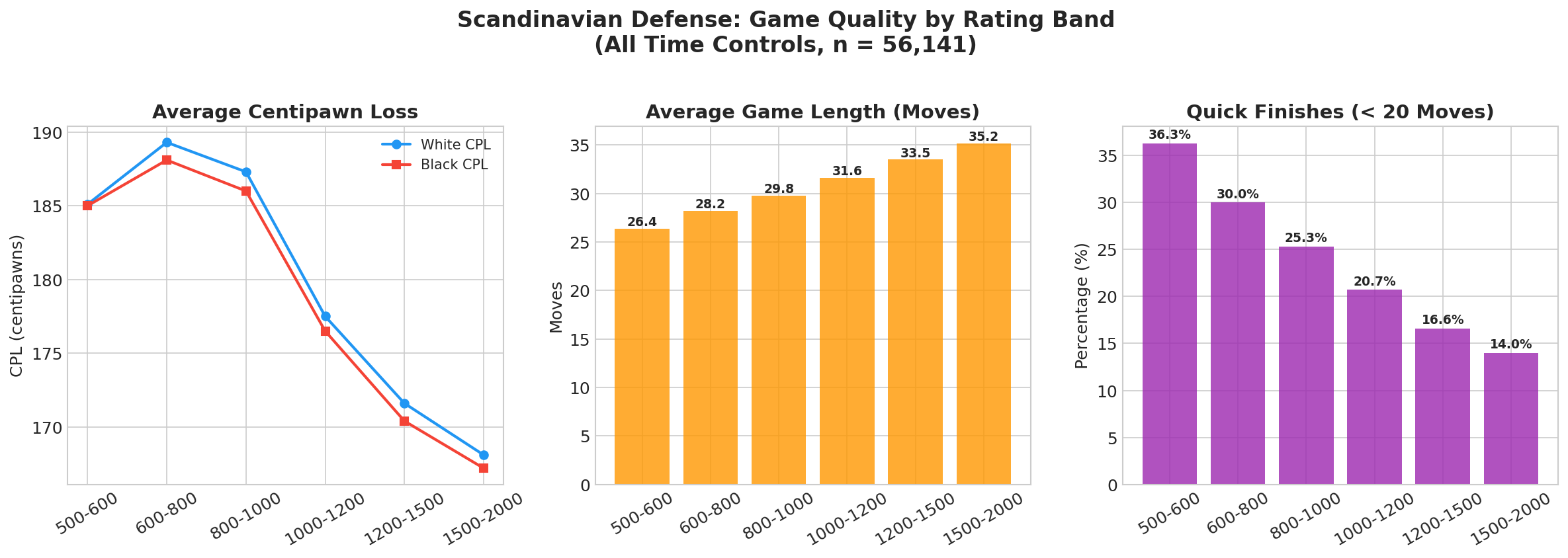
- Centipawn Loss (CPL): Both White and Black make fewer inaccuracies as ratings increase, which is expected. However, Black's CPL is consistently slightly lower than White's in the Scandinavian, suggesting the opening is relatively easy for Black to play without making massive blunders.
- Game Length: Scandinavian games tend to be slightly longer at higher ratings, indicating that the opening leads to solid, grind-it-out middlegames rather than quick tactical crushes.
- Quick Finishes: The percentage of games ending in under 20 moves drops dramatically from 36.3% at the 500-600 level to just 14.0% at the 1500-2000 level.
5. Actionable Advice by Rating Bracket
Based on the data, here is your roadmap for playing (or facing) the Scandinavian Defense.
For the 800–1000 Player (Lichess 1200–1400)
- If you play Black: The Scandinavian is a fantastic weapon here. It immediately takes White out of their prep and forces them to solve concrete problems. Stick to the Main Line (2...Qxd5) and retreat the Queen to a5. Focus on solid development (Nf6, c6, Bf5 or Bg4) and you will often find White overextending.
- If you play White: Don't panic. Play 2.exd5 and 3.Nc3. Accept the free tempo and focus on developing your pieces naturally (d4, Nf3, Bc4 or Bd3). Don't launch premature attacks against the Black Queen; just build a strong center.
For the 1000–1500 Player (Lichess 1400–1800)
- If you play Black: You will start to notice White players handling the opening better. This is the time to learn the Modern Variation (2...Nf6). It scores exceptionally well in this bracket (up to 58.7% win rate) because it avoids the standard 3.Nc3 tempo-gain and leads to more complex, less forcing positions.
- If you play White: You should be comfortable against the 2...Qxd5 lines by now. Against 2...Nf6, be prepared with a solid response like 3.d4 (allowing 3...Nxd5) or 3.Bb5+ (trying to hold the pawn).
For the 1500–2000 Player (Lichess 1800–2100+)
- If you play Black: The data is clear: the Scandinavian becomes an uphill battle at this level. White players know the theory and will consistently secure a comfortable += advantage out of the opening. If you stick with it, you must know your theory deeply, particularly in the 3...Qd6 or 3...Qa5 lines, and be prepared to defend slightly worse but solid positions.
- If you play White: Enjoy the structural and developmental advantages the opening gives you. Use your space advantage to slowly squeeze Black. The engine evaluation of +0.29 is real, and with patient, principled play, you should score well.
Data and Methodology
This analysis was conducted using a dataset of 26,922 Blitz games featuring the Scandinavian Defense (ECO B01), extracted from a larger corpus of 56,141 Lichess games across all time controls.
Rating Calibration: All raw data was collected using Lichess ratings. To make the insights actionable for the majority of readers, we calibrated the rating bands to approximate Chess.com Blitz ratings using established conversion metrics (e.g., Lichess 1200 ≈ Chess.com 800; Lichess 1850 ≈ Chess.com 1600). The charts display the Chess.com equivalents prominently, with Lichess equivalents noted for transparency.
Tools Used:
- Data extraction via the Lichess API and Grandmaster Guide MCP analytics endpoints.
- Statistical analysis using Python (Pandas, NumPy).
- Visualizations generated with Matplotlib and Seaborn.
- FEN board renders created using python-chess.
Raw Data Files: The underlying CSV data files used for this analysis are attached to this report for independent verification:
scandinavian_blitz_games.csv(Raw game data)scandinavian_blitz_band_stats.csv(Aggregated stats by rating band)scandinavian_blitz_subvariations.csv(Performance of specific sub-variations)mcp_scandinavian_decay.csv(Broader dataset win rates)mcp_scandinavian_deep_stats.csv(Broader dataset game quality metrics)
Chess Coach April 14, 2026