The Ruy Lopez (1.e4 e5 2.Nf3 Nc6 3.Bb5) is one of the oldest and most respected openings in chess. While Grandmasters navigate its deep strategic waters with precision, the reality for club players is far more chaotic. At the beginner and intermediate levels, the "Spanish Game" is often decided not by subtle positional maneuvering, but by sudden tactical collapses and early blunders.
This data-driven guide examines the most common blunders made by Black in the Ruy Lopez across Chess.com Rapid rating bands from 800 to 1500. By analyzing a sample of over 450 Rapid games (and cross-referencing with a macro-dataset of 162,000 games), we have categorized the exact moments where Black's position falls apart.
Whether you are struggling to survive the opening or looking to punish your opponents' mistakes, this roadmap provides actionable advice to help you climb the rating ladder.
1. The Anatomy of a Blunder
To understand where Black goes wrong, we categorized blunders—defined as moves that swing the engine evaluation by at least +2.0 pawns in White's favor—into distinct tactical and strategic buckets.
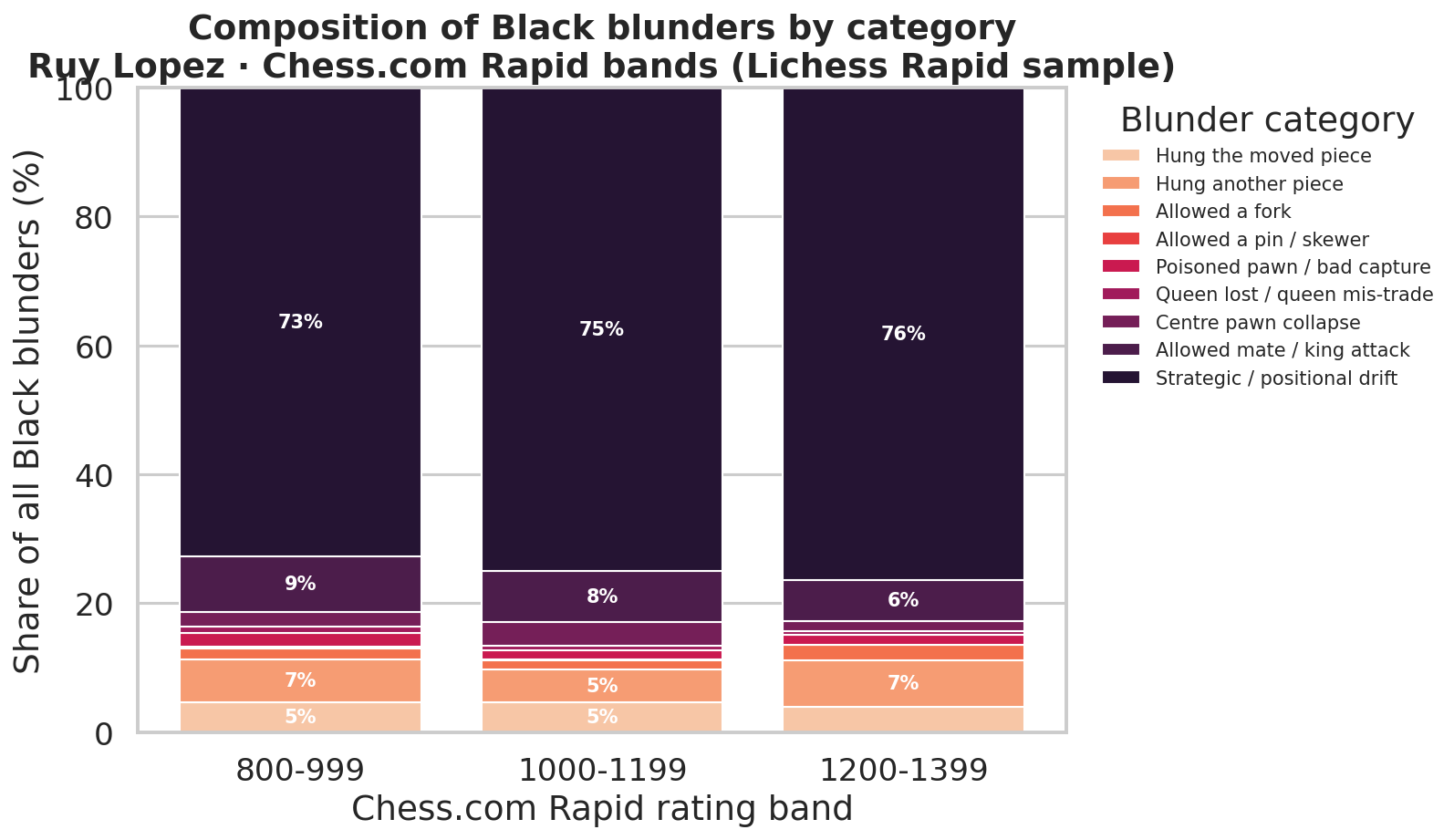
Across all rating bands under 1200, Strategic / positional drift accounts for the vast majority of evaluation swings (over 70%). These are moves that do not immediately lose a piece but allow White to build an overwhelming advantage—such as a crushing king attack or a dominant center.
However, when we isolate the purely tactical blunders, clear patterns emerge:
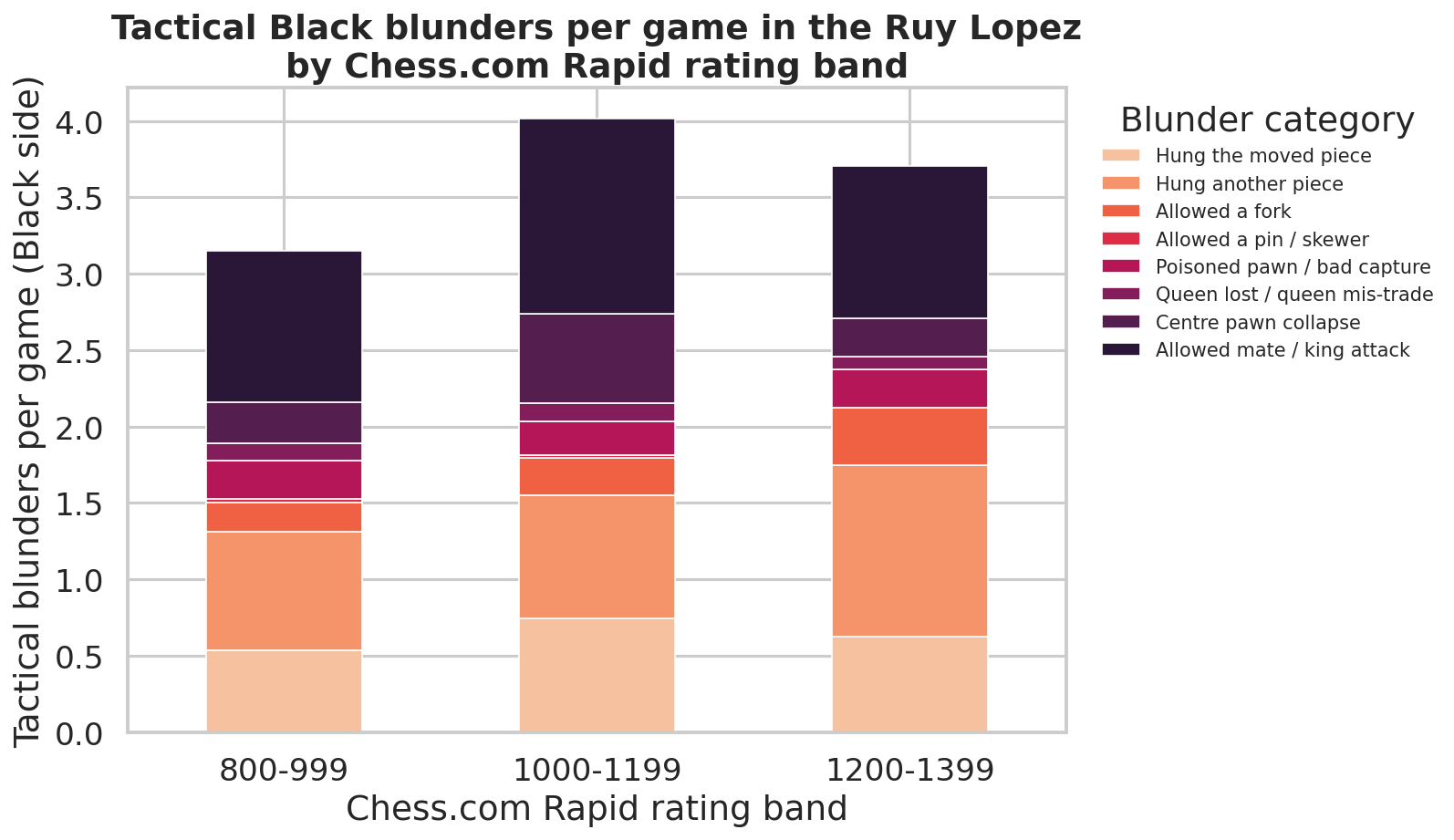
In the 800–999 rating band, players average nearly 3 purely tactical blunders per game. The most frequent culprits are hanging pieces (either the piece just moved or another piece left undefended) and allowing mate or a devastating king attack. As players cross the 1000 threshold, the frequency of hanging pieces drops, but vulnerability to forks and poisoned pawns remains a persistent issue.
2. When Do the Blunders Happen?
The Ruy Lopez is famous for its slow, maneuvering nature, but the data reveals that danger strikes early for Black.
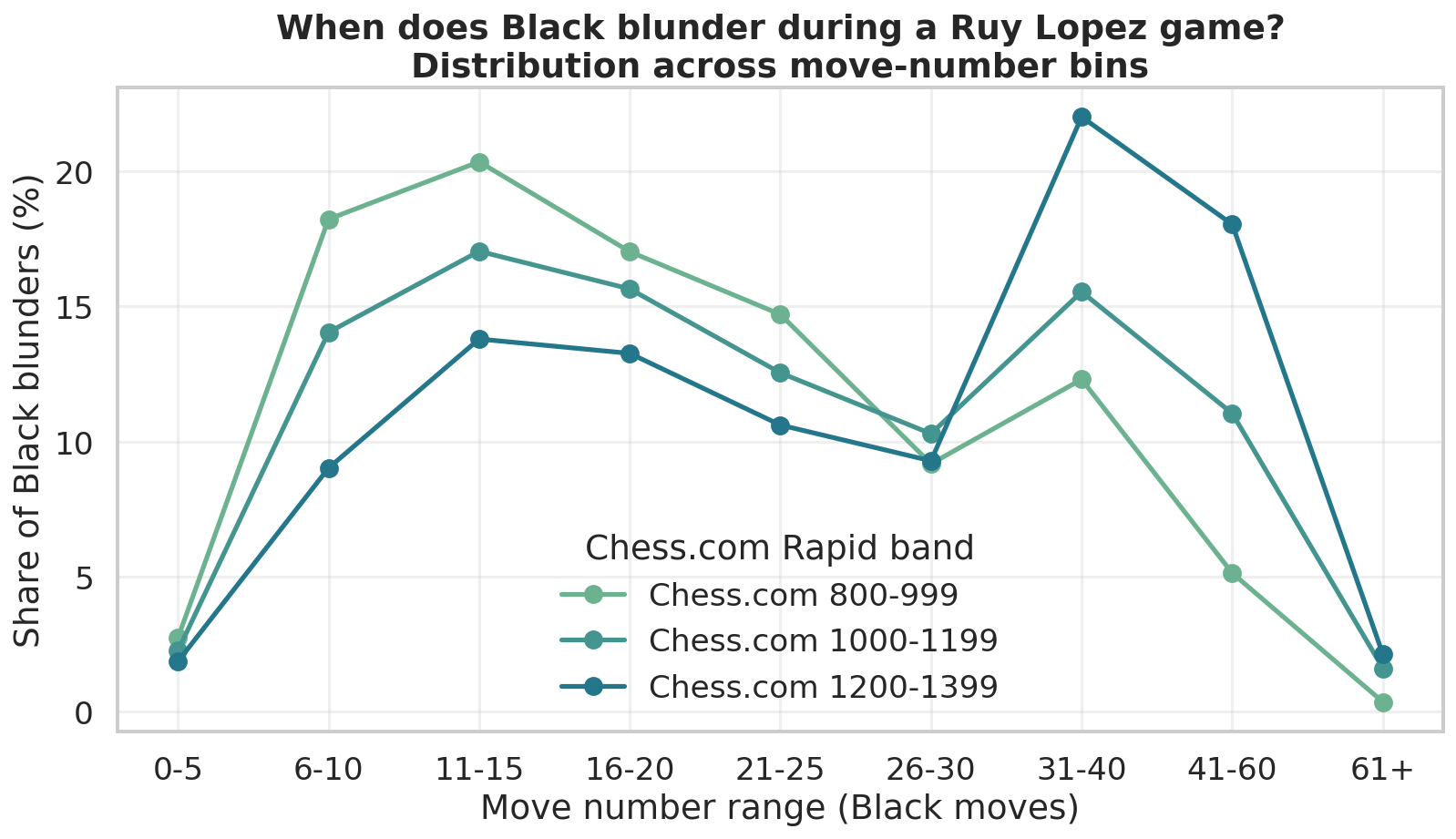
For players in the 800–999 band, the highest concentration of blunders occurs between moves 11 and 15—the exact moment when the opening transitions into the middlegame. Players successfully memorize the first 5–8 moves but collapse once they are forced to formulate their own plans.
Interestingly, macro-analytics across 162,000 games confirm this trend:
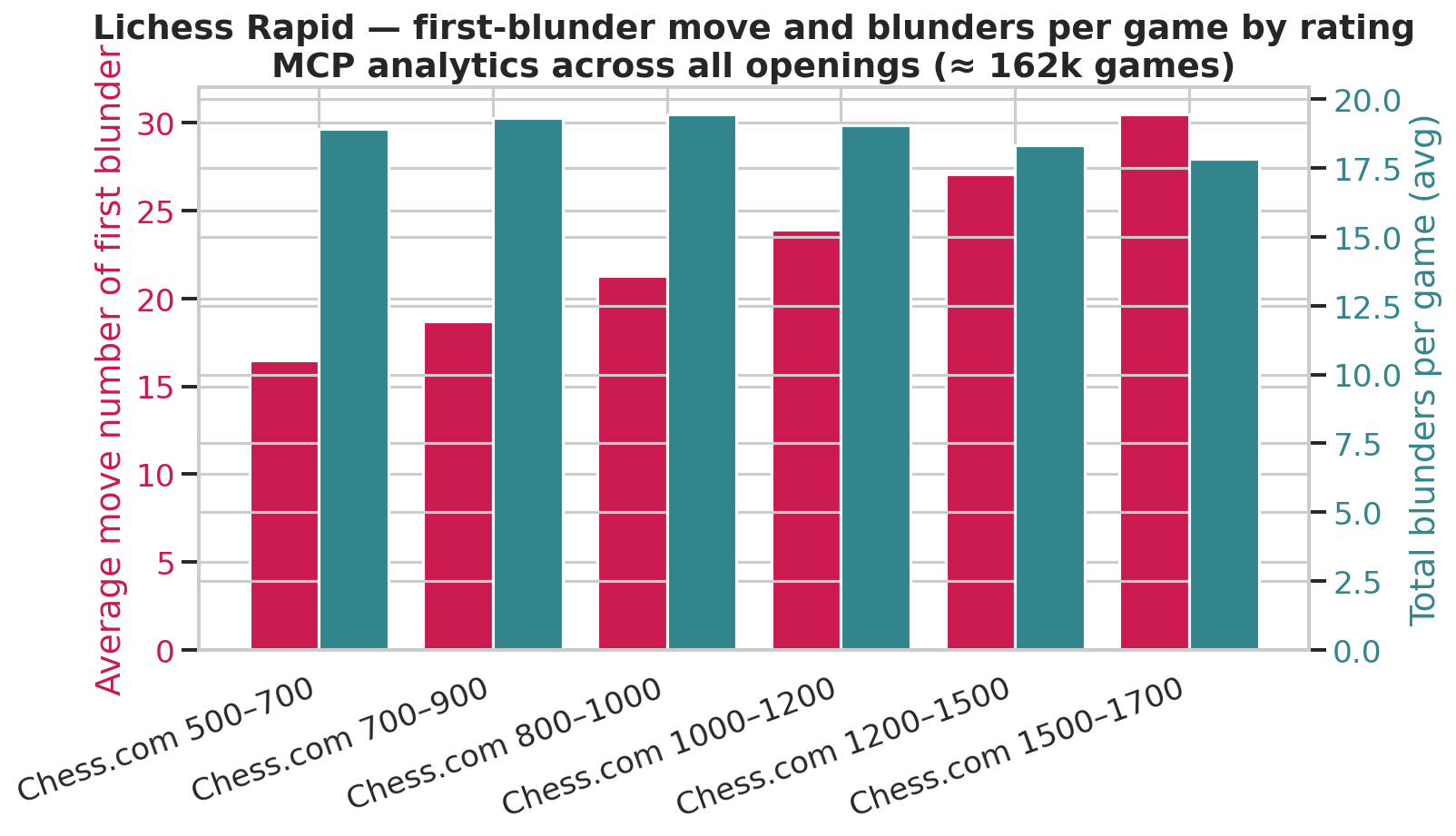
The average move number for the first blunder steadily increases with rating. A Chess.com 800 player typically makes their first major mistake around move 16, while a 1500 player survives until move 27.
3. The Danger Zones: Top Blunder Patterns
Let's examine the specific tactical traps that catch Black players off guard, complete with visual examples from real games.
The Poisoned Pawn (The ...Nxe4 Trap)
One of the most common tactical errors in the Ruy Lopez occurs when Black gets greedy in the center. In variations like the Open Spanish or the Berlin Defense, White often leaves the e4-pawn undefended. Capturing it at the wrong moment is a recipe for disaster.
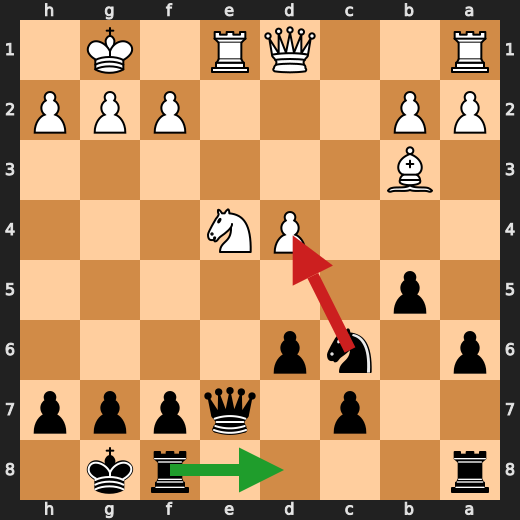
The Blunder: In this typical position, Black plays 15...Nxd4?, winning a pawn. However, this allows White to play 16.Nxd6+, winning material back with interest due to the discovered attack and the exposed Black king. The Fix: The principled 15...Rfd8 keeps everything coordinated. Before grabbing a central pawn, always check for discovered attacks or pins along the e-file (especially if White's rook is on e1).
Premature Central Breaks (...d5)
The Ruy Lopez is a battle for the center, and Black often feels pressured to strike back with ...d5. However, timing is everything. A premature ...d5 often leads to a collapse of Black's pawn structure.
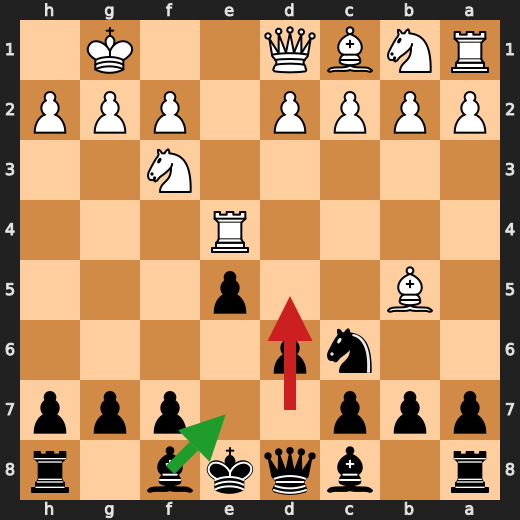
The Blunder: Black plays 6...d5? aiming for activity. White simply rips the center open, exploiting the pin on the e-file and the awkward placement of Black's pieces. The Fix: Calm development with 6...Be7 keeps the position solid. Only push ...d5 when your king is safe and your pieces are prepared to support the tension.
Allowing Forks and Double Attacks
As the board opens up, knights and queens become incredibly dangerous. Players under 1200 frequently move pieces to squares that allow devastating forks.
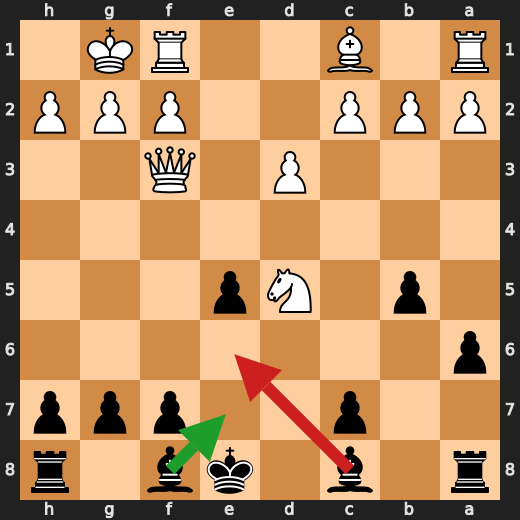
The Blunder: Black plays 11...Be6??, completely overlooking the threat of 12.Nxc7+, which forks the king, rook, and bishop. The Fix: A simple developing move like 11...Be7 avoids the tactic entirely. Always scan the board for knight jumps (especially to c7, f7, and d6) before committing your pieces.
Hanging the Moved Piece
The most tragic blunders are unforced errors where a player simply moves a piece to a square controlled by the opponent.
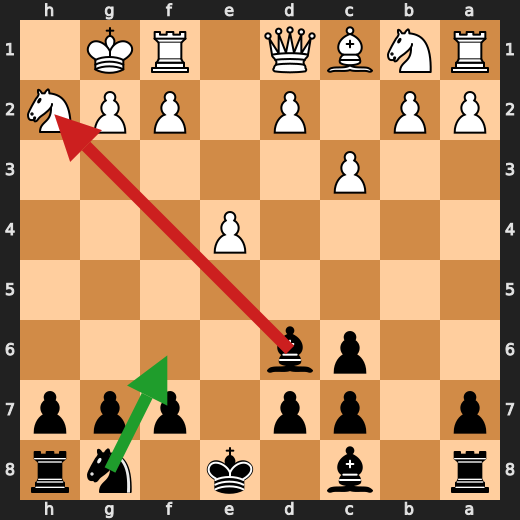
The Blunder: Black attempts a Greek Gift sacrifice with 9...Bxh2+??, forgetting that White's knight on f3 (now on h2) perfectly defends the square. The bishop is lost for nothing. The Fix: 9...Nf6 develops with no risk. Never launch an attack without verifying that the target square is actually vulnerable.
4. Actionable Advice by Rating Band
Based on the data, here is your roadmap for surviving and thriving in the Ruy Lopez.
For Chess.com 800–999
- Focus on Board Vision: Your primary goal is to stop hanging pieces in one move. Before you touch a piece, ask yourself: "Is the square I am moving to safe?" and "Did my last move leave anything undefended?"
- Beware the e-file: If White has a rook on e1, do not grab the e4-pawn unless you have calculated the consequences. Pins and discovered attacks on the e-file are lethal at this level.
- Develop, Don't Attack: Stop trying to launch early mating attacks (like premature ...Bxh2+ sacrifices). Focus on getting your pieces out and castling safely.
For Chess.com 1000–1199
- Survive the Transition: The data shows you are most vulnerable between moves 11 and 15. Once your opening preparation ends, take a deep breath. Do not rush central breaks like ...d5 unless your king is completely safe.
- Scan for Forks: Knights are your worst enemy in this band. Always check for potential knight forks on c7, f7, and d6 before finalizing your move.
- Mind the King: You are still losing too many games to sudden king attacks. Ensure your king has defenders nearby, especially if White starts massing pieces on the kingside.
For Chess.com 1200–1399
- Positional Discipline: At this level, purely tactical blunders decrease, but "strategic drift" takes over. You are losing games because you allow White to slowly build an overwhelming position. Focus on pawn structure and piece coordination.
- Understand the Sub-Variations: The Ruy Lopez has many branches. Whether you play the Berlin, the Morphy Defense, or the Steinitz, you need to understand the plans, not just the moves. Know when to challenge the center and when to hold the tension.
Data and Methodology
This analysis is based on a dataset of Lichess Rapid games, filtered for the Ruy Lopez (ECO C60-C99).
- Platform Calibration: Lichess Rapid ratings were mapped to Chess.com Rapid ratings using standard conversion tables (e.g., Lichess 1200–1450 ≈ Chess.com 800–999).
- Blunder Definition: A "Black blunder" was defined as a move that swung the Stockfish evaluation by at least +2.0 pawns in White's favor.
- Categorization: Blunders were categorized using a custom heuristic engine that analyzed the material balance and tactical geometry (forks, pins, hanging pieces) within a 4-ply lookahead.
- Macro Analytics: Headline statistics (such as first-blunder timing) were cross-referenced against a broader dataset of 162,000 games provided by the Grandmaster Guide MCP.
Underlying Data Files:
View full data →gameId ratingBand avgRating moveNo san evalBefore evalAfter swing category description fenBefore eco openingName Lvdh60tS 800-999 1127 7 Bxe5 -1.36 1.25 2.61 Strategic / positional drift Bxe5 loses position without a single tactical blow r1b1k1nr/ppp1qppp/2pb4/4P3/4P3/5N2/PPP2PPP/RNBQ1RK1 b kq - 0 7 C64 Ruy Lopez: Classical Variation Lvdh60tS 800-999 1127 8 Qxe5 -1.21 1.23 2.44 Strategic / positional drift Qxe5 loses position without a single tactical blow r1b1k1nr/ppp1qppp/2p5/4N3/4P3/8/PPP2PPP/RNBQ1RK1 b kq - 0 8 C64 Ruy Lopez: Classical Variation Lvdh60tS 800-999 1127 9 Nf6 -1.03 1.17 2.2 Strategic / positional drift Nf6 loses position without a single tactical blow r1b1k1nr/ppp2ppp/2p5/4q3/4P3/2N5/PPP2PPP/R1BQ1RK1 b kq - 1 9 C64 Ruy Lopez: Classical Variation ZdacS4PV 1000-1199 1538 7 f6 -0.6 2.56 3.16 Strategic / positional drift f6 loses position without a single tactical blow r1bqkbnr/2p2pp1/p1np3p/1p2p3/4P3/1BP2N2/PP1P1PPP/RNBQ1RK1 b kq - 1 7 C70 Ruy Lopez: Morphy Defense, Caro Variation ZdacS4PV 1000-1199 1538 8 g5 -2.2 2.21 4.41 Strategic / positional drift g5 loses position without a single tactical blow r1bqkbnr/2p3p1/p1np1p1p/1p2p3/4P3/1BP2N2/PP1P1PPP/RNBQR1K1 b kq - 1 8 C70 Ruy Lopez: Morphy Defense, Caro Variation
View full data →ratingBand category blunders pctOfBlunders blundersPerGame samplesGames 800-999 Strategic / positional drift 1815 72.72 5.585 325 800-999 Allowed mate / king attack 215 8.61 0.662 325 800-999 Hung another piece 167 6.69 0.514 325 800-999 Hung the moved piece 116 4.65 0.357 325 800-999 Centre pawn collapse 57 2.28 0.175 325 - Statistical Summary (JSON)
Chess Coach April 18, 2026