A data-driven roadmap for Rapid players from 800 to 2000.
The Ruy Lopez (1.e4 e5 2.Nf3 Nc6 3.Bb5) is often hailed as the ultimate test of chess understanding. Grandmasters spend lifetimes studying its nuances, and coaches routinely prescribe it to improving players to teach them about central tension, pawn structures, and long-term maneuvering. But does this complex opening actually deliver results for the average club player?
To answer this, we analyzed 17,782 Rapid games played in the Ruy Lopez (ECO C60–C99) from the March 2025 Lichess database, comparing them against a baseline of nearly 200,000 Rapid games. We segmented the data into rating bands corresponding to Chess.com Rapid ratings from 800 to 2000 (adjusting from Lichess ratings per standard conversion metrics).
The data reveals a fascinating truth: the Ruy Lopez is not a magic bullet, and its effectiveness changes dramatically as you climb the rating ladder. Here is your data-driven guide to navigating the Spanish Game.
The Big Picture: Win Rates Across the Rating Spectrum
Before diving into specific variations, let's look at the overall performance of the Ruy Lopez across different skill levels.
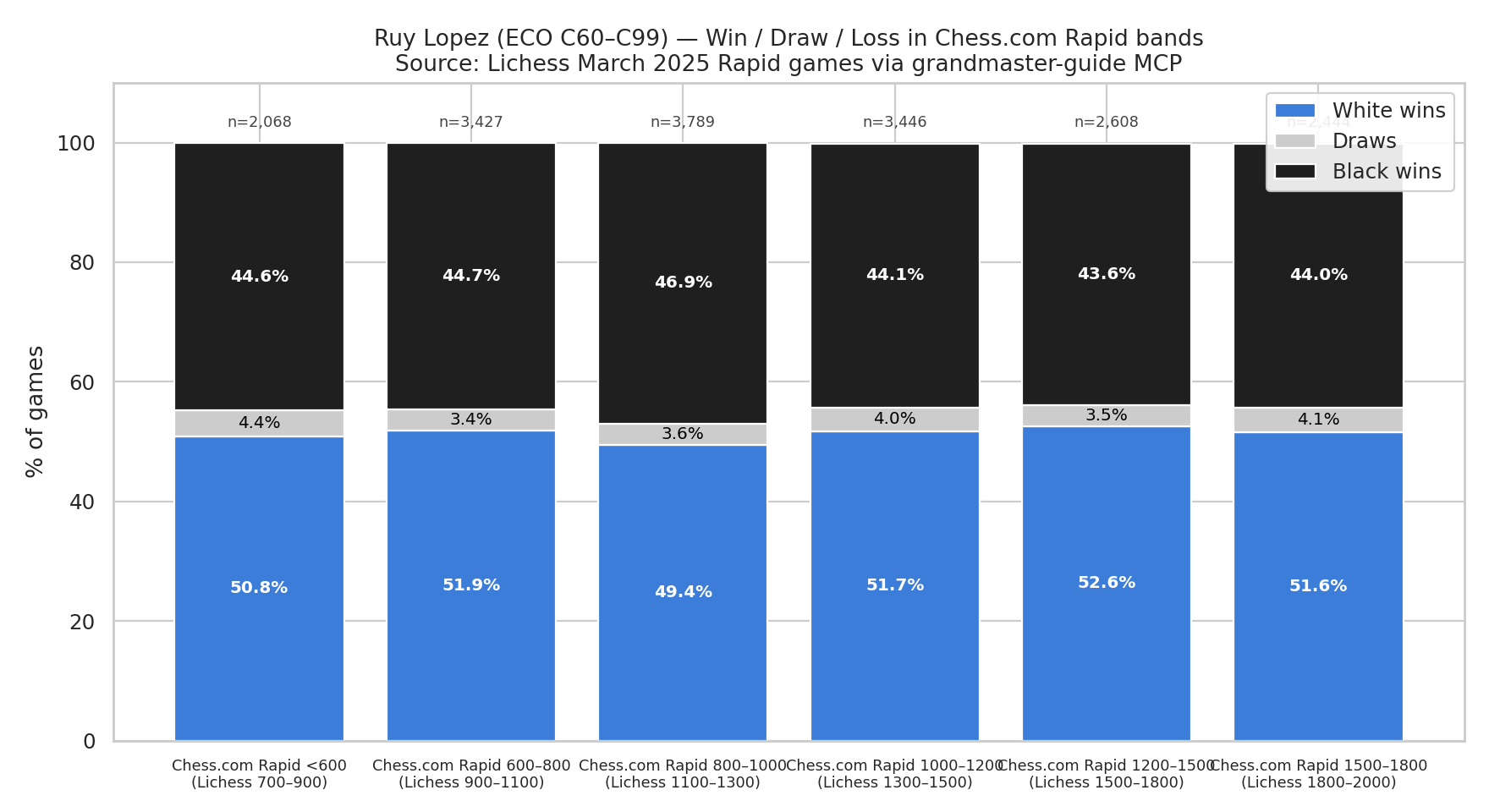
At first glance, White maintains a positive win rate across all bands, hovering between 49.4% and 52.6%. However, looking at raw win rates in isolation can be misleading, as White naturally enjoys a first-move advantage in chess. The real question is: does the Ruy Lopez perform better than other openings?
To find out, we compared the "White Score %" (Wins + 0.5 × Draws) of the Ruy Lopez against the Italian Game (1.e4 e5 2.Nf3 Nc6 3.Bc4) and the overall average for all Rapid openings.
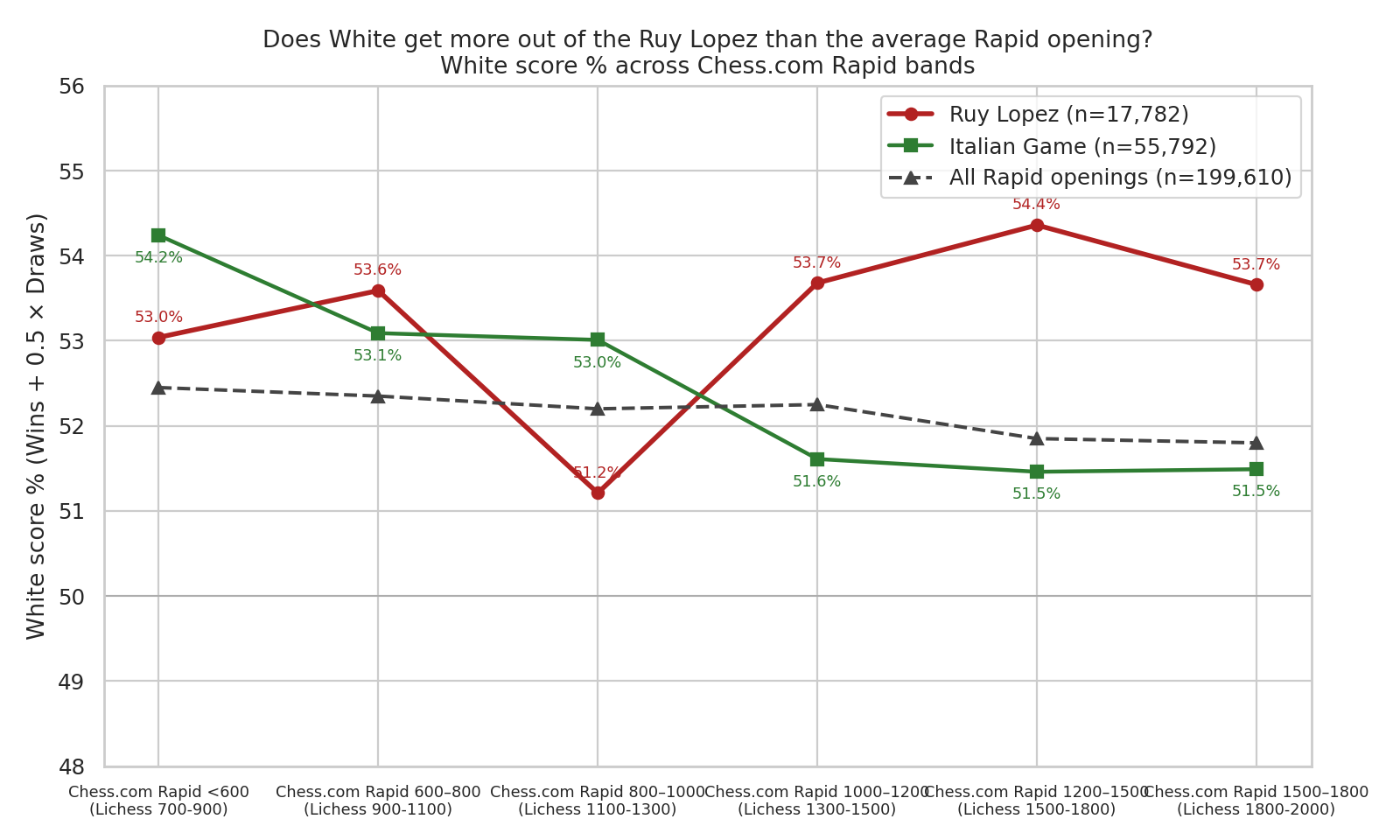
This chart uncovers a critical insight for improving players:
- Below 1000 (Chess.com Rapid): The Ruy Lopez actually underperforms both the Italian Game and the average opening baseline. At the 800–1000 band, White scores only 51.2% in the Ruy Lopez, compared to 53.0% in the Italian.
- The Turning Point (1000–1200): Right around the 1000-1200 mark, the lines cross. The Ruy Lopez suddenly becomes significantly more effective than the Italian Game.
- Above 1200: The Ruy Lopez consistently outperforms the baseline, rewarding players who have invested time in understanding its strategic depth.
Actionable Advice for the <1000 Player
If you are rated below 1000 on Chess.com, the data suggests that the Ruy Lopez might be too complex for practical results. The Italian Game (3.Bc4) offers more direct, understandable attacking plans that yield better immediate returns. If you do play the Ruy Lopez, focus entirely on opening principles (development, center control, king safety) rather than memorizing deep theory, as games at this level are rarely decided by opening nuances.
The Sub-Variation Landscape: What Works Where?
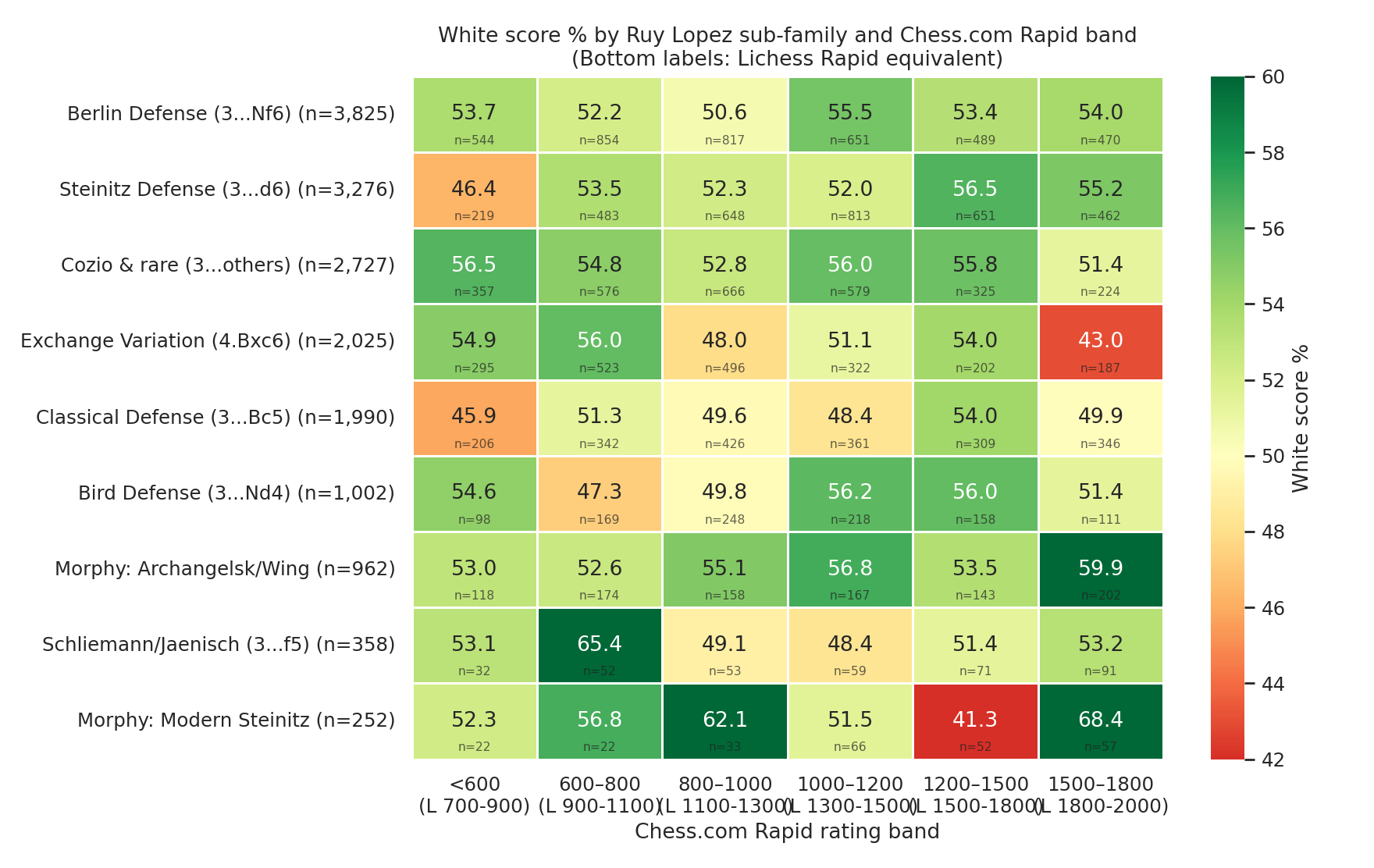
The Ruy Lopez is not one opening; it is a massive complex of different defensive setups. We broke down the performance of major sub-families to see which variations are punishing for Black, and which ones hold up well.
The Berlin Defense (3...Nf6)
The Berlin is the most popular defense across all rating bands. Interestingly, it is remarkably stable. White maintains a steady 50–55% score regardless of the rating level. It is a solid, reliable choice for Black, but it doesn't offer the immediate equalizing magic it does at the Grandmaster level.
The Steinitz Defense (3...d6)
This is where we see the most dramatic rating dependency.
- Below 1000: Black actually scores quite well (White scores only 46.4% in the lowest band). The solid, closed nature of the Steinitz frustrates lower-rated White players who lack the patience to maneuver.
- Above 1200: The script flips entirely. White's score surges to 56.5%. Higher-rated players understand how to exploit Black's cramped position and lack of space.
The Exchange Variation (4.Bxc6)
The Exchange Variation is a powerful weapon for White at lower levels (scoring 54–56% below 1000). It simplifies the position and creates a clear structural imbalance. However, as players reach the 1500–1800 band, its effectiveness collapses to a dismal 43.0%. Stronger Black players easily secure the bishop pair and neutralize White's structural advantage.
Actionable Advice for the 1000–1500 Player
This is the "sweet spot" where learning Ruy Lopez theory starts paying dividends.
- As White: If you face the Steinitz (3...d6), rejoice. Learn the standard plans of building a strong center with c3 and d4, and you will consistently outplay your opponents. Consider dropping the Exchange Variation as you approach 1500, as it loses its bite.
- As Black: The Classical Defense (3...Bc5) is a highly practical choice in this band, keeping White's score below 50%. It leads to active piece play and avoids the passive suffering often found in the Steinitz.
The Reality of Amateur Play: Blunders and Move Quality
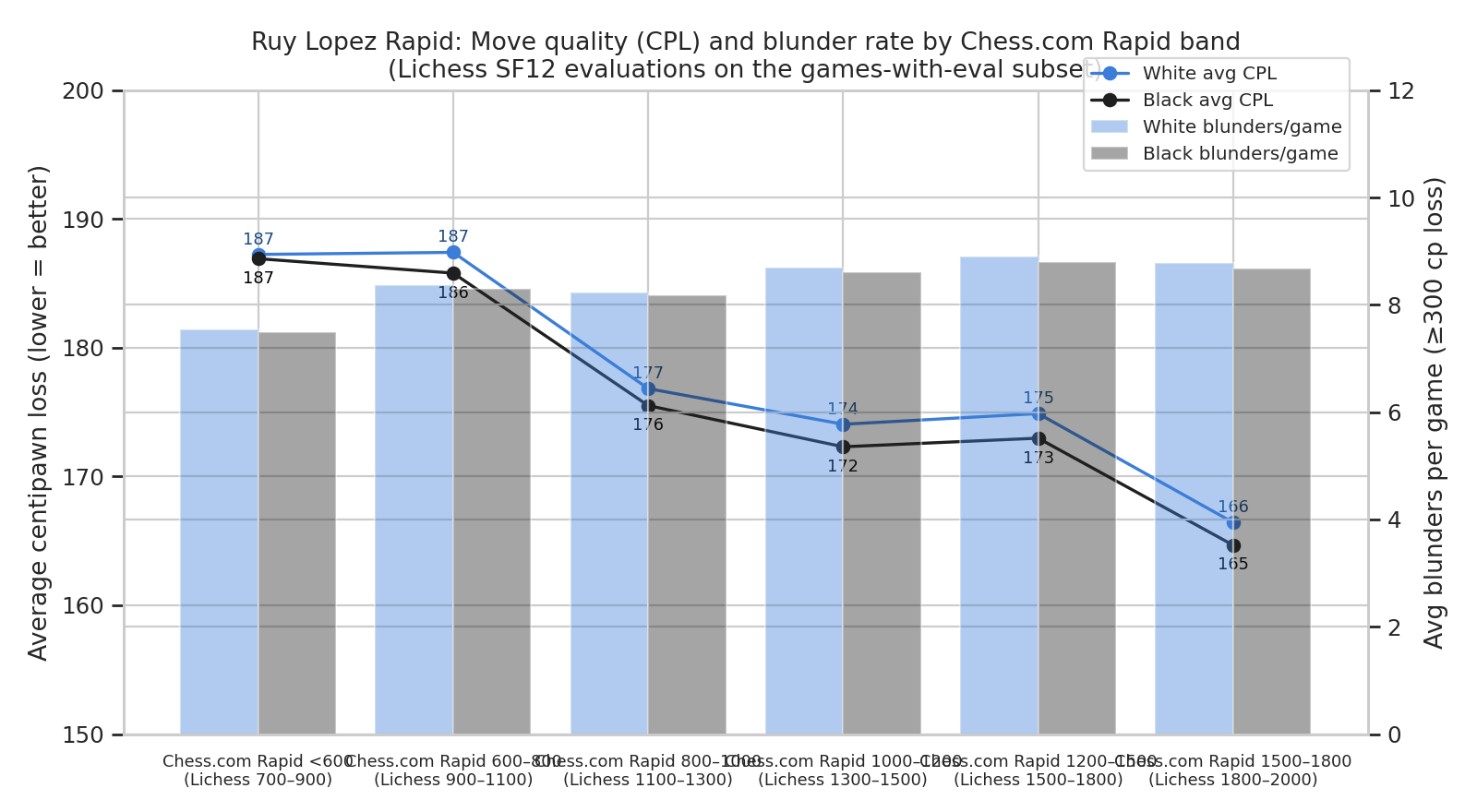
Why does the Ruy Lopez underperform at lower levels? The answer lies in the complexity of the positions it generates. We analyzed the Average Centipawn Loss (CPL) and the rate of severe blunders (eval drops of ≥300 centipawns) across the rating bands.
The data is sobering:
- Between 800 and 1500 Chess.com Rapid, the average CPL is essentially flat at around 175. This means the typical player is losing about 1.75 pawns of value per move relative to perfect engine play.
- In this same range, players average 8 to 9 severe blunders per game.
This confirms a fundamental truth: in the amateur Ruy Lopez, the opening phase rarely decides the game. The positions are so complex that both sides inevitably blunder heavily in the middlegame.
Visualizing the Chaos
To illustrate this, we extracted actual games from our dataset where the evaluation swung wildly due to typical amateur mistakes in Ruy Lopez structures.
Example 1: The Exchange Variation Trap (1100-1300 Band)
In the Exchange Variation, lower-rated players often misjudge the resulting endgames or misplace their pieces in the simplified middlegame.
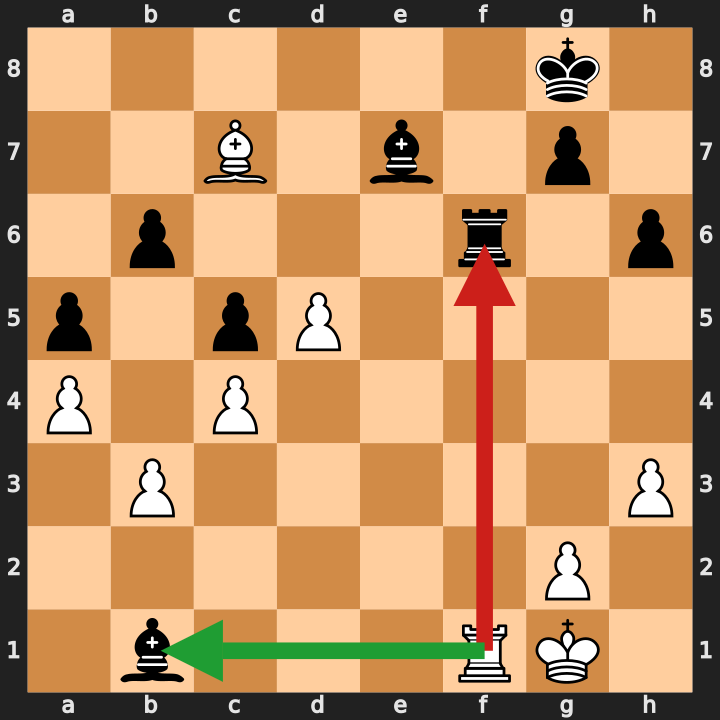 Game: Lichess shhF09T0 (Avg Rating: 1193). White plays the disastrous Rxf6 (red arrow), throwing away a massive advantage. The engine prefers the calm f1b1 (green arrow).
Example 2: The Bird Variation Miscalculation (1500-1800 Band)
Even at higher levels, the unusual structures of sidelines like the Bird Variation (3...Nd4) induce severe tactical errors.
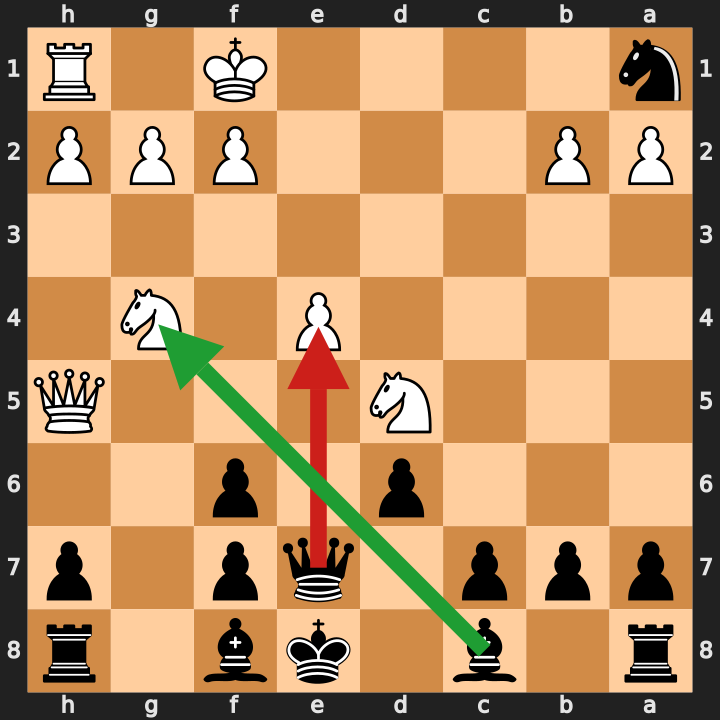 Game: Lichess oatY3N9i (Avg Rating: 1644). Black plays Qxe4 (red arrow), a massive blunder dropping over 8 pawns in evaluation. The correct move was c8g4 (green arrow).
Actionable Advice for the 1500–2000 Player
At this level, the Ruy Lopez is statistically your best 1.e4 weapon. However, the data shows that blunder rates only begin to drop significantly (down to ~7.5 per game) as you approach the 1800 mark.
- Focus on Tactics within Structures: Don't just memorize opening moves. Study the typical tactical motifs that arise in the specific Ruy Lopez variations you play (e.g., the Marshall Attack, the Chigorin).
- Endgame Conversion: The Ruy Lopez often leads to complex endgames. Improving your endgame technique will allow you to convert the small advantages you gain from the opening, capitalizing on the structural nuances you've created.
Conclusion: A Roadmap for the Spanish Game
The Ruy Lopez is a magnificent opening, but our data shows it is a tool that requires a certain level of craftsmanship to wield effectively.
- 800–1000: Play the Italian Game instead. If you play the Ruy, focus strictly on opening principles.
- 1000–1500: Start incorporating the Ruy Lopez. Punish the Steinitz Defense, but be wary of relying on the Exchange Variation as you climb higher.
- 1500–2000: The Ruy Lopez is your strongest weapon. Deepen your understanding of the resulting middlegame structures and focus on reducing your blunder rate in complex positions.
The "Spanish Torture" is real, but you have to be strong enough to apply it.
Data and Methodology
- Source: Lichess open database (March 2025 Rapid games), accessed via the grandmaster-guide MCP.
- Sample Size: 17,782 Ruy Lopez games (ECO C60–C99); 199,610 total Rapid games for baseline comparison.
- Rating Calibration: Lichess Rapid ratings were mapped to approximate Chess.com Rapid ratings using standard community conversion tables (e.g., Lichess 1100-1300 ≈ Chess.com 800-1000).
- Engine Analysis: Move quality (CPL) and blunder identification were performed using Stockfish 12 evaluations embedded in the Lichess PGN data, normalized to the white perspective.
Data Files (Attached):
ruy_lopez_winrates_by_band_rapid.csvcomparison_baseline_italian_ruy_rapid.csvruy_lopez_subfamily_winrates_rapid.csv
Chess Coach, April 18, 2026