By Chess Coach April 20, 2026
One of the most common material imbalances in chess occurs when a player sacrifices a rook for a minor piece (a knight or bishop) and two pawns. On paper, the traditional point system suggests this is an equal trade: a rook is worth 5 points, while a minor piece (3) plus two pawns (2) equals 5. However, human intuition often struggles with this imbalance. Lower-rated players frequently overestimate the value of the rook, while stronger players understand the long-term potential of the minor piece and the pawn mass.
To understand how this imbalance actually plays out in practice, we analyzed 12,000 Blitz games from the Lichess database, specifically targeting players with Chess.com ratings between 800 and 1500. By examining the engine evaluations (Stockfish 17) at the exact moments this imbalance appeared, we can uncover the truth behind the "Rook vs Minor + 2 Pawns" debate and provide actionable advice for your rating level.
1. How Often Does This Imbalance Occur?
Before diving into the evaluations, it is helpful to know how frequently you will encounter this scenario. Across all rating bands, the "Rook vs Minor + 2 Pawns" imbalance appears in roughly 3.5% to 4.3% of Blitz games.
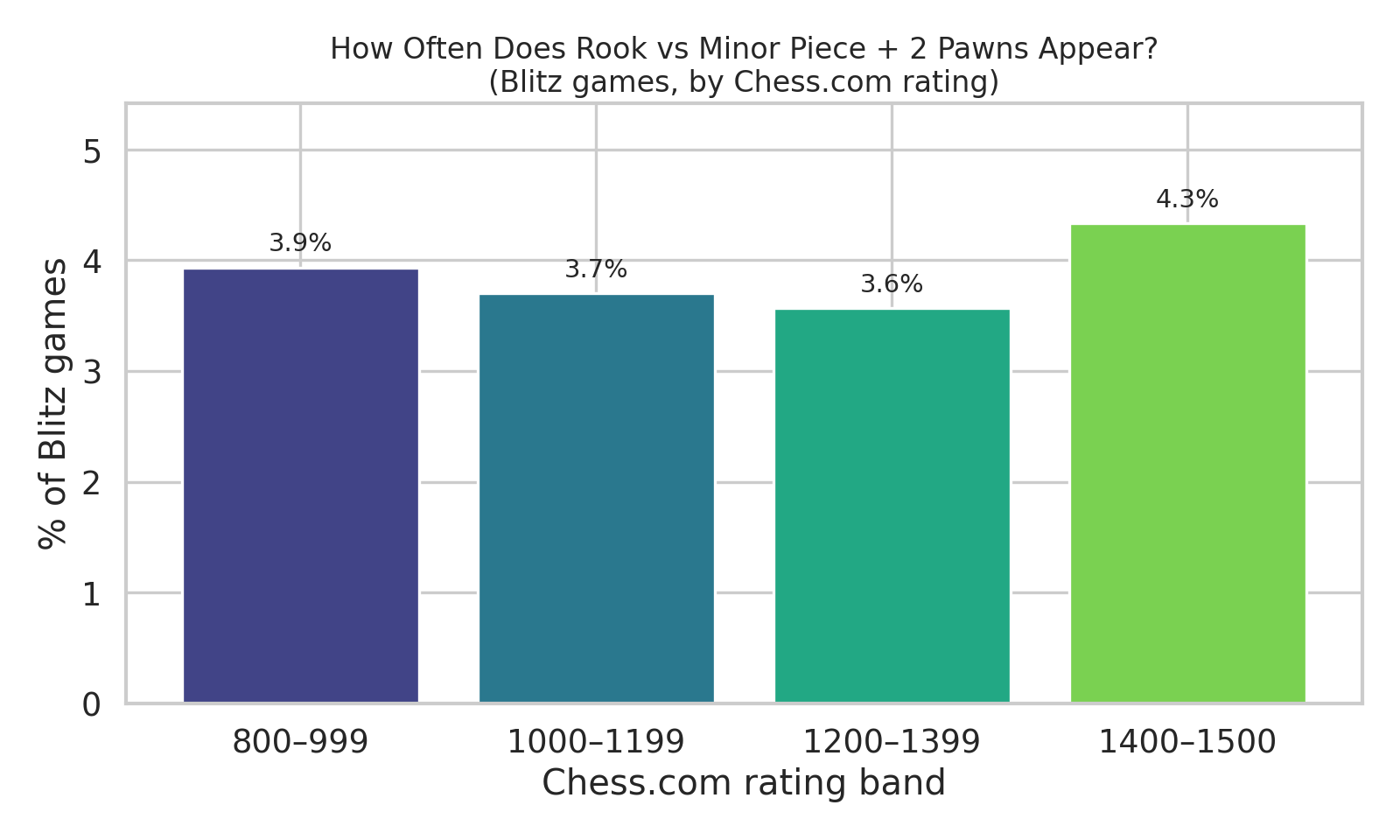
While it may not happen in every session, it occurs often enough that misunderstanding it can cost you valuable rating points over time. Interestingly, the frequency is relatively stable across the 800–1500 range, meaning players of all intermediate levels are willingly entering (or blundering into) this material distribution.
2. The Engine's Verdict: It's Usually Equal
The most striking finding from the data is that the engine largely agrees with the traditional point system: a rook is generally equal to a minor piece and two pawns.
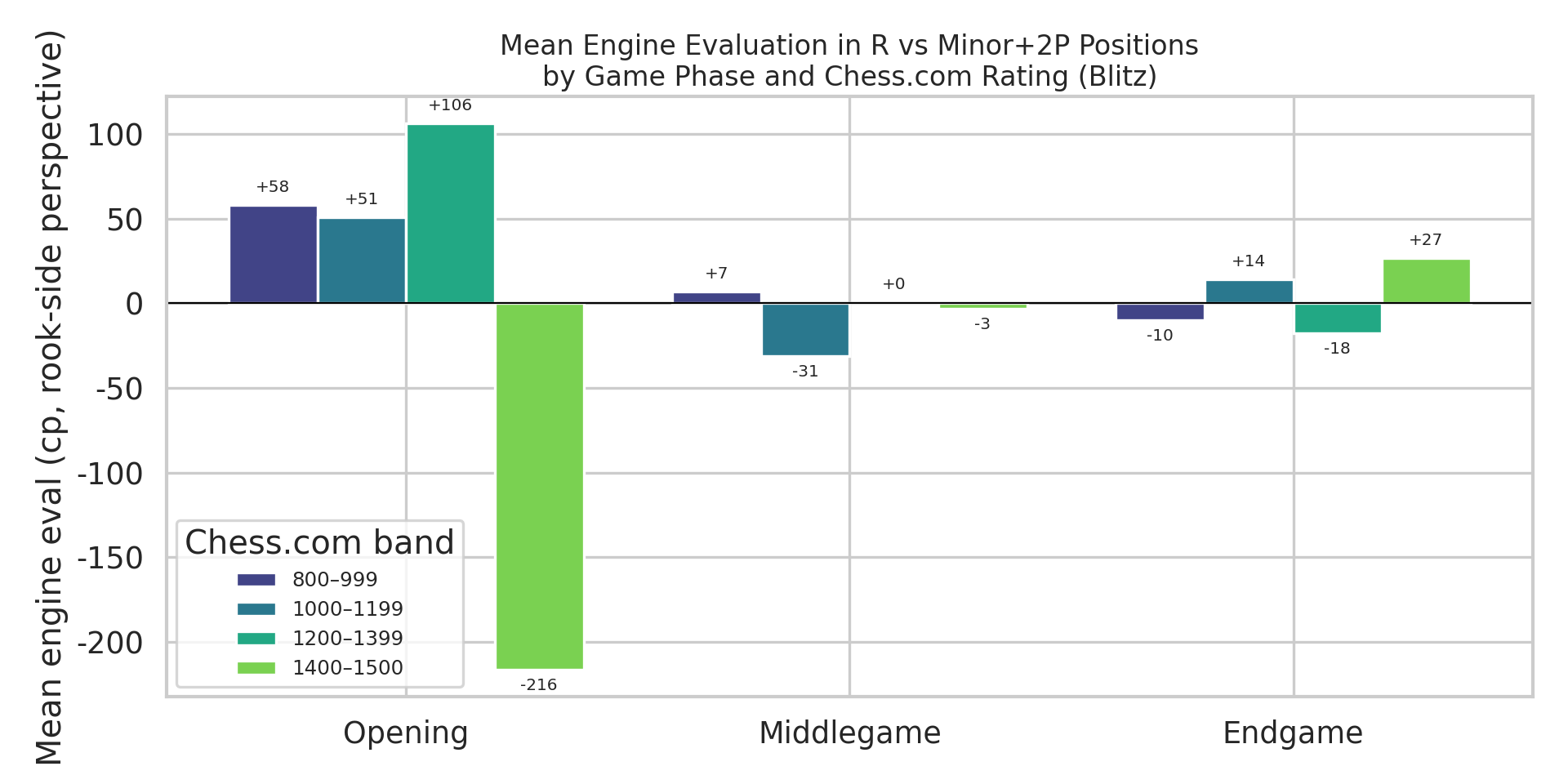
When we look at the average centipawn evaluation from the perspective of the player holding the rook, the scores cluster remarkably close to 0.0 (perfect equality) in both the middlegame and the endgame.
The Middlegame Reality
In the middlegame, the average evaluation across all rating bands hovers between -31 and +7 centipawns. This means that, on average, neither side has a distinct advantage. The minor piece and the two pawns provide enough positional compensation—such as central control, outposts for the knight, or passed pawn potential—to offset the raw power of the rook.
The Endgame Shift
As the game transitions into the endgame, the evaluations remain balanced, but the variance increases. At the 1400–1500 level, the average evaluation slightly favors the rook (+27 centipawns), suggesting that stronger players are better at utilizing the rook's mobility in open endgame positions. However, at the 800–999 level, the evaluation slightly favors the minor piece and pawns (-10 centipawns).
3. Who Actually Wins? The Human Element
While the engine sees equality, human results tell a different story. The data reveals a fascinating divergence between objective evaluation and practical outcomes.
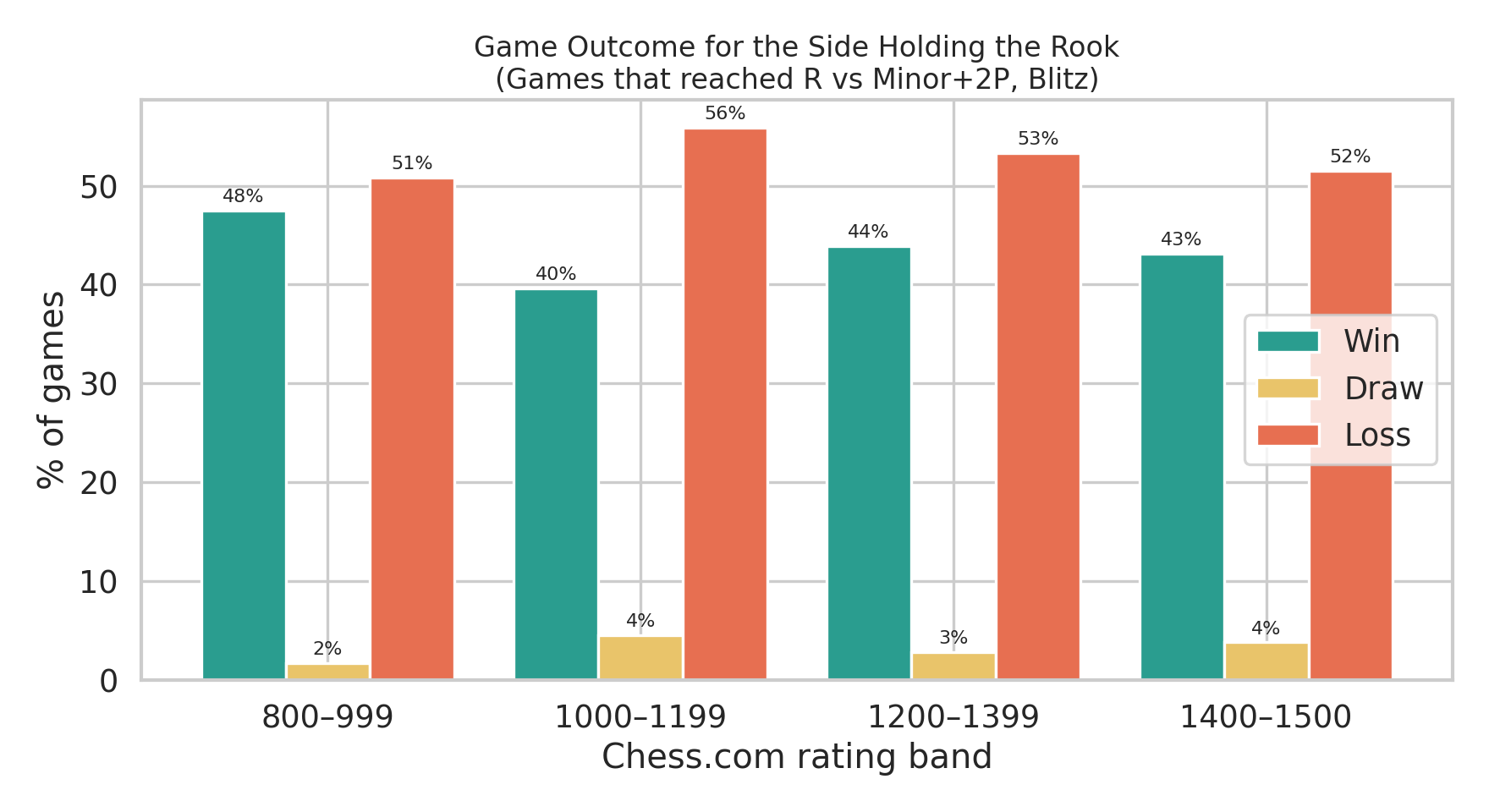
Across all rating bands from 800 to 1500, the player holding the rook loses more often than they win.
- At 800–999: The rook holder wins 48% of the time and loses 51%. It is essentially a coin flip, but the minor piece side has a slight edge.
- At 1000–1199: The gap widens significantly. The rook holder loses 56% of the time and wins only 40%.
- At 1200–1500: The rook holder's win rate recovers slightly to 43–44%, but they still lose over 50% of the time.
Why Does the Rook Struggle?
The data suggests that for beginner and intermediate players, playing with a minor piece and two extra pawns is practically easier than playing with a lone rook. Two extra pawns often mean a safer king or a dangerous passed pawn mass. A knight or bishop can anchor the defense or coordinate with the pawns. Conversely, a rook requires open files and clear targets to be effective. If the position is closed or the pawns restrict the rook's movement, the "5-point" piece becomes a passive spectator.
4. Visualizing the Imbalance
To better understand how the engine evaluates these positions, let's look at a few examples from the dataset.
Example 1: The Power of the Pawn Mass (Chess.com 800–999)
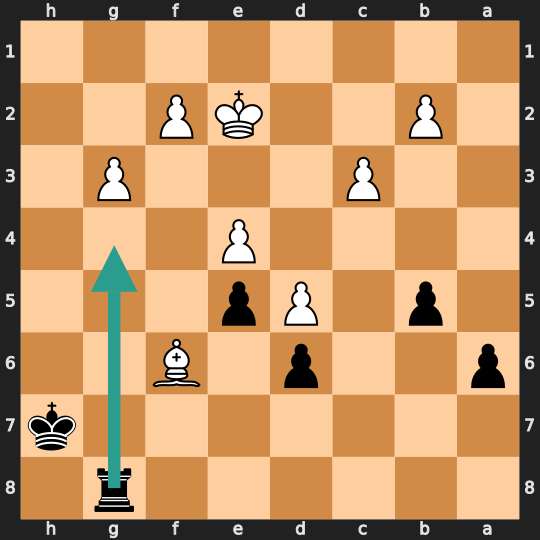
Black (with the rook) stands on move 33. Material count says Black is slightly ahead (rook vs bishop + 2 pawns ≈ 0 net), and the engine agrees: 0.0. The passed c/d pawns and outside bishop give White full compensation.
In this position, Black has a rook, but White's bishop and two pawns provide complete equality. The engine suggests the best move is for Black to play Rg4, attempting to activate the rook, but White's position remains solid.
Example 2: When the Rook Fails (Chess.com 1200–1399)
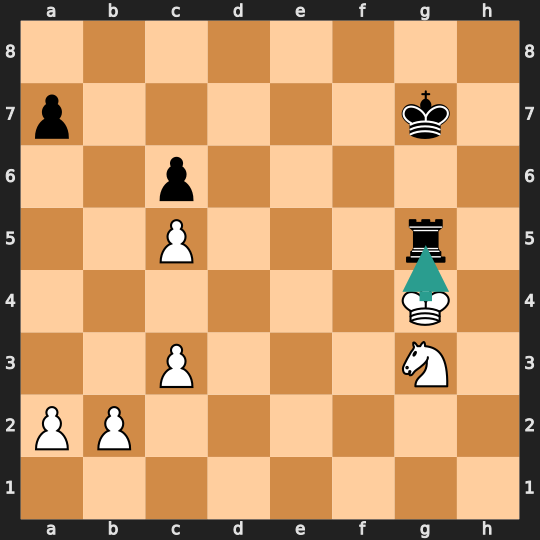
Black’s rook looks ‘up material’ on paper but the two White connected pawns on c3/c5 plus the knight’s fork geometry give White −7 for the rook-holder.
Here, Black's rook is entirely outclassed. White's connected pawns and the well-placed knight dominate the board. The engine evaluates this as completely winning for White (the side with the minor piece and pawns), highlighting how easily a rook can be neutralized in the endgame.
5. Actionable Advice by Rating Band
Based on the data, here is a roadmap for handling the Rook vs Minor + 2 Pawns imbalance as you climb the rating ladder.
For the 800–999 Player
- Don't Fear the Sacrifice: If you have the opportunity to trade your rook for a minor piece and two pawns, take it. The data shows that at your level, the minor piece side actually performs slightly better.
- Focus on Pawn Safety: If you have the two pawns, keep them defended and use them to control the center. If you have the rook, your primary goal must be to win those pawns back before they become dangerous.
For the 1000–1199 Player
- The Danger Zone: This is the rating band where the rook holder performs the worst (losing 56% of the time). Players at this level often overestimate the rook and fail to realize how strong two coordinated pawns can be.
- Activate the Rook: If you hold the rook, you must open files. A passive rook behind a locked pawn structure is worse than a minor piece. Sacrifice a pawn if necessary to open lines for your rook.
For the 1200–1399 Player
- Endgame Awareness: As you approach 1400, endgame technique becomes critical. The data shows that engine evaluations in the endgame start to diverge more sharply.
- Passed Pawns vs. Active Rooks: If you have the minor piece and pawns, push your passed pawns. If you have the rook, you must use it actively to attack the opponent's king or cut off their pieces. Passive defense with a rook usually leads to a slow loss.
For the 1400–1500 Player
- The Shift Toward the Rook: At this level, the rook holder's performance begins to improve, and the engine evaluations in the endgame slightly favor the rook (+27 cp). Stronger players are better at utilizing the rook's long-range capabilities.
- Coordination is Key: The imbalance is no longer just about raw material; it is about piece coordination. If you have the minor piece, ensure it is working together with your pawns to create a fortress or a blockade. If you have the rook, look for ways to infiltrate the opponent's position and create multiple weaknesses.
Data and Methodology
This analysis was conducted using 12,000 Blitz games sourced from the Lichess database via the grandmaster-guide MCP. The games were filtered to include only those with Stockfish 17 evaluations.
To align with the target audience, Lichess Blitz ratings were mapped to approximate Chess.com Blitz ratings using the following conversion:
- Chess.com 800–999 ≈ Lichess 1200–1419
- Chess.com 1000–1199 ≈ Lichess 1420–1564
- Chess.com 1200–1399 ≈ Lichess 1565–1704
- Chess.com 1400–1500 ≈ Lichess 1705–1780
The analysis focused on positions where the material difference (excluding kings and queens) was exactly one rook versus one minor piece (knight or bishop) and two pawns. Engine evaluations were extracted from the perspective of the player holding the rook.
Underlying Data Files:
Chess Coach April 20, 2026