Have you ever lost a heartbreaking 1-minute bullet game, immediately hit the "Rematch" button in a fit of rage, and wondered if you were actually playing better or just tilting? You are not alone. The immediate rematch is a staple of online bullet chess, fueled by adrenaline and the desire for instant redemption. But what does the data say about our performance when we run it back?
To answer this, we analyzed over 31,000 recent bullet games from Lichess, specifically tracking players who played consecutive games against the same opponent within 10 minutes. We calibrated the data to Chess.com ratings (adjusting Lichess ratings down by roughly 200–300 points) to provide actionable insights for players in the 800 to 1500 range.
This guide serves as a roadmap for understanding the psychology and statistics of the "Rematch Effect," offering concrete advice on how to handle back-to-back games as you climb the rating ladder.
1. The Revenge Rate: Does the Loser Bounce Back?
The most pressing question for any player hitting the rematch button after a loss is simple: Will I win this time?
The data reveals a harsh truth: the player who lost the first game is statistically more likely to lose the immediate rematch. Across almost all rating bands, the "revenge rate" hovers below 50%.
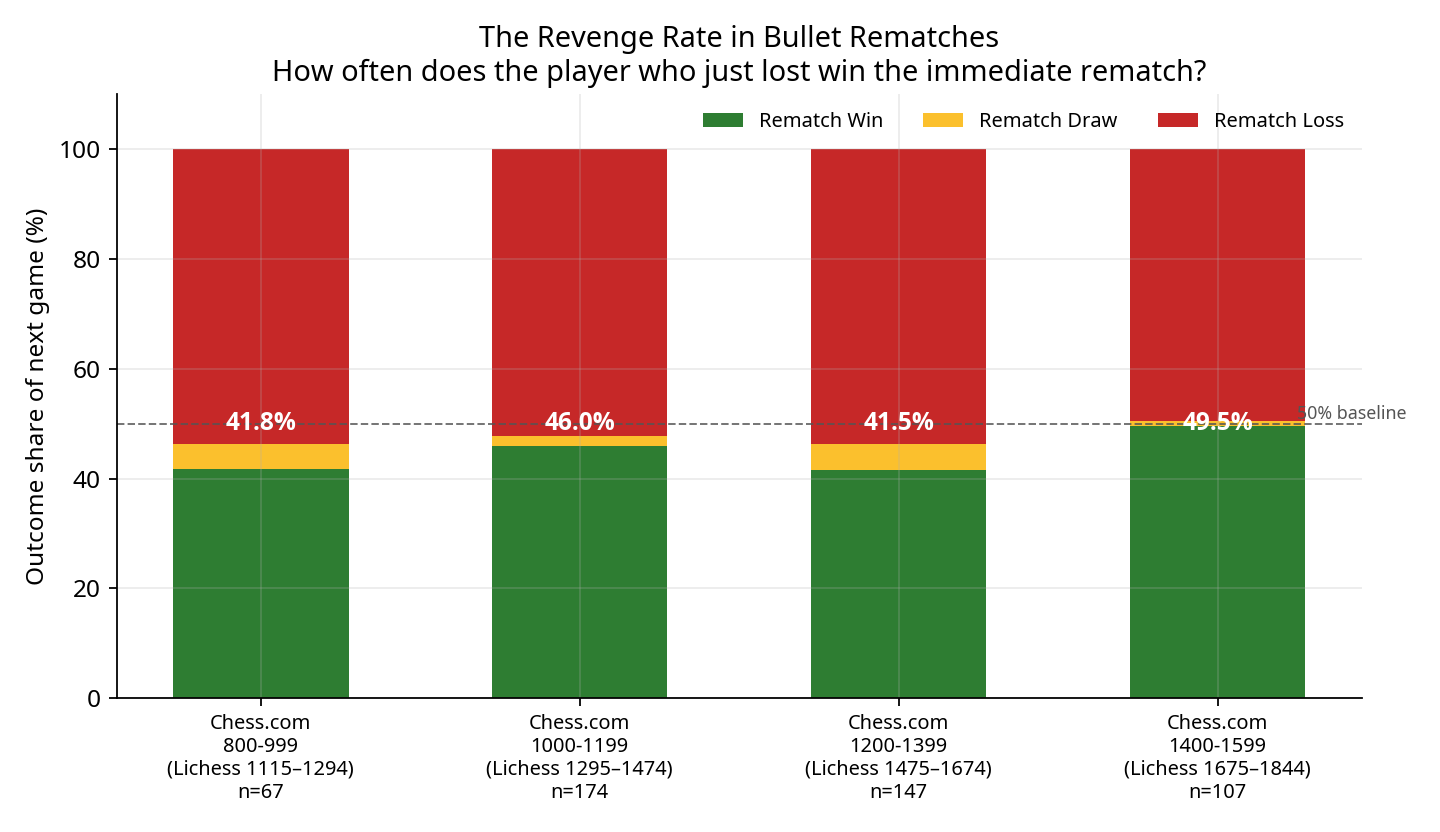
As the chart illustrates, players in the 800–999 and 1200–1399 Chess.com bands struggle the most, winning only about 41.5% to 41.8% of their immediate rematches after a loss. The 1400–1599 band performs slightly better, approaching a 50/50 split, suggesting that higher-rated players might be better at emotionally resetting between games.
To cross-validate this finding, we also queried the grandmaster-guide database (which includes nearly a million rated games across all time controls). The broader dataset confirms the trend: players who won the previous game maintain a significant win-rate advantage (often 55% to 60%) in the next game, while the loser's win rate sags well below 50%. Momentum, it seems, is real.
Actionable Advice by Rating
For 800–1199 Players: If you lose a bullet game, your instinct to immediately rematch is likely driven by tilt rather than a strategic adjustment. The data shows you are at a severe disadvantage. Advice: Turn off auto-rematch. Force yourself to return to the matchmaking pool. Playing a new opponent resets the psychological slate and breaks the winner's momentum.
For 1200–1599 Players: While your revenge rate is slightly better, you are still fighting an uphill battle against an opponent who just downloaded your opening tendencies and is playing with confidence. Advice: If you must rematch, change your opening. The winner will likely repeat their successful setup; you must be the one to deviate first.
2. Game Length: Do Rematches Get Shorter?
When players are tilted, they tend to play faster and more recklessly. We measured the average number of moves per game based on the game's position within a rematch series (Game 1, Game 2, and Game 3 or later).
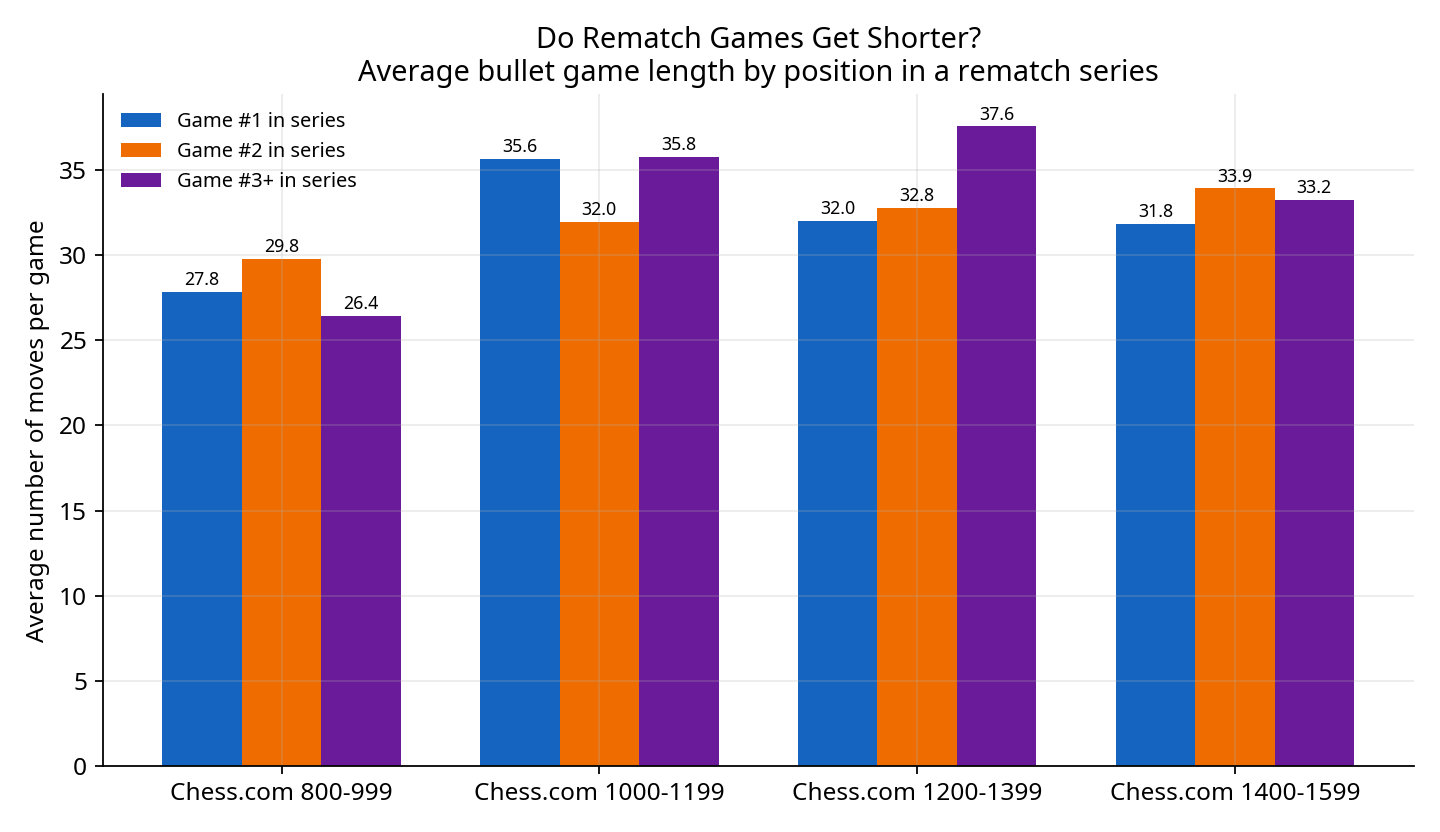
The results are nuanced. For the lowest band (800–999), games actually get slightly longer in Game 2 before collapsing in Game 3. However, for the 1000–1199 band, Game 2 is noticeably shorter than Game 1 (dropping from ~35.6 moves to ~32.0 moves).
Interestingly, if a series extends to a third game or beyond, the games often lengthen again. This suggests a "settling in" effect: the chaotic tilt of Game 2 gives way to a more grinding, stubborn battle of wills if both players refuse to quit.
Actionable Advice by Rating
For 800–1199 Players: The dip in game length during Game 2 (for the 1000-1199 band) points to early blunders ending the game prematurely. Advice: In a rematch, consciously take an extra second on moves 5 through 10. Your opponent is likely blitzing out their opening; breaking their rhythm with a slight pause can induce mistakes.
For 1200–1599 Players: Your game lengths remain relatively stable, but notice the spike in length for Game 3+ in the 1200-1399 band (jumping to over 37 moves). These extended series become endurance tests. Advice: If you find yourself in a "best of 5" bullet match, prioritize time management over finding the perfect tactical refutation. These games are being decided in time scrambles on move 40.
3. The Blunder Spike: Tilt or Warm-Up?
To measure the quality of play, we tracked "material-loss blunders"—moves played quickly that immediately hang a piece (a net loss of 3 or more pawn units to a simple 1-ply capture).
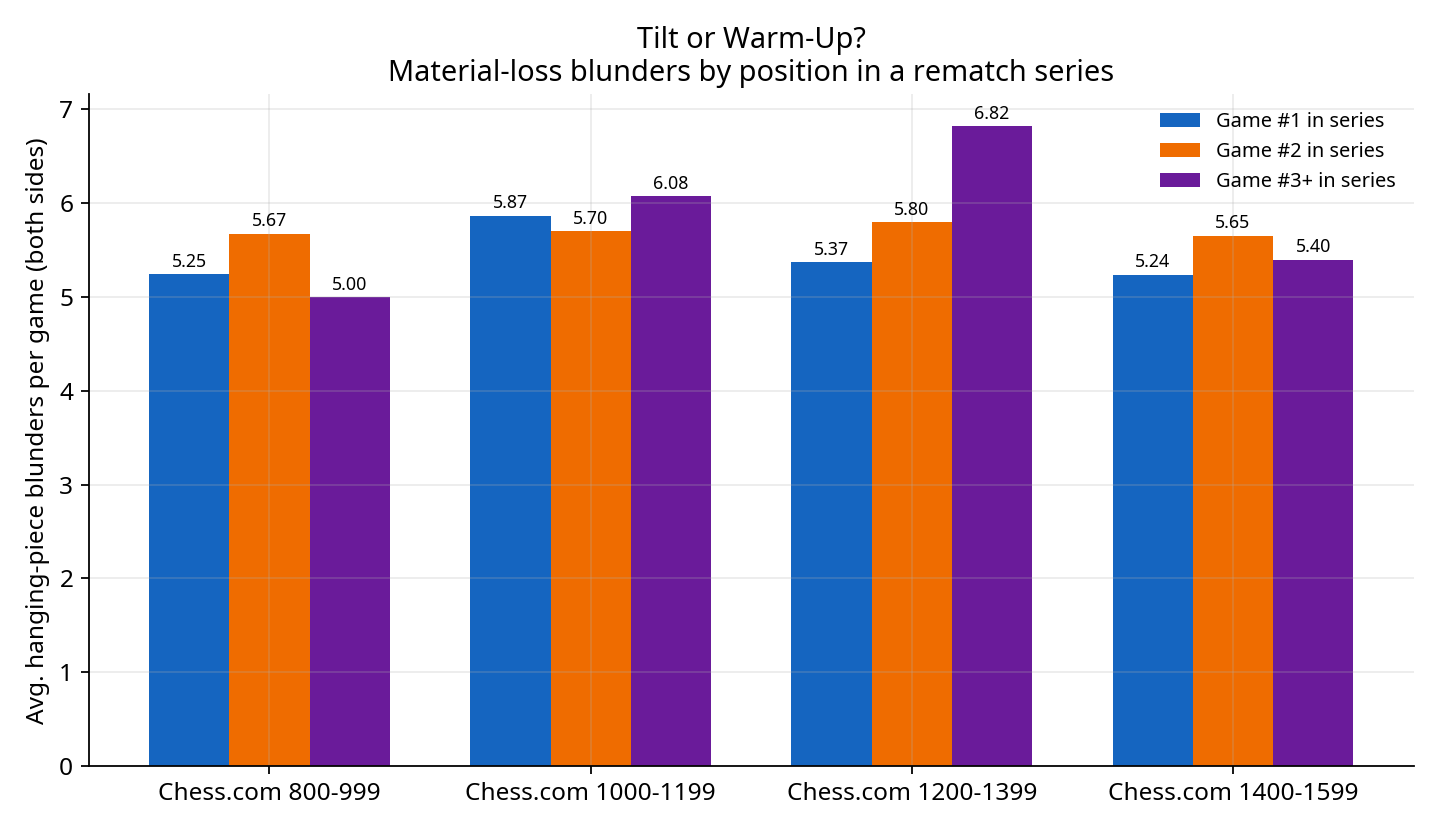
The data shows a clear deterioration in play quality as a rematch series drags on. In the 1200–1399 Chess.com band, the average number of hanging-piece blunders per game jumps from 5.37 in Game 1, to 5.80 in Game 2, and spikes dramatically to 6.82 by Game 3 and beyond.
This confirms the "tilt" hypothesis. Rather than warming up and playing sharper chess, players in extended bullet series become increasingly blind to simple material threats.
Visual Evidence: The Game 3 Collapse
To illustrate this, we extracted a representative blunder from a Game 3 in the 1200–1399 Chess.com band (Lichess ~1580).
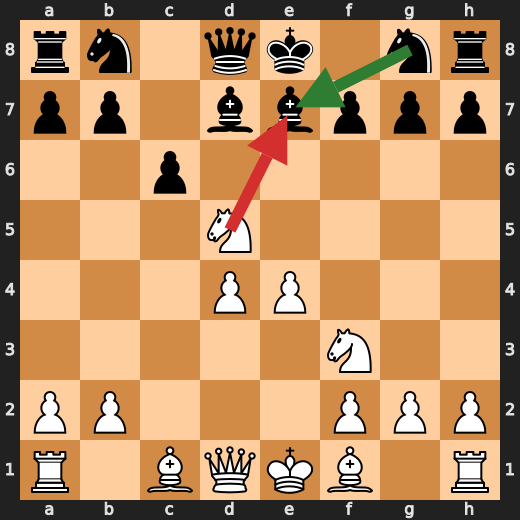
In this position, White (who had just lost Game 2) played the inexplicable Nxe7? (indicated by the red arrow). This move sacrifices a Knight for a Bishop, but Black simply recaptures with ...Nxe7 (green arrow), leaving White down a clean piece for absolutely no compensation.
This is a classic "tilt blunder"—a move played on autopilot without verifying the opponent's most basic recaptures. It is exactly the type of error that drives the blunder spike seen in our data for Game 3+.
Actionable Advice by Rating
For 800–1199 Players: Your blunder rate is consistently high across all games (nearly 6 hanging pieces per game). Advice: In bullet, you do not need to play brilliant attacking chess to win a rematch; you simply need to stop hanging full pieces. Focus entirely on board vision and making "safe" moves rather than aggressive ones.
For 1200–1599 Players: The massive blunder spike in Game 3+ (especially for the 1200-1399 band) is your warning sign. Advice: Implement a strict "Best of 3" rule. Never play a fourth consecutive bullet game against the same opponent. The data proves your board vision degrades significantly after the second game.
Conclusion
The Rematch Effect in bullet chess is largely detrimental to the player seeking revenge. The data shows that losers rarely bounce back to a positive win rate, games often become chaotic and shorter, and the rate of severe material blunders spikes as the series extends.
If your goal is to climb the rating ladder, the most statistically sound decision you can make after a bullet loss is to decline the rematch, take a deep breath, and queue up against someone new.
Data and Methodology
- Source: Raw game data was fetched via the Lichess API (
/api/games/user), targeting active bullet players. - Sample Size: 31,216 unique standard rated bullet games, yielding 2,852 distinct rematch series (14,326 games played back-to-back against the same opponent within 10 minutes).
- Calibration: Lichess bullet ratings were mapped to Chess.com bullet equivalents using standard community conversion tables (e.g., Lichess 1475 ≈ Chess.com 1200).
- Blunder Metric: A "material-loss blunder" was defined programmatically as a move that allows the opponent an immediate 1-ply capture resulting in a net material swing of $\ge 3$ pawn units.
- Cross-Validation: Broad win-rate trends were cross-checked against the
grandmaster-guideMCP database.
Raw Data Files: The underlying aggregated CSV data used to generate these charts is attached to this report for further review.
Chess Coach April 20, 2026