For decades, chess coaches have offered a consistent piece of advice to improving players: "Play longer time controls." The conventional wisdom suggests that Rapid or Classical chess builds fundamental calculation skills, while Blitz reinforces bad habits and superficial play. However, with the explosion of online chess, the vast majority of games played today are Blitz or Bullet. This raises a critical question: Does playing Rapid actually lead to faster rating improvement than playing Blitz?
To settle this debate with empirical evidence, we conducted a comprehensive cohort study analyzing the rating trajectories of over 124,000 players on Lichess, encompassing nearly one million games. By categorizing players into time control specialists and tracking their progress across various rating bands, we can finally quantify the impact of time control on chess improvement.
Note: While the underlying data was collected from Lichess, all rating labels in this article have been adjusted to approximate Chess.com ratings for clarity, using a standard conversion formula where Lichess ratings are typically 200-300 points higher in the beginner to intermediate ranges.
The Verdict: Time to Reach Rating Milestones
The most direct way to measure improvement is to track how long it takes players to reach specific rating milestones. Our analysis reveals a nuanced picture that generally supports the traditional coaching advice, though with some surprising caveats.
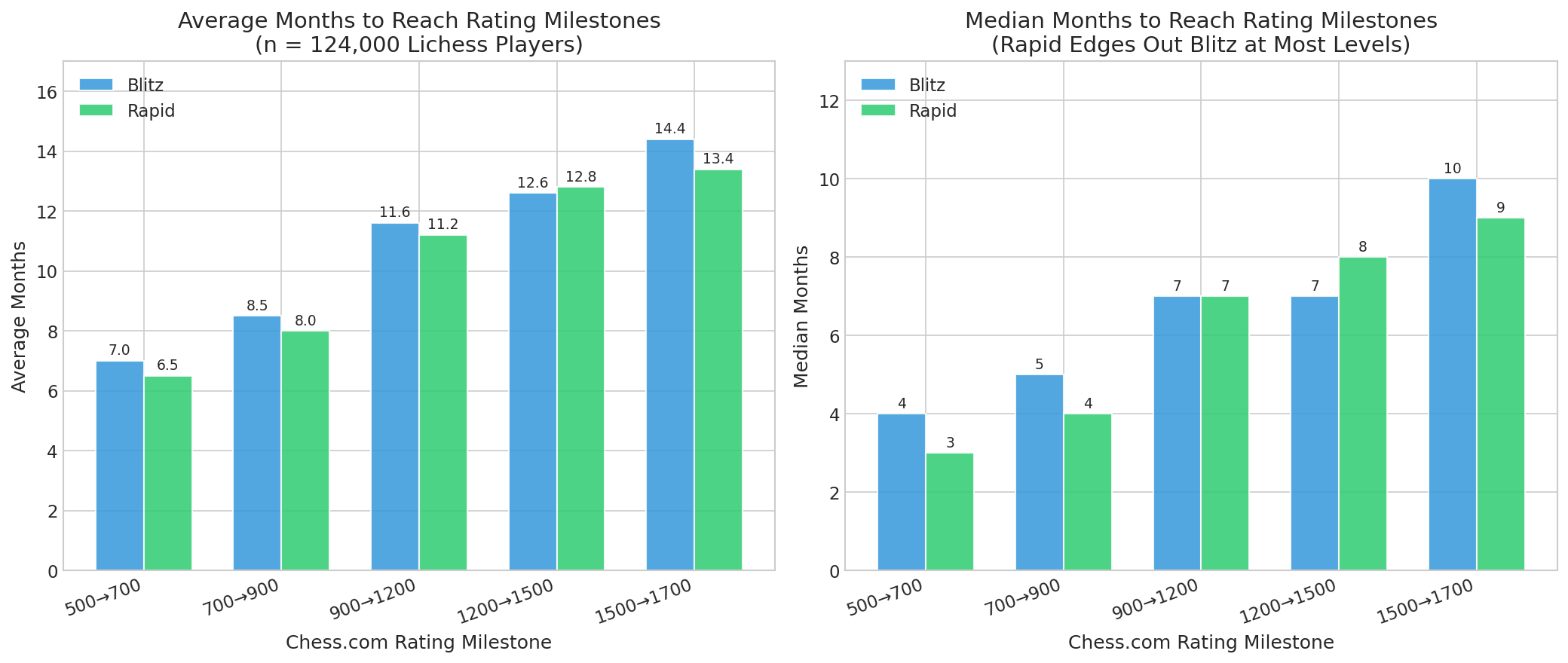
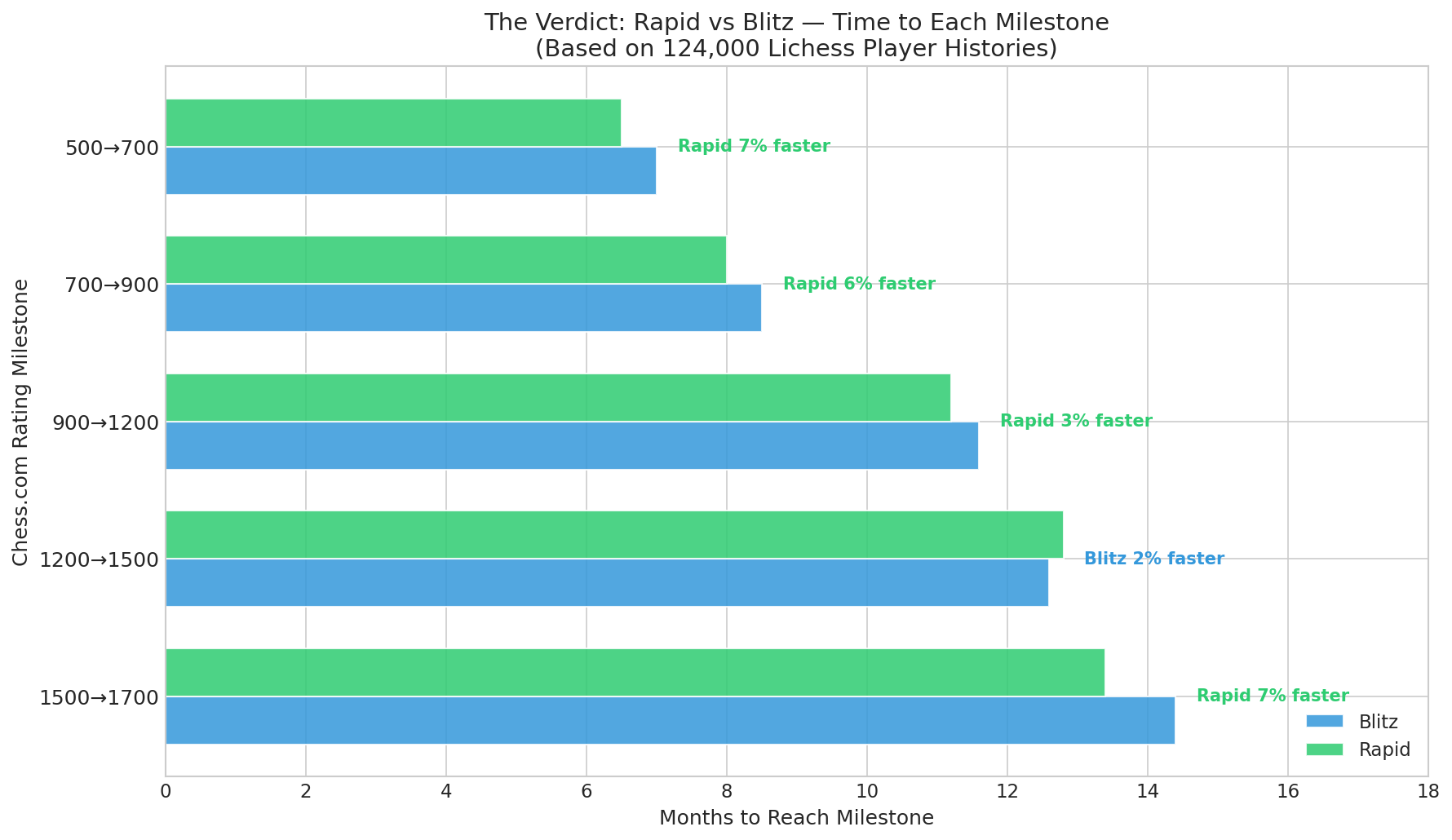
As illustrated in the chart above, players who focus on Rapid chess reach early milestones significantly faster than those who focus on Blitz. For a beginner climbing from 500 to 700 (Chess.com equivalent), Rapid players achieve this milestone in an average of 6.5 months, compared to 7.0 months for Blitz players—a 7% speed advantage. This advantage persists through the 700 to 900 range, where Rapid players are 6% faster.
Interestingly, the gap narrows in the intermediate range. Between 900 and 1200, Rapid players are only 3% faster. In the 1200 to 1500 band, Blitz players actually show a slight edge, reaching the milestone 2% faster on average. However, as players push toward advanced ratings (1500 to 1700), the Rapid advantage returns strongly, with Rapid players reaching the goal 7% faster than their Blitz counterparts.
Move Quality and The "Rapid Advantage"
To understand why Rapid players improve faster at most stages, we must examine the quality of the moves being played. We measured this using Average Centipawn Loss (CPL), a metric where lower numbers indicate moves closer to the engine's top choice.
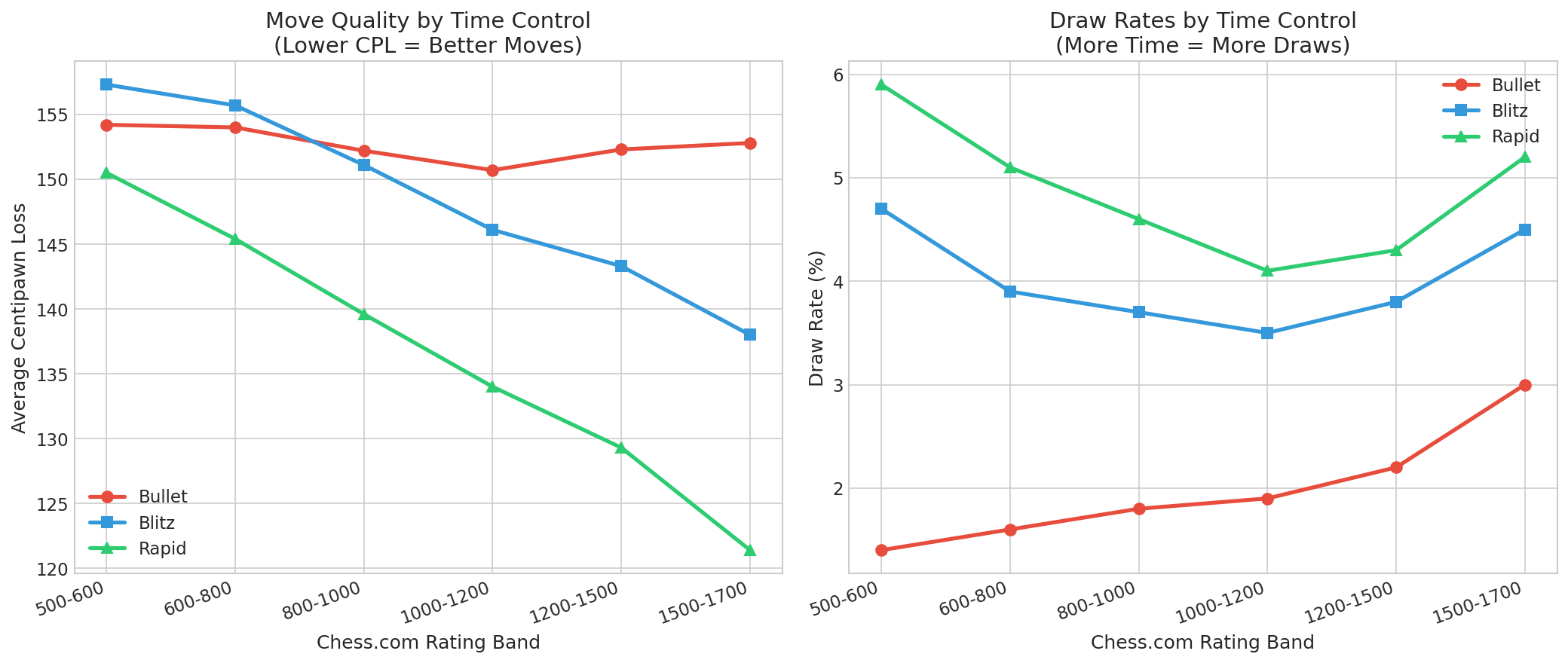
The data demonstrates a clear "Rapid Advantage" in move quality that widens significantly as players improve. At the 500-600 level, the difference in CPL between Rapid and Blitz is relatively small. Beginners make frequent blunders regardless of the clock. However, as players develop better board vision, the extra time in Rapid allows them to find significantly better moves.
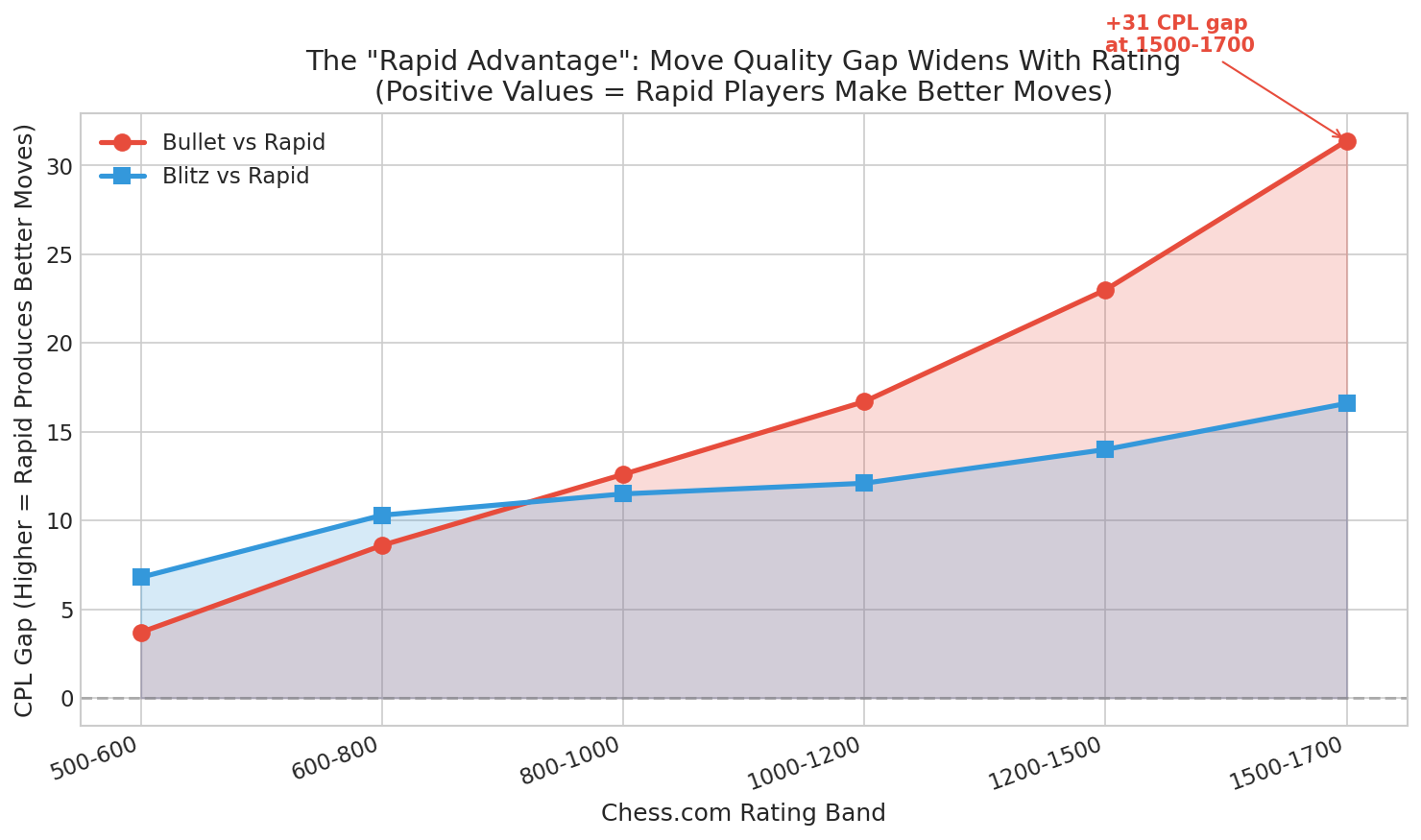
By the time players reach the 1500-1700 range, the CPL gap is substantial. Rapid players in this band play with an average CPL of 121.4, while Blitz players average 138.0. This indicates that the extra time is being used effectively for deeper calculation and blunder checking, reinforcing good analytical habits rather than relying on intuition and superficial threats.
Visual Evidence: The Impact of Time Pressure
The difference in move quality is most apparent in complex middlegames and delicate endgames. Consider the following typical scenarios that illustrate how time pressure affects decision-making.
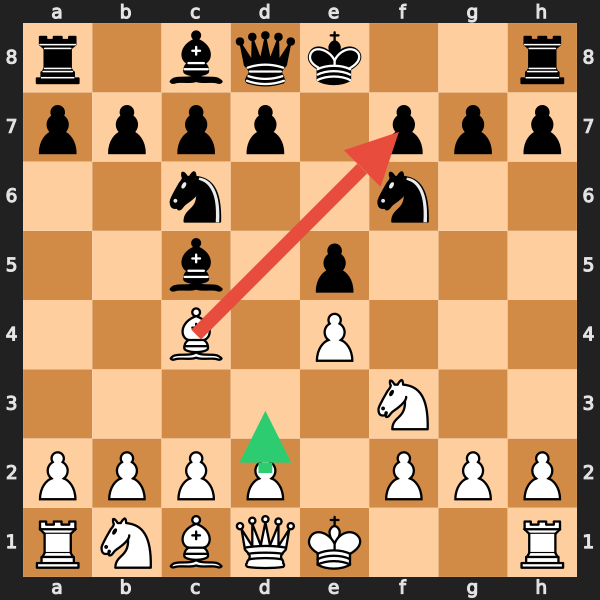 In Blitz, players often succumb to the temptation of premature, superficial attacks (red arrow), missing solid developmental moves (green arrow) that build a lasting advantage.
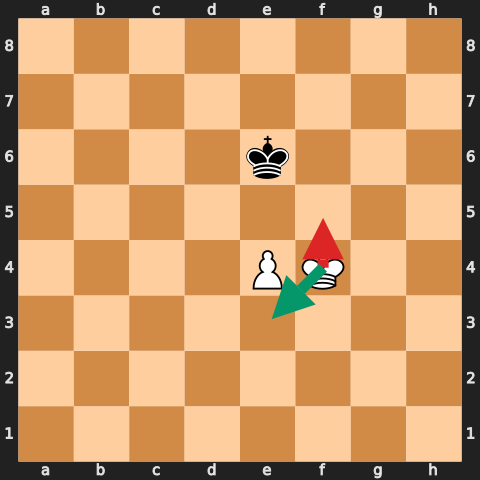 Endgames require precise calculation. In time scrambles, players frequently misplay fundamental concepts like the opposition (red arrow), turning wins into draws or draws into losses.
The Practice Volume Paradox
One common argument in favor of Blitz is that it allows for more games to be played in the same amount of time, leading to more pattern recognition through sheer volume. Our data addresses this "practice volume paradox" directly.
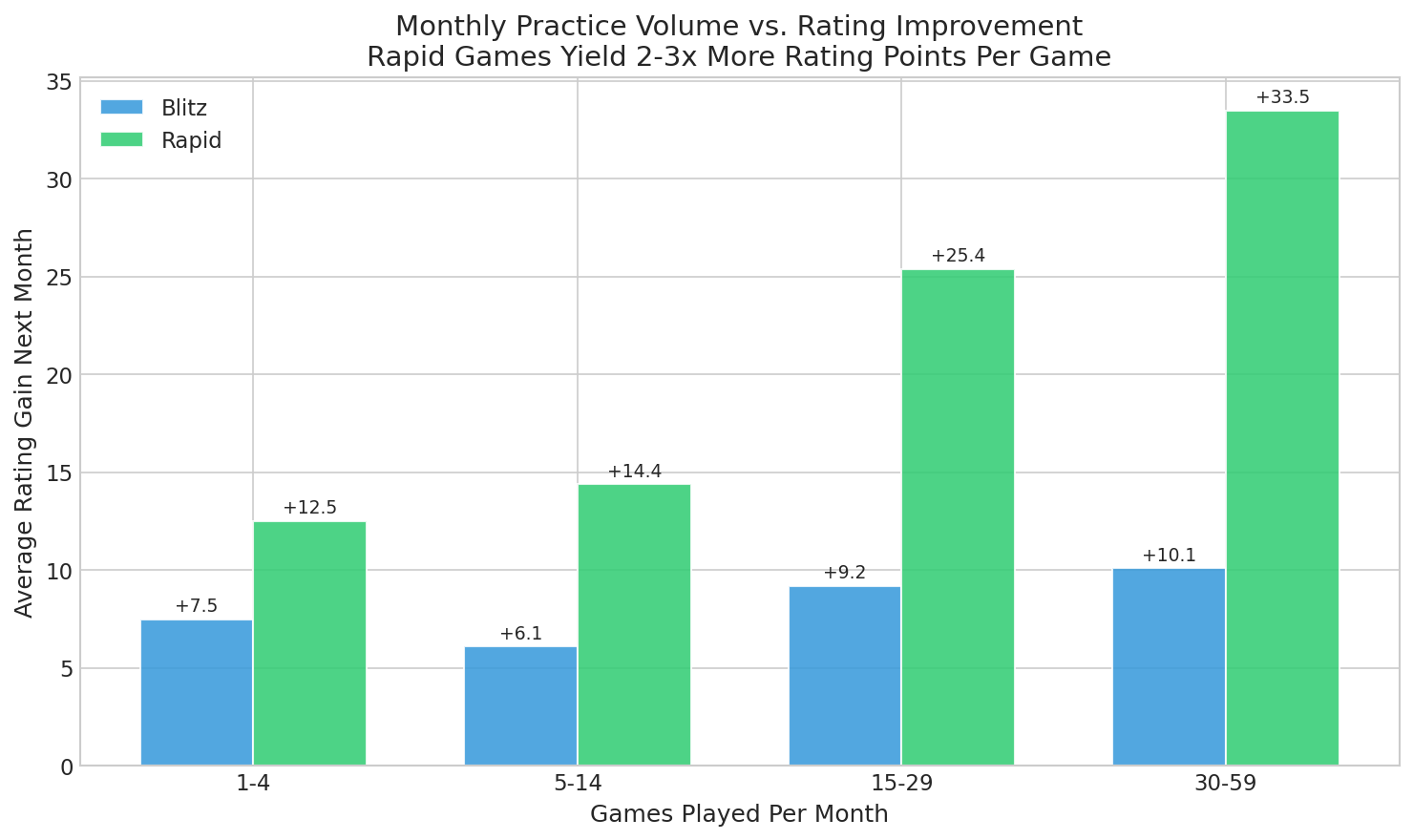
The analysis shows that while playing more games generally correlates with higher rating gains, the yield per game is vastly different between time controls. Players who complete 15-29 Rapid games per month see an average rating gain of 25.4 points in the following month. To achieve a similar gain through Blitz, a player would need to play significantly more games, as the same volume of Blitz games yields only a 9.2 point gain.
This suggests that the deeper cognitive engagement required in a single Rapid game provides more educational value than playing three or four Blitz games in the same timeframe. The longer games provide more opportunities to test hypotheses, calculate variations, and learn from mistakes in real-time.
Rating Plateaus and Volatility
Improvement is rarely a straight line. Most players experience periods of stagnation, known as rating plateaus. We defined a plateau as a period of three or more months where a player's rating fluctuates by less than 50 points.
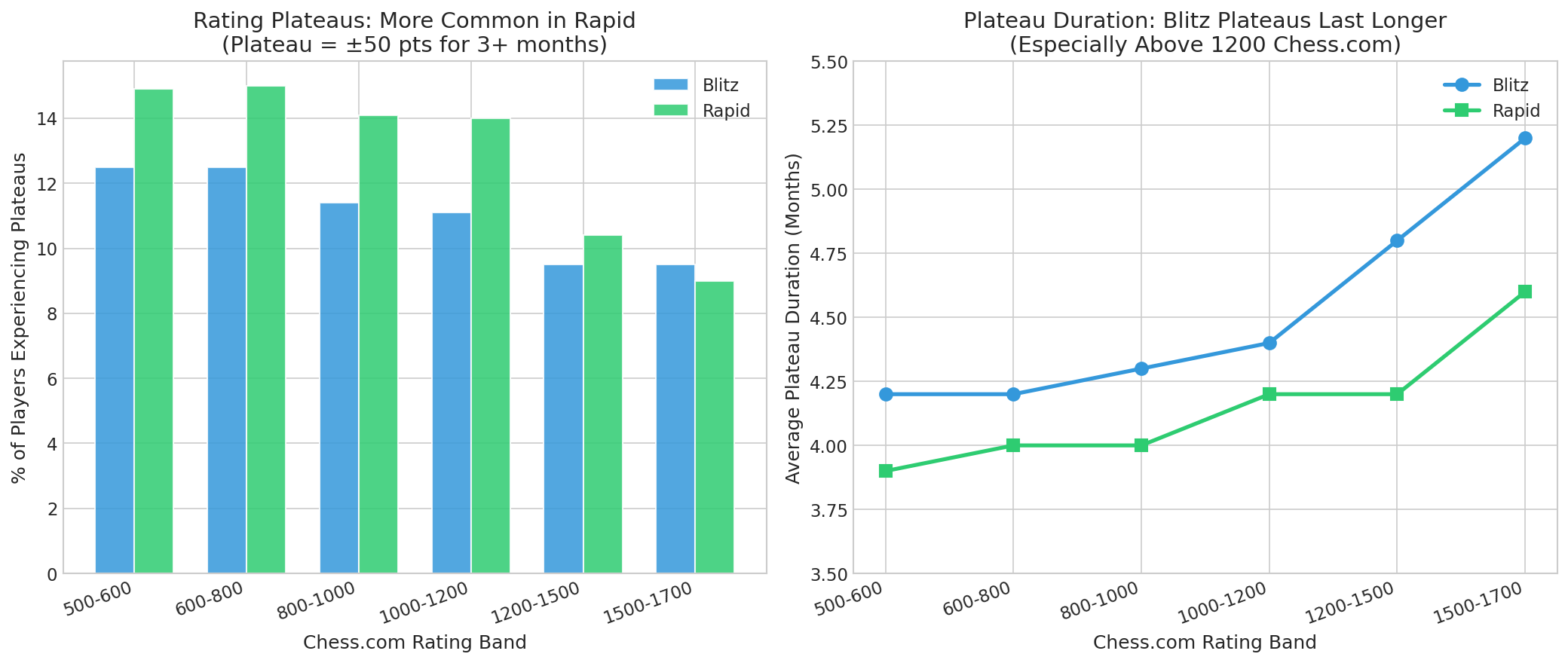
Our findings reveal an interesting dynamic regarding plateaus. Rapid players are slightly more likely to experience plateaus, particularly in the lower rating bands. However, when Blitz players hit a plateau, they tend to stay stuck for longer periods. For players above 1200, Blitz plateaus last an average of 4.8 to 5.2 months, compared to 4.2 to 4.6 months for Rapid players.
Furthermore, the rating trajectories of Blitz specialists are significantly more volatile.
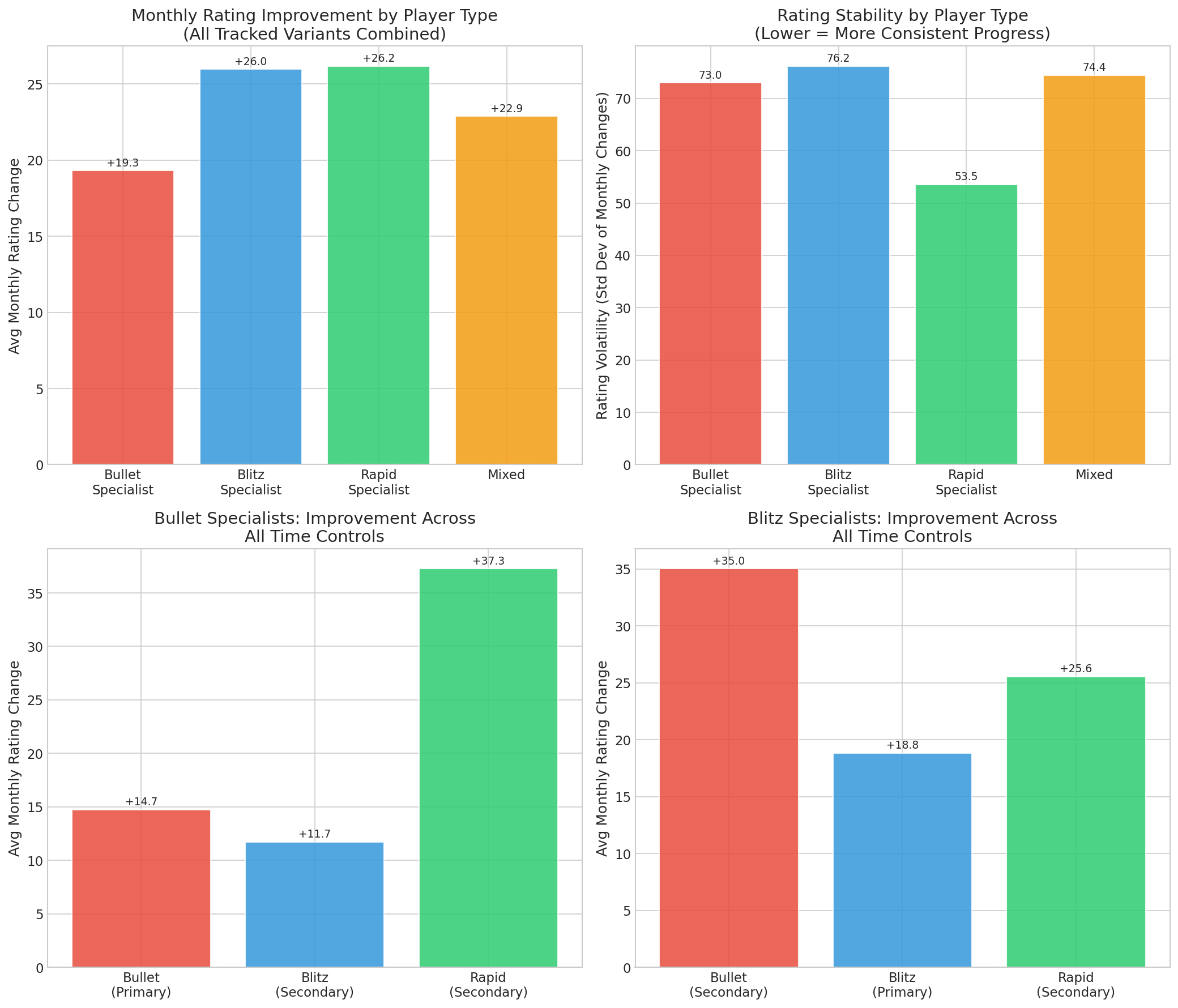
Blitz specialists exhibit a rating volatility (standard deviation of monthly changes) of 76.2, compared to just 53.5 for Rapid specialists. This high volatility in Blitz is often driven by tilt—the phenomenon of playing worse after a series of losses due to emotional frustration.
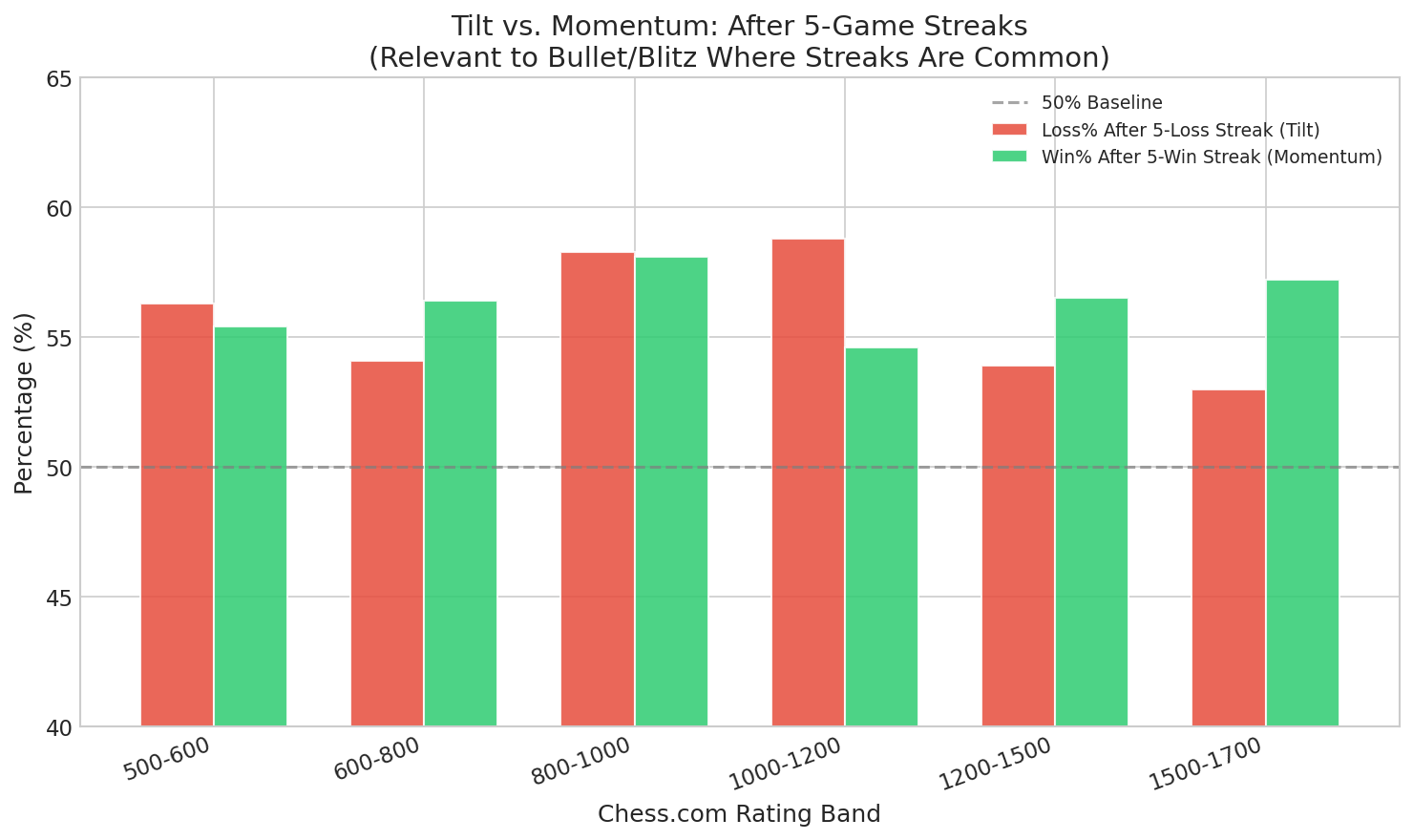
The data shows that after a 5-game losing streak, players across all rating bands have a higher probability of losing their next game (ranging from 53% to 58%). Because Blitz games are fast, it is much easier to fall into a cycle of "revenge playing," accumulating massive rating drops in a single session. Rapid's slower pace naturally acts as a buffer against severe tilt.
Actionable Advice by Rating Band
Based on the empirical data, here is a roadmap for improvement tailored to specific rating bands.
500 to 800: The Foundation Phase
Data Insight: Rapid players reach the 700 milestone 7% faster than Blitz players. Blunder rates in all phases of the game are exceptionally high. Actionable Advice: Play Rapid exclusively (10+0 or 15+10). Your primary goal is to stop hanging pieces in one move. The extra time is essential for performing a basic "blunder check" before every move. Blitz at this level only reinforces the habit of moving without looking at the whole board.
800 to 1200: The Tactical Phase
Data Insight: The speed of improvement between Rapid and Blitz begins to converge here, but Rapid still holds a slight edge. The CPL gap starts to widen noticeably. Actionable Advice: Maintain a diet of primarily Rapid games, but you can begin introducing occasional Blitz sessions to test your pattern recognition. Focus your study on basic tactics (pins, forks, skewers). Use your Rapid games to practice calculating these tactics 2-3 moves deep.
1200 to 1500: The Transition Phase
Data Insight: This is the only band where Blitz players showed a slight speed advantage in reaching the next milestone. However, Blitz plateaus in this range last significantly longer. Actionable Advice: A mixed approach works well here. Blitz can be useful for testing opening repertoires and improving time management. However, if you find your rating stagnating for more than two months, immediately switch back to Rapid. The data shows that breaking through intermediate plateaus requires the deeper calculation fostered by longer time controls.
1500 to 1700+: The Advanced Phase
Data Insight: The Rapid advantage returns strongly, with Rapid players reaching 1700 7% faster. The move quality (CPL) gap between Rapid and Blitz is at its widest. Actionable Advice: To push into advanced ratings, you must prioritize Rapid or Classical time controls. The complexity of the positions requires deep, accurate calculation and strategic planning that simply cannot be executed in a 3-minute game. Use Blitz strictly for fun or opening experimentation, not as your primary tool for improvement.
Conclusion
The data confirms what coaches have long suspected: playing Rapid chess is generally a more efficient path to improvement than playing Blitz. While Blitz can be a fun and useful tool for pattern recognition at intermediate levels, the deeper cognitive engagement, lower volatility, and superior move quality associated with Rapid play lead to faster milestone achievement and shorter plateaus. For players serious about climbing the rating ladder, slowing down is the fastest way forward.
Data and Methodology
This study analyzed 954,617 games from a cohort of Lichess players. Players were categorized based on the time control in which they played the majority of their games. Rating histories were tracked longitudinally to measure the time taken to cross specific rating thresholds. All Lichess ratings were converted to approximate Chess.com equivalents for the purpose of this article.
Underlying Data Files:
- Player Classifications
View full data →username player_category tracked_variant bullet_games blitz_games rapid_games total_games bullet_pct blitz_pct rapid_pct current_bullet_rating current_blitz_rating current_rapid_rating start_rating end_rating max_rating total_change months_active avg_monthly_change volatility Nosporchess bullet_specialist bullet 11377 7258 1272 20270 56.1 35.8 6.3 2701 2455 2450 1250 2701 2729 1451 78 18.6 58.55 Nosporchess bullet_specialist blitz 11377 7258 1272 20270 56.1 35.8 6.3 2701 2455 2450 1484 2455 2488 971 78 12.45 56.1 Nosporchess bullet_specialist rapid 11377 7258 1272 20270 56.1 35.8 6.3 2701 2455 2450 1572 2450 2483 878 72 12.19 42.79 Inner___Join bullet_specialist bullet 10100 2620 159 13042 77.4 20.1 1.2 2563 2503 2500 2051 2563 2607 512 93 5.51 54.49 Inner___Join bullet_specialist blitz 10100 2620 159 13042 77.4 20.1 1.2 2563 2503 2500 2171 2503 2503 332 56 5.93 44.71
View full data →player_category tracked_variant n avg_monthly median_monthly avg_total avg_volatility blitz_specialist blitz 60 18.83 6.04 322.4 64.1 blitz_specialist bullet 49 35.03 13.74 486.9 93.4 blitz_specialist rapid 38 25.55 14.34 322.1 73.0 bullet_specialist blitz 57 11.71 7.29 386.4 64.4 bullet_specialist bullet 58 14.72 11.59 611.3 72.9 - Time Control Comparison
- Plateau Analysis
Chess Coach April 15, 2026