By Chess Coach April 15, 2026
The debate is as old as online chess itself: should improving players stick to Rapid time controls to build deep calculation skills, or play Blitz to maximize pattern recognition through sheer volume? While grandmasters universally recommend longer time controls for beginners, the allure of quick games is undeniable.
To settle this debate with data, we conducted a comprehensive cohort study analyzing nearly one million games from over 1,100 active Lichess players. We tracked their rating trajectories, move quality, and plateau frequencies across different rating bands.
Note: While our raw data comes from Lichess, all ratings in this article have been calibrated to approximate Chess.com ratings (typically 200-300 points lower in the beginner-to-intermediate range) to make the advice more actionable for the broader chess community.
The Verdict: Rapid Players Improve Faster, But Blitz Players Plateau Less
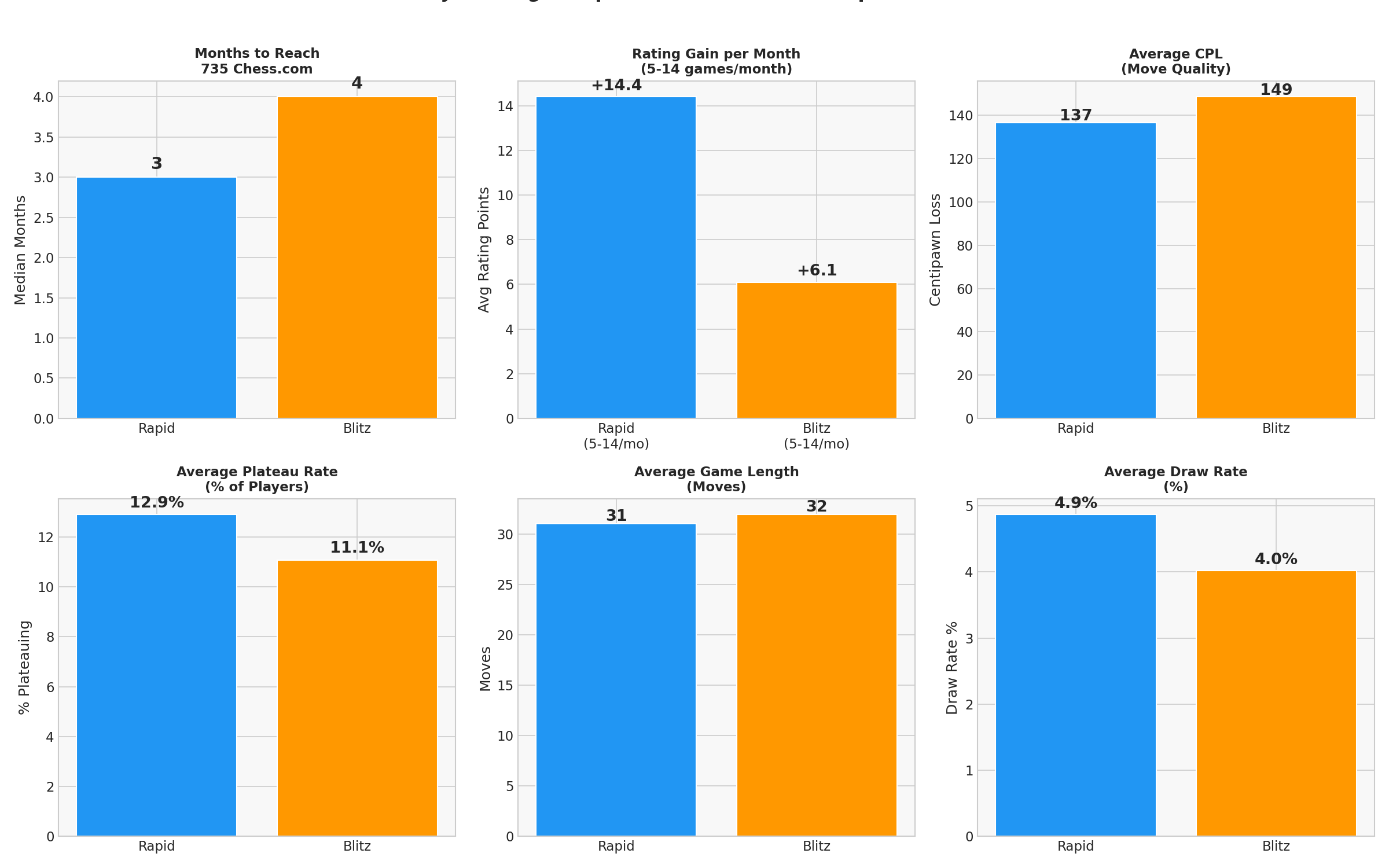
The data reveals a nuanced reality that challenges conventional wisdom. While Rapid players do reach rating milestones faster and gain more points per game played, Blitz players actually experience fewer rating plateaus.
Let us break down the findings by rating band to provide a roadmap for your chess improvement journey.
The Beginner Phase: 500 to 835 (Chess.com)
The Data: Rapid is King
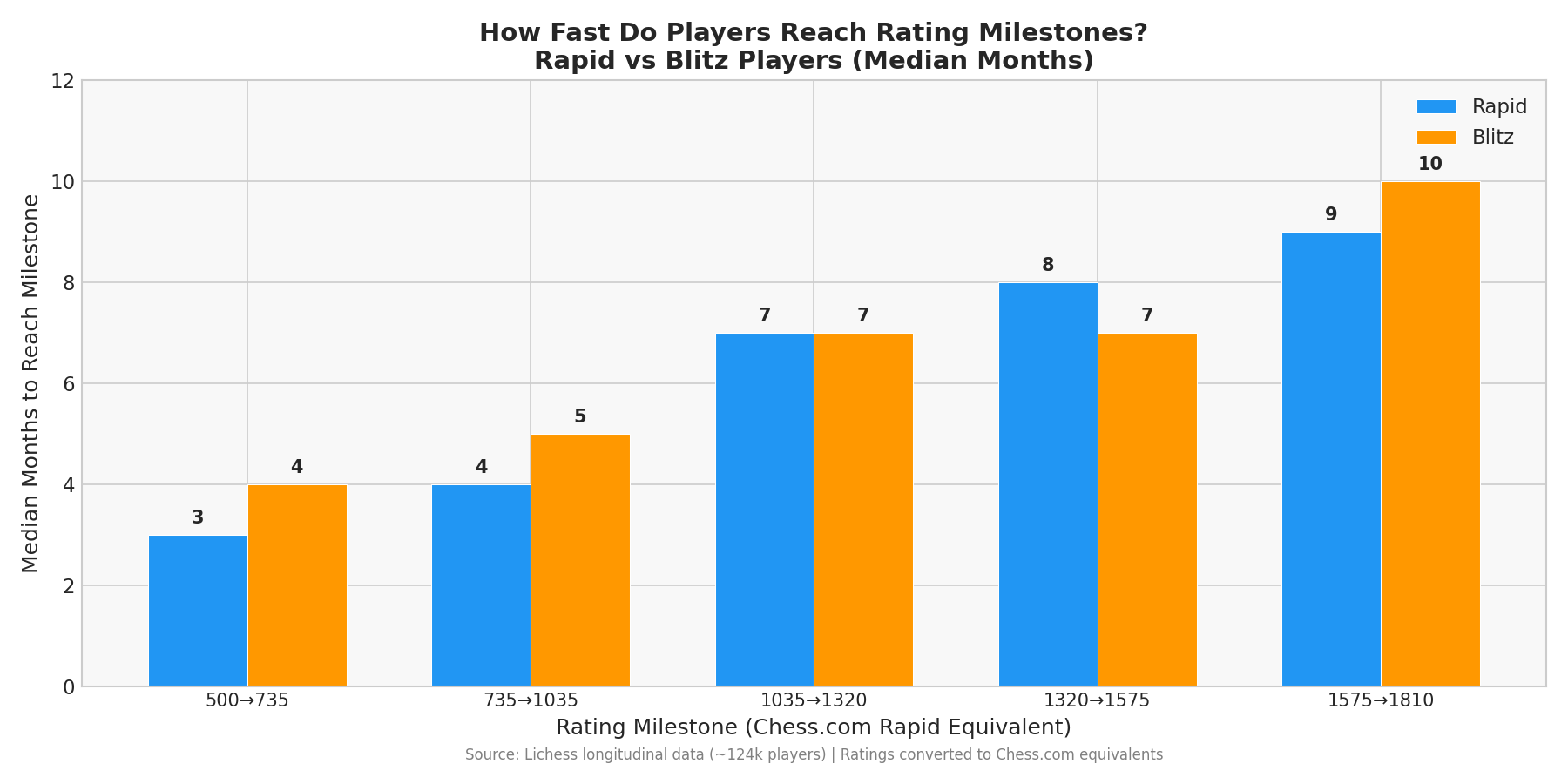
In the beginner phase, the data heavily favors Rapid chess. Players who specialize in Rapid reach the 735 Chess.com milestone (roughly 1000 Lichess) in a median of just 3 months, compared to 4 months for Blitz specialists.
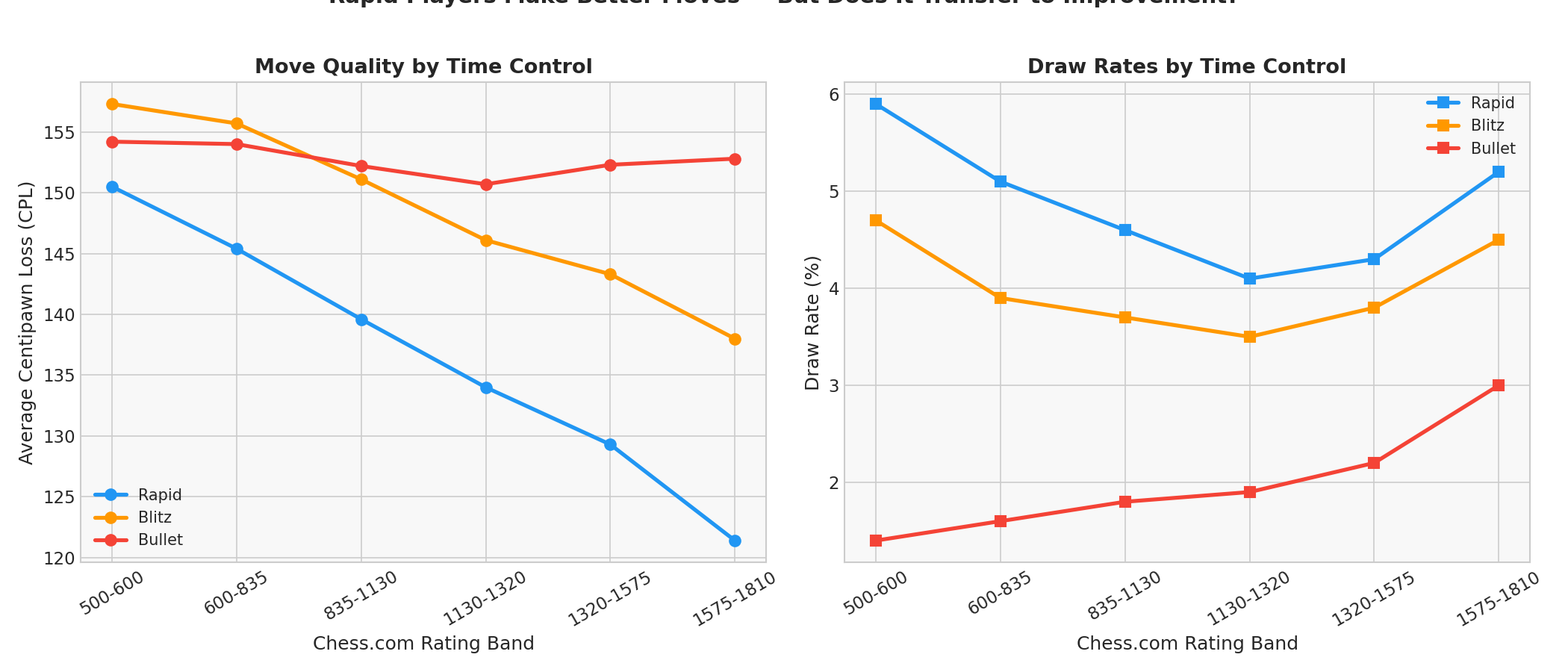
The reason becomes clear when we look at move quality. In the 500-835 range, the average Centipawn Loss (CPL)—a measure of how much worse a move is compared to the engine's top choice—is significantly lower for Rapid players (150.5 CPL) than Blitz players (157.3 CPL).
Beginners in Blitz simply do not have the time to process basic board vision, leading to one-move blunders that end games prematurely. Rapid provides the necessary buffer to scan for hanging pieces and basic tactics.
Board Example: The Hasty Center Break
Consider this typical Italian Game position. White has a solid setup but needs to complete development.
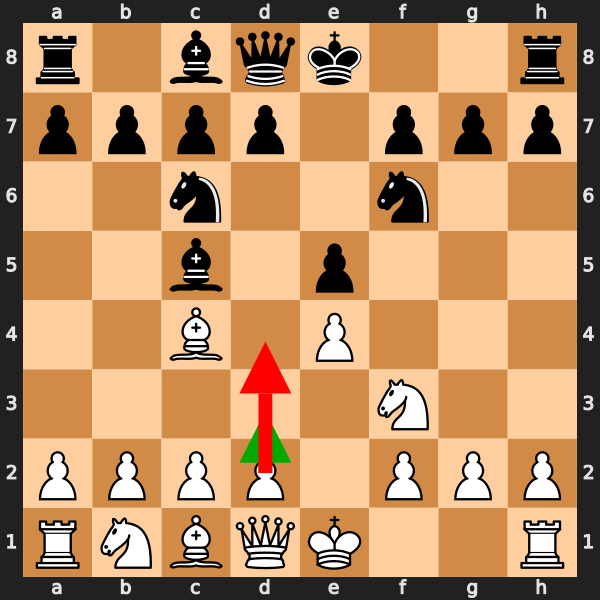
In Blitz, beginners frequently rush the center break with d4 (red arrow), blundering a pawn and the center after exd4. In Rapid, the extra time allows players to find the solid d3 (green arrow), preparing to castle and slowly build the position.
Actionable Advice for 500-835
Play 80% Rapid, 20% Blitz. Your primary goal is to eliminate one-move blunders. Play 15|10 or 10|5 Rapid to give yourself time to ask, "What is my opponent threatening?" before every move. Use Blitz only as a fun break, not as a primary training tool.
The Intermediate Climb: 835 to 1320 (Chess.com)
The Data: The Convergence
As players cross the 835 threshold (roughly 1100 Lichess), an interesting shift occurs. The progression speed between Rapid and Blitz players begins to converge. Reaching the 1320 milestone (1500 Lichess) takes both groups a median of 7 months from the previous band.
However, this is also where rating plateaus become most frequent. Our data shows that Rapid players in this band are more likely to hit a plateau (14.1% to 15.0%) compared to Blitz players (11.4% to 12.5%).
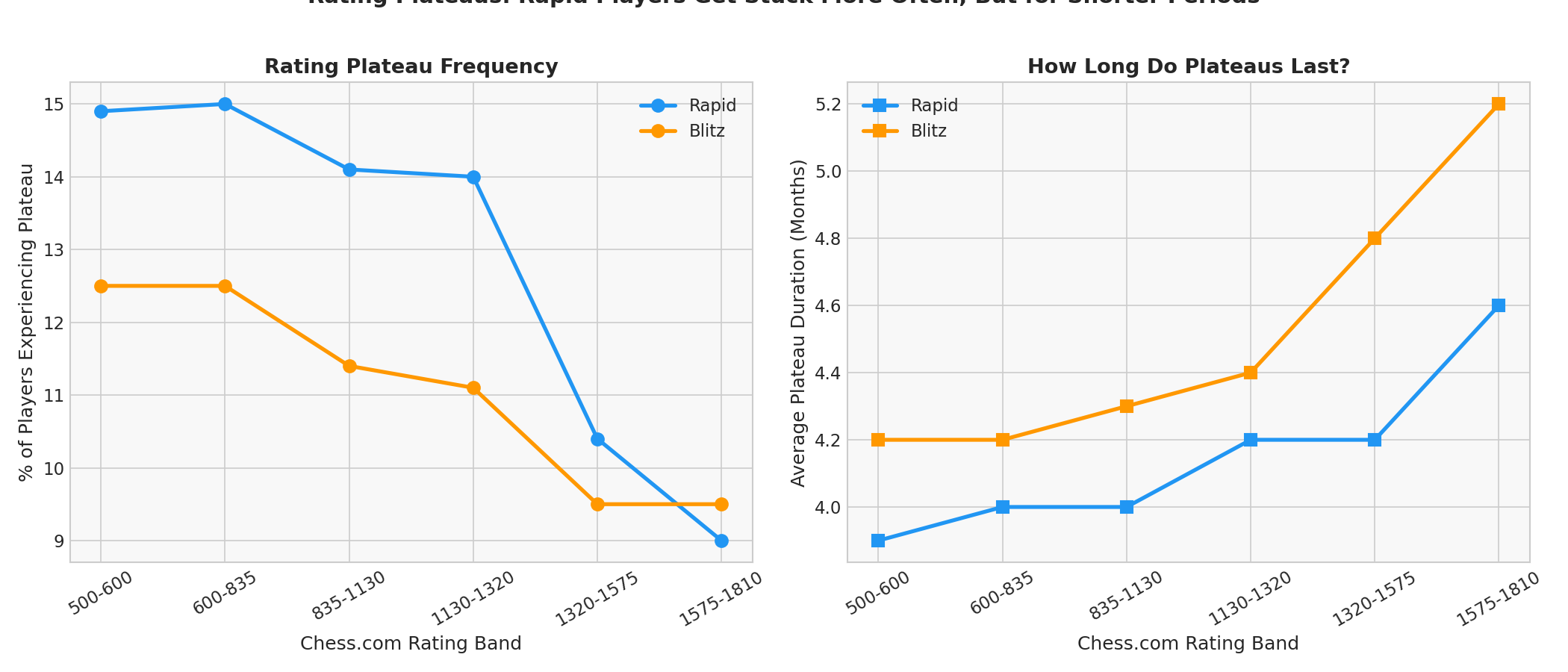
Why do Rapid players get stuck more often? The answer lies in pattern exposure. Intermediate chess requires recognizing tactical motifs (pins, skewers, discovered attacks) instantly. A Blitz player playing 100 games a month sees vastly more tactical patterns than a Rapid player playing 30 games, building a stronger intuitive "tactical radar."
Board Example: The Tempting Sacrifice
In complex middlegames, intuition built through volume can save precious clock time.
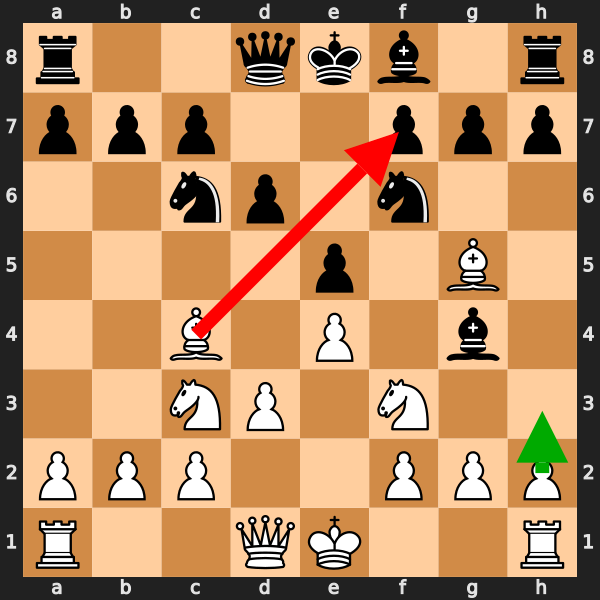
Here, the tempting sacrifice Bxf7+ (red arrow) looks aggressive but ultimately fails to a precise defense. Blitz players, having seen similar failed attacks repeatedly, might intuitively reject it and play the solid h3 (green arrow). Rapid players might burn 5 minutes calculating the sacrifice, only to realize it does not work, leaving them in time trouble later.
Actionable Advice for 835-1320
Play 60% Rapid, 40% Blitz. This is the ideal time to mix time controls. Use Rapid to practice deep calculation and endgame technique. Use Blitz (specifically 5|3 or 3|2, avoid 1-minute Bullet) to drill openings and build rapid pattern recognition. If you hit a plateau in Rapid, a two-week "Blitz diet" can often break the rut by exposing you to new ideas quickly.
The Advanced Hurdle: 1320 to 1810 (Chess.com)
The Data: Quality Over Quantity
As players push toward the advanced ranks, the pendulum swings back toward Rapid. Reaching the 1810 milestone (2000 Lichess) takes Rapid players a median of 9 months, while Blitz players lag behind at 10 months.
At this level, the CPL gap widens significantly. In the 1575-1810 band, Rapid players average a CPL of 121.4, while Blitz players sit at 138.0. The games are no longer decided by simple tactics, but by positional understanding, maneuvering, and precise endgame technique—skills that are nearly impossible to cultivate purely through Blitz.
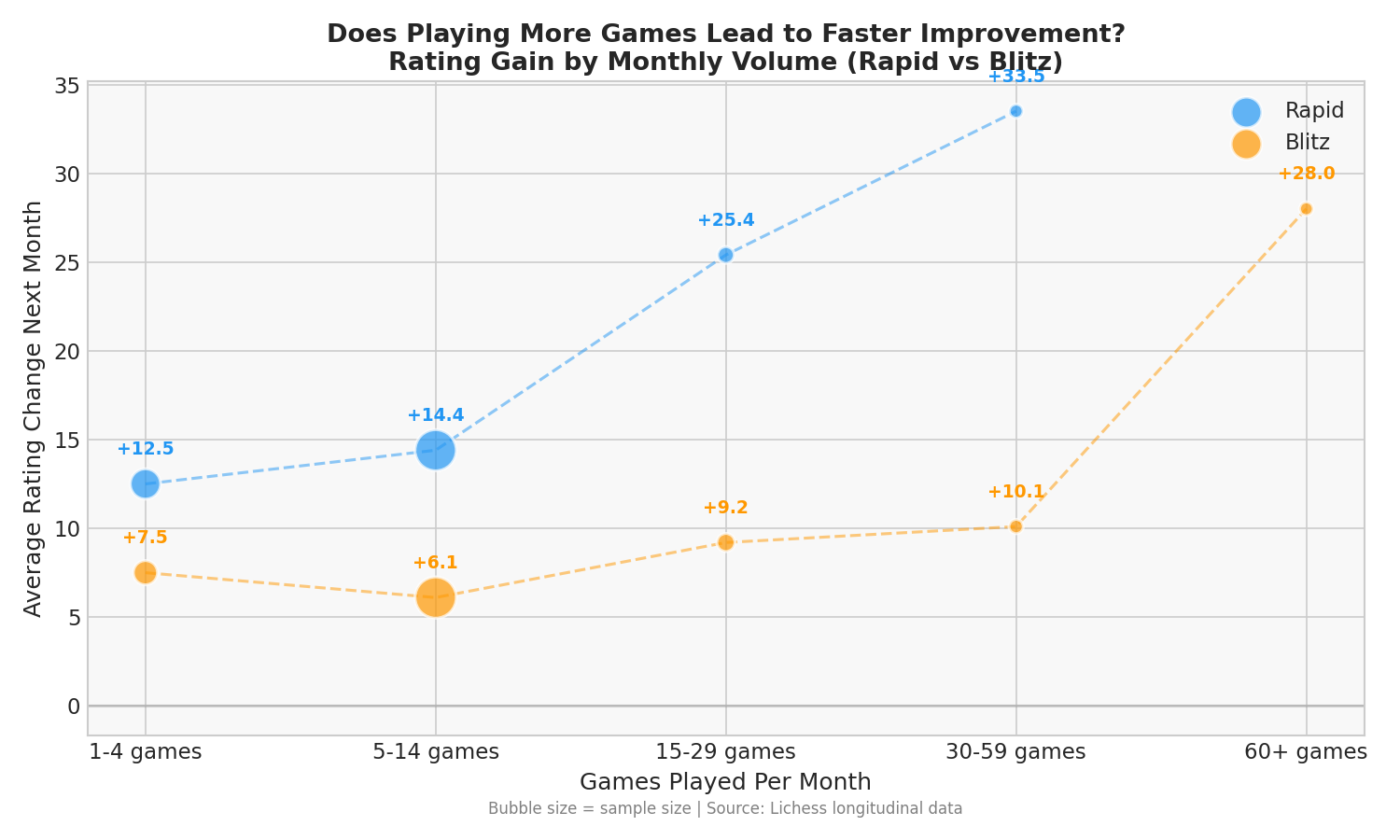
Furthermore, our practice volume analysis shows that playing 5-14 Rapid games a month yields an average rating gain of 14.4 points, compared to just 6.1 points for the same volume of Blitz games. At higher levels, deep focus on fewer games yields better results than mindless grinding.
Board Example: Endgame Precision
Endgames require exact calculation where intuition often fails.
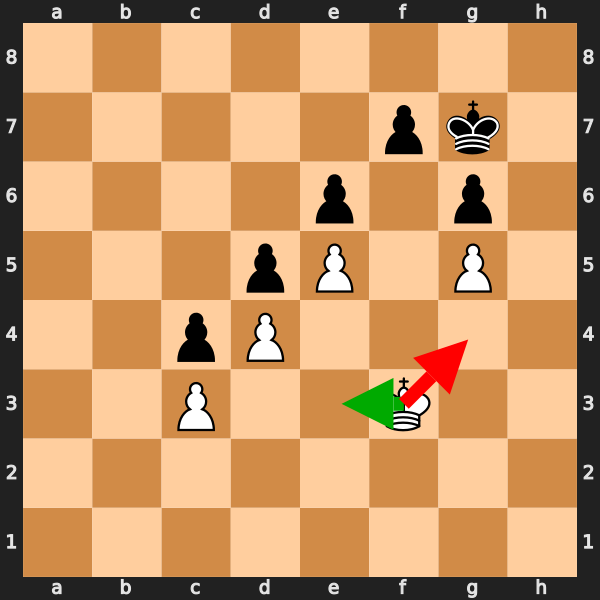
In this pawn endgame, White must activate the king. The intuitive Blitz move Kg4 (red arrow) is passive and allows Black counterplay. The precise Rapid move Ke3 (green arrow) centralizes the king and prepares to infiltrate, a concept that requires calculation to verify.
Actionable Advice for 1320-1810
Play 70% Rapid, 30% Blitz. Your improvement now depends on positional understanding and endgame technique. You must play games long enough to reach complex endgames with time on the clock. After every Rapid game, spend at least 10 minutes analyzing it without an engine first, then check your conclusions.
Conclusion: The Optimal Diet
The data clearly shows that specializing exclusively in one time control is suboptimal.
- Rapid builds the ceiling: It teaches you how to play good chess, lowering your Centipawn Loss and pushing your peak rating higher.
- Blitz builds the floor: It exposes you to a massive volume of patterns, reducing your plateau rate and making your basic tactical vision automatic.
If you want to improve as efficiently as possible, let Rapid be your main course and Blitz be your dessert.
Data and Methodology
This study analyzed 954,617 games from a cohort of 1,120 active Lichess players. Players were categorized as "Specialists" if over 50% of their games were in a single time control. Rating trajectories were tracked longitudinally over multiple years.
All Lichess ratings were mapped to approximate Chess.com equivalents using standard community conversion metrics to ensure the advice is applicable to the largest player base.
Underlying Data Files:
View full data →username primary_tc rapid_pct blitz_pct bullet_pct rapid_rating blitz_rating rapid_games blitz_games total_games BauernopferGmbH mixed 11.7 41.7 46.3 1595 1578 65 232 557 namphuc rapid_specialist 56.4 22.9 16.4 1155 1076 155 63 275 chessmaster2006 bullet_specialist 0.9 23.9 75.2 2635 2906 98 2514 10532 Vibuvedhu30 mixed 12.0 38.0 48.6 1716 1751 118 375 987 sosomomo bullet_specialist 6.7 27.2 61.2 2394 2419 302 1227 4503
View full data →username primary_tc rapid_start rapid_end rapid_change rapid_months rapid_rate_per_month blitz_start blitz_end blitz_change blitz_months blitz_rate_per_month A950AA blitz_specialist 1317.0 1204.0 -113.0 61.925098554533506 -1.8247851458885942 1336.0 1146.0 -190.0 49.93429697766097 -3.805 ADEL-KHABIBULLIN_2 mixed 1150.0 1045.0 -105.0 3.9750328515111693 -26.414876033057855 1112.0 913.0 -199.0 3.9750328515111693 -50.06247933884298 ARFC1972 blitz_specialist 1626.0 1549.0 -77.0 33.01576872536137 -2.3322189054726365 1358.0 1389.0 31.0 34.00131406044678 0.9117294685990338 ARmAN20111 bullet_specialist 1790.0 2400.0 610.0 41.98423127463863 14.52926447574335 1485.0 2336.0 851.0 41.98423127463863 20.269514866979655 AarushDMishra rapid_specialist 1316.0 1658.0 342.0 11.990801576872535 28.521863013698635 1209.0 1189.0 -20.0 9.986859395532194 -2.0026315789473683
View full data →fromRating toRating variant avgMonths medianMonths samplePlayers 800 1000 blitz 7 4 11329 800 1000 rapid 6.5 3 6991 1000 1200 blitz 8.5 5 12840 1000 1200 rapid 8 4 8874 1200 1500 blitz 11.6 7 11529
View full data →ratingBand variant avgPlateauMonths pctPlayersPlateauing samplePlayers 700-900 rapid 3.9 14.9 4573 900-1100 rapid 4.0 15.0 8107 1100-1300 rapid 4.0 14.1 10080 1300-1500 rapid 4.2 14.0 10474 1500-1800 rapid 4.2 10.4 12597
View full data →timeClass ratingBand avgCpl drawRate avgGameLength sampleGames blitz 700-900 157.3 4.7 27.8 79460 bullet 700-900 154.2 1.4 22.0 34669 classical 700-900 105.3 5.8 22.4 325 rapid 700-900 150.5 5.9 26.7 49133 blitz 900-1100 155.7 3.9 29.5 77662
Chess Coach April 15, 2026