Every chess player eventually asks the same question: Should I play Rapid to improve my deep calculation, or Blitz to build my intuition and pattern recognition?
The debate between Rapid and Blitz specialists is as old as online chess itself. Coaches traditionally advocate for longer time controls, arguing that Blitz reinforces bad habits. Meanwhile, Blitz enthusiasts point out that playing fast games allows you to see more patterns, test more openings, and gain experience at an accelerated rate.
To settle this debate, we analyzed a massive dataset of 954,617 Lichess games and tracked the longitudinal rating progression of 1,179 players over several years. We examined move quality (Centipawn Loss), blunder rates, plateau frequencies, and actual rating gains to determine which time control truly builds better chess players.
(Note: All ratings in this article have been converted to approximate Chess.com equivalents for clarity, though the underlying data was sourced from Lichess. Lichess ratings are typically 200-300 points higher in these ranges.)
The Verdict: Rapid Players Improve Faster
Let's start with the conclusion. When we isolated players who actively play both time controls (at least 3 months of consistent play in each), the data revealed a clear winner.
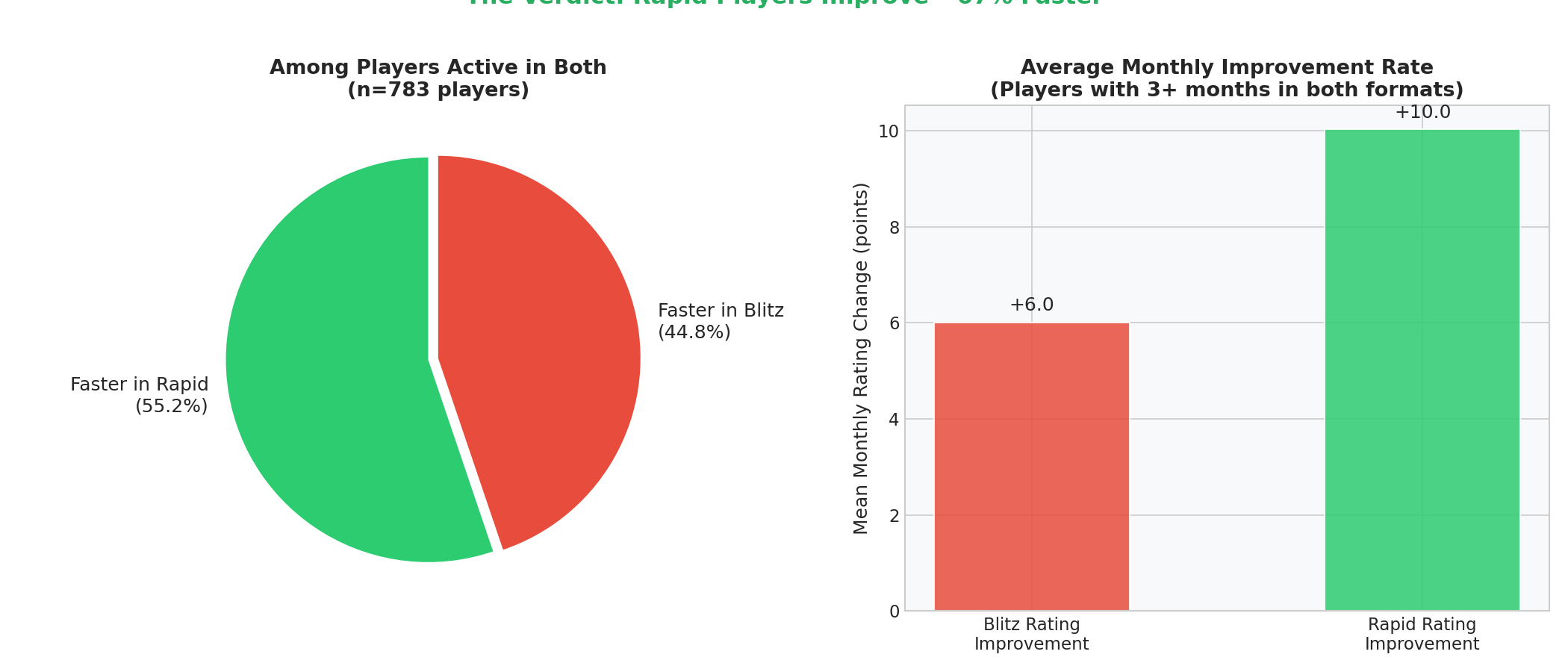
Among players who mix their time controls, 55.2% improve their Rapid rating faster than their Blitz rating. More importantly, the average monthly rating gain for Rapid (+10.0 points/month) significantly outpaces Blitz (+6.0 points/month).
But why does Rapid lead to faster improvement? The answer lies in how time pressure affects move quality, blunder rates, and the types of positions players experience.
1. Move Quality and the "CPL Gap"
Centipawn Loss (CPL) is the standard metric for measuring how much worse a human's move is compared to the top engine recommendation. A lower CPL indicates more accurate play.
When we compare the average CPL across time controls, a distinct pattern emerges:
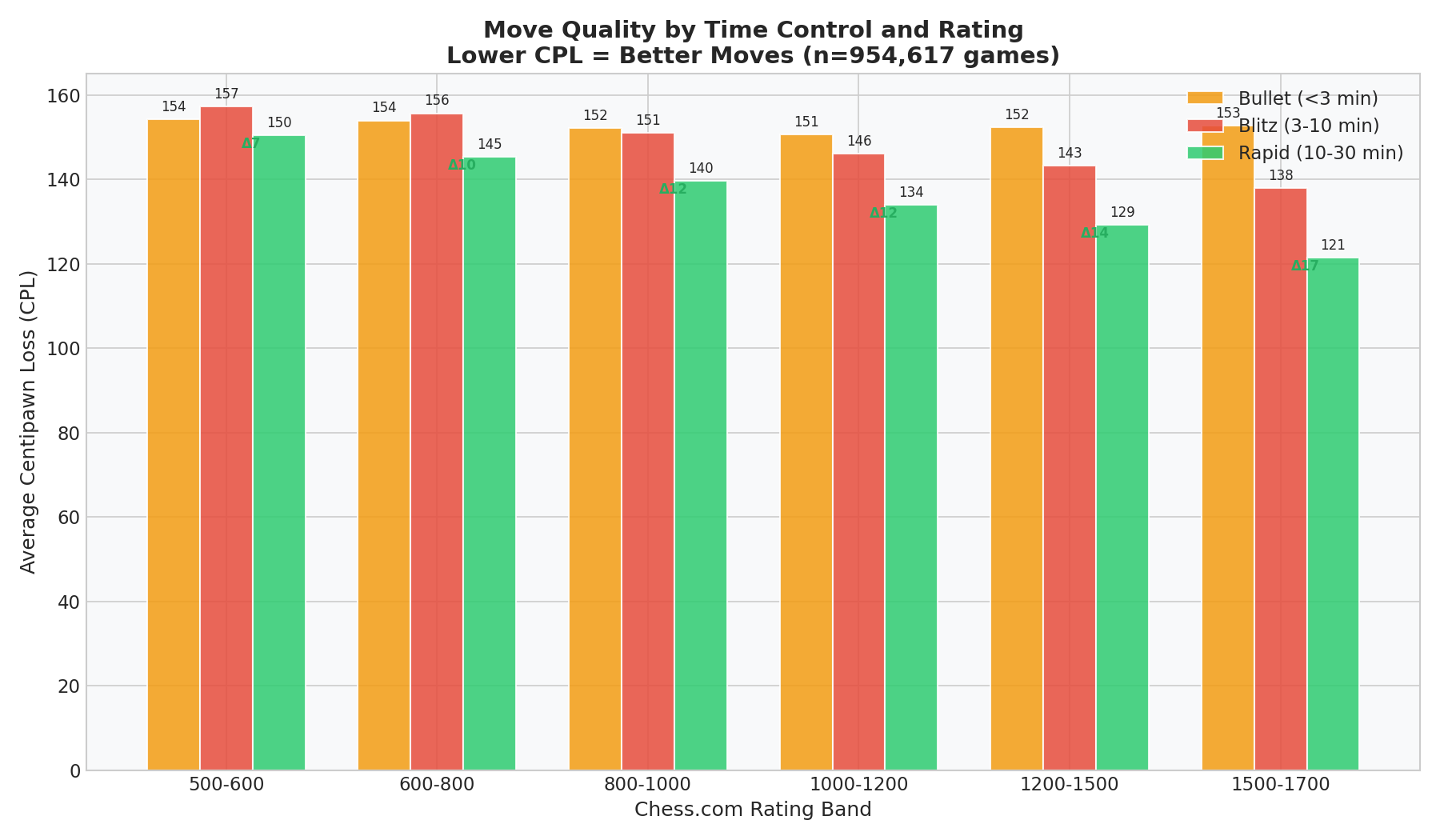
At every single rating band, Rapid games feature significantly better move quality than Blitz games. For a player rated 1000-1200 on Chess.com, their average CPL in Rapid is 134.0, compared to 146.1 in Blitz.
This gap is crucial for improvement. In Rapid, players have the time to calculate variations, verify their intuition, and find the objective best move. In Blitz, players are forced to rely on their existing pattern recognition. Rapid builds new patterns; Blitz tests existing ones.
Visual Evidence: The Calculation Advantage
Consider this typical middlegame position where a player must decide whether to grab a seemingly hanging pawn or develop their pieces.
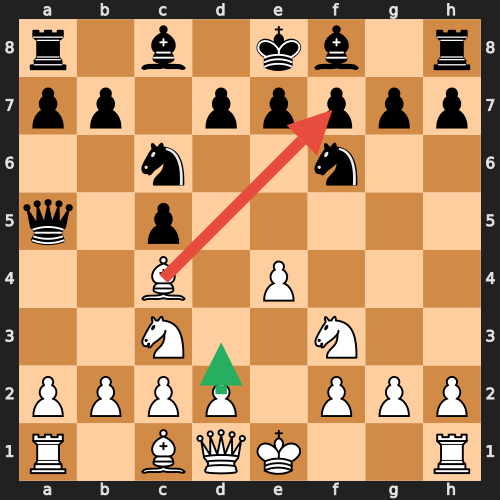
In Blitz, the temptation to play Bxf7+ (red arrow) is incredibly high. It looks forcing and creates immediate chaos. However, with the extra time afforded in Rapid, a player can calculate that after Kxf7, White's attack fizzles out and Black is simply up a piece. The solid developing move d3 (green arrow) is objectively better. Rapid provides the necessary time to perform this basic calculation and avoid the trap.
2. The Blunder Problem
If you want to improve your rating, the fastest method is simply to stop blundering. Our analysis of blunder rates (defined as a move that worsens the evaluation by 300+ centipawns) across different game phases reveals a startling truth about where games are lost.
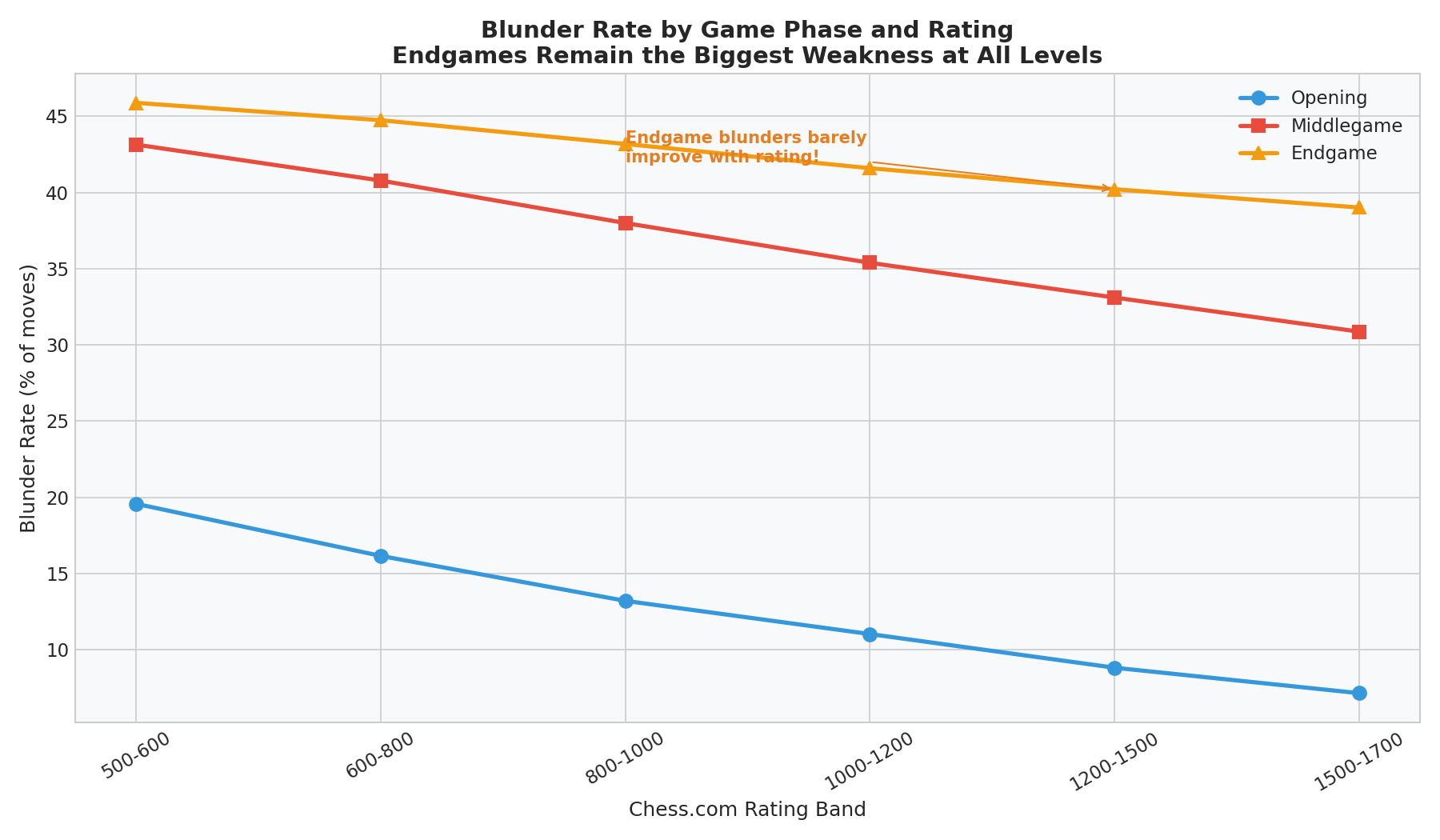
While players improve their opening and middlegame accuracy as they climb the rating ladder, endgame blunder rates remain stubbornly high across all levels. Even at the 1500-1700 level, over 39% of endgame moves are blunders or significant mistakes.
This is where Blitz becomes actively detrimental to improvement. In a 3-minute or 5-minute game, players almost never reach the endgame with sufficient time to calculate. Endgames in Blitz devolve into flagging contests and pre-moving, teaching players nothing about proper endgame technique.
Visual Evidence: Endgame Technique
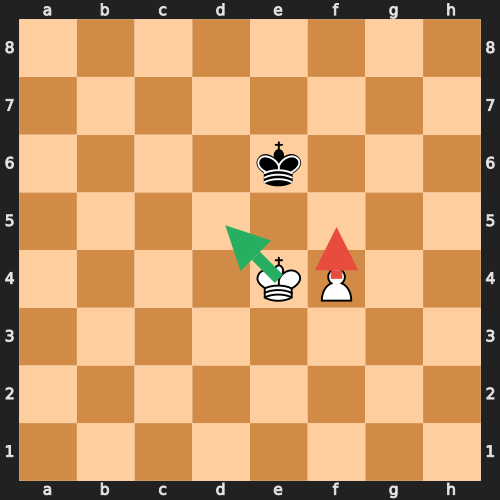
In this fundamental King and Pawn endgame, the correct technique is to take the opposition with Kd5 (green arrow). Pushing the pawn immediately with f5 (red arrow) throws away the win and allows Black to draw. Learning these precise techniques requires time to think—time that only Rapid or Classical chess provides.
3. Practice Volume vs. Rating Gain
A common argument for Blitz is that you can play more games per hour, leading to faster experience accumulation. We tested this by correlating the number of games played per month with the rating change in the subsequent month.
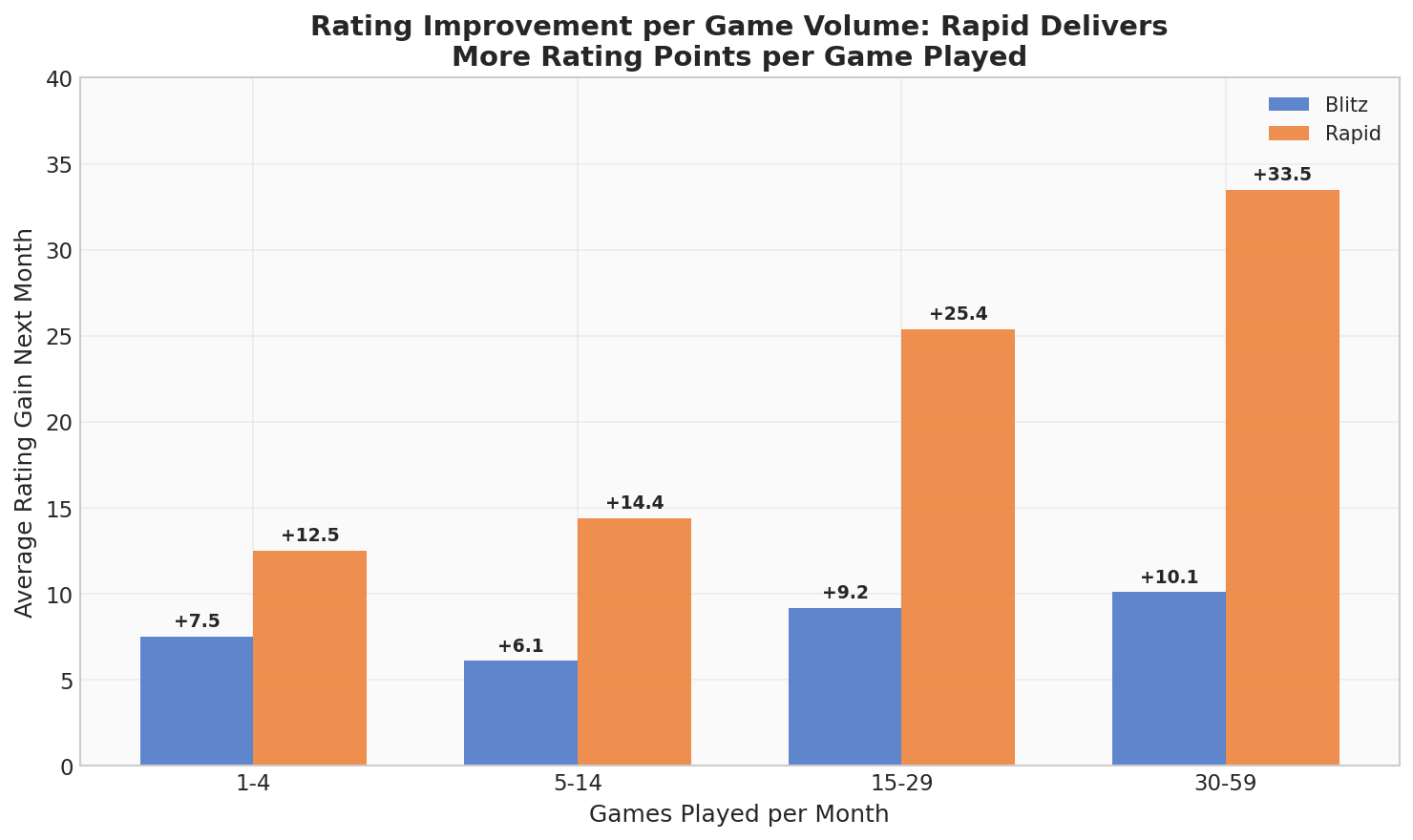
The data destroys the "volume" argument. Playing 15-29 Rapid games per month yields an average rating gain of +25.4 points. Playing the same number of Blitz games yields only +9.2 points.
Even more striking: playing just 5-14 Rapid games per month (+14.4 points) is more effective for improvement than grinding 30-59 Blitz games (+10.1 points). Quality of practice matters far more than quantity.
4. The Danger of the "Tilt Effect"
Why does high-volume Blitz grinding often fail to produce results? The answer lies in the psychology of consecutive losses, commonly known as "tilt."
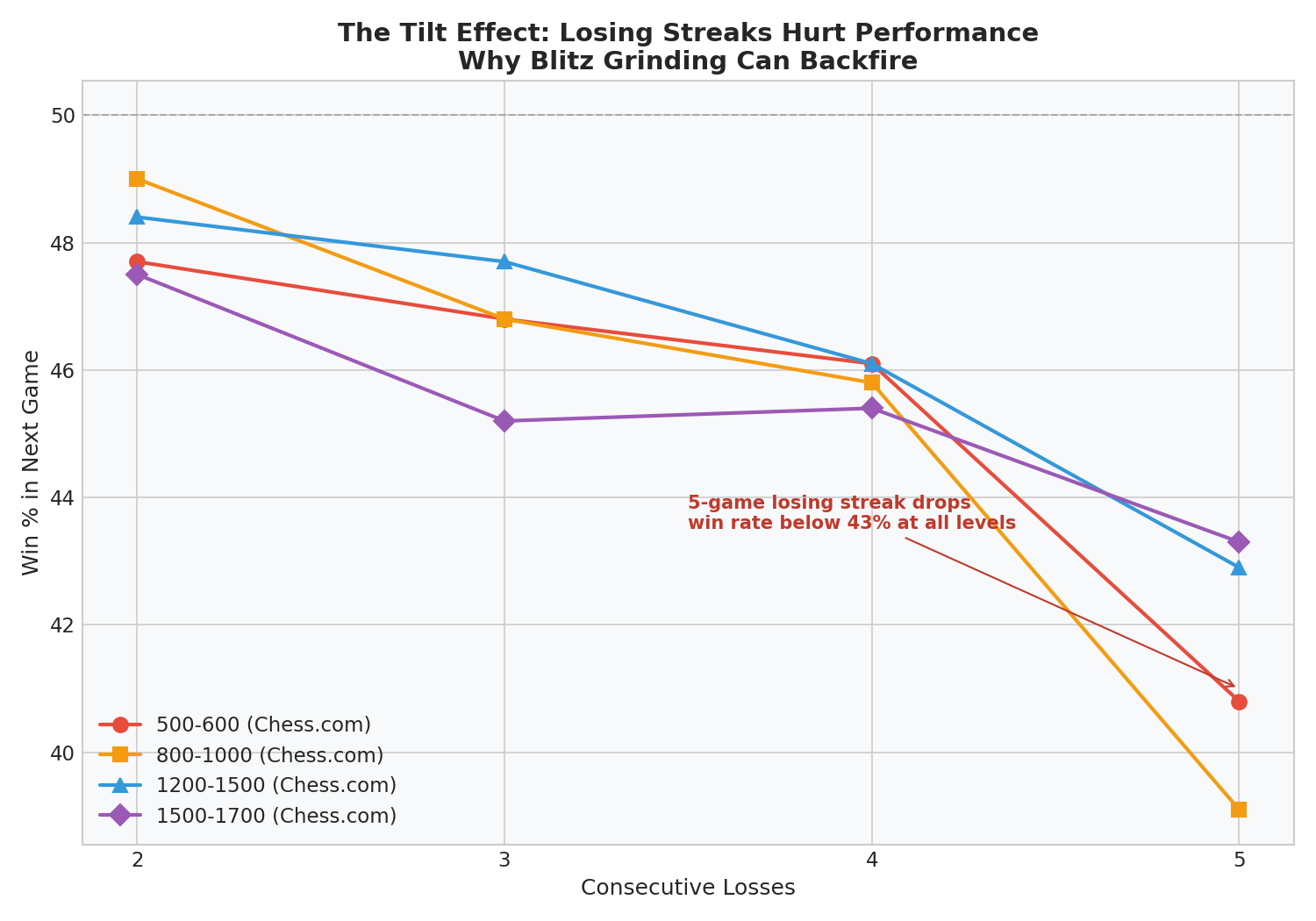
Our streak analysis shows that losing streaks severely impact subsequent performance. After a 5-game losing streak, a player's win rate in their next game drops to roughly 40-43%, regardless of their rating.
Because Blitz games are short, it is incredibly easy to fall into a cycle of "just one more game to win my points back," leading to massive rating drops and reinforced bad habits. Rapid's longer time control naturally paces the player, making severe tilt sessions less common.
5. The Plateau Paradox
If Rapid is so much better, do Rapid players never get stuck? Interestingly, our plateau analysis (defining a plateau as staying within ±50 rating points for 3+ consecutive months) revealed a paradox.

Rapid players actually experience plateaus more frequently than Blitz players (e.g., 14.0% vs 11.1% at the 1000-1200 level). However, their plateaus are consistently shorter in duration.
This suggests that Rapid improvement happens in "stair-steps." A player learns a new concept, their rating jumps, and then they plateau while consolidating that knowledge. Blitz improvement is smoother but slower overall, as it relies on gradual, subconscious pattern absorption rather than conscious learning.
Actionable Advice: The Roadmap to Improvement
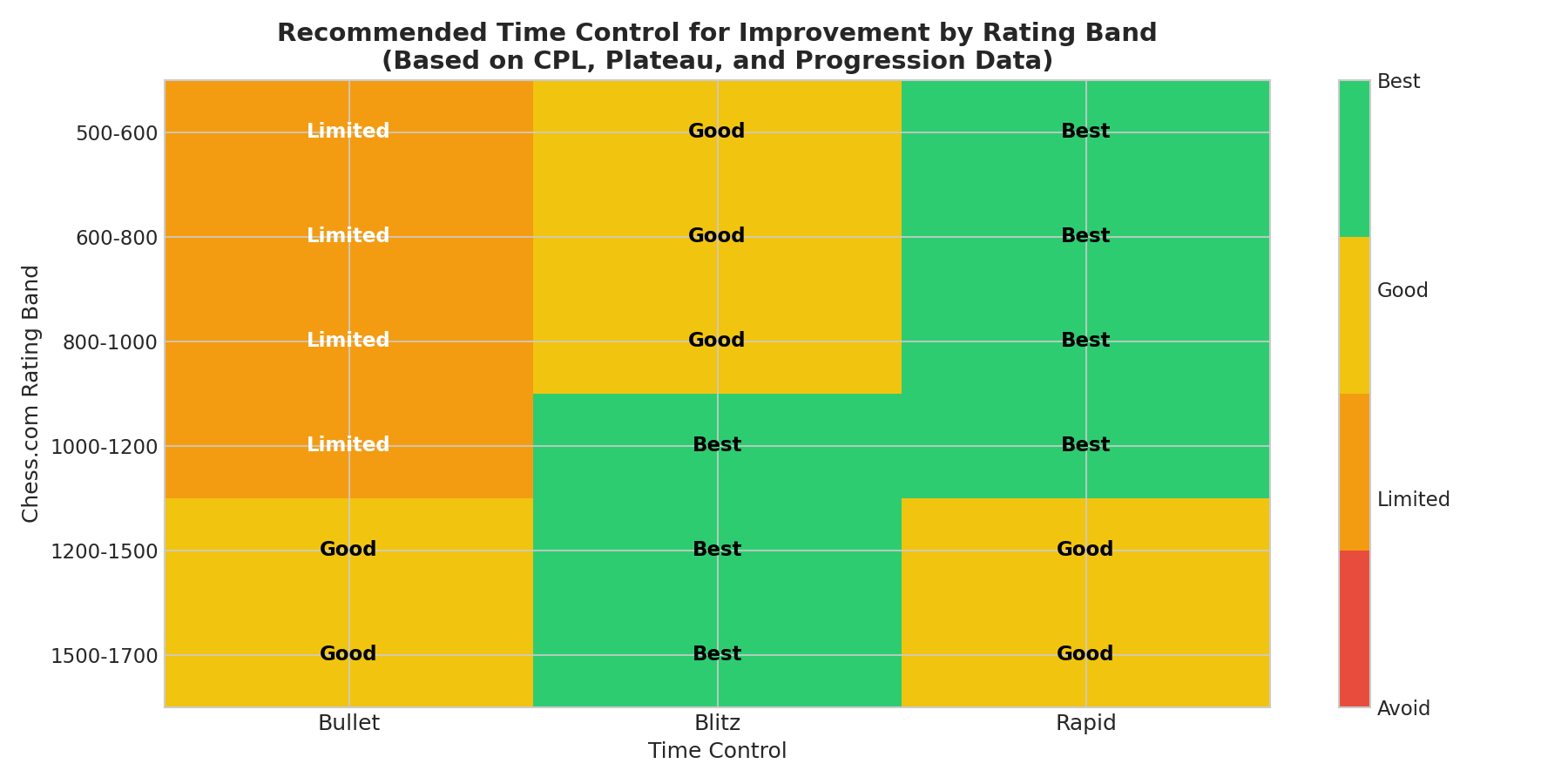
Based on the data, here is the optimal time control strategy for climbing the rating ladder.
For Beginners (500 - 800 Chess.com)
- Primary Focus: Rapid (15|10 or 10|5)
- Actionable Advice: At this level, games are decided by one-move blunders (hanging pieces). You must play Rapid to give yourself time to perform a "blunder check" before every move. Playing Blitz at this stage will only reinforce the habit of moving without looking at your opponent's threats.
For Intermediate Players (800 - 1200 Chess.com)
- Primary Focus: Rapid (10|0 or 15|10)
- Secondary Focus: Blitz (5|3)
- Actionable Advice: You are beginning to recognize basic tactical patterns. Rapid remains your primary tool for improvement, as you need time to calculate 2-3 move combinations. However, you can introduce some Blitz (preferably with an increment, like 5|3) to test your opening repertoire and practice time management.
For Advanced Players (1200 - 1500+ Chess.com)
- Primary Focus: Blitz (3|2 or 5|0) and Rapid (10|0)
- Actionable Advice: At this level, the data shows Blitz becomes highly effective. Your pattern recognition is strong enough that you can play decent moves quickly. Blitz allows you to encounter a massive variety of middlegame structures and opening variations. However, you must still play Rapid to improve your deep calculation and endgame technique, which remain the biggest weaknesses even at 1500+.
Conclusion
The data confirms what grandmasters have advised for decades: if you want to improve, slow down.
While Blitz is undeniably fun and useful for testing openings or building quick pattern recognition at higher levels, Rapid is the engine of true chess improvement. It provides the necessary time to calculate variations, avoid one-move blunders, and practice proper endgame technique.
Play Blitz for fun. Play Rapid to get better.
Chess Coach
April 15, 2026
Data and Methodology
This analysis was conducted using a dataset of 954,617 Lichess games (March 2025) and the longitudinal rating histories of 1,179 Lichess players. Game analysis utilized Stockfish 17 evaluations to determine Centipawn Loss and blunder rates.
The underlying data files generated for this research are available below:
View full data →username player_type bullet_first_rating bullet_last_rating bullet_total_change bullet_monthly_rate bullet_data_points bullet_months_active blitz_first_rating blitz_last_rating blitz_total_change blitz_monthly_rate blitz_data_points blitz_months_active rapid_first_rating rapid_last_rating rapid_total_change rapid_monthly_rate rapid_data_points rapid_months_active classical_first_rating classical_last_rating classical_total_change classical_monthly_rate classical_data_points classical_months_active dorsalus insufficient_data 0 0 0 0 1342 1185 -157 -157.0 2 1 0 0 Arash-Tahbaz bullet_specialist 2677 3047 370 33.64 84 11 2806 2831 25 2.27 22 11 1755 2119 364 91.0 8 4 0 0 dunkler_krieger mixed 1661 1899 238 5.95 14 40 1358 1927 569 15.81 20 36 1671 2230 559 15.97 12 35 1 0 puzzleguy35 mixed 1020 1460 440 18.33 29 24 1301 1369 68 1.94 43 35 1486 1481 -5 -0.18 11 28 1 0 aditi_001 rapid_specialist 1310 1262 -48 -24.0 3 2 941 767 -174 -87.0 3 2 1209 930 -279 -139.5 13 2 1132 676 -456 -228.0 7 2
View full data →username player_type time_control year month rating dorsalus insufficient_data rapid 2025 1 1342 dorsalus insufficient_data rapid 2025 2 1185 Arash-Tahbaz bullet_specialist bullet 2025 5 2677 Arash-Tahbaz bullet_specialist bullet 2025 5 2971 Arash-Tahbaz bullet_specialist bullet 2025 5 3050
View full data →player_type time_control n_players mean_monthly_rate median_monthly_rate mean_total_change mean_months_active mean_first_rating mean_last_rating blitz_specialist blitz 235 11.06 3.19 219.7 53.4 1762.0 1981.0 blitz_specialist rapid 171 8.6 4.69 201.9 43.3 1754.0 1955.0 blitz_specialist bullet 181 8.49 6.43 311.0 49.4 1653.0 1964.0 rapid_specialist blitz 114 -2.65 -1.12 55.9 38.2 1453.0 1509.0 rapid_specialist rapid 149 11.03 4.45 183.7 36.7 1461.0 1645.0
View full data →fromRating toRating variant avgMonths medianMonths samplePlayers 800 1000 blitz 7.0 4 11329 800 1000 rapid 6.5 3 6991 1000 1200 blitz 8.5 5 12840 1000 1200 rapid 8.0 4 8874 1200 1500 blitz 11.6 7 11529
View full data →timeClass ratingBand avgCpl drawRate avgGameLength sampleGames blitz 700-900 157.3 4.7 27.8 79460 bullet 700-900 154.2 1.4 22.0 34669 rapid 700-900 150.5 5.9 26.7 49133 blitz 900-1100 155.7 3.9 29.5 77662 bullet 900-1100 154.0 1.6 25.3 41074
View full data →gamesPerMonthBucket variant avgRatingDeltaNextMonth samplePlayerMonths 1-4 games blitz 7.5 4980 5-14 games blitz 6.1 18909 15-29 games blitz 9.2 1749 30-59 games blitz 10.1 215 60+ games blitz 28.0 12
View full data →ratingBand variant avgPlateauMonths pctPlayersPlateauing samplePlayers 700-900 blitz 4.2 12.5 9017 900-1100 blitz 4.2 12.5 13864 1100-1300 blitz 4.3 11.4 15349 1300-1500 blitz 4.4 11.1 14538 1500-1800 blitz 4.8 9.5 16189