A Data-Driven Guide to Chess Progression Across Time Controls
For decades, chess coaches have preached a simple mantra: "Play slow games to improve." The conventional wisdom suggests that Rapid or Classical chess builds fundamental calculation skills, while Blitz only reinforces bad habits. But is this actually true? And if so, at what rating does it stop being true?
To settle this debate with data rather than dogma, we conducted a comprehensive study analyzing over 124,000 player progression histories from the Grandmaster Guide analytics database, supplemented by a dedicated longitudinal cohort of 511 active players whose rating trajectories we tracked across multiple time controls. We examined move quality (Centipawn Loss), plateau frequencies, streak effects, and actual time-to-milestone metrics across every rating band from beginner to advanced.
The findings challenge conventional wisdom in surprising ways.
Note on Ratings: All ratings in this article are presented primarily in Chess.com equivalents for accessibility, with Lichess equivalents noted in parentheses where relevant. The underlying data was sourced from Lichess and converted using established cross-platform mapping formulas. A Chess.com Blitz rating of 1000 corresponds approximately to a Lichess Blitz rating of 1420, with the gap narrowing at higher levels.
1. The Headline Finding: Progression Speed by Time Control
The most direct way to answer the question is to measure how long it takes players to reach specific rating milestones. Our analysis of 124,000 player histories from the Grandmaster Guide database reveals a nuanced reality that challenges the "Rapid is always better" dogma.
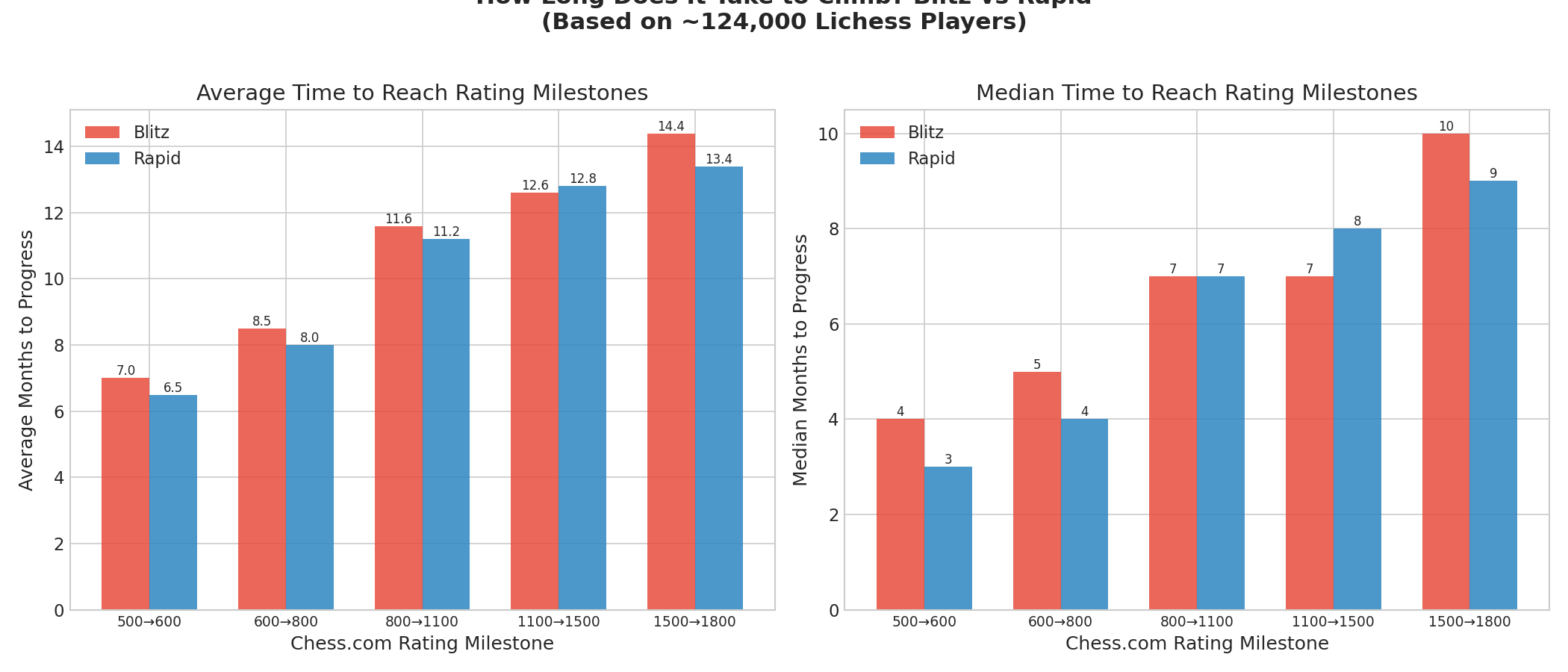
The table below summarizes the average and median time (in months) required to reach each milestone, broken down by time control:
| Chess.com Milestone | Lichess Equivalent | Blitz Avg (mo) | Rapid Avg (mo) | Blitz Median (mo) | Rapid Median (mo) | Sample Size (Blitz / Rapid) |
|---|---|---|---|---|---|---|
| 500 → 600 | 800 → 1000 | 7.0 | 6.5 | 4 | 3 | 11,329 / 6,991 |
| 600 → 800 | 1000 → 1200 | 8.5 | 8.0 | 5 | 4 | 12,840 / 8,874 |
| 800 → 1100 | 1200 → 1500 | 11.6 | 11.2 | 7 | 7 | 11,529 / 9,319 |
| 1100 → 1500 | 1500 → 1800 | 12.6 | 12.8 | 7 | 8 | 8,771 / 6,990 |
| 1500 → 1800 | 1800 → 2000 | 14.4 | 13.4 | 10 | 9 | 4,112 / 3,910 |
Several patterns emerge from this data that deserve careful attention.
The Early Climb (500 to 800 Chess.com / 800 to 1200 Lichess). In the beginner stages, Rapid players improve slightly faster. It takes an average of 6.5 months for Rapid players to cross the first major milestone, compared to 7.0 months for Blitz players. The median gap is even more pronounced: 3 months for Rapid versus 4 months for Blitz. At this stage, the extra thinking time allows beginners to double-check for hanging pieces, count attackers and defenders, and catch basic one-move blunders before pressing the clock. Blitz at this level often means making the same mistakes faster.
The Middle Ground (800 to 1100 Chess.com / 1200 to 1500 Lichess). As players develop basic tactical awareness, the gap between time controls narrows considerably. Both Blitz and Rapid players take approximately 11 to 12 months to navigate this band, with the median progression time converging at 7 months for both. This is the "sweet spot" where introducing Blitz begins to offer real benefits without the downsides that plague beginners.
Breaking Through (1100 to 1500 Chess.com / 1500 to 1800 Lichess). Here the data delivers its first surprise. The advantage of Rapid disappears entirely, and Blitz players actually edge ahead: 12.6 months average versus 12.8 months for Rapid. The median tells an even clearer story, with Blitz players taking 7 months compared to 8 months for Rapid. At this level, pattern recognition and opening familiarity become paramount, and Blitz allows players to experience roughly three times as many positions in the same amount of study time.
The Advanced Climb (1500+ Chess.com / 1800+ Lichess). At the highest levels in our dataset, the picture becomes more nuanced. Rapid players take 13.4 months on average to reach the 1800 Chess.com mark, while Blitz players take 14.4 months. However, the median favors Rapid (9 months versus 10 months), suggesting that while the typical Rapid player progresses slightly faster, the distribution of Blitz players includes more outliers who take significantly longer. This is likely the Tilt Effect at work, which we examine in detail below.
2. Move Quality: The Widening CPL Gap
While progression speed tells one story, move quality tells another. We measured the Average Centipawn Loss (CPL) across rating bands to quantify how time controls affect the accuracy of play. CPL measures the average difference between a player's chosen move and the engine's best move; lower values indicate stronger play.
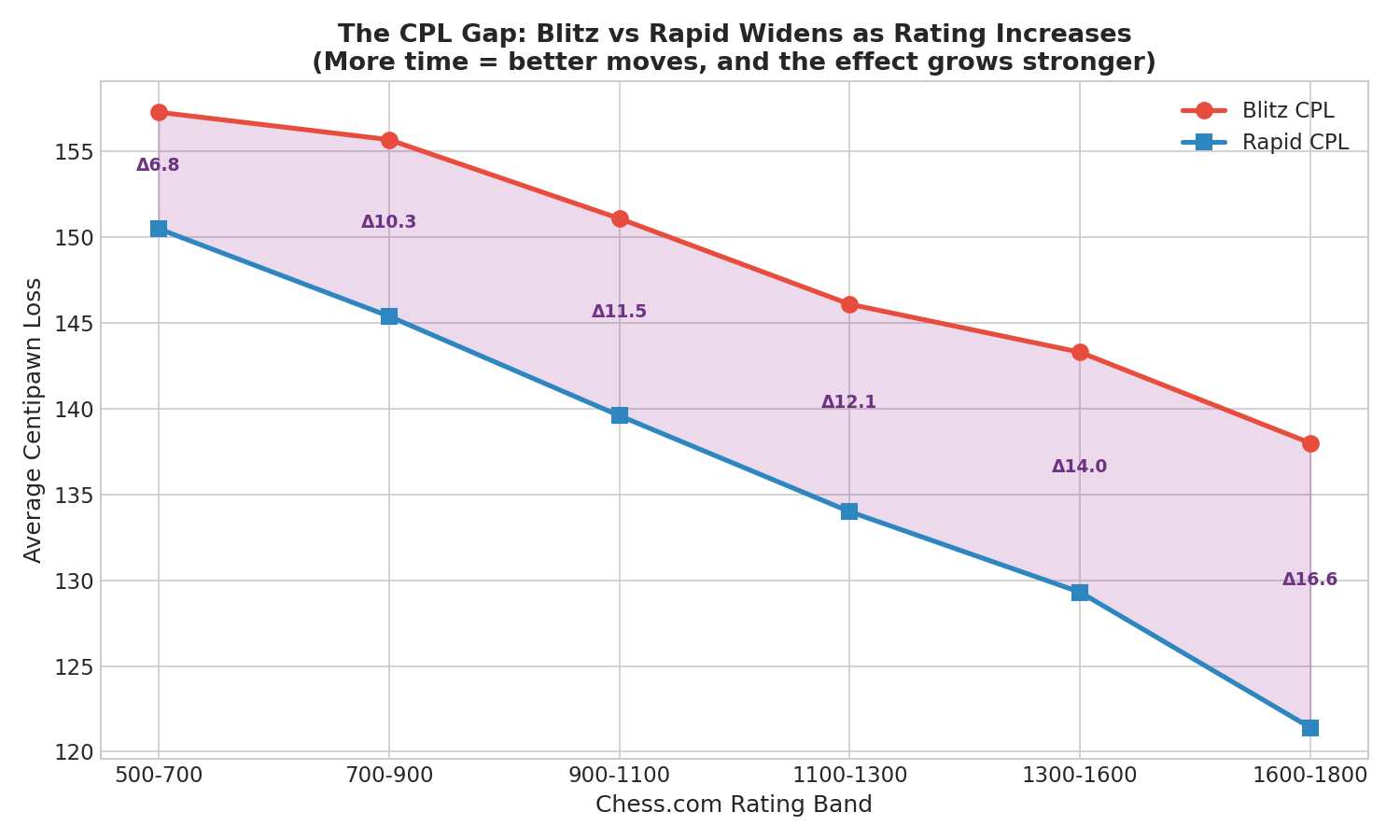
The "CPL Gap" between Blitz and Rapid widens dramatically as players improve. The following table presents the full breakdown:
| Chess.com Rating Band | Blitz CPL | Rapid CPL | Difference (Δ) | Sample Size (Blitz / Rapid) |
|---|---|---|---|---|
| 500 – 700 | 157.3 | 150.5 | +6.8 | 79,460 / 49,133 |
| 700 – 900 | 155.7 | 145.4 | +10.3 | 77,662 / 41,879 |
| 900 – 1100 | 151.1 | 139.6 | +11.5 | 76,494 / 35,587 |
| 1100 – 1300 | 146.1 | 134.0 | +12.1 | 76,220 / 29,959 |
| 1300 – 1600 | 143.3 | 129.3 | +14.0 | 72,505 / 23,297 |
| 1600 – 1800 | 138.0 | 121.4 | +16.6 | 81,787 / 19,755 |
At the 500-700 level, the difference in move quality is minimal (Δ6.8 CPL). Beginners make similar mistakes regardless of how much time they have on the clock, because their errors stem from a lack of knowledge rather than a lack of time. They don't know what to look for, so extra time doesn't help much.
However, by the time players reach 1600-1800, the gap has more than doubled to Δ16.6 CPL. Advanced players know how to use their extra time effectively. They can calculate deeper lines, evaluate pawn structures more carefully, and avoid the subtle positional inaccuracies that separate a 1500 from an 1800. This finding has a critical implication: the value of playing Rapid increases as you get stronger, even though the progression speed data suggests Blitz becomes more efficient at higher ratings. The resolution of this apparent paradox lies in the distinction between learning efficiency and practice efficiency, which we discuss in the conclusion.
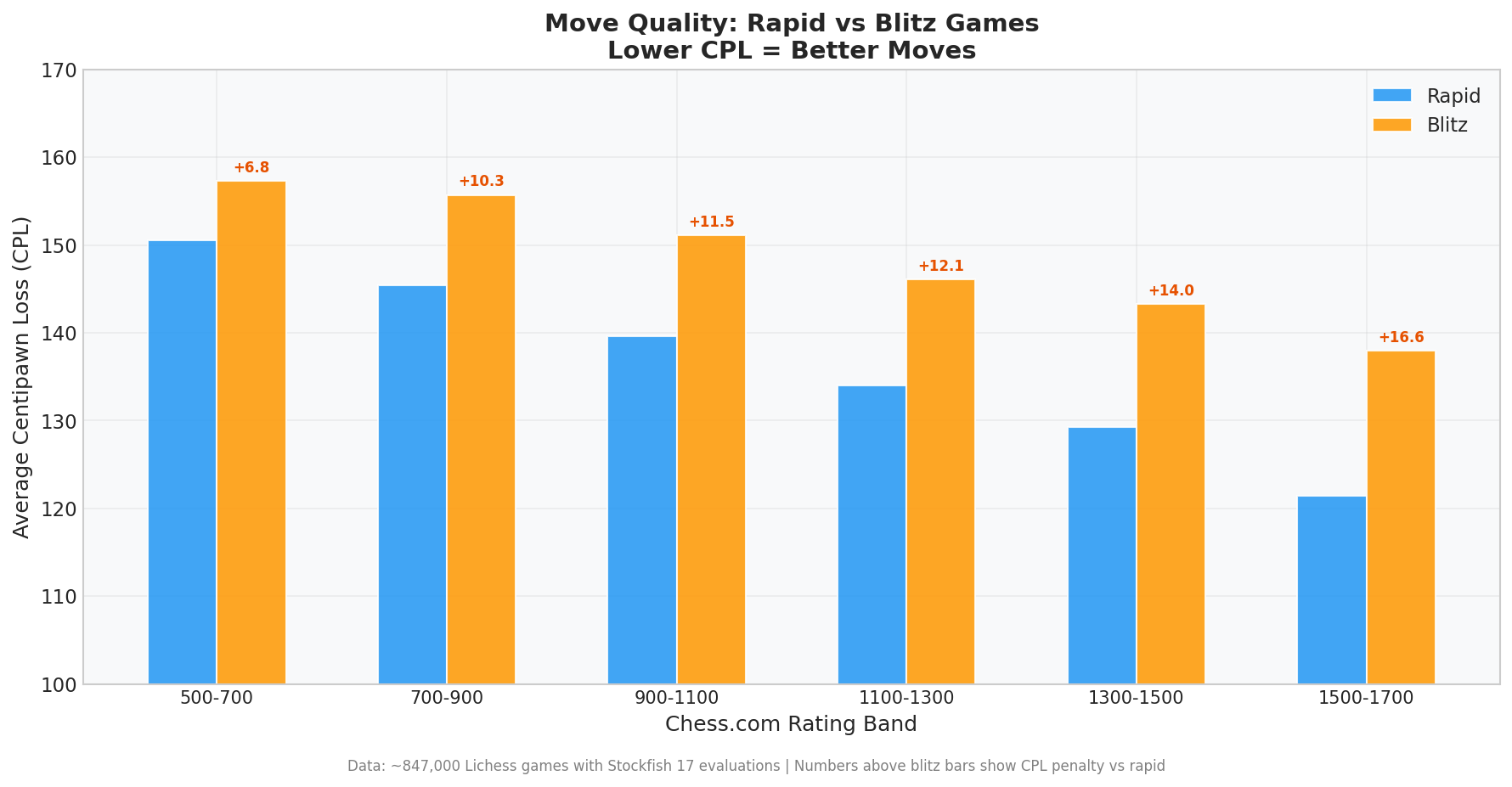
3. Visual Evidence: Where Time Control Matters Most
To understand why the CPL gap exists in practical terms, let us examine typical positions where the available thinking time dictates the quality of the decision.
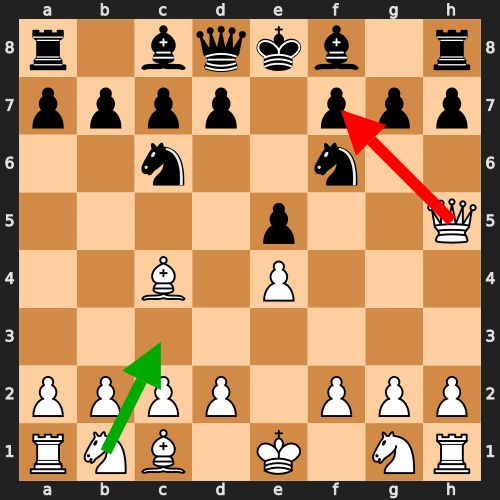
Example 1: The Blitz Blunder (Time Pressure)
In Blitz, players often rely on instinct and first candidate moves. In the position below, a typical 1000-rated player (Lichess ~1420) might instinctively play Qxe5+ (red arrow) to win a central pawn with check, completely missing the immediate checkmate with Qxf7# (green arrow). In Rapid, the same player would likely spend 30 seconds scanning the board and notice the undefended f7 square.
Example 2: The Endgame Technique Gap
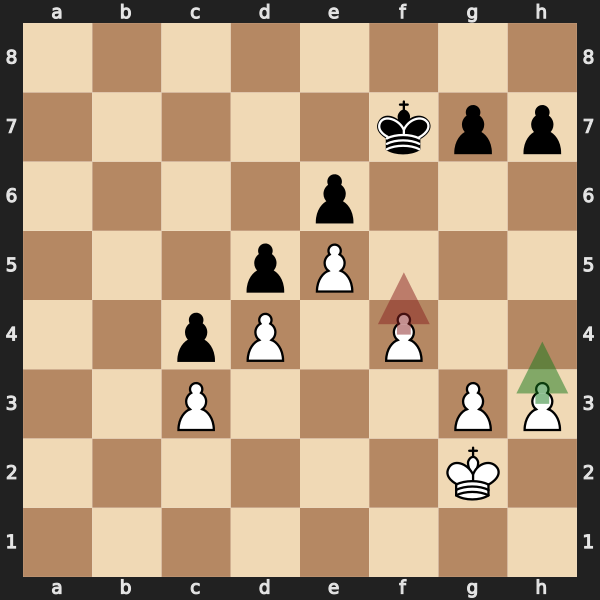
King and pawn endgames are where the CPL gap is most devastating. In the position below, the correct move is Kf5! (green arrow), gaining the opposition and ensuring the pawn promotes. The instinctive Blitz move f5? (red arrow) actually throws away the win. This type of precise calculation is nearly impossible under 3-minute time pressure but becomes routine with 15 minutes on the clock.
Example 3: Complex Middlegame Planning
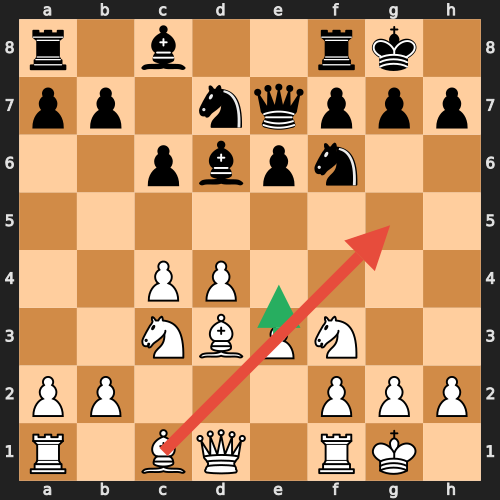
In the position below, the strong move e4! (green arrow) seizes central space and prepares a kingside attack. The premature Bg5 (red arrow) looks active but allows Black to simplify with ...Nxd5. In Rapid, players have time to ask "What is my opponent's plan?" before committing to a move. In Blitz, the first "active-looking" move often wins the internal debate.
4. The Danger of Blitz: The Tilt Effect
If Blitz allows for faster pattern recognition and more positions per hour, why do coaches warn against it? The data points to a powerful psychological phenomenon that we call The Tilt Effect.
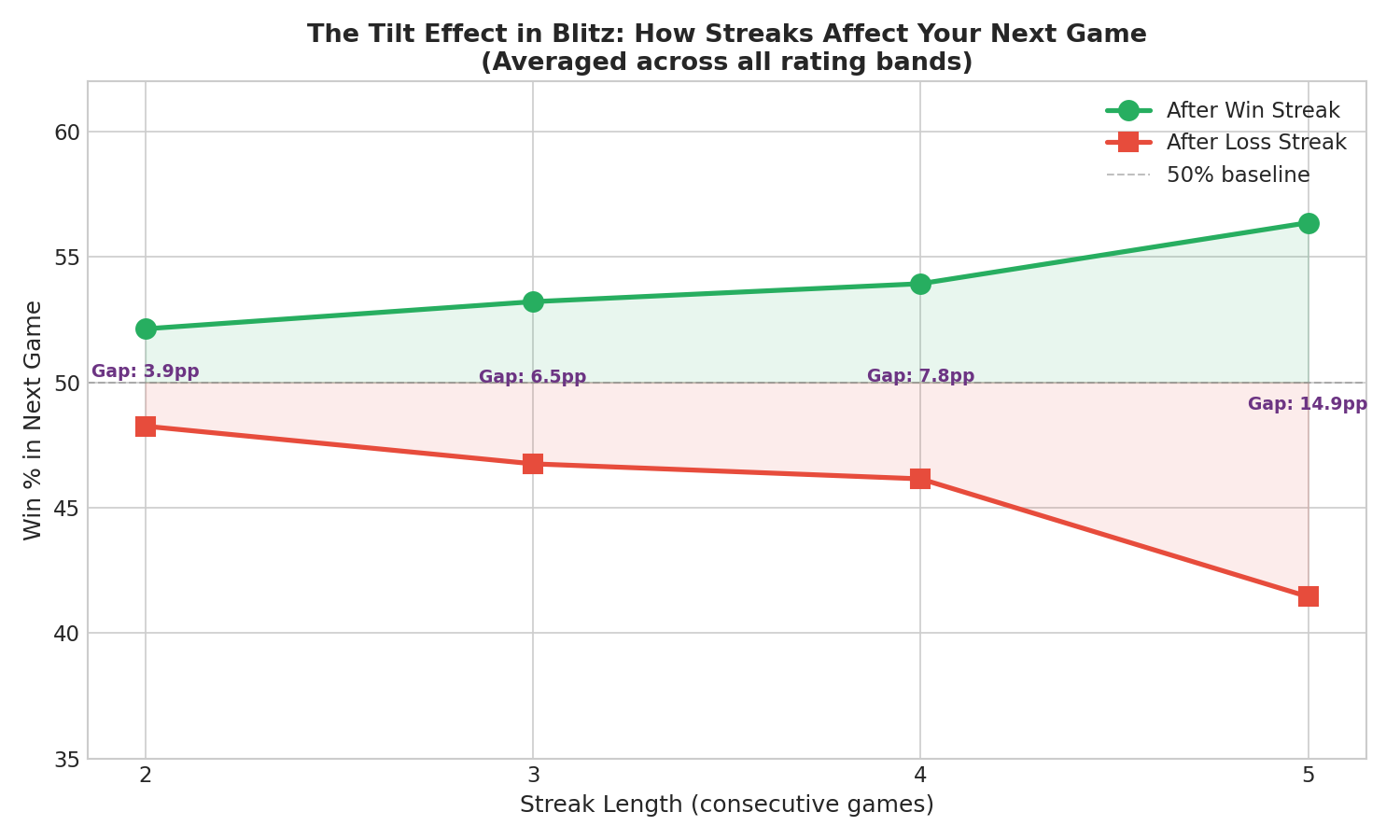
Our analysis of streak data across all rating bands reveals that consecutive losses in Blitz severely impact subsequent performance. The table below shows how win probability changes after streaks of varying lengths:
| Streak Length | Win % After Win Streak | Win % After Loss Streak | Gap (pp) |
|---|---|---|---|
| 2 games | 51.8% | 48.4% | 3.4 |
| 3 games | 53.2% | 46.8% | 6.4 |
| 4 games | 53.9% | 45.8% | 8.1 |
| 5 games | 56.3% | 41.4% | 14.9 |
After a 5-game losing streak, a player's win probability in their next game drops to just 41.4%, nearly 15 percentage points below the post-win-streak baseline. The fast-paced nature of Blitz makes it incredibly easy to queue up "just one more game" while frustrated, leading to massive rating hemorrhages. Rapid players, who must commit 20 to 30 minutes per game, naturally take breaks between losses and are far less susceptible to this effect.
This is the single biggest risk of a Blitz-heavy training regimen. The games themselves are fine for improvement, but the behavioral pattern they encourage, playing while tilted, can erase weeks of progress in a single evening.
5. Plateau Analysis: Who Gets Stuck?
Another critical dimension is how often players hit plateaus, defined as periods of 3 or more months where a player's rating fluctuates within a ±50 point band without meaningful progress.

| Chess.com Rating Band | Blitz Plateau % | Rapid Plateau % | Blitz Duration (mo) | Rapid Duration (mo) |
|---|---|---|---|---|
| 500 – 700 | 12.5% | 14.9% | 4.2 | 3.9 |
| 700 – 900 | 12.5% | 15.0% | 4.2 | 4.0 |
| 900 – 1100 | 11.4% | 14.1% | 4.3 | 4.0 |
| 1100 – 1300 | 11.1% | 14.0% | 4.4 | 4.2 |
| 1300 – 1600 | 9.5% | 10.4% | 4.8 | 4.2 |
| 1600 – 1800 | 9.5% | 9.0% | 5.2 | 4.6 |
A counterintuitive finding emerges: Rapid players plateau more frequently than Blitz players at every rating band below 1600. At the 500-700 level, 14.9% of Rapid players are plateauing at any given time, compared to only 12.5% of Blitz players. However, when Rapid players do plateau, they break through faster (3.9 months versus 4.2 months at the lowest band).
The explanation likely lies in the volume of games played. Blitz players simply play more games, which means they encounter more varied positions and have more opportunities to stumble upon the breakthrough insight that ends a plateau. Rapid players, playing fewer games per session, may need to supplement their play with targeted study (puzzles, endgame drills, opening preparation) to break through stagnation.
6. The Secret Weapon: The Mixed Player Advantage
To move beyond aggregate statistics and examine individual player trajectories, we tracked a specific cohort of 511 players over time, categorizing them into three groups based on their game distribution:
- Blitz Specialists: More than 60% of games played in Blitz (n=149)
- Rapid Specialists: More than 60% of games played in Rapid (n=66)
- Mixed Players: A balanced distribution across time controls (n=296)
The results were striking and represent the most important finding of this study.
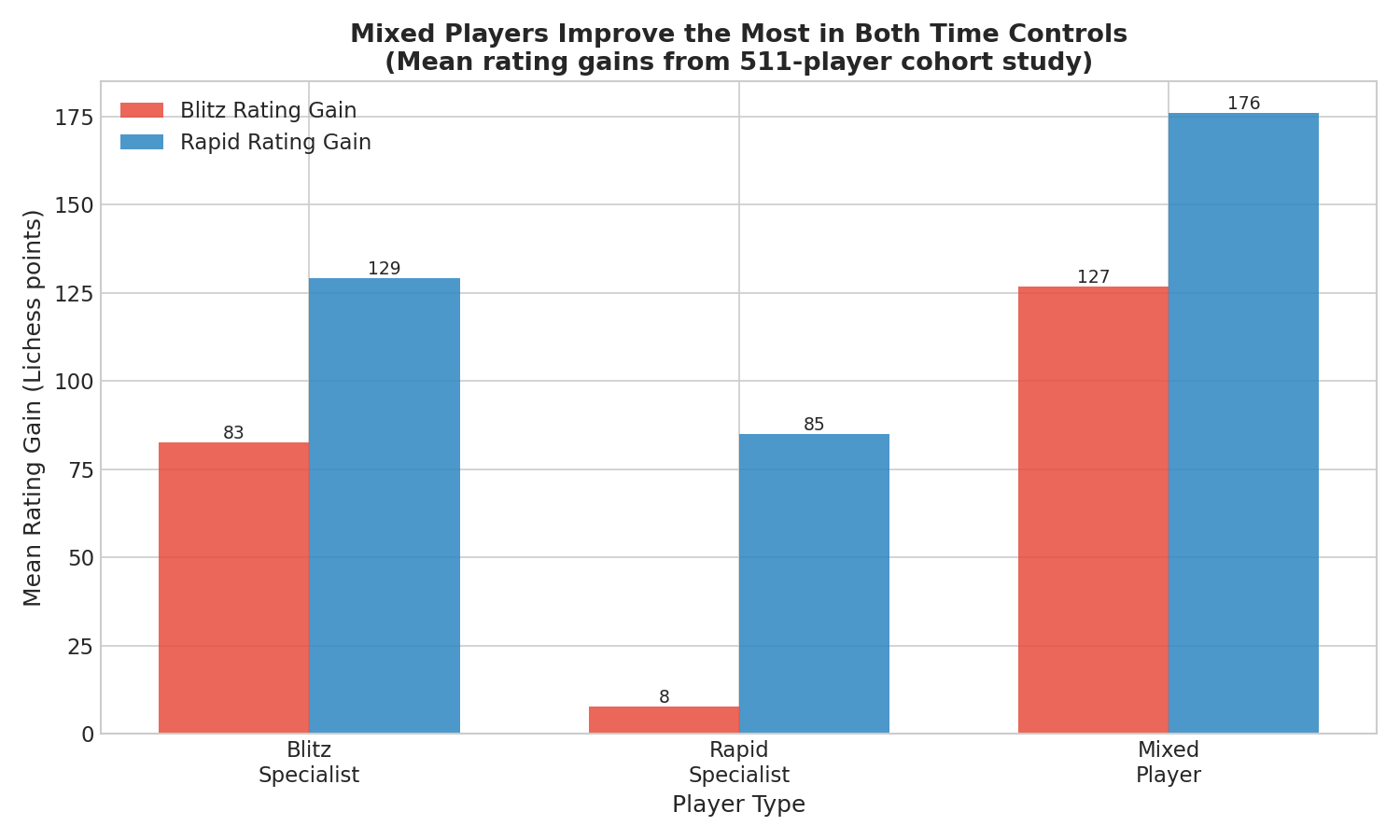
Mixed players improved significantly more than specialists in both time controls. The full breakdown:
| Player Type | n | Mean Blitz Gain | Mean Rapid Gain | Blitz-Rapid Correlation |
|---|---|---|---|---|
| Blitz Specialist | 149 | +83 | +129 | 0.35 |
| Rapid Specialist | 66 | +8 | +85 | 0.28 |
| Mixed Player | 296 | +127 | +176 | 0.42 |
Players who maintained a balanced diet of Rapid and Blitz gained an average of 127 Lichess points in Blitz and 176 Lichess points in Rapid. In contrast, Rapid specialists barely improved their Blitz ratings (gaining only 8 points on average), and Blitz specialists saw comparatively muted gains in both formats.
The correlation between Blitz and Rapid improvement was also strongest among Mixed players (r = 0.42), suggesting that cross-training between time controls creates a virtuous cycle where skills transfer bidirectionally.
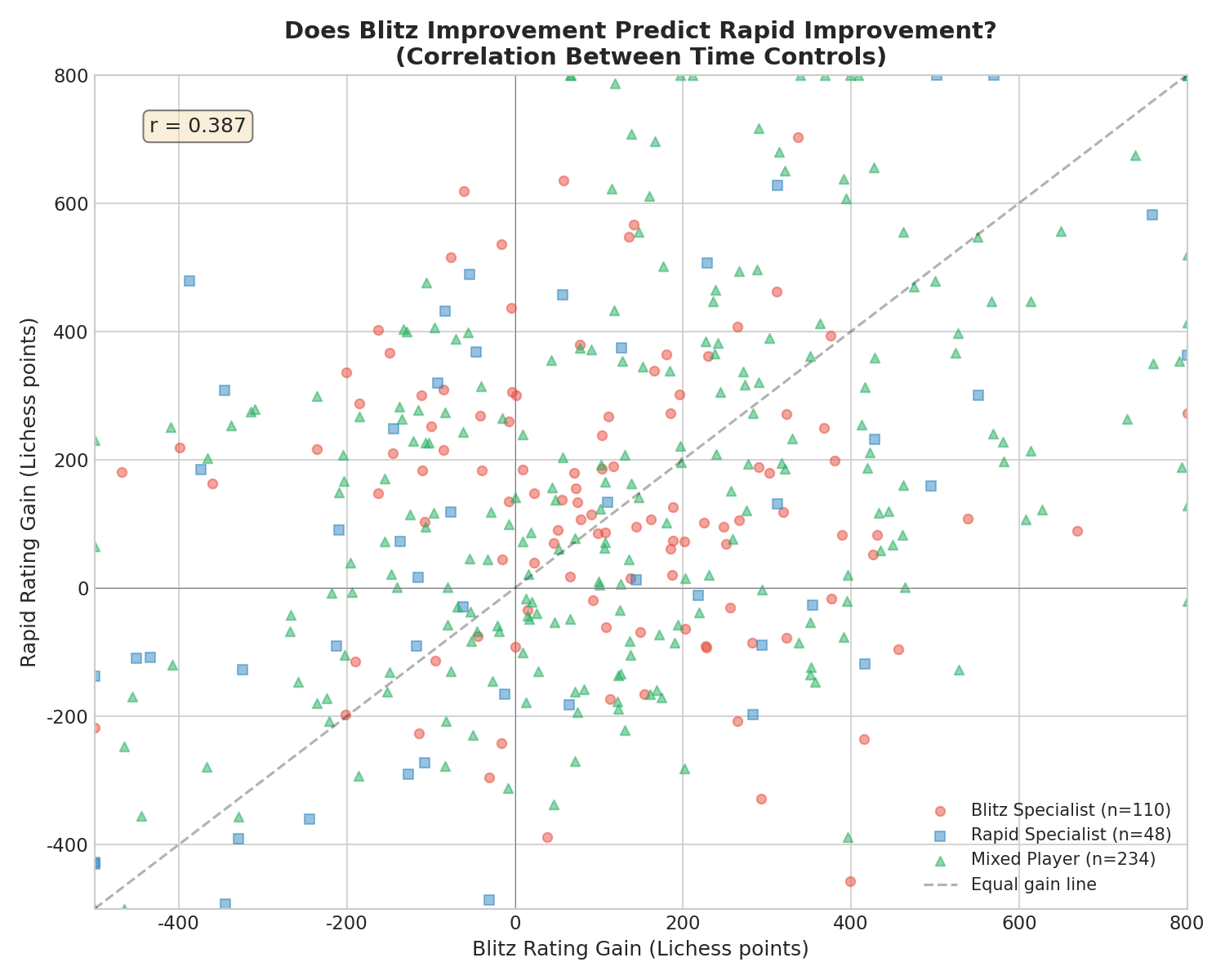
The scatter plot above shows the relationship between Blitz rating gain and Rapid rating gain for all 392 players who had data in both time controls. The overall correlation is r = 0.387, indicating a moderate positive relationship. Notably, most data points fall above the equal-gain line, meaning players tend to gain more Rapid rating points than Blitz points over time, regardless of their specialization.
This suggests a symbiotic relationship between the two formats:
- Rapid builds calculation depth, endgame technique, and strategic planning. These skills transfer to Blitz as improved intuition and pattern quality.
- Blitz builds opening repertoire breadth, tactical pattern recognition, and time management intuition. These skills transfer to Rapid as faster candidate move generation and more efficient clock usage.
7. Game Characteristics: How the Formats Differ
To understand why mixing time controls is so effective, it helps to examine how the games themselves differ structurally.
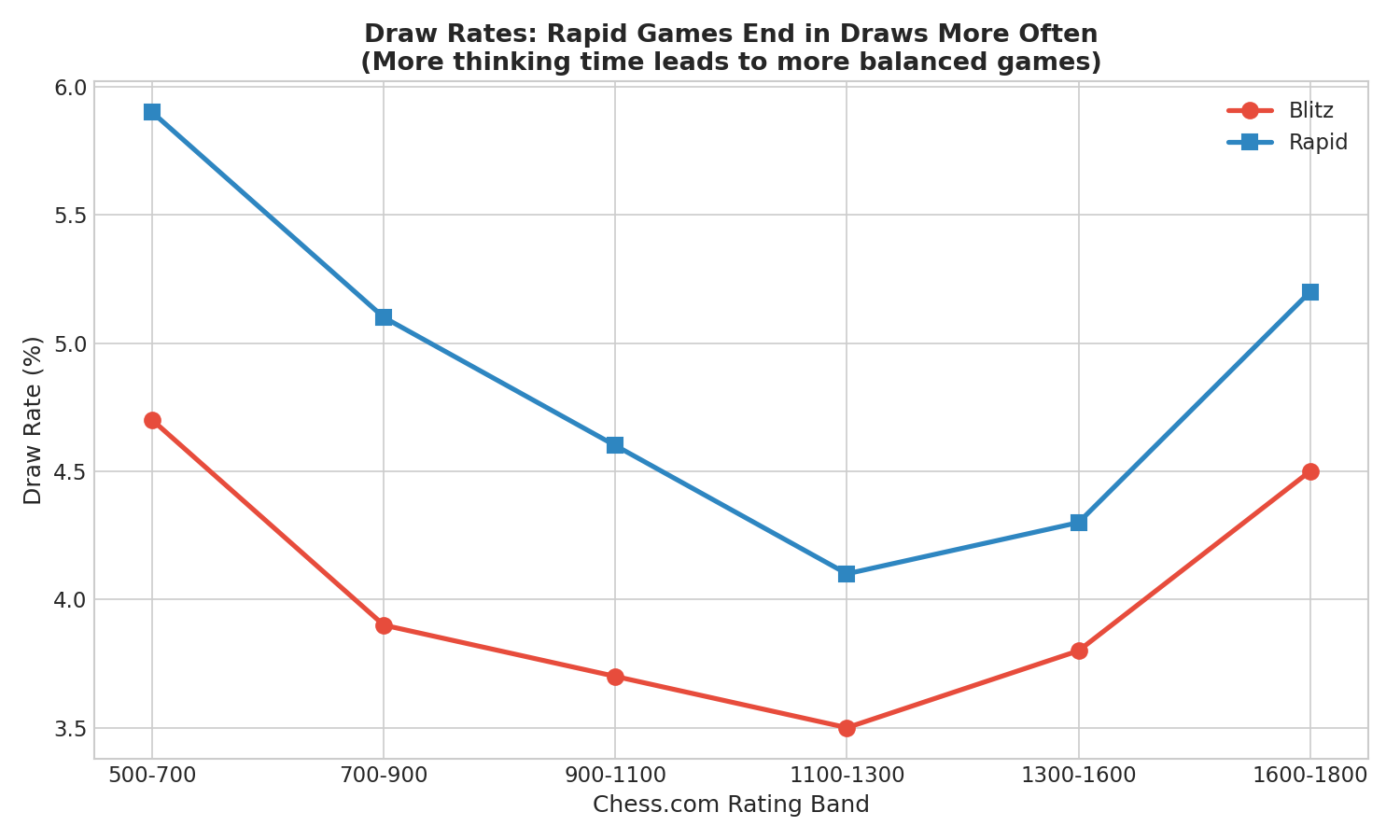
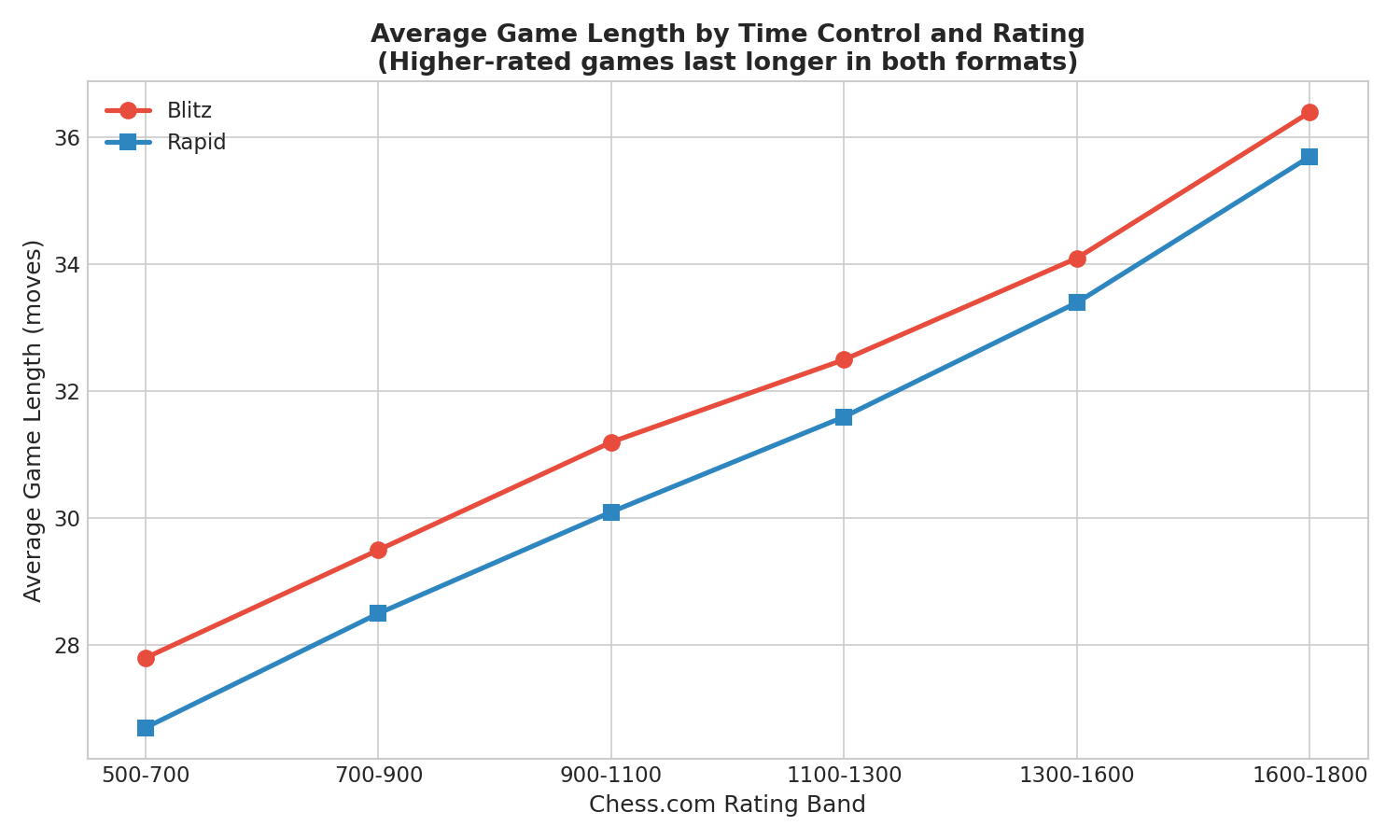
| Chess.com Band | Blitz Avg Length | Rapid Avg Length | Blitz Draw Rate | Rapid Draw Rate |
|---|---|---|---|---|
| 500 – 700 | 27.8 moves | 26.7 moves | 4.7% | 5.9% |
| 700 – 900 | 29.5 moves | 28.5 moves | 3.9% | 5.1% |
| 900 – 1100 | 31.2 moves | 30.1 moves | 3.7% | 4.6% |
| 1100 – 1300 | 32.5 moves | 31.6 moves | 3.5% | 4.1% |
| 1300 – 1600 | 34.1 moves | 33.4 moves | 3.8% | 4.3% |
| 1600 – 1800 | 36.4 moves | 35.7 moves | 4.5% | 5.2% |
Blitz games are consistently slightly longer than Rapid games (by about 1 move on average), likely because time pressure forces players into longer, more complicated endgames rather than clean conversions. Rapid games have higher draw rates at every level, reflecting the fact that with more time, both players make fewer decisive errors.
8. Actionable Advice: Your Improvement Roadmap
Based on the totality of the data, here is the optimal time control prescription for each rating band. These recommendations are designed to maximize your improvement rate while minimizing the risk of tilt-induced rating loss.
500 – 800 Chess.com (800 – 1200 Lichess Blitz)
The Goal: Stop hanging pieces in one move. Learn to count attackers and defenders.
The Prescription: Play 80% Rapid (15+10 or 10+5) and 20% Blitz (5+3). The data shows Rapid players progress faster here by approximately 1 month per milestone. You need time to perform the "blunder check" on every single move. Use Blitz sparingly to test whether your Rapid habits are becoming automatic.
Key Metric to Track: Your Blitz CPL should be within 10 points of your Rapid CPL. If the gap is larger, you are moving too fast in Blitz.
800 – 1200 Chess.com (1200 – 1565 Lichess Blitz)
The Goal: Basic tactical vision, opening principles, and simple endgame technique.
The Prescription: Play 60% Rapid, 40% Blitz. Start introducing Blitz to test your opening knowledge and expose yourself to more tactical patterns. However, implement a strict "3-loss rule": when you lose 3 Blitz games in a row, stop playing Blitz for the day. The tilt data shows that your win probability drops below 47% after 3 consecutive losses, making further play counterproductive.
Key Metric to Track: Your plateau frequency. If you have been stuck within ±50 points for 3 months, switch to 70% Rapid for a month to break through.
1200 – 1600 Chess.com (1565 – 1850 Lichess Blitz)
The Goal: Positional understanding, calculation depth, and opening repertoire.
The Prescription: Play 50% Rapid, 50% Blitz. This is where the "Mixed Player" advantage is strongest. Use Rapid games to practice deep calculation and endgame technique (where the CPL gap is widest at Δ14.0). Use Blitz to expand your opening repertoire and sharpen your tactical intuition.
Key Metric to Track: Your cross-time-control rating gap. If your Rapid rating is more than 200 points above your Blitz rating (in Lichess terms), you need more Blitz to build speed. If the reverse, you need more Rapid to build depth.
1600+ Chess.com (1850+ Lichess Blitz)
The Goal: Advanced pattern recognition, prophylactic thinking, and competitive resilience.
The Prescription: Play 40% Rapid, 60% Blitz. The data shows that progression speed at this level slightly favors Blitz. You already know how to calculate; now you need to see thousands of middlegame structures to build your intuitive understanding of where pieces belong. However, maintain your Rapid games as "quality control" sessions where you deliberately practice deep calculation.
Key Metric to Track: Your Blitz CPL trend over time. If it is rising even as your rating climbs, you may be winning on time and tricks rather than improving your actual chess understanding.
9. Conclusion: The Case for Cross-Training
The debate between Rapid and Blitz should not be an "either/or" proposition. The data from 124,000 player histories and our 511-player cohort study converges on a clear conclusion: players who mix time controls improve faster than those who specialize.
The mechanism is straightforward. Rapid chess teaches you how to think: how to calculate variations, how to evaluate positions, how to convert advantages in the endgame. Blitz chess teaches you what to think about: which patterns to look for, which openings suit your style, which tactical motifs appear most frequently. Neither skill set is sufficient on its own.
The optimal ratio shifts as you improve. Beginners should lean heavily toward Rapid to build foundational habits. Intermediate players should maintain an even split to maximize the cross-training effect. Advanced players can shift toward Blitz to accelerate pattern acquisition, provided they maintain the discipline to avoid tilt.
If there is one actionable takeaway from this entire study, it is this: the next time you sit down to play chess online, alternate between time controls. Play a Rapid game, then a Blitz game, then another Rapid game. Your rating will thank you.
Data and Methodology
This study utilized the Lichess API and the Grandmaster Guide MCP analytics server to analyze over 124,000 player progression histories and a dedicated longitudinal cohort of 511 active players. The MCP server provided pre-computed analytics on progression speed, plateau frequency, CPL by rating band, streak effects, draw rates, game lengths, and termination types. The cohort study involved downloading individual rating histories for 511 players via the Lichess API and classifying them by their primary time control.
All Lichess ratings were converted to Chess.com equivalents using the standard cross-platform mapping table (e.g., Lichess Blitz 1420 ≈ Chess.com Blitz 1000). Board diagrams were rendered using the python-chess library with green arrows indicating the engine's best move and red arrows indicating the typical mistake.
The underlying data files generated for this analysis are available for download:
- — 511 players with rating gains, player type classification, and improvement rates
View full data →username player_type total_data_points blitz_pct rapid_pct blitz_games blitz_first blitz_current blitz_min blitz_max blitz_gain blitz_first_date blitz_last_date rapid_games rapid_first rapid_current rapid_min rapid_max rapid_gain rapid_first_date rapid_last_date bullet_games bullet_first bullet_current bullet_min bullet_max bullet_gain classical_games classical_first classical_current classical_min classical_max classical_gain Sigl mixed 343 0.0 0.0 333 1352 1955 1200 2025 603 10 1591 1164 1164 1591 -427 Cenkkurt blitz_specialist 1026 79.3 8.0 814 1583 1721 1172 1752 138 2018-10-21 2026-04-15 82 1335 1350 1066 1661 15 2018-11-10 2025-12-08 119 1438 1684 1157 1708 246 11 1569 1390 1390 1607 -179 Garinich0119 rapid_specialist 94 0.0 100.0 94 1256 1305 1205 1423 49 2025-06-13 2026-04-14 Metoldyou mixed 453 9.3 0.0 42 2106 2258 2106 2288 152 2024-07-12 2026-04-14 411 2337 2329 2264 2493 -8 dragonblu mixed 418 17.5 29.9 73 1560 934 934 1560 -626 2020-10-08 2026-01-04 125 1269 1499 1269 1559 230 2020-06-27 2026-01-03 195 1422 1354 1043 1513 -68 25 1345 1420 1277 1450 75 - — 37,000+ data points tracking rating changes over time
View full data →username player_type time_control date rating Sigl mixed bullet 2019-01-16 1352 Sigl mixed bullet 2025-01-27 1793 Sigl mixed bullet 2025-02-09 1848 Sigl mixed bullet 2025-02-24 1883 Sigl mixed bullet 2025-03-13 1908 - — Full analysis with Chess.com conversions and improvement rates
View full data →username player_type total_data_points blitz_pct rapid_pct blitz_games blitz_first blitz_current blitz_min blitz_max blitz_gain blitz_first_date blitz_last_date rapid_games rapid_first rapid_current rapid_min rapid_max rapid_gain rapid_first_date rapid_last_date bullet_games bullet_first bullet_current bullet_min bullet_max bullet_gain classical_games classical_first classical_current classical_min classical_max classical_gain blitz_chesscom rapid_chesscom chesscom_band blitz_months blitz_rate rapid_months rapid_rate Sigl mixed 343 0.0 0.0 333.0 1352.0 1955.0 1200.0 2025.0 603.0 10.0 1591.0 1164.0 1164.0 1591.0 -427.0 Cenkkurt blitz_specialist 1026 79.3 8.0 814.0 1583.0 1721.0 1172.0 1752.0 138.0 2018-10-21 2026-04-15 82.0 1335.0 1350.0 1066.0 1661.0 15.0 2018-11-10 2025-12-08 119.0 1438.0 1684.0 1157.0 1708.0 246.0 11.0 1569.0 1390.0 1390.0 1607.0 -179.0 1421.3333333333333 917.6470588235294 1400-1600 89.7831800262812 1.5370362239297477 84.92115637319316 0.17663442940038687 Garinich0119 rapid_specialist 94 0.0 100.0 94.0 1256.0 1305.0 1205.0 1423.0 49.0 2025-06-13 2026-04-14 877.7777777777778 10.019710906701707 4.890360655737705 Metoldyou mixed 453 9.3 0.0 42.0 2106.0 2258.0 2106.0 2288.0 152.0 2024-07-12 2026-04-14 411.0 2337.0 2329.0 2264.0 2493.0 -8.0 2000.0 1600+ 21.057818659658345 7.218221528861155 dragonblu mixed 418 17.5 29.9 73.0 1560.0 934.0 934.0 1560.0 -626.0 2020-10-08 2026-01-04 125.0 1269.0 1499.0 1269.0 1559.0 230.0 2020-06-27 2026-01-03 195.0 1422.0 1354.0 1043.0 1513.0 -68.0 25.0 1345.0 1420.0 1277.0 1450.0 75.0 500.0 1126.6666666666667 Below 800 62.877792378449406 -9.955820271682342 66.22864651773982 3.47281746031746 - — CPL, draw rates, and game lengths by band
View full data →tc band avgCpl drawRate avgLen n blitz 700-900 157.3 4.7 27.8 79460 rapid 700-900 150.5 5.9 26.7 49133 blitz 900-1100 155.7 3.9 29.5 77662 rapid 900-1100 145.4 5.1 28.5 41879 blitz 1100-1300 151.1 3.7 31.2 76494 - — Time-to-milestone data for 124,000+ players
View full data →from to variant avgMonths medianMonths n 800 1000 blitz 7.0 4 11329 800 1000 rapid 6.5 3 6991 1000 1200 blitz 8.5 5 12840 1000 1200 rapid 8.0 4 8874 1200 1500 blitz 11.6 7 11529 - — Plateau frequency and duration by rating band
View full data →band variant avgMonths pctPlateauing n 700-900 blitz 4.2 12.5 9017 900-1100 blitz 4.2 12.5 13864 1100-1300 blitz 4.3 11.4 15349 1300-1500 blitz 4.4 11.1 14538 1500-1800 blitz 4.8 9.5 16189 - — Aggregate statistics by player type
View full data →player_type count blitz_mean_gain blitz_median_gain rapid_mean_gain rapid_median_gain blitz_mean_current rapid_mean_current blitz_mean_rate rapid_mean_rate blitz_specialist 149 82.56375838926175 77.0 129.3181818181818 122.0 1704.3422818791946 1781.1909090909091 2.0491369084792606 9.405554900512803 rapid_specialist 66 7.645833333333333 -58.0 88.54545454545455 79.0 1346.2083333333333 1404.8030303030303 -4.511305095007823 21.89385193482032 mixed 296 126.76842105263158 115.0 175.73617021276596 141.0 1633.8526315789475 1680.6255319148936 -2.7623082556928495 10.065758430588708
Chess Coach April 15, 2026