Most chess players assume their rapid rating is a reliable predictor of their blitz and bullet performance. The conventional wisdom suggests that if you improve your deep calculation in rapid games, your intuitive play in faster time controls will naturally follow. However, when we analyze the data of thousands of active players, a more complex and fascinating picture emerges.
This article serves as a data-driven roadmap for players rated between 800 and 1500 on Chess.com. By analyzing over 1,200 player profiles and nearly a million games, we will quantify the actual correlation between time controls, identify exactly where this correlation breaks down, and provide actionable advice for climbing the rating ladder.
The Illusion of Overall Correlation
When we look at the entire player population, the correlation between time controls appears incredibly strong. Our analysis of players who actively play all three major time controls reveals a Pearson correlation coefficient of $r = 0.935$ between Rapid and Blitz ratings, and $r = 0.838$ between Rapid and Bullet ratings.
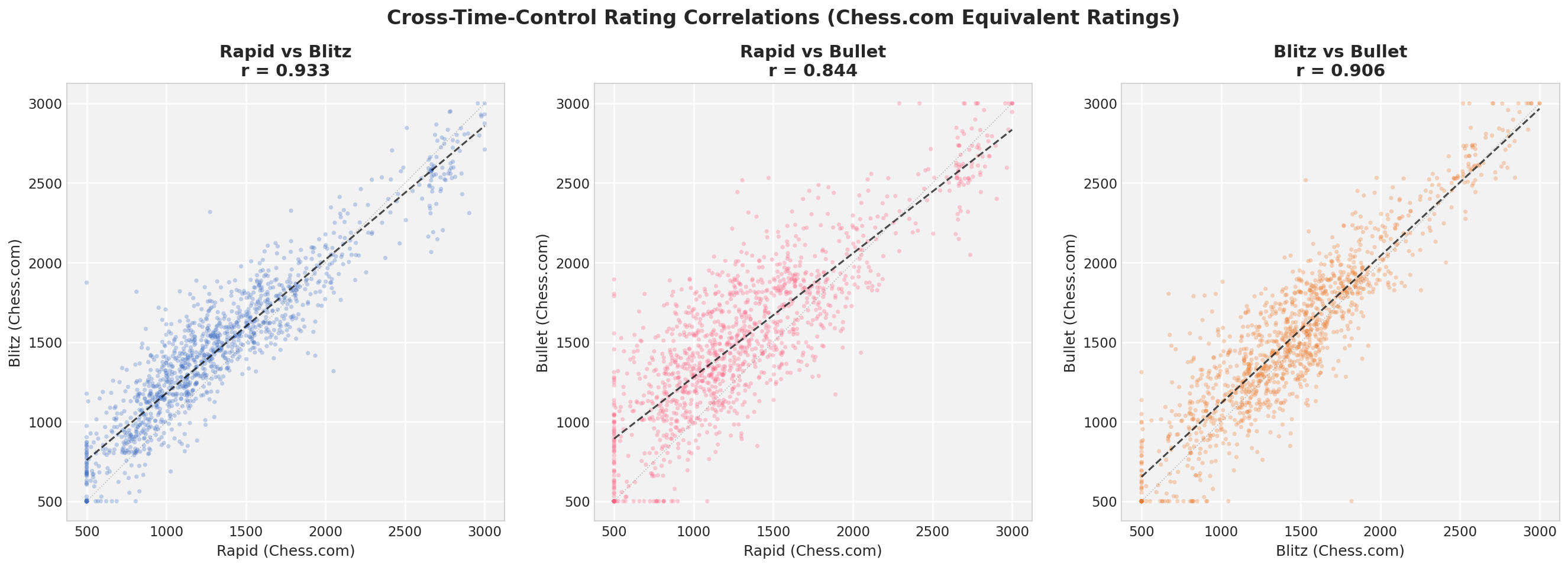
At first glance, this suggests that your ratings move in lockstep. A 2000-rated rapid player will almost certainly crush an 800-rated bullet player in any time format. However, this overall correlation is heavily influenced by the massive skill gap between the top and bottom of the rating pool. When we zoom in on specific rating bands—the players you actually face in matchmaking—the story changes dramatically.
The Breakdown of Correlation by Skill Level
The true test of correlation is whether knowing a player's rapid rating helps predict their blitz or bullet rating compared to their peers. When we isolate players into 200-point rating bands, the predictive power of rapid ratings plummets.
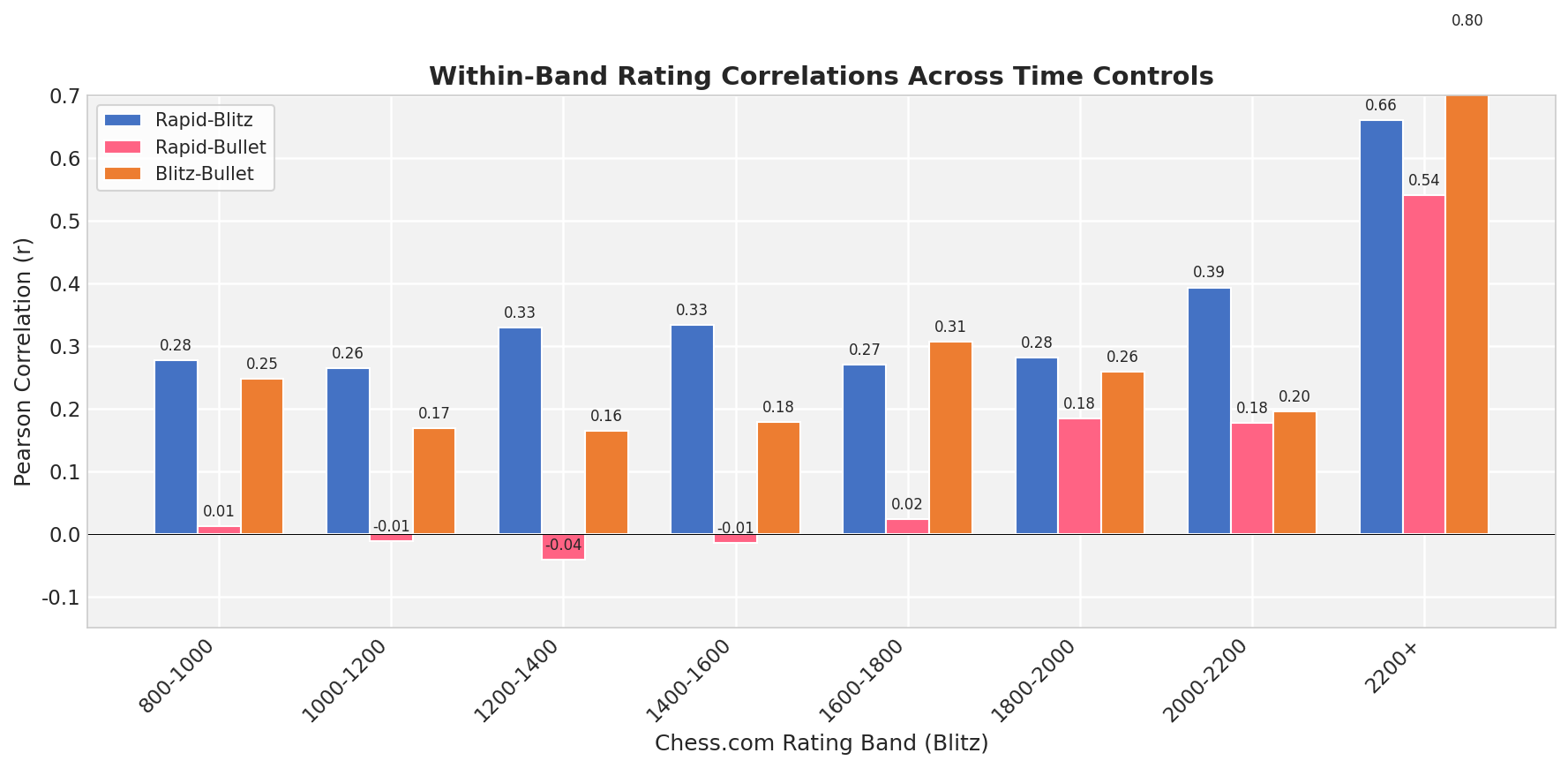
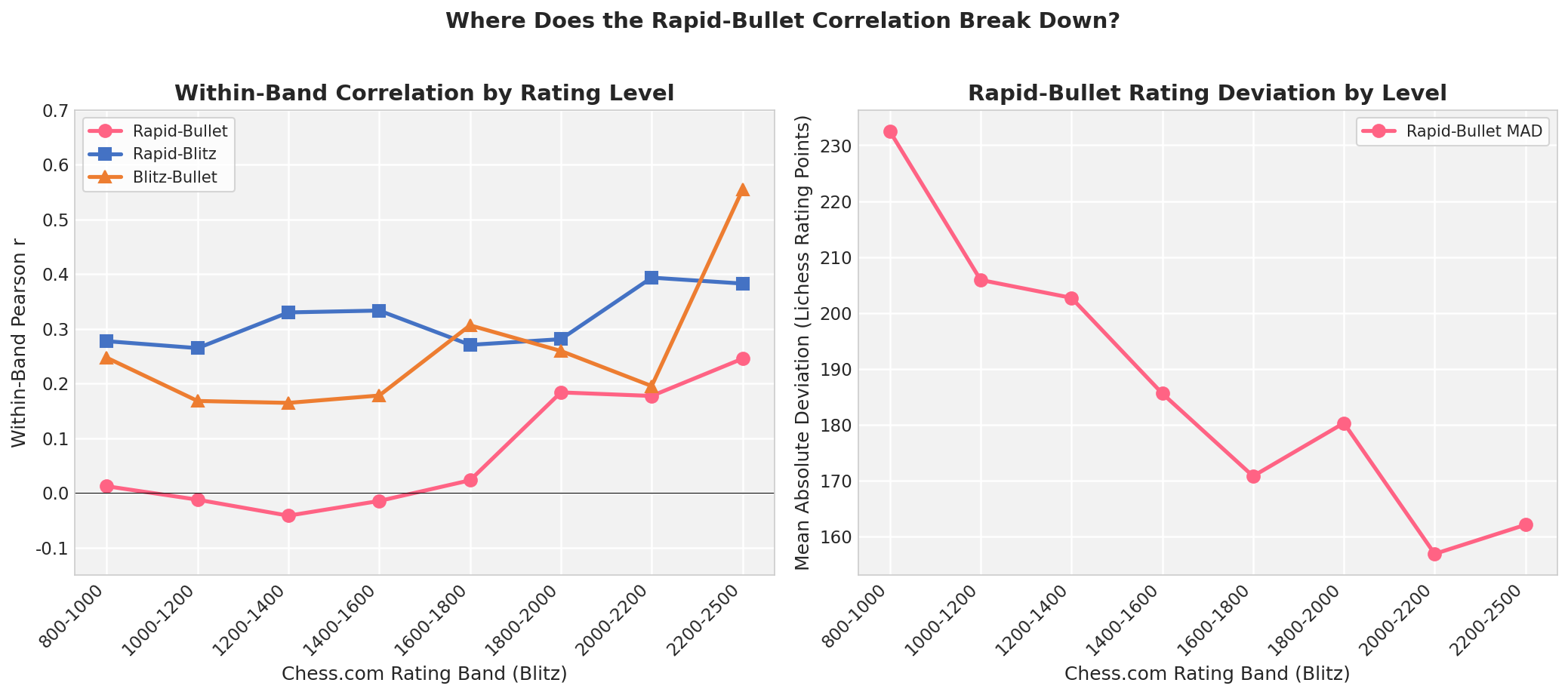
For players rated between 800 and 1800 (Chess.com equivalent), the correlation between Rapid and Bullet ratings is essentially zero. In the 1000-1200 band, the correlation is $r = -0.012$. In the 1200-1400 band, it is $r = -0.042$. This means that if you take two players rated 1300 in rapid, one might be an 1100 bullet player while the other is a 1500 bullet player. Their rapid rating tells you absolutely nothing about their bullet skills relative to each other.
The correlation between Rapid and Blitz is slightly stronger but still remarkably weak within these bands, hovering around $r = 0.30$. It is only when players cross the 2000+ threshold that the correlations begin to tighten again, suggesting that master-level players possess a universal chess foundation that translates across all speeds.
The "Blitz is Higher" Phenomenon
A common question among improving players is why their blitz rating often exceeds their rapid rating, especially on platforms like Chess.com. Our data reveals just how widespread this phenomenon is.
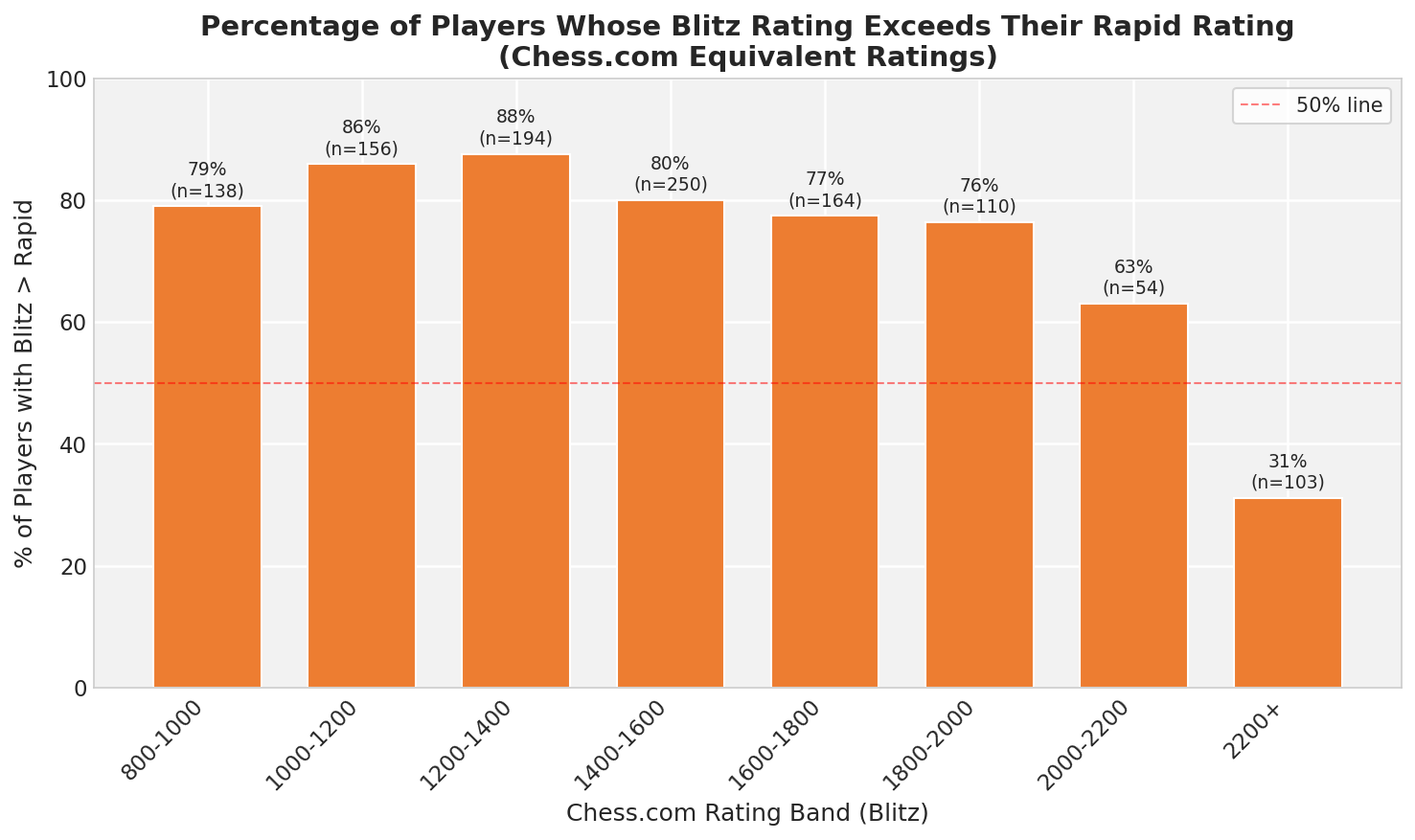
Overall, 73.1% of the players in our dataset have a higher Chess.com equivalent blitz rating than rapid rating. This trend peaks in the 1200-1400 rating band, where a staggering 87.6% of players boast a higher blitz rating.
It is crucial to understand that this does not necessarily mean these players are "better" at blitz. Rating pools are distinct ecosystems. The rapid pool often contains a higher concentration of newer or more casual players, while the blitz pool is highly competitive and saturated with experienced players. The rating mapping between platforms (such as Lichess to Chess.com) also compresses rapid ratings more severely than blitz ratings.
Move Quality and Time Pressure
To understand why ratings diverge, we must look at how time pressure affects move quality. Using Stockfish 17 evaluations from over 950,000 games, we analyzed the average Centipawn Loss (CPL) across time controls.
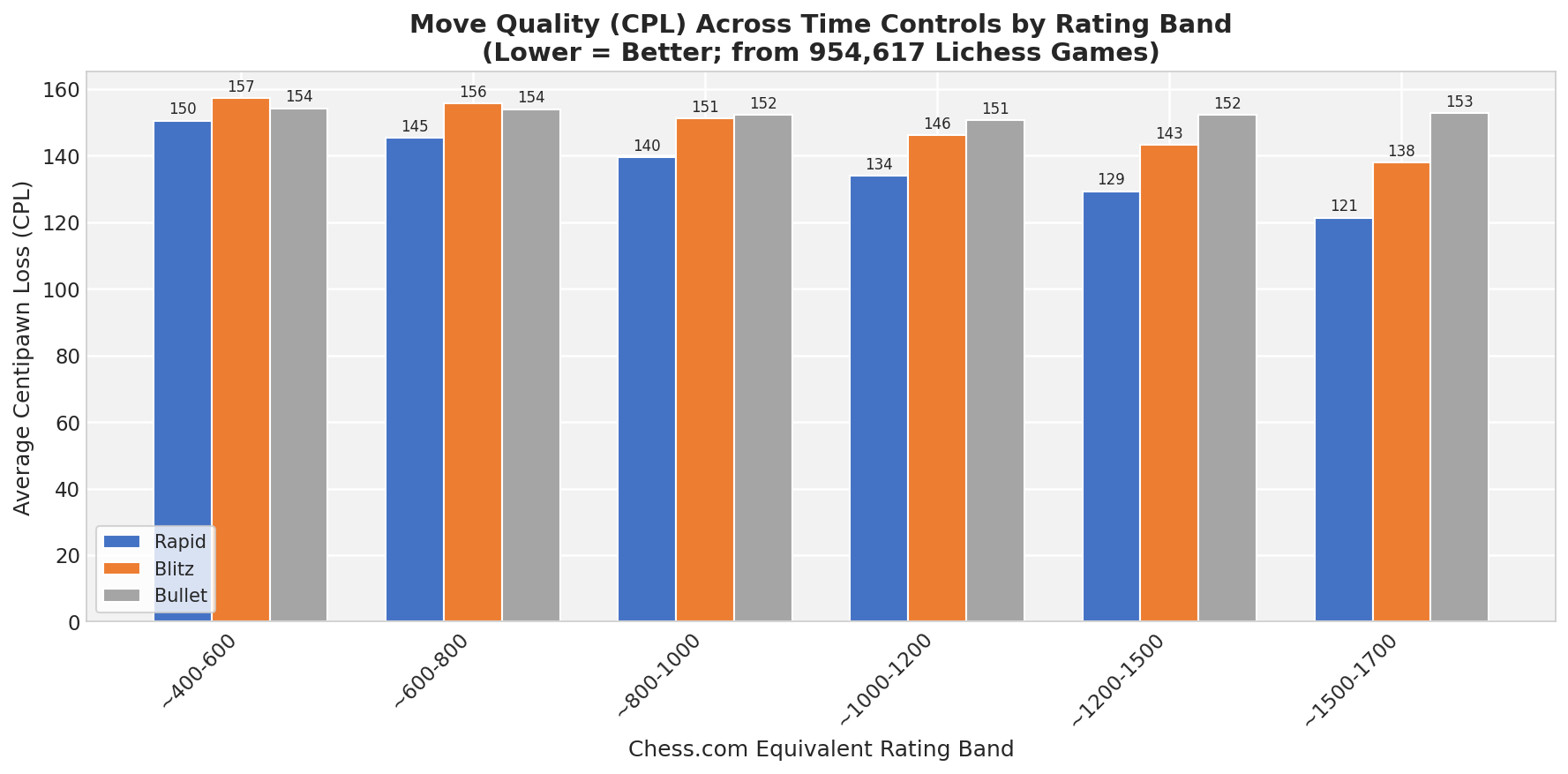
Unsurprisingly, move quality degrades as the clock ticks faster. Across all rating bands, rapid games exhibit the lowest CPL (highest accuracy), while bullet games show the highest CPL. However, the gap in accuracy between time controls is what separates different rating levels.
Lower-rated players (800-1200) show a relatively small difference in accuracy between rapid and blitz. They are making fundamental errors regardless of the clock. As players improve (1200-1600), the accuracy gap widens. They have learned to use their time effectively in rapid to find better moves, but they still struggle to apply those concepts intuitively in blitz.
Roadmap to Improvement: Actionable Advice by Rating Band
Based on the data, here is a targeted guide for improving your play and bridging the gap between your time controls.
The 800 - 1000 Band: The Fundamentals Phase
At this level, the data shows that move quality is nearly identical across rapid, blitz, and bullet. The primary differentiator is blunder frequency.
Actionable Advice: Stop playing bullet. The data shows that bullet at this level is decided entirely by who blunders their queen last, not by chess skill. Focus exclusively on rapid games (10+0 or 15+10). Your goal is to build a mental checklist: Are my pieces defended? Is my opponent threatening a one-move capture?
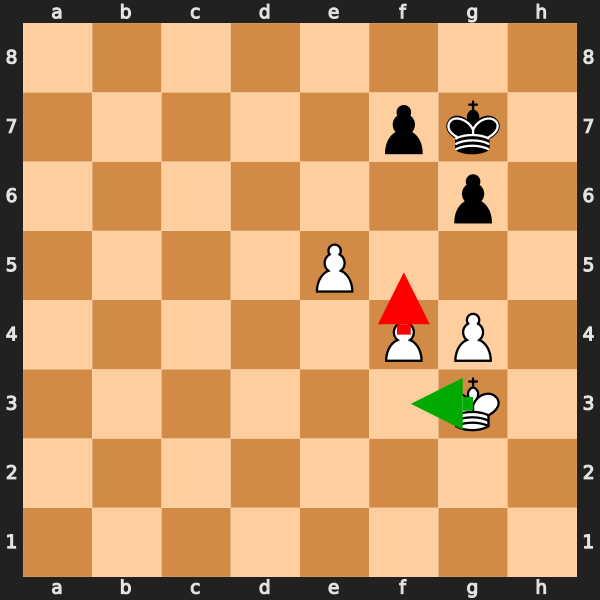 In endgames like this, rapid players take the time to calculate King activity (Kf3), while bullet players often push pawns impulsively (f5?), losing the game.
The 1000 - 1200 Band: The Tactical Awakening
Here, we see the highest percentage of players (85.9%) with blitz ratings higher than their rapid ratings. Players at this level have developed basic tactical vision but lack the strategic depth required to win longer games.
Actionable Advice: Your rapid rating is lagging because you are playing rapid like it is blitz. You must learn to use your clock. When the position becomes complex, force yourself to calculate at least two moves deep for both sides. Study basic endgames; our data shows that game length increases significantly at this level, meaning more games are decided in the endgame rather than by early tactical blunders.
The 1200 - 1400 Band: The Intuition Gap
This is where the correlation between rapid and bullet completely breaks down ($r = -0.042$). Players here often have a solid grasp of opening principles and basic strategy, which serves them well in rapid. However, their intuitive pattern recognition is not yet fast enough for bullet.
Actionable Advice: To bring your blitz and bullet ratings up to your rapid level, you need to drill tactical patterns until they become subconscious. Use puzzle rush or puzzle storm features. You should not be calculating basic forks or pins in a blitz game; you should simply see them.
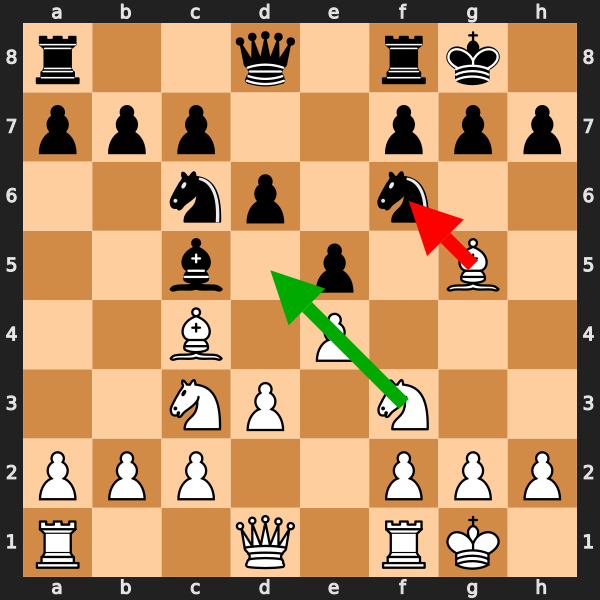 In complex middlegames, time pressure forces errors. A rapid player might find the strong Nd5, while a blitz player might panic and play the premature Bxf6.
The 1400 - 1600 Band: The Time Management Hurdle
At this stage, players are generally competent, but the accuracy gap between rapid and blitz is at its widest. You know how to find the right moves, but you struggle to find them quickly.
Actionable Advice: Focus on your opening repertoire and transition into the middlegame. You should be able to play the first 10-12 moves of your main openings quickly and confidently, saving your clock for critical middlegame decisions. Review your games to identify where you are spending the most time. If you are burning two minutes on move 8 of a standard opening, you need to review your theory.
Conclusion
The assumption that your rapid rating dictates your blitz and bullet performance is a myth, particularly for players rated between 800 and 1800. The skills required to calculate deeply in a 15-minute game are fundamentally different from the intuitive pattern recognition and time management required in a 3-minute game.
By understanding where your specific rating band struggles—whether it is basic blunder checking, tactical intuition, or time management—you can tailor your training to bridge the gap and become a more well-rounded chess player.
Data and Methodology
This analysis is based on a dataset of 1,278 Lichess players who actively play bullet, blitz, and rapid time controls (minimum 20 games in each). The data was collected via the Lichess API in April 2026.
To make the insights applicable to the broader chess community, Lichess ratings were converted to approximate Chess.com equivalents using a standard community mapping table (e.g., a 1565 Lichess Blitz rating maps to approximately 1200 Chess.com Blitz). Move quality (CPL) and draw rate statistics were sourced from a database of 954,617 Stockfish 17 evaluated Lichess games.
Underlying Data Files:
View full data →username bullet_rating bullet_games bullet_rd bullet_prov blitz_rating blitz_games blitz_rd blitz_prov rapid_rating rapid_games rapid_rd rapid_prov classical_rating classical_games classical_rd classical_prov has_bullet has_blitz has_rapid tc_count myshka_grmn 1641 789 99 False 1452 2294 76 False 1362 579 136 True 1591 78 208 True True True False 2 Jerzyh 1755 1061 52 False 1602 1080 45 False 1717 844 57 False 1623 20 146 True True True True 3 Pap-G 3106 16549 52 False 2802 11293 48 False 2946 547 77 False 2211 24 197 True True True True 3 Maxicypr 2446 31160 45 False 2057 1312 81 False 1690 1 345 True 1500 0 500 True True True False 2 skusnir004 1626 354 88 False 1729 16915 45 False 1736 4329 45 False 1800 79 123 True True True True 3
View full data →pair pearson_r pearson_p spearman_rho n Rapid vs Blitz 0.9354 0.0 0.9177 1278 Rapid vs Bullet 0.8376 0.0 0.7983 1278 Blitz vs Bullet 0.9008 0.0 0.8758 1278
View full data →band_chesscom pair pearson_r n 800-1000 Rapid-Blitz 0.2775 138 800-1000 Rapid-Bullet 0.0123 138 800-1000 Blitz-Bullet 0.2472 138 1000-1200 Rapid-Blitz 0.2648 156 1000-1200 Rapid-Bullet -0.0123 156
View full data →gap mean median std q25 q75 n Rapid - Blitz (Lichess) 54.4 61.0 136.7 -25.0 138.0 1278 Rapid - Bullet (Lichess) 1.3 4.0 247.8 -161.8 173.0 1278 Blitz - Bullet (Lichess) -53.1 -52.0 199.0 -186.0 77.0 1278 Rapid - Blitz (Chess.com equiv) -126.8 -124.0 205.4 -251.2 0.0 1278 Rapid - Bullet (Chess.com equiv) -209.3 -198.5 307.3 -406.7 2.3 1278
View full data →band_chesscom blitz_higher_count total pct_blitz_higher 800-1000 109 138 79.0 1000-1200 134 156 85.9 1200-1400 170 194 87.6 1400-1600 200 250 80.0 1600-1800 127 164 77.4
View full data →timeClass ratingBand avgCpl drawRate avgGameLength sampleGames blitz 700-900 157.3 4.7 27.8 79460 bullet 700-900 154.2 1.4 22.0 34669 classical 700-900 105.3 5.8 22.4 325 rapid 700-900 150.5 5.9 26.7 49133 blitz 900-1100 155.7 3.9 29.5 77662
Chess Coach April 15, 2026