When intermediate players evaluate material, the Queen is universally respected as the most powerful piece on the board. However, chess is a game of dynamic imbalances. One of the most fascinating and misunderstood material distributions is the Queen versus Three Minor Pieces. While mathematically the Queen (9 points) is roughly equivalent to three minor pieces (3 points each), the practical reality of coordinating three pieces against a single powerful attacker creates unique challenges for both sides.
To understand how this imbalance plays out in practice, we analyzed 6,000 Rapid games played by intermediate players. The data reveals not only how rare this pure imbalance is, but also how players at different rating levels handle the resulting complexity. This article serves as a roadmap for players rated between 800 and 1500 on Chess.com, offering data-backed insights and actionable advice for navigating this unique material distribution.
Data and Methodology
The analysis is based on a random sample of 6,000 Rapid games sourced from the Lichess database via the grandmaster-guide MCP. Because Lichess ratings are generally higher than Chess.com ratings in the intermediate range, we calibrated the data using a standard conversion mapping. The games were divided into four Chess.com rating bands:
- 800–1000 (Lichess 1400–1615)
- 1000–1200 (Lichess 1615–1765)
- 1200–1400 (Lichess 1765–1880)
- 1400–1500 (Lichess 1880–1930)
For each band, we analyzed 1,500 games to detect occurrences of the Queen vs 3 Minor Pieces imbalance. We distinguished between "strict" occurrences (where the imbalance persisted for at least 3 plies) and "transient" occurrences (where the imbalance appeared briefly, often during a sequence of captures). We also tracked "near-miss" scenarios, such as a Queen versus two minor pieces, to provide context on how often players face similar, but less extreme, material disparities.
The Rarity of the Pure Imbalance
The first major finding from the data is just how rare the pure Queen vs 3 Minor Pieces imbalance actually is. Across all 6,000 games, the strict imbalance occurred in only 11 games (0.18%).
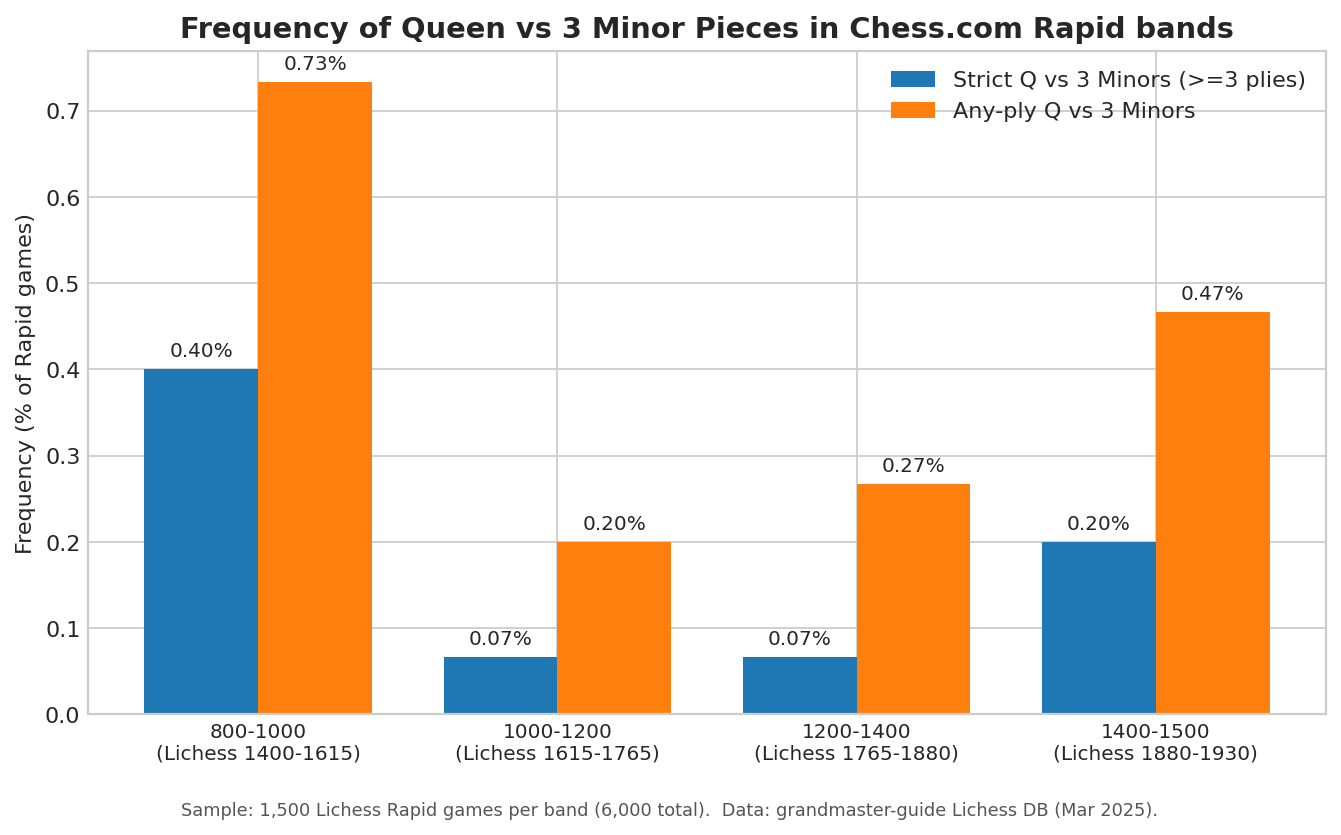
As the chart illustrates, the strict imbalance is most frequent in the 800–1000 band (0.40%) and drops significantly in the 1000–1200 and 1200–1400 bands (0.07%). It ticks up slightly in the 1400–1500 band (0.20%). This suggests that lower-rated players are more prone to chaotic material trades that result in this imbalance, while higher-rated players generally avoid such complex, asymmetrical positions unless they see a clear tactical justification.
Interestingly, the "any-ply" (transient) occurrences are more common, indicating that players often pass through this material state during a sequence of captures, but quickly resolve it by capturing another piece.
The "Near-Miss" Scenario
While the pure Queen vs 3 Minor Pieces imbalance is rare, the "near-miss" scenario—where one side has a Queen and the other has at least two minor pieces—is much more common.
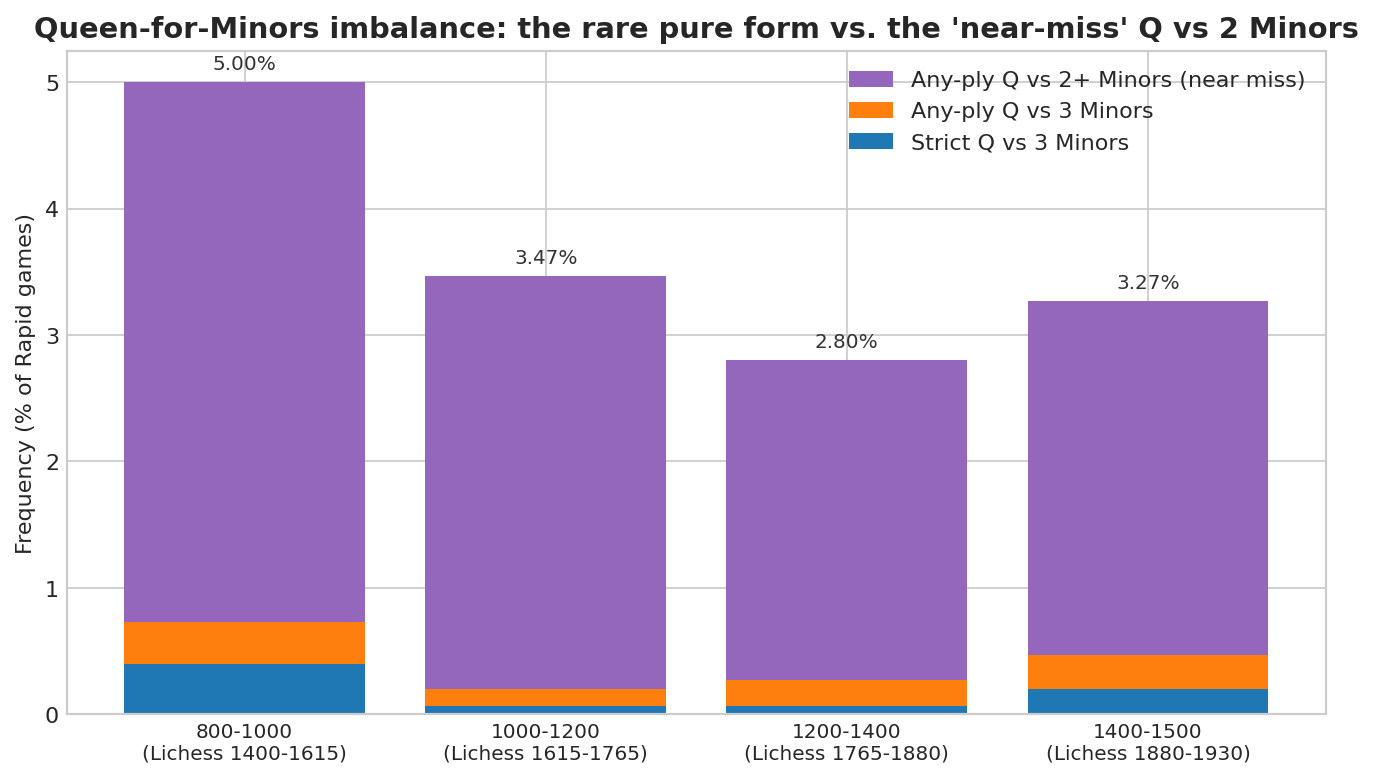
This chart highlights that players are far more likely to encounter a Queen vs 2 Minor Pieces situation (often resulting from a Queen for Rook and Minor Piece trade, or simply blundering a piece). For intermediate players, mastering the coordination of two minor pieces against a Queen is a more practical and frequent challenge than handling three.
Outcomes and Duration
When the strict Queen vs 3 Minor Pieces imbalance does occur, who typically wins? The data provides a mixed picture, heavily influenced by the rating band.
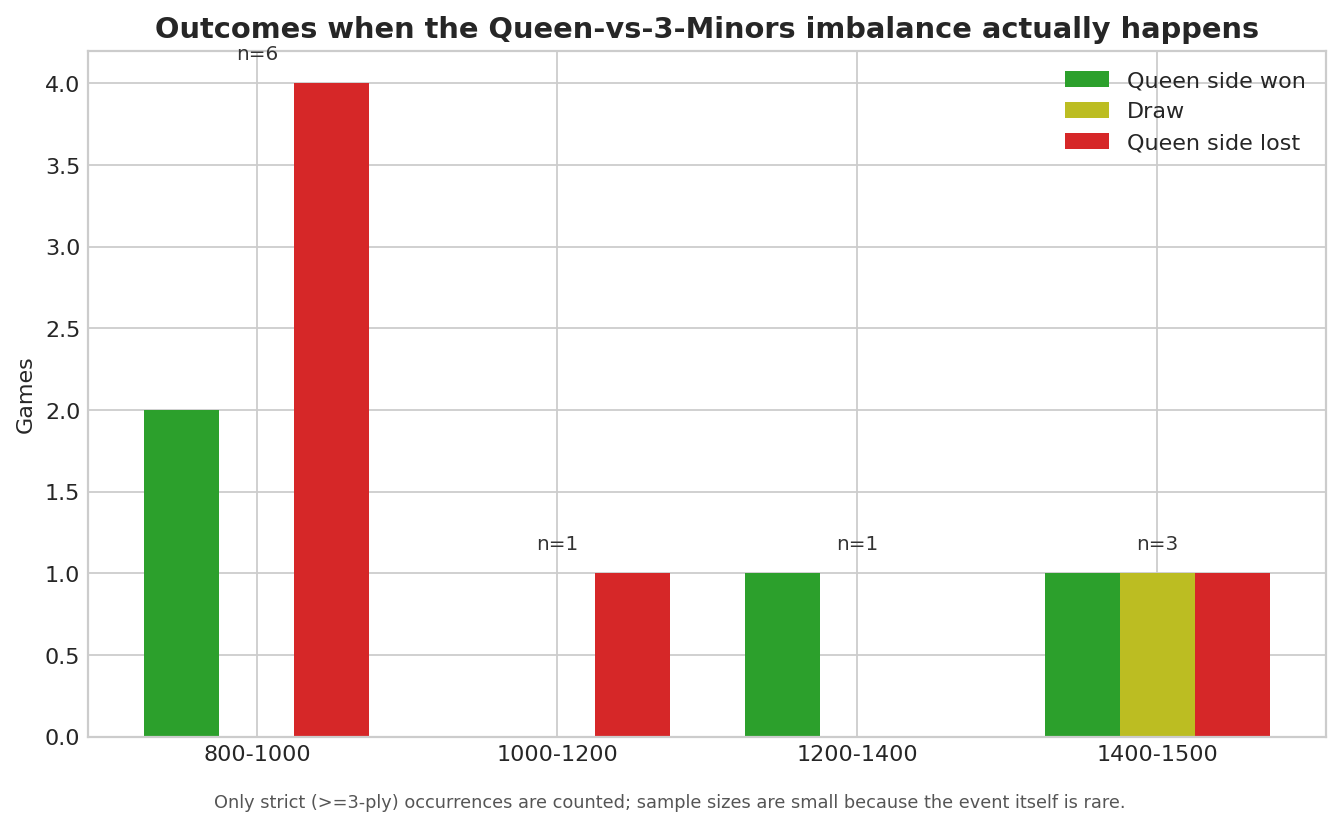
In the 800–1000 band, the side with the three minor pieces actually won more often (4 wins to 2). This suggests that at lower ratings, the player with the Queen struggles to deal with the coordinated threats of three minor pieces, or perhaps the Queen was won at the cost of significant positional concessions. In the higher bands, the sample size is too small to draw definitive conclusions, but the outcomes are more balanced.
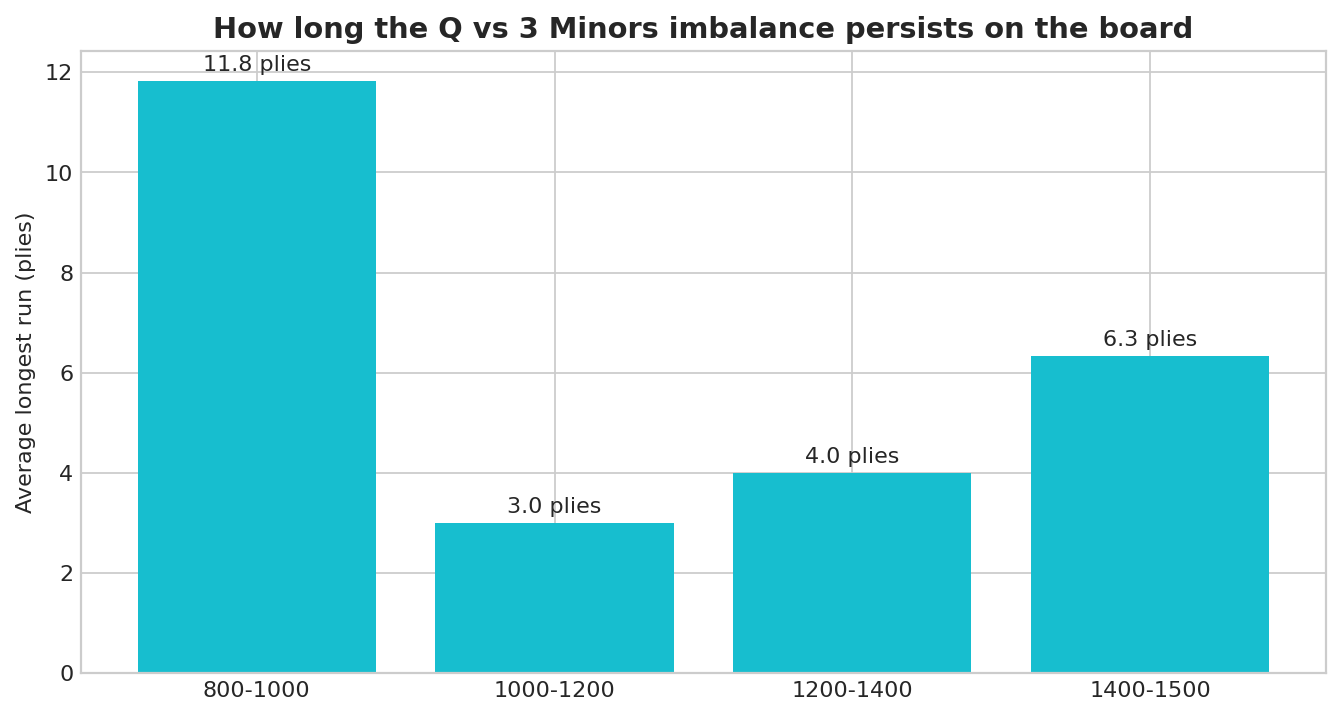
The duration of the imbalance also varies. In the 800–1000 band, the imbalance persists for an average of nearly 12 plies (6 full moves), indicating that players are willing to play out the resulting complex positions. In the middle bands, the duration drops significantly, suggesting that the imbalance is often quickly resolved through further tactical exchanges or blunders.
Roadmap and Actionable Advice by Rating Band
Based on the data and engine analysis of specific games, here is a roadmap for handling the Queen vs Minor Pieces imbalance as you climb the rating ladder.
800–1000: Avoiding Chaotic Blunders
In this band, the imbalance often arises from chaotic tactical sequences where players lose track of the material balance. The data shows that the side with the three minor pieces often wins, suggesting that the Queen holder struggles with coordination.
Actionable Advice:
- Simplify the Position: If you have the Queen, your goal should be to simplify the position. Trade off pawns to open lines for your Queen and reduce the minor pieces' ability to create outposts.
- Beware of Forks: Minor pieces, especially Knights, excel at creating forks. When playing against three minor pieces, constantly scan for potential Knight forks that could win your Queen or other material.
Visual Evidence:
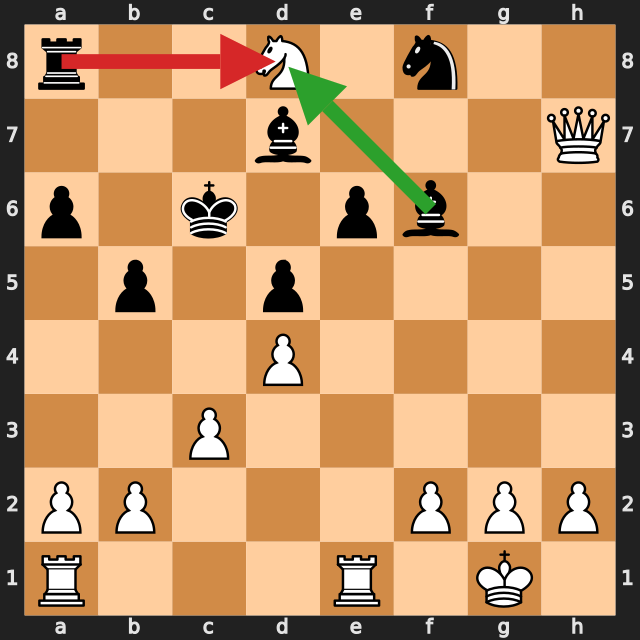
In this example from the 800-1000 band, Black plays Rxd8??, hanging the rook and allowing White to maintain a powerful Queen. The engine prefers Bxd8, which keeps the material balance closer and maintains the tension of the minor pieces against the Queen.
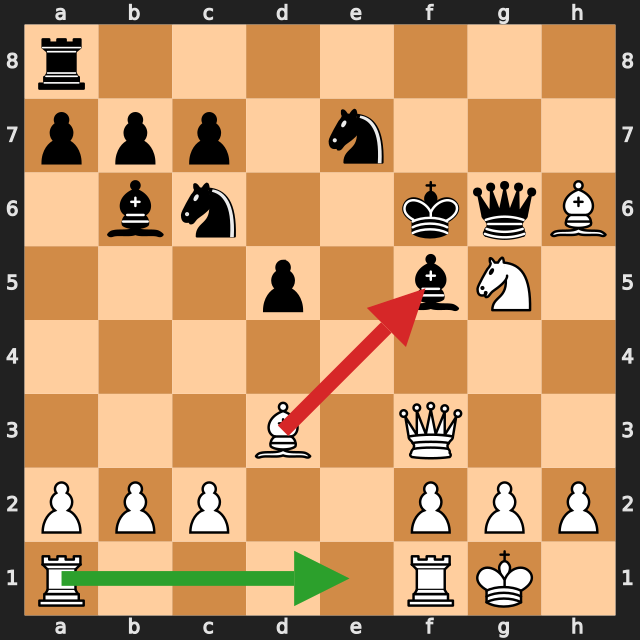
In another example, White plays Bxf5??, giving up the Queen for a Bishop and Knight. The engine suggests Rae1, coordinating the pieces and maintaining a slight edge without sacrificing the Queen.
1000–1200: Improving Coordination
As players reach the 1000–1200 range, the frequency of the strict imbalance drops dramatically. Players are becoming more aware of material value and are less likely to stumble into such complex trades.
Actionable Advice:
- Coordinate the Minors: If you have the three minor pieces, your success depends entirely on coordination. Keep your pieces defending each other and use them to control key squares. A loose minor piece is an easy target for a Queen.
- Target Weaknesses: Use the Queen's mobility to target undefended pawns and create multiple threats simultaneously. The minor pieces cannot easily defend across the entire board.
Visual Evidence:
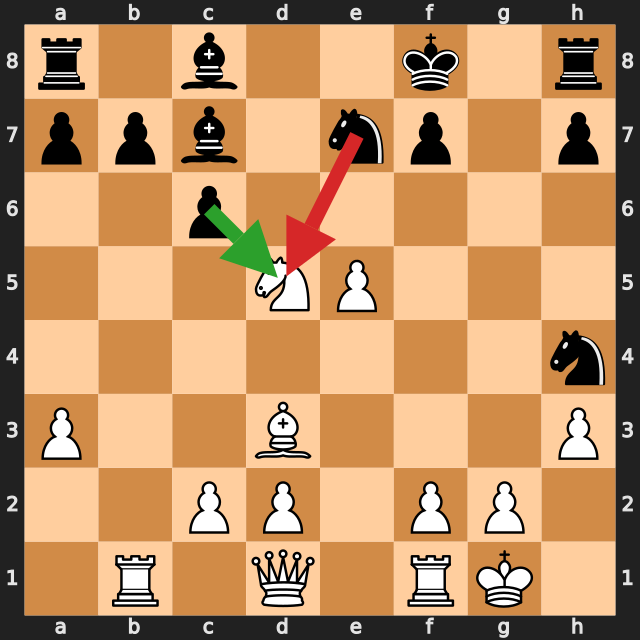
Here, Black plays Nxd5??, inviting a recapture that ultimately costs the Queen. The engine prefers cxd5, keeping the material balanced and avoiding the complex imbalance.
1200–1400: Positional Understanding
In this band, the imbalance remains rare. When it does occur, it is often the result of a calculated (though perhaps flawed) sacrifice rather than a simple blunder.
Actionable Advice:
- Evaluate the King Safety: The safety of the Kings is paramount in these imbalances. A Queen can quickly exploit an exposed King, while three coordinated minor pieces can weave a mating net if the opponent's King is vulnerable.
- Control the Center: The side with the minor pieces must control the center to restrict the Queen's mobility. Use pawns to support the minor pieces and create a solid central presence.
1400–1500: Tactical Precision
At the top of the intermediate range, players are more tactically precise. The slight uptick in the frequency of the imbalance suggests that players are more willing to enter these complex positions if they believe they have a tactical advantage.
Actionable Advice:
- Calculate Forcing Variations: Before entering a Queen vs 3 Minor Pieces imbalance, calculate the forcing variations carefully. Ensure that your pieces will be coordinated and that you are not leaving any immediate tactical vulnerabilities.
- Use the Queen's Range: The Queen's primary advantage is its range. Use it to attack from a distance, forcing the minor pieces into passive defensive positions.
Conclusion
The Queen vs 3 Minor Pieces imbalance is a rare but fascinating occurrence in intermediate Rapid chess. While the pure form is uncommon, understanding the dynamics of this material distribution—and the more frequent "near-miss" scenarios—can significantly improve your tactical awareness and positional understanding. By focusing on coordination, king safety, and tactical precision, you can navigate these complex imbalances with confidence as you climb the rating ladder.
Chess Coach April 21, 2026
Data and Methodology Files
The underlying data and analysis scripts used to generate this report are available in the attached CSV files:
band_summary_v2.csv: Summary statistics for each rating band.per_game_v2.csv: Detailed analysis of all 6,000 games, including imbalance detection and outcomes.