The debate has raged on chess forums for years: "My puzzle rating is 2000, why am I stuck at 1200 in rapid?" Players often wonder if their puzzle rating is inflated, if they are uniquely bad at translating tactics to real games, or if there is a specific threshold where puzzle training finally "pays off."
To answer these questions definitively, we analyzed a dataset of 2,763 active chess players, comparing their puzzle ratings with their rapid game ratings. We also cross-referenced this with blunder taxonomy data from over 5.8 million Lichess puzzles and engine evaluations from nearly a million games. The findings are clear, sometimes surprising, and highly actionable.
Platform Note: While our raw data comes from Lichess, all game ratings in this article have been converted to their Chess.com Rapid equivalents using an empirically derived mapping table. Lichess puzzle ratings remain on the Lichess scale, as Chess.com puzzle ratings use a fundamentally different algorithm. Where relevant, the approximate Lichess equivalent is noted in parentheses.
The Mathematical Reality: Yes, There is a Gap
The first question most players ask is whether a gap between puzzle and game rating is normal. The data provides a resounding yes. Across our entire sample, the average player's Lichess puzzle rating is 258 points higher than their Lichess rapid rating (which translates to an even larger numerical gap when compared to Chess.com ratings).
However, the relationship is strongly correlated ($R = 0.815$). Your puzzle rating does predict your game rating, just not on a 1:1 scale.
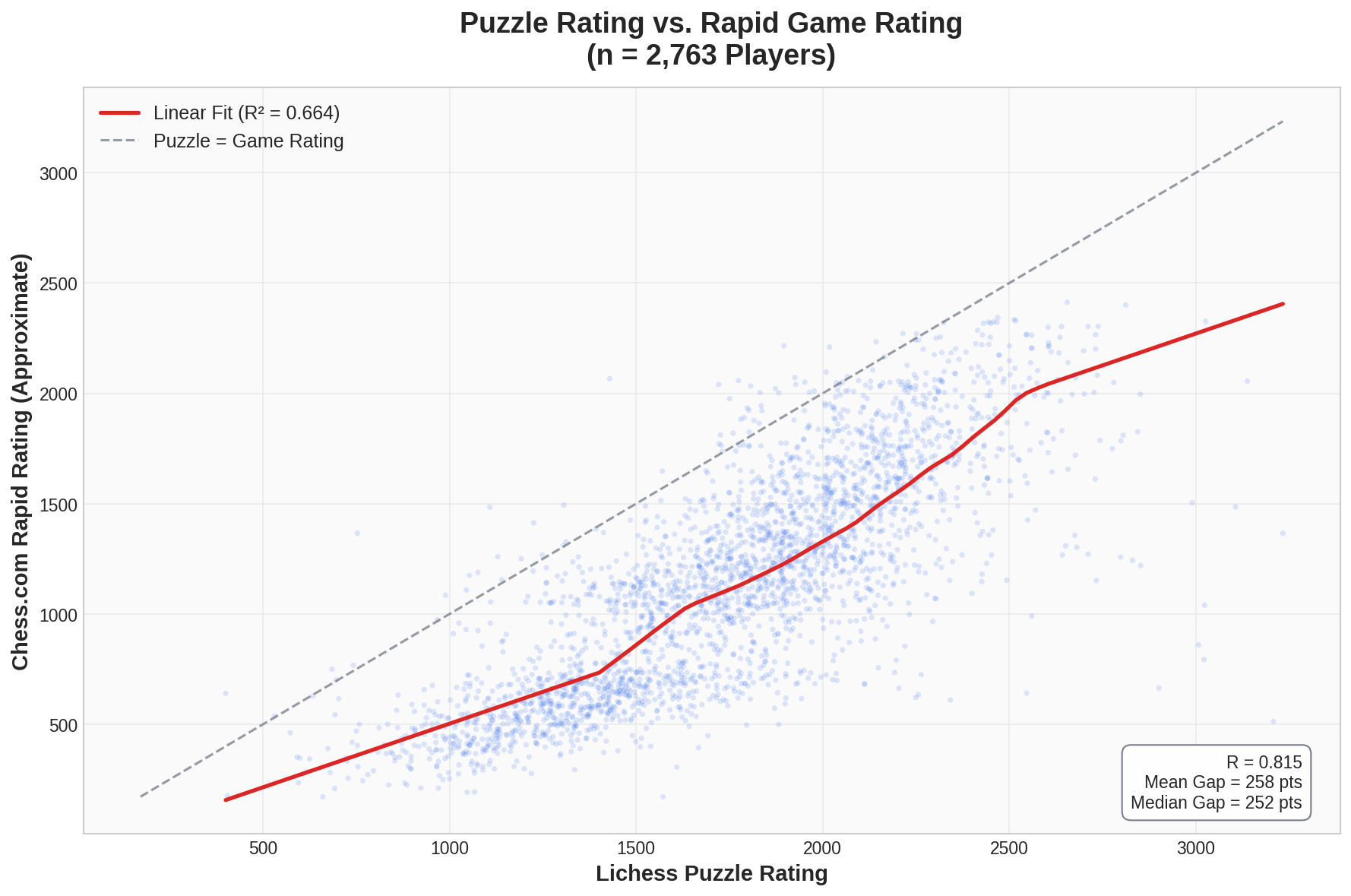
The linear regression formula for predicting your Chess.com Rapid rating based on your Lichess puzzle rating is approximately:
Chess.com Rapid ≈ (0.918 × Puzzle Rating) - 463
This means that for every 100 points your puzzle rating increases, your predicted Chess.com Rapid rating rises by about 92 points—but with a large constant offset of -463. In practical terms, a puzzle rating of 1500 predicts a Chess.com Rapid rating of roughly 914, and a puzzle rating of 2000 predicts approximately 1373.
The Gap Narrows as You Improve
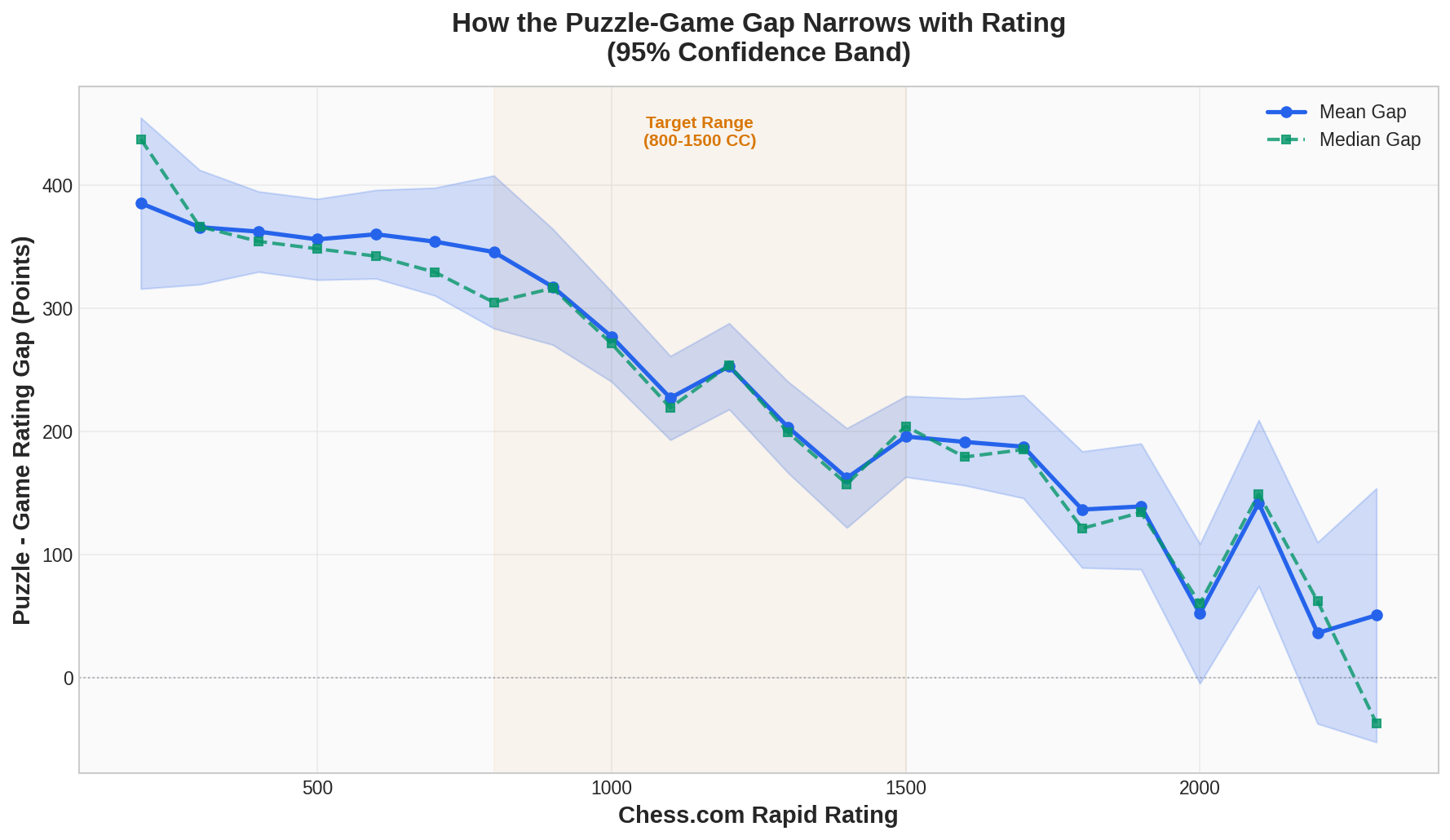
One of the most striking findings is that the "puzzle gap" is not static. It is massive for beginners and shrinks significantly as players reach advanced levels.
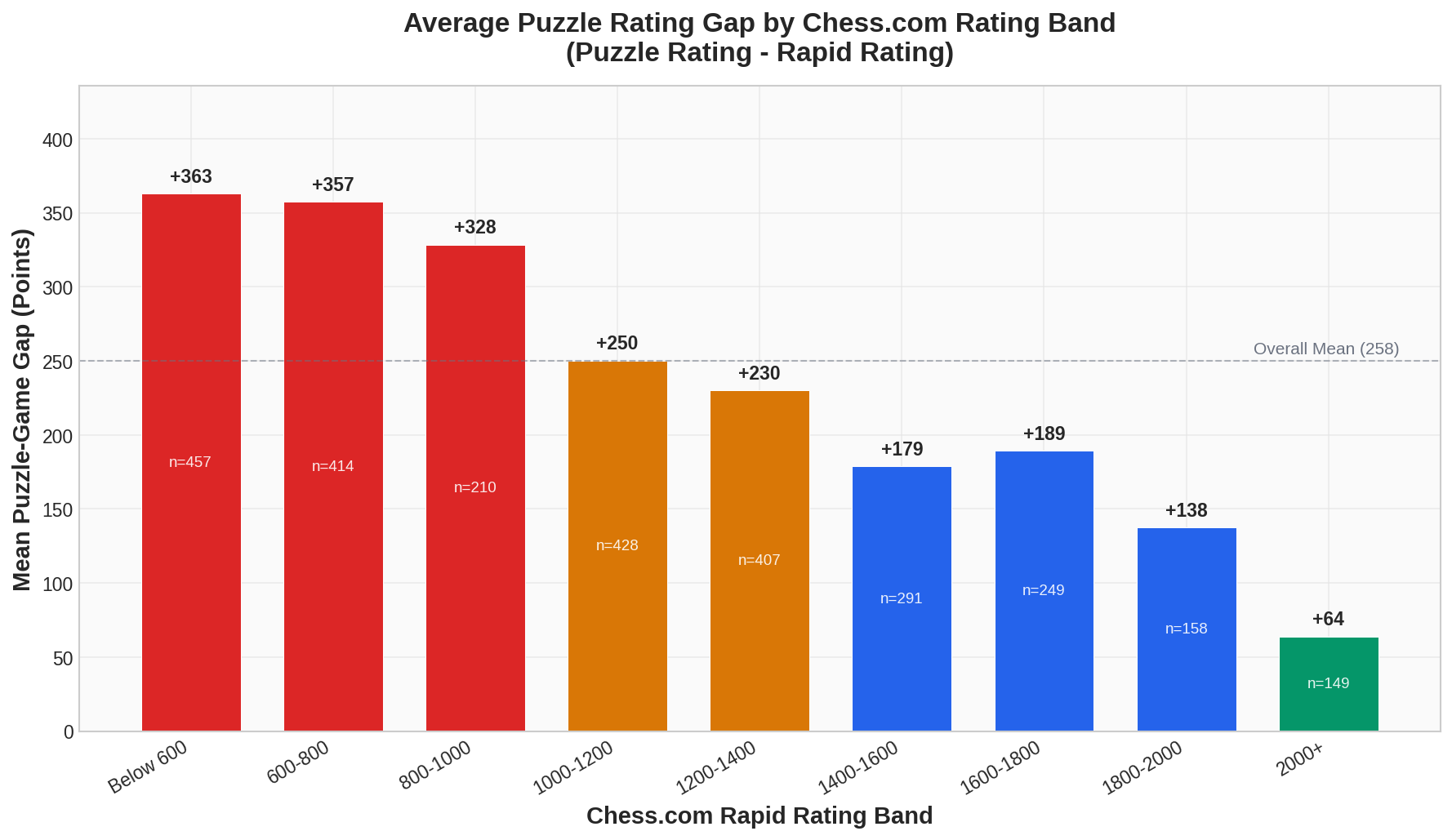
For players rated below 800 on Chess.com, the gap between their puzzle rating and their equivalent game rating is enormous—often exceeding 350 points on the Lichess scale. An astonishing 96% of players below 600 have a puzzle rating higher than their game rating.
By the time a player reaches 1800+ on Chess.com, the gap shrinks to under 140 points, and only about 70% of players have a puzzle rating higher than their game rating.
The following table summarizes the key statistics for each Chess.com rating band:
| Chess.com Rating Band | Sample Size | Mean Puzzle Rating | Mean Gap (Puzzle - Game) | % with Puzzle > Game |
|---|---|---|---|---|
| Below 600 | 457 | 1,185 | +363 | 96.1% |
| 600 - 800 | 414 | 1,490 | +357 | 93.0% |
| 800 - 1,000 | 210 | 1,648 | +328 | 91.0% |
| 1,000 - 1,200 | 428 | 1,733 | +250 | 83.4% |
| 1,200 - 1,400 | 407 | 1,898 | +230 | 84.5% |
| 1,400 - 1,600 | 291 | 2,007 | +179 | 80.8% |
| 1,600 - 1,800 | 249 | 2,150 | +189 | 79.9% |
| 1,800 - 2,000 | 158 | 2,221 | +138 | 72.8% |
| 2,000+ | 149 | 2,347 | +64 | 63.8% |
The "Large Gap" Phenomenon: Why Tactics Don't Always Translate
In our dataset, 8.2% of players exhibited a "Large Gap"—defined as a puzzle rating that is 600+ points higher than their Lichess rapid rating (often a 800+ point gap compared to Chess.com).
These players typically boast puzzle ratings around 2000-2100 but are stuck at 1000-1200 in Chess.com Rapid (approximately 1400-1600 on Lichess). Why does this happen? The data points to three primary causes.
1. The "I Know There's a Tactic" Advantage
When you solve a puzzle, you are explicitly told that a tactical sequence exists. In a real game, nobody taps you on the shoulder. Our blunder taxonomy data reveals that players in the 1000-1300 range miss clear tactical wins (evaluations of +3 to +6) in over 39% of games where they occur.
2. Opening Traps and Positional Blunders
A player might be brilliant at calculating a 3-move mating net, but if they fall for an opening trap or hang a piece in a quiet position, those calculation skills never get used.
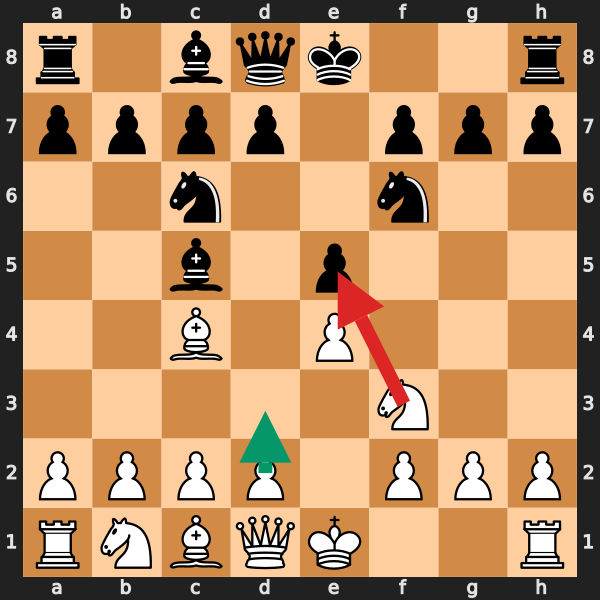 Red arrow: A common beginner mistake (Nxe5??) in the Italian Game, falling for a trap. Green arrow: The solid developing move (d3). Puzzle skills don't prevent opening knowledge gaps.
3. Time Management
Puzzles are untimed. Rapid games are not. Our analysis of clock data shows that players with large gaps often spend too much time calculating complex lines in simple positions, leading to time trouble and subsequent blunders later in the game.
The Roadmap: Actionable Advice by Rating Band (800 - 1500)
Based on the data, here is a guide to what your puzzle rating should be to reach specific Chess.com milestones, and what you should focus on to get there.
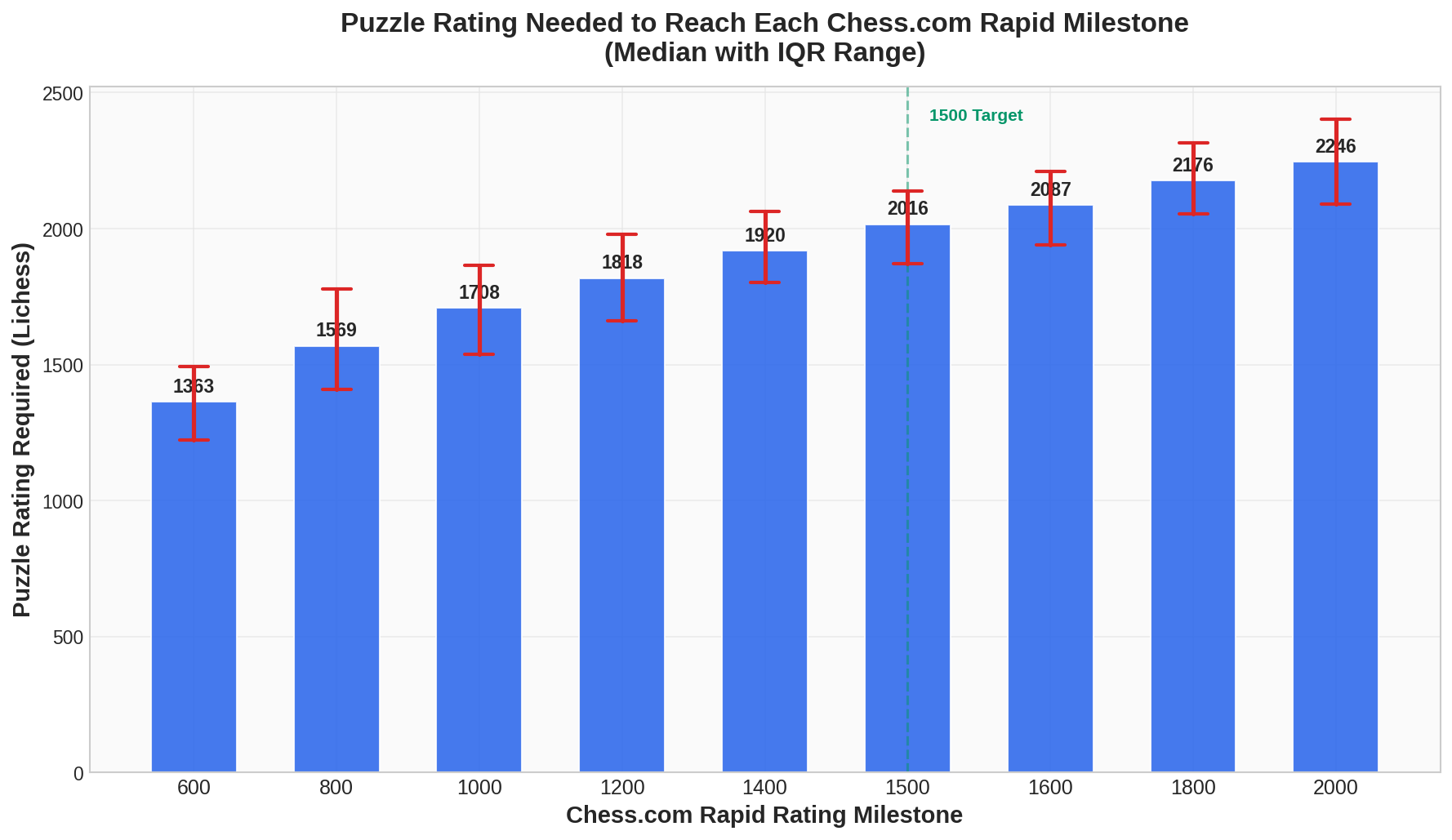
| Chess.com Rapid Milestone | Median Puzzle Rating Needed | 25th Percentile | 75th Percentile |
|---|---|---|---|
| 600 | 1,363 | ~1,220 | ~1,510 |
| 800 | 1,569 | ~1,400 | ~1,720 |
| 1,000 | 1,708 | ~1,540 | ~1,880 |
| 1,200 | 1,818 | ~1,640 | ~1,990 |
| 1,400 | 1,920 | ~1,730 | ~2,100 |
| 1,500 | 2,016 | ~1,830 | ~2,200 |
| 1,600 | 2,037 | ~1,860 | ~2,230 |
| 1,800 | 2,176 | ~1,980 | ~2,370 |
| 2,000 | 2,246 | ~2,050 | ~2,440 |
The 800 - 1,000 Band (Lichess Rapid ~1,400 - 1,615)
Target Puzzle Rating: ~1,550 - 1,700
Players in this band average 18.2 blunders (evaluation drop of 300+ centipawns) per 10 games. A staggering 40% of these blunders occur in positions where the player was already winning. The problem is not a lack of tactical vision—it is a lack of basic safety awareness.
Actionable Advice: Stop trying to solve 2000-rated puzzles. Your games are being decided by 1-move blunders (hanging pieces). Focus exclusively on "Mate in 1" and "One Move" puzzle themes until your blunder rate drops below 10 per 10 games. Before every move, perform a strict "blunder check": ask yourself, "Does my opponent's last move attack anything? Does my intended move leave anything undefended?"
The 1,000 - 1,200 Band (Lichess Rapid ~1,615 - 1,765)
Target Puzzle Rating: ~1,700 - 1,850
The blunder rate drops slightly at this level, but the mistake rate (100-299 centipawn loss) jumps to 6.4 per game. Players here are missing basic 2-move tactics like forks and pins, particularly when these patterns arise in positions that do not "look" tactical.
Actionable Advice: This is the rating where basic tactical patterns become the primary differentiator. Focus your puzzle training on specific themes: Forks, Pins, and Discovered Attacks. On Lichess, you can filter puzzles by theme. Aim to solve 10-15 themed puzzles per day rather than 50 random ones.
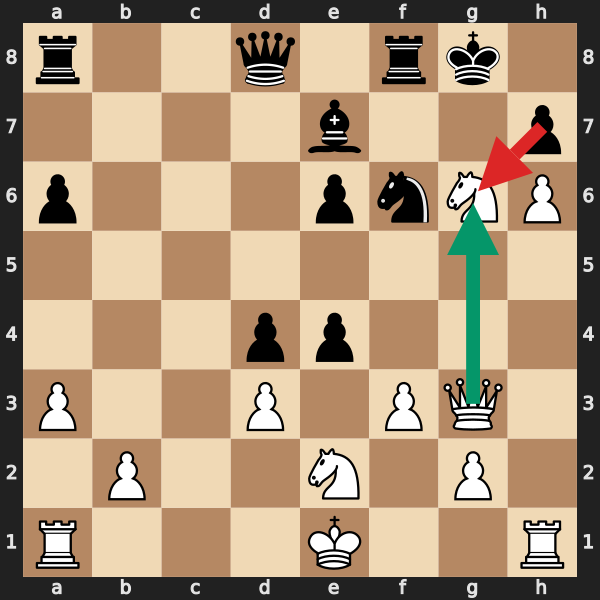 A typical 1000-level puzzle. Black plays hxg6?? opening the h-file. White plays Qg6, threatening Qg7#.
The 1,200 - 1,400 Band (Lichess Rapid ~1,765 - 1,880)
Target Puzzle Rating: ~1,850 - 2,000
Players here are tactically competent but struggle with conversion. Our endgame frequency data shows that Rook endgames appear in 18% of games at this level, but the conversion rate of a +2 advantage is surprisingly low. The puzzle-game gap at this level averages 230 points, suggesting that while these players can see tactics when prompted, they struggle to create them in real games.
Actionable Advice: Shift 30% of your puzzle time to "Endgame" themes. You are likely building advantages in the middlegame but failing to convert them efficiently. Learn basic Philidor and Lucena positions. Additionally, begin analyzing your losses—not for blunders, but for the quiet moments where you made a slightly passive move that let your opponent equalize.
The 1,400 - 1,500 Band: Breaking 1500 (Lichess Rapid ~1,880 - 1,930)
Target Puzzle Rating: ~2,000 - 2,150
To break 1500 on Chess.com, our regression model predicts you need a Lichess puzzle rating of approximately 2,154. The empirical median of players currently at 1500 is 2,016. This is the inflection point where puzzle training alone is no longer sufficient—you need to integrate positional understanding.
Actionable Advice: At this level, simple tactics are rarely handed to you. You must create them through positional pressure. Focus on "Defensive Move" and "Quiet Move" puzzles—these are the themes that separate the 1400 from the 1500 player. Start analyzing your games to see why you missed tactics: was it a lack of calculation, or were your pieces simply on passive squares that could never generate threats?
The Myth of "Grinding Puzzles"
Perhaps the most surprising finding in our dataset was the relationship between the number of puzzles solved and the size of the puzzle-game gap.
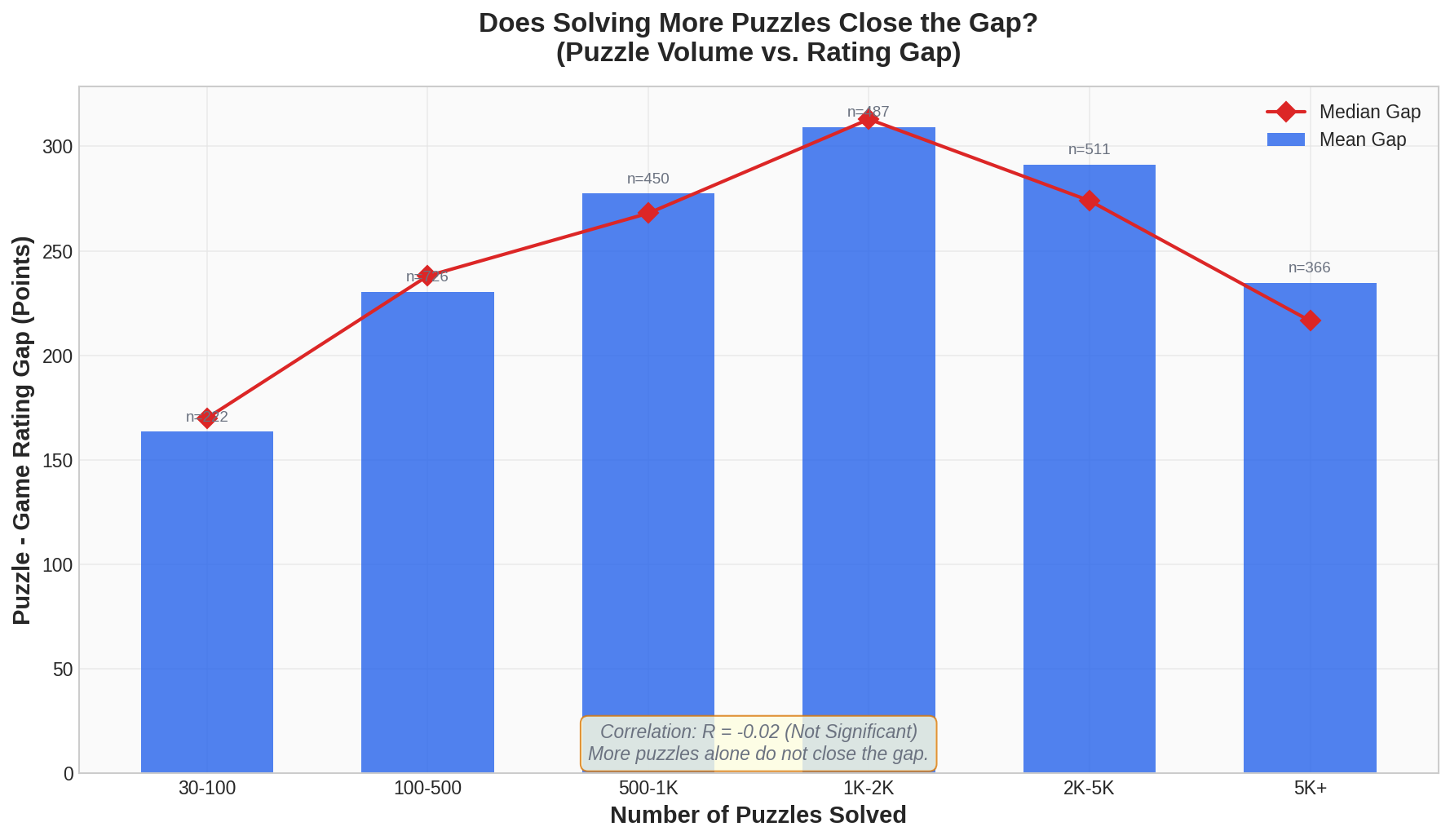
There is zero statistical correlation ($R = -0.02$) between the volume of puzzles solved and the closure of the rating gap.
A player who has solved 5,000 puzzles is just as likely to have a 400-point gap as a player who has solved 500. Mindlessly grinding puzzles does not automatically translate to game strength.
To bridge the gap, puzzle training must be:
- Deliberate — Focus on themes that match your weaknesses, not random puzzles.
- Reflective — After solving (or failing) a puzzle, spend 30 seconds understanding why the solution works.
- Integrated — Combine puzzle training with game analysis. When you blunder in a game, find a puzzle that tests the same pattern.
- Appropriately rated — Solving puzzles 500 points above your game rating is not productive. Stay within 200-300 points of your puzzle rating.
Data and Methodology
This analysis was conducted using a dataset of 2,763 active Lichess players, collected via the Lichess API. To ensure data quality, we only included players with established (non-provisional) ratings and a minimum of 30 puzzle sessions and 20 rapid games.
Game evaluations and blunder statistics were sourced from a database of ~950,000 Lichess games annotated with Stockfish 17 evaluations, accessed through the Grandmaster Guide analytics platform. Puzzle theme data was derived from the Lichess puzzle database (5.88 million puzzles).
Statistical Methods: Linear regression was used for the primary correlation analysis (R = 0.815, R² = 0.664, p < 0.001). A second-degree polynomial fit was also tested (R² = 0.670) but did not meaningfully improve the model. Rating band statistics use 200-point Chess.com intervals. All confidence intervals are at the 95% level.
Underlying Data Files:
| File | Description | ||||||||||||||||||||||||||||||||||||||||||||||||||||||||||||||||||||||||||||||
|---|---|---|---|---|---|---|---|---|---|---|---|---|---|---|---|---|---|---|---|---|---|---|---|---|---|---|---|---|---|---|---|---|---|---|---|---|---|---|---|---|---|---|---|---|---|---|---|---|---|---|---|---|---|---|---|---|---|---|---|---|---|---|---|---|---|---|---|---|---|---|---|---|---|---|---|---|---|---|---|
|
Raw player data: puzzle rating, rapid rating, games played | ||||||||||||||||||||||||||||||||||||||||||||||||||||||||||||||||||||||||||||||
|
Processed data with Chess.com conversions and gap calculations | ||||||||||||||||||||||||||||||||||||||||||||||||||||||||||||||||||||||||||||||
|
Aggregated statistics by Chess.com rating band | ||||||||||||||||||||||||||||||||||||||||||||||||||||||||||||||||||||||||||||||
|
Gap analysis grouped by puzzle rating level | ||||||||||||||||||||||||||||||||||||||||||||||||||||||||||||||||||||||||||||||
| analysis_summary.json | Full statistical summary in JSON format |
Chess Coach, April 15, 2026