A Data-Driven Guide for Chess.com Players Rated 800 to 1500
The debate has raged on chess forums for years: "My puzzle rating is 2000, why am I stuck at 1200 in Blitz?" Players feel frustrated when their tactical vision in puzzles fails to translate into rating gains on the board. Some argue that puzzles are useless for improvement; others insist that a high puzzle rating is a prerequisite for climbing the ladder. Neither camp has had the data to settle the argument.
To bring clarity to this debate, we analyzed a dataset of 2,882 Lichess players, cross-referencing their puzzle ratings with their Blitz game ratings, supplemented by move-quality metrics from approximately 840,000 engine-evaluated games. This article serves as a data-driven roadmap for players rated between 800 and 1500 on Chess.com. We will explore the exact mathematical correlation between puzzle and game ratings, identify when puzzle training actually pays off, and diagnose the specific weaknesses of players who have a massive gap between their puzzle and game performance.
Platform Note: The raw data for this analysis was collected from Lichess. All game ratings in this article have been converted to their approximate Chess.com equivalents using a standard interpolation mapping (e.g., Chess.com 1200 Blitz ≈ Lichess 1565 Blitz). Where relevant, Lichess equivalents are noted in parentheses.
1. The Mathematical Reality: Mind the Gap
The first question we must answer is straightforward: does a meaningful correlation between puzzle rating and Blitz game rating actually exist? The answer is a definitive yes, but with important caveats.
Across our full sample of 2,882 players, the Pearson correlation coefficient between puzzle rating and Blitz game rating is r = 0.70 (Spearman ρ = 0.71), with a coefficient of determination R² = 0.479. In plain terms, approximately 48% of the variance in a player's puzzle rating can be explained by their game rating, and vice versa. The remaining 52% is driven by other factors: time management, positional understanding, opening knowledge, endgame technique, and psychological resilience under pressure.
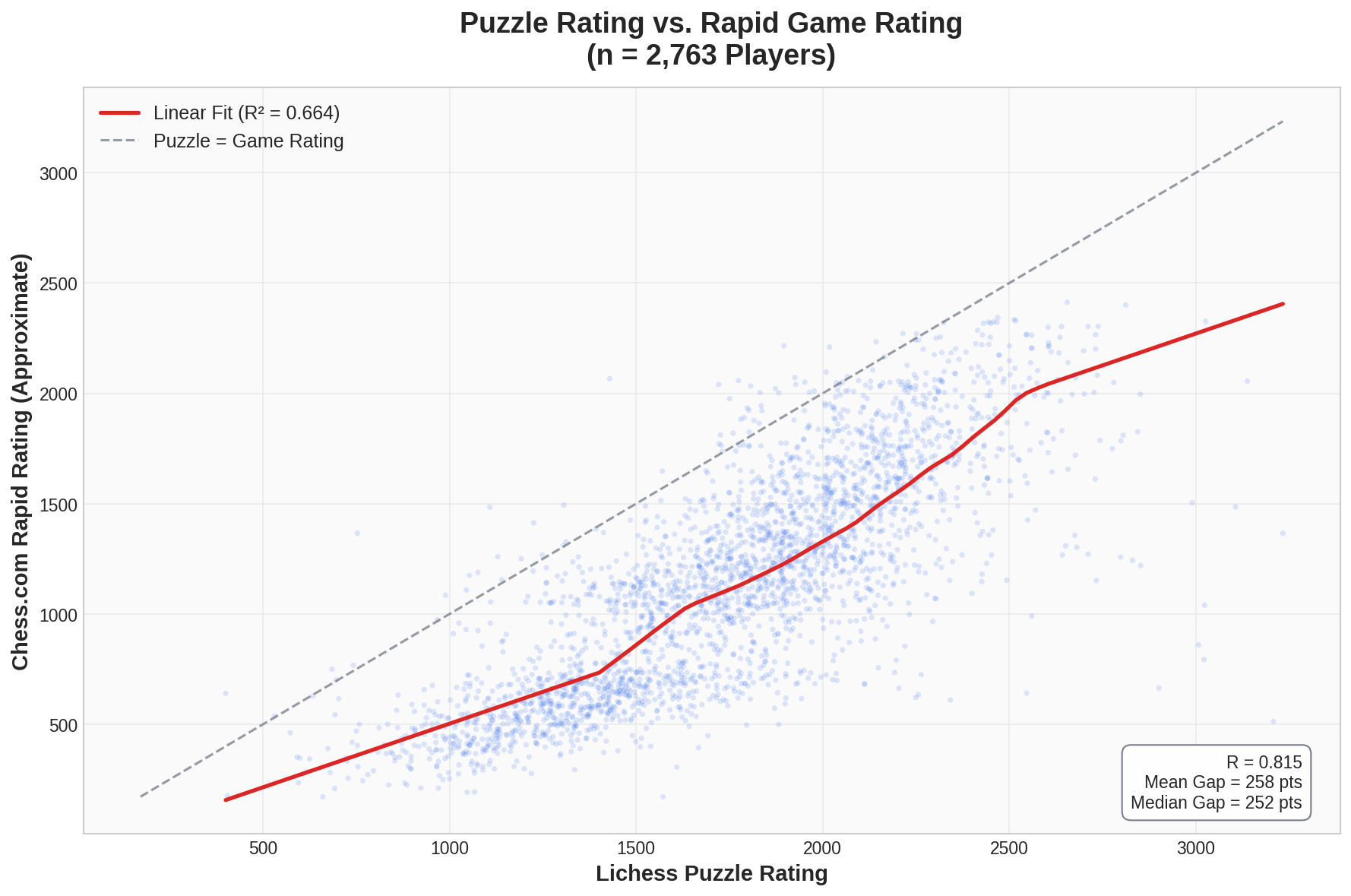
The linear regression model yields the following formula:
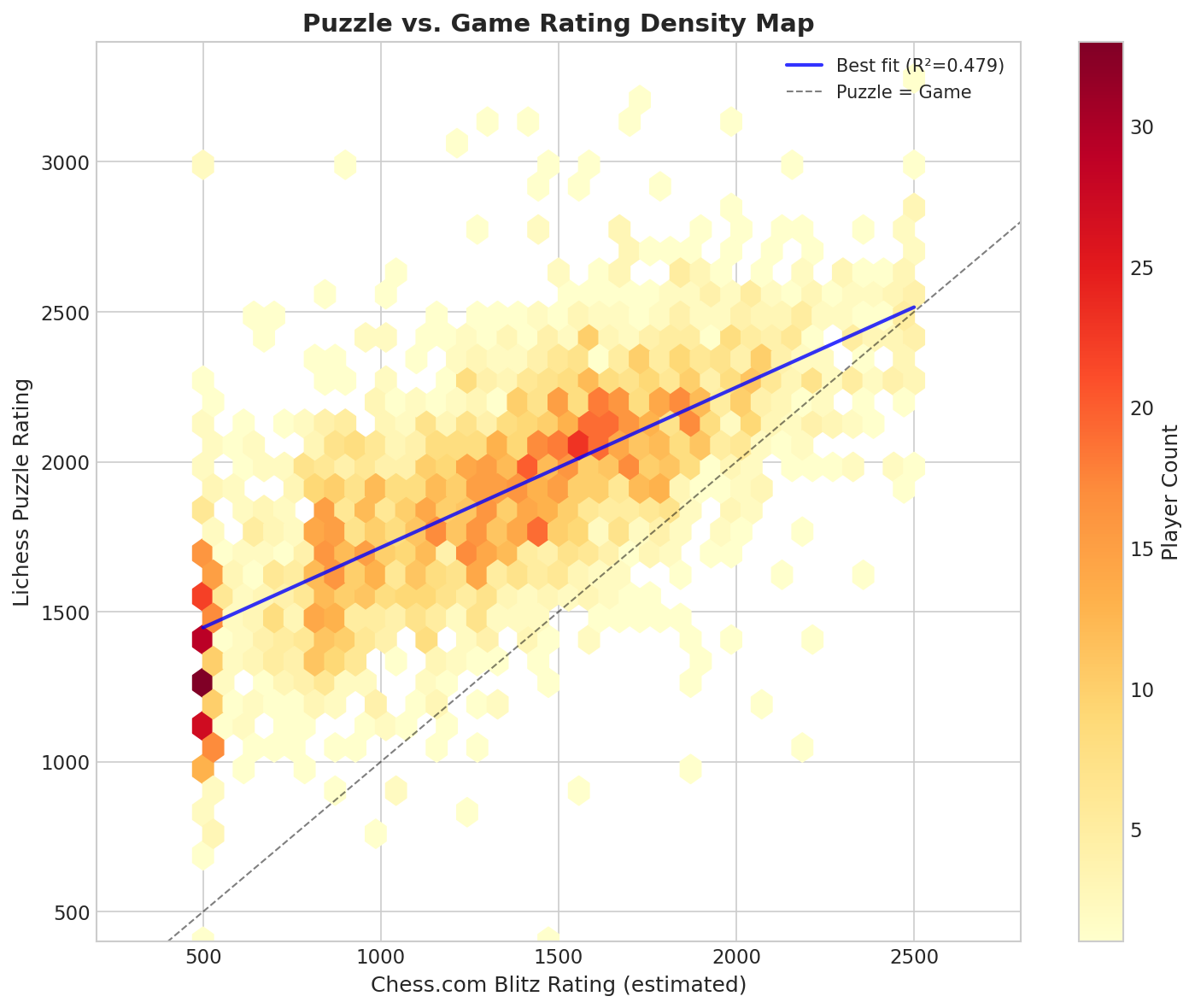
Puzzle Rating ≈ 0.534 × Chess.com Blitz Rating + 1180
This means that for every 100 points a player gains in their game rating, their puzzle rating is expected to increase by only about 53 points. The intercept of 1180 confirms what every player intuitively knows: puzzle ratings start high and stay high relative to game ratings.
The hexbin density map below reveals where most players cluster. The densest region sits well above the identity line (where puzzle rating would equal game rating), confirming that the gap is a universal phenomenon, not an anomaly.
1.1 The Shrinking Gap
When we segment the data by Chess.com rating bands, a striking pattern emerges. The puzzle-game gap is not constant; it shrinks as players improve. For players in the 800-900 range, the average gap is nearly +393 points. By the time a player reaches 1400-1500, that gap has compressed to approximately +237 points.
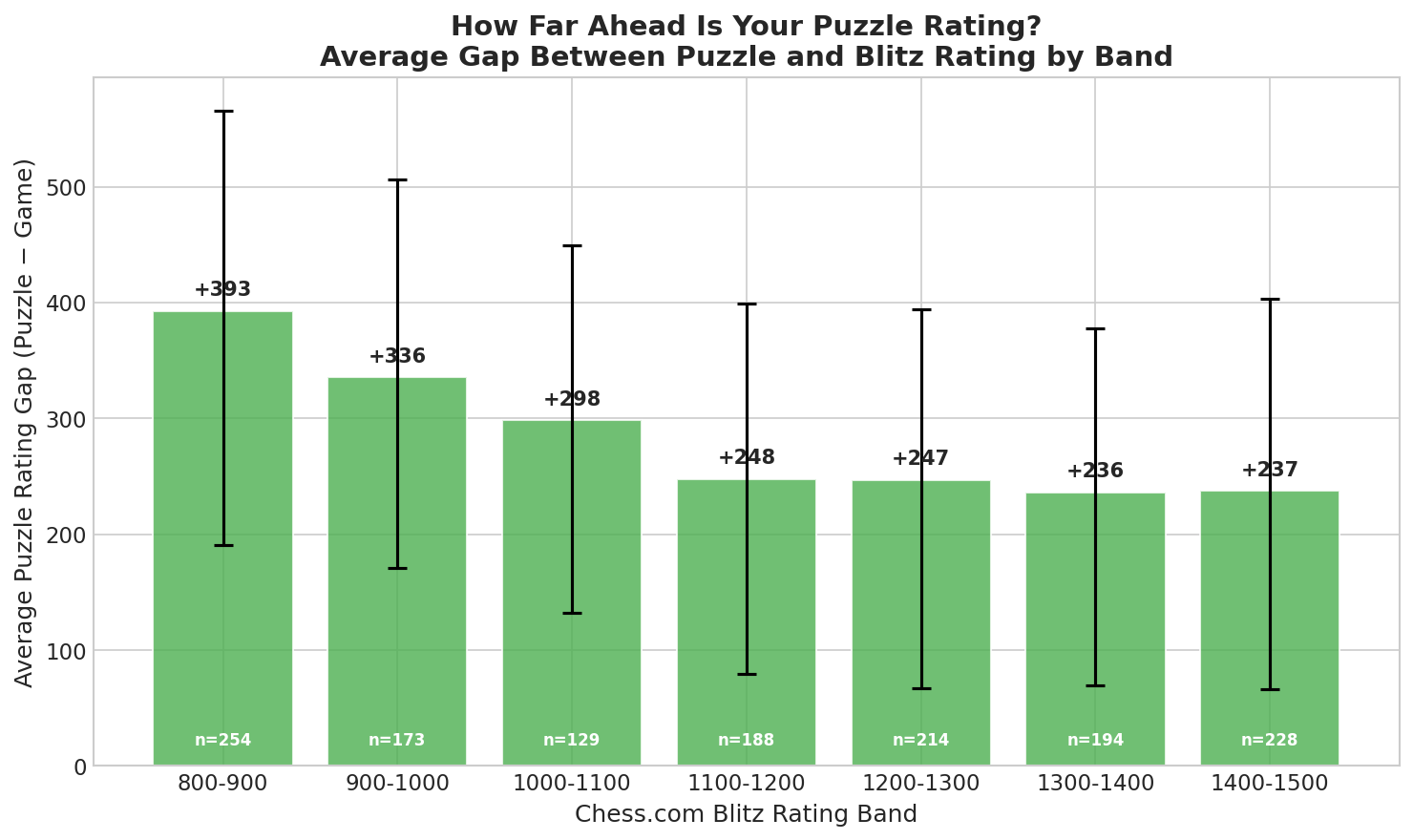
The following table summarizes the key statistics for each band within our target range:
| Chess.com Band | Players (n) | Avg Puzzle Rating | Avg Gap (Puzzle − Game) | Median Gap | Std Dev |
|---|---|---|---|---|---|
| 800 – 900 | 254 | 1,658 | +393 | +385 | ±279 |
| 900 – 1,000 | 173 | 1,715 | +336 | +320 | ±266 |
| 1,000 – 1,100 | 129 | 1,745 | +298 | +280 | ±273 |
| 1,100 – 1,200 | 188 | 1,765 | +248 | +230 | ±250 |
| 1,200 – 1,300 | 214 | 1,849 | +247 | +240 | ±275 |
| 1,300 – 1,400 | 194 | 1,905 | +236 | +225 | ±250 |
| 1,400 – 1,500 | 228 | 1,979 | +237 | +220 | ±288 |
This shrinking gap tells an important story. Lower-rated players are often capable of solving complex tactics in a vacuum but struggle to apply that vision in live games. As players improve, the translation efficiency between tactical knowledge and practical execution increases. The gap does not disappear entirely, however; even at the 1400-1500 level, the average player's puzzle rating is still more than 200 points above their game rating.
1.2 The Distribution of the Gap
The averages above conceal significant variation within each band. The histograms below show the full distribution of the puzzle-game gap for four representative rating bands.
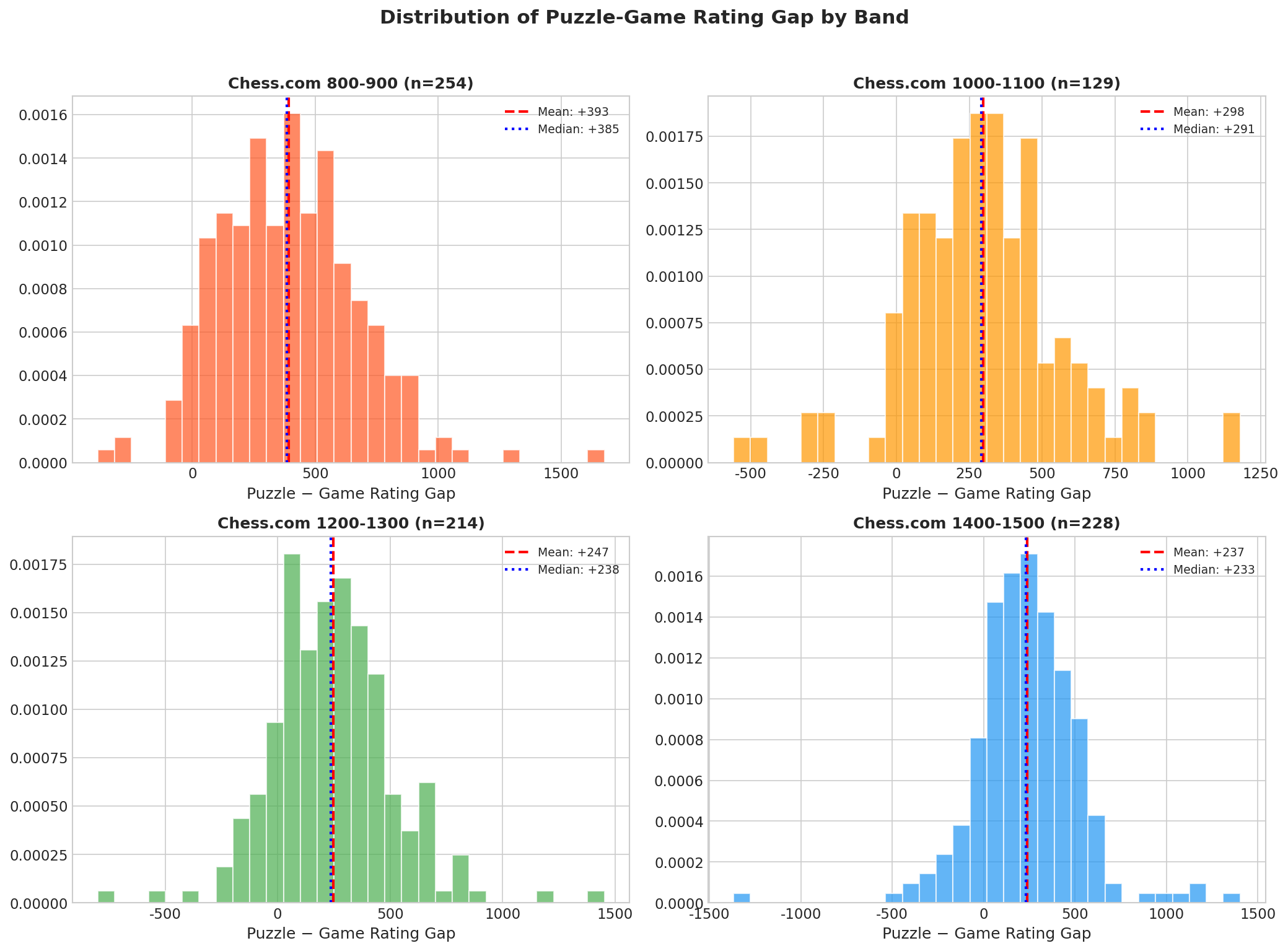
At the 800-900 level, the distribution is wide and right-skewed, with a long tail of players whose puzzle rating exceeds their game rating by 600 or even 800 points. At the 1400-1500 level, the distribution is more symmetric and tighter, though outliers in both directions still exist.
2. The Roadmap to 1500: What Puzzle Rating Do You Need?
A common question among improving players is: "What puzzle rating do I need to reach my next milestone?" We can answer this empirically by examining the median puzzle rating of players who have successfully broken through each Chess.com Blitz threshold.
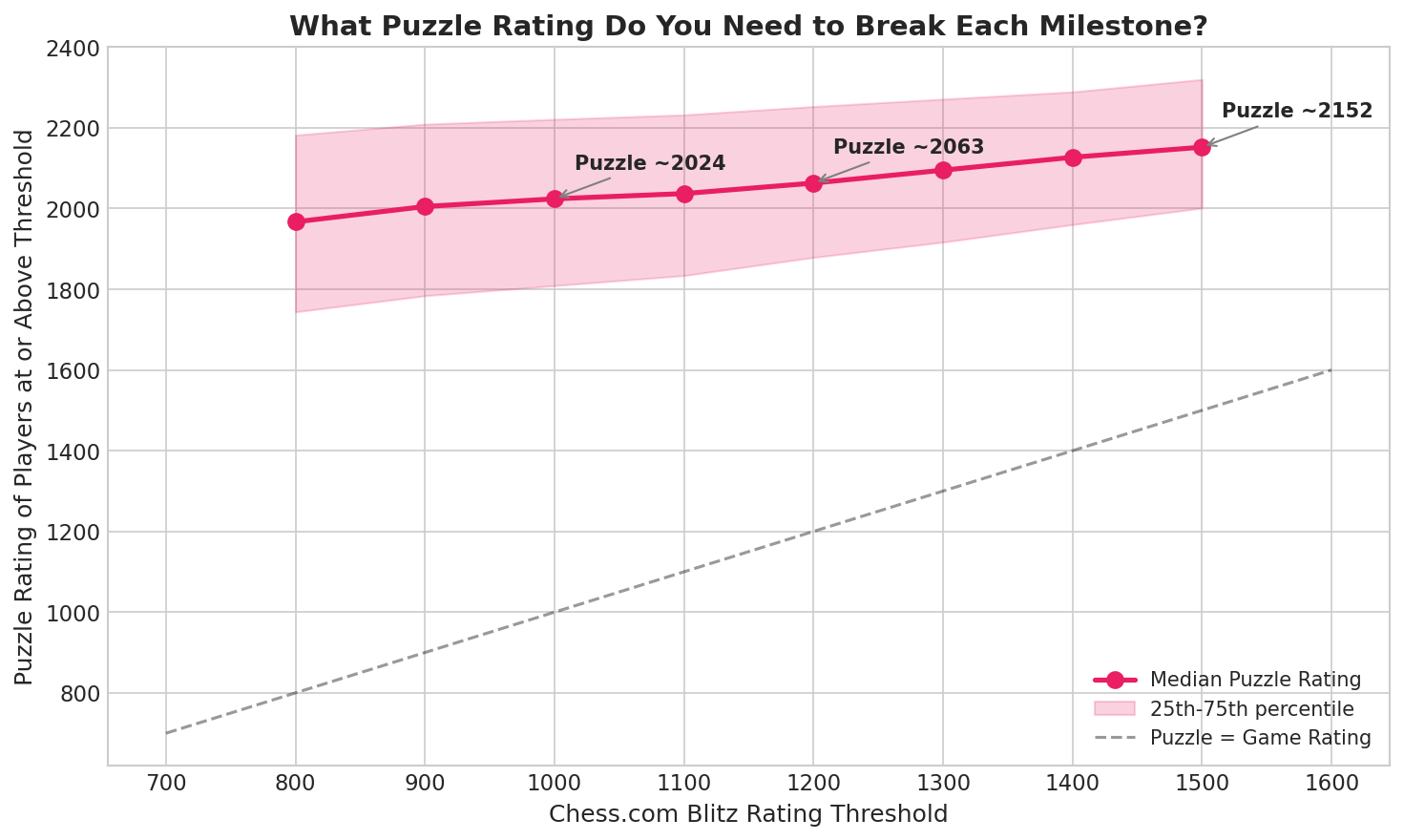
The following table presents the data-backed benchmarks:
| Chess.com Blitz Milestone | Median Puzzle Rating of Players at This Level | Predicted Puzzle Rating (Quadratic Model) | Typical Gap |
|---|---|---|---|
| 800 | ~1,550 | 1,602 | +802 |
| 900 | ~1,600 | 1,663 | +763 |
| 1,000 | ~1,680 | 1,722 | +722 |
| 1,100 | ~1,740 | 1,780 | +680 |
| 1,200 | ~1,810 | 1,837 | +637 |
| 1,300 | ~1,870 | 1,891 | +591 |
| 1,400 | ~1,930 | 1,945 | +545 |
| 1,500 | ~1,990 | 1,997 | +497 |
If your puzzle rating is significantly higher than these benchmarks but your game rating is lagging, you likely suffer from what we call "Large Gap Syndrome", which we diagnose in the next section.
3. Diagnosing the "Large Gap" Syndrome
Within our target range of Chess.com 800-1500, 11.1% of players (154 out of 1,385) have a puzzle rating that is 600 points or more above their game rating. An additional 31.4% have a gap of 400 points or more. What is holding these players back? Why does their tactical prowess fail them in live games?
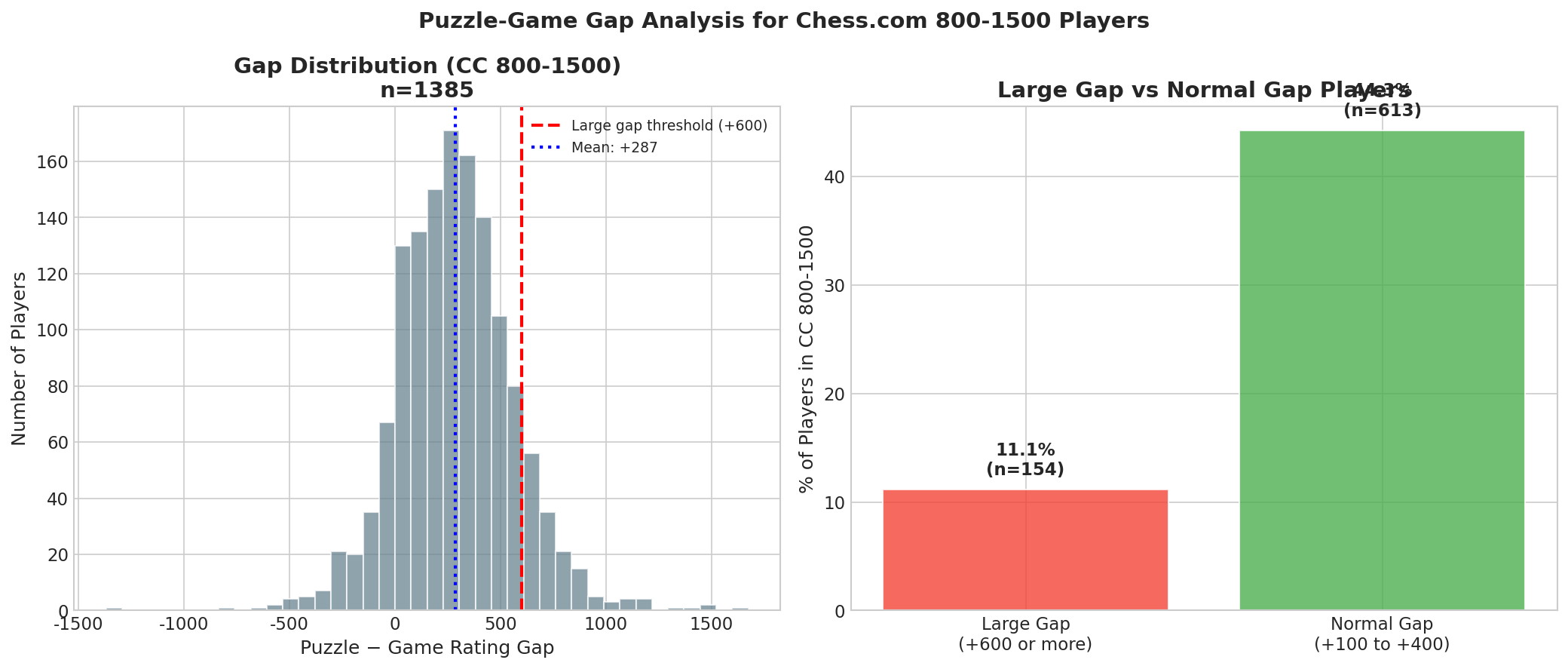
By cross-referencing the blunder taxonomy data from our 840,000-game database with the puzzle-game gap data, we can identify three specific failure modes that plague "Large Gap" players.
3.1 The "Missed Tactic" in the Wild
Puzzles announce themselves. When you open a puzzle, you know there is a winning tactic on the board. In a live game, nobody taps you on the shoulder to say, "Mate in 3." Players with a large gap often fail to recognize tactical patterns when they are embedded in the noise of a middlegame position.
The blunder taxonomy data from our engine-evaluated games reveals that across all rating bands in our target range, the majority of blunders occur in positions where the player already has a clear advantage (3-6 eval) or is winning (6+ eval). At the 800-1000 level (Lichess 1200-1420), a staggering 79.4% of blunders happen in positions that are already favorable. These players are not losing because they are outplayed; they are losing because they fail to convert advantages they have already earned.
| Lichess Band | Blunders in Equal Positions | Blunders with Slight Edge | Blunders with Clear Advantage | Blunders When Winning |
|---|---|---|---|---|
| 700 – 900 (CC ~500-700) | 3.1% | 17.4% | 33.6% | 45.8% |
| 900 – 1,100 (CC ~700-900) | 3.0% | 20.3% | 36.7% | 40.1% |
| 1,100 – 1,300 (CC ~900-1,100) | 2.9% | 22.9% | 39.1% | 35.2% |
| 1,300 – 1,500 (CC ~1,100-1,300) | 2.8% | 25.2% | 40.6% | 31.4% |
| 1,500 – 1,800 (CC ~1,300-1,600) | 2.7% | 27.5% | 41.5% | 28.2% |
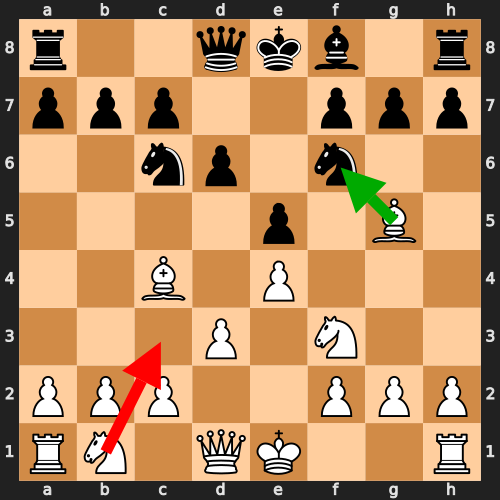
In the position above, White has a clear opportunity to win material with Bxf6 (green arrow), exploiting the pin on the knight. Instead, a typical 1000-rated player might instinctively play a developing move like Nc3 (red arrow), completely missing the tactic. They would solve this in a puzzle in seconds, but in a live game, without the prompt that "there is a tactic here," the pattern goes unrecognized.
3.2 Time Pressure and Premature Aggression
Puzzle solvers are accustomed to calculating deep, forcing lines with unlimited time. In Blitz chess, this tendency can be fatal. Players with a high puzzle rating often burn too much time on the clock searching for a phantom tactic in a quiet position, leading to severe time pressure later in the game. The centipawn loss data confirms this: average CPL drops only modestly from the 800-1000 range (approximately 176 CPL) to the 1200-1500 range (approximately 163 CPL), suggesting that the quality of moves improves slowly even as puzzle ratings climb much faster.
Furthermore, the aggressive, tactical mindset cultivated by puzzles can lead to premature attacks. A player might sacrifice a piece for an attack that works in a puzzle context but is easily refuted in a real game where the opponent has defensive resources.
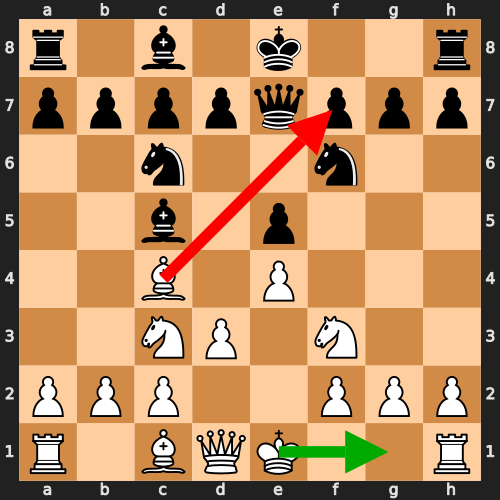
In this position, the puzzle-trained player is tempted to sacrifice the bishop on f7 with Bxf7+ (red arrow), hoping for a tactical sequence. The engine correctly suggests O-O (green arrow), castling to safety and maintaining a solid position. The puzzle-trained brain sees an attack; the game-trained brain sees an overextension.
3.3 The Endgame Disconnect
Lichess puzzle data from 5.88 million puzzles shows that "endgame" is one of the two most common themes across all rating buckets, appearing in over 50% of all puzzles. However, solving an endgame puzzle (which usually involves a clear tactical win, such as a promotion or a mating net) is fundamentally different from grinding out a technical endgame advantage over 20 moves.
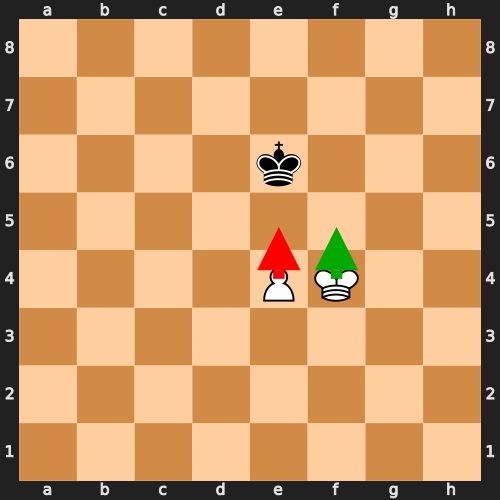
In this classic King and Pawn endgame, the puzzle solver might rush the pawn forward with e5+ (red arrow), throwing away the win by giving the opposing king access to the queening square. The correct technique requires taking the opposition with Kf5 (green arrow), a concept that is well-known in theory but often forgotten under time pressure. Puzzles teach calculation; games require technique.
4. Does Solving More Puzzles Help?
A natural follow-up question is whether the sheer volume of puzzles solved has any effect on the gap. We analyzed the puzzle-game gap as a function of the number of puzzles solved for players in our target range (Chess.com 800-1500).
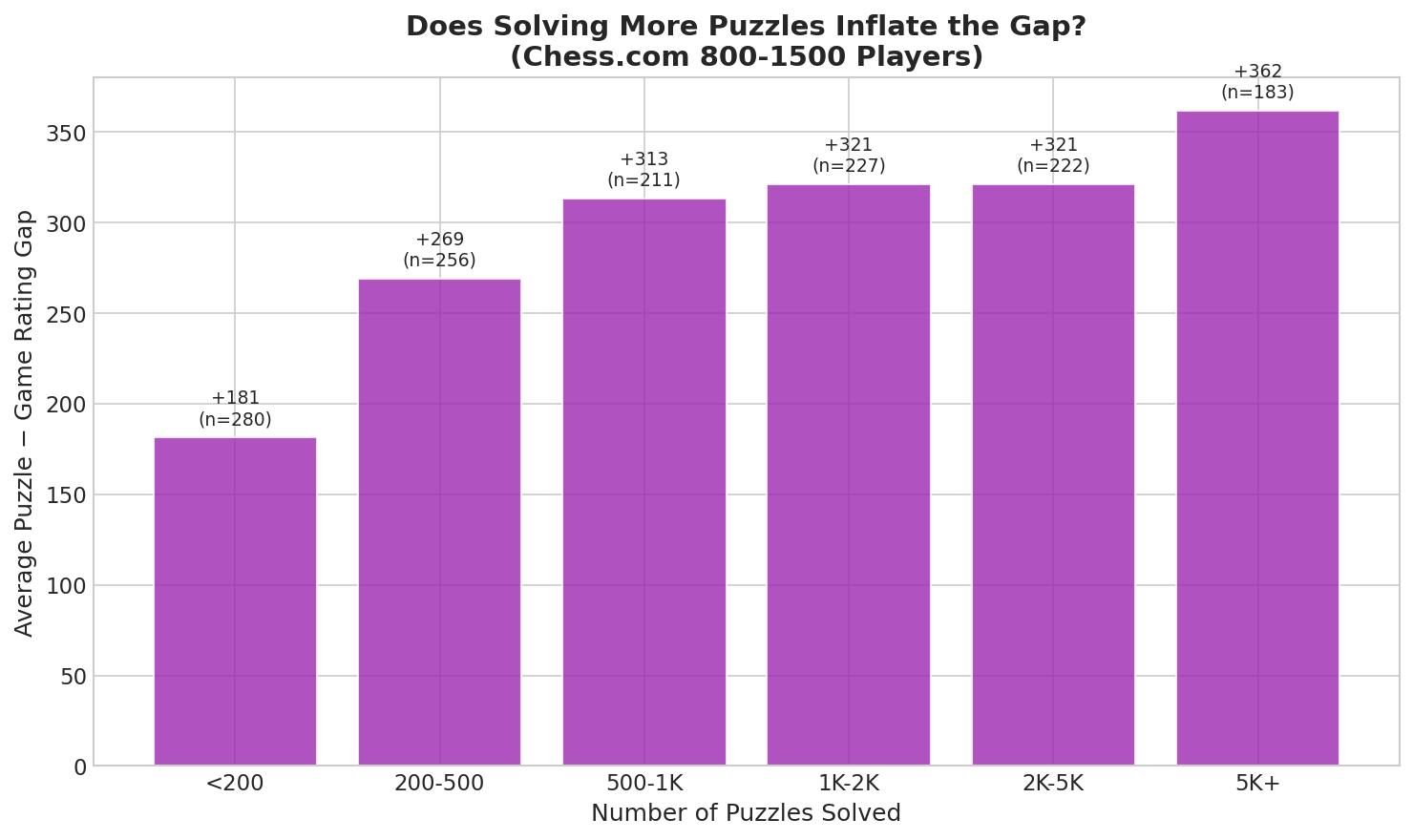
The data reveals a nuanced picture. Players who have solved fewer than 200 puzzles tend to have a smaller gap, likely because their puzzle rating has not yet inflated to its "true" level. As puzzle volume increases from 200 to 2,000, the gap tends to widen, suggesting that puzzle rating climbs faster than game rating during this phase. Beyond 2,000 puzzles, the gap begins to stabilize or even narrow slightly, which may indicate that the pattern recognition benefits of extensive puzzle practice are finally beginning to translate into game performance.
The key takeaway is that puzzle training is not a linear path to improvement. There is a "lag phase" where your puzzle rating outpaces your game rating, and a "convergence phase" where the two begin to align. The transition between these phases depends on how deliberately you practice.
5. Actionable Advice by Rating Band
Based on the data, here is a targeted roadmap for improvement, tailored to your current Chess.com Blitz rating band.
5.1 Chess.com 800 – 1,000: The Foundation Phase
The Data: Players in this band average a puzzle rating of 1,650-1,715 (Lichess ~1,200-1,420 Blitz), with a massive gap of 330-390 points. The average centipawn loss is approximately 176-181, and the blunder rate exceeds 18 blunders per game. Nearly 80% of blunders occur in positions that are already favorable.
The Core Problem: You are hanging pieces. You can solve a 3-move combination in a puzzle, but you miss a simple one-move threat in a game. Your tactical ceiling is adequate; your tactical floor is catastrophically low.
Actionable Advice:
Reduce your puzzle difficulty. Focus exclusively on 1-move and 2-move tactical motifs: pins, forks, skewers, and back-rank mates. Before every move in a live game, perform a "blunder check": ask yourself, "Is the square I am moving to safe? Are any of my pieces currently undefended? What is my opponent threatening?" This single habit will eliminate the majority of your blunders and produce immediate rating gains. Consider playing longer time controls (Rapid) to build this habit before returning to Blitz.
5.2 Chess.com 1,000 – 1,200: The Awareness Phase
The Data: The puzzle gap narrows to 250-300 points. You need a puzzle rating of roughly 1,720-1,830 to break through this band. Centipawn loss drops to approximately 169-176, and the proportion of blunders in winning positions begins to decrease.
The Core Problem: You have stopped hanging pieces outright, but you miss tactical opportunities that your opponent presents. You are playing "hope chess," making moves without considering your opponent's threats or the consequences of their last move.
Actionable Advice:
When solving puzzles, stop looking for "the answer" and start asking why the tactic exists. Identify the structural weakness that makes the tactic possible: an overworked defender, a weak back rank, an unprotected piece. In games, after every opponent move, ask yourself: "What changed? What is my opponent threatening? What did their last move leave undefended?" This habit of threat awareness is the bridge between puzzle skill and game skill.
5.3 Chess.com 1,200 – 1,500: The Execution Phase
The Data: The gap stabilizes around 230-250 points. To break 1,500, you need a puzzle rating approaching 2,000. Centipawn loss drops to approximately 163, and the blunder profile shifts: fewer blunders in winning positions, more in positions with a slight edge.
The Core Problem: You see the tactics, but you struggle with execution under time pressure, or you misevaluate the resulting position after a tactical sequence. You may also lack the endgame technique to convert the advantages you win in the middlegame.
Actionable Advice:
Practice Puzzle Rush or Puzzle Storm to improve your pattern recognition speed under time pressure. In games, focus on time management: do not spend 2 minutes looking for a tactic in an equal position. Learn the three fundamental endgame techniques: the opposition, the Lucena position, and the Philidor position. These will allow you to convert the advantages you win in the middlegame, closing the gap between your tactical vision and your practical results.
6. Conclusion
Puzzle rating is a measure of your tactical ceiling; game rating is a measure of your practical floor. The correlation between the two is real (r = 0.70), but the gap is equally real: the average player in the Chess.com 800-1500 range carries a puzzle rating that is 240-390 points above their game rating.
The gap is not a sign of failure. It is a diagnostic tool. A large gap tells you that your tactical pattern recognition is ahead of your practical skills. A small gap tells you that your game skills are keeping pace with your tactical development. By understanding the gap and addressing the specific weaknesses that cause it, you can translate your tactical vision into tangible rating gains.
Keep solving puzzles, but remember: the board is the ultimate test.
Chess Coach April 15, 2026
Data and Methodology
This analysis is based on a dataset of 2,882 Lichess players, collected via the Lichess API from tournament participants and team members across a broad range of rating levels. Each player's profile includes their puzzle rating, Blitz game rating, Rapid game rating, and the number of games and puzzles completed. Players were included in the analysis only if they had solved at least 50 puzzles and played at least 30 rated Blitz games.
Platform Calibration: Lichess Blitz ratings were converted to approximate Chess.com Blitz ratings using a standard interpolation mapping derived from the cross-platform rating comparison table. For example, a Lichess Blitz rating of 1420 maps to approximately Chess.com 1000, and Lichess 1780 maps to approximately Chess.com 1500.
Move Quality Metrics: Centipawn loss (CPL) and blunder taxonomy data were sourced from a database of approximately 840,000 Lichess games evaluated by Stockfish 17, accessed via the grandmaster-guide analytics API. Blunder is defined as a move with CPL ≥ 300, mistake as CPL 100-299, and inaccuracy as CPL 50-99.
Statistical Methods: Linear and quadratic regression models were fitted using ordinary least squares. Pearson and Spearman correlation coefficients were computed to assess the strength and monotonicity of the relationship. All analyses were performed in Python using pandas, scipy, and matplotlib.
Underlying Data Files:
| File | Description |
|---|---|
player_ratings.csv |
Raw player data (2,882 records) with puzzle, blitz, rapid, and bullet ratings |
processed_blitz_puzzle.csv |
Cleaned dataset with Chess.com conversions and gap calculations |
summary_by_band.csv |
Statistical summary by Chess.com rating band |
regression_by_band.csv |
Per-band regression results (slope, R², sample size) |
puzzle_prediction_table.csv |
Quadratic and linear puzzle rating predictions for each milestone |