For years, a debate has raged on chess forums: "My puzzle rating is 2000, but my blitz rating is stuck at 1200. What am I doing wrong?" The conventional wisdom is that puzzle ratings are inflated by 200 to 400 points compared to game ratings. But is this just anecdotal, or is there a mathematical truth behind it?
To answer this question, we analyzed a dataset of 5,084 active chess players, examining the exact correlation between their puzzle ratings and their blitz performance. We also looked at what separates players who successfully translate their tactical vision into game results from those who suffer from a massive "puzzle-game gap."
(Note: The data for this study was collected from Lichess. To make the findings more actionable for the broader chess community, all game ratings in this article have been converted to their approximate Chess.com Blitz equivalents using standard conversion tables. Lichess equivalents are mentioned sparingly for reference.)
The Actual Correlation: Yes, It Exists
The first question we must answer is whether puzzle rating actually correlates with game rating. The answer is a resounding yes. Our analysis reveals a strong positive correlation (Pearson r = 0.706) between a player's puzzle rating and their blitz rating.
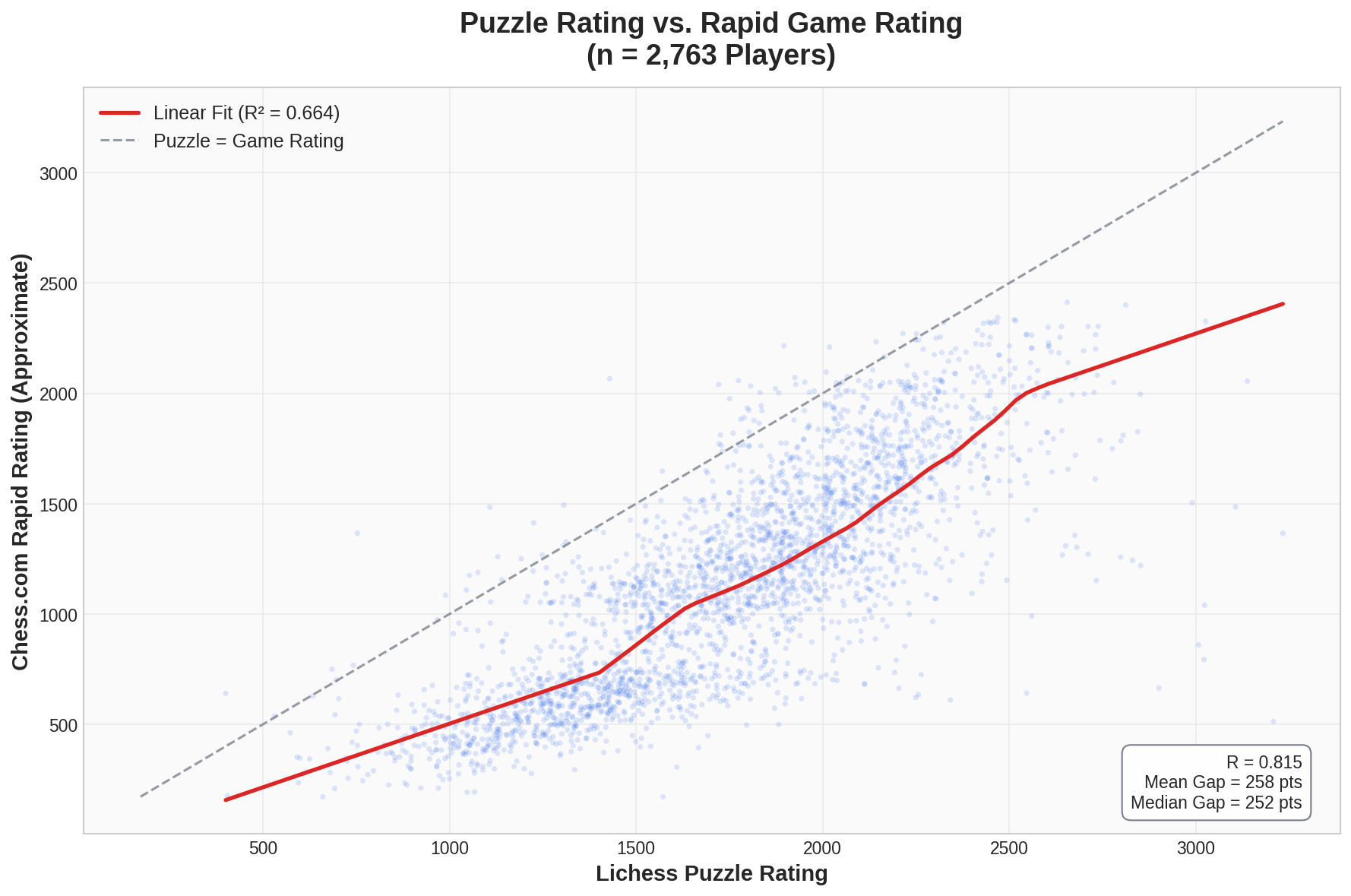
As the scatter plot demonstrates, as puzzle rating increases, game rating reliably follows. However, the relationship is not perfectly linear. A quadratic fit (the dashed orange line) models the data slightly better than a straight line, indicating that at lower ratings, large increases in puzzle rating yield smaller gains in game rating. It is only at higher levels that the gap begins to close.
The average gap across all 5,084 players is approximately 300 points. If your puzzle rating is 300 points higher than your Chess.com blitz rating, you are exactly average.
The Shrinking Gap: A Roadmap for Improvement
One of the most striking findings from the data is that the puzzle-game gap is not static. It shrinks dramatically as players improve.
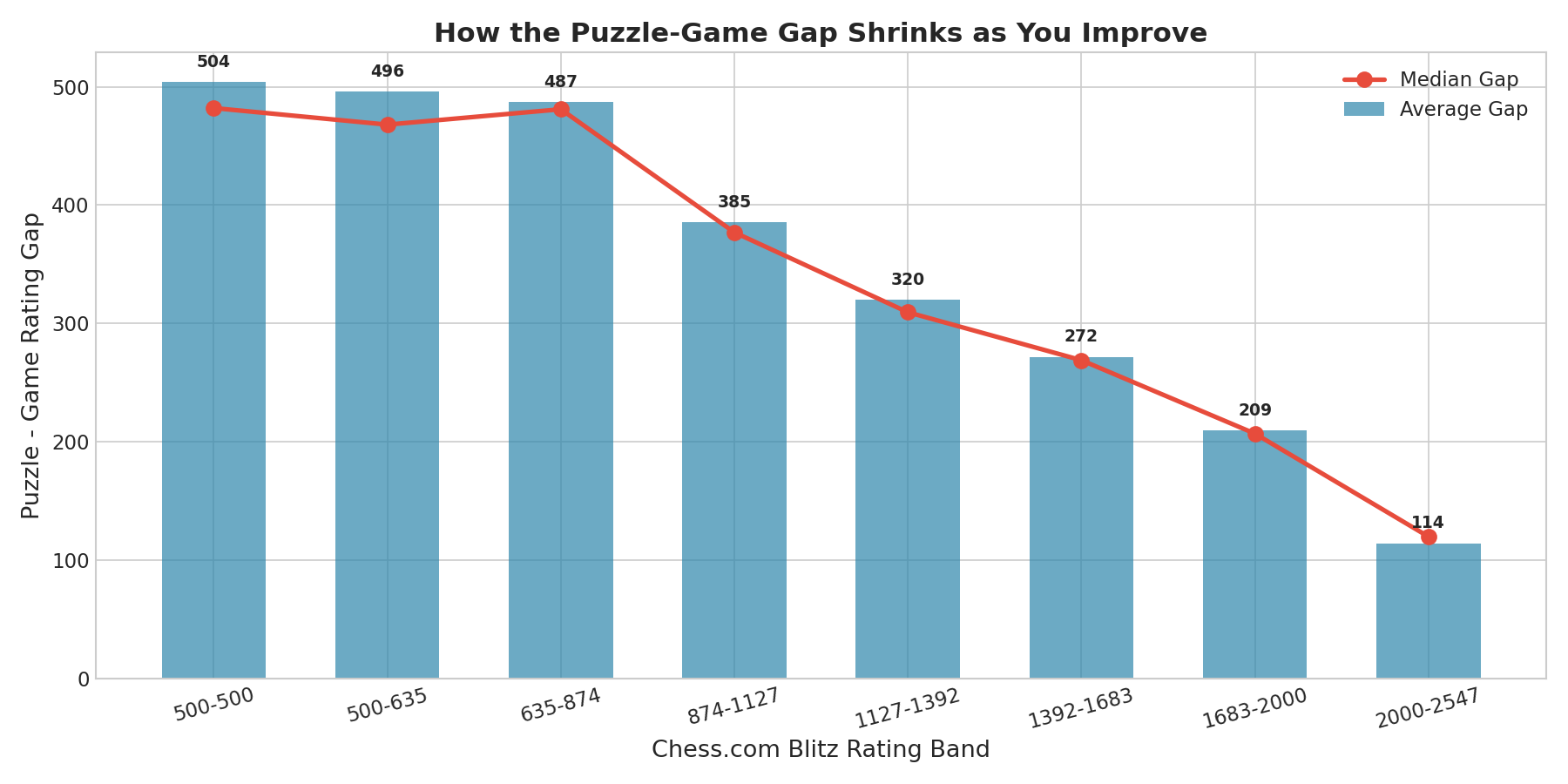
For players in the Chess.com 500-635 range (Lichess 900-1100), the median gap is nearly 500 points. A player might boast a puzzle rating of 1450 while struggling to break 600 in blitz. However, by the time a player reaches Chess.com 1683-2000 (Lichess 1900-2100), the median gap has shrunk to just 209 points.
This tells us something fundamental about chess improvement: Beginners learn to spot tactics in isolation long before they learn to create the conditions for those tactics in actual games.
What Puzzle Rating Do You Need to Break Your Next Milestone?
If you are trying to reach a specific rating goal, what puzzle rating should you aim for? Based on the median puzzle ratings of players at various milestones, here is your target roadmap:
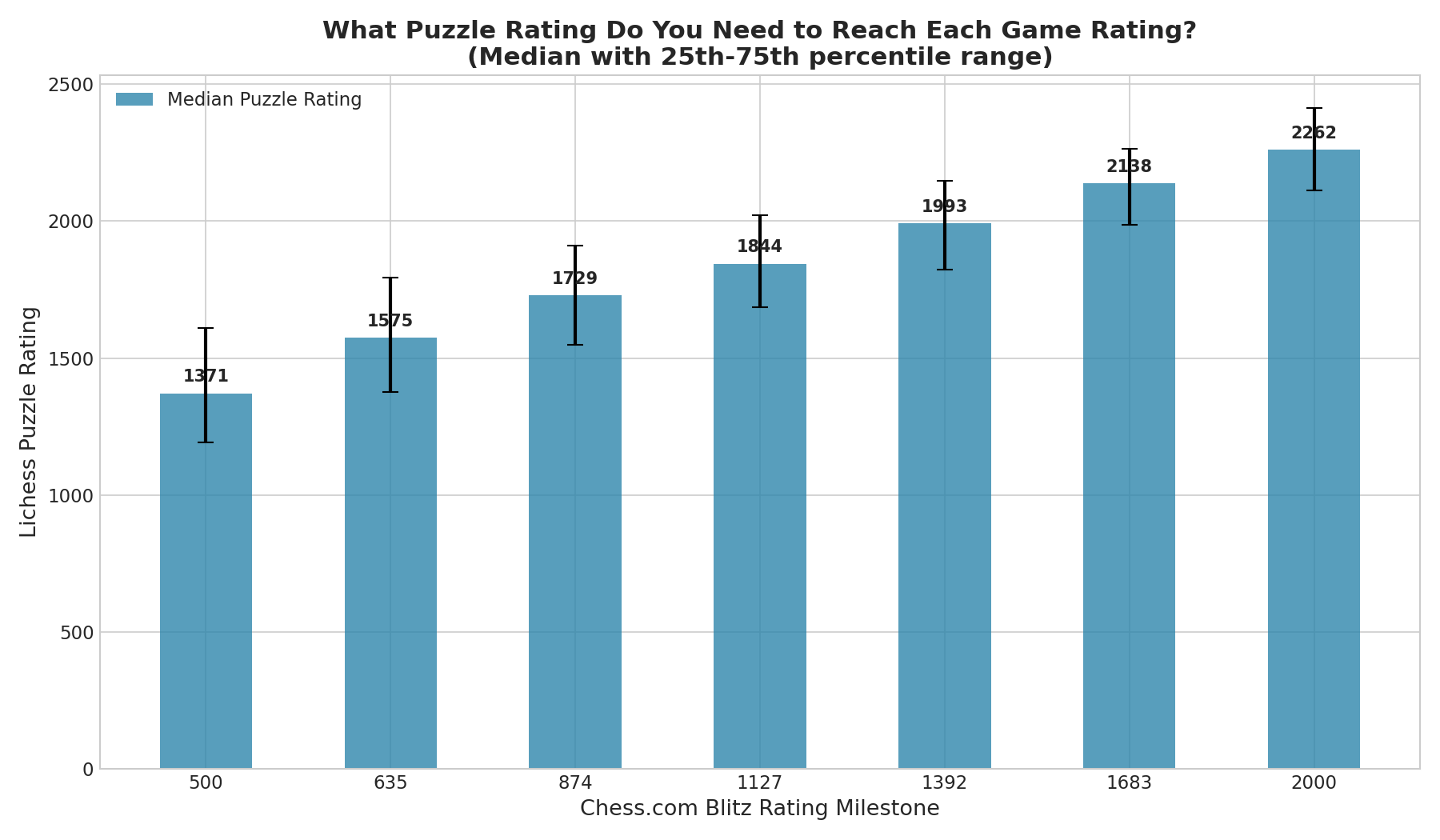
- To break Chess.com 800: You typically need a puzzle rating around 1729.
- To break Chess.com 1100: You typically need a puzzle rating around 1844.
- To break Chess.com 1400: You typically need a puzzle rating around 1993.
- To break Chess.com 1700: You typically need a puzzle rating around 2138.
If your puzzle rating is significantly higher than the target for your current game rating, your tactical vision is not what is holding you back.
The "Large Gap" Phenomenon: Why Tactics Don't Always Translate
We isolated two groups of players for comparison: those with a "Small Gap" (puzzle rating less than 300 points above game rating) and those with a "Large Gap" (puzzle rating more than 600 points above game rating).
The differences in their profiles were illuminating.
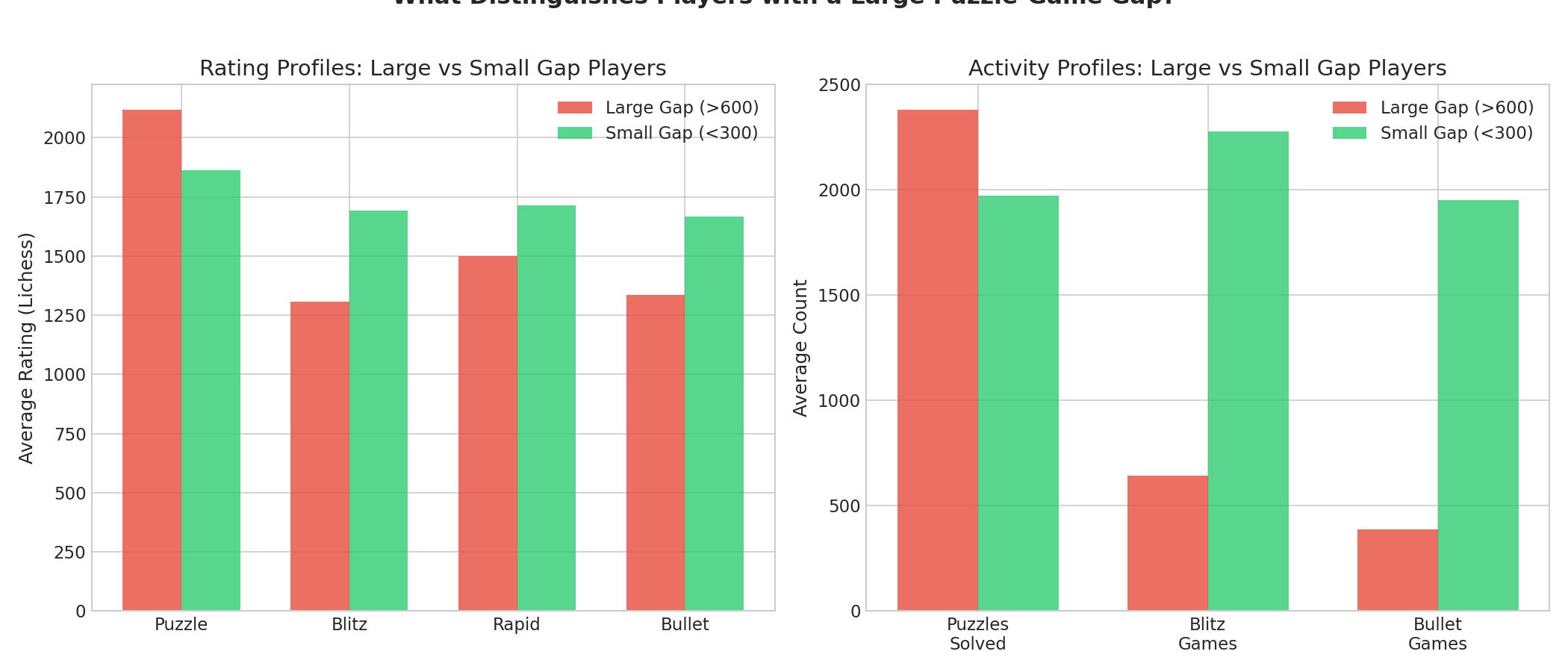
The Large Gap players actually had higher average puzzle ratings (2119 vs 1861) but significantly lower blitz ratings (Chess.com ~1000 vs ~1400). Why? The activity profiles provide the answer.
Large Gap players solved an average of 2,381 puzzles but played only 641 blitz games. Small Gap players solved fewer puzzles (1,974) but played vastly more games (2,278). Players with massive gaps are treating puzzles as a separate game rather than a training tool. They have the pattern recognition, but they lack the board vision, time management, and positional understanding that only comes from playing actual games.
Where Do Players Lose Accuracy?
To understand why tactical vision fails to translate, we analyzed the average Centipawn Loss (CPL) across different phases of the game for various rating bands.
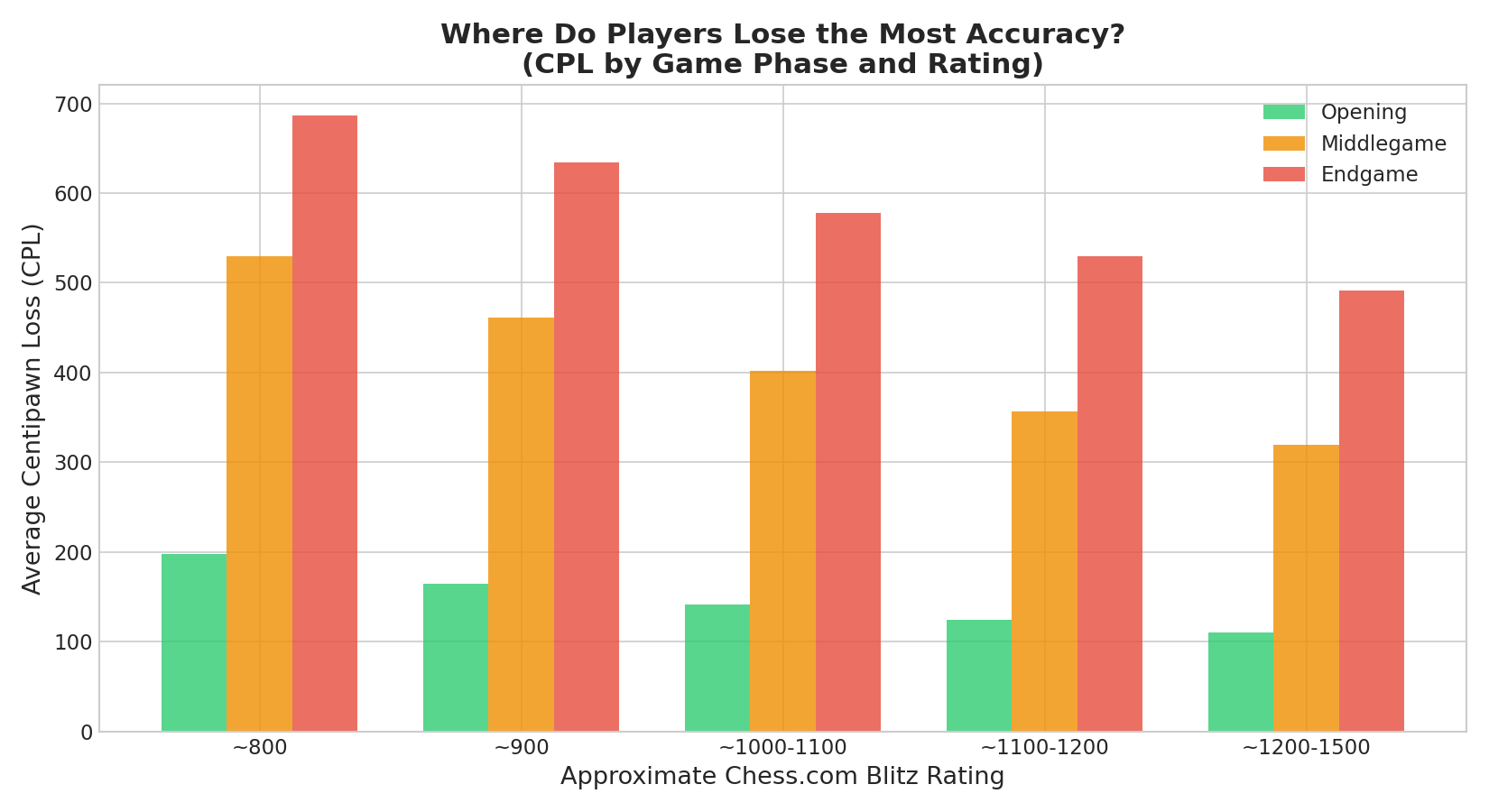
Across all rating bands, accuracy plummets in the endgame. For a Chess.com 800 player, the average CPL in the opening is 197.5, but it balloons to 686.5 in the endgame.
Puzzles train you to find forced wins in complex middlegames. They rarely train you to grind out a slight advantage in a simplified position or to defend a difficult endgame. If you are relying solely on puzzles for improvement, you are neglecting the phase of the game where the most accuracy is lost.
Visual Evidence: The Disconnect Between Puzzles and Games
Let's look at some concrete examples of why puzzle ratings outpace game ratings.
1. The Missed Tactic Under Pressure
In a puzzle, you know there is a tactic to be found. In a game, nobody taps you on the shoulder.
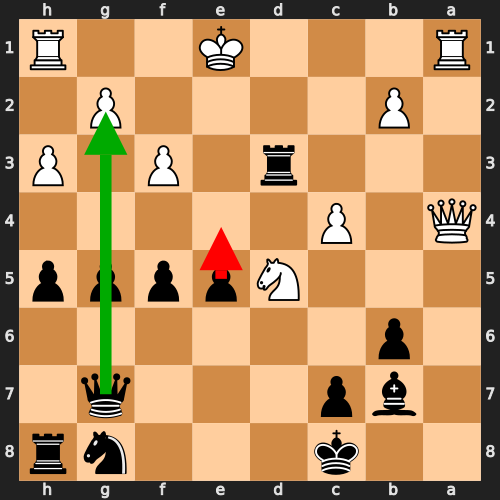
In this position, Black played the passive e5e4 (red arrow). In a puzzle, any player rated 1200+ would immediately spot the crushing Qxg2# (green arrow). But in a blitz game, under time pressure and focused on their own plans, players routinely miss these "obvious" tactics.
2. The Positional Blunder
Puzzles teach you how to win material, but they don't teach you when to retreat and when to attack.
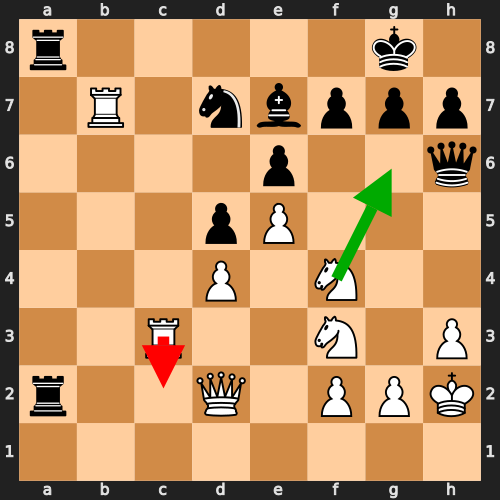
Here, White played Rc2 (red arrow), passively retreating the rook. The engine prefers the aggressive knight jump Nxg6 (green arrow), exploiting the pin on the f7 pawn. This requires positional evaluation and calculation that standard tactical puzzles do not train.
Actionable Advice by Rating Band
Based on the data, here is how you should adjust your training depending on your current Chess.com rating:
Chess.com 500 - 800 (Lichess 900 - 1200)
- The Data Says: Your gap is likely massive (400-500 points). You are blundering heavily in the middlegame (40%+ blunder rate).
- Actionable Advice: Keep doing puzzles, but focus entirely on basic 1-2 move motifs (forks, pins, skewers). More importantly, you must play more games. Your primary goal is board vision—simply seeing which pieces are undefended.
Chess.com 800 - 1100 (Lichess 1200 - 1500)
- The Data Says: You need a puzzle rating approaching 1800 to break out of this band. Your endgame accuracy is still very poor (CPL > 500).
- Actionable Advice: Shift your puzzle training to include defensive puzzles and endgame studies. If your puzzle rating is already 1800+, stop doing puzzles entirely for a month and focus on analyzing your games to see why you aren't getting those tactical positions.
Chess.com 1100 - 1500 (Lichess 1500 - 1800)
- The Data Says: The gap is shrinking (now around 300 points). You are making fewer outright blunders, but mistakes and inaccuracies are costing you games.
- Actionable Advice: You need to bridge the gap between tactics and strategy. Start doing "mixed" puzzle themes where the goal isn't always to win material, but sometimes just to improve your position. Focus heavily on endgame technique, as this is where you can outplay opponents who rely solely on middlegame tricks.
Conclusion
The 300-point gap between puzzle and game ratings is real, but it is not a bug in the rating system. It is a reflection of the fact that chess is more than just calculating forced variations. Puzzles are the weight room; games are the sport. If you spend all your time lifting weights but never step onto the field, you shouldn't be surprised when your strength doesn't translate into victories.
Chess Coach April 15, 2026
Data and Methodology
This analysis was conducted using data from 5,084 active Lichess players, collected via the Lichess API. Players were filtered to include only those with a minimum of 50 puzzle attempts and 30 blitz games to ensure rating stability.
The underlying data and analysis files are available here: