It is one of the most common questions asked by beginner and intermediate chess players: "My puzzle rating is 1400, so why am I stuck at 1000 in Rapid?"
To answer this question, we conducted a data-driven analysis of over 1,100 active players with Chess.com Rapid ratings between 800 and 1500. By analyzing their game histories and puzzle performance, we mapped the exact divergence between tactical solving ability and actual over-the-board (OTb) performance. The data reveals that a significant gap is not an anomaly—it is the statistical norm. More importantly, understanding why this gap exists provides a clear roadmap for improvement.
The Data: Measuring the Gap
Our analysis categorized players into four rating bands based on their Chess.com Rapid equivalents (800-1000, 1000-1200, 1200-1400, and 1400-1500). For each player, we compared their median Rapid rating against their median puzzle rating.
The results are striking: across every rating band, the median puzzle rating significantly exceeds the median Rapid rating.
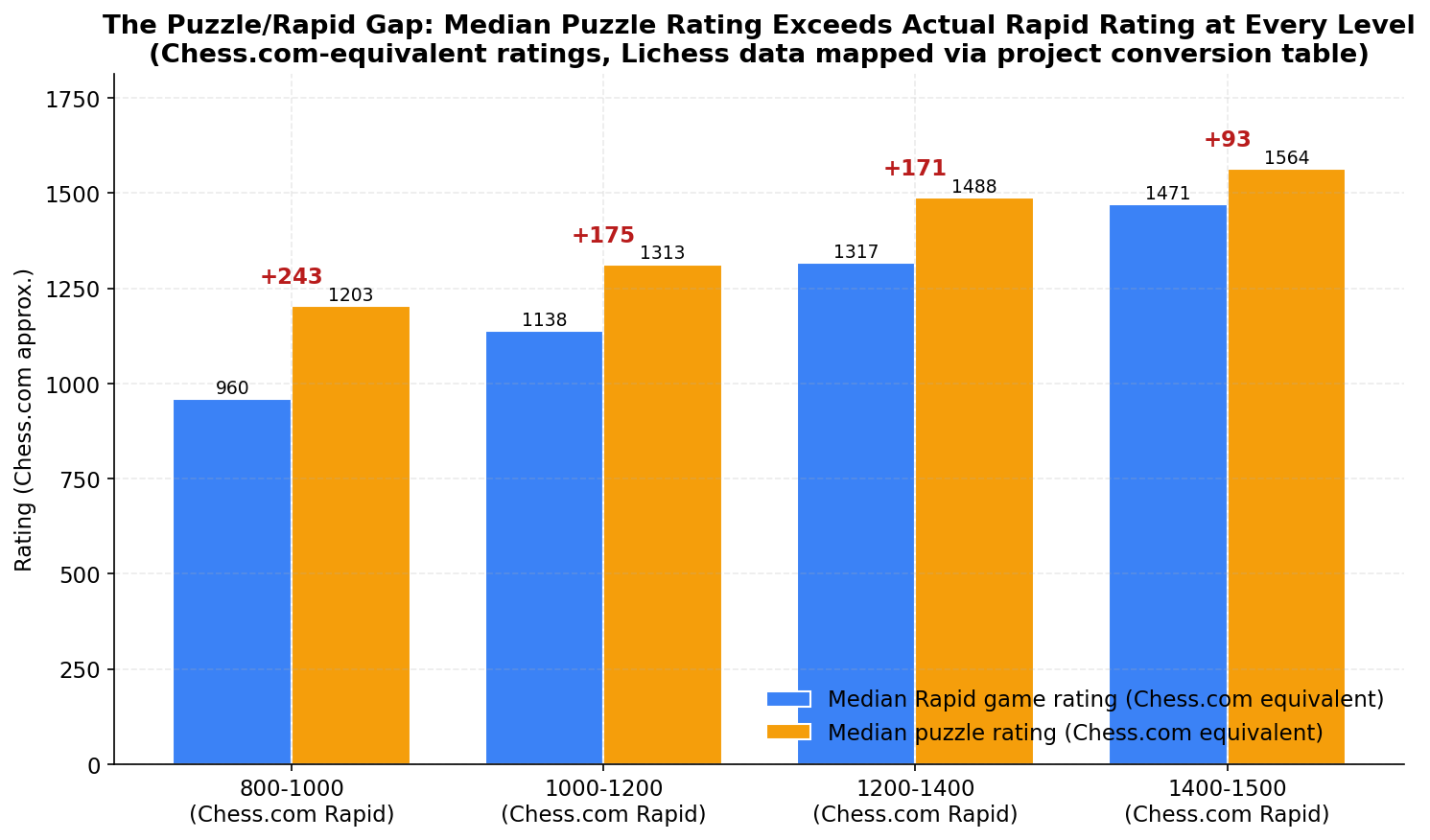
For a player sitting at 1000 Chess.com Rapid, the median puzzle rating is approximately 1175 (or roughly 1313 when mapped to Chess.com equivalents from Lichess data). In fact, 76% of players in the 1000-1200 band have a puzzle rating higher than their game rating.
This divergence is not uniform. As players improve their Rapid rating, the gap between their puzzle and game ratings actually shrinks.
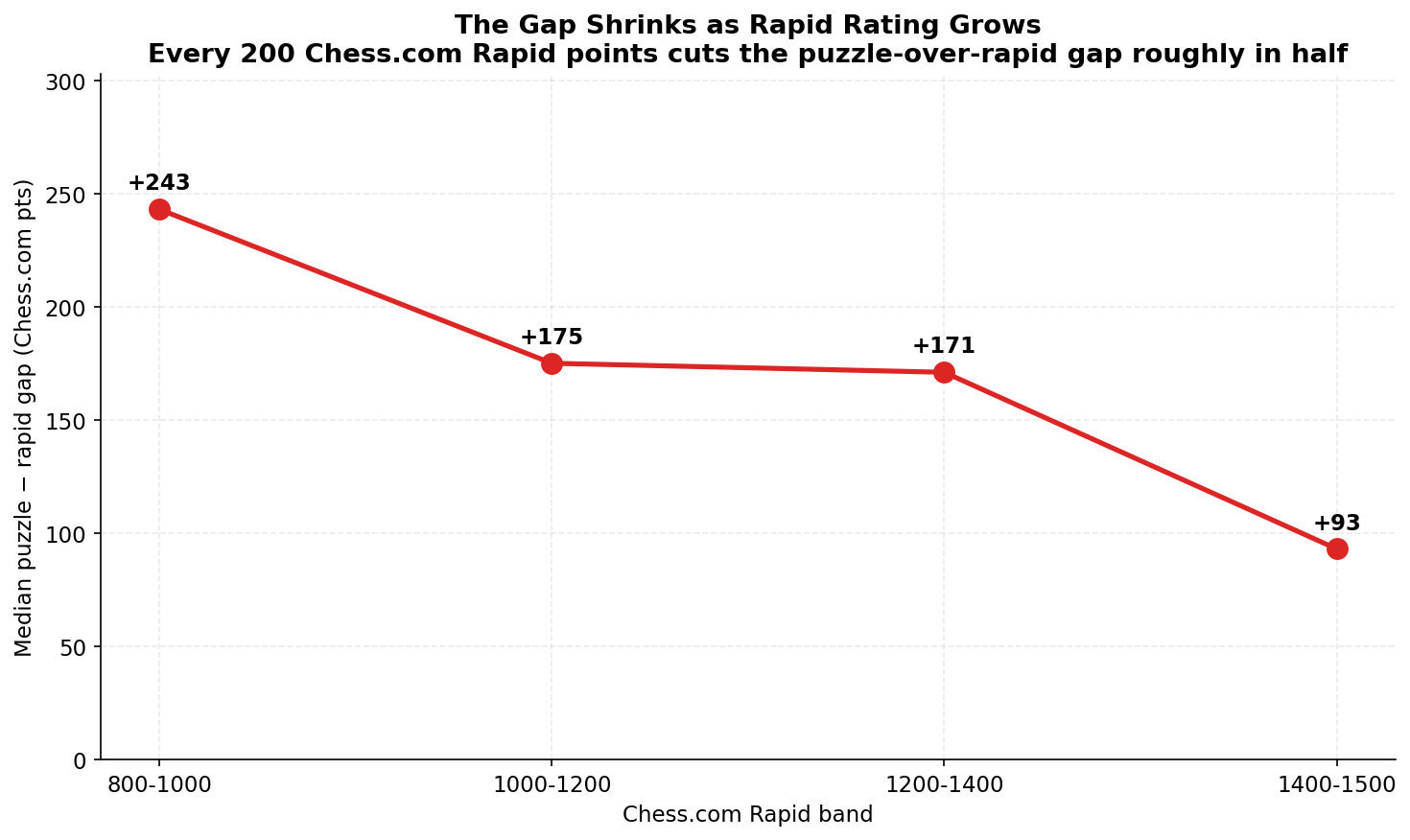
At the 800-1000 level, the median gap is a massive 243 points. By the time a player reaches the 1400-1500 band, the gap narrows to just 93 points. This suggests that lower-rated players are acquiring tactical vision through puzzles but are struggling to apply it in live games, whereas higher-rated players have learned to translate their tactical knowledge into consistent game results.
Why Does the Gap Exist?
The disparity between puzzle and game ratings stems from the fundamental differences between solving a curated tactic and playing a live game.
When you are presented with a puzzle, you are implicitly given two massive hints: there is a definitive winning sequence, and it exists right now. You do not have to worry about your opponent's long-term plans, positional weaknesses, or time management. You simply calculate the forcing lines.
In a real game, nobody taps you on the shoulder to announce that a tactic is available. You must evaluate the position, formulate a plan, and constantly scan for tactical opportunities while defending against your opponent's threats.
Consider the following position, typical of a 1100-1200 level puzzle:
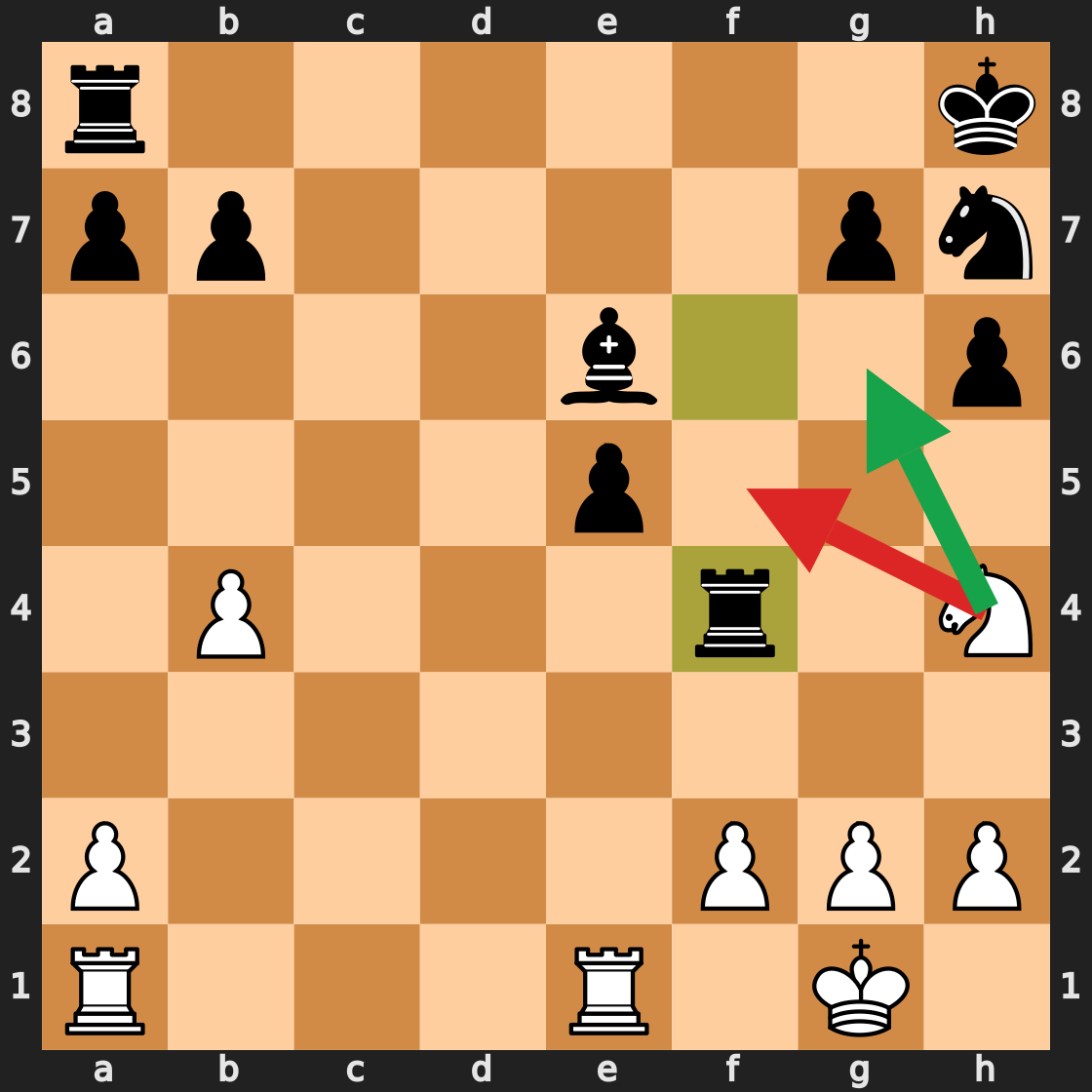
In a puzzle context, the solver knows a crushing blow is available. The winning move is the knight fork Nh6+ (green arrow), winning the rook on f4. However, in a live game, a 1000-rated player might easily be tempted by a natural-looking but inferior move like Nf5 (red arrow), attacking the rook on e6 but missing the immediate tactical sequence. The pressure of the clock and the lack of a "tactics alert" make the optimal move much harder to find.
Furthermore, puzzle ratings are not zero-sum. In live games, every point you gain is taken from an opponent. In puzzles, ratings can inflate over time through sheer volume of practice, even if the player's underlying skill has plateaued.
Our data confirms this inflation effect. We bucketed players by the total number of puzzles they had solved.
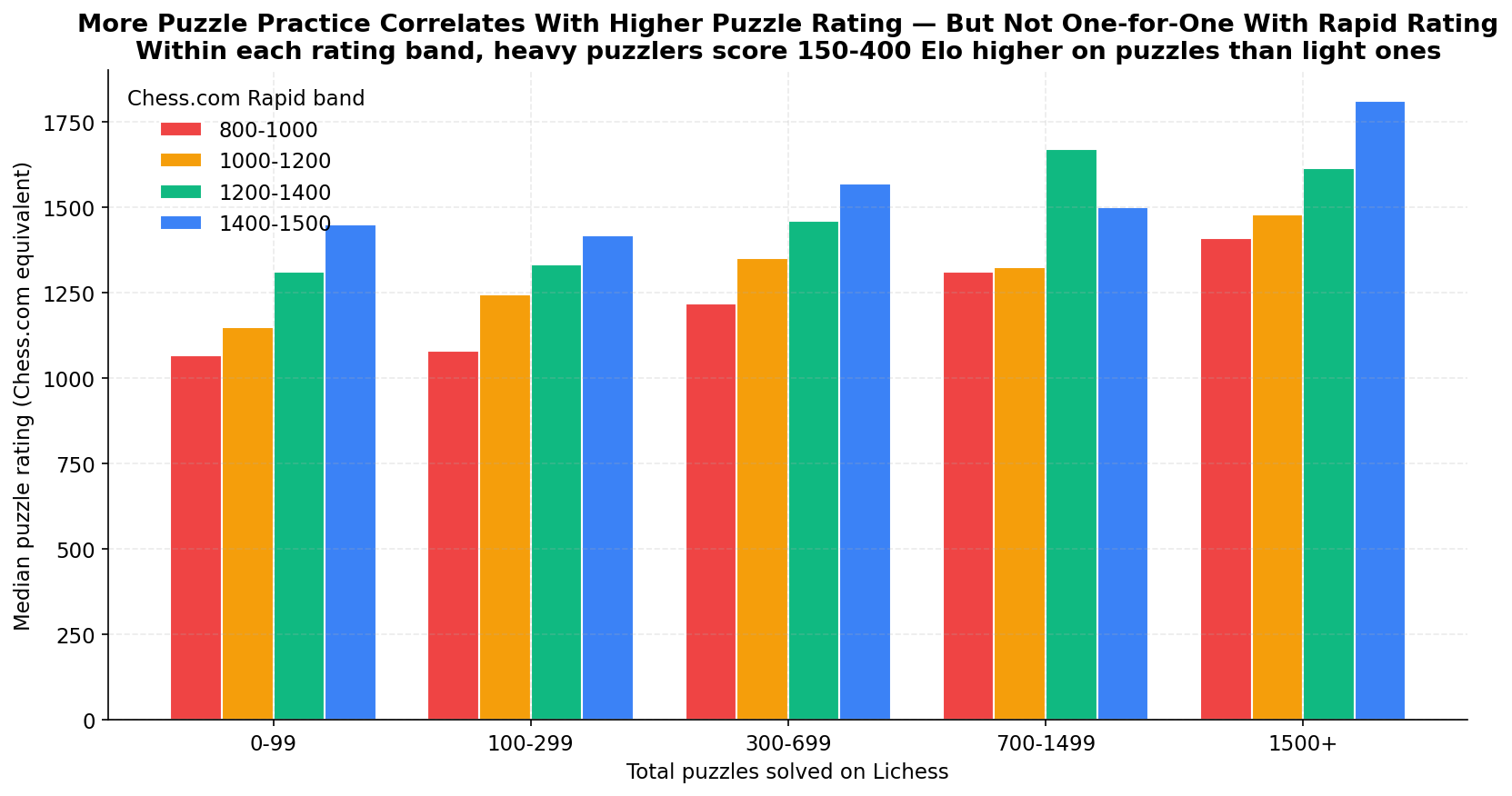
Within the 1000-1200 Rapid band, players who had solved over 1,500 puzzles boasted a median puzzle rating nearly 330 points higher than those who had solved fewer than 100 puzzles. Yet, their actual Rapid ratings were nearly identical. Massive puzzle volume inflates the puzzle rating but yields diminishing returns for actual game performance unless paired with other training methods.
The Roadmap to Improvement
If your puzzle rating is soaring while your Rapid rating stagnates, your training needs to shift from isolated tactical calculation to holistic game application. Here is actionable advice tailored to your current rating band.
800-1000 Chess.com Rapid
The Situation: You have the largest gap (median +243 points). You can spot basic tactics when prompted, but you miss them in games and frequently blunder pieces. Actionable Advice: Focus on board vision and blunder-checking. Before every move, ask yourself: "Are any of my pieces undefended?" and "Did my opponent's last move create a threat?" Play longer time controls (like 15|10) to give yourself time to perform these checks. Puzzles are still useful, but prioritize simple, one-move tactical motifs (pins, skewers, forks) over complex calculation.
1000-1200 Chess.com Rapid
The Situation: The gap is narrowing (+175 points). You understand basic tactics and opening principles, but you struggle to create tactical opportunities or you miss intermediate moves. Actionable Advice: Start integrating "candidate moves" into your thought process. When evaluating a position, identify two or three plausible moves before calculating any single line deeply. This prevents tunnel vision. Additionally, review your games to see why you missed tactics. Was it time pressure? A lack of positional understanding?
Consider this endgame scenario, typical of a 1400-level puzzle:
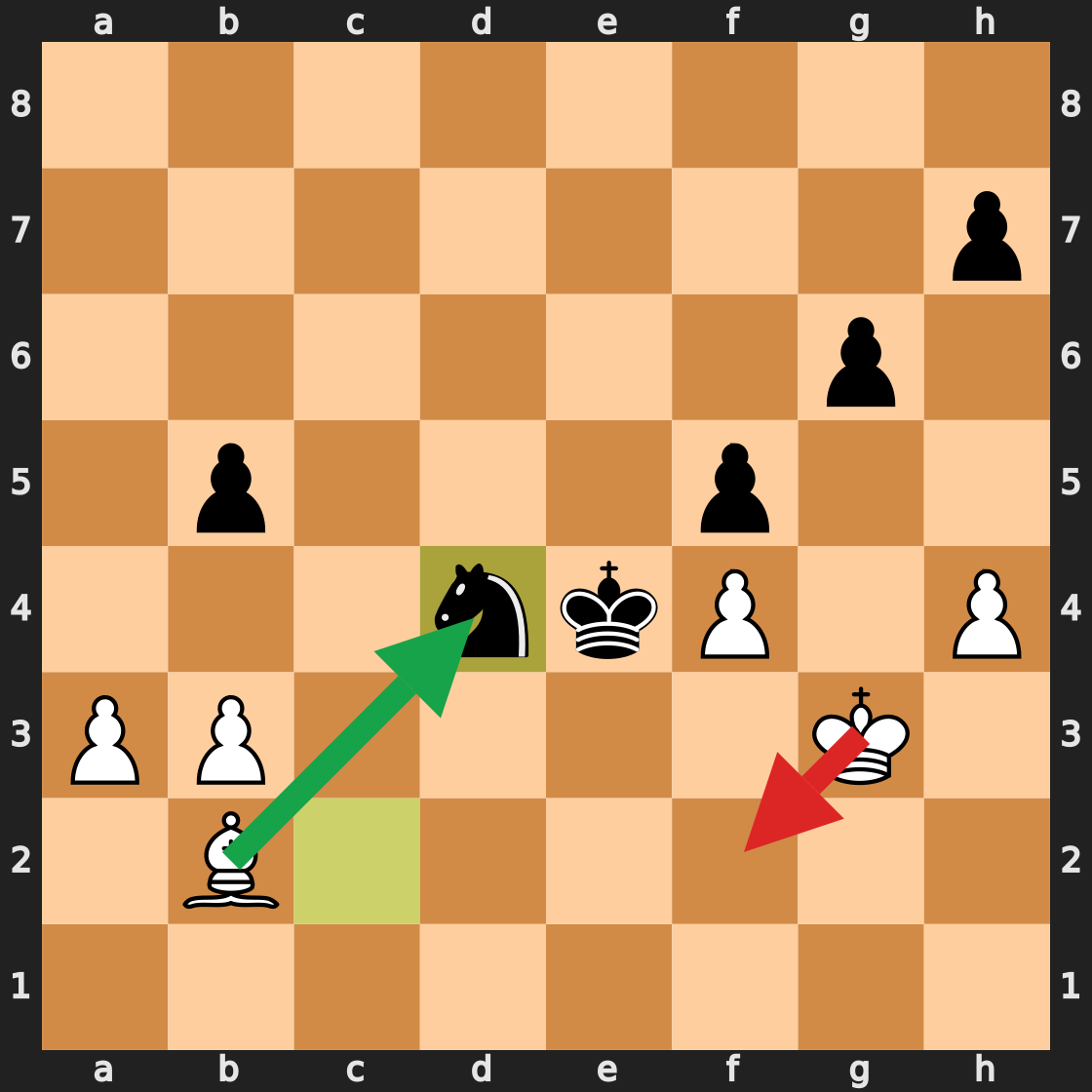
The winning move is capturing the knight with Bxd4 (green arrow). A common mistake in live play is a passive king move like Kf2 (red arrow), allowing the opponent to consolidate. Recognizing these critical moments requires active calculation, not just passive defense.
1200-1400 Chess.com Rapid
The Situation: The gap is stabilizing (+171 points). Your tactical foundation is solid, but you are likely losing games due to positional mistakes or poor endgame technique. Actionable Advice: Shift your focus toward middlegame planning and endgame fundamentals. Tactics flow from superior positions. Learn how to exploit pawn structure weaknesses, control open files, and coordinate your pieces. If you reach a balanced endgame, ensure you know the essential theoretical wins (e.g., King and Pawn vs. King).
1400-1500 Chess.com Rapid
The Situation: The gap is small (+93 points). Your puzzle and game ratings are closely aligned, indicating a balanced skill set. Actionable Advice: At this level, mindless puzzle grinding offers severe diminishing returns. Focus on targeted calculation training. Solve complex, multi-move puzzles without moving the pieces on the board until you see the entire sequence. Deepen your opening repertoire and study master games to understand how grandmasters create the positional pressure that leads to tactical breakthroughs.
Data and Methodology
This analysis was conducted using a dataset of over 955,000 Lichess games, accessed via the Lichess API. We filtered for active players who had completed at least 20 Rapid games and 20 rated puzzles. This yielded a robust sample of 1,102 players.
Because Lichess ratings are generally higher than Chess.com ratings at the beginner and intermediate levels, we applied a calibrated conversion mapping to translate Lichess Rapid ratings into approximate Chess.com equivalents. For example, a Lichess Rapid rating of 1230 was mapped to a Chess.com Rapid rating of 1000. The puzzle ratings were similarly adjusted to provide a consistent frame of reference.
The underlying data files, including the raw ratings and statistical summaries, are available for review:
View full data →band_cc username lichess_rapid_rating lichess_puzzle_rating chesscom_rapid_approx chesscom_puzzle_approx puzzle_minus_rapid_li rapid_games puzzle_games 800-1000 gmolnar03 1587 1717 1415 1583 130 47 317 1000-1200 DeanofParanoia 1319 1509 1099 1312 190 50 2565 1200-1400 chamkh 1663 1545 1511 1360 -118 2436 832 1000-1200 RandomNumberGenerato 1169 1356 939 1142 187 579 60 1400-1500 KMRR 1395 1590 1188 1419 195 522 8223
View full data →band_cc n rapid_med_li rapid_mean_li puzzle_med_li puzzle_mean_li diff_med diff_mean diff_sd pct_puzzle_higher pct_puzzle_higher_150 cc_approx_rapid_med cc_approx_puzzle_med cc_approx_puzzle_minus_rapid pearson_r puzzle_games_median 800-1000 328 1190 1209 1408 1447 216 238 264 82.9 62.2 960 1203 244 0.451 401.0 1000-1200 308 1352 1364 1510 1534 166 169 257 75.6 52.6 1138 1313 176 0.245 433.5 1200-1400 273 1513 1502 1645 1632 130 130 249 71.8 46.5 1317 1488 170 0.398 644 1400-1500 193 1632 1629 1703 1718 75 88 266 60.6 38.9 1471 1564 93 0.241 387
View full data →band_cc puzzle_games_bucket n med_rapid_li med_puzzle_li med_cc_rapid med_cc_puzzle 800-1000 0-99 72 1193 1290 963 1067 800-1000 100-299 75 1176 1302 946 1080 800-1000 300-699 47 1152 1422 922 1218 800-1000 700-1499 45 1218 1508 988 1311 800-1000 1500+ 89 1213 1581 983 1408
Chess Coach April 21, 2026