A Data-Driven Guide for Chess.com 800–1500 Players
Premoving—inputting a move before your opponent has played theirs—is a staple of Bullet and Blitz chess. But what happens when players bring this habit into Rapid time controls? In a game where you have 10 or 15 minutes on the clock, does moving in under half a second save valuable time, or does it lead to catastrophic blunders?
To answer this, we analyzed a sample of nearly 700 Rapid games (representing roughly 27,000 post-opening moves) played on Lichess, mapped to Chess.com rating equivalents between 800 and 1500. By examining the engine evaluation (Stockfish 12) before and after every move, we measured the "Centipawn Loss" (CPL) and blunder rates across different time-spent buckets.
The data reveals a clear "Premove Penalty" for most rating bands, but also uncovers surprising nuances in how different skill levels handle fast moves. This guide breaks down the findings and provides actionable advice for climbing the rating ladder.
1. The Blunder Rate: Premoves vs. Deep Thinks
Our primary metric for accuracy is the Blunder Rate—the percentage of moves that result in a Centipawn Loss of 300 or more (equivalent to losing a full piece or worse). We categorized moves by the time spent: under 0.5 seconds (our proxy for premoves and instant reactions), 0.5–2 seconds, 2–5 seconds, 5–15 seconds, and 15+ seconds.
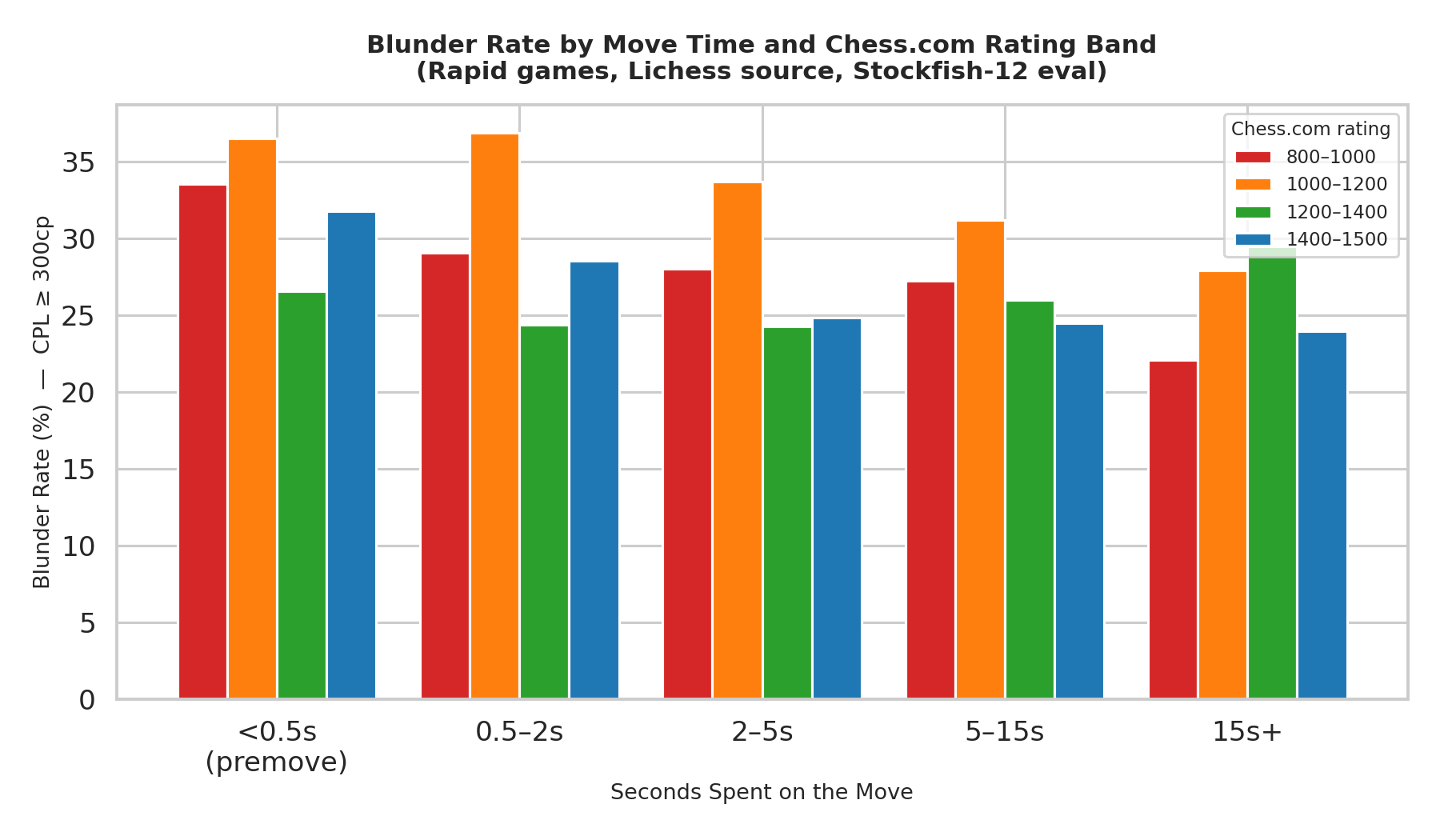
The chart above illustrates a stark reality: for players between 800 and 1200, and again between 1400 and 1500, moving in under 0.5 seconds results in the highest blunder rates of any time bucket. Conversely, taking 15 seconds or more consistently yields the lowest blunder rates across all bands.
The Premove Penalty Quantified
To understand the true cost of rushing, we compared the blunder rate of premoves (<0.5s) directly against the blunder rate of long-thought moves (15s+).
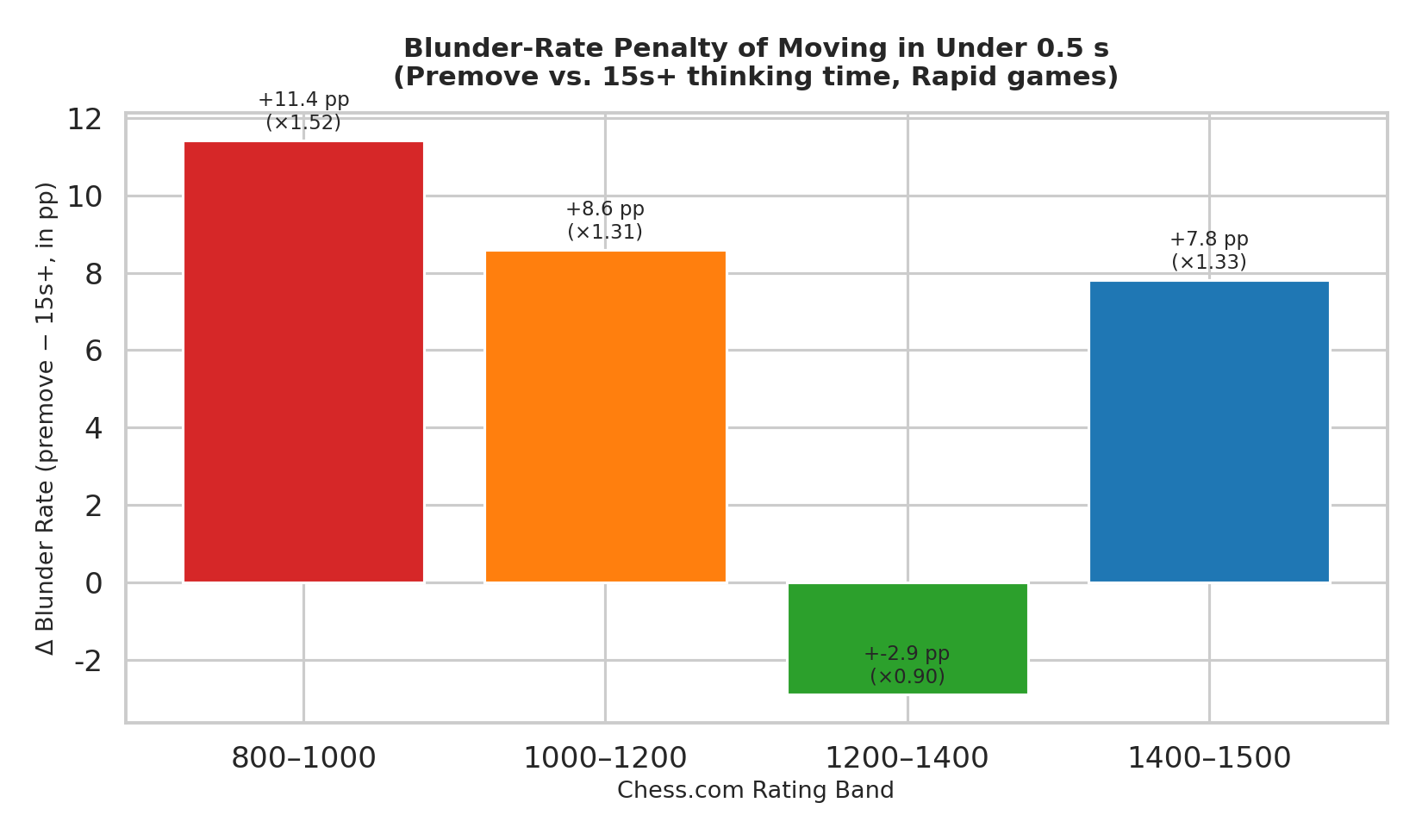
- 800–1000 Band: Premoving increases the blunder rate by a massive 11.4 percentage points compared to thinking for 15+ seconds. This is a 1.52x multiplier on the likelihood of blundering.
- 1000–1200 Band: The penalty remains high at +8.6 percentage points. Interestingly, this band exhibits the highest overall blunder rates across all time buckets, suggesting a transitional phase where players are attempting more complex tactics but frequently miscalculating.
- 1200–1400 Band: The anomaly. Players in this band actually show a negative penalty (-2.9 pp). This suggests that when 1200–1400 players premove, they are almost exclusively doing so in completely forced situations (like obvious recaptures), avoiding the speculative premoves that plague other bands.
- 1400–1500 Band: The penalty returns (+7.8 pp). As players approach 1500, they begin to play faster overall and attempt more anticipatory premoves, leading to a resurgence in fast-move blunders.
2. Average Centipawn Loss: The Cost of Rushing
While blunders are the most dramatic errors, Average Centipawn Loss (CPL) gives us a broader view of move quality.
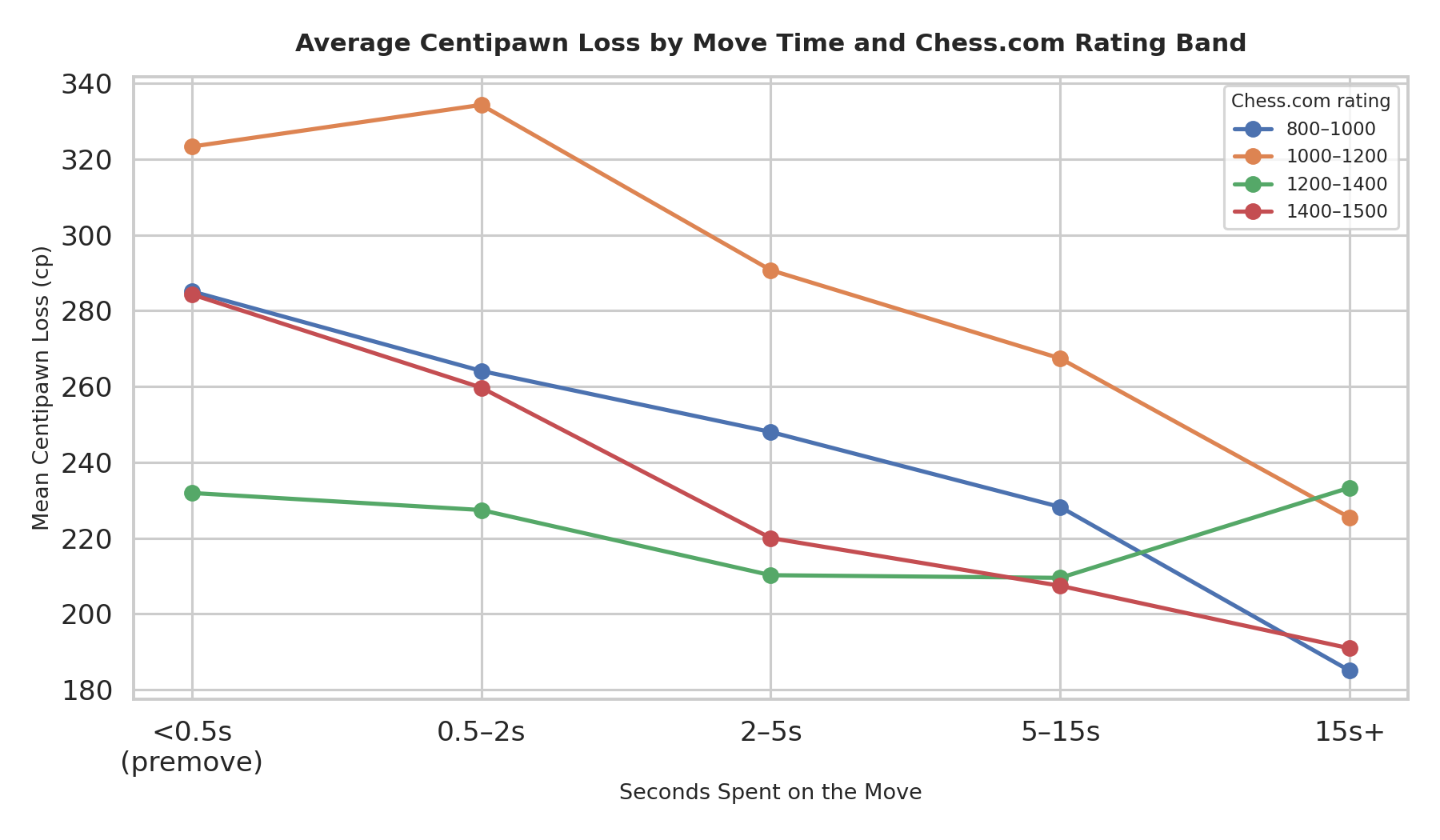
The trend is unmistakable: the faster you move, the more accuracy you sacrifice. The 1000–1200 band struggles the most with fast moves, averaging over 320 CPL for moves under 2 seconds. The 1400–1500 band shows significant improvement in overall CPL compared to lower bands, but still suffers a sharp spike in inaccuracy when moving in under 0.5 seconds.
Move-Quality Mix
Breaking down the severity of errors (Inaccuracies, Mistakes, and Blunders) further highlights the danger of the sub-0.5s move.
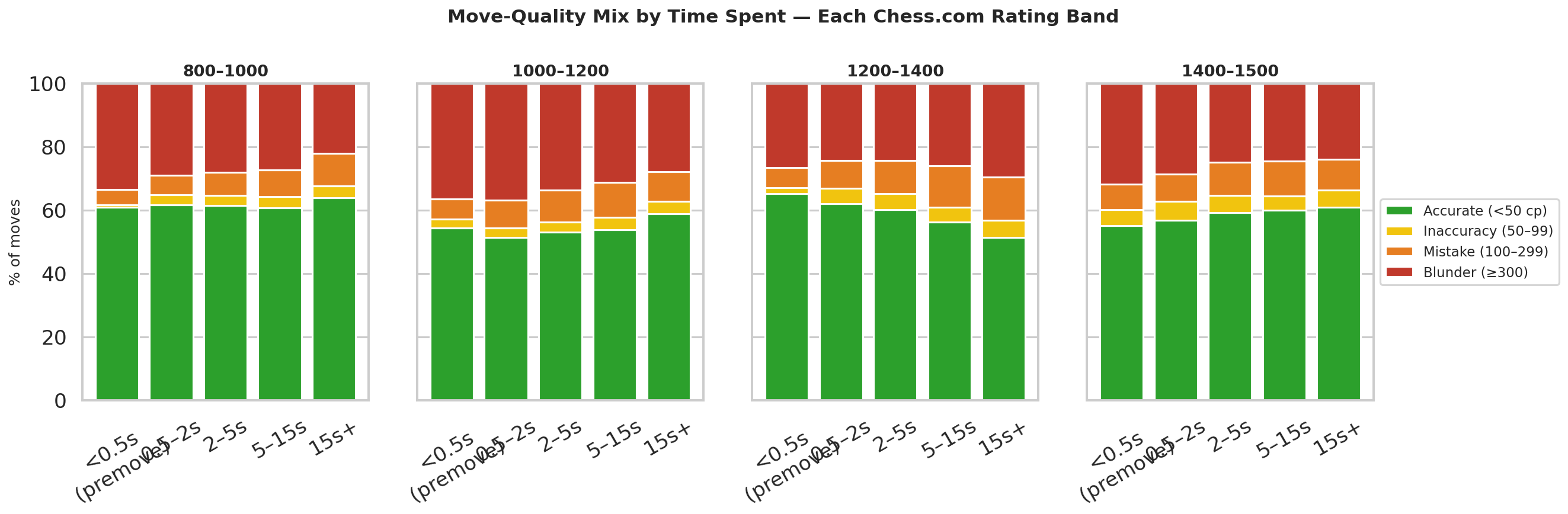
In the 800–1000 and 1000–1200 bands, the red "Blunder" segment is visibly thickest in the <0.5s column. Even in the 1400–1500 band, where the overall proportion of "Accurate" moves (green) is higher, the premove bucket still contains a disproportionate amount of red and orange (Mistakes).
3. Anatomy of a Premove Blunder
What does a premove blunder actually look like? By extracting the highest-CPL errors from our <0.5s bucket, we can see the tactical blindness that occurs when players move without looking.
Example 1: The Blind Recapture (800–1000 Band)
In this position, Black has just played ...exd4. White, anticipating a standard recapture, instantly plays Nxd4?? (moving the Knight from f3 to d4).
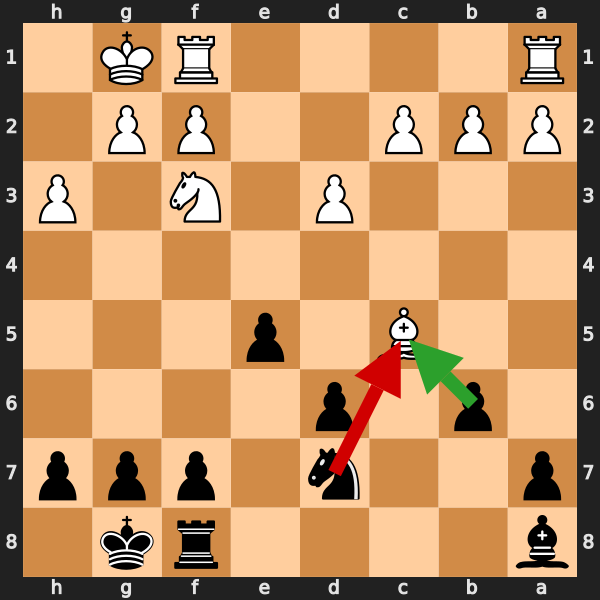
Red arrow: The played premove (Nxd4). Green arrow: The engine's best move (Bxd4).
The Reality: White premoved the Knight recapture, completely missing that the d4 square is heavily defended by Black's Queen and Bishop. The engine evaluates this as a massive blunder (CPL 491), as White simply hangs a full piece. The correct move was to recapture with the Bishop, maintaining the tension.
Example 2: Ignoring the Threat (1000–1200 Band)
Here, Black has just pushed a pawn, attacking White's Knight. White, perhaps focused on their own attacking plans on the queenside, instantly plays Rac8?? (moving the Rook to c8).
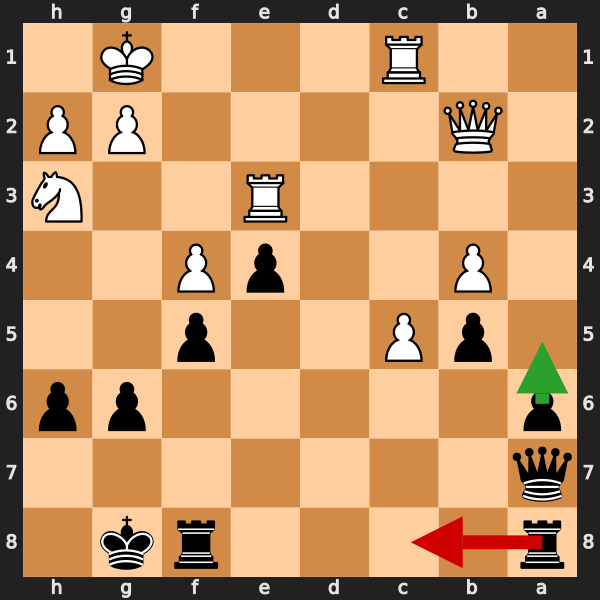
Red arrow: The played premove (Rac8). Green arrow: The engine's best move (a5).
The Reality: White's premove completely ignores the immediate threat to their Knight on h3. Black simply captures the Knight on the next move. This is a classic case of "tunnel vision" exacerbated by moving too quickly (CPL 786).
4. Actionable Advice by Rating Band
Based on the data, here is a roadmap for improving your Rapid game by managing your time and curbing the premove habit.
For the 800–1000 Player
- The Data Says: You suffer the highest relative penalty for premoving (a 52% increase in blunders).
- Actionable Advice: Ban the premove. In Rapid chess, you have time. Even on obvious recaptures, force yourself to pause for 2 seconds. Use that time to ask: "Did my opponent's last move uncover a new attack? Is the square I'm moving to actually safe?"
For the 1000–1200 Player
- The Data Says: You have the highest absolute blunder rates and CPL across all time buckets, peaking on fast moves. You are trying complex ideas but rushing the execution.
- Actionable Advice: Calculate, don't guess. You are losing games because you play the first move that looks good. When you find a good move, sit on your hands and look for a better one. Aim to shift your average move time from the 2–5s bucket into the 5–15s bucket.
For the 1200–1400 Player
- The Data Says: You are the only group that doesn't heavily penalize yourselves with premoves, likely because you only use them for strictly forced moves.
- Actionable Advice: Maintain the discipline. Your fast-move discipline is good. To reach the next level, focus on the quality of your long-thought moves. Your 15s+ blunder rate (29.5%) is actually higher than your premove blunder rate. When you spend time thinking, ensure you are calculating concrete variations, not just staring at the board.
For the 1400–1500 Player
- The Data Says: You premove more frequently than lower bands (2.59% of moves), and it costs you (+7.8 pp blunder penalty). You are playing Rapid like it's Blitz.
- Actionable Advice: Respect the time control. You have the tactical vision to maintain a low CPL when you think (191 CPL for 15s+ moves). Stop throwing away that advantage by rushing. Reserve premoves only for severe time scrambles (under 1 minute on the clock). In the middlegame, treat every move as a critical decision.
Data and Methodology
- Source: ~700 Rapid games downloaded via the Lichess API (using the grandmaster-guide MCP).
- Rating Calibration: Lichess Rapid ratings were mapped to Chess.com equivalents using standard conversion tables (e.g., Chess.com 1000 ≈ Lichess 1615).
- Evaluation: Every post-opening ply was evaluated using Stockfish 12 to determine Centipawn Loss (CPL).
- Premove Proxy: Moves with a recorded clock difference of <0.5 seconds were classified as premoves/instant reactions.
Raw Data Files:
Chess Coach, April 20, 2026