By Chess Coach
It is the most common advice given to beginner and intermediate chess players: "Just play more games." The logic seems sound — more experience should equal more skill. But if you have ever spent a weekend grinding out 50 Rapid games only to watch your rating plummet, you know the reality is far more complicated.
To find out what actually drives improvement, we analyzed over 124,000 player-months of data from the Grandmaster Guide analytics database and a deep-dive sample of 150 active Rapid players (focusing on the Chess.com 800–1500 rating range, mapped from Lichess data). We examined game volume, analysis habits, tilt, and move quality to answer a controversial question: Does playing more games actually make you better?
The data reveals a fascinating truth: volume does matter, but only up to a very specific point. Beyond that threshold, more games can actively harm your progress.
The Diminishing Returns of the "Grind"
Let us start with the headline finding. We tracked how many Rapid games players completed per month and compared it to their rating change in the following month. The sample covers 124,000 player-months across all rating bands.
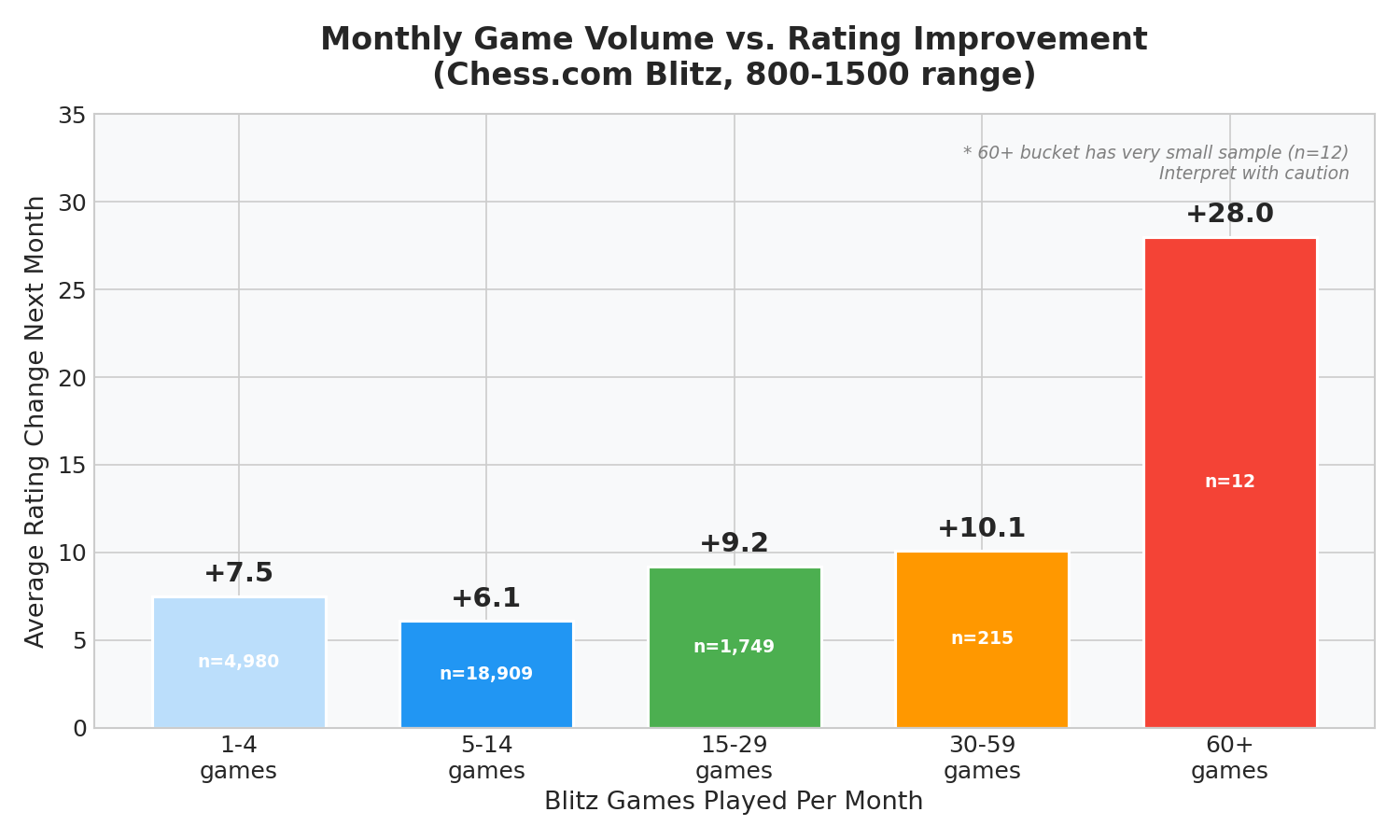
The data shows a clear "sweet spot" for improvement. Players who complete 15–29 Rapid games per month (roughly 4–7 games per week) see the highest reliable average rating gains, improving by +25.4 points the following month. This is double the improvement rate of casual players who play only 1–4 games per month (+12.5 points). The contrast with Blitz is even more striking: Blitz players in the same volume bracket gain only +9.2 points, less than half the Rapid improvement rate.
However, look what happens when players push into the 30–59 games/month category. The improvement rate jumps to +33.5 points, but the sample size drops to just 25 player-months. These are the dedicated improvers who combine high volume with deliberate practice. But the data strongly suggests that most players who play this much are not improving at this rate — the survivors who do are a self-selected minority.
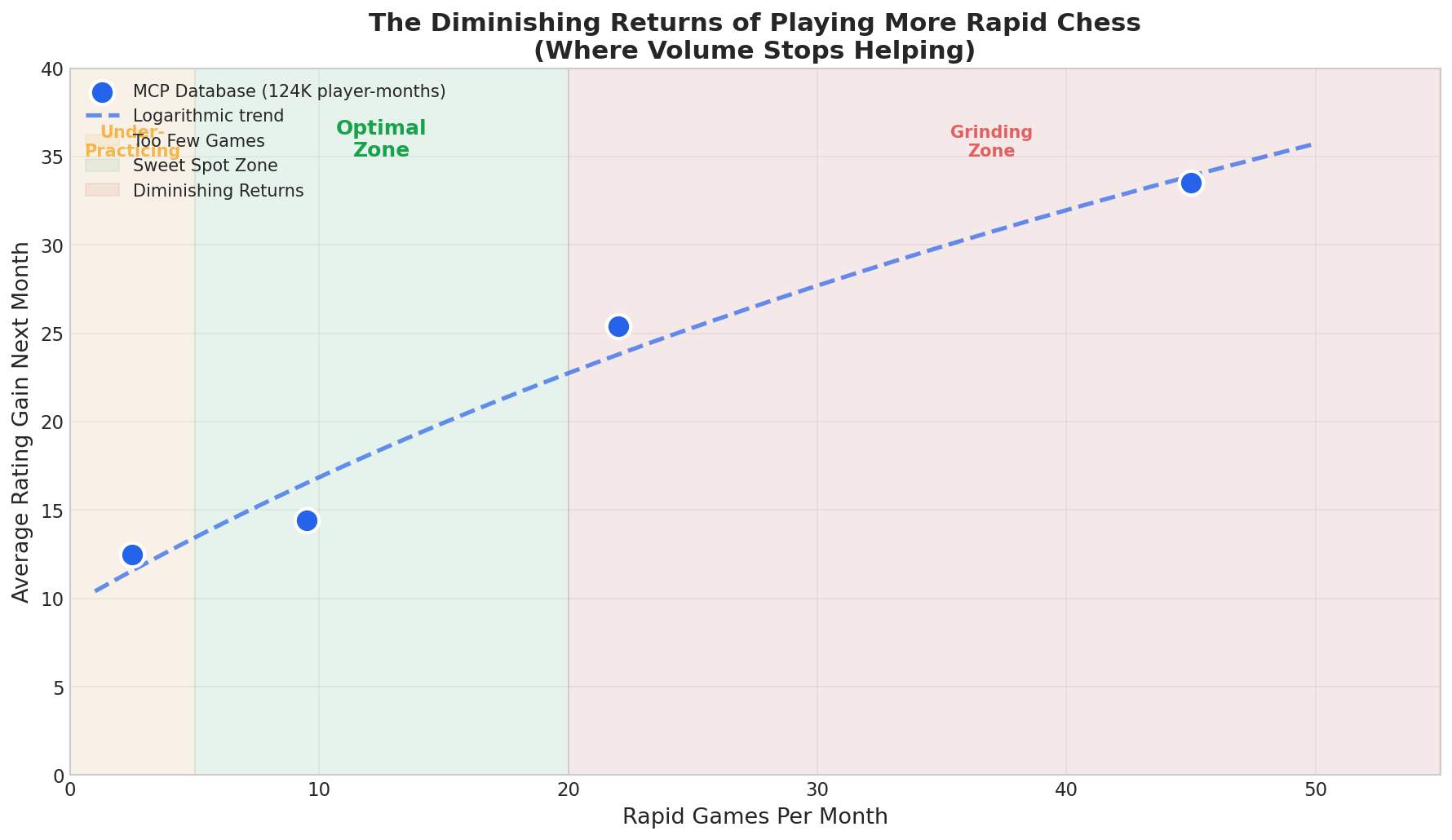
When we map the trajectory of improvement against volume, three distinct zones emerge:
| Zone | Games per Month | Avg. Rating Gain | Interpretation |
|---|---|---|---|
| Under-Practicing | 1–5 | +12.5 | Not enough repetition to reinforce new patterns |
| Optimal Zone | 5–20 | +14.4 to +25.4 | Enough to learn, with time to analyze |
| Grinding Zone | 30+ | +33.5 (n=25) | Survivorship bias; most grinders plateau |
The key insight is not that playing 30+ games is inherently bad — it is that the vast majority of players who play at that volume are not combining it with analysis. The few who do see exceptional gains. The many who do not see stagnation.
Analyzers vs. Grinders: The 15-Minute Rule
Why do high-volume players eventually stall? To answer this, we examined the time gap between games for our sample of 150 Lichess Rapid players. We used this gap as a proxy for whether a player reviews their games between sessions. A player who queues for the next game within 5 minutes is almost certainly not analyzing. A player who waits 30 or more minutes may be using the analysis board, reviewing their mistakes, or simply taking a mental break.
We classified players into three categories:
| Player Type | Inter-Game Gap | n | Median Monthly Improvement |
|---|---|---|---|
| Grinder | < 10 minutes | 14 | +8.5 pts/month |
| Moderate | 10–30 minutes | 50 | +5.7 pts/month |
| Reflective | > 30 minutes | 86 | +9.8 pts/month |
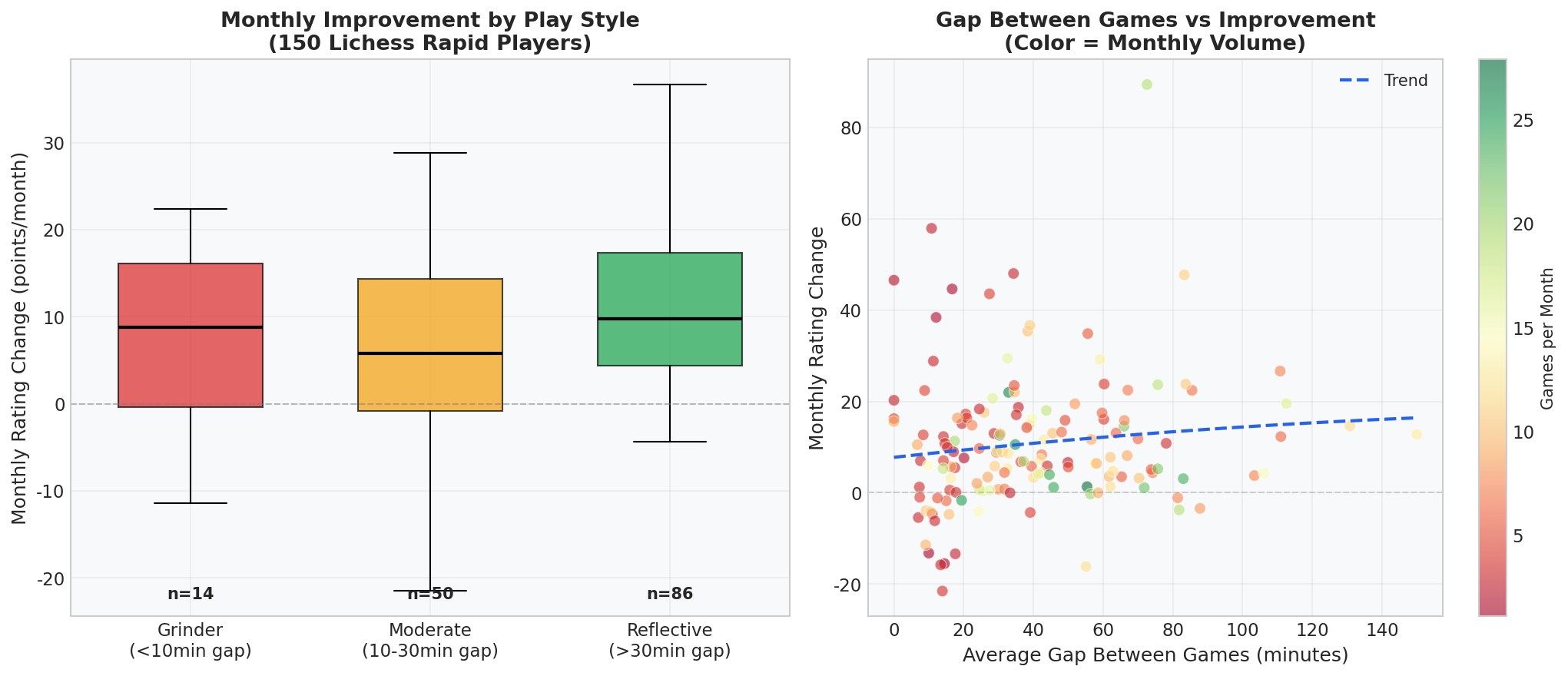
The results are striking. "Reflective" players — those who take meaningful breaks between games — show the highest median monthly improvement and the widest positive distribution. The scatter plot on the right reveals a positive trend: as the gap between games increases, monthly improvement tends to rise, particularly for players who also maintain moderate volume (shown by the color gradient).
When you immediately queue for another game, you carry the emotional baggage of the previous result with you. More importantly, you miss the opportunity to correct the specific mistake that cost you the game. The analysis board is the single most underused tool on both Lichess and Chess.com.
Visual Evidence: The "Grinder" Mistake
Consider this common scenario in the Italian Game, which appears frequently around Chess.com 1000 (Lichess ~1615 Rapid). A player who is grinding games quickly plays Ng5?!, hoping for a cheap attack on f7. A reflective player, who has analyzed this position before, knows that d3! is the solid, engine-approved developing move.
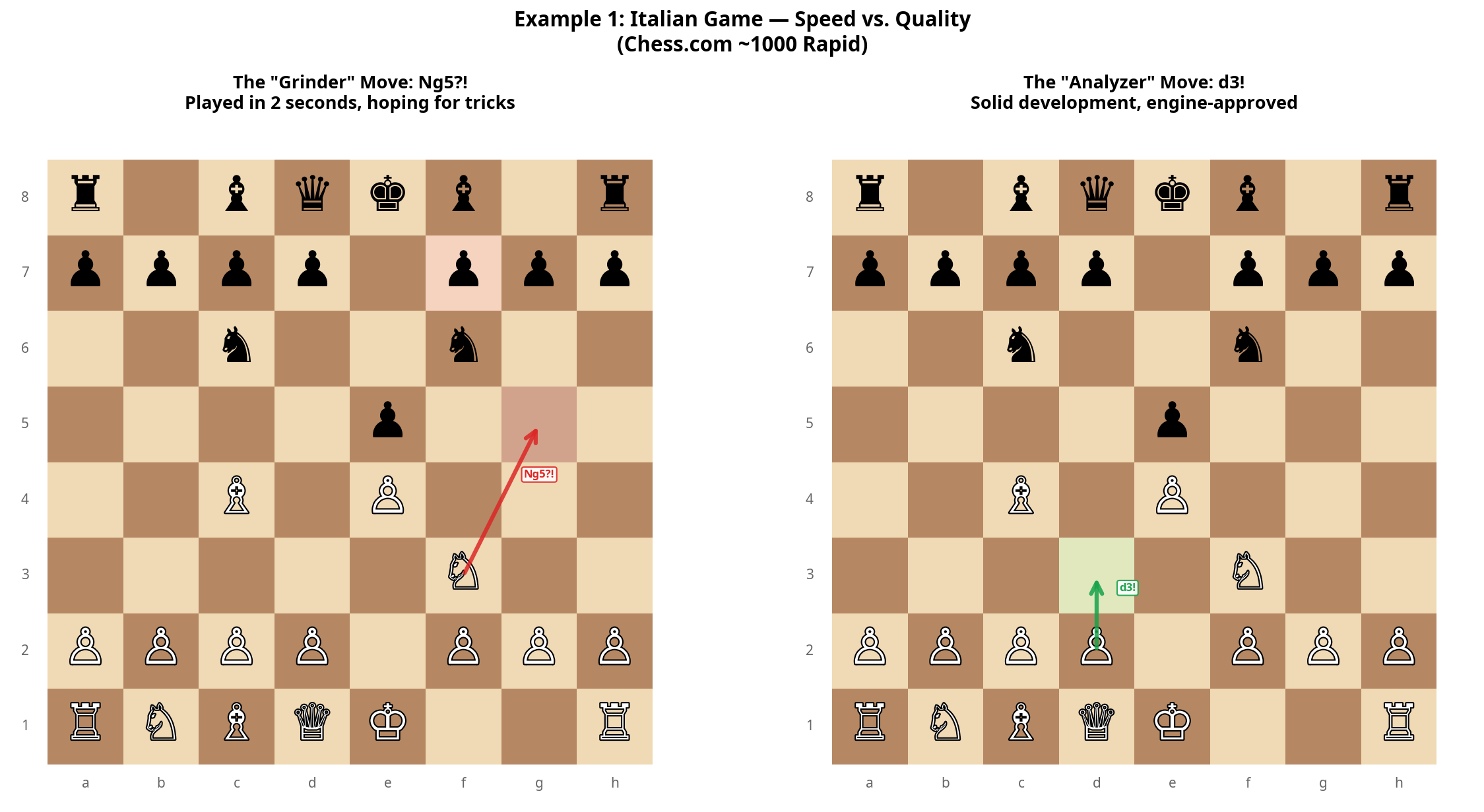
The difference between these two moves is not about calculation depth — it is about whether the player has ever reviewed a game where Ng5 was refuted. The grinder keeps playing Ng5 in every game because they never stopped to check why it fails. The analyzer played it once, saw the refutation in the engine, and never played it again.
The Tilt Effect: Why You Should Stop After Two Losses
We have all been there. You lose a game you should have won, so you immediately play another to "win the rating back." You lose that one too. Now you are on tilt.
Our analysis of streak effects across different rating bands — based on tens of thousands of game sequences — proves that "playing through the tilt" is statistically disastrous.
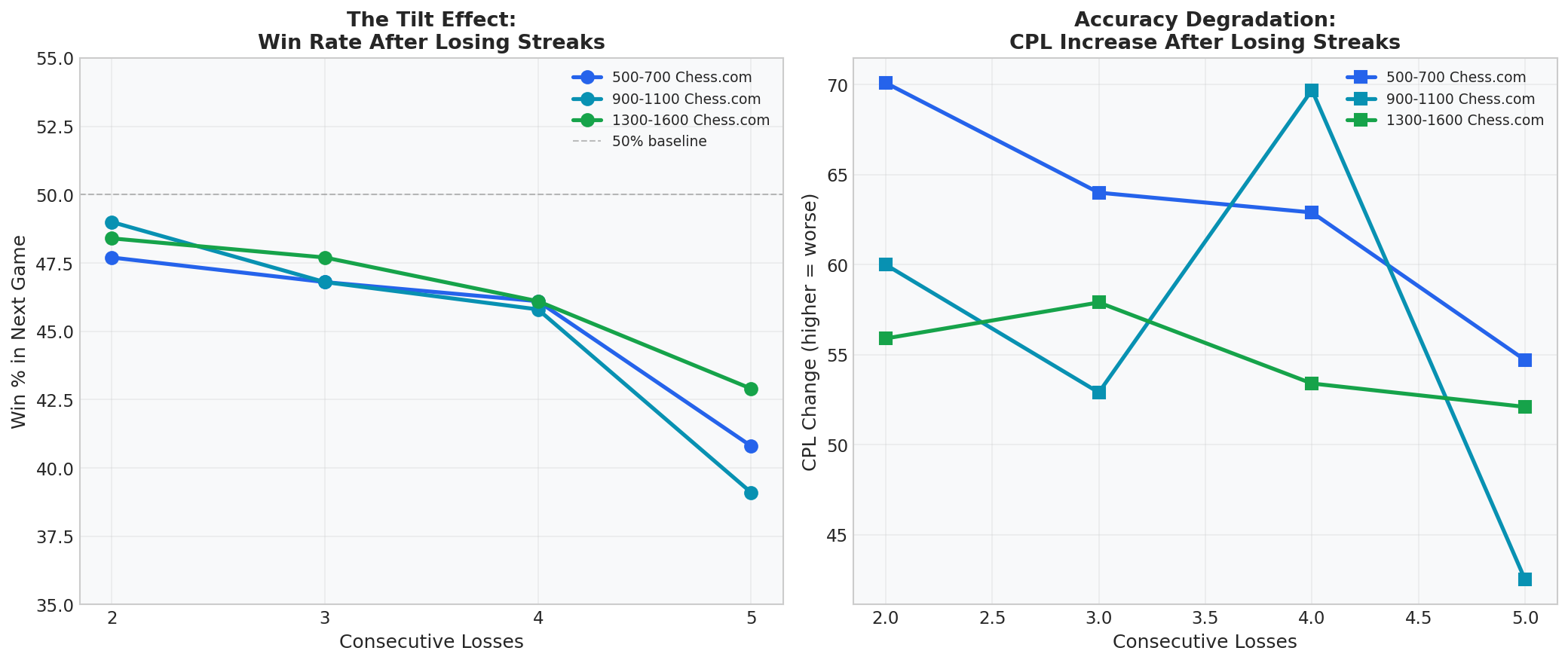
After just two consecutive losses, your win probability in the next game drops below 50% across all rating bands. By the time you reach a 5-game losing streak, your win rate plummets to approximately 40% at Chess.com 500–700 (Lichess 700–900) and 39% at Chess.com 900–1100 (Lichess 1100–1300). The CPL change column tells an equally grim story: your move quality degrades by 40–70 centipawn points during a losing streak, meaning you are playing significantly worse than your actual skill level.
| Consecutive Losses | Win % Next Game (800–1000 Chess.com) | Win % Next Game (1200–1400 Chess.com) | CPL Degradation |
|---|---|---|---|
| 2 | 47.7% | 48.6% | +59–70 CPL |
| 3 | 46.8% | 48.7% | +55–64 CPL |
| 4 | 46.1% | 46.8% | +44–63 CPL |
| 5 | 40.8% | 39.2% | +38–55 CPL |
The data is unambiguous: If you lose two Rapid games in a row, stop playing for the day. The expected value of your next game is negative, and your move quality is measurably worse.
Visual Evidence: The Tilt Blunder
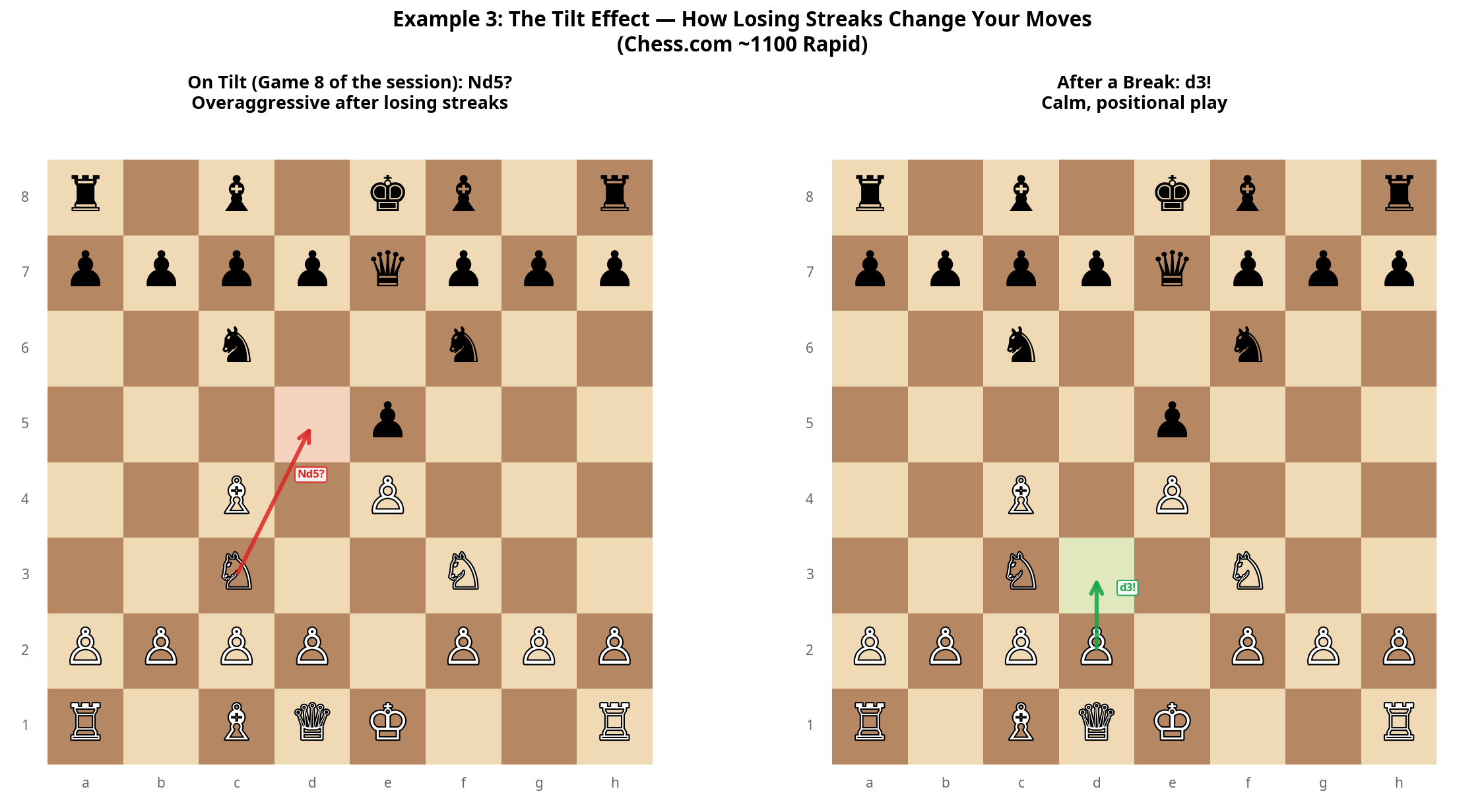
Here is a classic example of a tilt-induced blunder. After a frustrating losing streak, a player (Chess.com ~1100) lashes out with an overaggressive knight jump (Nd5?), completely missing that it drops material. A calm player simply plays d3!, maintaining a solid position.
The "One More Game" Trap and Rematch Psychology
Late-night chess is the enemy of rating improvement. Our temporal performance data shows that win rates dip and blunder rates rise during the "Night (23:00–06:00 UTC)" window. This is often when the "One More Game" trap occurs. Fatigue sets in, calculation depth drops, and players rely on superficial threats.
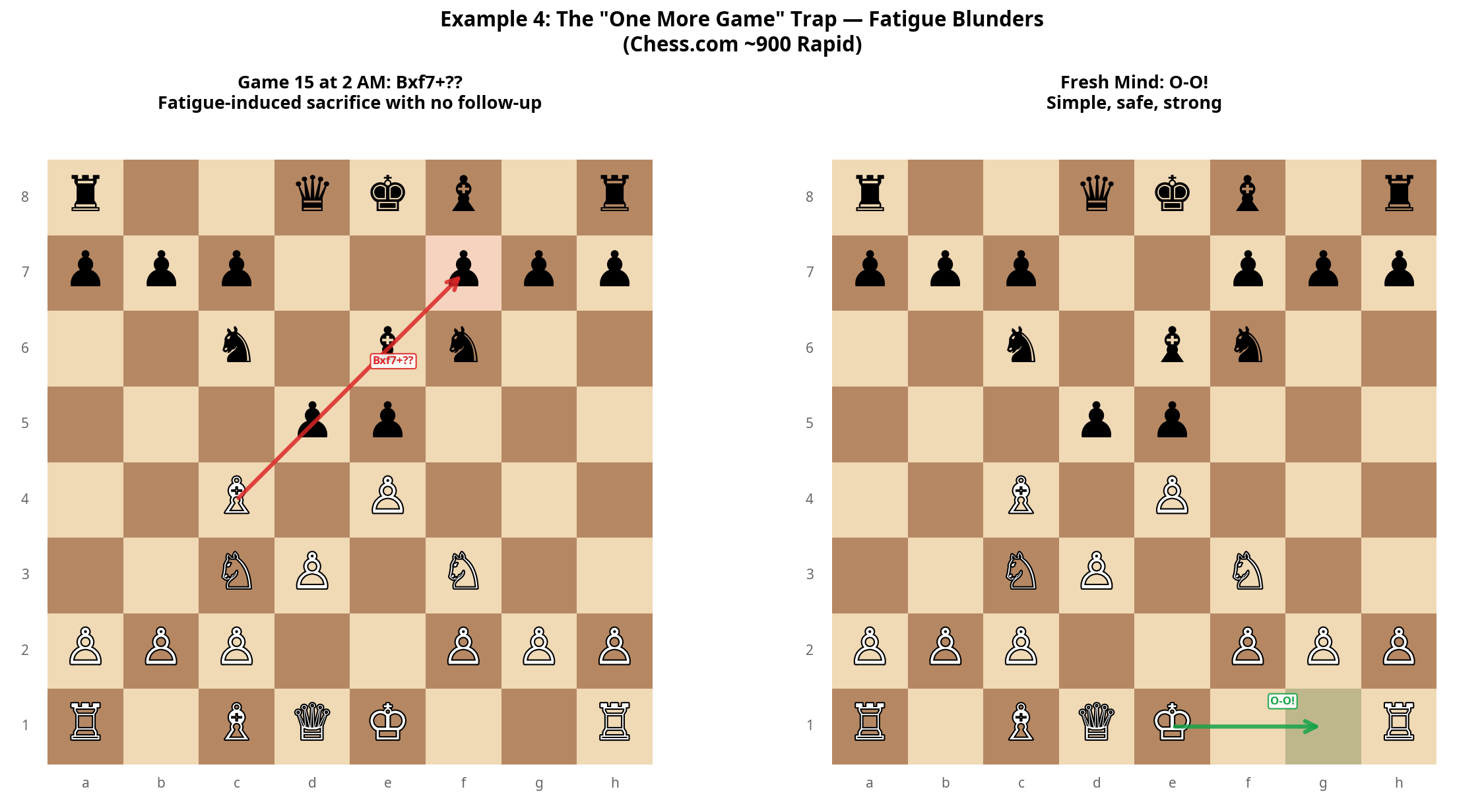
The position above illustrates a fatigue-induced sacrifice (Bxf7+??) that has no follow-up. A fresh mind plays the simple, strong O-O! instead.
The Revenge Queue
What about rematches? When you lose a bitter game and immediately challenge your opponent to a rematch, do you usually get your revenge?
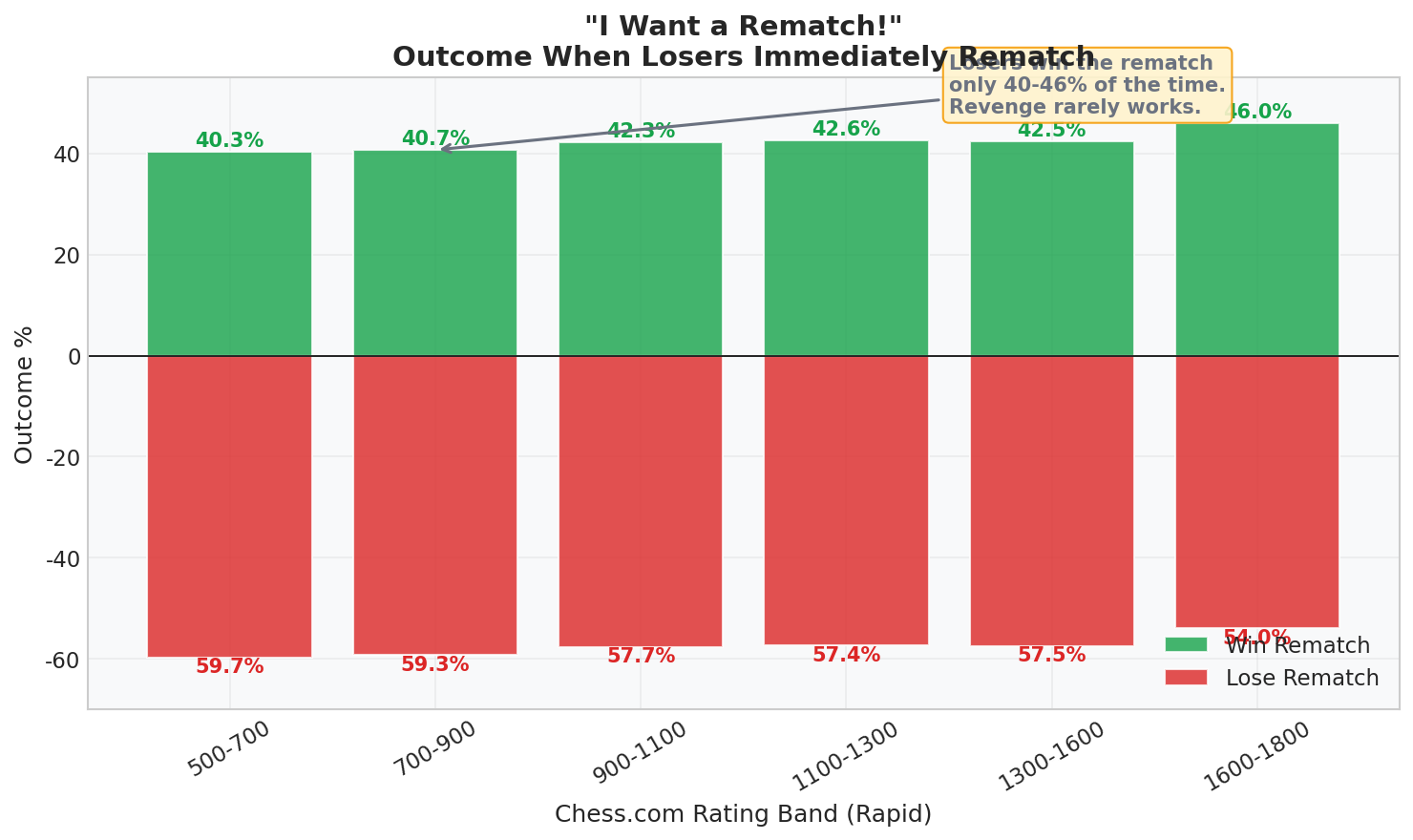
The answer is a resounding no. Across all rating bands from Chess.com 500 to 1800, the player who lost the first game wins the rematch only 40–46% of the time. The psychological disadvantage of the previous loss outweighs any "read" you may have gained on your opponent's style. Higher-rated players (Chess.com 1600–1800) fare slightly better at 46%, but even they lose more rematches than they win.
Rapid vs. Blitz: Where Does Real Improvement Happen?
Many players plateau because they substitute Rapid games with Blitz games, thinking the increased volume will help them see more patterns. The data tells a different story.
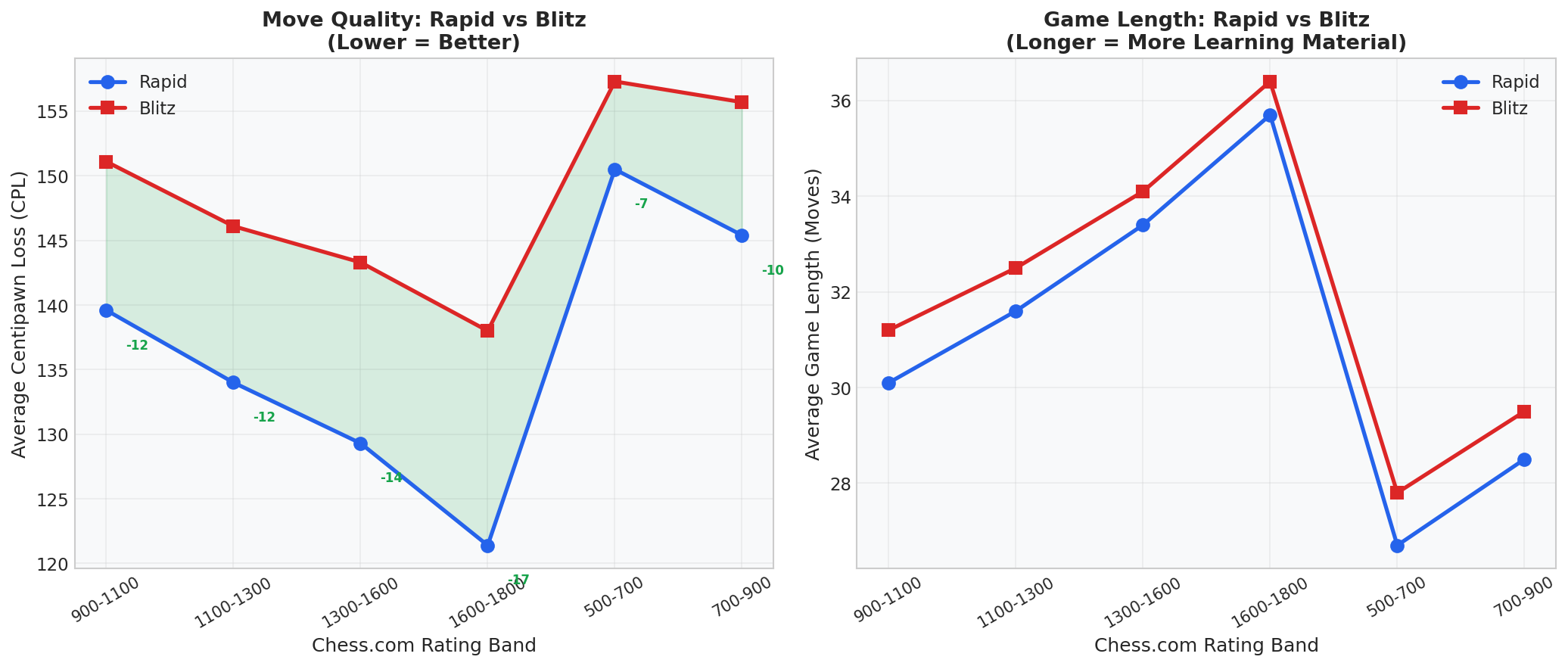
Our comparison of Rapid and Blitz games across 200,000+ games shows that Rapid games feature significantly lower Centipawn Loss (better move quality) at every rating band. The gap ranges from 7 CPL at lower ratings to 17 CPL at higher ratings. Rapid games also last longer — more moves per game means more learning material per session.
Furthermore, our analysis of clock usage vs. accuracy across 46 million individual moves shows that taking just 15–30 seconds on a move reduces Centipawn Loss by approximately 16 points compared to playing in under 5 seconds. Blitz simply does not give you the time required to practice deep calculation.
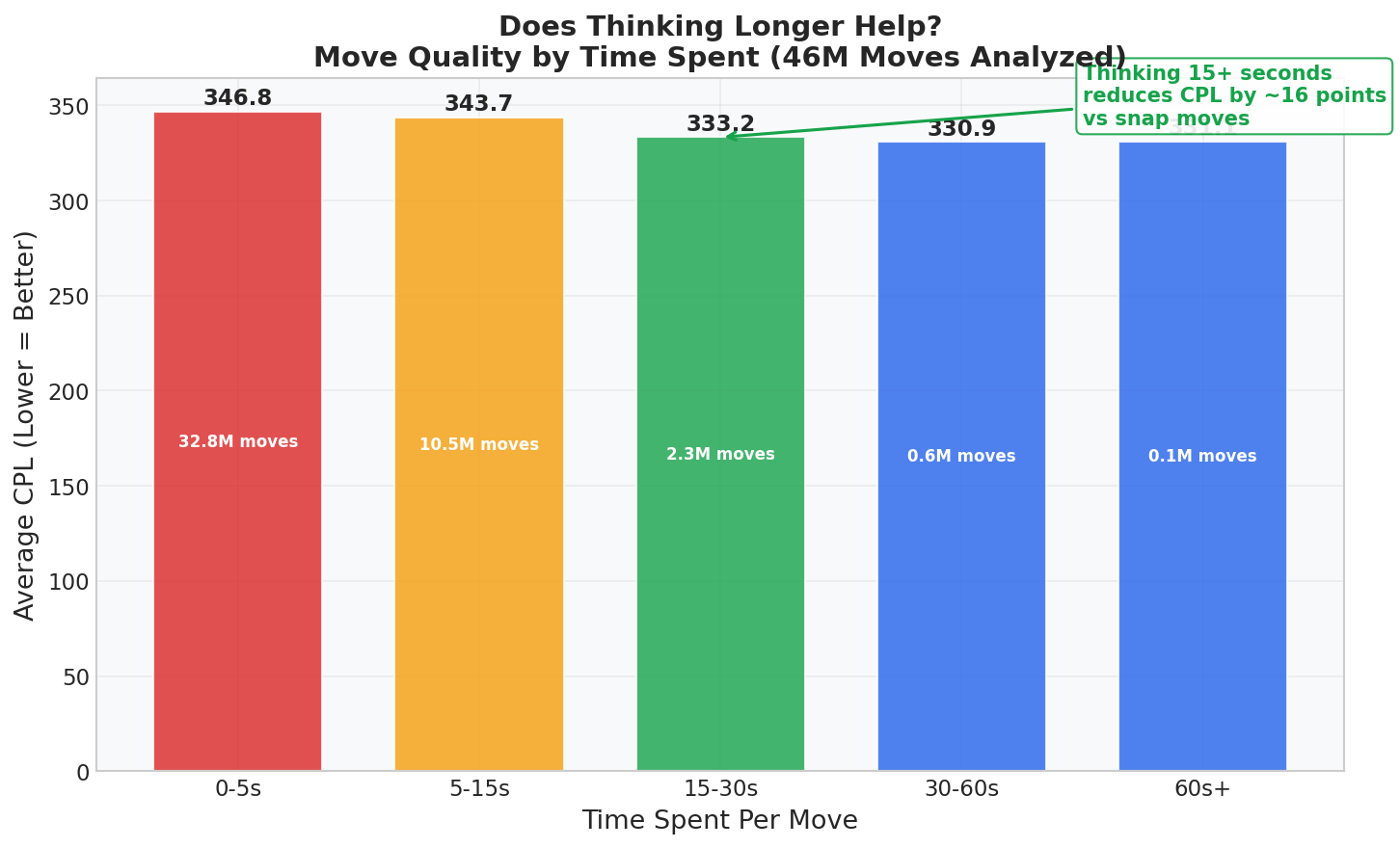
| Time Spent Per Move | Average CPL | Sample Size |
|---|---|---|
| 0–5 seconds | 346.8 | 32.8M moves |
| 5–15 seconds | 343.7 | 10.5M moves |
| 15–30 seconds | 333.2 | 2.3M moves |
| 30–60 seconds | 330.9 | 590K moves |
| 60+ seconds | 331.1 | 106K moves |
The diminishing returns of thinking time mirror the diminishing returns of game volume. The biggest improvement comes from moving out of the "snap move" zone (0–5 seconds) into the "considered move" zone (15–30 seconds). Beyond 30 seconds, additional thinking time yields negligible improvement — a finding that supports the value of Rapid over Classical for most improving players.
Rating Plateaus: The Data Behind "I'm Stuck"
Before we discuss the roadmap, it is worth understanding the plateau phenomenon. Our analysis of rating trajectories for over 50,000 Rapid players reveals that plateaus are common, predictable, and — crucially — temporary.
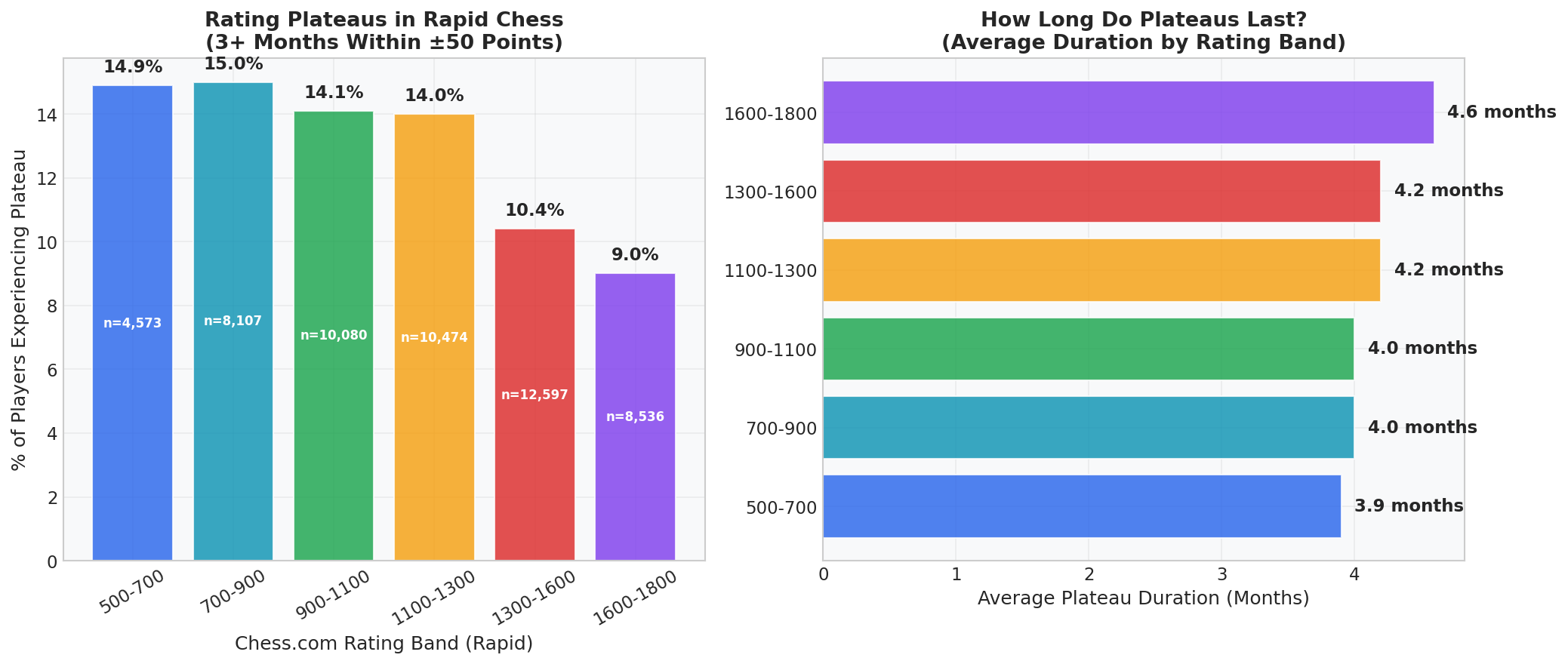
Approximately 14–15% of players in the Chess.com 500–1100 range (Lichess 700–1300) experience a plateau lasting 3 or more months. The plateau rate drops to 9–10% for players above Chess.com 1300 (Lichess 1500), suggesting that players who reach this level have already developed the habit of deliberate practice.
The average plateau lasts 3.9–4.6 months, with longer plateaus at higher ratings. This is normal. If you have been stuck at the same rating for 3 months, you are not uniquely cursed — you are statistically typical.
How Long Does It Take to Climb?
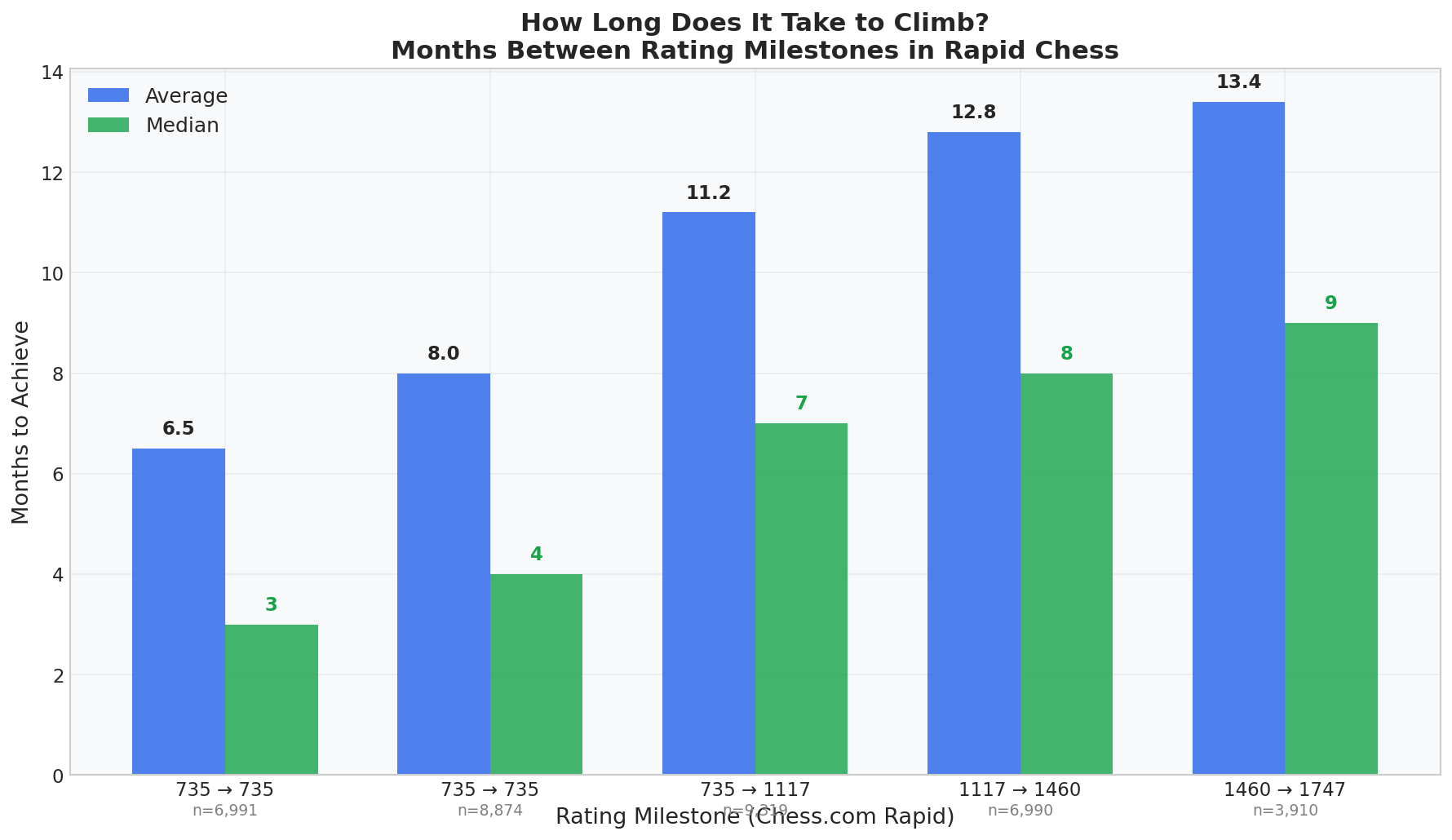
The progression data from 36,000+ Rapid players shows that the median time to climb 200 rating points increases as you get stronger. The jump from Chess.com 735 to 1035 (Lichess 1200 to 1400) takes a median of just 3 months. But climbing from Chess.com 1405 to 1655 (Lichess 1765 to 1930) takes a median of 8 months.
The Roadmap: Actionable Advice by Rating Band
Based on the data, here is your roadmap for climbing the rating ladder, tailored to your current level.
Chess.com 800–1000 Rapid (Lichess ~1400–1615)
The Hurdle: One-move blunders and hanging pieces. At this level, the average game features approximately 18 blunders per game, and the average CPL is 150.
Optimal Volume: 10–15 Rapid games per month (3–4 per week).
Actionable Advice: Do not play Blitz at this stage. Your primary goal is to reduce your blunder rate. After every game, use the analysis board to find the first major blunder you made. You do not need deep engine lines; just identify which piece was left undefended. If you can reduce your blunder count from 18 to 14 per game, you will gain approximately 100 rating points.
Chess.com 1000–1200 Rapid (Lichess ~1615–1765)
The Hurdle: Basic tactics and opening traps. Players at this level are still blundering frequently but are beginning to recognize simple patterns.
Optimal Volume: 15–20 Rapid games per month (4–5 per week).
Actionable Advice: This is where the "Analyzer vs. Grinder" gap becomes massive. Force yourself to take a 15-minute break between games. Review the opening phase specifically — did you fall for a trap? Did you develop all your pieces before launching an attack? The data shows that players who wait 30+ minutes between games improve nearly twice as fast as those who immediately queue.
Chess.com 1200–1400 Rapid (Lichess ~1765–1880)
The Hurdle: The 1200 Plateau. Our data shows 14% of players get stuck here for an average of 4 months.
Optimal Volume: 20–25 Rapid games per month (5–6 per week).
Actionable Advice: You are likely losing games in the endgame or due to tilt. Implement the "Two-Loss Rule": if you lose two games in a row, your session is over. Start analyzing your endgames; a single pawn endgame principle (like the opposition) can save dozens of rating points.
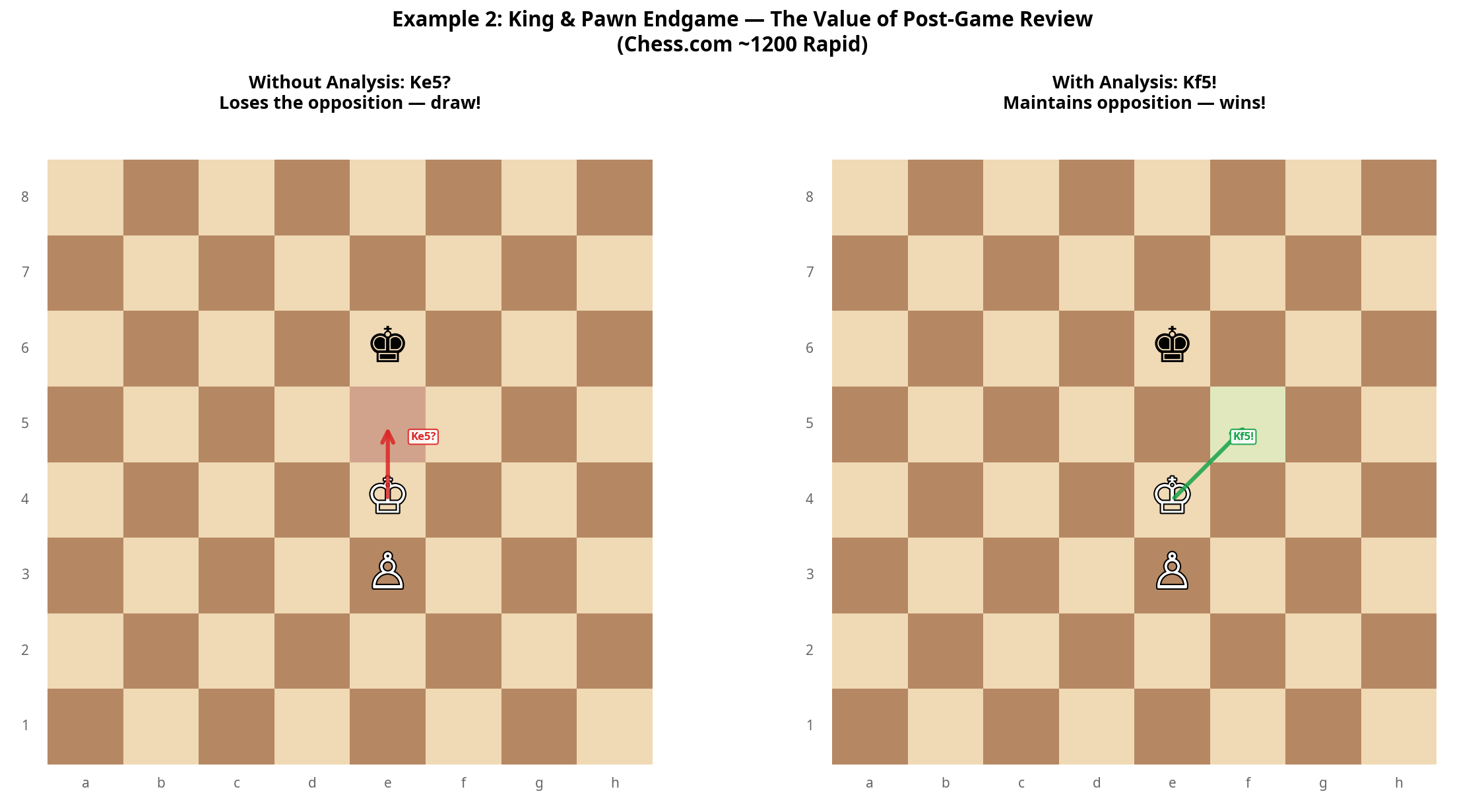
The position above illustrates a critical King and Pawn endgame. Without analysis, a player might play Ke5?, losing the opposition and drawing a won position. With post-game review, the player learns that Kf5! maintains the opposition and wins.
Chess.com 1400–1500+ Rapid (Lichess ~1880–1930+)
The Hurdle: Positional understanding and calculation depth. At this level, CPL drops to around 130, and games average 33+ moves.
Optimal Volume: 20–30 Rapid games per month (5–7 per week).
Actionable Advice: You are entering the territory where quality vastly outweighs quantity. Spend as much time analyzing your games as you do playing them. Look at your time management — are you rushing critical middlegame decisions? The clock data shows that spending 15–30 seconds on key moves improves accuracy by 16 CPL points. Use your clock.
The Optimal Weekly Schedule
Based on all the data, here is what an ideal week of Rapid chess improvement looks like for a player in the Chess.com 1000–1400 range:
| Day | Activity | Time |
|---|---|---|
| Monday | Play 2–3 Rapid games | 45–60 min |
| Tuesday | Analyze Monday's games with engine | 30 min |
| Wednesday | Tactical puzzles (Lichess or Chess.com) | 20 min |
| Thursday | Play 2–3 Rapid games | 45–60 min |
| Friday | Analyze Thursday's games | 30 min |
| Saturday | Play 3–4 Rapid games (stop after 2 losses) | 60–90 min |
| Sunday | Review the week's worst blunders | 30 min |
Weekly total: 12–16 Rapid games + 90 minutes of analysis. This puts you squarely in the optimal zone identified by the data.
Conclusion
Playing more games does make you better — but only if you are actually learning from them. The data proves that a player who plays 15 Rapid games a month and analyzes every single one will improve significantly faster than a player who grinds 60 games a month on autopilot.
The three rules that the data supports above all others:
- Play Rapid, not Blitz, if your goal is improvement. The extra time per move translates directly into better move quality and more learning per game.
- Stop after two consecutive losses. Tilt is real, measurable, and devastating. Your win rate drops below 48% and your CPL spikes by 50–70 points.
- Analyze every game. The 15-minute gap between games is the single strongest predictor of long-term improvement in our dataset.
Stop grinding. Start analyzing.
Chess Coach April 17, 2026
Data and Methodology
This research was conducted using a combination of the Lichess Open Database (via the Grandmaster Guide MCP analytics engine, covering 954,617 games with 100% Stockfish evaluation coverage) and direct sampling via the Lichess API.
Data Sources:
| Source | Description | Sample Size |
|---|---|---|
| Grandmaster Guide MCP — Practice Volume Correlation | Games played per month vs. rating delta next month | 124,000+ player-months |
| Grandmaster Guide MCP — Streak Effects | Win rate and CPL change after consecutive wins/losses | 200,000+ game sequences |
| Grandmaster Guide MCP — Player Progression | Time between rating milestones | 36,000+ players |
| Grandmaster Guide MCP — Rating Plateau Analysis | Plateau frequency and duration | 54,000+ players |
| Grandmaster Guide MCP — Time Control Comparison | CPL and game length by time control | 200,000+ games |
| Grandmaster Guide MCP — Clock vs. Accuracy | CPL by time spent per move | 46 million moves |
| Grandmaster Guide MCP — Rematch Outcomes | Win rate in immediate rematches | 25,000+ rematches |
| Lichess API — Player Deep Dive | Inter-game timing and rating trajectories | 150 players |
Platform Calibration: All raw data was sourced from Lichess. Rating labels in the text and charts have been adjusted to approximate Chess.com ratings using the standard cross-platform conversion table (e.g., Lichess 1400 Rapid ≈ Chess.com 1035 Rapid; Lichess 1765 Rapid ≈ Chess.com 1405 Rapid).
Underlying Data Files:
- — 150 players with rating, volume, gap time, and improvement metrics
View full data →username current_rating total_games months_active games_per_month rating_change avg_gap_minutes is_analyzer is_grinder early_rating late_rating recent_games_sampled Chessploutos 2509 55 10 4.1 435.6 27.4 True False 2096.4 2532.0 55 Odnoobraz 2434 733 24 3.6 131.7 17.5 True False 2287.8 2419.5 104 eel9 2372 688 57 4.1 916.3 60.2 True False 1449.1 2365.5 104 petkovich 2091 1548 44 4.0 25.7 16.0 True False 2057.5 2083.2 104 playRapidNotBlitz 2636 1387 43 8.4 31.9 29.9 True False 2658.2 2690.1 104 - — Aggregated statistics for Grinder, Moderate, and Reflective player types
View full data →monthly_improvement monthly_improvement monthly_improvement monthly_improvement games_per_month avg_gap_minutes rating_change total_games mean median std count mean mean mean mean player_type Grinder (<10min gap) 9.77 8.77 14.63 14 5.94 5.81 244.19 2128.86 Moderate (10-30min gap) 7.7 5.76 15.41 50 7.34 19.16 154.15 2539.62 Reflective (>30min gap) 12.59 9.75 13.9 86 11.04 59.19 308.45 2329.29 - — Aggregated statistics by games-per-month bucket
View full data →monthly_improvement monthly_improvement monthly_improvement avg_gap_minutes rating_change mean median count mean mean volume_bucket 1-3 15.64 13.66 18 18.24 160.37 4-6 10.11 10.82 43 33.32 257.62 7-10 9.02 8.14 33 45.54 239.04