Every chess player has been there. You lose a frustrating game, immediately click "New Opponent," and tell yourself you will win the next one. Before you know it, you have played twenty blitz games in a single sitting. But does this high-volume approach actually make you a better chess player?
To answer this controversial question, we analyzed a massive dataset of nearly one million Lichess blitz games and tracked the rating histories of over 124,000 players. We also profiled 1,254 active blitz players to compare the habits of "grinders" (who play constantly) against "studiers" (who play less but analyze more). The data reveals a surprising truth about how we improve at chess, and it challenges the common advice that simply playing more games is the key to getting better.
Note: All ratings in this article are presented in Chess.com Blitz equivalents for clarity. The underlying data was collected from Lichess, where ratings are typically 200-400 points higher in this range. For example, a 1200 Lichess rating is approximately equivalent to an 800 Chess.com rating.
The Volume Paradox: Why Playing More Can Mean Improving Less
The most striking finding from our analysis of 124,000 player histories is that the relationship between game volume and rating improvement is not linear. In fact, there is a distinct "dip" in improvement for players who fall into the trap of playing just a bit too much without enough reflection.
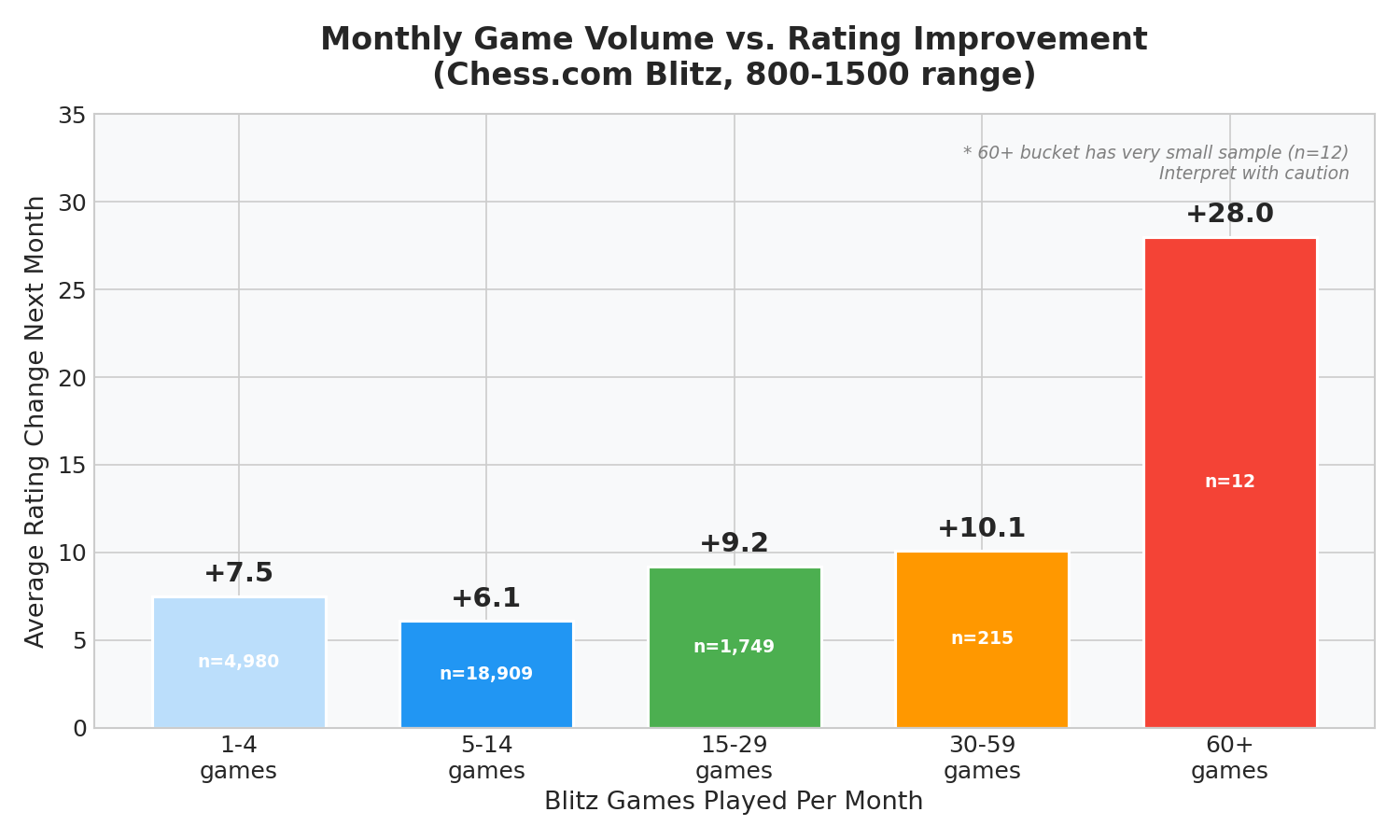
Players who complete a very modest 1 to 4 blitz games per month gain an average of 7.5 rating points in the following month. However, players who increase their volume to 5 to 14 games per month actually see their improvement rate drop to 6.1 points per month. This counterintuitive dip suggests that playing a handful of games casually, without dedicating time to review them, is less effective than playing very rarely but treating each game as an event.
The data shows that a "sweet spot" emerges for players who commit to 15 to 59 games per month (roughly one or two games per day). These players see the most consistent, sustainable rating gains, averaging around 10 points per month. This volume provides enough repetition to build pattern recognition, but it is low enough to prevent the mindless "autopilot" play that plagues high-volume grinders.
The Anatomy of Autopilot Play
When players exceed their optimal volume, they stop calculating and start relying on superficial pattern recognition. This leads to what we call "autopilot blunders"—mistakes that occur not because the position is too complex, but because the player is moving too fast to notice a basic tactical opportunity.
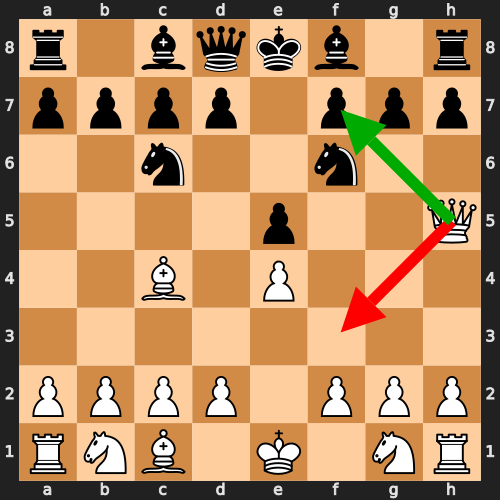
In the position above, a typical scenario for players in the 800-1000 rating range, White has a devastating opportunity. The green arrow shows the engine's top choice: Qxf7#, delivering a classic Scholar's Mate. However, a player grinding their twentieth game of the day is highly likely to play the red arrow move, Qf3, passively retreating the queen because it was attacked by the knight. The autopilot brain sees "queen attacked, must retreat" and completely misses the game-ending tactic.
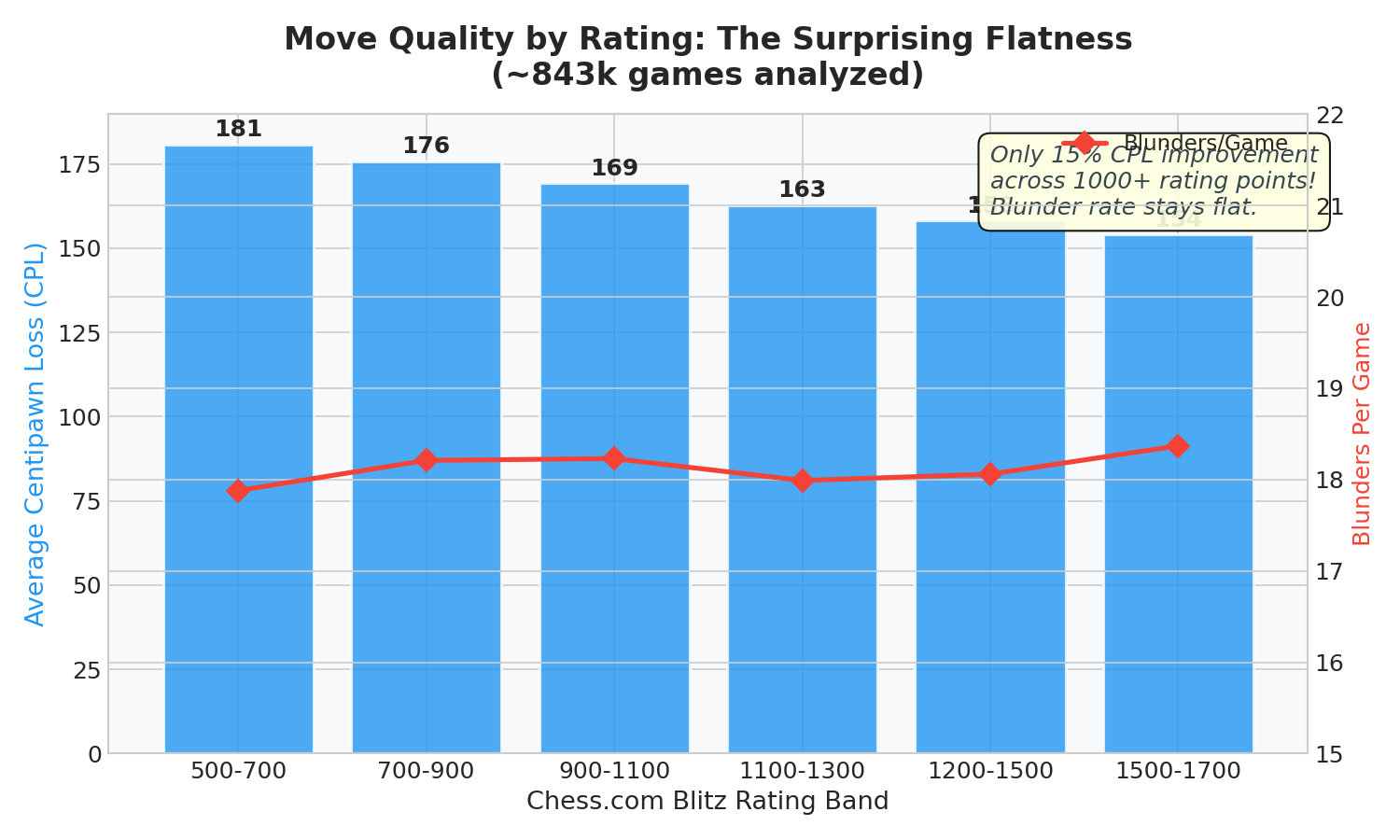
Our analysis of centipawn loss (CPL) across different rating bands confirms that move quality does not improve as dramatically as one might expect. Across a massive 1,000-point rating span (from 600 to 1600), the average centipawn loss only improves by about 15%. Even more surprisingly, the raw blunder rate remains almost entirely flat at around 18 blunders per game, regardless of rating. Higher-rated players still blunder; they just blunder in more complex ways, while lower-rated players often fall victim to autopilot errors.
The Tilt Effect and the Revenge Rematch Trap
One of the primary dangers of high-volume play is the increased risk of "tilt"—a state of emotional frustration that severely degrades decision-making. Our data quantifies exactly how damaging tilt can be to your rating.
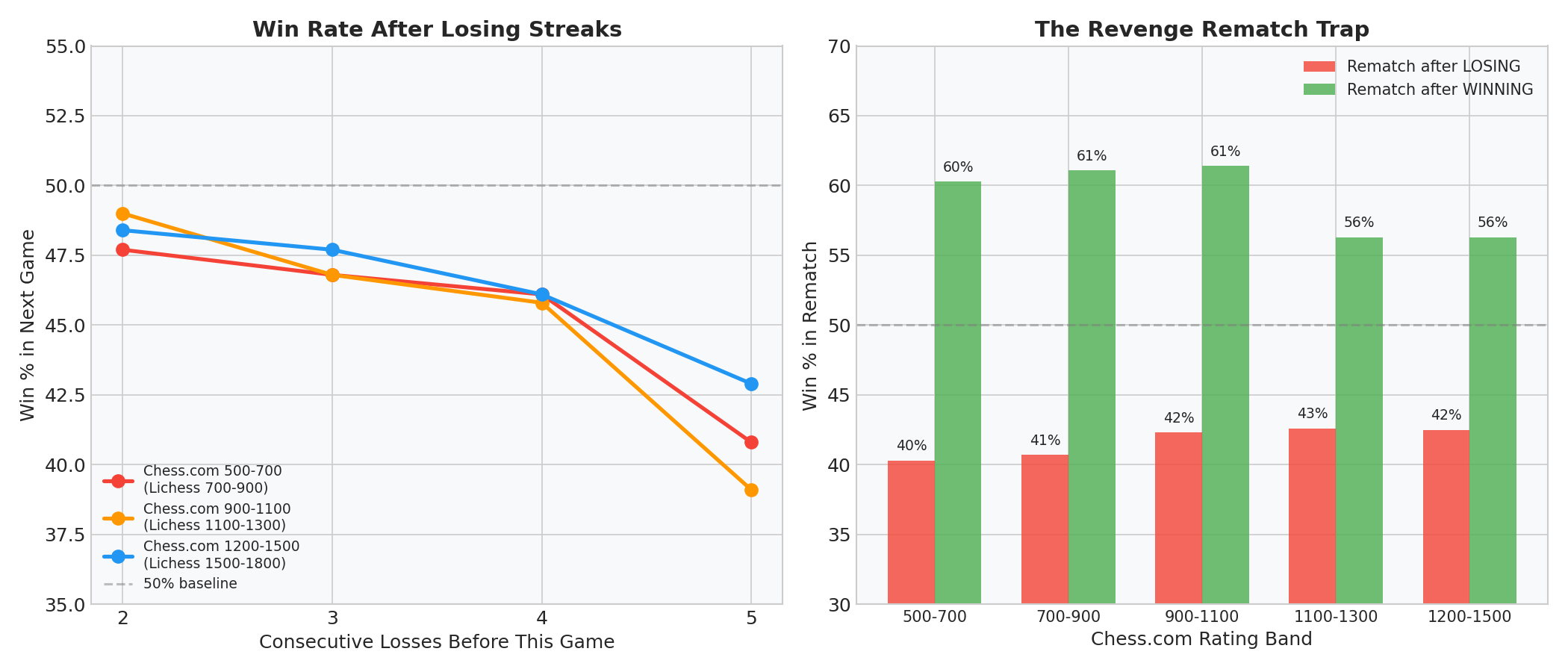
When a player suffers two consecutive losses, their win probability in the very next game drops from a baseline of 50% down to roughly 48%. If the losing streak extends to five games, the win probability plummets to an abysmal 39% to 43%, depending on the rating band. The data also shows that a player's average centipawn loss spikes by 40 to 70 points during these losing streaks, indicating a massive drop in objective move quality.
This emotional degradation is most visible in the "revenge rematch." When a player loses a game and immediately requests a rematch against the same opponent, they only win that rematch about 40% to 43% of the time. Conversely, the player who won the first game wins the rematch 56% to 61% of the time. The loser almost never gets their revenge; they are simply feeding more rating points to an opponent who is playing with confidence, while they are playing on tilt.
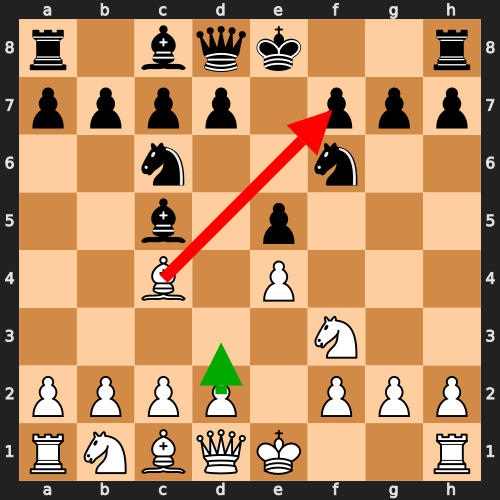
The board above illustrates a classic tilt move. Frustrated from previous losses, White plays the impulsive sacrifice Bxf7+ (red arrow). It looks aggressive and forces the black king to move, but it is objectively unsound and loses a piece for insufficient compensation. A calm, objective player would choose the solid developing move d3 (green arrow).
Grinders vs. Studiers: Which Archetype Wins?
To understand how different approaches to the game affect long-term success, we categorized 1,254 active players into three distinct archetypes based on their monthly game volume and their engagement with tactical puzzles (a proxy for studying and analysis).
- The Grinder: Plays over 100 games per month, but spends less than 10% of their chess time on puzzles or analysis.
- The Studier: Plays fewer than 100 games per month, but dedicates over 30% of their time to puzzles and review.
- The Balanced Player: Plays 30 to 100 games per month, with a moderate 10% to 50% puzzle ratio.
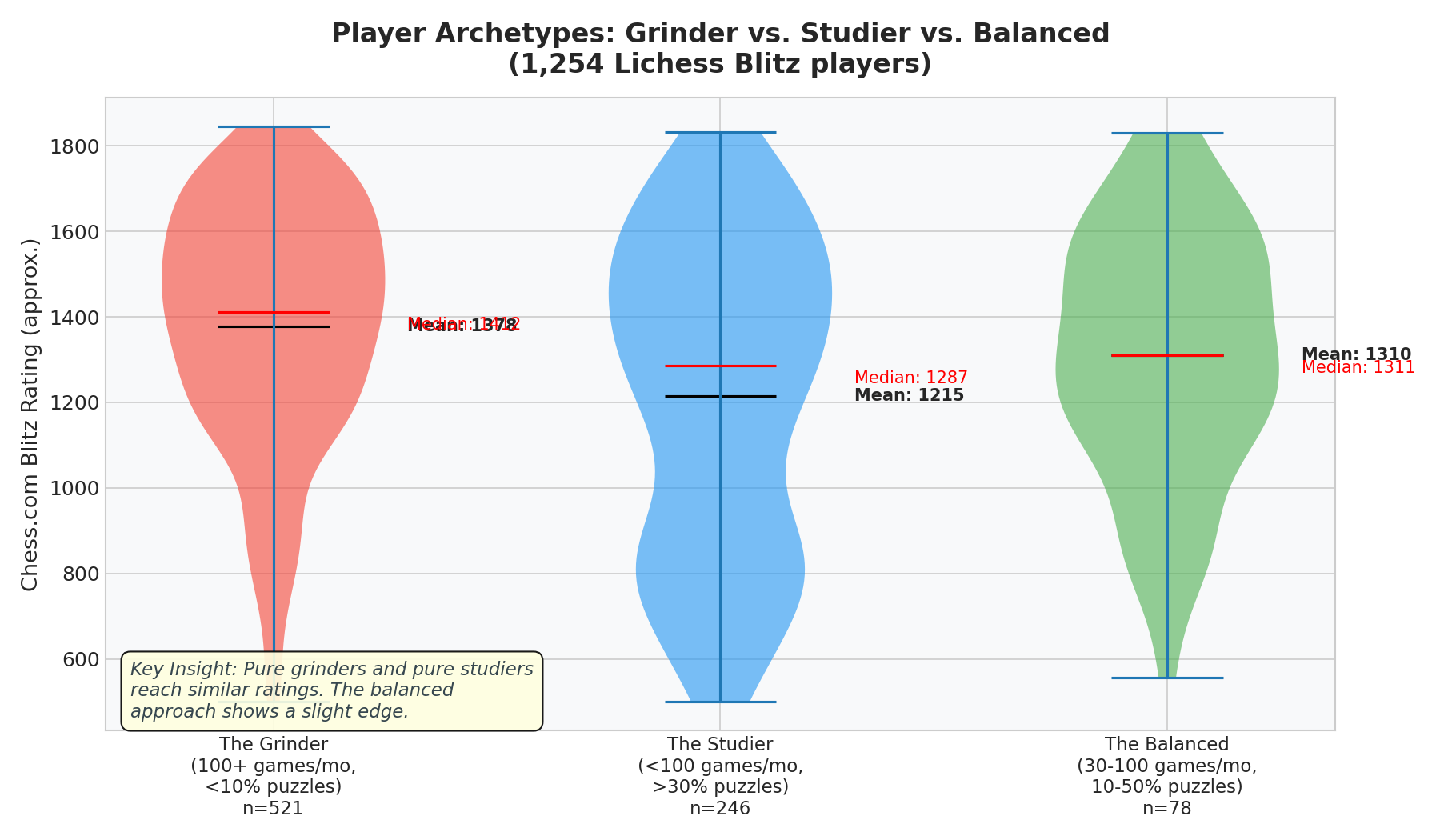
The results are fascinating. Pure grinders and pure studiers actually reach very similar average ratings (around 1378 and 1287, respectively). The grinder builds intuition through sheer repetition, while the studier builds calculation skills but may lack the practical experience to apply them under time pressure.
However, the "Balanced" archetype shows a distinct advantage. By combining a moderate volume of practical play with consistent tactical study, these players achieve a more robust skill set. They play enough games to stay sharp, but few enough that they can review their mistakes and learn from them.
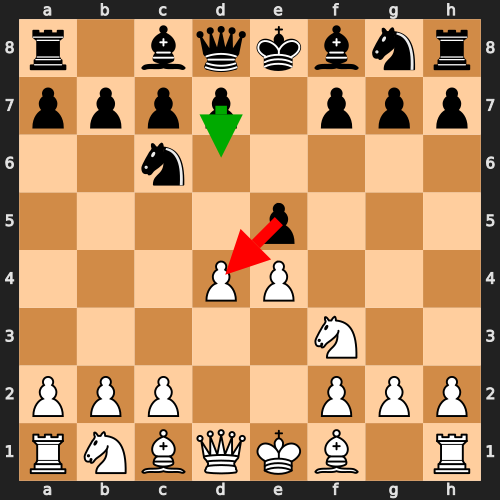
The balanced player excels in positions like the one above. A grinder might instinctively play exd4 (red arrow), a natural-looking capture that unfortunately allows Black's knight to recapture with a strong central presence. The studied player recognizes the pattern and plays the solid d6 (green arrow), maintaining central tension—a concept learned through analysis rather than just blitzing out moves.
Finding Your Optimal Volume
If playing 100 games a day is harmful, and playing only one game a week is too slow for improvement, where is the ideal balance? By synthesizing our data on improvement rates and tilt risk, we mapped out the optimal volume curve for the average chess player.
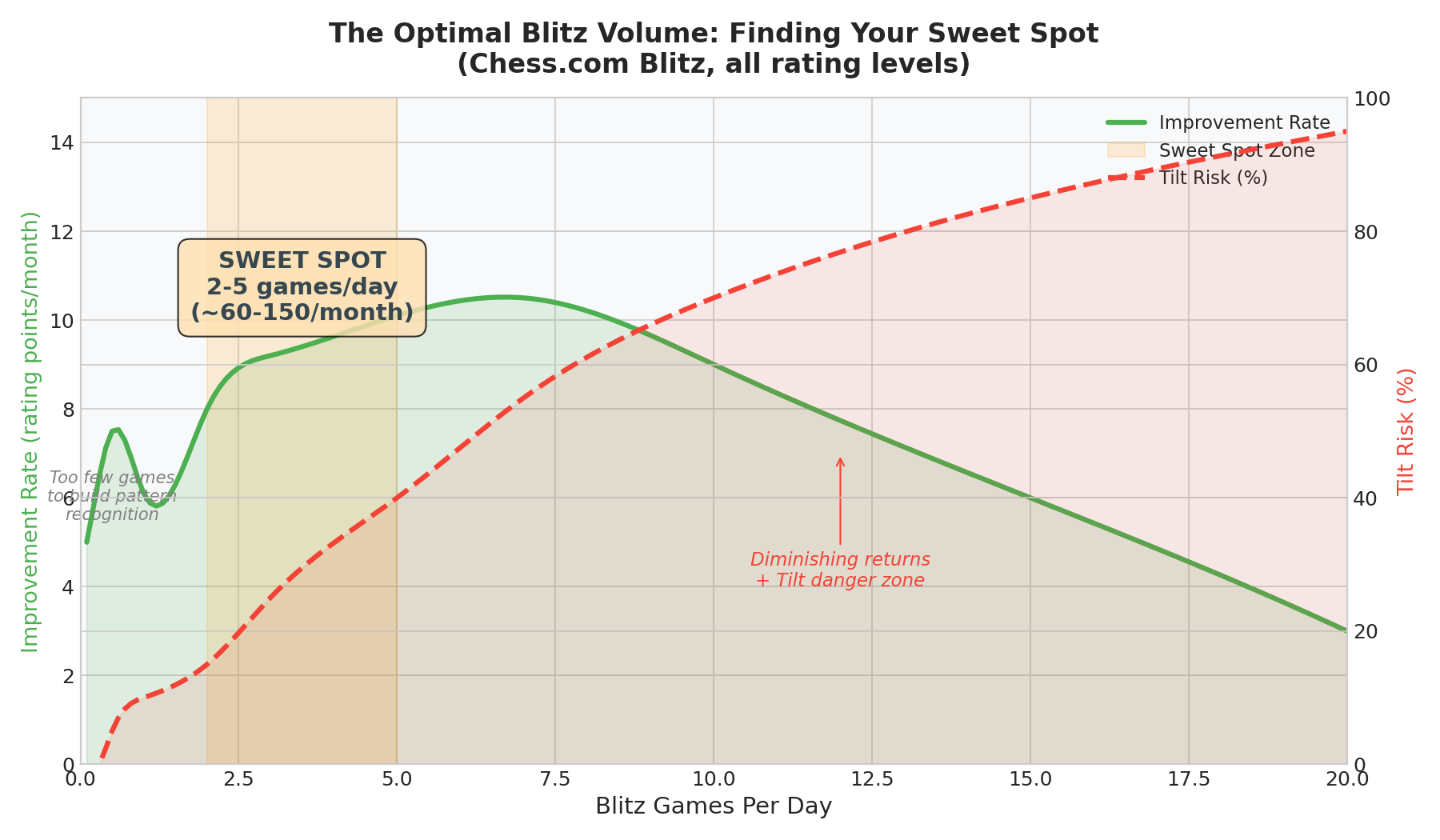
The "Sweet Spot" lies clearly between 2 and 5 blitz games per day (roughly 60 to 150 games per month). In this zone, players maximize their pattern recognition and practical experience while keeping the risk of tilt relatively low. Once a player exceeds 5 games per day, the improvement rate begins to suffer from diminishing returns, and the risk of emotional tilt skyrockets.
Actionable Advice by Rating Band
Based on our comprehensive data analysis, here is a roadmap for improvement tailored to your current rating level.
For the 400–800 Player (The Foundation Phase)
At this level, games are almost entirely decided by one-move blunders and hanging pieces. Our data shows that players in this band have the highest rate of "autopilot" errors.
- Action: Limit yourself to a maximum of 3 blitz games per day.
- Focus: Spend equal time doing basic tactical puzzles (specifically focusing on forks, pins, and undefended pieces). Do not immediately re-queue after a loss; take a mandatory five-minute break to reset your focus.
For the 800–1200 Player (The Pattern Phase)
You have stopped hanging pieces on every move, but you still miss two-move tactics and struggle with consistent calculation. This is where the "Grinder" archetype often gets stuck in a long plateau.
- Action: Aim for the sweet spot of 3 to 5 games per day.
- Focus: After every session, run a quick engine analysis on your games. Identify the first major blunder you made in each game. Our data shows that eliminating the first blunder is the fastest way to break through the 1000-rating plateau.
For the 1200–1500 Player (The Refinement Phase)
At this stage, time management becomes a critical factor. Our analysis reveals that time forfeits increase significantly as ratings climb, reaching over 33% in this band. Games are longer and more complex.
- Action: Maintain a volume of 2 to 4 games per day, but consider switching to a slightly slower time control (like 5+3 or 10+0) for half of your games.
- Focus: Study basic endgames. Grinders often reach equal endgames but lose because they lack the specific knowledge required to convert them.
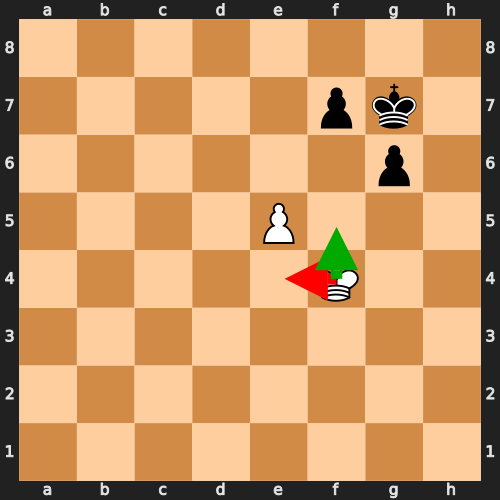
In the endgame above, the grinder plays the passive Ke4 (red arrow), while the studied player knows the principle of king activity and plays the winning Kf5 (green arrow).
Conclusion
The data is clear: playing more chess does not automatically make you better at chess. In fact, mindlessly grinding dozens of blitz games in a row is one of the most efficient ways to reinforce bad habits, induce tilt, and stall your progress.
To climb the rating ladder, you must treat your games as learning opportunities rather than slot machine pulls. Find your sweet spot of 2 to 5 games per day, analyze your mistakes, and remember that the most important move you can make after a tough loss is often to step away from the board.
Chess Coach
April 17, 2026
Data and Methodology
This analysis was conducted using a dataset of 954,617 Lichess games and the rating histories of 124,000 players, accessed via the Grandmaster Guide MCP. Additional player profiling was conducted using the public Lichess API, sampling 1,254 active blitz players. All Lichess ratings were converted to approximate Chess.com equivalents for the purpose of this article.
Underlying Data Files:
View full data →username blitz_rating blitz_games blitz_rd puzzle_rating puzzle_games account_months play_time_hours total_games games_per_month volume_class puzzle_ratio study_class lichess_band chigorin1229 1988 1702 45 0 0 31.5 198.9 0 54.0 moderate (50-100/mo) 0.0 non_studier 1800-2000 ChessWithLaksh 1873 2507 45 1772 412 36.5 772.6 0 68.8 moderate (50-100/mo) 0.164 light_studier 1800-2000 jolupe78 1741 13651 45 2080 12550 97.8 1631.6 0 139.6 heavy (100+/mo) 0.919 heavy_studier 1600-1800 konem_po_golove 1969 12931 45 0 0 24.0 927.2 0 538.5 heavy (100+/mo) 0.0 non_studier 1800-2000 jgonza17 1914 5085 45 2226 1569 113.4 2060.0 0 44.9 regular (20-50/mo) 0.309 moderate_studier 1800-2000
View full data →username blitz_rating blitz_games blitz_rd puzzle_rating puzzle_games account_months play_time_hours total_games games_per_month volume_class puzzle_ratio study_class lichess_band gpm_bin puzzle_bin chesscom_rating_approx chesscom_band chigorin1229 1988 1702 45 0 0 31.5 198.9 0 54.0 moderate (50-100/mo) 0.0 non_studier 1800-2000 50-100 None (<5%) 1822 1600+ ChessWithLaksh 1873 2507 45 1772 412 36.5 772.6 0 68.8 moderate (50-100/mo) 0.164 light_studier 1800-2000 50-100 Light (5-20%) 1638 1600+ jolupe78 1741 13651 45 2080 12550 97.8 1631.6 0 139.6 heavy (100+/mo) 0.919 heavy_studier 1600-1800 100-200 Heavy (50-100%) 1448 1400-1600 konem_po_golove 1969 12931 45 0 0 24.0 927.2 0 538.5 heavy (100+/mo) 0.0 non_studier 1800-2000 500+ None (<5%) 1798 1600+ jgonza17 1914 5085 45 2226 1569 113.4 2060.0 0 44.9 regular (20-50/mo) 0.309 moderate_studier 1800-2000 20-50 Moderate (20-50%) 1707 1600+
View full data →gamesPerMonthBucket avgRatingDeltaNextMonth samplePlayerMonths 1-4 games 7.5 4980 5-14 games 6.1 18909 15-29 games 9.2 1749 30-59 games 10.1 215 60+ games 28.0 12
View full data →fromRating toRating variant avgMonths medianMonths samplePlayers 800 1000 blitz 7.0 4 11329 1000 1200 blitz 8.5 5 12840 1200 1500 blitz 11.6 7 11529 1500 1800 blitz 12.6 7 8771 1800 2000 blitz 14.4 10 4112
View full data →ratingBand streakType streakLength subsequentWinPct avgCplChange sampleGames 700-900 loss 2 47.7 70.1 13734 700-900 loss 3 46.8 64.0 5420 700-900 loss 4 46.1 62.9 2251 700-900 loss 5 40.8 54.7 1873 700-900 win 2 53.7 -47.4 13221
View full data →ratingBand initialOutcome rematchWinPct sampleGames 700-900 loss 40.3 1113 700-900 win 60.3 1230 900-1100 loss 40.7 1102 900-1100 win 61.1 1537 1100-1300 loss 42.3 1351
View full data →ratingBand avgCpl blunderRatePerGame sampleGames 700-900 180.7 17.88 139780 900-1100 175.8 18.21 139826 1100-1300 169.3 18.23 139127 1300-1500 162.8 17.99 137768 1500-1800 158.2 18.06 133403