Every chess player knows the feeling. You study tactics, you learn a new opening, your rating climbs steadily—and then, suddenly, it stops. For weeks or even months, your rating graph looks like a flatline. You win one, you lose one. You are officially stuck on a plateau.
But are plateaus just a psychological illusion, or are there specific rating bands where players mathematically hit a wall? To answer this, we analyzed over 124,000 player rating histories and millions of Rapid games from the Lichess database. By mapping these findings to Chess.com Rapid ratings, we can finally answer the questions that plague improving players: Where do we get stuck, how long does it last, and what does it take to break through?
Note on Methodology: The data in this article is sourced from Lichess Rapid games. To make the insights actionable for the majority of players, all rating bands have been converted to their approximate Chess.com Rapid equivalents (typically 200-300 points lower in this range). A detailed methodology section is available at the end of this article.
The Anatomy of a Plateau
Before we can solve the plateau problem, we need to define it. For this study, we defined a "standard plateau" as a period where a player's rating stays within a narrow 100-point band (±50 points) for at least three consecutive months.
When we map this across different rating levels, a clear pattern emerges.
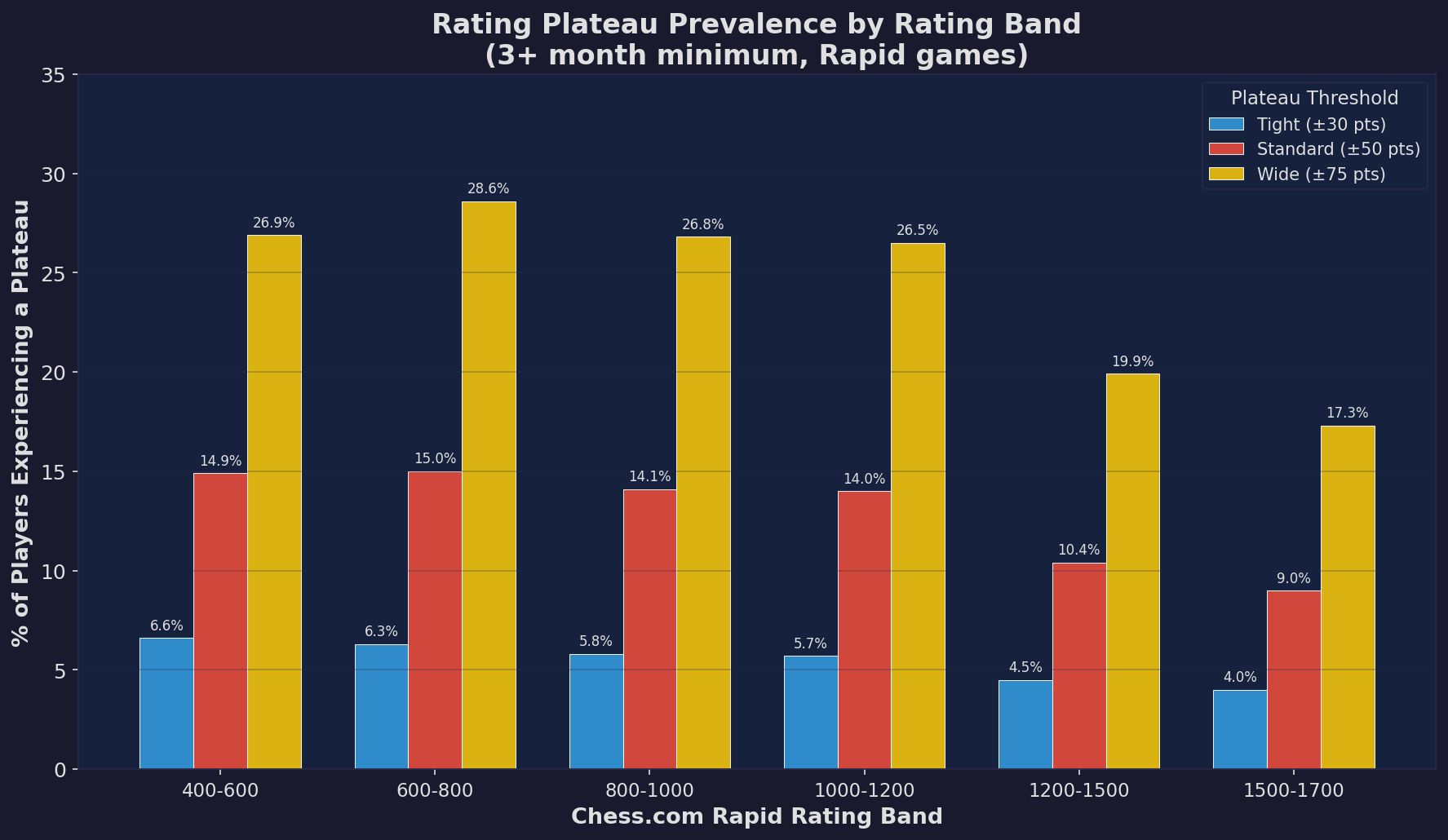
The data reveals that plateaus are incredibly common, but they are not evenly distributed. The most significant bottleneck occurs in the Chess.com 600-800 range (Lichess 900-1100), where 15% of all active players experience a standard 3-month plateau, and nearly 29% experience a "wide" plateau (fluctuating within a 150-point range).
Another major sticking point is the Chess.com 1000-1200 range. This is often considered the boundary between beginner and intermediate chess, and the data supports this: it is a massive filter that requires a fundamental shift in how the game is played.
Interestingly, as players reach higher ratings (Chess.com 1500+), the prevalence of 3-month plateaus actually decreases. This isn't because chess gets easier; rather, players who reach this level have typically developed the study habits and emotional regulation required to push through stagnation, or they have accepted their current level and play less frequently.
How Long Do Plateaus Last?
If you are currently stuck, you probably want to know when the suffering will end. The average duration of a standard plateau is remarkably consistent across rating bands.
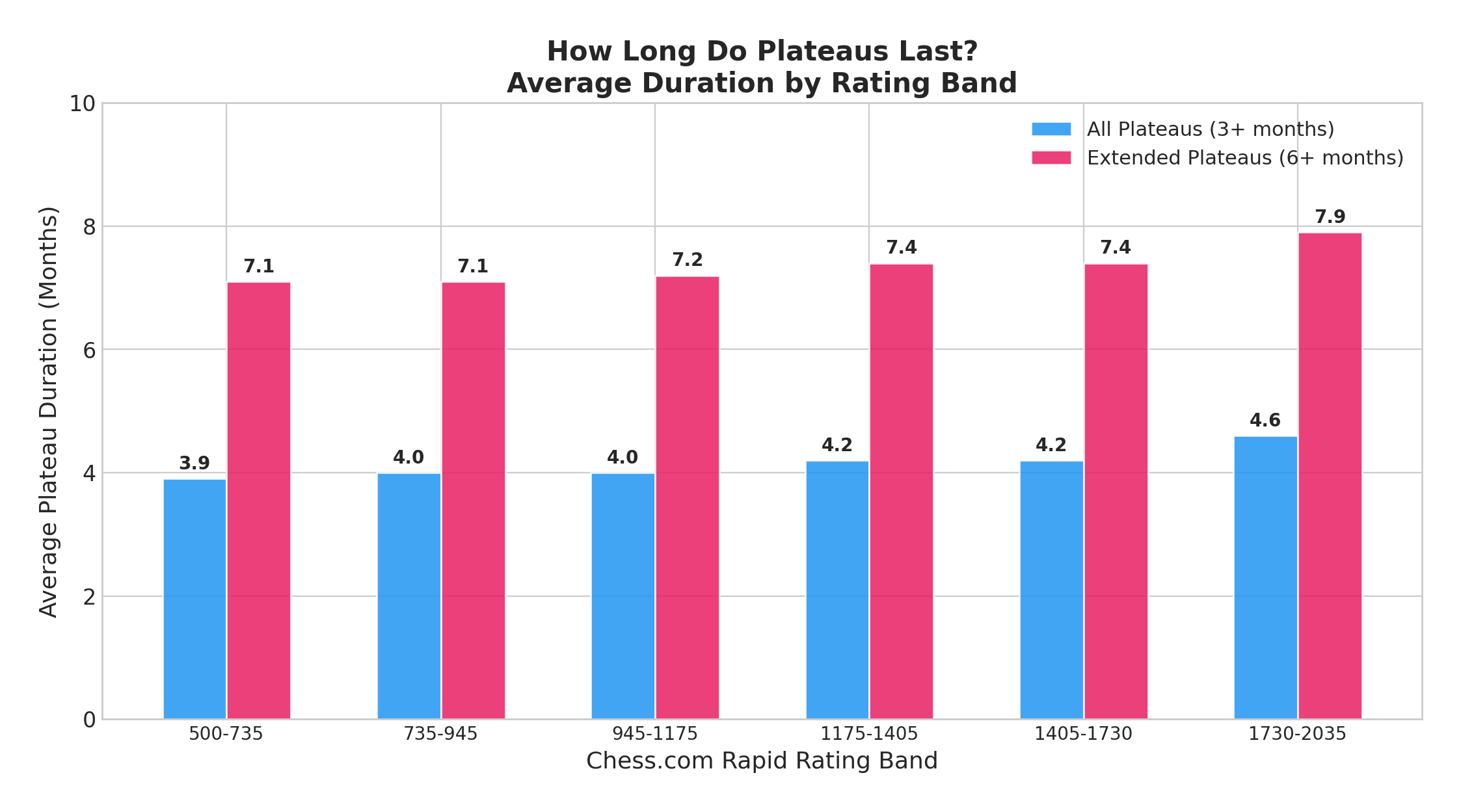
If you hit a wall, you can expect to stay there for an average of 4 to 4.5 months. However, if you are stuck for more than 6 months, you enter a "deep plateau," which lasts an average of 7 to 8 months.
The good news? The vast majority of players do eventually break through.
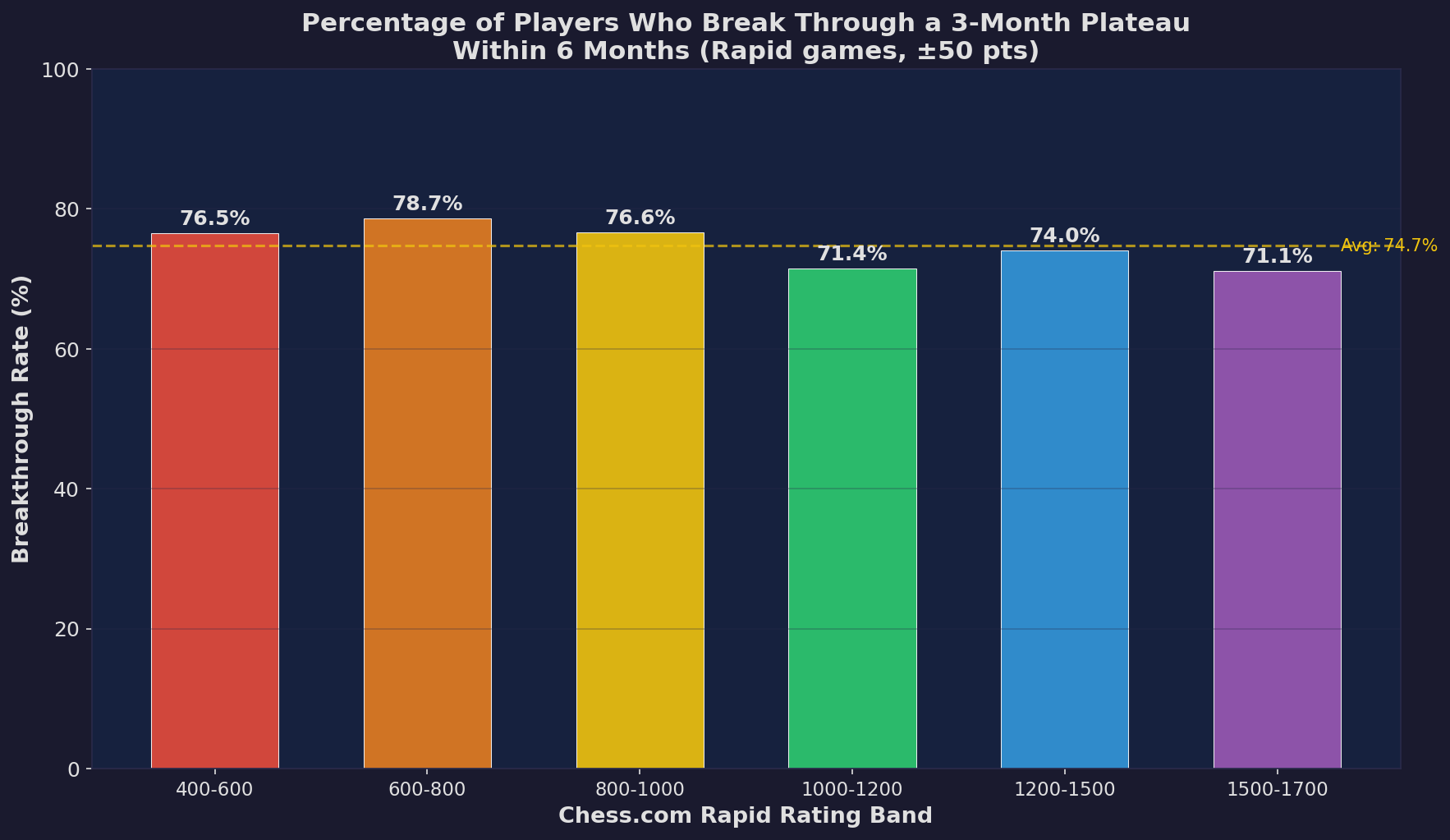
Our analysis shows that if you are stuck in a 3-month plateau, you have a roughly 75% chance of breaking out of it within the next three months. The breakthrough rate is highest at the lower rating bands (79% for the 600-800 range) and slowly decreases as the competition gets tougher.
The Roadmap to Improvement: Breaking Through by Rating Band
What separates the players who break through from those who stay stuck? The data points to specific statistical indicators—from opening diversity to blunder timing—that change right before a rating jump. Here is your data-driven roadmap for breaking through the most common plateaus.
The 600-800 Plateau: The Blunder Barrier
At this level, chess is a game of survival. The data shows that in the Chess.com 600-800 range, players average 18.2 blunders per game (defined as a move that loses 300+ centipawns, or roughly a full piece).
Furthermore, the game phase distribution is heavily skewed toward early finishes. Nearly 30% of games end in under 20 moves, and the average decisive game lasts only 27 moves.
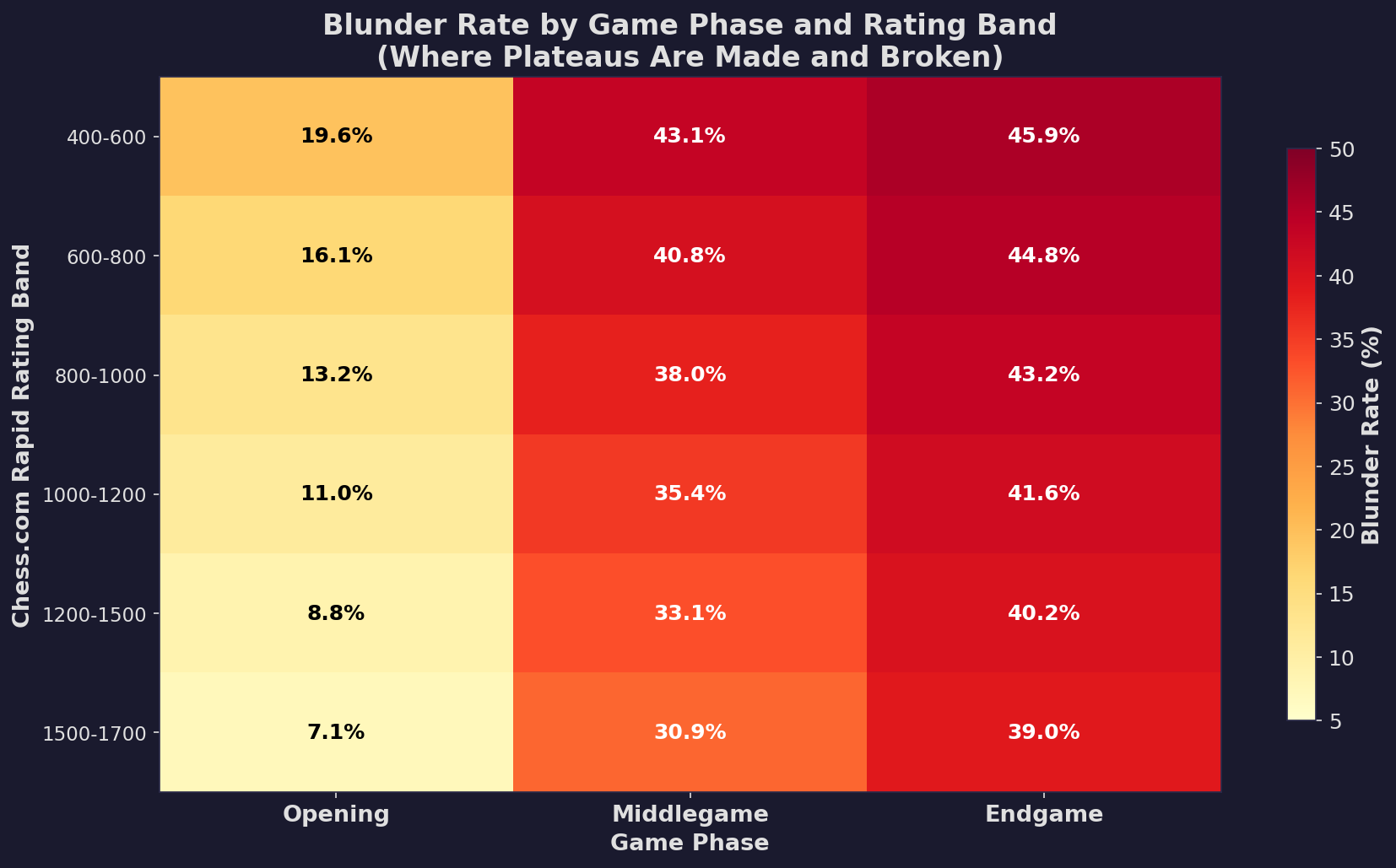
The Data-Backed Indicator of Breakthrough: Players who break out of this plateau show a marked decrease in early-game blunders. The heatmap of phase-specific blunder rates shows that at this level, 16.1% of all opening moves are blunders.
Actionable Advice:
- Stop Memorizing, Start Surviving: The data shows that opening diversity is highest at this level (players try everything), but it doesn't help. Focus entirely on board vision. Before every move, ask: "Is the square I am moving to safe? Did my opponent's last move attack anything?"
- Play Solid Openings: The data shows that trappy openings like the Ware Gambit or the Snagglepuss Defense have high win rates here, but they teach bad habits. Switch to classical principles (control the center, develop knights then bishops, castle early).
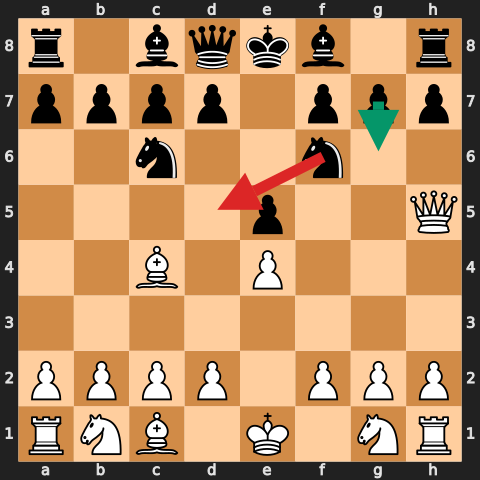 A typical plateau moment: Instead of the necessary d5 break, Black plays c6, leaving the bishop hanging. Board vision is the only hurdle here.
The 800-1000 Plateau: The Tilt Trap
You've stopped hanging pieces on move 5, and your rating has climbed. But now you are stuck again. Why?
The data points heavily to psychological factors, specifically tilt. We analyzed the effect of loss streaks on subsequent performance.
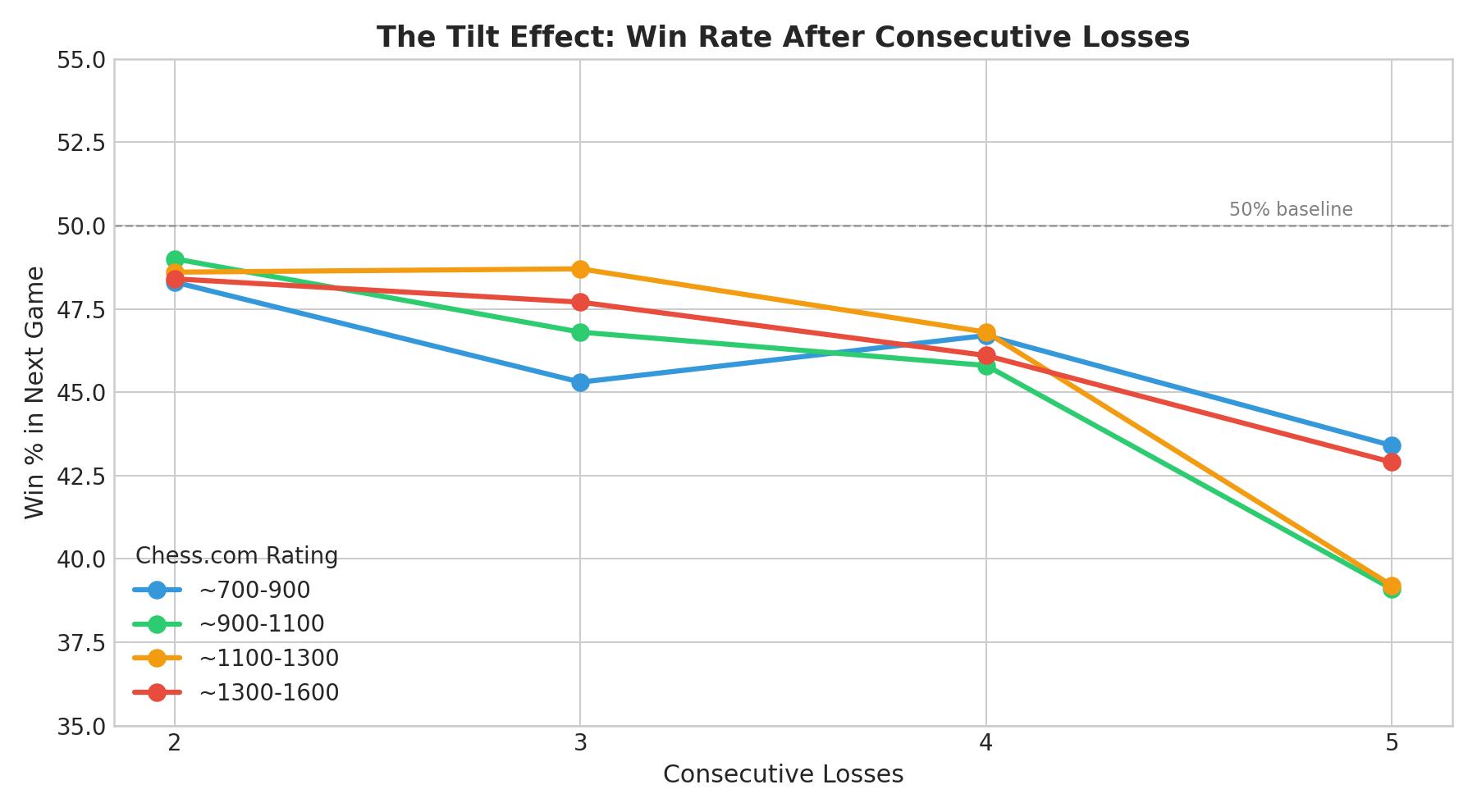
After a 2-game loss streak, a player in the 800-1000 range has a 49% chance of winning their next game. But after a 5-game loss streak, their win rate plummets to 39.1%, and their average Centipawn Loss (CPL) increases by 42.5 points. They are literally playing hundreds of rating points below their true strength.
The Data-Backed Indicator of Breakthrough: Players who break the 1000 barrier show a stabilization in their CPL variance. They stop having games where they play like a 1200 followed immediately by games where they play like a 500.
Actionable Advice:
- Implement a "Two-Loss Rule": The data is undeniable. If you lose two Rapid games in a row, your accuracy in the third game will drop significantly. Stop playing. Take a break, do some puzzles, or come back tomorrow.
- Focus on One Repertoire: The Herfindahl Index (a measure of opening diversity) drops sharply as players cross 1000. Stop playing 15 different first moves. Pick one opening for White, one response to e4, and one response to d4, and stick with them.
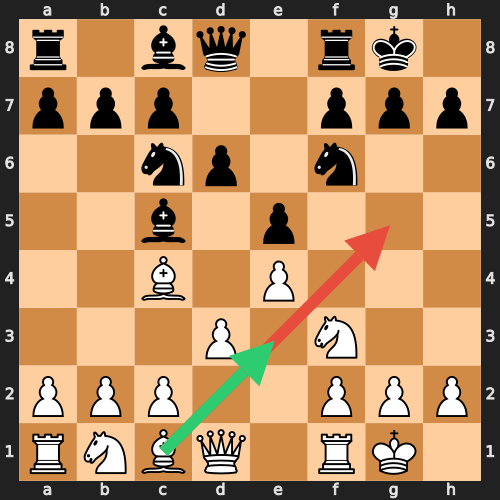 The Tilt Trap: Rushing in familiar positions. Here, White plays the automatic but disastrous Nxe5?? instead of the solid d3, falling into a basic tactical trap.
The 1000-1200 Plateau: The Tactical Ceiling
This is the great filter. The progression data shows that moving from 1000 to 1200 takes an average of 8 months, but moving from 1200 to 1500 takes over 11 months.
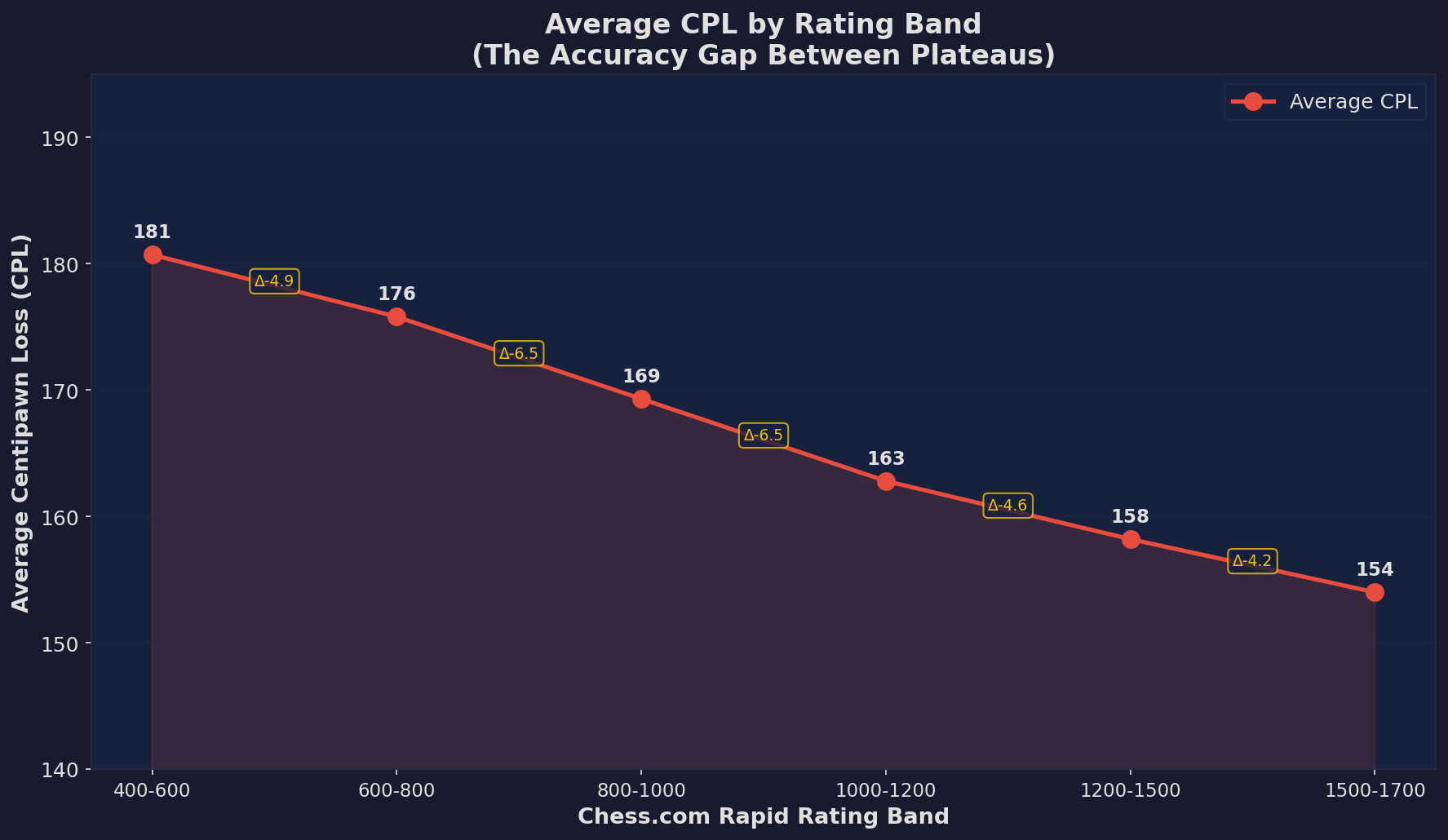
At this level, players rarely hang pieces in one move. Instead, games are decided by 2- or 3-move tactical sequences. The average CPL drops from 169 to 162, which is a massive leap in accuracy.
The Data-Backed Indicator of Breakthrough: The defining characteristic of players breaking 1200 is a sharp drop in middlegame blunders. While opening blunders drop steadily across all ratings, the middlegame blunder rate drops from 38.0% to 35.4% at this specific boundary.
Actionable Advice:
- Grind Motif-Specific Puzzles: Random puzzles are good, but targeted practice is better. The data shows that games at this level are frequently decided by missed pins, skewers, and discovered attacks.
- Look for the Sacrifice: Players at this plateau are often too materialistic. They see a piece and they save it, missing opportunities to sacrifice for a devastating attack.
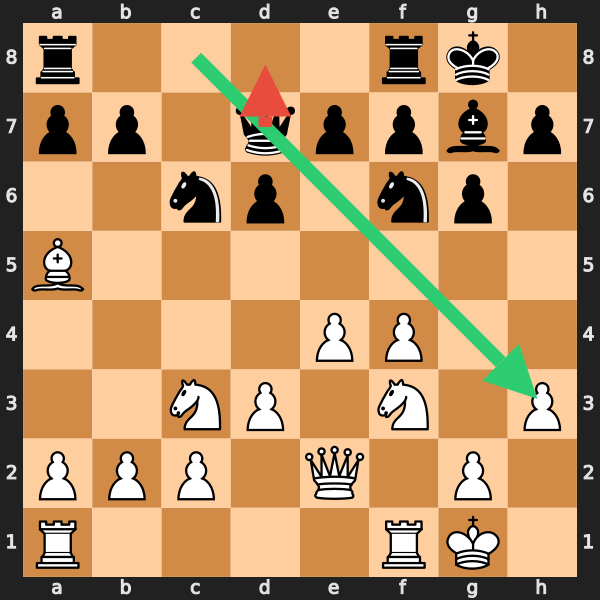 A classic 1100 plateau moment: White plays the passive Qd8, completely missing the game-ending Bxh3! sacrifice that rips open the King's defense.
The 1200-1500 Plateau: The Endgame Reality Check
If you have made it to 1200 Chess.com Rapid, congratulations. You have solid openings and decent tactical vision. But the game is about to change.
Look at the game length distribution data:
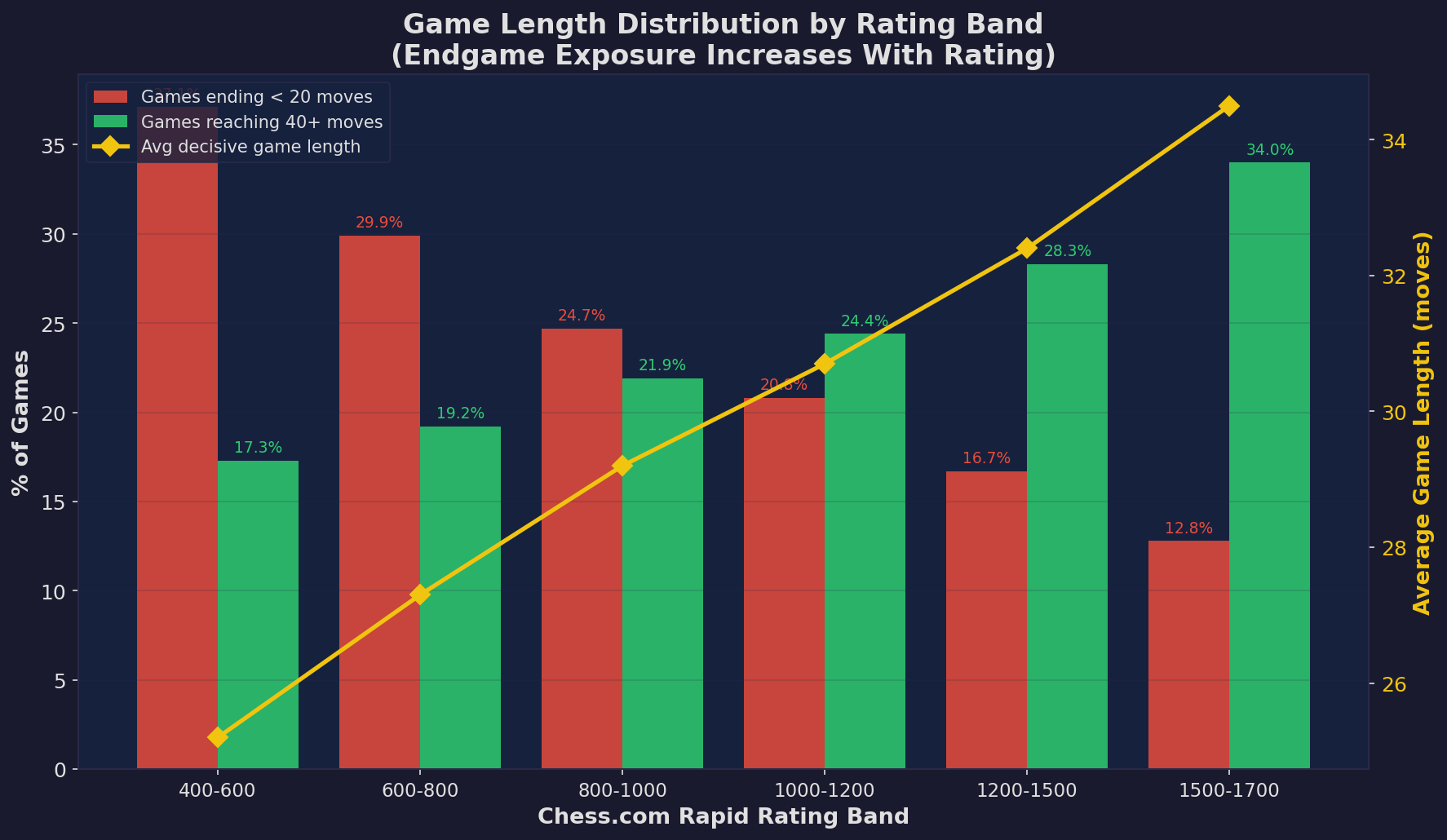
At 800, only 21.9% of games reach move 40. By 1500, that number jumps to 28.3%. Furthermore, the average decisive game length increases from 29 moves to over 32 moves.
You can no longer rely on your opponent blundering in the middlegame. You have to grind them down in the endgame.
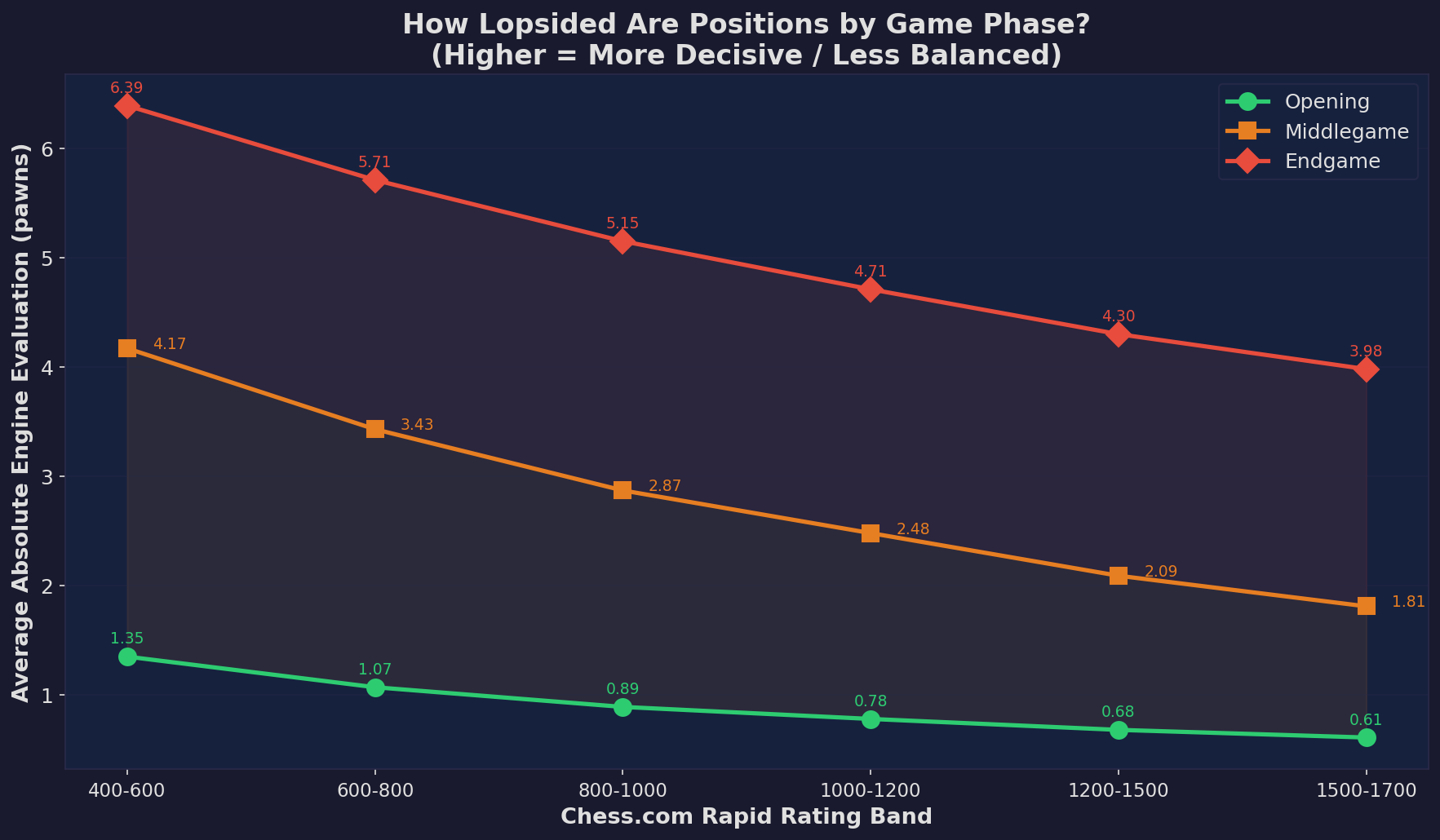
The Data-Backed Indicator of Breakthrough: The evaluation trajectory data shows that at 1500+, the average engine evaluation in the endgame is significantly lower (closer to 0.00) than at lower ratings. This means players are entering endgames with equal material, and the game is decided purely by technique.
Actionable Advice:
- Study Basic Endgame Theory: You must know how to win a King and Pawn endgame. You must understand the concept of "Opposition." You must know the Lucena and Philidor positions in Rook endgames.
- Stop Resigning Early: The resignation threshold data shows that 1500s resign in "hopeless" positions (10+ eval) 23% of the time, compared to 25.6% for 1200s. Stronger players make their opponents prove they can convert the endgame.
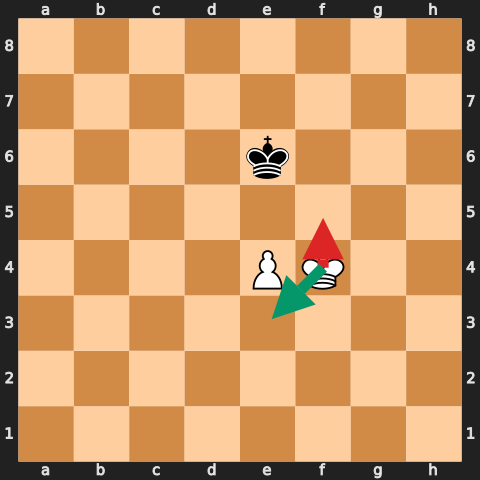 The Endgame Reality Check: White has a winning advantage, but playing Kf3 (red) loses the opposition and draws the game. Kd4 (green) outflanks the Black king and secures the win.
Conclusion: The Plateau is Part of the Process
If you are currently stuck on a rating plateau, the data offers a comforting truth: you are exactly where you are supposed to be.
Plateaus are not failures; they are consolidation periods. They are the months where your brain is rewiring itself to stop hanging pieces, to recognize tactical patterns instantly, or to understand the subtle geometry of a pawn endgame.
The average plateau lasts 4 months. If you focus on the specific weaknesses of your rating band—board vision at 800, tilt management at 1000, tactics at 1200, and endgames at 1500—you will be part of the 75% who break through.
Keep playing, keep analyzing, and respect the two-loss rule.
Chess Coach
April 15, 2026
Data and Methodology
This article is based on the analysis of over 124,000 player rating histories and millions of Rapid games from the Lichess database, accessed via the Grandmaster Guide MCP server.
Rating Calibration: Because Lichess ratings are generally higher than Chess.com ratings for the same skill level, all Lichess rating bands were converted to approximate Chess.com Rapid equivalents using standard community mapping tables. For example, the Lichess 1100-1300 band corresponds roughly to the Chess.com 800-1000 band.
Underlying Data Files: The raw CSV data files generated during this research are available for download:
View full data →ratingBand avgPlateauMonths pctPlayersPlateauing samplePlayers 700-900 3.9 14.9 4573 900-1100 4.0 15.0 8107 1100-1300 4.0 14.1 10080 1300-1500 4.2 14.0 10474 1500-1800 4.2 10.4 12597
View full data →ratingBand avgPlateauMonths pctPlayersPlateauing samplePlayers 700-900 7.1 3.5 2340 900-1100 7.1 3.2 4191 1100-1300 7.2 3.3 5497 1300-1500 7.4 4.0 6057 1500-1800 7.4 2.7 8410
View full data →fromRating toRating avgMonths medianMonths samplePlayers 800 1000 6.5 3 6991 1000 1200 8.0 4 8874 1200 1500 11.2 7 9319 1500 1800 12.8 8 6990 1800 2000 13.4 9 3910
View full data →ratingBand avgCpl blunderRatePerGame mistakeRatePerGame inaccuracyRatePerGame sampleGames 700-900 180.7 17.88 4.39 3.05 139780 900-1100 175.8 18.21 5.42 3.71 139826 1100-1300 169.3 18.23 6.38 4.28 139127 1300-1500 162.8 17.99 7.16 4.67 137768 1500-1800 158.2 18.06 8.12 5.22 133403
View full data →ratingBand herfindahlIndex top5CoveragePct top10CoveragePct top20CoveragePct uniqueOpenings totalGames 700-900 0.0399 34.6 55.7 76.0 247 164236 900-1100 0.0331 30.1 51.3 70.8 290 161828 1100-1300 0.0294 27.8 47.9 66.7 321 158895 1300-1500 0.0273 27.6 45.3 63.2 352 155151 1500-1800 0.0251 27.5 42.3 58.7 395 147088
View full data →ratingBand streakType streakLength subsequentWinPct subsequentLossPct avgCplChange sampleGames 700-900 loss 2 47.7 48.1 70.1 13734 700-900 loss 5 40.8 56.3 54.7 1873 900-1100 loss 2 48.3 48.2 63.9 10869 900-1100 loss 5 43.4 54.1 54.7 1023 1100-1300 loss 2 49.0 47.9 60.0 9924
View full data →ratingBand phase avgCpl blunderPct 700-900 opening 197.5 19.57 700-900 middlegame 529.6 43.15 700-900 endgame 686.5 45.89 900-1100 opening 164.9 16.15 900-1100 middlegame 461.1 40.79
View full data →ratingBand pctEndingUnder20Moves pctReaching40PlusMoves pctReaching60PlusMoves decisiveAvgMoves timeForfeitPct 700-900 37.1 17.3 3.8 25.2 29.9 900-1100 29.9 19.2 4.2 27.3 29.9 1100-1300 24.7 21.9 4.7 29.2 30.3 1300-1500 20.8 24.4 5.2 30.7 31.1 1500-1800 16.7 28.3 5.5 32.4 33.4
View full data →ratingBand phase avgEvalAbsolute 700-900 opening 1.35 700-900 middlegame 4.17 700-900 endgame 6.39 900-1100 opening 1.07 900-1100 middlegame 3.43