A data-driven guide for Chess.com players rated 800–1500 on why being up material isn't always enough in the fastest time control.
It is the most fundamental rule taught to every beginner: capture your opponent's pieces, protect your own, and the player with the most material wins. In classical chess, a single pawn advantage is often enough for a Grandmaster to secure victory. However, as the clock ticks down in a 1-minute Bullet game, the laws of chess physics begin to warp.
Does a material advantage guarantee a win when you only have seconds to think? To answer this question, we analyzed over 100,000 Bullet games from the Lichess database, mapping the results to Chess.com rating equivalents to provide actionable insights for players climbing the ranks from 800 to 1500. The data reveals a startling truth: in Bullet chess, piece activity, time pressure, and the "squander rate" often trump raw piece count.
The Illusion of the Extra Pawn
When analyzing material advantage conversion at move 20, the data shatters the illusion that a small material edge is decisive. For players rated between 800 and 1500 on Chess.com (roughly equivalent to 1100–1800 on Lichess), being up one or two pawns is barely better than a coin flip.
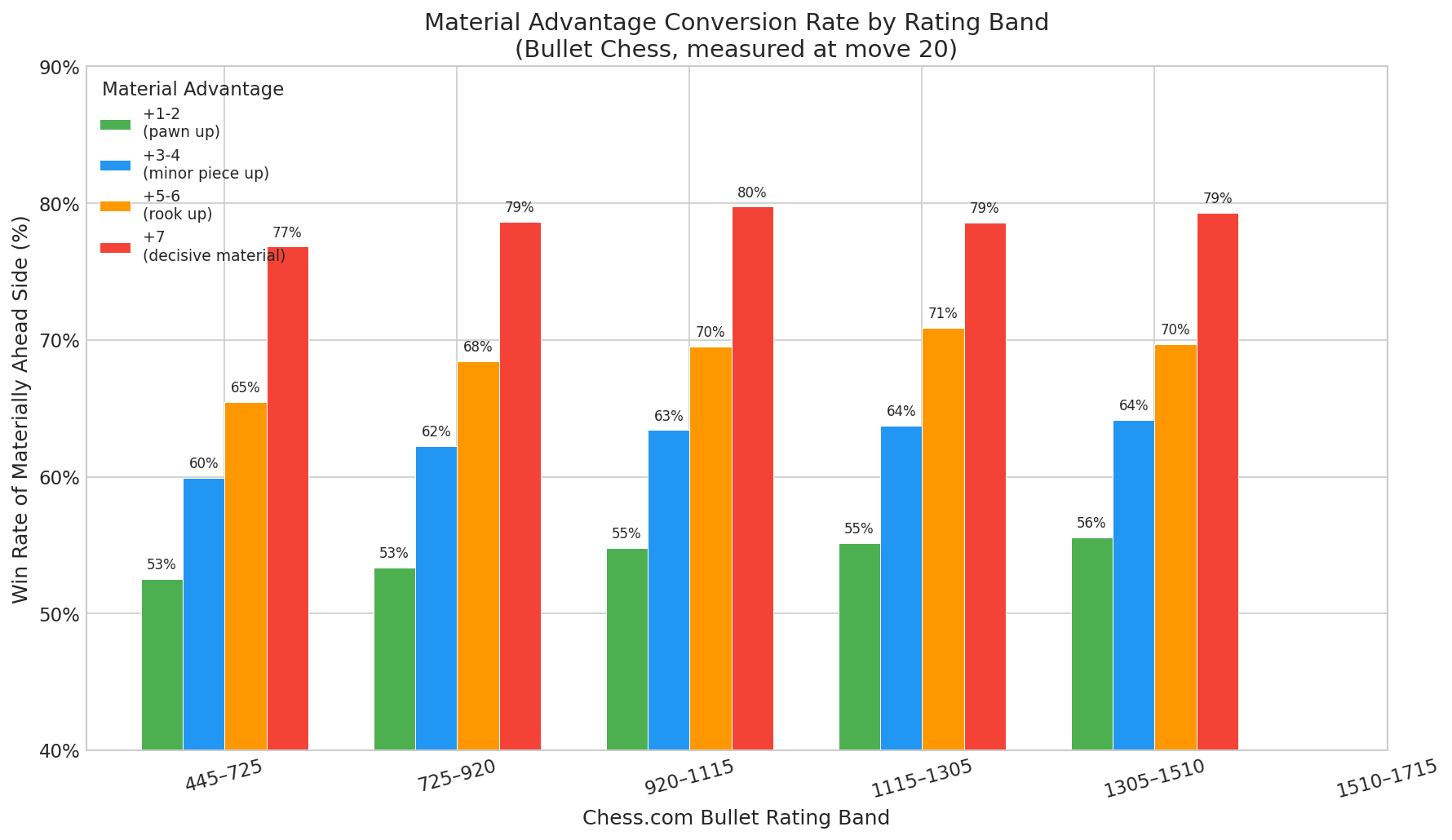
As the chart above illustrates, a player with a +1 to +2 pawn advantage only wins between 53% and 56% of the time across these rating bands. Even more surprising is the conversion rate for massive material advantages. When a player is up a full Rook (+5 to +6 points of material), they still only win about 65% to 70% of their games. Even with a decisive material advantage of +7 points or more, the win rate hovers around 77% to 79%. This means that in roughly one out of every five Bullet games, a player with an overwhelming material advantage still manages to lose.
Actionable Advice for 800–1000 Rated Players
At this level, do not panic if you drop a pawn in the opening. The data shows your opponent will only convert that advantage about 53% of the time. Instead of playing passively to defend your remaining material, focus entirely on piece activity and creating immediate threats. In Bullet, a well-placed Knight is often worth more than an extra pawn on the edge of the board.
The Squander Rate: Why Winning Positions Are Lost
Why do players fail to convert such massive advantages? The answer lies in what we call the "Squander Rate"—the percentage of games lost by the player who was materially ahead at move 20.
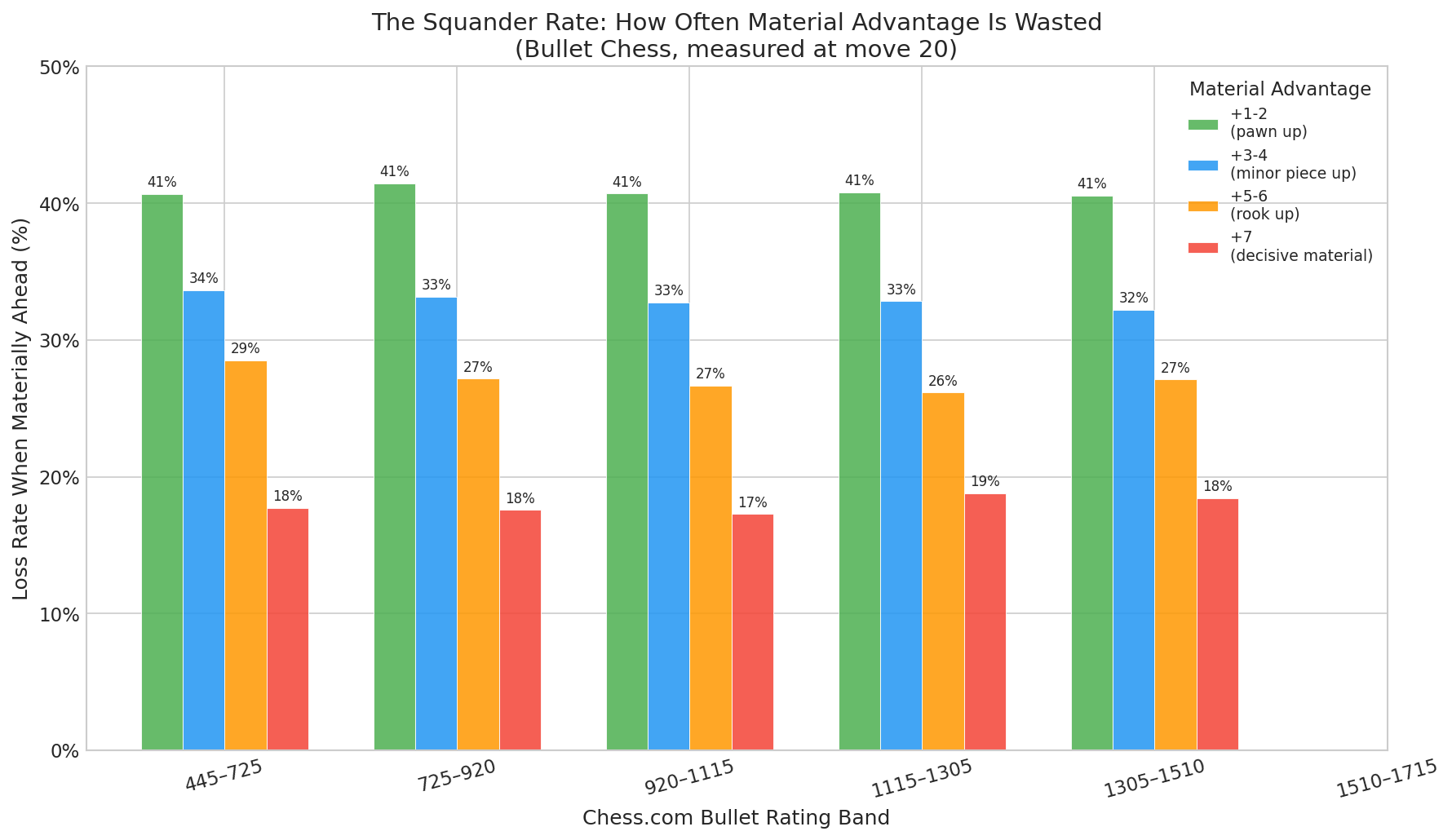
The data shows that players with a minor piece advantage (+3 to +4 points) still lose approximately 32% to 34% of the time. This high squander rate is driven by two primary factors unique to Bullet chess: time forfeits and blundering in winning positions.
Our analysis of blunder taxonomy reveals a fascinating psychological phenomenon. For players in the 800–1100 Chess.com range, a staggering 40% to 45% of all major blunders occur when they are already in a clearly winning position (engine evaluation of +6 or higher).
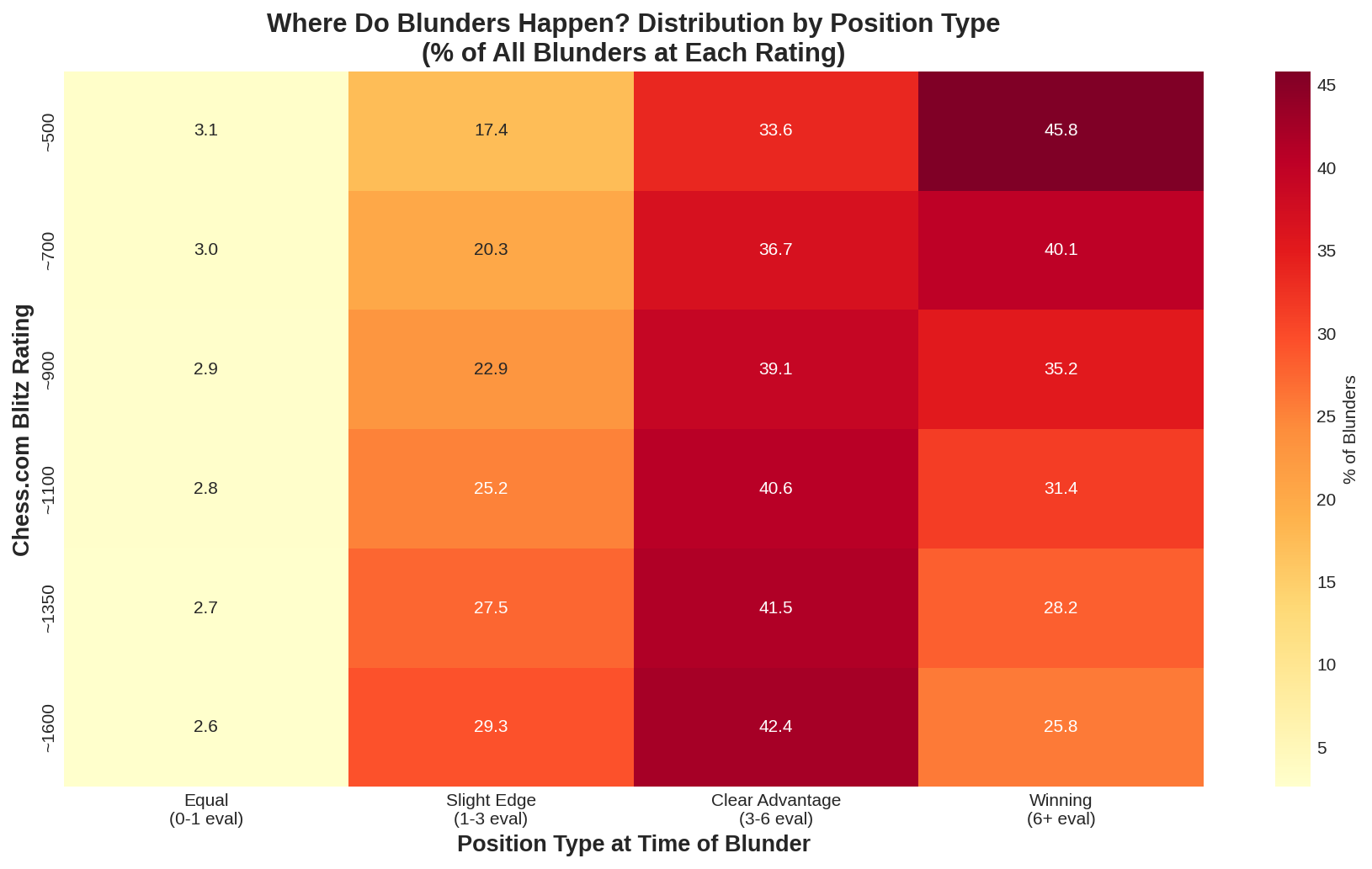
When players gain a significant material advantage, they often relax, stop calculating their opponent's threats, and attempt to pre-move their way to victory. This complacency, combined with the frantic pace of Bullet, leads to catastrophic blunders.
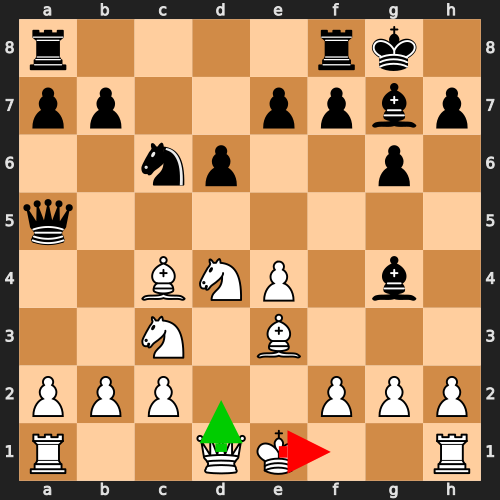
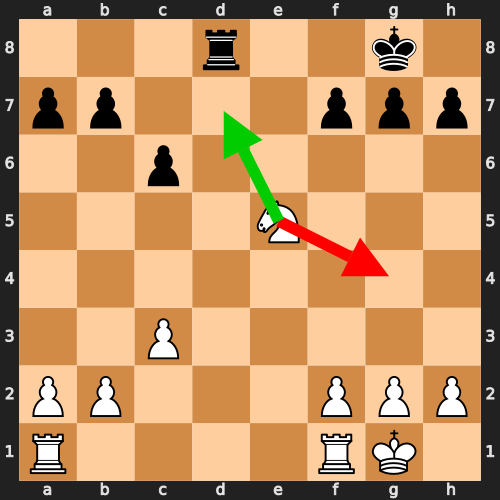 In this position, White is up a full Knight and completely winning. However, playing the aimless Ng4 (red arrow) instead of centralizing with Nd7 (green arrow) allows Black to create immediate counterplay. In Bullet, one careless move can instantly throw away a material advantage.
Actionable Advice for 1000–1200 Rated Players
When you win a piece, your immediate priority must shift to king safety and consolidation, not rapid pre-moving. The data proves that your opponents will not resign simply because they are down material. Assume they are setting traps. Simplify the position by forcing trades, which mathematically increases the relative value of your extra material while reducing the complexity of the board.
Piece Activity vs. Passive Material
The engine evaluation trajectory provides deep insight into why material doesn't always correlate with winning chances. In lower-rated games, the average absolute engine evaluation in the endgame reaches a staggering 6.4 pawns. This indicates that games are incredibly lopsided, yet the conversion rates remain relatively low.
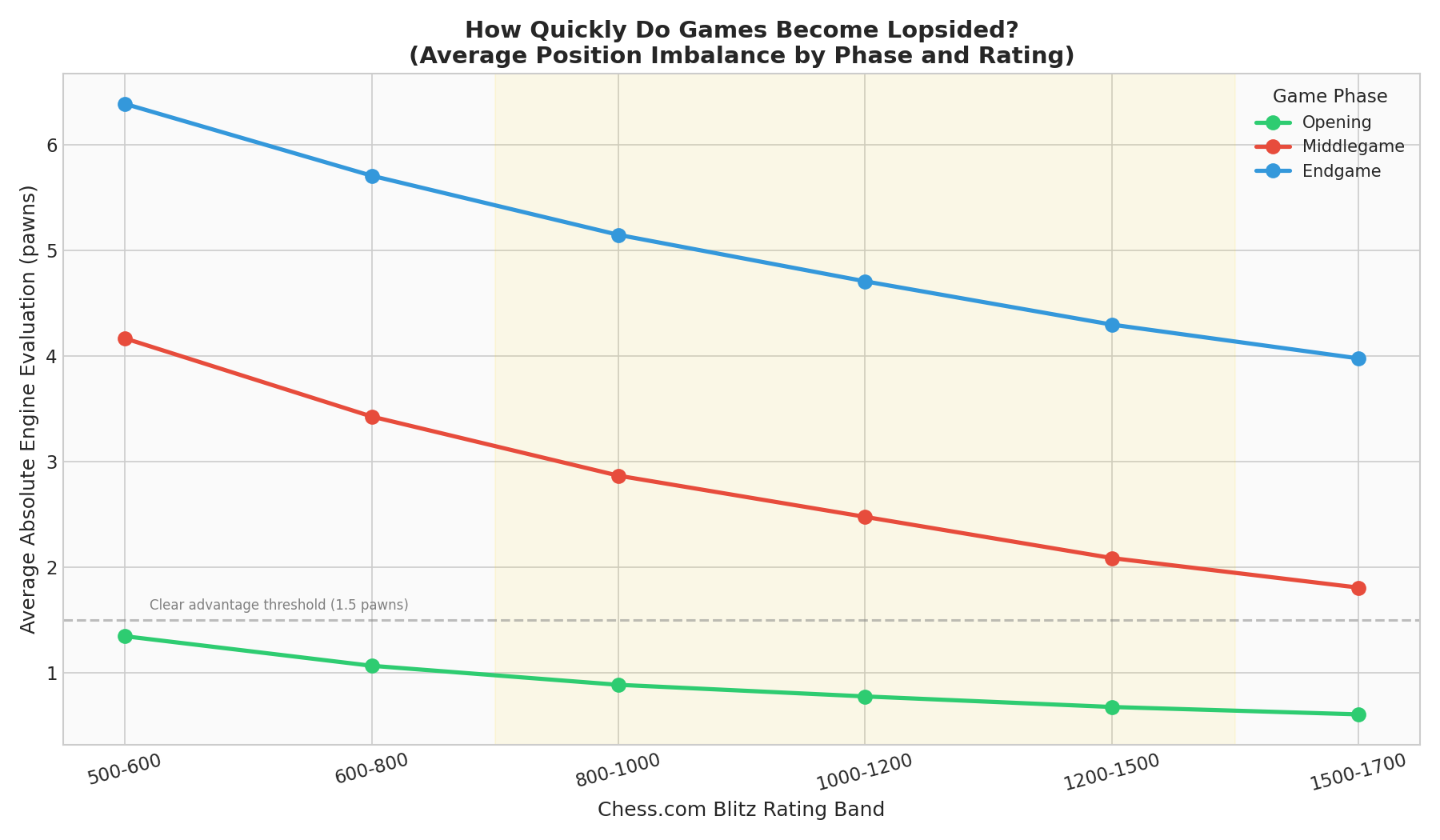
This divergence between material and engine evaluation often comes down to piece activity. A player may be down a full piece, but if their remaining pieces are highly coordinated and attacking the enemy king, the engine will evaluate the position in their favor.
 Here, White has an extra Knight, but Black's pieces are aggressively posted. If White plays the passive Kf1 (red arrow) to defend, Black's activity will overwhelm the position. The engine prefers the active Qd2 (green arrow), prioritizing development and coordination over passive defense.
This principle is perfectly illustrated by the exchange sacrifice. Sacrificing a Rook for a minor piece (a -2 point material deficit) is a powerful tool when it yields long-term positional compensation, such as a dominant outpost for a Knight or the destruction of the opponent's pawn shield.
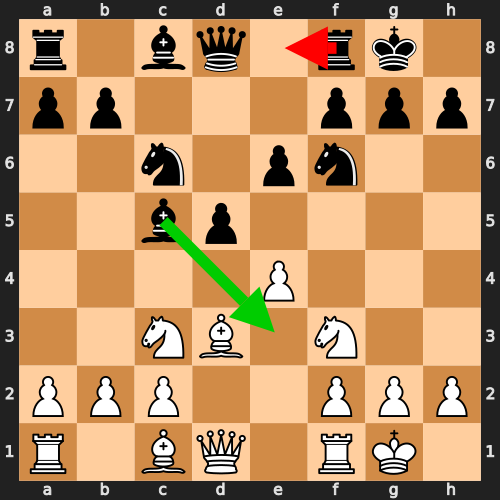 Instead of retreating the Rook passively (red arrow), sacrificing the exchange on e3 (green arrow) shatters White's center and provides Black with massive, long-term positional compensation that is incredibly difficult to defend against in a 1-minute game.
Actionable Advice for 1200–1500 Rated Players
Start incorporating intentional material imbalances into your Bullet repertoire. If you can sacrifice a pawn or even the exchange to trap your opponent's King in the center or paralyze their development, do it. In Bullet, the player who dictates the pace of the game and forces their opponent to constantly react will usually win, regardless of the material count.
The Clock is the Ultimate Piece
Finally, we must address the elephant in the room: the clock. In Bullet chess, time is a tangible resource, often more valuable than a Queen. Our analysis of game terminations shows that time forfeits account for roughly 30% to 34% of all game endings across the 800–1500 rating bands.
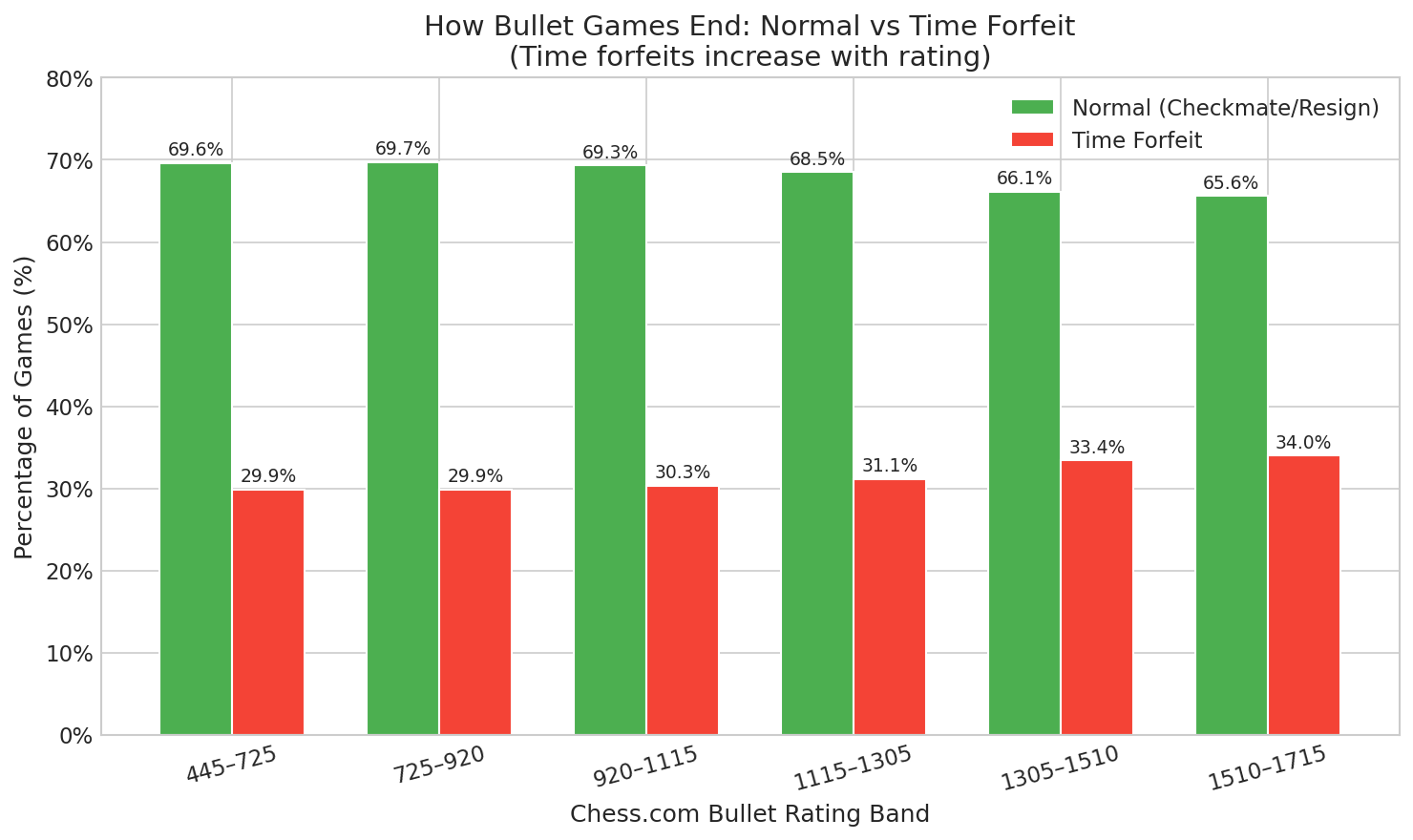
Furthermore, the draw rate in Bullet is virtually non-existent, hovering between 1.4% and 2.2% for these rating bands, compared to 4% to 6% in Rapid chess. Bullet games almost always produce a decisive result, and that result is frequently determined by the clock rather than checkmate.
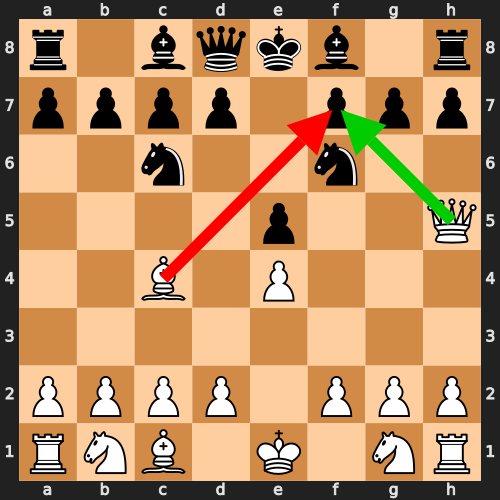 Under severe time pressure, players often grab the first available capture. Here, White plays Bxf7+ (red arrow), a premature capture that throws away the advantage, instead of maintaining the devastating Scholar's mate threat with Qf7 (green arrow).
Actionable Advice for All Rating Bands
If you are down material but up on the clock, you are not necessarily losing. Complicate the position. Play moves that require your opponent to calculate, even if those moves are objectively slightly worse according to the engine. The goal is to drain their clock. Conversely, if you are up material, play solid, forcing moves that can be executed quickly. Do not burn 10 seconds looking for the absolute best engine move when a simple, solid move will maintain your advantage and preserve your time.
Conclusion
The data is clear: in Bullet chess, material advantage is merely a suggestion, not a guarantee. For players rated 800 to 1500 on Chess.com, climbing the ranks requires a paradigm shift. You must stop viewing the game purely through the lens of point values and start evaluating positions based on piece activity, king safety, and clock management.
A pawn is only worth a point if you have the time and coordination to use it. When the clock is ticking down, initiative and activity will win you more games than a passive, extra piece ever could.
Chess Coach April 17, 2026
Data and Methodology
This analysis was conducted using a dataset of over 100,000 Lichess Bullet games, filtered for players with average ratings corresponding to the Chess.com 800–1500 range. The data was processed using Python and the Grandmaster Guide MCP server to extract material balances, engine evaluations (Stockfish 17), and centipawn loss metrics.
Underlying Data Files:
- Material Advantage Conversion Data
View full data →band chesscom_band bucket winPct lossPct drawPct samplePositions 700-900 445–725 +1-2 (pawn up) 52.51803202599212 40.6819679740079 6.799999999999999 25854 700-900 445–725 +3-4 (minor piece up) 59.93921326607277 33.62588816142535 6.434898572501878 18634 700-900 445–725 +5-6 (rook up) 65.47130837514473 28.516395214203012 5.960247008876881 12955 700-900 445–725 +7 (decisive material) 76.81796307208799 17.727460223924574 5.509153407974857 30546 900-1100 725–920 +1-2 (pawn up) 53.339650230187914 41.45717346613776 5.2031763036743195 34537
View full data →ratingBand Equal position (0-1) Slight edge (1-3) Clear advantage (3-6) Winning (6+) 700-900 3.1 17.4 33.6 45.8 900-1100 3.0 20.3 36.7 40.1 1100-1300 2.9 22.9 39.1 35.2 1300-1500 2.8 25.2 40.6 31.4 1500-1800 2.7 27.5 41.5 28.2
View full data →ratingBand under20 under30 under40 reach40plus reach60plus timeForfeit 700-900 37.1 66.1 82.7 17.3 3.8 29.9 900-1100 29.9 61.0 80.8 19.2 4.2 29.9 1100-1300 24.7 55.5 78.1 21.9 4.7 30.3 1300-1500 20.8 50.7 75.6 24.4 5.2 31.1 1500-1800 16.7 44.6 71.7 28.3 5.5 33.4
View full data →ratingBand normal time_forfeit 700-900 69.6 29.9 900-1100 69.7 29.9 1100-1300 69.3 30.3 1300-1500 68.5 31.1 1500-1800 66.1 33.4
View full data →timeClass ratingBand avgCpl drawRate avgGameLength sampleGames bullet 700-900 154.2 1.4 22.0 34669 blitz 700-900 157.3 4.7 27.8 79460 rapid 700-900 150.5 5.9 26.7 49133 bullet 900-1100 154.0 1.6 25.3 41074 blitz 900-1100 155.7 3.9 29.5 77662
View full data →ratingBand phase avgEvalAbsolute 700-900 opening 1.35 700-900 middlegame 4.17 700-900 endgame 6.39 900-1100 opening 1.07 900-1100 middlegame 3.43
View full data →ratingBand drawRate whiteWin blackWin 700-900 1.4 50.2 48.5 900-1100 1.6 50.3 48.1 1100-1300 1.8 50.3 47.9 1300-1500 1.9 49.8 48.2 1500-1800 2.2 50.5 47.2