For beginner and intermediate chess players, material count is often the primary metric used to evaluate a position. "I'm up a piece, I should be winning," is a common refrain. However, as players climb the rating ladder, the relationship between material advantage and actual game outcomes becomes increasingly complex.
To understand this dynamic, we analyzed 12,000 Lichess Blitz games (approximately 788,000 plies) across four rating bands corresponding to Chess.com ratings between 800 and 1500. By comparing the material balance on the board with Stockfish 12's engine evaluation at every ply, we mapped exactly when and why material advantages fail to convert into victories.
This guide serves as a roadmap for improvement, highlighting the critical thresholds where piece activity overrides piece count, and providing actionable advice for each rating segment.
The Divergence: When the Engine Disagrees with the Material
The first question we asked was: How often does the player who is ahead in material actually have a worse position according to the engine? We defined a "divergent ply" as a position where one side has a material lead, but Stockfish evaluates the position as favoring the materially-down side by at least 0.5 pawns (50 centipawns).
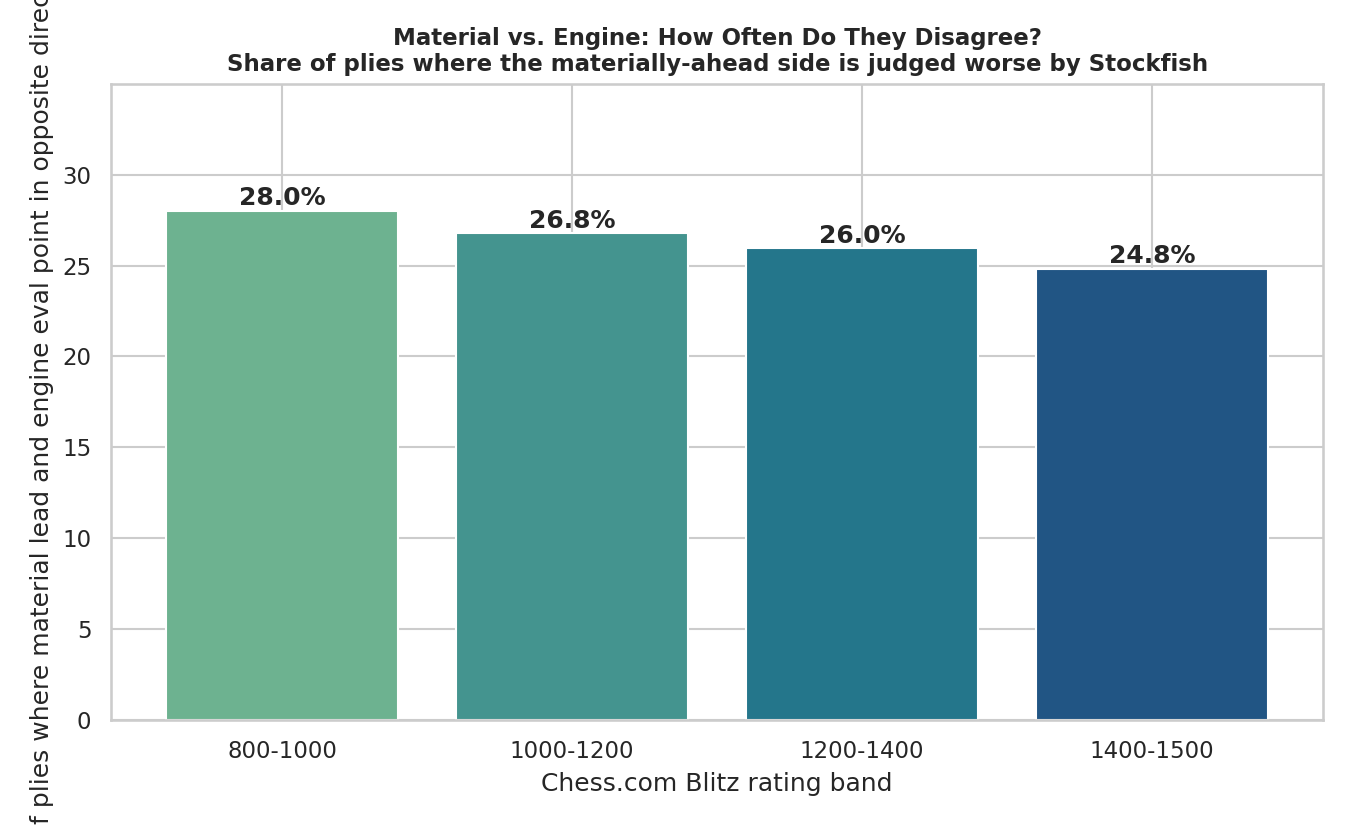
The data reveals that divergence is remarkably common. At the Chess.com 800-1000 level, 28.0% of all plies where a material imbalance exists are evaluated by the engine in favor of the side that is down material. While this rate decreases as players improve, it remains high: even at the 1400-1500 level, nearly 1 in 4 plies (24.8%) feature this contradiction.
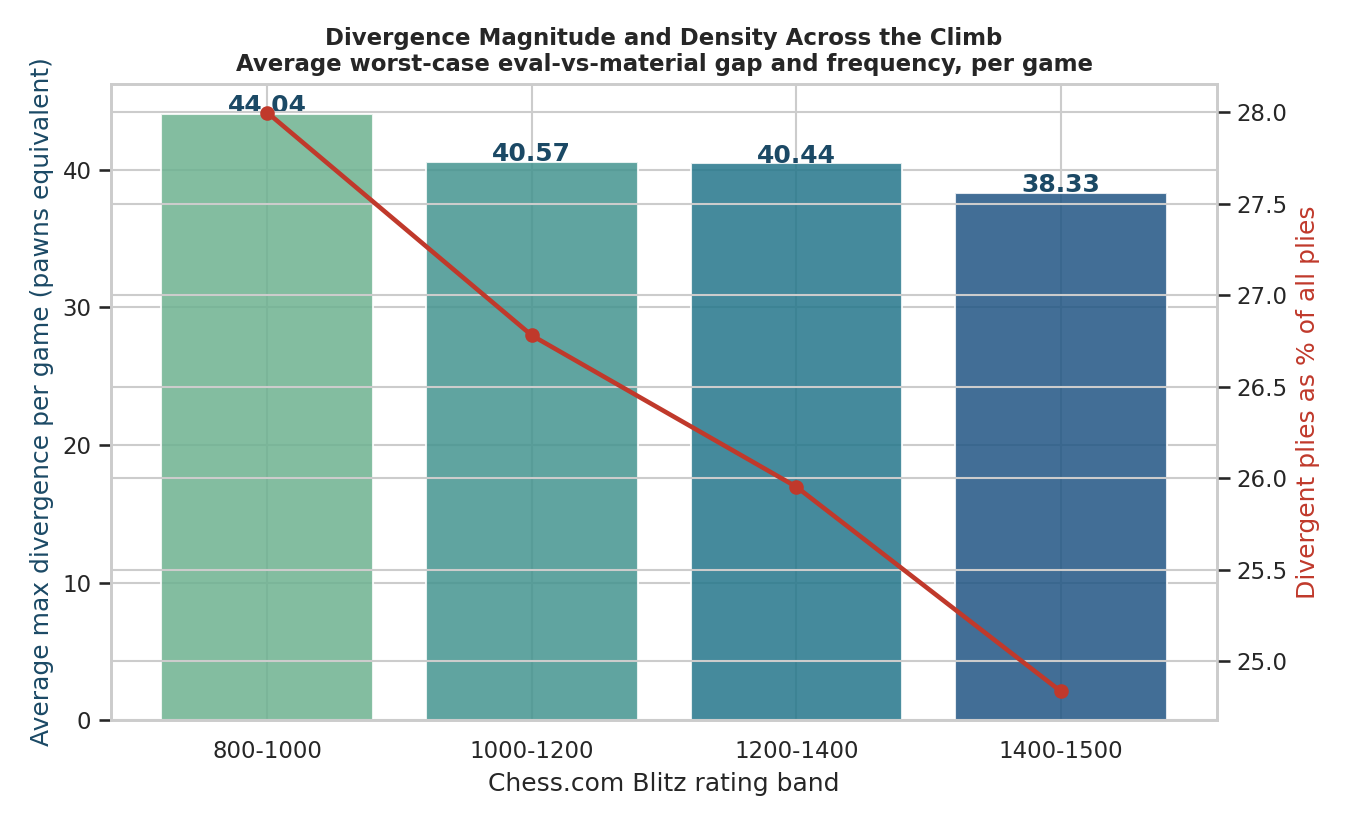
This high rate of divergence underscores a fundamental truth of chess: material is only one component of evaluation. King safety, piece coordination, and initiative frequently outweigh raw piece count, especially in the chaotic environment of Blitz chess.
The Conversion Threshold: When Does Material Matter?
If material doesn't always dictate the evaluation, how reliably does it predict the final outcome? We examined the win rates of players holding various material advantages at move 20.
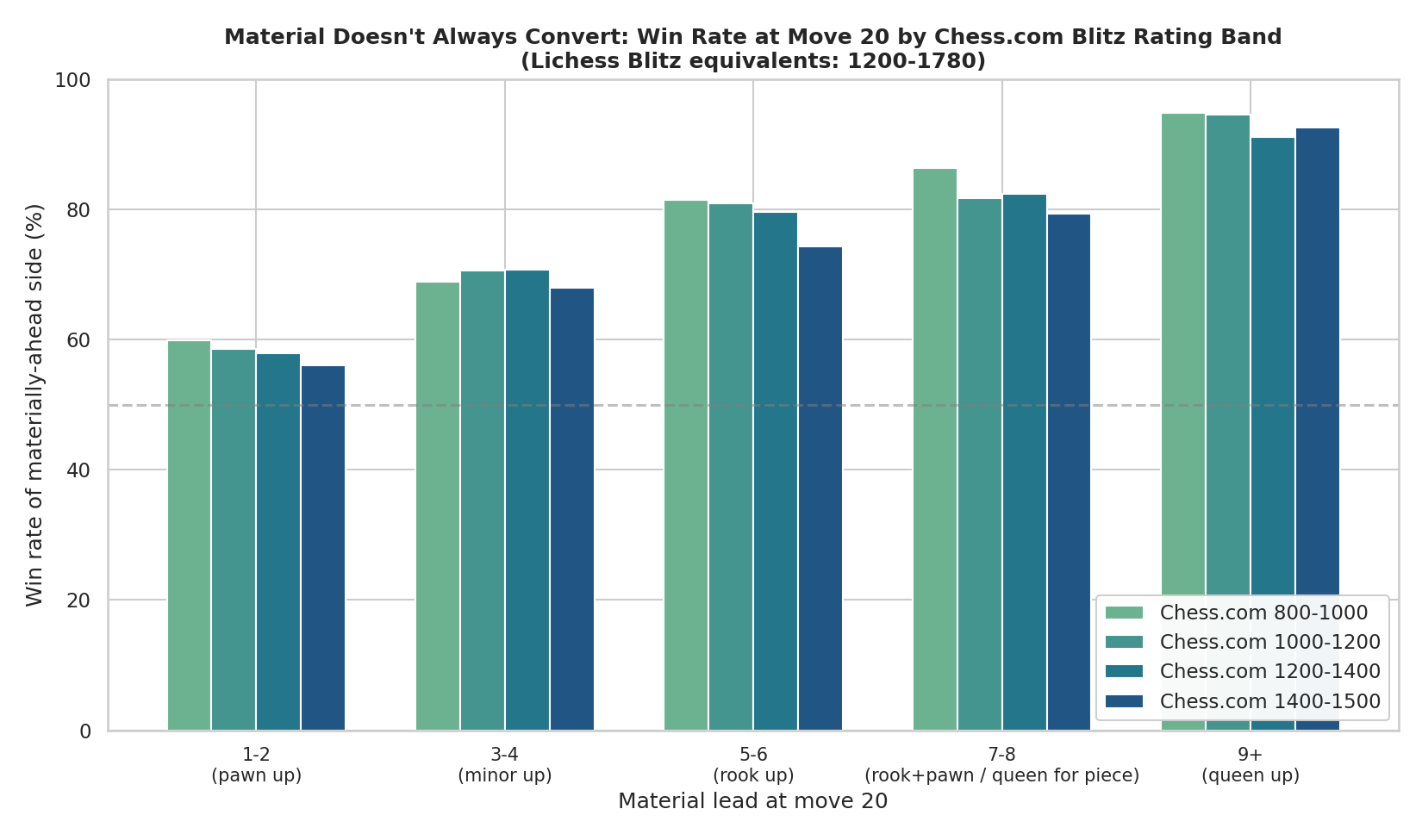
The results are striking. A 1-2 pawn advantage at move 20 is far from decisive. In fact, the conversion rate for a small pawn lead actually decreases slightly as ratings increase—from 59.8% at 800-1000 down to 55.9% at 1400-1500. This counterintuitive finding suggests that stronger players are better equipped to defend slightly worse positions and generate counterplay.
Even massive material advantages are not guaranteed wins. Being up a full Queen (9+ points) at move 20 still results in a loss or draw in 5-8% of games across these rating bands.
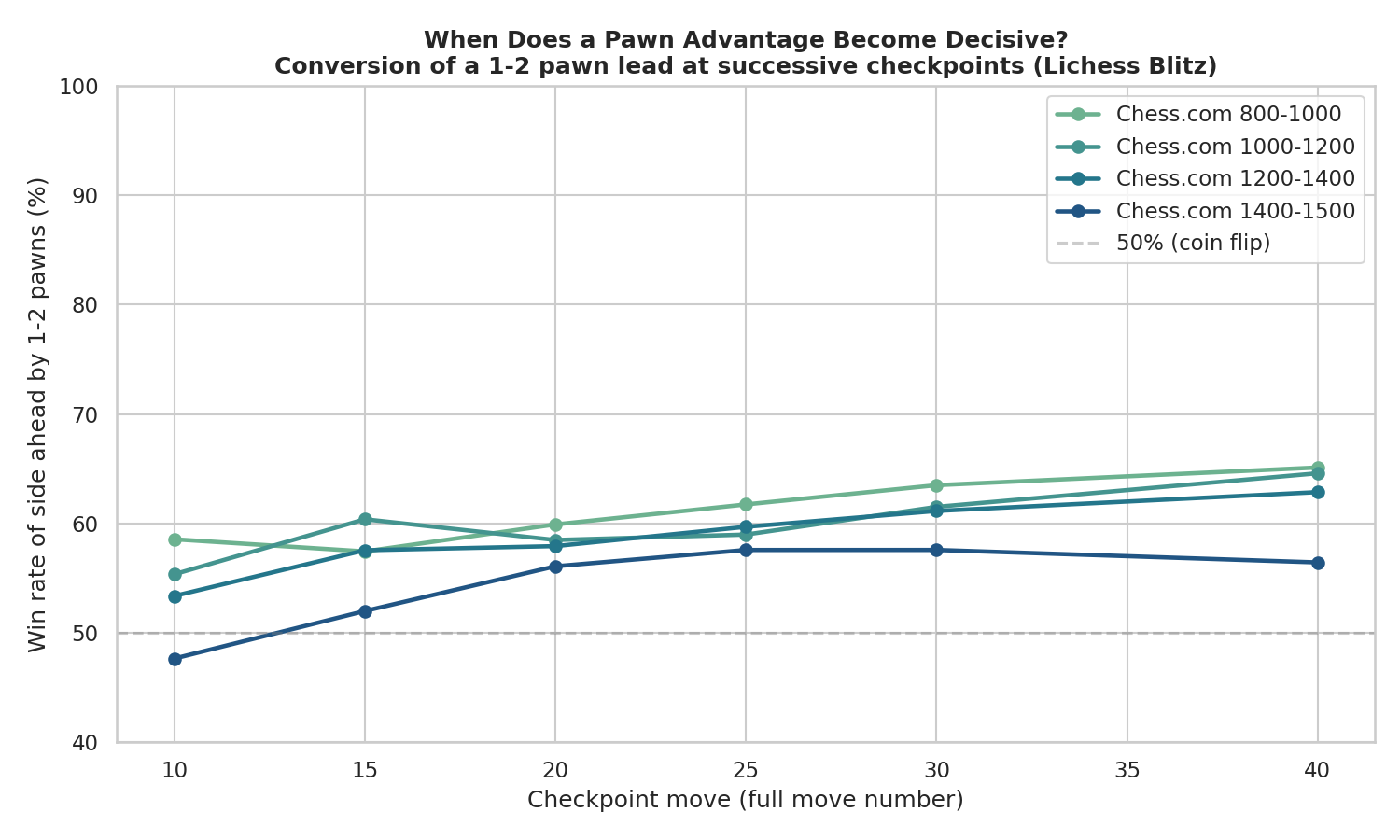
When we track a 1-2 pawn advantage across the entire game, we see that it only becomes a statistically reliable predictor of victory (approaching a 60% win rate) deep into the endgame (move 30+). At move 10, a one-pawn lead in the 1400-1500 band is essentially a coin flip (47.7% win rate).
The Illusion of Compensation: Down a Piece, But "Better"
We isolated positions where a player was down a full minor piece or more (≥3 points of material) but Stockfish evaluated their position as significantly better (≥ +1.0 pawns). These are positions where the engine sees overwhelming positional compensation—perhaps a devastating attack or an unstoppable passed pawn.
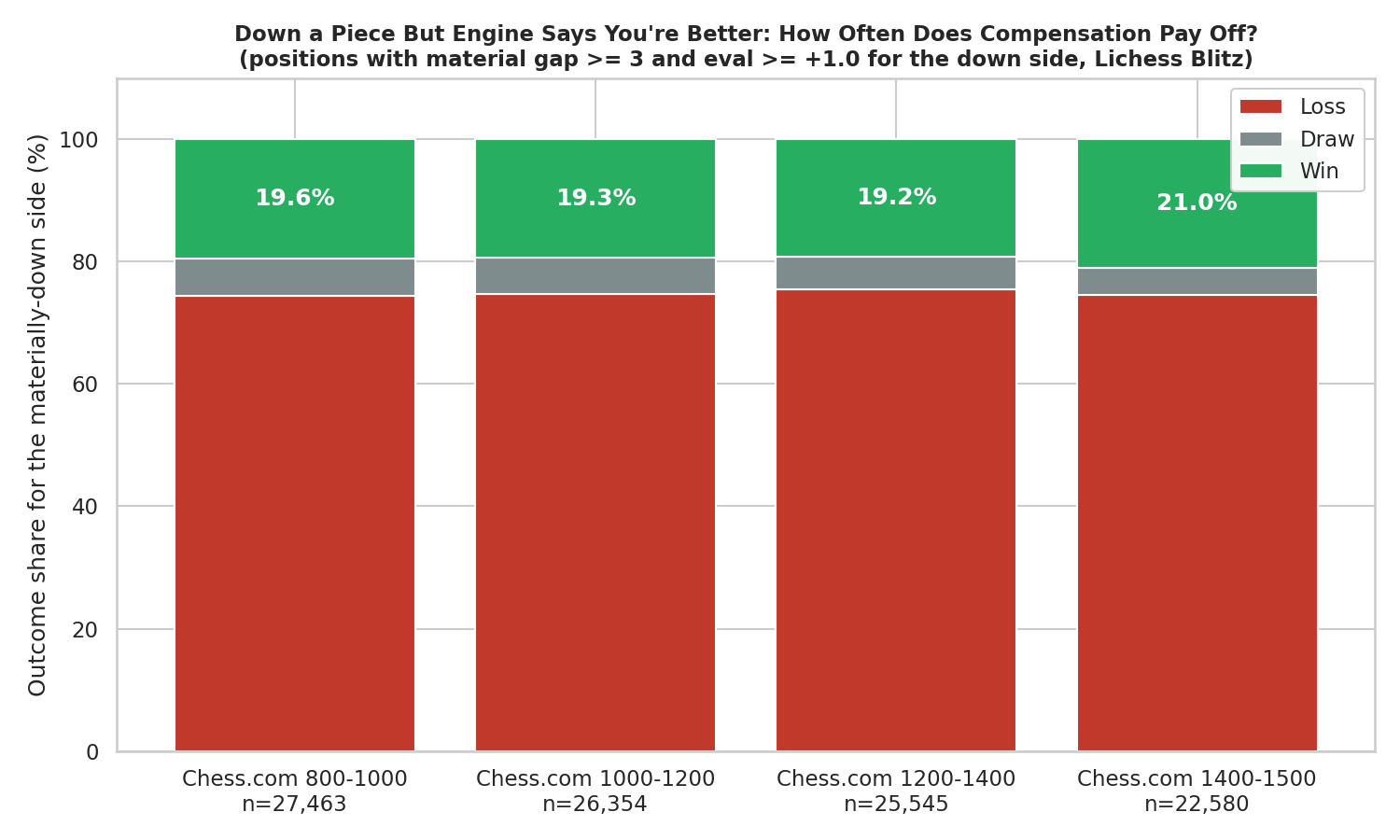
Despite the engine's optimism, human players in these rating bands struggle immensely to convert these positions. Across all four bands, the materially-down side only wins about 19-21% of the time. In roughly 75% of cases, the raw material advantage eventually prevails.
This highlights a critical gap between engine evaluation and human practical play: positions requiring precise calculation to justify a material deficit are exceptionally difficult to handle in Blitz, even when objectively "winning."
The Exchange Sacrifice: A Misunderstood Weapon
The exchange sacrifice—giving up a Rook (5 points) for a minor piece (3 points)—is a hallmark of advanced positional play. We detected over 4,800 instances where a player sacrificed the exchange from a roughly equal position.
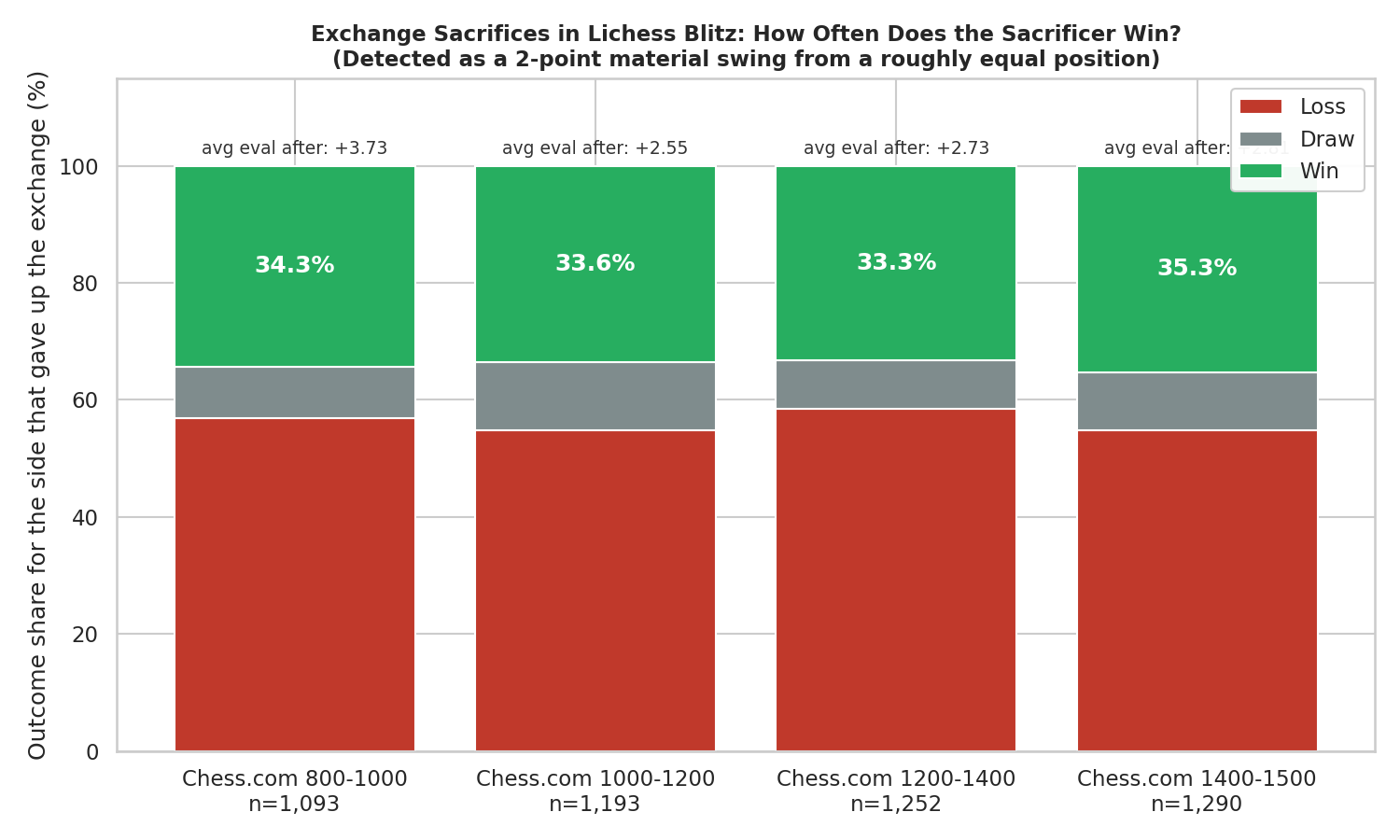
Stockfish generally approved of these sacrifices, evaluating the resulting positions at an average of +2.55 to +3.73 pawns in favor of the sacrificer. However, the actual win rates tell a different story. The side that sacrificed the exchange won only 33-35% of the time across all rating bands.
This indicates that while players in the 800-1500 range can identify opportunities for exchange sacrifices that are objectively sound, they lack the technique to exploit the resulting positional advantages under time pressure.
Roadmap to Improvement: Actionable Advice by Rating Band
Based on the data, here is a targeted roadmap for climbing the rating ladder.
Chess.com 800-1000 (Lichess Blitz 1200-1420)
The Data: Players at this level have the highest rate of divergent plies (28.0%) and frequently blunder massive material leads.
Actionable Advice: Focus entirely on board vision and basic safety. Do not sacrifice material for speculative attacks. If you are up material, prioritize trading pieces (not pawns) to simplify the position and reduce your opponent's counterplay.
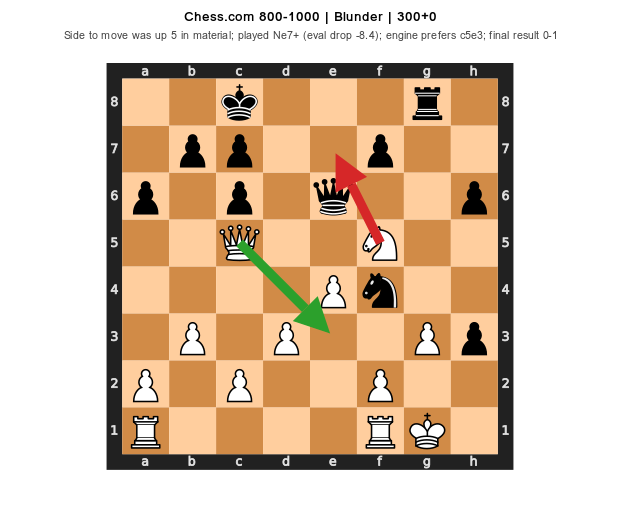
Visual Evidence: In this example, White is up a full piece but blunders the advantage instantly.
Chess.com 1000-1200 (Lichess Blitz 1420-1565)
The Data: Conversion of a 1-2 pawn lead at move 20 is still below 60%.
Actionable Advice: Stop "pawn grabbing" in the opening if it compromises your development or King safety. The data shows that a one-pawn lead early in the game is statistically meaningless at this level. Prioritize rapid development and castling over winning a single pawn.
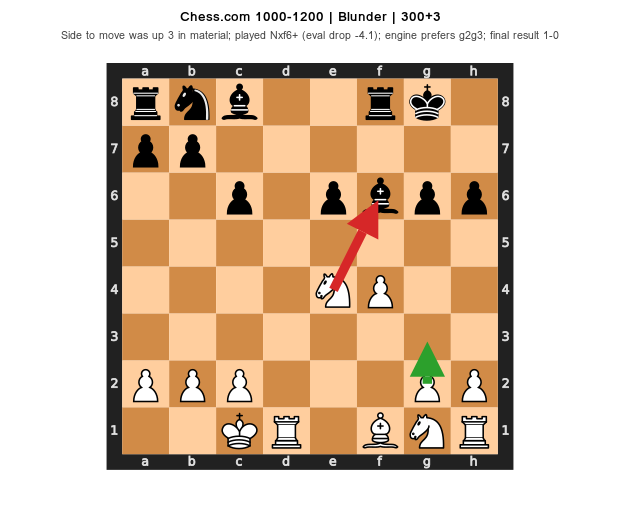
Visual Evidence: White is up material but plays a move that drops the evaluation significantly, missing a stronger continuation.
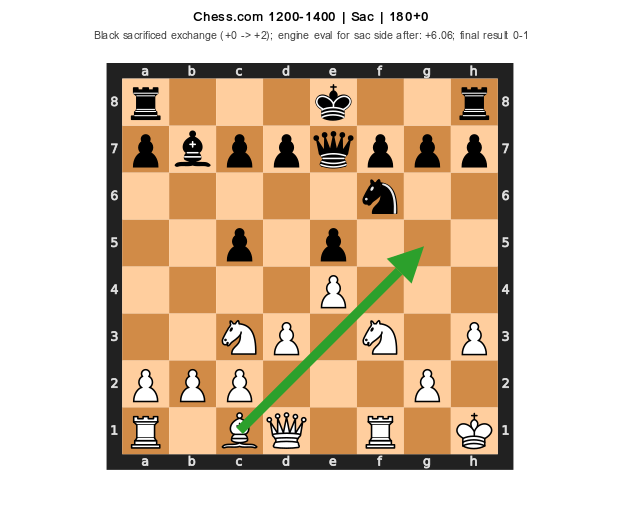
Chess.com 1200-1400 (Lichess Blitz 1565-1705)
The Data: Players here attempt exchange sacrifices that the engine loves (+2.73 avg eval) but only win 33.3% of the time.
Actionable Advice: Be highly skeptical of your own sacrifices. Unless you see a forced mate or an immediate, tangible return of material, avoid speculative exchange sacrifices in Blitz. You are likely creating a position that is too difficult to play with limited time.
Visual Evidence: A successful exchange sacrifice where Black gives up the Rook for a Bishop, leading to a winning position.
Chess.com 1400-1500 (Lichess Blitz 1705-1780)
The Data: The conversion rate for small material advantages actually drops here, as opponents become more resilient defenders.
Actionable Advice: When you gain a material advantage, you must actively suppress your opponent's counterplay. The data shows your opponents will not simply roll over. Focus on "prophylaxis"—identifying and stopping your opponent's threats before advancing your own plans.
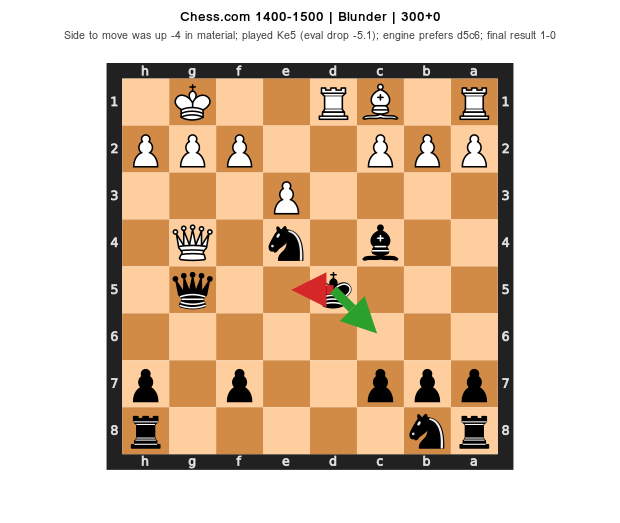
Visual Evidence: Even at this level, players can misplay materially advantageous positions under pressure.
Data and Methodology
This research analyzed 12,000 Lichess Blitz games played in March 2025. The games were segmented into four rating bands based on the average Elo of the players, mapped to approximate Chess.com Blitz ratings.
Every ply of every game was annotated with Stockfish 12 evaluations (depth 16+) and material balance scores. The analysis focused on identifying divergences between raw material count and engine evaluation, tracking conversion rates at specific move checkpoints, and isolating specific tactical patterns like exchange sacrifices.
The underlying data files used to generate the charts in this article are available below:
- Checkpoint Material Outcome
- Down Piece Compensation
- Divergence Summary
- Exchange Sacrifices
- First Advantage Outcome
- Per Game Summary
Chess Coach <2026-04-20>