By Chess Coach April 20, 2026
One of the most common frustrations for beginner and intermediate chess players is losing a game despite being up material. You win a pawn, then a piece, and you feel the game is in the bag. Yet, 20 moves later, your king is mated or your position has completely collapsed.
Why does this happen? At what rating does a material advantage actually become a reliable predictor of victory? And how often do players successfully sacrifice material for long-term positional compensation?
To answer these questions, we analyzed a dataset of 3,694 Rapid games (totaling over 193,000 plies) played on Lichess, mapped to Chess.com Rapid rating bands between 800 and 1500. We also cross-referenced our findings against a massive population-level dataset of ~715,000 positions provided by the Grandmaster-Guide engine analytics.
This article serves as a roadmap for improvement, breaking down the data by rating band and providing actionable advice to help you stop throwing away winning positions.
The Myth of the "Winning" Pawn Advantage
A common piece of advice given to beginners is "if you are up a pawn, trade pieces and win the endgame." However, our data reveals that at the beginner and intermediate levels, being up a pawn is far from a guaranteed win.
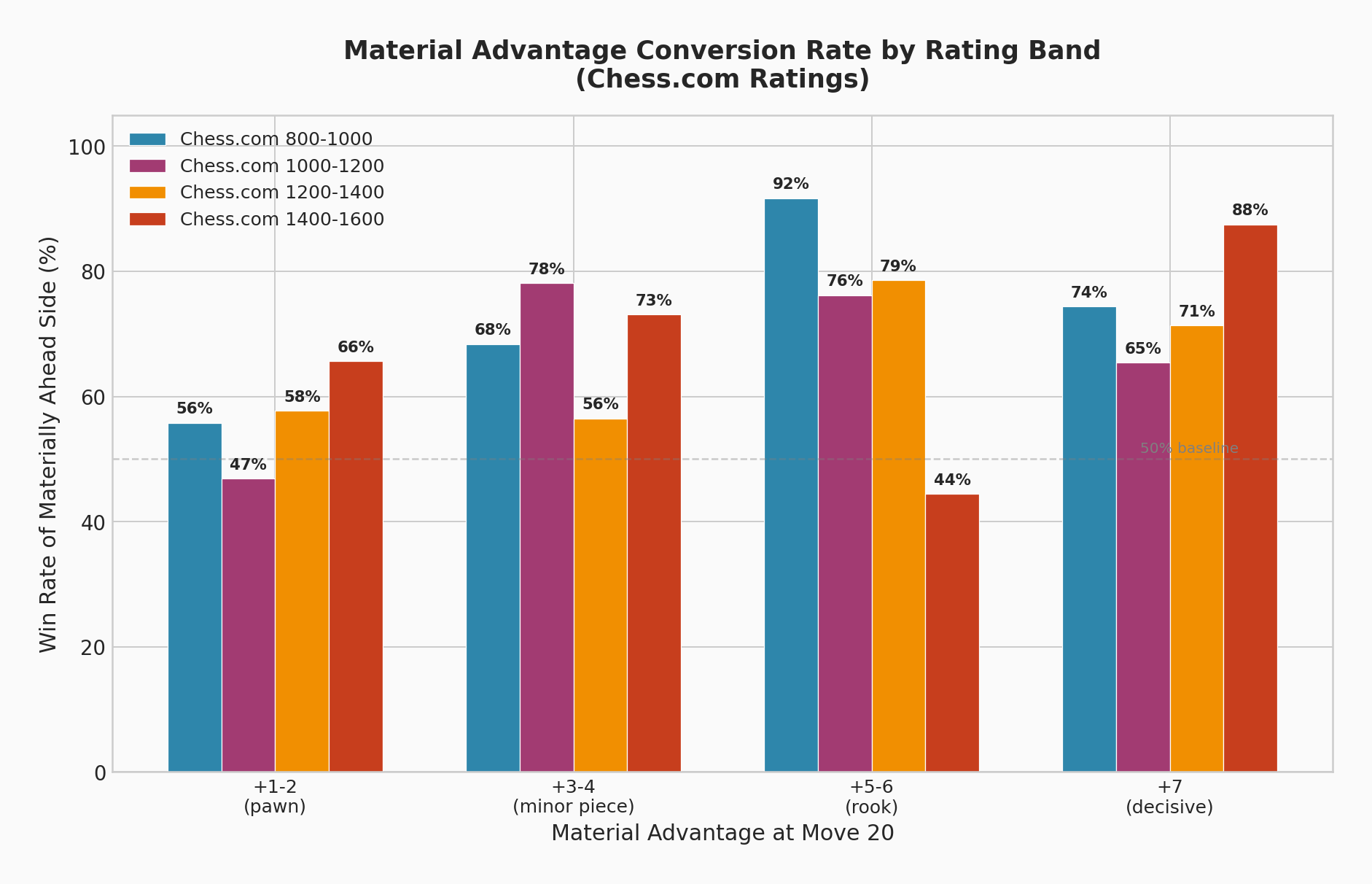
As the chart above illustrates, a +1 to +2 pawn advantage at move 20 yields a win rate of only 53% to 65% across the 800-1500 rating bands. In fact, players who are up a pawn or two at move 20 actually go on to lose the game 30% to 40% of the time.
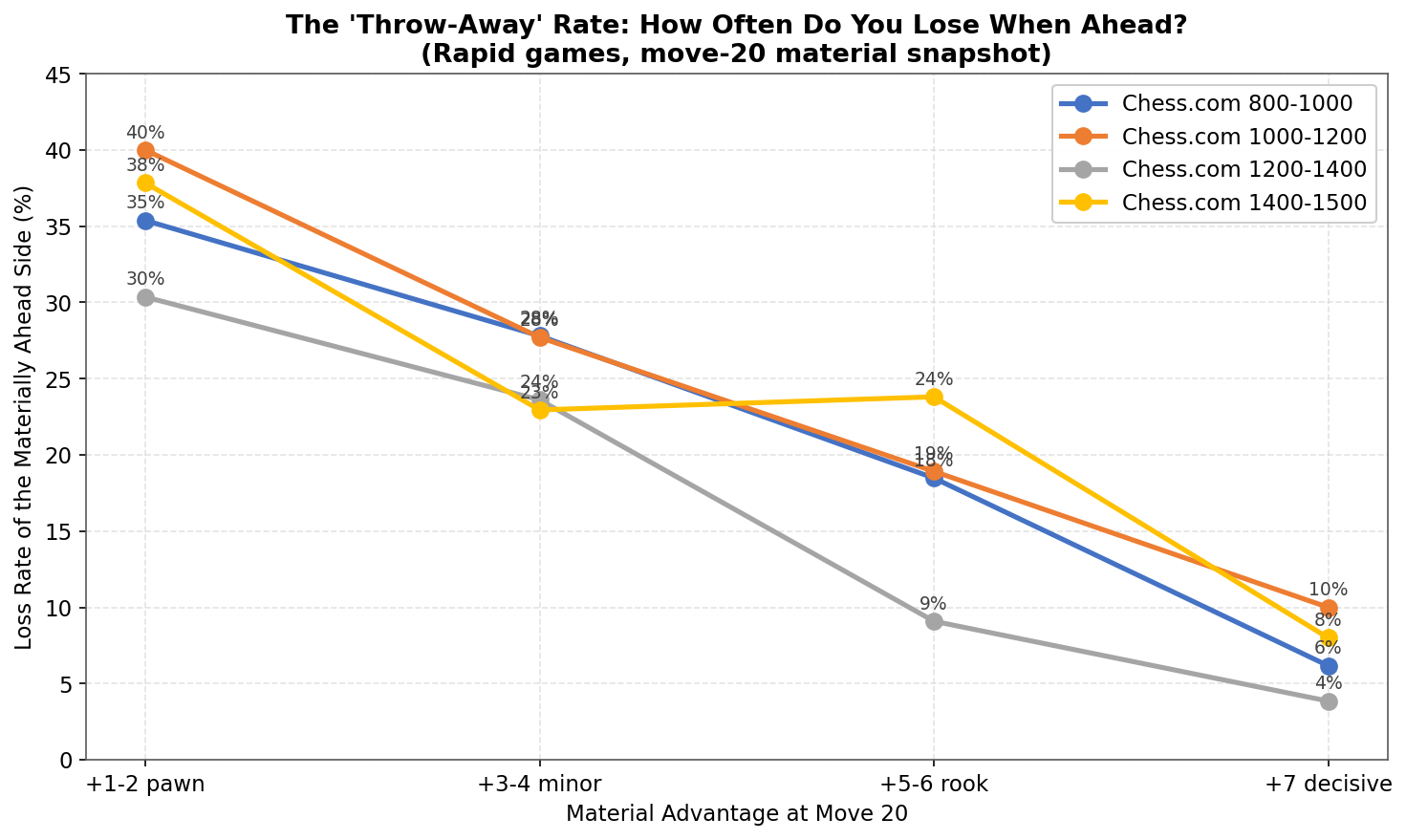
It is not until a player achieves a minor piece advantage (+3 to +4) that win rates begin to approach the 70% mark. A full rook advantage (+5 to +6) pushes the win rate above 75%, and only a decisive material advantage (+7 or more) reliably secures victory in roughly 90% of games.
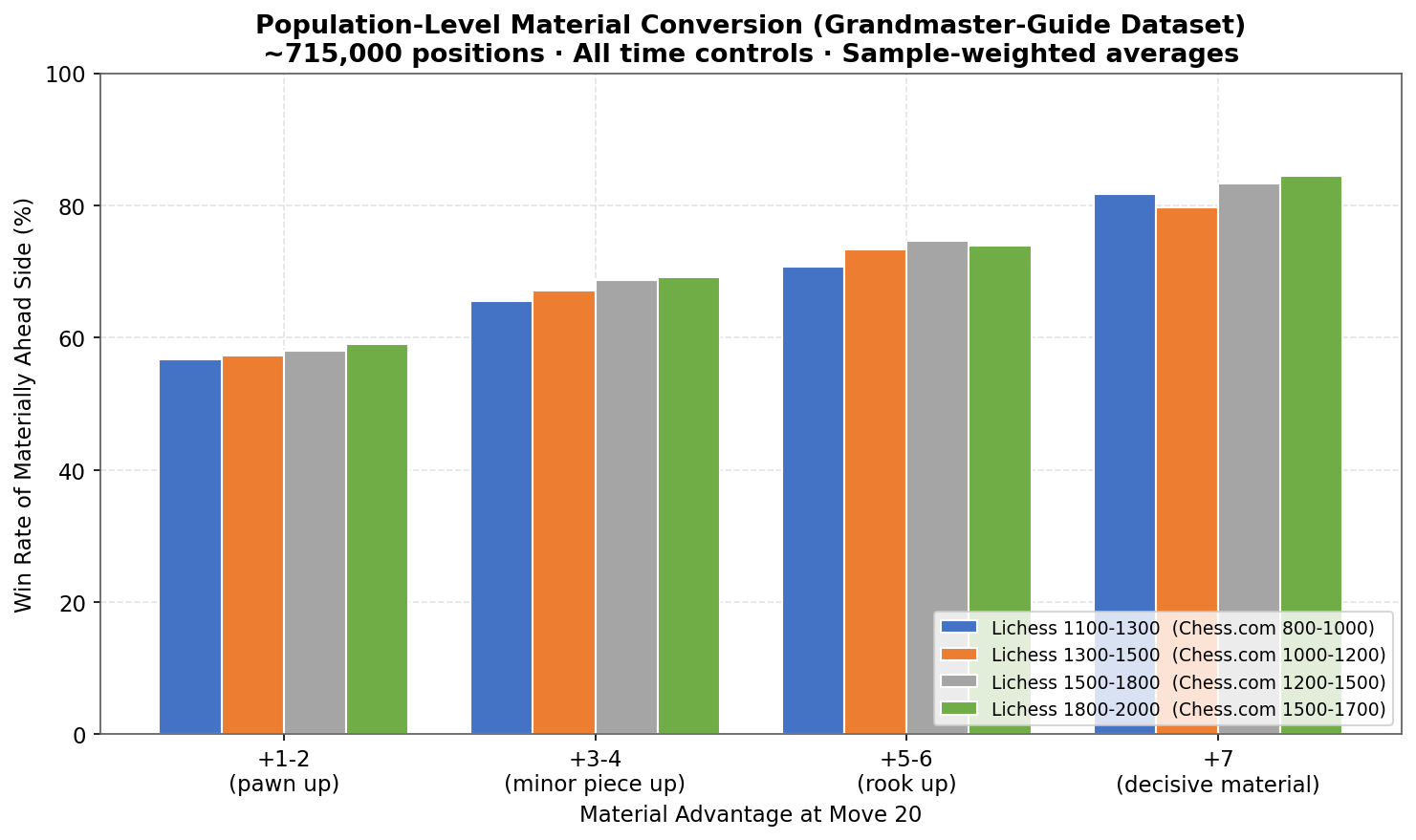
This trend is corroborated by our population-level data across all time controls:
Actionable Advice: 800-1000 Rating Band
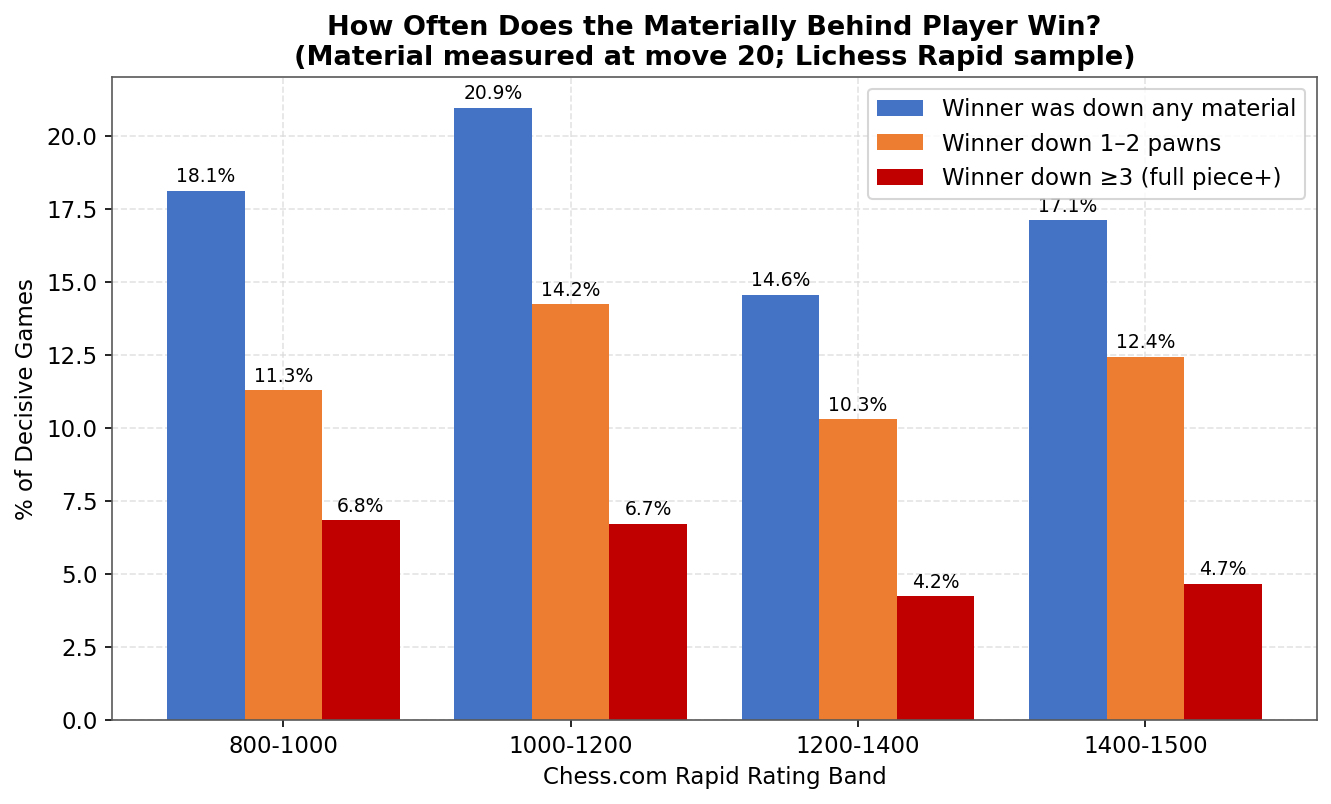
At this level, material advantages are highly volatile. The data shows that in 18.1% of decisive games, the player who eventually won was actually down material at move 20. Furthermore, in nearly 7% of games, the winner was down a full piece or more.
Your Roadmap:
- Stop relaxing when you win material. A one-pawn advantage means almost nothing at this rating. Do not rush to trade pieces into an endgame unless you have a clear, forced path.
- Focus on board vision. The high "throw-away" rate (losing when ahead) is primarily driven by one-move blunders. Before making a move, always ask: "What is my opponent threatening?"
A Classic 800-1000 Blunder:
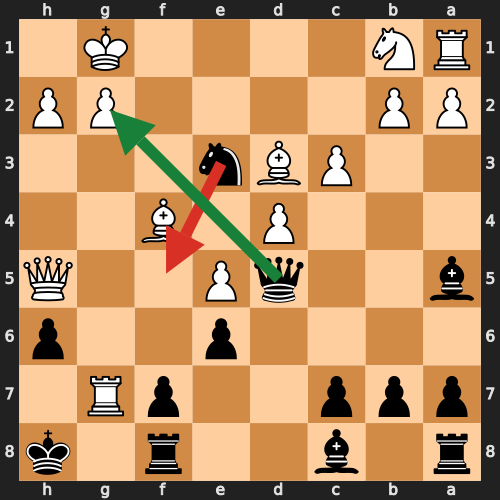
In the position below, Black is up a full rook (-5 material). Instead of consolidating, Black plays the aggressive but flawed Nxg5 (red arrow), completely missing White's threat. The engine's preferred move, f6 (green arrow), would have solidified the position.
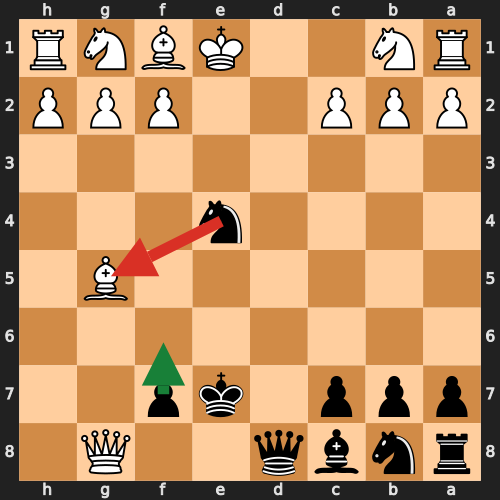 Black (up a rook) plays Nxg5, throwing away a massive advantage.
The Growing Importance of Position Quality
As players progress up the rating ladder, the divergence between raw material count and the engine's evaluation of the position becomes more pronounced.
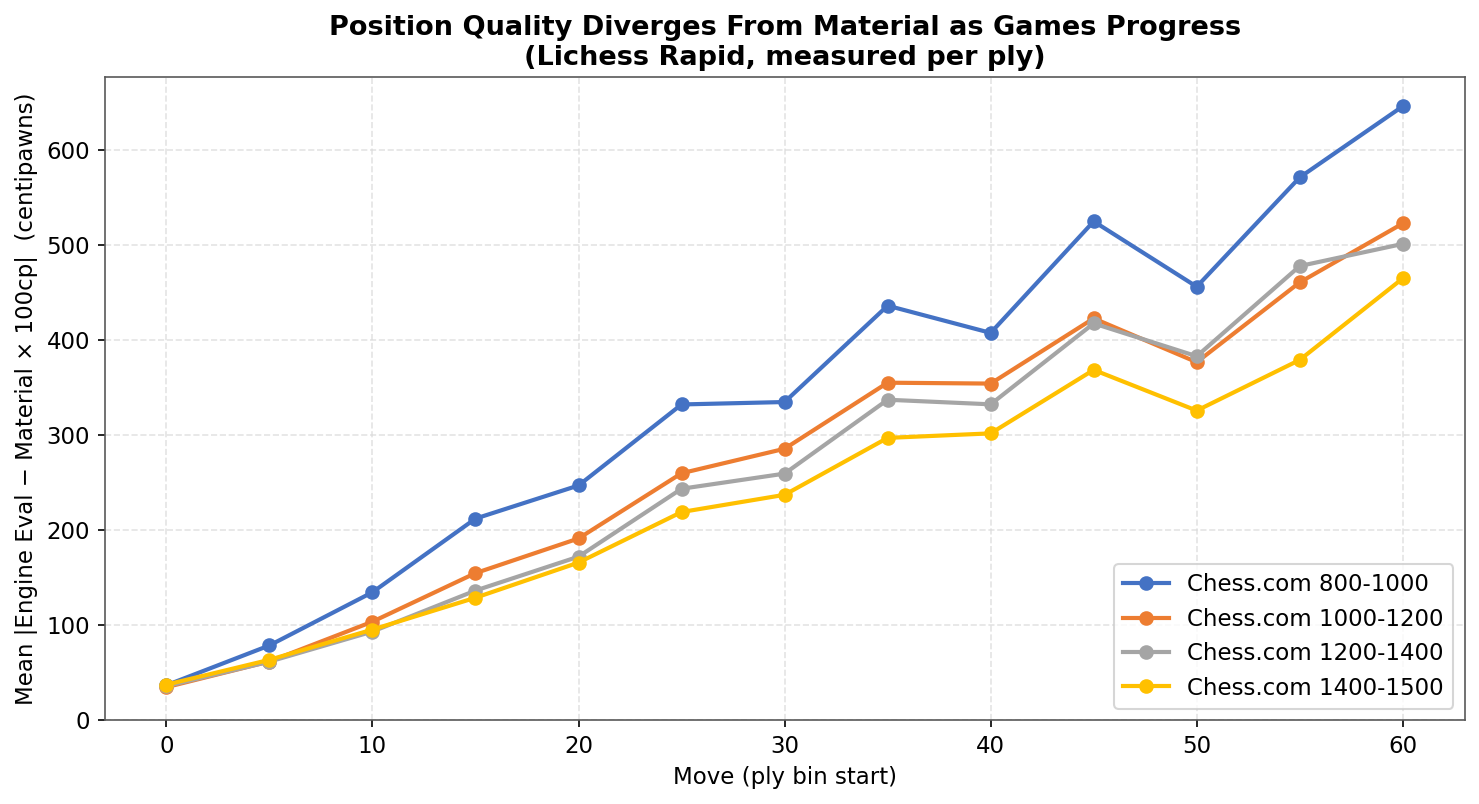
The chart above tracks the average absolute difference between the material count and the engine evaluation (in centipawns) as the game progresses. By move 30, the evaluation diverges from the material count by an average of 250 to 330 centipawns (roughly 2.5 to 3.3 pawns' worth of positional compensation). By move 60, this divergence grows to over 500 centipawns.
This indicates that as the board opens up and pieces become more active, where your pieces are matters just as much as how many pieces you have.
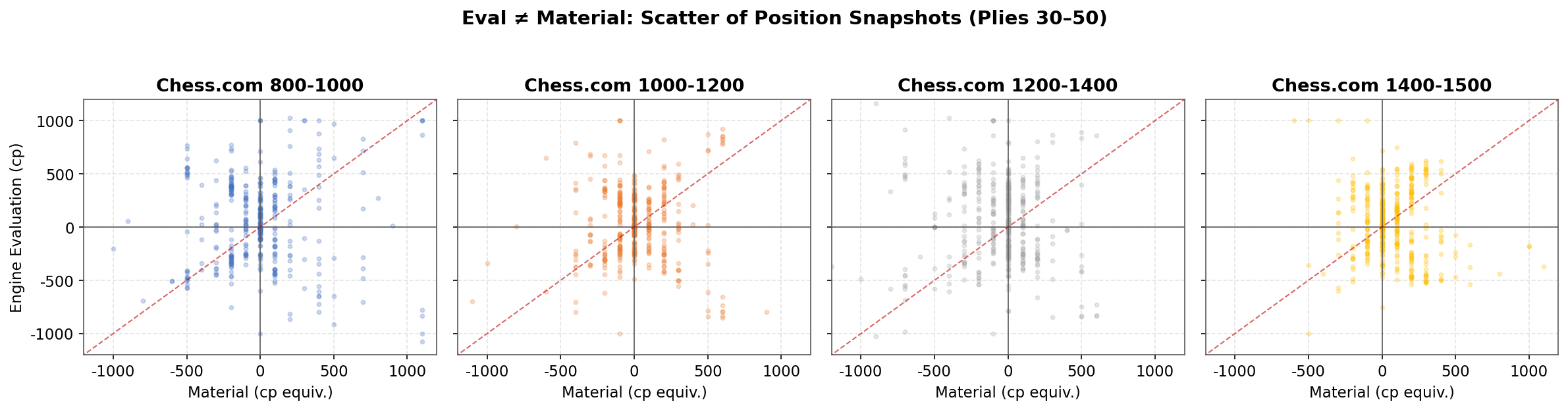
The scatter plots above show position snapshots between plies 30 and 50. If material perfectly predicted the evaluation, all points would lie on the red dashed line (y=x). Instead, we see a wide spread, with many positions showing a negative evaluation despite a positive material count, and vice versa.
Actionable Advice: 1000-1200 Rating Band
Players in this band are beginning to understand basic tactics, but they often struggle with piece coordination. The data shows that the "throw-away" rate for a minor piece advantage (+3 to +4) is still a staggering 28%.
Your Roadmap:
- Prioritize piece activity over material grabbing. Do not go out of your way to win a pawn if it means misplacing your pieces or exposing your king.
- Consolidate your advantage. When you win a piece, your immediate goal should be to coordinate your remaining forces and ensure king safety, not to launch an immediate attack.
A Classic 1000-1200 Blunder:
Here, Black is up a minor piece (-3 material). Instead of dealing with White's active pieces, Black plays Nf5 (red arrow), allowing White a devastating attack. The engine suggests Qxg2+ (green arrow) to force trades and simplify the position.
 Black (up a piece) plays Nf5, allowing White back into the game.
The Art of the Exchange Sacrifice
One of the most fascinating aspects of our analysis is the success rate of the exchange sacrifice (giving up a rook for a minor piece, typically a -2 material deficit).
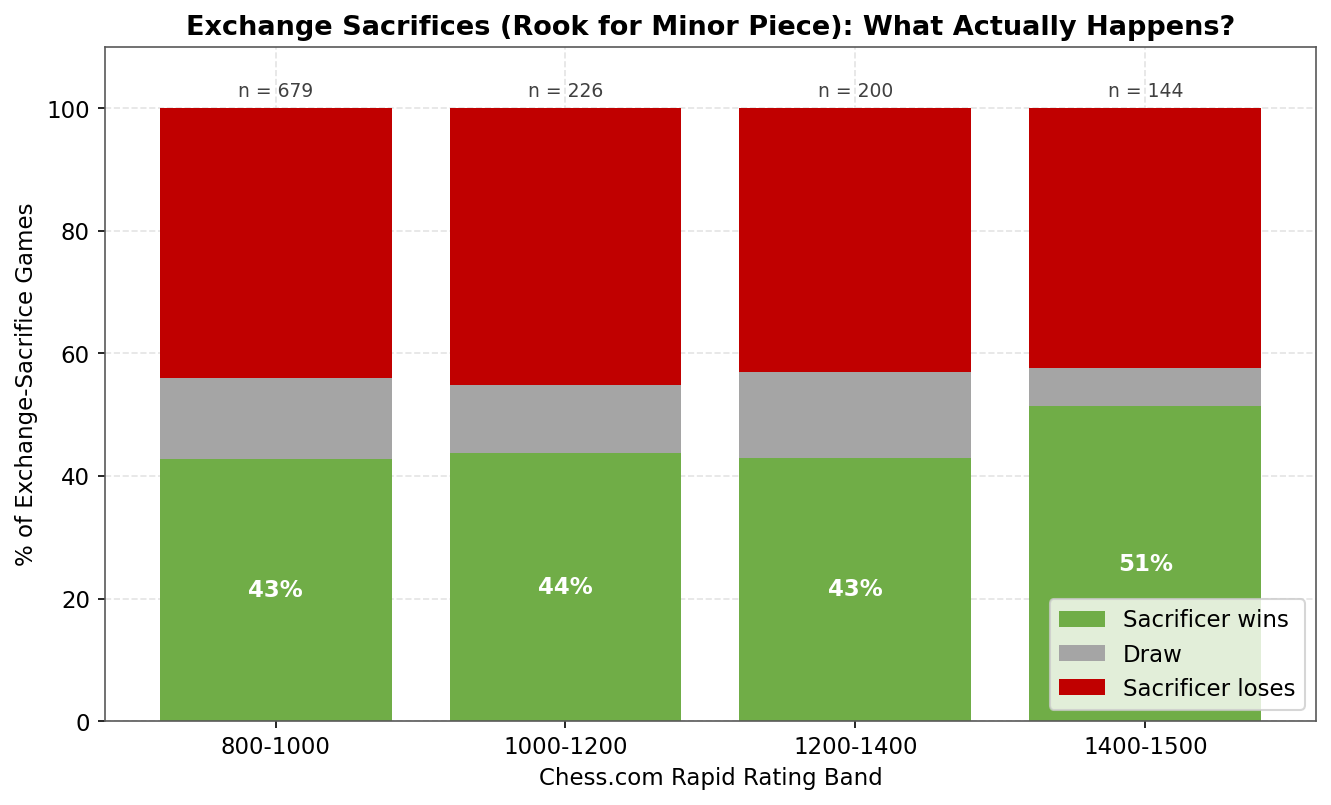
Across all rating bands, the player who sacrifices the exchange wins between 42% and 51% of the time. Given that the baseline win rate for White is roughly 50% and Black is roughly 46%, an exchange sacrifice is a statistically viable strategy, even at lower ratings.
Interestingly, the success rate jumps to 51.4% in the 1400-1500 rating band. This suggests that as players improve their positional understanding, they become better at utilizing the long-term compensation (such as a strong outpost for a knight or a dominant bishop pair) that an exchange sacrifice provides.
Actionable Advice: 1200-1400 Rating Band
At this level, the percentage of decisive games where the winner was down material drops to 14.5%. Players are getting better at converting advantages, but they still struggle with complex, dynamic positions.
Your Roadmap:
- Learn to evaluate compensation. Start looking for opportunities where giving up a small amount of material (like an exchange) yields a significant positional advantage, such as a safer king or a dominant minor piece.
- Improve your defensive technique. When you are up material, your opponent will often launch desperate attacks. Learn to defend calmly without returning the material unnecessarily.
A Classic 1200-1400 Blunder:
White is up a minor piece (+3 material) but faces a complex position. White plays Na4 (red arrow), misplacing the knight and allowing Black to seize the initiative. The engine prefers Rf4 (green arrow), actively defending and preparing to challenge Black's control.
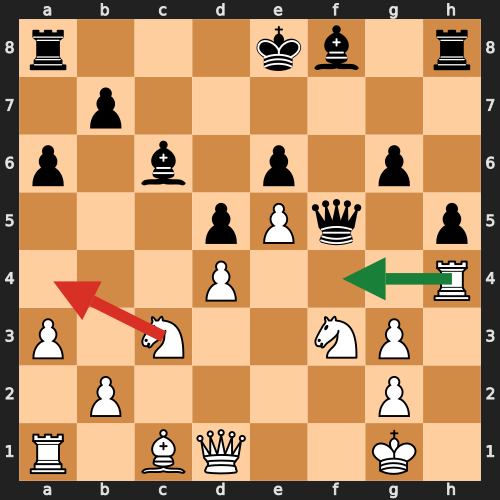 White (up a piece) plays Na4, losing the thread of the position.
Crossing the 1500 Threshold
As you approach the 1500 Chess.com Rapid rating mark, the data shows a clear shift. The "throw-away" rate for a minor piece advantage drops to 23%, and a decisive material advantage (+7) results in a win 92% of the time.
However, players in this band are still vulnerable to positional mistakes. The divergence between material and evaluation remains high, indicating that games are often decided by piece activity and king safety rather than raw material count.
Actionable Advice: 1400-1500 Rating Band
You are now entering the realm of advanced intermediate chess. Raw blunders are less common, and games are increasingly decided by positional nuances.
Your Roadmap:
- Master the endgame. At this level, a one-pawn advantage is still only converted into a win 59% of the time. Improving your endgame technique is the most reliable way to increase this conversion rate.
- Understand dynamic imbalances. You must become comfortable playing positions where material is unequal but the evaluation is balanced (e.g., two minor pieces vs a rook and a pawn).
A Classic 1400-1500 Blunder:
Black is up a full rook (-5 material) but faces a dangerous attack. Black plays g5 (red arrow), weakening the kingside structure. The engine prefers the more solid g6 (green arrow), keeping the king safe while maintaining the material advantage.
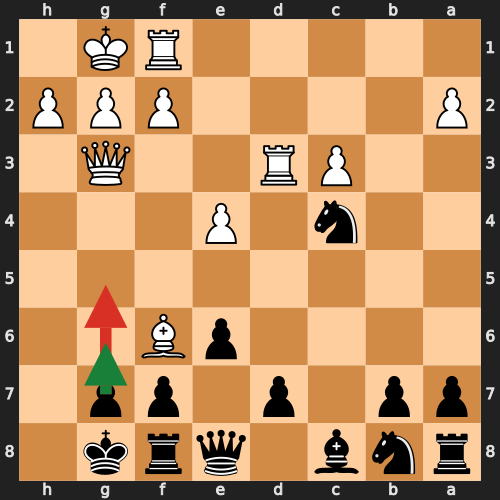 Black (up a rook) plays g5, creating unnecessary weaknesses.
Conclusion
The data is clear: material advantage is only one piece of the puzzle. At the beginner and intermediate levels, a one-pawn advantage is statistically insignificant, and even a full piece advantage is thrown away in over a quarter of games.
To climb the rating ladder, you must shift your focus from simply counting pieces to evaluating piece activity, king safety, and positional compensation. Stop relaxing when you win material, learn to defend tenaciously, and always prioritize the quality of your position over the quantity of your pieces.
Data and Methodology
This analysis was conducted using a sample of 3,694 Rapid games played on Lichess in March 2025. The Lichess ratings were mapped to approximate Chess.com Rapid ratings using established conversion tables (e.g., Chess.com 1000 ≈ Lichess 1615).
Game data was parsed using Python, and positions were evaluated using the Stockfish engine to determine the divergence between raw material count and positional evaluation. Population-level statistics were sourced from the Grandmaster-Guide analytics API, encompassing over 715,000 positions across all time controls.
Underlying Data Files:
- Divergence Summary by Rating Band
- Material Conversion Rates at Move 20
- Evaluation vs Material Divergence by Ply
- Evaluation vs Material Scatter Sample
Chess Coach April 20, 2026