Pawn storms are among the most visceral and exciting attacking motifs in chess. Launching a wall of pawns toward the opponent's castled king feels powerful, but how often does it actually work? Does the success rate change as you climb the rating ladder?
To answer these questions, we analyzed 12,000 Blitz games played on Lichess, mapping the data to Chess.com rating bands between 800 and 1600. By combining engine evaluations with real-world outcomes, we have created a roadmap to help you understand when to push your pawns and when to hold them back.
Data and Methodology Overview
For this study, we defined a "pawn storm" as a position where the attacking side has advanced at least three pawns from their starting squares on the flank where the opponent's king is castled, with at least two of those pawns reaching the 4th rank or beyond.
We collected 3,000 Blitz games for each of the following Chess.com rating bands (using Lichess equivalents for data retrieval):
- 800–1000 (Lichess Blitz ≈ 1200–1420)
- 1000–1200 (Lichess Blitz ≈ 1420–1565)
- 1200–1400 (Lichess Blitz ≈ 1565–1705)
- 1400–1600 (Lichess Blitz ≈ 1705–1850)
Using Stockfish 16.1, we evaluated the exact moment the pawn storm threshold was reached to determine whether the attack was objectively sound or a speculative gamble.
1. How Common Are Pawn Storms?
Pawn storms are a relatively frequent occurrence in club-level Blitz, appearing in roughly 12% to 18% of games depending on the rating band.
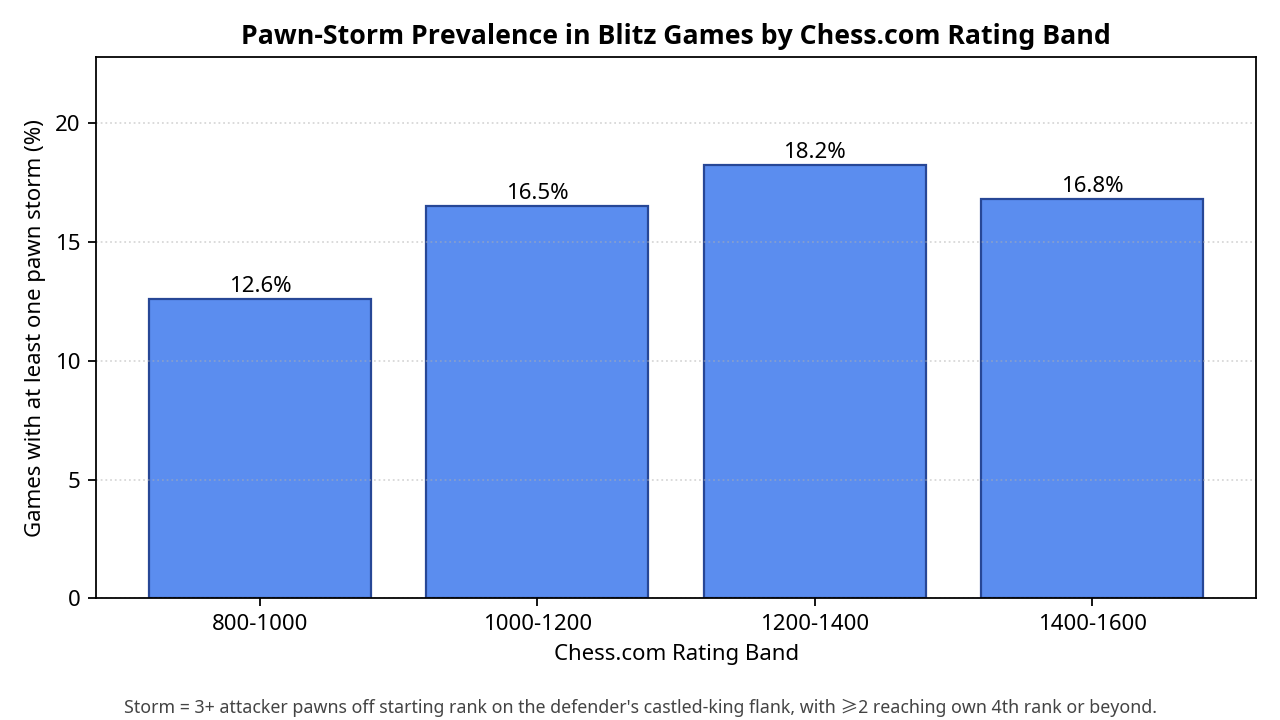
Interestingly, the frequency of pawn storms peaks in the 1200–1400 rating band. At this level, players have learned the basic attacking patterns and are eager to apply them, often forcing the issue. As players approach the 1400–1600 band, the prevalence slightly decreases, likely because defenders become better at preventing the conditions that allow a storm to build.
2. The Reality of Storm Success Rates
When you launch a pawn storm, you are committing to a high-stakes attack. The data reveals that pawn storms are double-edged swords.
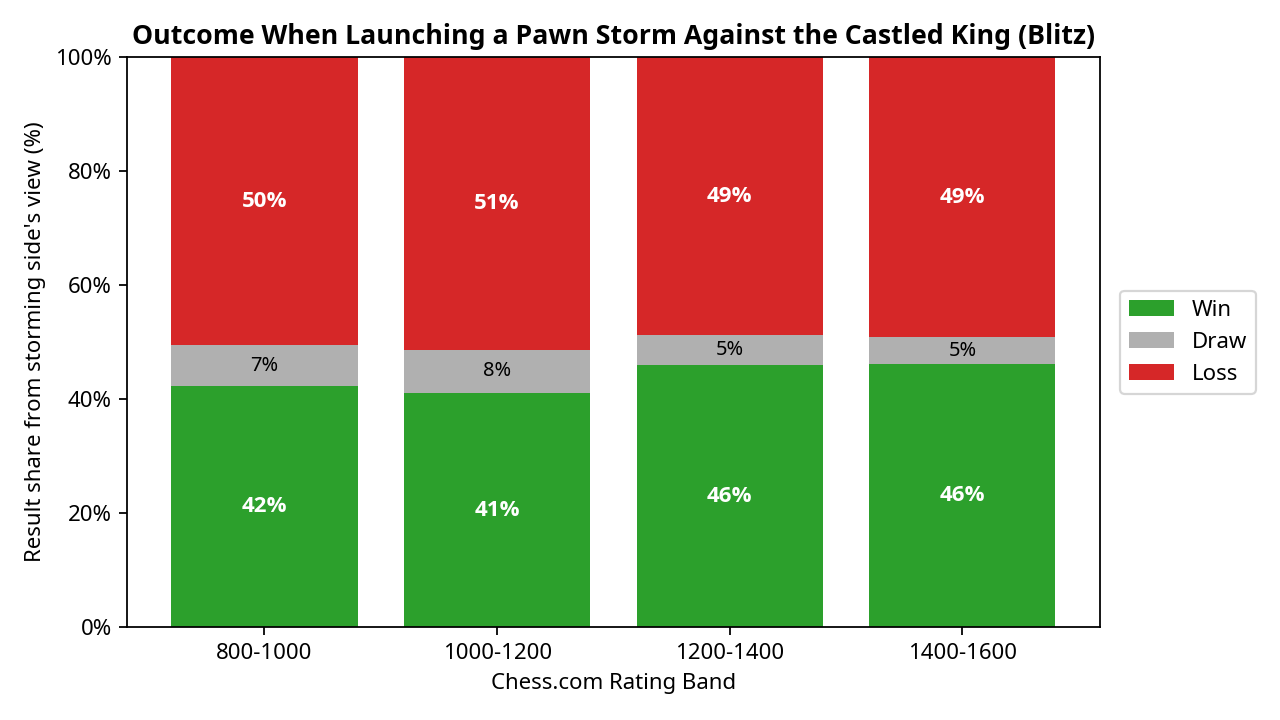
Across all rating bands, the storming side loses more often than they win. The win rate hovers between 41% and 46%, while the loss rate is consistently near 50%. This suggests that many pawn storms at the club level are overextensions. When the attack fizzles out, the resulting structural weaknesses and exposed king often lead to defeat.
Expected Score vs. Baseline
To put this into perspective, we compared the expected score (where a win is 1 point, a draw is 0.5, and a loss is 0) of the storming side against the baseline average score of 50%.
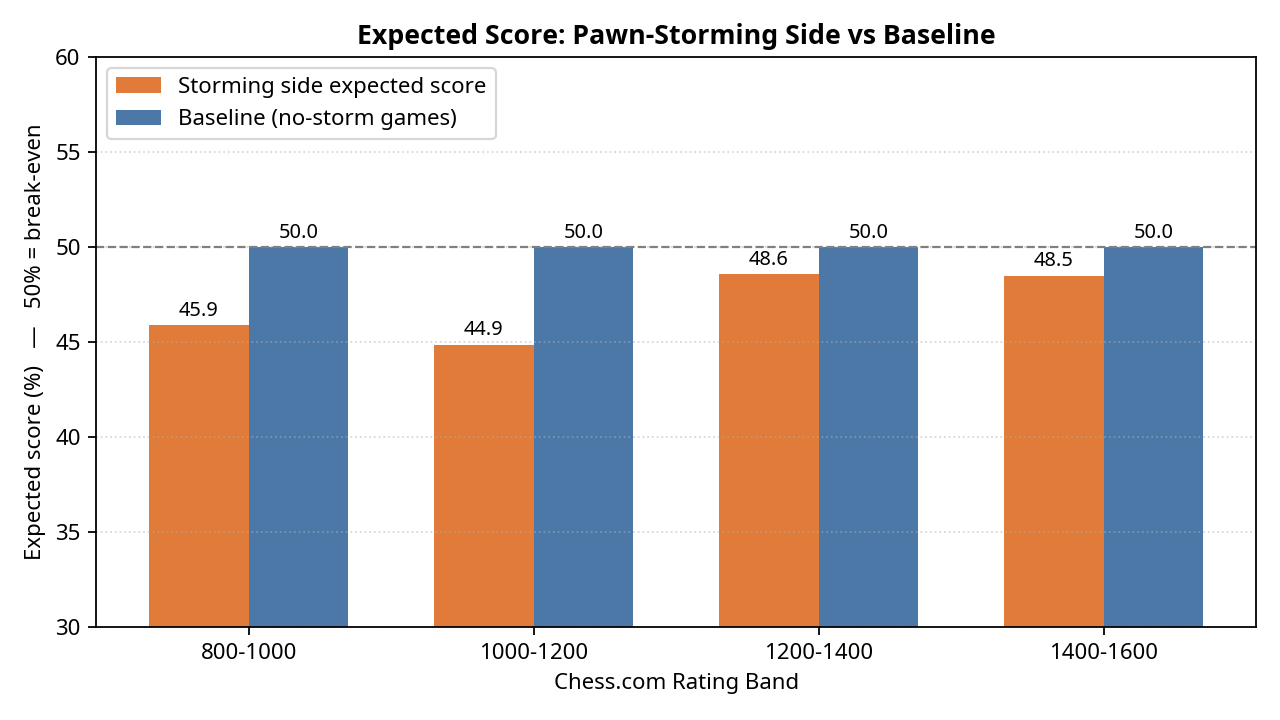
In every rating band, launching a pawn storm actually lowers your expected score compared to the baseline. The drop is most severe in the 1000–1200 band, where the expected score falls to 44.9%. This data underscores a critical lesson: pawn storms should not be your default plan. They require specific positional justifications to succeed.
3. The Role of King Safety: Opposite vs. Same-Side Castling
The effectiveness of a pawn storm is heavily dependent on where your own king is located. The classic scenario involves opposite-side castling, where you throw your pawns at the enemy king while your own king is safely tucked away on the other side of the board.
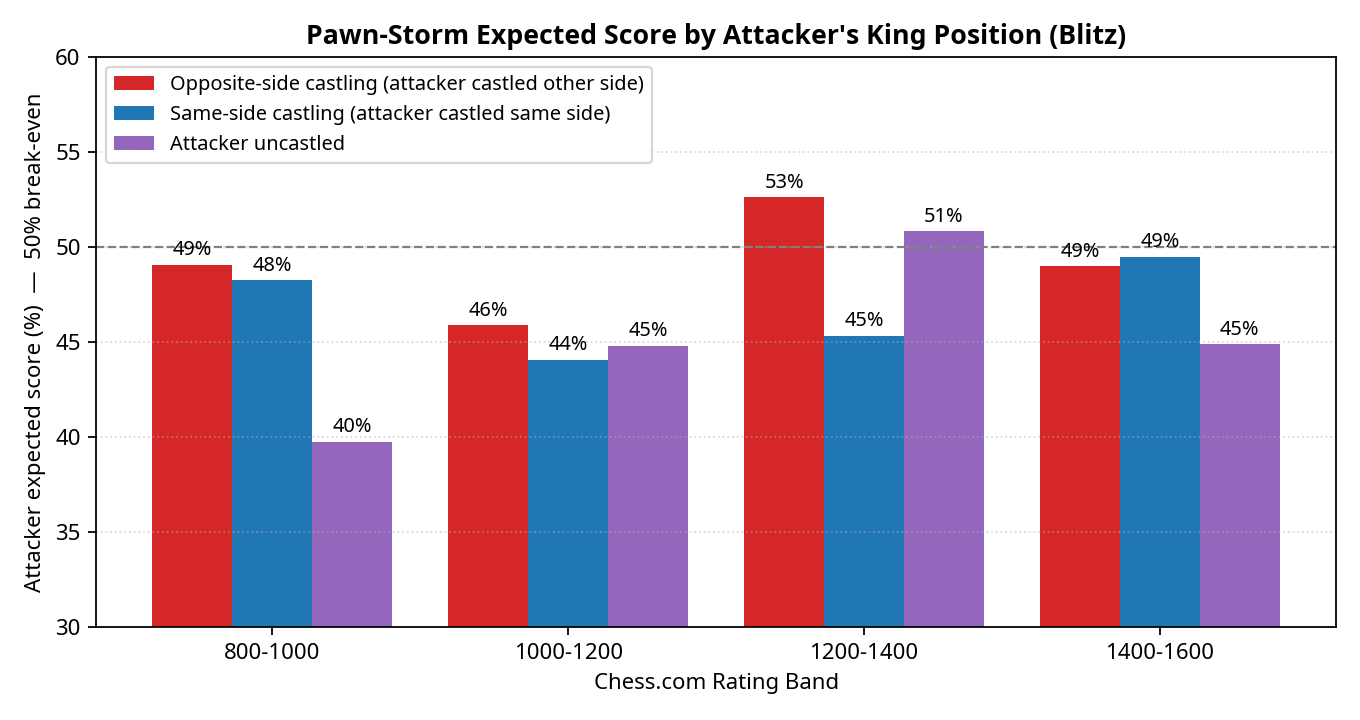
The data confirms conventional chess wisdom:
- Opposite-side castling storms are the most effective, yielding an expected score near or above 50% in the higher rating bands.
- Same-side castling storms are significantly riskier. By pushing the pawns in front of your own king, you expose yourself to counterattacks. The expected score for same-side storms is consistently lower.
- Uncastled attackers perform the worst, especially in the 800–1000 band (expected score of 40%). Launching a flank attack while your king remains in the center is a recipe for disaster.
4. Engine Evaluation at the Moment of Launch
Are players launching storms from winning positions, or are they using them as desperate measures? We looked at the Stockfish evaluation at the exact ply the storm threshold was reached.
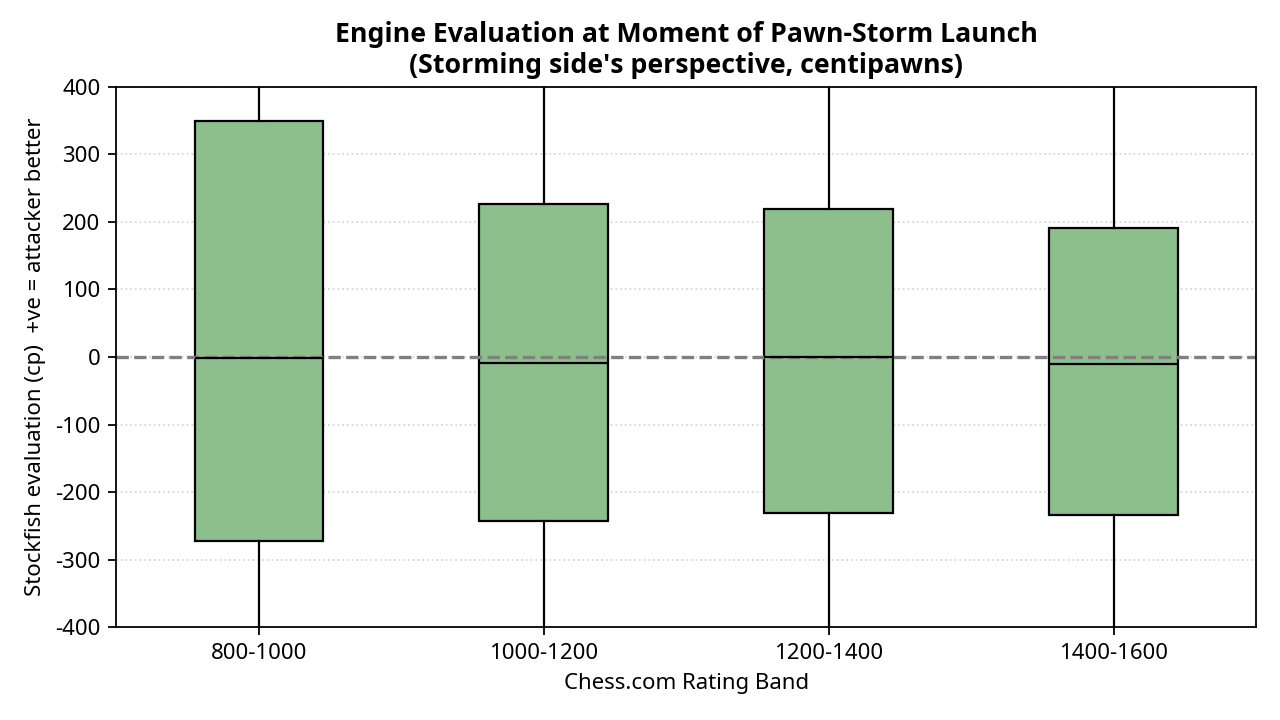
The median evaluation is remarkably close to 0.0 (equal) across all bands. However, the variance is massive. Players are launching storms in completely winning positions (+3.00) and completely losing positions (-3.00).
Does the Engine Agree with the Attack?
We categorized the engine evaluation at launch into buckets (Worse, Equal, Better) and calculated the expected score for each.
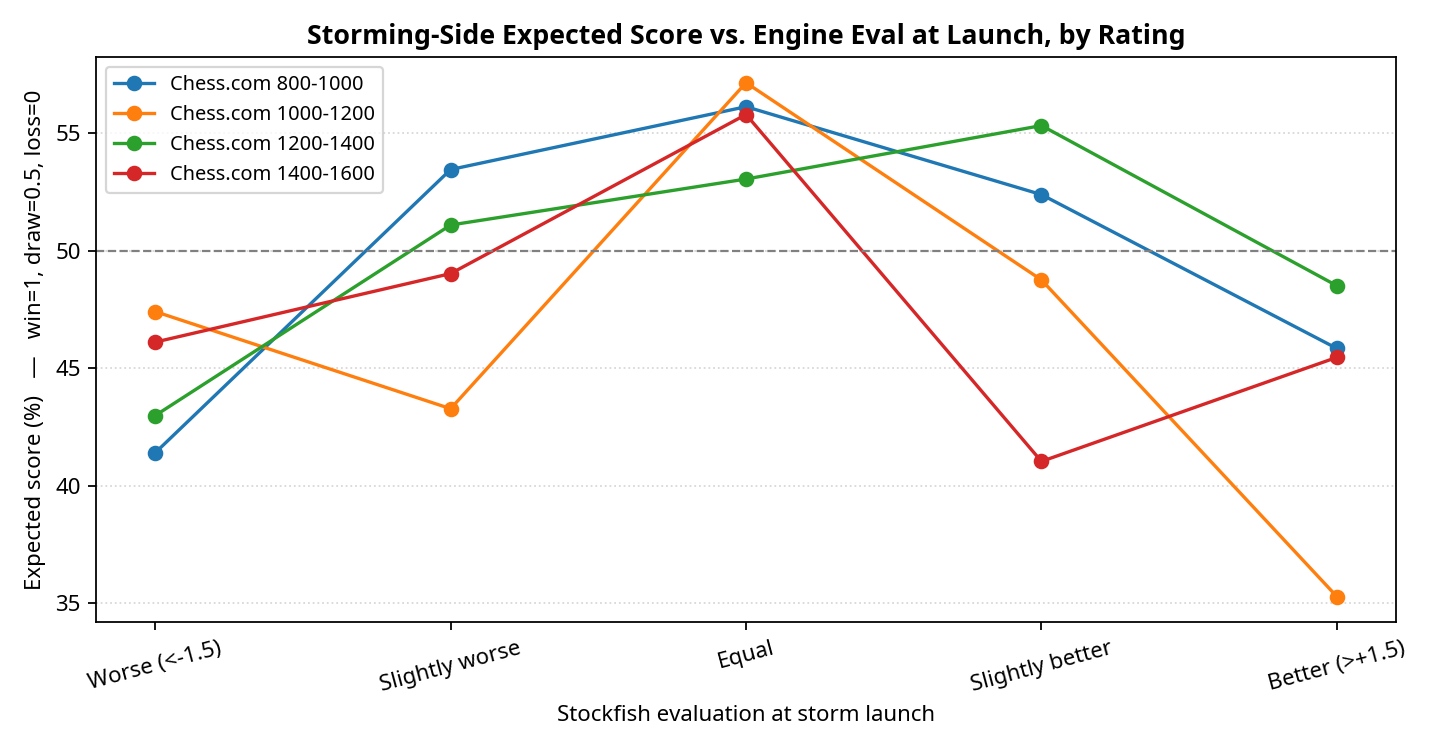
A fascinating trend emerges: pawn storms perform best when the position is roughly equal. When the attacker is already significantly better (>+1.5), the expected score actually drops. Why? Because in a clearly winning position, a pawn storm is often an unnecessary complication that introduces variance and allows the opponent counterplay. Conversely, when the position is equal, a well-timed storm can create the imbalances needed to secure a win.
5. Visual Evidence: The Good, The Bad, and The Ugly
To illustrate these concepts, let's look at three real examples from our dataset. In each diagram, the red arrow shows the move played by the storming side, while the green arrow shows Stockfish's top recommendation.
The Successful Opposite-Side Storm (1400–1600 Band)
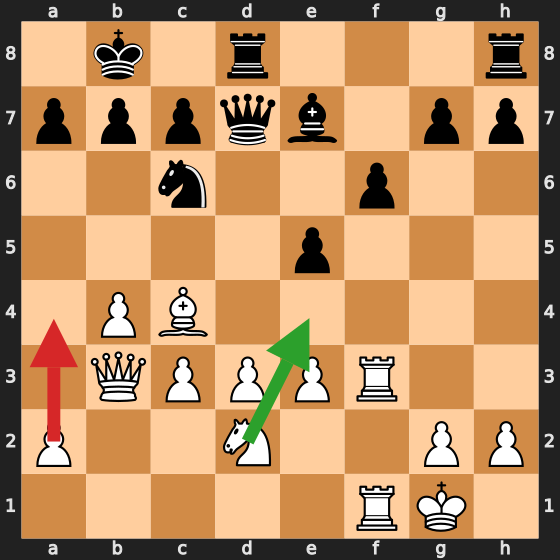
In this position, White has castled queenside and Black has castled kingside. White plays a4, continuing the pawn storm. While the engine slightly prefers centralizing the knight with Nde4, the pawn push is completely sound. White maintains a strong attack without compromising their own king safety, eventually winning the game.
The Same-Side Backfire (1000–1200 Band)
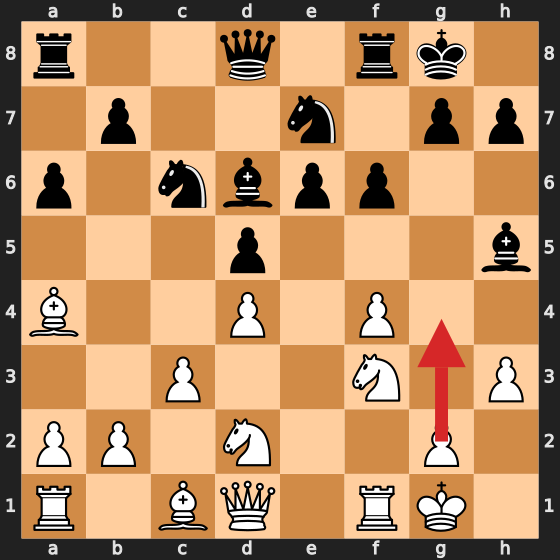
Here, White has castled kingside and decides to launch a same-side storm with g4. Interestingly, the engine agrees that g4 is the best move in this specific position! However, the evaluation is already -0.82 (favoring Black). White's king is severely exposed, and despite finding the "best" attacking move, the structural damage is too great. Black easily repels the attack and wins. This highlights the inherent danger of same-side storms: even when objectively correct, they are incredibly difficult to execute perfectly in Blitz.
The Uncastled Overreach (800–1000 Band)
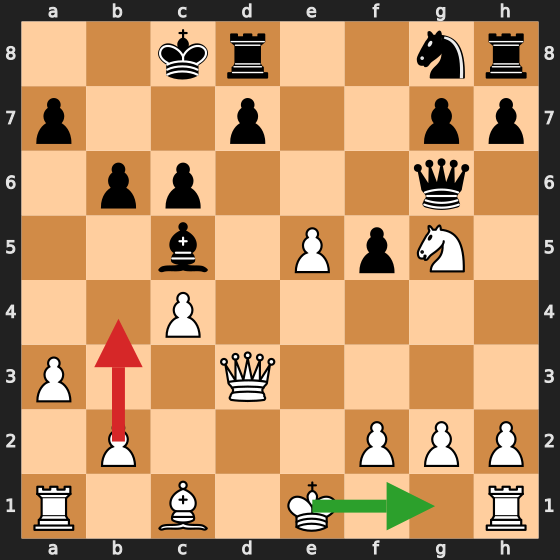
White's king is still on e1, yet they push b4 to attack Black's queenside. The engine strongly disagrees, recommending O-O to secure the king first. By ignoring king safety, White allows Black to open the center and exploit the uncastled king. White's attack never materializes, and they lose the game.
Actionable Advice by Rating Band
Based on the data, here is a roadmap for improving your pawn storm execution as you climb the ranks.
800–1000: Secure Your King First
At this level, the biggest mistake is launching attacks while your own king is vulnerable. The data shows a dismal 40% expected score for uncastled attackers. Actionable Advice: Make a strict rule for yourself: do not push flank pawns until your king is castled and safe. Focus on development and central control before dreaming of a mating net.
1000–1200: Avoid Same-Side Storms
Players in this band are eager to attack but often choose the wrong moments. Same-side castling storms perform terribly here (44% expected score). Actionable Advice: If you and your opponent have castled on the same side, look for central breaks or piece play rather than pawn storms. Pushing the pawns in front of your king creates weaknesses that your opponents are beginning to learn how to exploit.
1200–1400: The Danger of Over-Complication
This band sees the highest frequency of pawn storms, but also a significant drop in expected score when launching storms from already winning positions. Actionable Advice: When you have a clear advantage (+1.5 or better), prioritize consolidation and simplification. Do not launch a speculative pawn storm that gives your opponent tactical chances. Win cleanly.
1400–1600: Mastering the Opposite-Side Attack
At this level, players are better at defending, making raw aggression less effective. However, opposite-side castling storms remain a potent weapon (49% expected score). Actionable Advice: Focus on the speed of your attack. In opposite-side castling scenarios, the game is a race. Ensure your pawn storm is supported by your pieces and that you are opening lines faster than your opponent is on the other side of the board.
Conclusion
Pawn storms are not a universal solution to breaking down a defense. The data clearly shows that they are high-risk endeavors that, on average, lower your expected score. However, when applied in the right context—specifically in opposite-side castling scenarios from roughly equal positions—they remain one of the most effective ways to play for a win.
Push your pawns with purpose, keep your king safe, and remember that sometimes the best attack is the one you don't launch.
Chess Coach
April 20, 2026
Data and Methodology
The raw data and analysis scripts used for this article are available in the attached CSV files. The dataset includes 12,000 Lichess Blitz games, evaluated using Stockfish 16.1 via the Grandmaster Guide MCP server.
band_stats.csv: Aggregated statistics by rating band.storm_games.csv: Detailed game-by-game data for all identified pawn storms.game_summary.csv: High-level summary of all processed games.