A Data-Driven Guide to Endgame Conversion in Blitz Chess
Every chess player knows the feeling. You navigate a complex middlegame, trade down pieces, and emerge into the endgame with a clear advantage: a pawn majority. The engine evaluation flashes +1.5. The win seems inevitable. Yet, twenty moves later, you are staring at a checkmate or a drawn position, wondering where it all went wrong.
For intermediate players, this scenario is not just a frustrating anecdote; it is a statistical reality. Our analysis of hundreds of thousands of Blitz games reveals that a pawn majority is far from a guaranteed victory. In fact, for players rated between 800 and 1500 on Chess.com, an extra pawn in the endgame is squandered with alarming frequency.
This guide serves as a roadmap for improvement, breaking down the data across three rating bands (800–1000, 1000–1200, and 1200–1500) to understand why these advantages slip away and, more importantly, how you can stop the bleeding and start converting your majorities into wins.
| Chess.com Rating Band | Lichess Equivalent | Pawn Majority Win Rate (Move 30) | Failure Rate | Endgame Blunder Rate |
|---|---|---|---|---|
| 800–1000 | ~1100–1300 | 55.9% | 44.1% | 43.2% |
| 1000–1200 | ~1300–1500 | 54.4% | 45.6% | 41.6% |
| 1200–1500 | ~1500–1800 | 60.7% | 39.3% | 40.2% |
The Reality of the Blitz Endgame
Before examining how players handle pawn majorities, we must first understand how often they actually reach the endgame. In Blitz chess, time pressure and tactical blunders often decide the game long before the kings are forced to march toward the center.
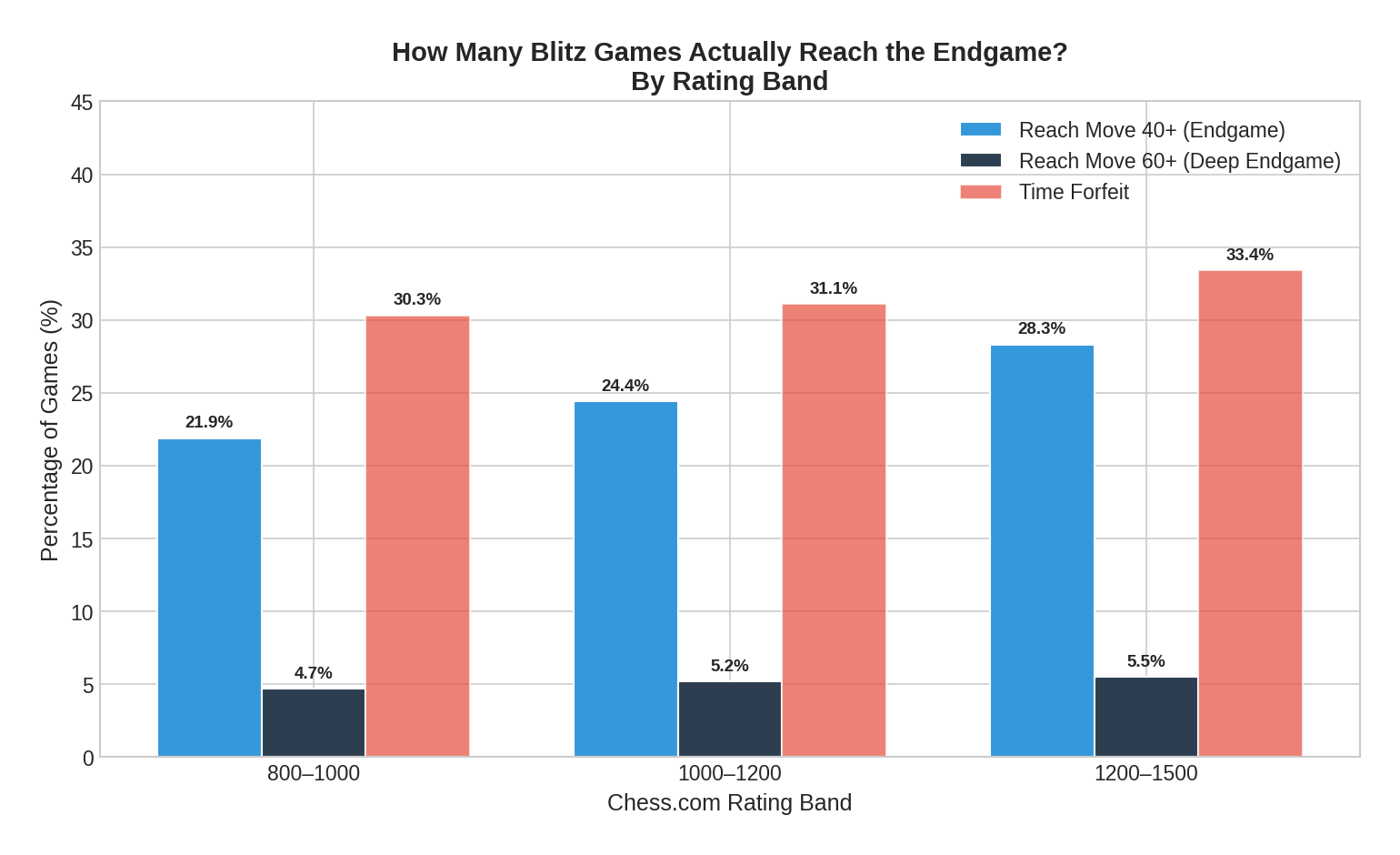
The data shows that only about a quarter of games reach move 40, which we define as the deep endgame. Interestingly, the likelihood of reaching the endgame increases with rating. Players in the 1200–1500 band reach move 40 in 28.3% of their games, compared to just 21.9% for the 800–1000 band. This suggests that as players improve, they become better at surviving the middlegame, making endgame skills increasingly critical.
However, reaching the endgame is only half the battle. The real challenge lies in navigating it accurately.
The Endgame Blunder Crisis
The endgame is often perceived as a phase of precise calculation and subtle maneuvering. For intermediate players, however, it is a minefield of blunders.
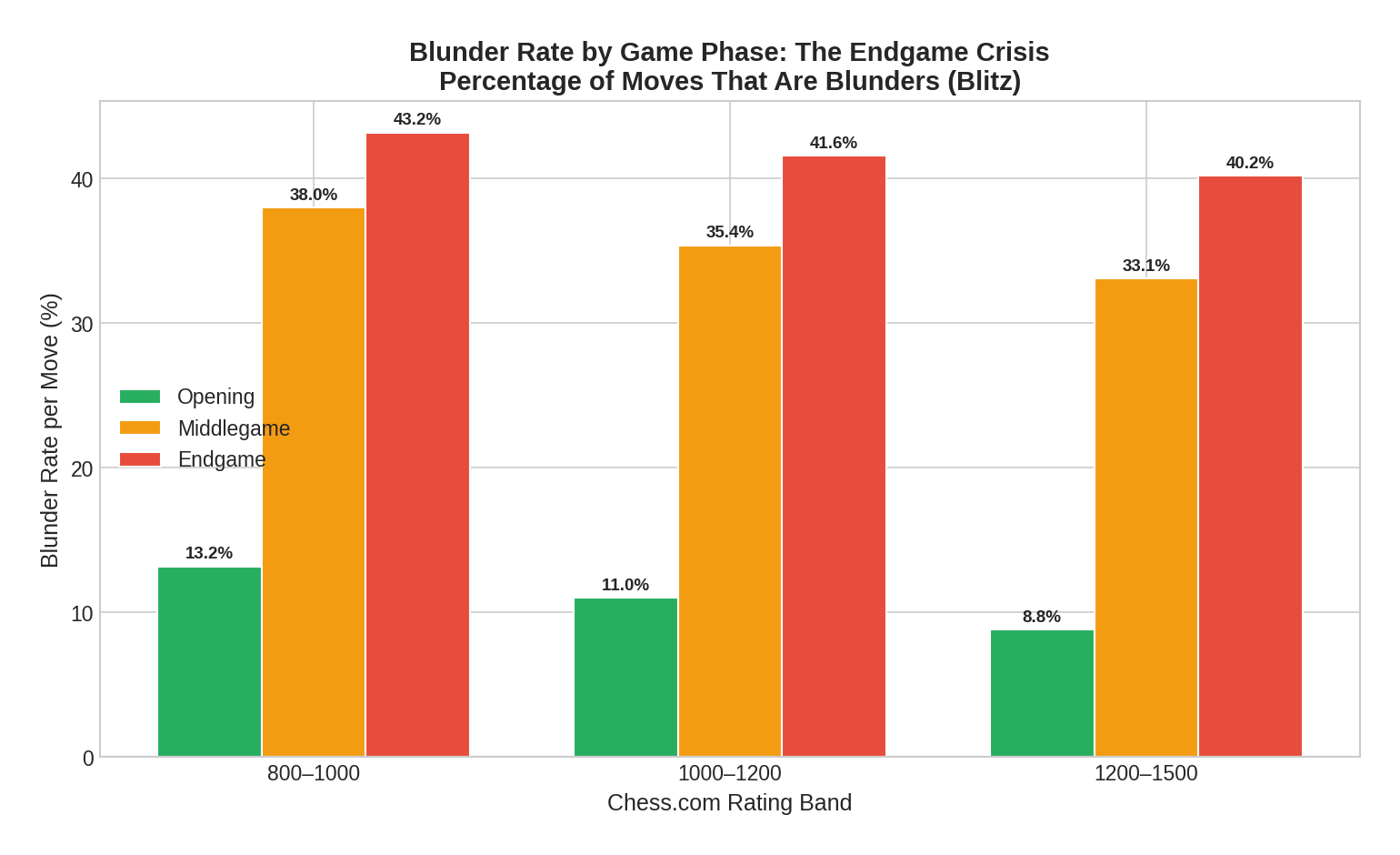
Across all intermediate rating bands, the blunder rate skyrockets in the endgame. For players rated 800–1000, a staggering 43.2% of all endgame moves are classified as blunders by the engine. Even in the 1200–1500 band, the blunder rate remains above 40%. This is a massive increase compared to the opening phase, where blunder rates hover around 9-10%.
This high blunder rate is the primary reason why material advantages, such as a pawn majority, are so frequently lost. When nearly every other move is a significant mistake, a single extra pawn is easily given away or rendered useless.
| Chess.com Rating Band | Opening Blunder Rate | Middlegame Blunder Rate | Endgame Blunder Rate | Endgame Avg CPL |
|---|---|---|---|---|
| 800–1000 | ~9.5% | ~33.8% | 43.2% | 578 |
| 1000–1200 | ~9.2% | ~33.2% | 41.6% | 529 |
| 1200–1500 | ~9.0% | ~32.5% | 40.2% | 491 |
The table above illustrates the dramatic escalation in error rates as the game progresses. While the opening is relatively safe—players have memorized their first few moves—the endgame is a completely different landscape. The centipawn loss (CPL) in the endgame exceeds 490 even for the strongest band in our study, meaning that on average, every single endgame move loses the equivalent of nearly five pawns worth of evaluation. This is a catastrophic level of inaccuracy.
The Pawn Majority: A Fragile Advantage
When a player enters the early endgame (around move 30) with a +1 to +2 material advantage—typically representing a pawn majority—the conversion rates are surprisingly low.
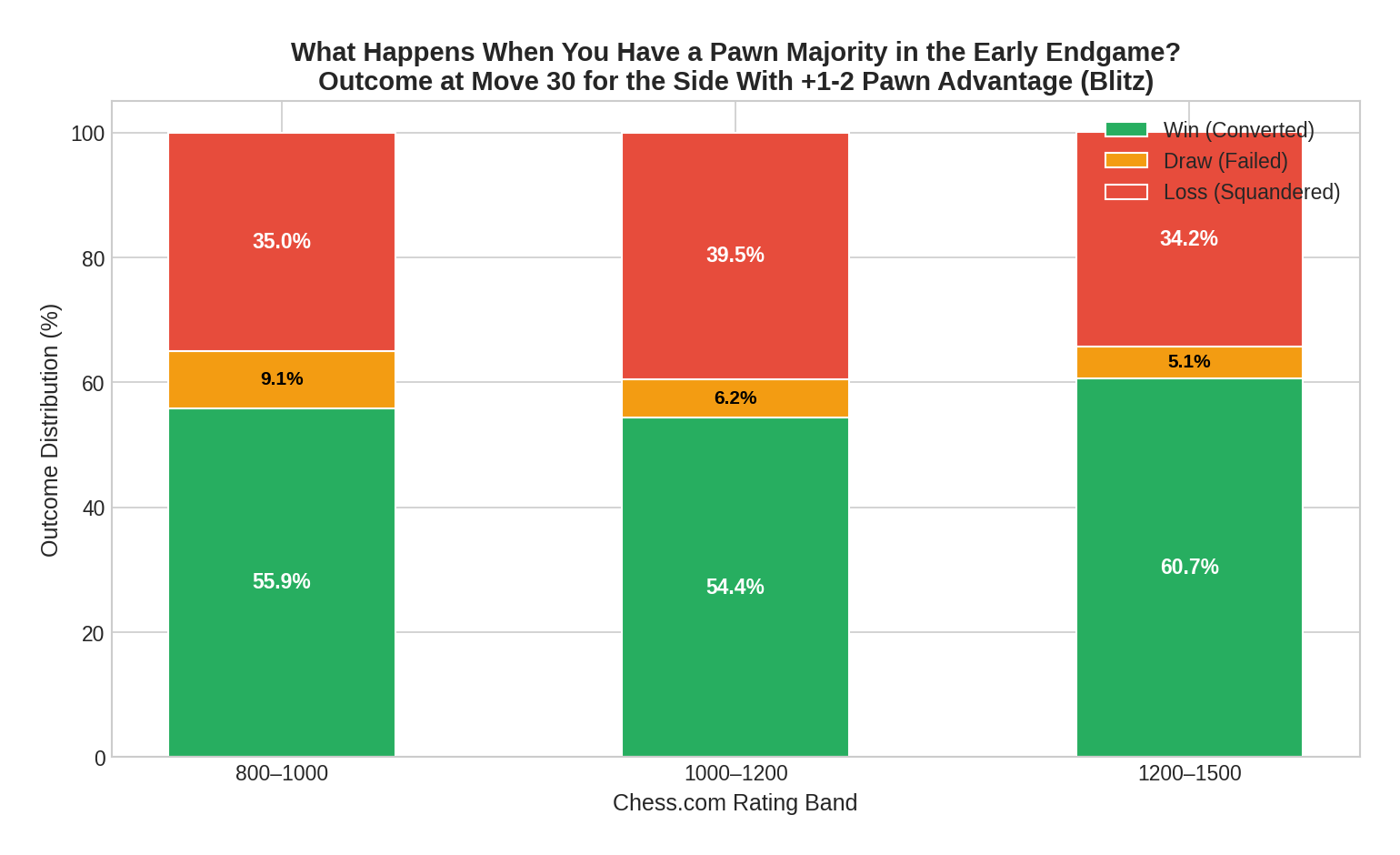
For players in the 800–1000 and 1000–1200 bands, having a pawn majority in the early endgame results in a win only about 54-56% of the time. This means that nearly half the time, the advantage is either drawn or completely lost. It is essentially a coin flip.
The breakthrough occurs in the 1200–1500 band. Here, the conversion rate jumps to 60.7%. This indicates a critical milestone in chess development: players in this range are beginning to understand the mechanics of pushing passed pawns and utilizing their king, rather than just relying on tactical tricks.
How Does Pawn Conversion Compare to Larger Material Advantages?
To put the pawn majority conversion rate in perspective, it is instructive to compare it against larger material advantages at the same point in the game.
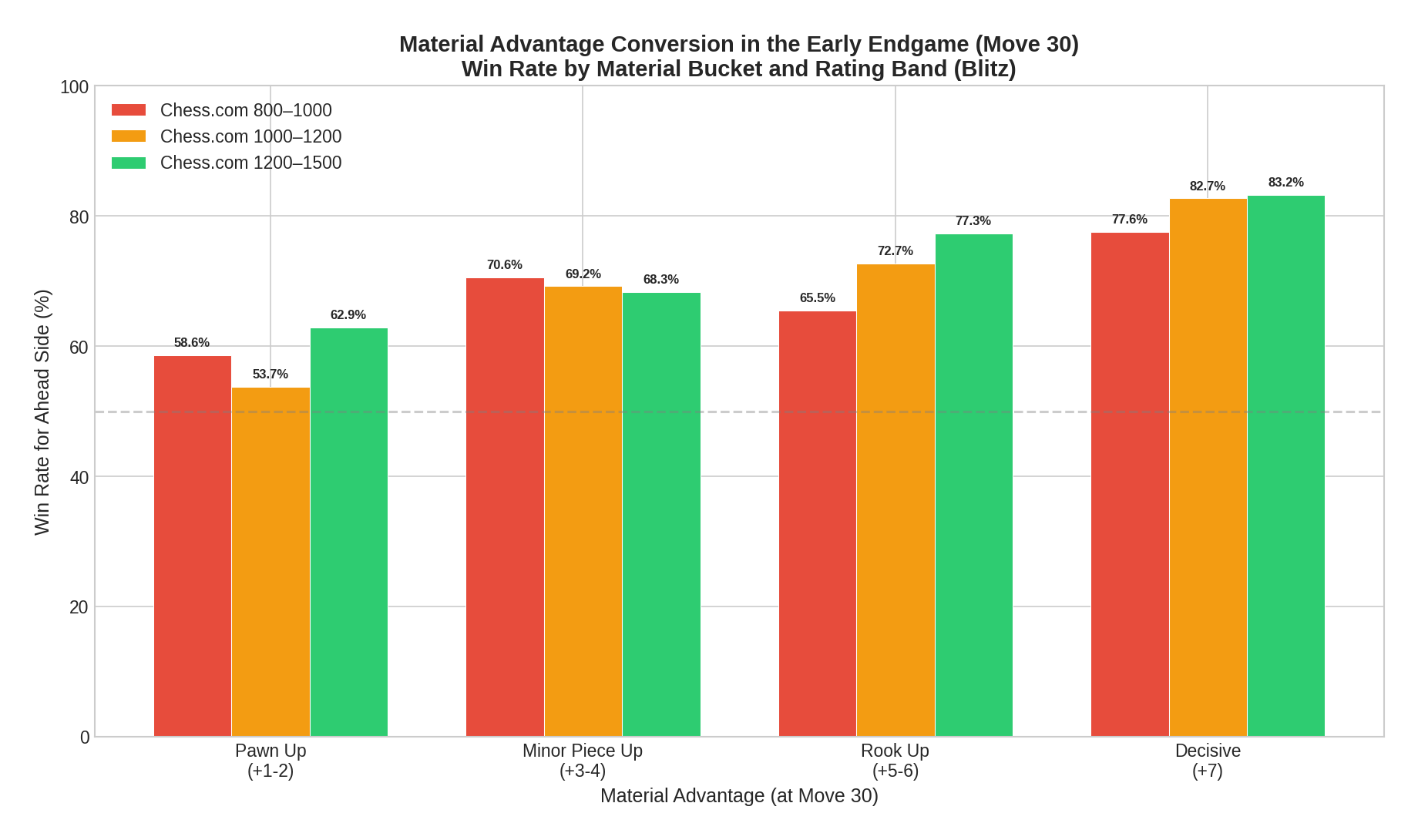
The data reveals a striking pattern. Being a pawn up (+1-2) at move 30 converts to a win only 54-63% of the time depending on rating, while being a minor piece up (+3-4) converts at 68-71%, and a rook up (+5-6) converts at 66-77%. The gap between a pawn advantage and a piece advantage is enormous, underscoring just how delicate a single-pawn majority truly is. Even a decisive material advantage (+7 or more) is not converted 100% of the time at these levels—players in the 800–1000 band still lose 22% of games where they are up a queen's worth of material.
The Failure Rate Across Game Phases
Another revealing angle is how the failure rate changes as the game progresses from the middlegame into the deep endgame.
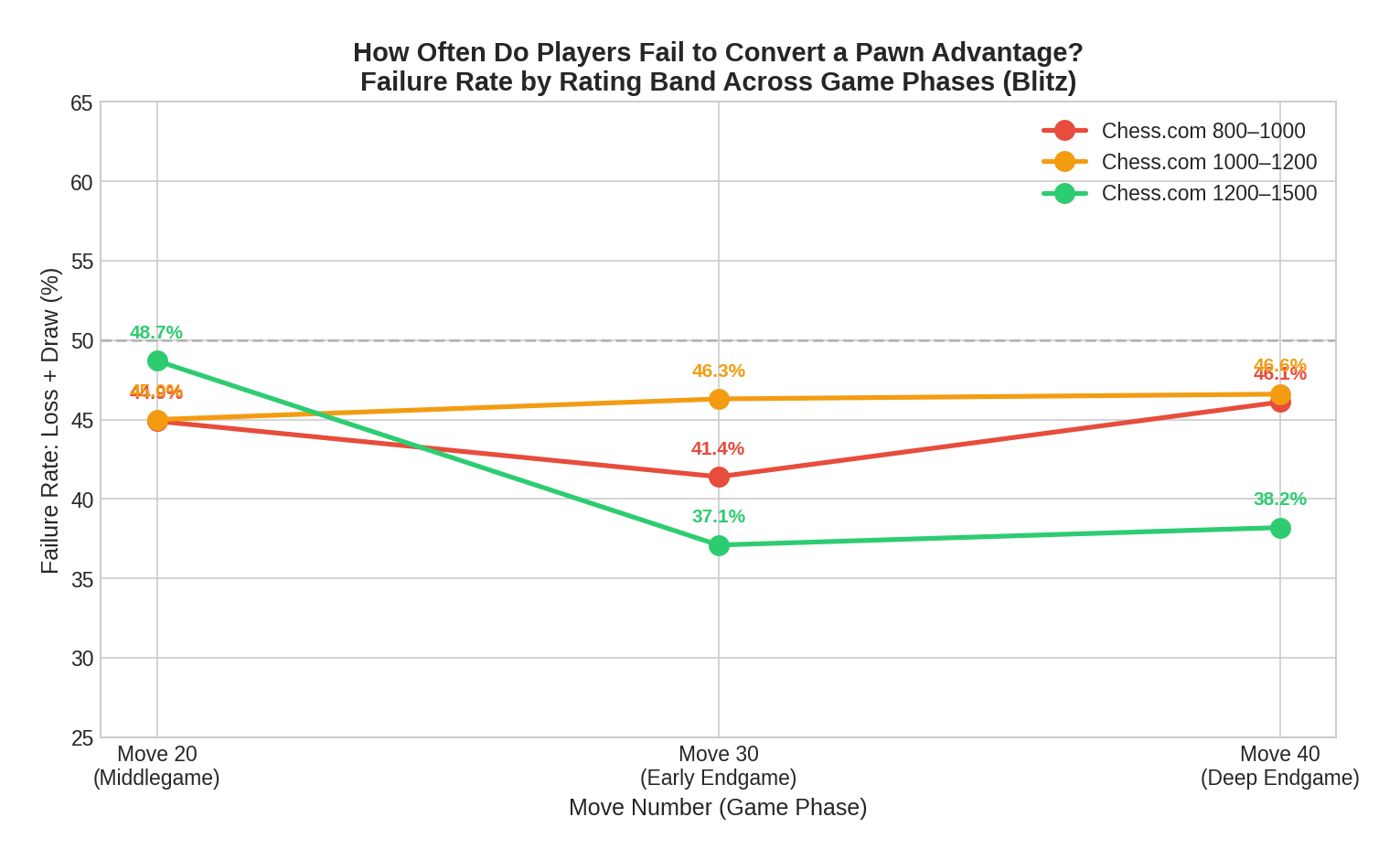
For the 1200–1500 band, the failure rate actually decreases from 48.7% in the middlegame to 37.1% in the early endgame, suggesting that these players are learning to simplify and convert. However, for the 1000–1200 band, the failure rate remains stubbornly flat at around 45-47% regardless of the game phase. This is a critical insight: players in the 1000–1200 range are not improving their conversion as the game simplifies, which means they lack fundamental endgame technique.
How Lopsided Do Positions Become?
The evaluation trajectory data shows how positions deteriorate across game phases for each rating band.
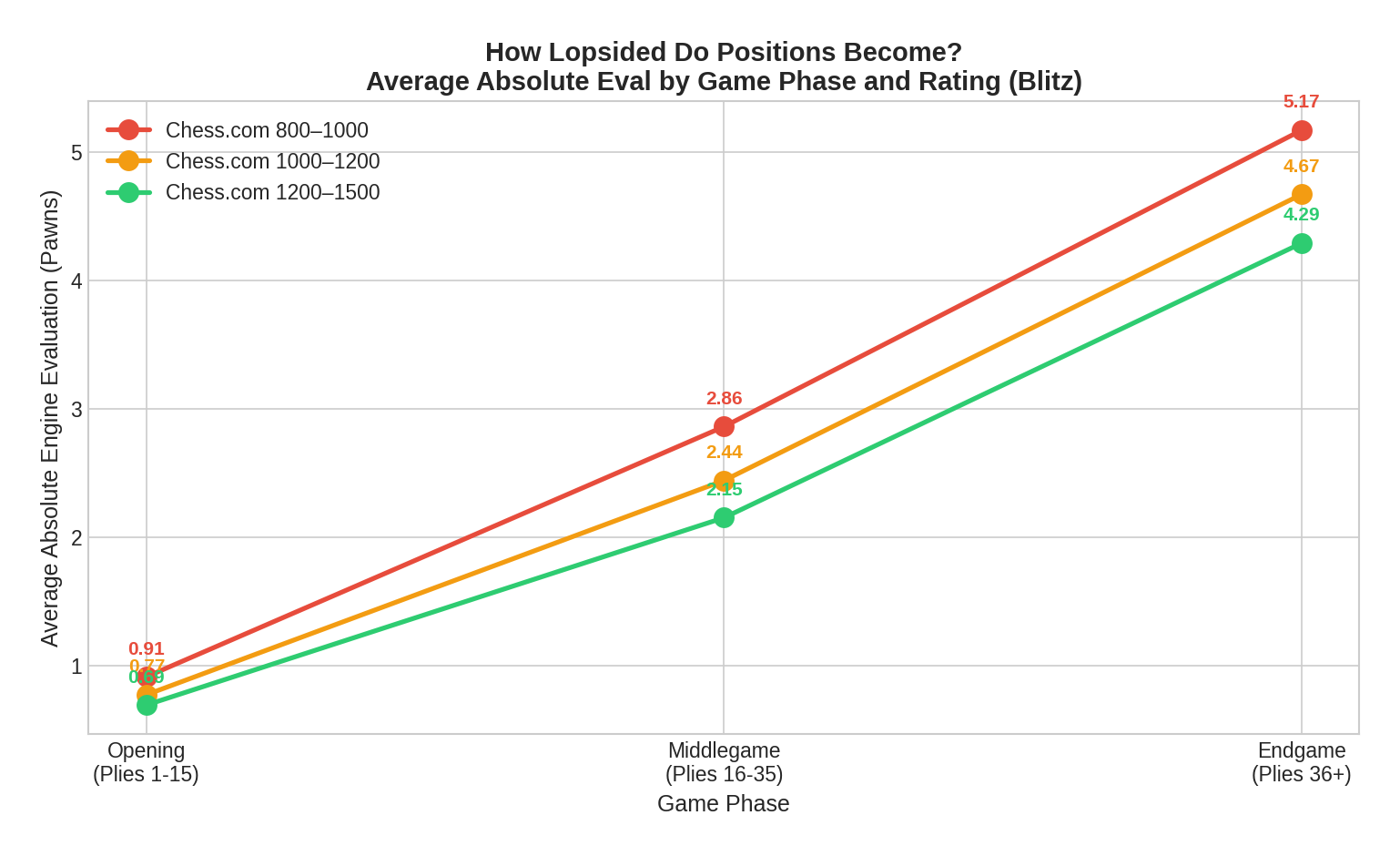
By the endgame, the average absolute evaluation exceeds 4.0 pawns for all intermediate bands. This means that most endgames at this level are not close, balanced affairs—they are already heavily lopsided. The fact that players still fail to convert from such advantageous positions further emphasizes the severity of the endgame blunder crisis.
The Anatomy of a Failed Conversion
Why do these advantages fail to materialize into wins? The data points to several common structural and tactical misunderstandings.
1. The Passive King
The most common mistake in pawn endgames is failing to activate the king. In the middlegame, the king must be protected; in the endgame, it becomes an attacking piece.
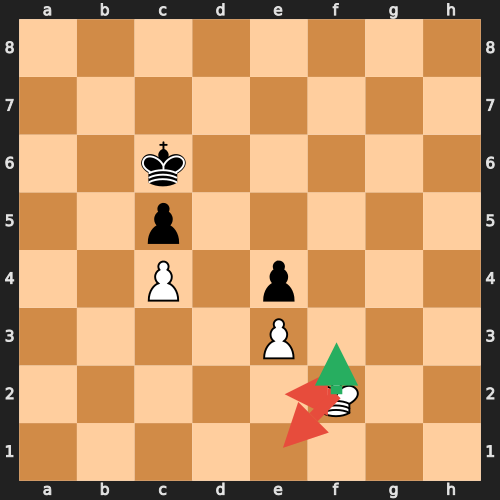
In the position above, White has an extra pawn, but the king is far removed from the action. The red arrows indicate passive or incorrect king moves. The green arrow shows the correct approach: the king must march forward to support the pawns and restrict the enemy king. A pawn majority is useless if your king is hiding on the back rank.
2. Ignoring the Outside Passed Pawn
An outside passed pawn is a massive advantage because it forces the enemy king to move away from the center to stop it, allowing your king to infiltrate and capture the remaining pawns.
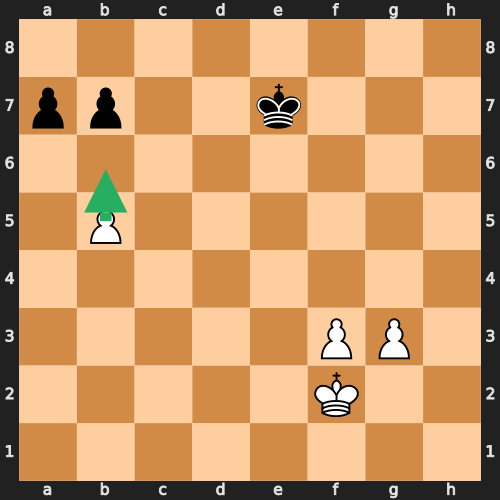
Intermediate players often fail to recognize the urgency of pushing the outside passed pawn. Instead of advancing the b-pawn (green arrow), they might waste time shuffling their king or making irrelevant pawn moves on the kingside, allowing the opponent to organize a defense.
3. Tactical Blindness in Rook Endgames
Rook endgames are notoriously difficult, and they are where many pawn majorities go to die. The presence of rooks introduces complex tactics that can instantly evaporate a material advantage.
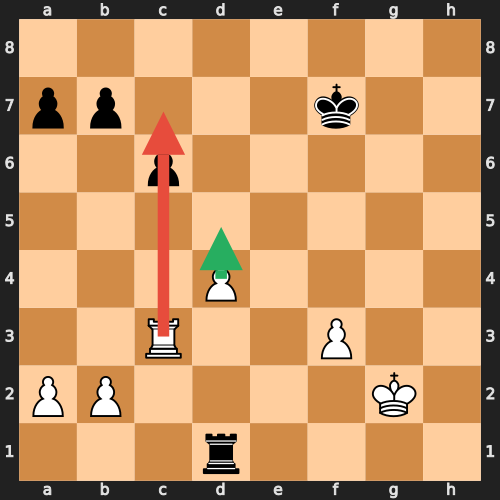
In this scenario, White has a passed d-pawn. The correct strategy is to push the pawn (green arrow), supported by the rook. However, a common blunder is to get greedy and hunt for more material, such as attacking the c6 pawn (red arrow). This allows Black to activate their rook, attack the white king, and potentially win the passed pawn.
4. Failing to Advance the Majority
Perhaps the most fundamental error is simply not pushing the pawns. Many intermediate players reach a position with a clear queenside or kingside majority and then proceed to shuffle pieces without making progress.
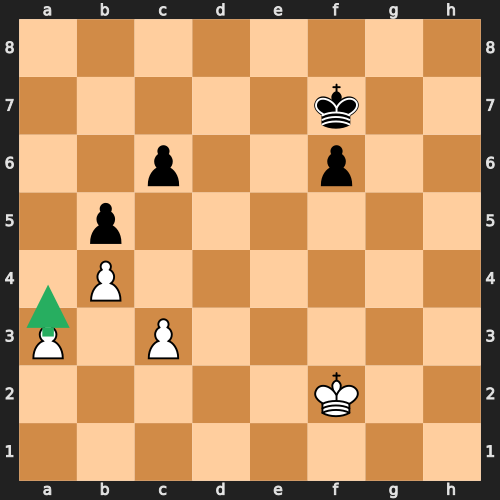
In the position above, White has a queenside pawn majority (3 pawns vs. 2). The green arrow shows the correct idea: advance the a-pawn to create a passed pawn. The principle is straightforward—push the pawn that is not directly opposed by an enemy pawn. Yet, in practice, intermediate players often hesitate, fearing that advancing pawns will create weaknesses. In the endgame, however, the opposite is true: static pawns are weak pawns.
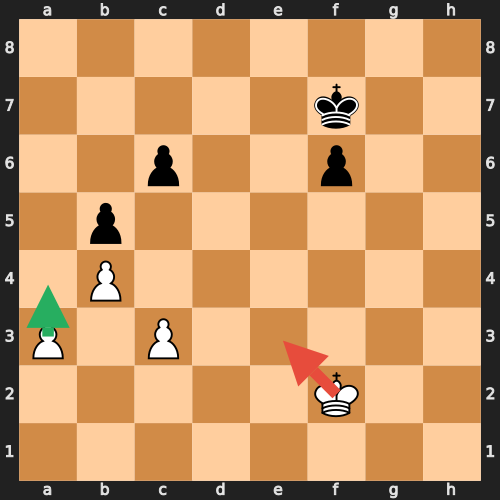
Here, the same position is shown with the common mistake: instead of advancing the majority (green arrow), the player makes a passive king move (red arrow). This gives the opponent time to bring their king closer and neutralize the majority.
Actionable Advice by Rating Band
Based on the data, here is a targeted roadmap for improving your endgame conversion rates.
For the 800–1000 Player: Stop the Bleeding
At this level, the failure rate for a pawn majority is nearly 45%. The primary issue is not a lack of profound endgame knowledge, but rather a high frequency of outright blunders.
Actionable Advice:
- Prioritize King Safety Over Pawn Pushing: Before you push your majority, ensure your king is not walking into a mating net or a fork. The 43.2% blunder rate means you are likely giving away pieces while trying to push pawns.
- Learn Basic Checkmates: Many drawn games in this band occur because players do not know how to mate with a King and Queen or King and Rook against a lone King. If you cannot execute these basic mates, your pawn majority is useless even if it promotes.
- Identify the Passed Pawn: Simply recognizing which pawn has no enemy pawns in front of it or on adjacent files is your first step. Focus your energy on supporting that specific pawn.
For the 1000–1200 Player: Activate the King
Players in this band are slightly better at avoiding catastrophic blunders, but their conversion rate (54.4%) is still barely better than a coin flip. The main culprit here is passive play.
Actionable Advice:
- The King is a Fighting Piece: As soon as the queens are traded off, your king must move toward the center of the board. A centralized king can support your pawn majority and block the enemy king.
- Create a Passed Pawn: If you have a 3-vs-2 majority on one side of the board, you must learn the mechanics of forcing a passed pawn. Push the pawn that does not have an enemy pawn directly in front of it.
- Avoid Pawn Overextension: Do not push your pawns so far forward that they become disconnected from your king and easily captured by the opponent's pieces.
For the 1200–1500 Player: Master the Rook Endgame
This band shows a significant leap in conversion ability (60.7%), indicating a growing understanding of endgame principles. However, there is still a 39.3% failure rate, largely driven by mismanagement of rook endgames.
Actionable Advice:
- Rooks Belong Behind Passed Pawns: Whether it is your passed pawn or your opponent's, your rook should generally be placed behind it. This maximizes the rook's activity as the pawn advances.
- Activity Over Material: In rook endgames, an active rook is often worth more than a pawn. Do not passively defend a pawn if it means your rook is tied down. Sacrifice the pawn if it allows your rook to become highly active and attack the opponent's weaknesses.
- Calculate the Pawn Race: You must begin calculating exactly how many moves it takes for your pawn to promote versus your opponent's pawn. This requires precise counting and an understanding of the "rule of the square."
Summary Table: Key Metrics by Rating Band
| Metric | 800–1000 | 1000–1200 | 1200–1500 |
|---|---|---|---|
| Games Reaching Move 40+ | 21.9% | 24.4% | 28.3% |
| Time Forfeit Rate | 30.3% | 31.1% | 33.4% |
| Pawn Majority Win Rate (Move 30) | 55.9% | 54.4% | 60.7% |
| Pawn Majority Failure Rate (Move 30) | 44.1% | 45.6% | 39.3% |
| Endgame Blunder Rate | 43.2% | 41.6% | 40.2% |
| Endgame Avg CPL | 578 | 529 | 491 |
| Avg Absolute Eval in Endgame | 5.17 | 4.67 | 4.29 |
The table above consolidates the key findings. The most striking observation is the gap between the 1000–1200 and 1200–1500 bands in pawn majority conversion. While the blunder rate only drops by 1.4 percentage points, the conversion rate jumps by over 6 percentage points. This suggests that the improvement is driven not by fewer mistakes in general, but by a qualitative shift in understanding—specifically, the ability to recognize and execute endgame plans rather than simply avoiding blunders.
Conclusion
A pawn majority is a powerful asset, but it is not a free point. The data clearly shows that intermediate players struggle immensely to convert these advantages, primarily due to high blunder rates and a misunderstanding of king activity. By recognizing the fragility of the endgame and applying targeted, rating-appropriate strategies, you can stop squandering your hard-earned majorities and start turning those +1.5 evaluations into actual victories.
Chess Coach April 14, 2026
Data and Methodology
This research is based on an analysis of Lichess Blitz games, utilizing the Grandmaster Guide MCP server to extract detailed analytics and position features. The data was segmented by Lichess rating bands and mapped to approximate Chess.com equivalents for clarity.
Note: Lichess ratings are generally 200-300 points higher than Chess.com ratings in this range. The mapping used for this analysis is: Lichess 1100-1300 ≈ Chess.com 800-1000; Lichess 1300-1500 ≈ Chess.com 1000-1200; Lichess 1500-1800 ≈ Chess.com 1200-1500.
The underlying data files generated during this research are available below:
- Accuracy vs Outcome
- Blunder Taxonomy
- CPL by Rating
View full data →ratingBand_lichess ratingBand_chesscom color avgCpl blunderPct mistakePct inaccuracyPct sampleMoves 1100-1300 800–1000 all 577.6 43.19 2.36 1.01 1610913 1100-1300 800–1000 black 568.4 42.66 2.35 1.01 790501 1100-1300 800–1000 white 586.5 43.7 2.38 1.02 820412 1300-1500 1000–1200 all 529.3 41.6 2.94 1.19 1761532 1300-1500 1000–1200 black 520.7 41.12 2.9 1.19 864409
View full data →ratingBand_lichess ratingBand_chesscom phase avgEvalAbsolute sampleGames 1100-1300 800–1000 opening 0.91 2715 1100-1300 800–1000 middlegame 2.86 2715 1100-1300 800–1000 endgame 5.17 2715 1300-1500 1000–1200 opening 0.77 2725 1300-1500 1000–1200 middlegame 2.44 2725 - Game Length Statistics
View full data →ratingBand_lichess ratingBand_chesscom pctReaching40PlusMoves pctReaching60PlusMoves pctEndingUnder20Moves pctEndingUnder30Moves decisiveAvgMoves drawAvgMoves timeForfeitPct sampleGames 1100-1300 800–1000 21.9 4.7 24.7 55.5 29.2 51.4 30.3 158524 1300-1500 1000–1200 24.4 5.2 20.8 50.7 30.7 52.6 31.1 154847 1500-1800 1200–1500 28.3 5.5 16.7 44.6 32.4 53.2 33.4 146728
View full data →checkAtMove ratingBand_lichess ratingBand_chesscom materialBucket side aheadSide winPct drawPct lossPct samplePositions 20 1100-1300 800–1000 ±0 (equal) ahead equal 0.0 4.1 95.9 559 20 1100-1300 800–1000 +1-2 (pawn up) ahead white 55.1 7.5 37.4 425 20 1100-1300 800–1000 +1-2 (pawn up) behind black 51.5 3.6 44.8 495 20 1100-1300 800–1000 +3-4 (minor piece up) ahead white 67.3 3.4 29.3 205 20 1100-1300 800–1000 +3-4 (minor piece up) behind black 61.1 6.6 32.3 229
View full data →checkAtMove gamePhase ratingBand_lichess ratingBand_chesscom winPct drawPct lossPct samplePositions failureRate 20 Middlegame 1100-1300 800–1000 55.1 7.5 37.4 425 44.9 20 Middlegame 1300-1500 1000–1200 55.0 4.8 40.2 458 45.0 20 Middlegame 1500-1800 1200–1500 51.3 5.9 42.8 439 48.7 30 Early Endgame 1100-1300 800–1000 58.6 7.6 33.8 210 41.4 30 Early Endgame 1300-1500 1000–1200 53.7 6.7 39.6 255 46.3 - Termination by Rating