A data-driven guide to opening selection for Chess.com Bullet players rated 500 to 1750
Every chess player has asked the question at least once: "Is my opening holding me back?" While grandmasters debate the subtleties of the Berlin Defense or the Najdorf Sicilian, the reality for the vast majority of online players is entirely different. An opening that scores a brilliant 60% win rate at the 500 level can become a genuine liability by the time you reach 1400. The reverse is equally true: openings that seem "boring" or "weak" at lower ratings can become devastating weapons as you improve.
To answer this question with data rather than opinion, we analyzed 282,998 Bullet games from the Lichess March 2025 database, covering the 100 most popular openings across six rating bands. All Lichess ratings have been converted to approximate Chess.com Bullet equivalents using standard cross-platform calibration tables (for example, Lichess Bullet 1115 corresponds to approximately Chess.com 800). This article presents the findings as a structured roadmap for improvement, from the ~500 level all the way to ~1750 and beyond.
Table of Contents
- The Bullet Chess Landscape
- 1.e4 vs 1.d4: The First Move Question
- The Opening Lifecycle: Decayers vs. Improvers
- The Complete Opening Heatmap
- Rating Band Roadmap: Actionable Advice
- Opening Diversity and Repertoire Width
- Bullet vs. Other Time Controls
- Key Takeaways
- Data and Methodology
The Bullet Chess Landscape: Fast, Decisive, and Unforgiving
Before examining specific openings, it is essential to understand the unique statistical environment of Bullet chess. Unlike Classical or Rapid formats, Bullet is defined by extreme time pressure, which produces a set of statistical signatures that directly influence opening effectiveness.
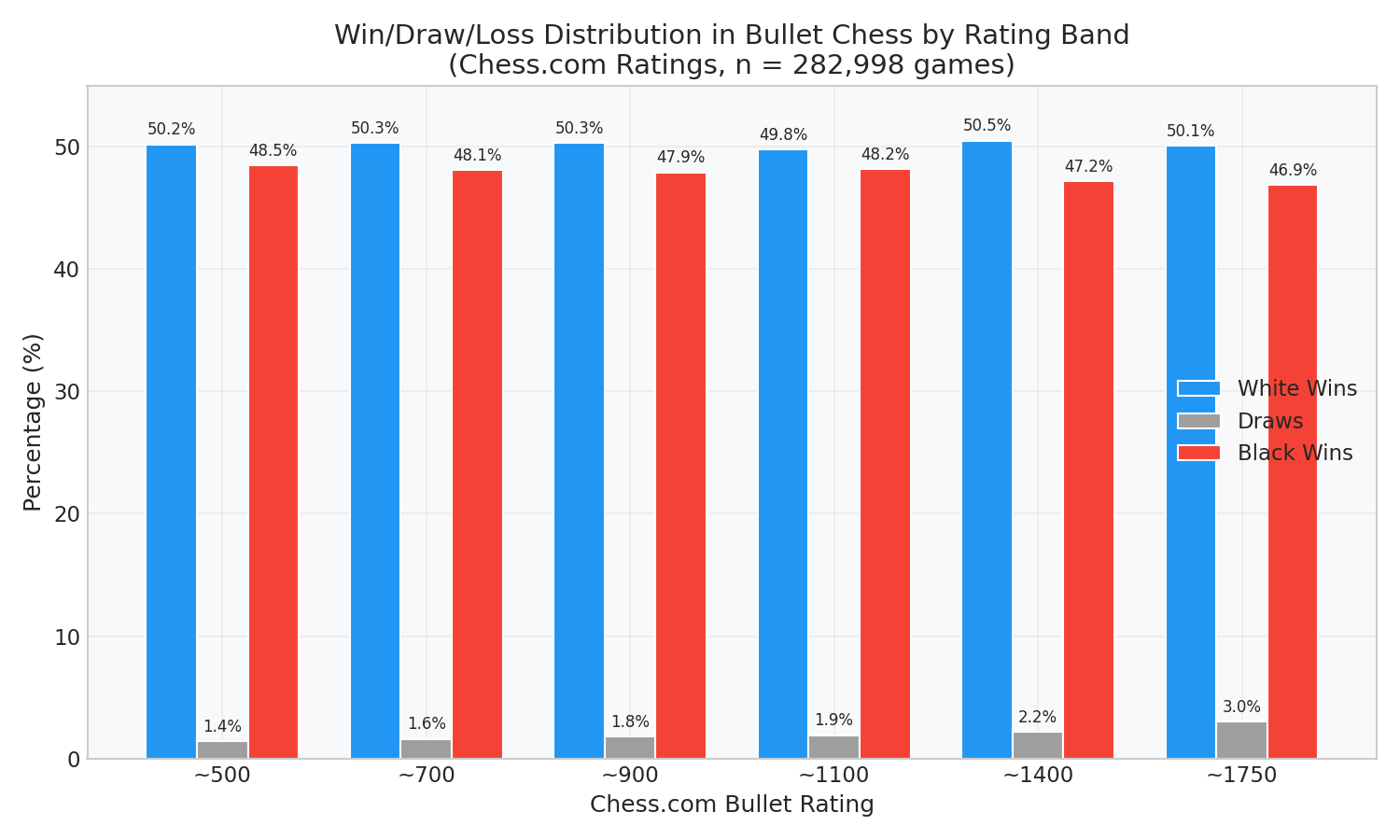
The most striking feature of Bullet chess is the near-absence of draws. At the ~500 Chess.com Bullet level (approximately Lichess 975), only 1.4% of games end in a draw. Even at the ~1750 level (Lichess ~2000), the draw rate climbs to just 3.0%. Compare this to Classical chess at similar ratings, where draw rates can reach 5-7% or higher. In Bullet, virtually every game produces a winner, which means your opening choice has a direct and measurable impact on your results.
| Chess.com Bullet Rating | White Win % | Draw % | Black Win % | Sample Games |
|---|---|---|---|---|
| ~500 | 50.2 | 1.4 | 48.5 | 34,669 |
| ~700 | 50.3 | 1.6 | 48.1 | 41,074 |
| ~900 | 50.3 | 1.8 | 47.9 | 45,388 |
| ~1100 | 49.8 | 1.9 | 48.2 | 47,397 |
| ~1400 | 50.5 | 2.2 | 47.2 | 49,779 |
| ~1750 | 50.1 | 3.0 | 46.9 | 64,691 |
White's first-move advantage is remarkably consistent across all Bullet rating bands, hovering around 50% with only minor fluctuations. The real story, however, is in the specific openings that White and Black choose to play.
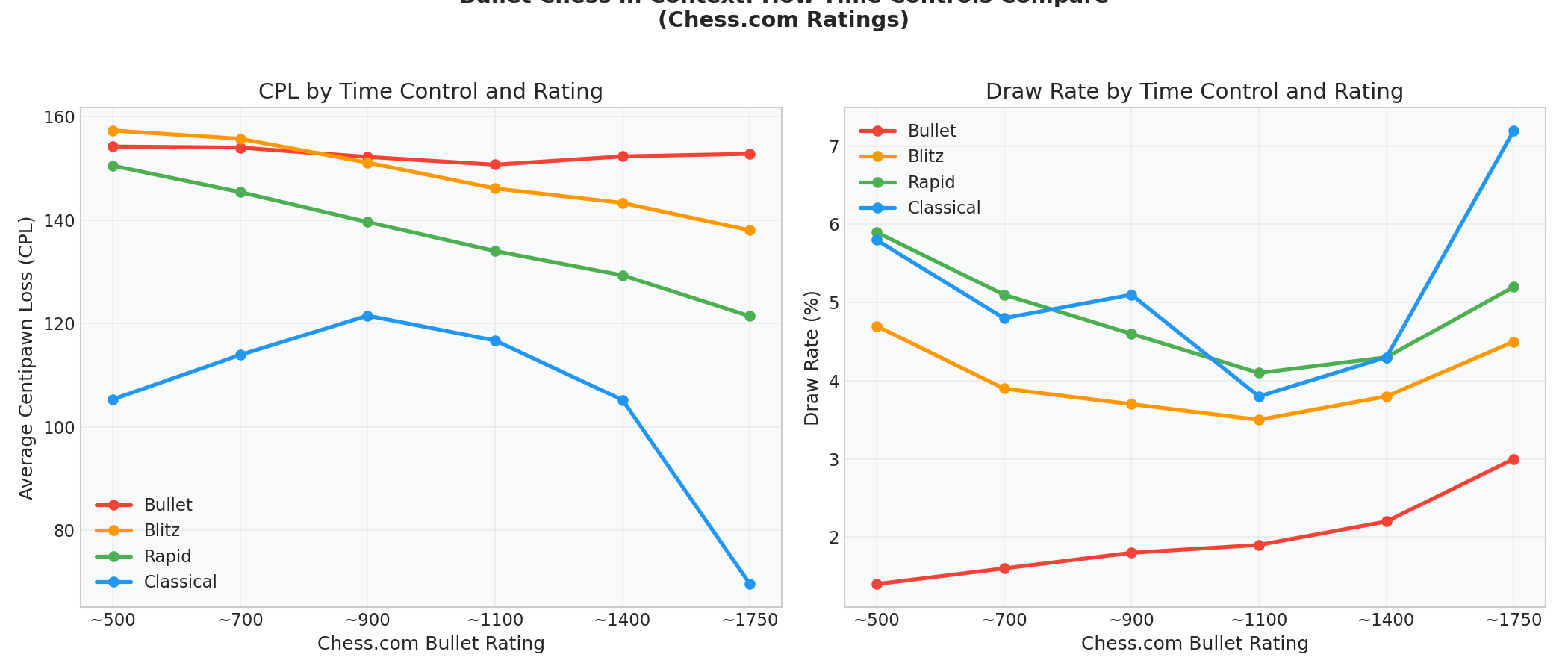
A second critical observation concerns move quality. The average Centipawn Loss (CPL) in Bullet chess remains essentially flat across rating bands: a ~500 rated player averages a CPL of approximately 154, while a ~1750 rated player averages 153. In contrast, CPL in Classical chess drops dramatically from 105 at the lowest band to 70 at the highest. Time pressure in Bullet is the great equalizer, which is precisely why tricky, aggressive, and practically challenging openings outperform their theoretical merit at every level.
1.e4 vs 1.d4: The First Move Question
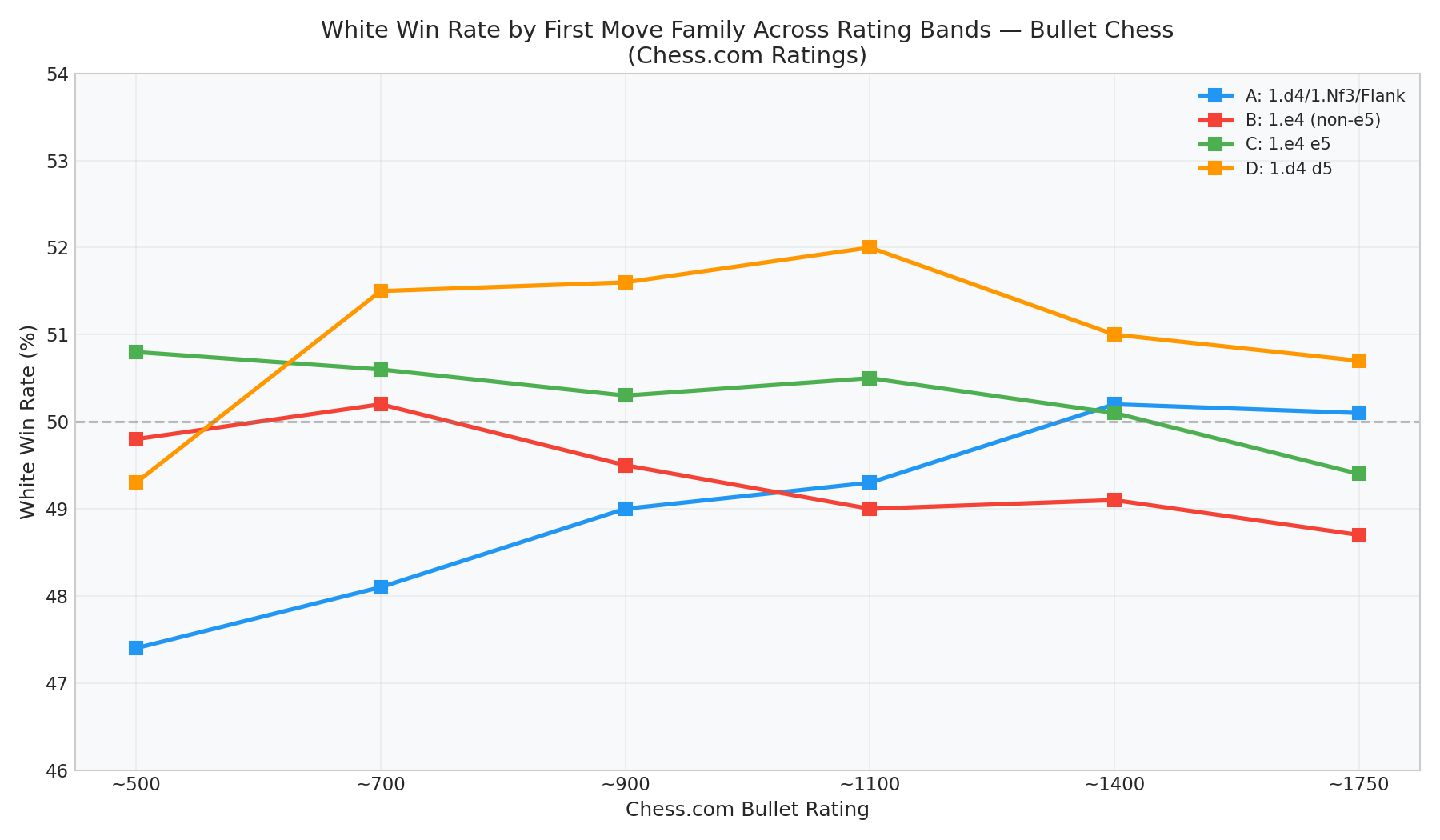
The age-old debate between 1.e4 and 1.d4 takes on a distinctive shape in Bullet chess. We grouped all openings by their ECO family to measure the aggregate performance of each first-move complex.
| ECO Family | Description | ~500 WR | ~700 WR | ~900 WR | ~1100 WR | ~1400 WR | ~1750 WR |
|---|---|---|---|---|---|---|---|
| A | 1.d4/1.Nf3/Flank | 47.4 | 48.1 | 49.0 | 49.3 | 50.2 | 50.1 |
| B | 1.e4 (non-e5) | 49.8 | 50.2 | 49.5 | 49.0 | 49.1 | 48.7 |
| C | 1.e4 e5 | 50.8 | 50.6 | 50.3 | 50.5 | 50.1 | 49.4 |
| D | 1.d4 d5 | 49.3 | 51.5 | 51.6 | 52.0 | 51.0 | 50.7 |
Several patterns emerge from this data. The 1.d4 d5 complex (D family) delivers the highest White win rates across nearly every rating band, peaking at 52.0% around ~1100. This is a somewhat surprising result, as 1.e4 is far more popular at these levels. The 1.e4 e5 complex (C family) starts strong at ~500 (50.8%) but gradually declines to 49.4% at ~1750 as Black players learn to equalize more effectively. Meanwhile, the Flank/1.d4/1.Nf3 systems (A family) start weakest at ~500 (47.4%) but steadily improve, reaching 50.2% at ~1400. These are the "improver" first moves that reward positional understanding.
The practical takeaway is clear: at lower ratings, 1.e4 is the path of least resistance. As you improve, consider adding 1.d4 d5 lines to your repertoire, as the data shows they consistently outperform 1.e4 lines from the ~700 level onward.
The Opening Lifecycle: Decayers vs. Improvers
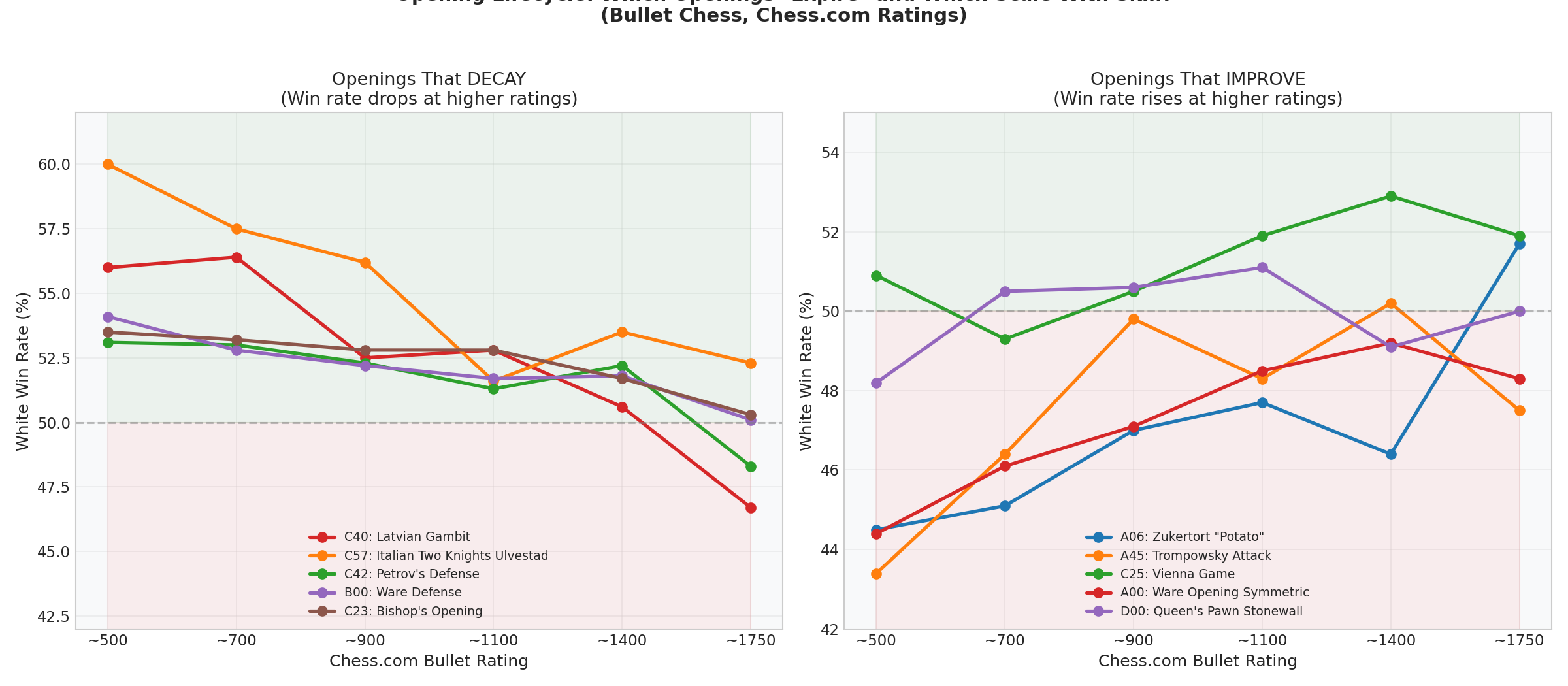
The most original finding from our analysis is the concept of the Opening Lifecycle. Openings do not perform uniformly across all ratings. Instead, they fall into two distinct behavioral categories based on how their win rate changes as the average game rating increases.
The Decayers: Weapons That Become Liabilities
Decayers are openings that boast impressive win rates at lower ratings but suffer a measurable drop in effectiveness as opponents become stronger. These are typically aggressive gambits, trap-based lines, or openings that rely on the opponent making a specific mistake early in the game.
| Opening | ECO | Peak WR | Peak Band | Lowest WR | Lowest Band | Decay (pp) |
|---|---|---|---|---|---|---|
| Latvian Gambit | C40 | 56.4% | ~700 | 46.7% | ~1750 | 9.7 |
| Italian Two Knights Ulvestad | C57 | 60.0% | ~500 | 51.6% | ~1100 | 8.4 |
| Petrov's Defense: Three Knights | C42 | 53.1% | ~500 | 48.3% | ~1750 | 4.8 |
| Ware Defense: Snagglepuss | B00 | 54.1% | ~500 | 50.1% | ~1750 | 4.0 |
| Bishop's Opening: del Rio | C23 | 53.5% | ~500 | 50.3% | ~1750 | 3.2 |
The most dramatic decayer in our dataset is the Latvian Gambit (1.e4 e5 2.Nf3 f5). This opening is a case study in how tactical tricks expire with rating.
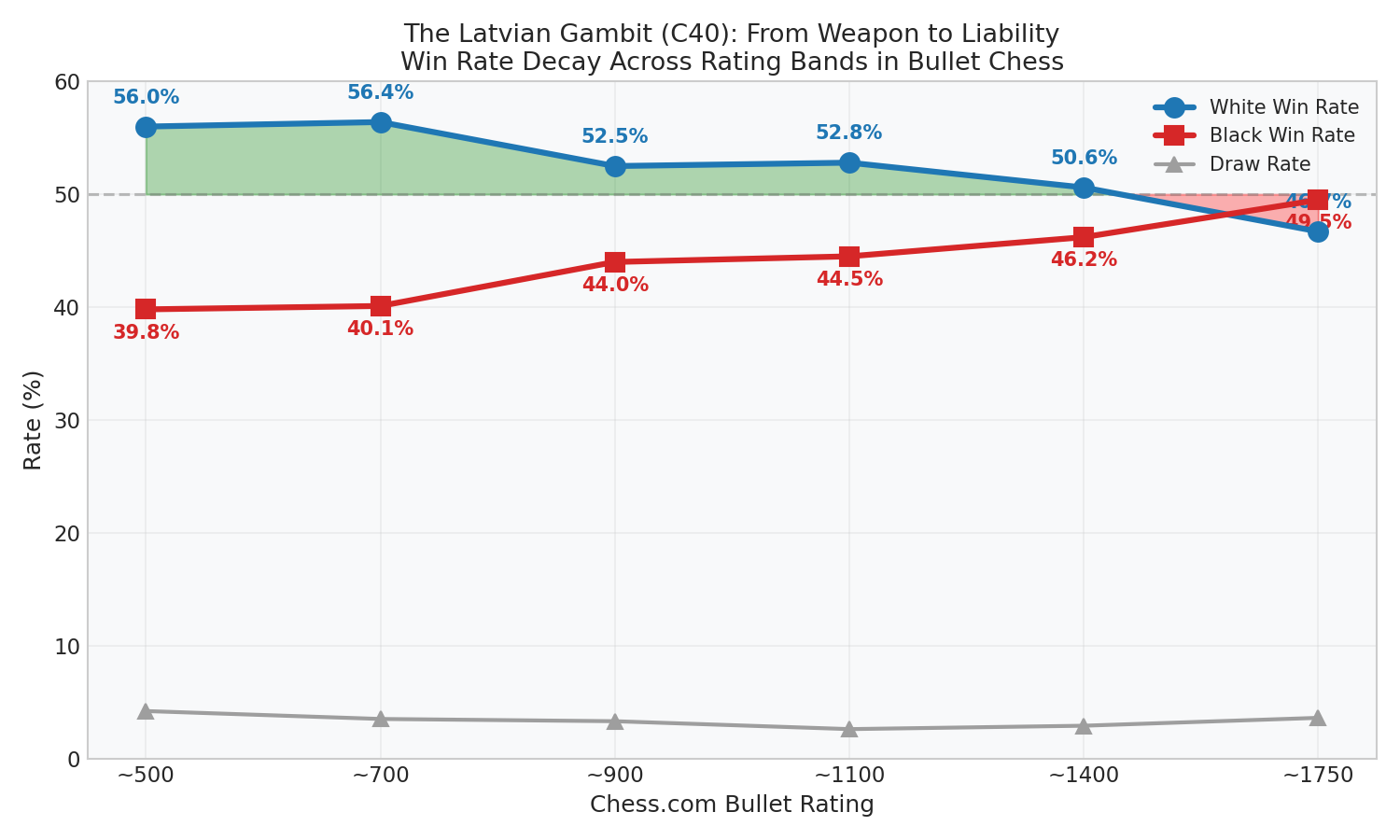
At the ~700 Chess.com Bullet level, the Latvian Gambit scores a peak White win rate of 56.4% (note: this measures White's performance when Black plays the Latvian, meaning White benefits from Black's risky choice). The gambit creates chaotic positions where the lower-rated player frequently mishandles the resulting complications. However, by ~1750, the win rate has collapsed to 46.7%, a staggering 9.7 percentage point decline. At higher ratings, Black players who choose the Latvian are essentially handing White a statistical advantage.
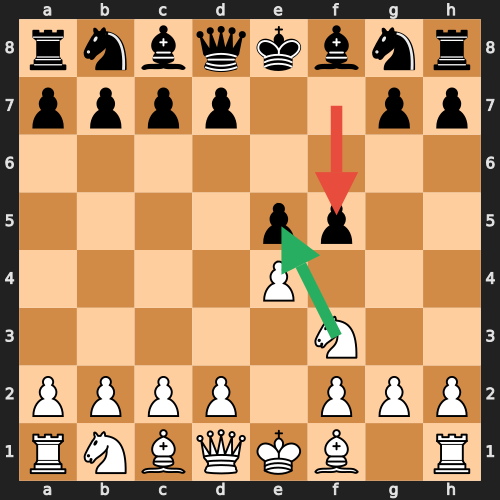
Position: After 1.e4 e5 2.Nf3 f5. The red arrow marks the risky f7-f5 push (the Latvian Gambit itself), which weakens Black's king and the e5 pawn. The green arrow shows White's strongest response: 3.exf5, simply accepting the pawn and maintaining a solid advantage.
The Italian Game: Two Knights Defense, Ulvestad Variation (C57) shows an even more extreme initial peak of 60.0% at ~500, but its decay is concentrated in a narrower band, dropping to 51.6% by ~1100. This is a classic "trap opening" that relies on Black misplaying the sharp b5 gambit.
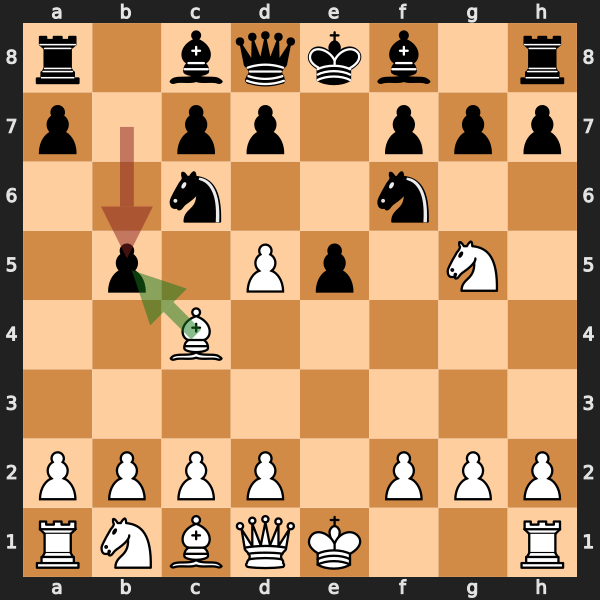
Position: After 1.e4 e5 2.Nf3 Nc6 3.Bc4 Nf6 4.Ng5 d5 5.exd5 b5. The red arrow marks the b5 gambit, which is theoretically dubious. The green arrow shows White's best: 6.Bxb5, accepting the pawn with advantage.
The Improvers: Openings That Scale With Skill
Improvers are the opposite: openings that produce mediocre or even negative results at lower ratings but become increasingly effective as the player's understanding deepens. These openings typically require appreciation of positional themes, pawn structures, or long-term strategic plans.
| Opening | ECO | Lowest WR | Lowest Band | Peak WR | Peak Band | Improvement (pp) |
|---|---|---|---|---|---|---|
| Zukertort "The Potato" | A06 | 44.5% | ~500 | 51.7% | ~1750 | 7.2 |
| Trompowsky Attack | A45 | 43.4% | ~500 | 50.2% | ~1400 | 6.8 |
| Ware Opening: Symmetric | A00 | 44.4% | ~500 | 49.2% | ~1400 | 4.8 |
| Vienna Game | C25 | 49.3% | ~700 | 52.9% | ~1400 | 3.6 |
| Scotch Gambit: Sarratt | C44 | 49.4% | ~500 | 53.3% | ~900 | 3.9 |
The Zukertort Opening (1.Nf3), colloquially known as "The Potato," is the strongest improver in the dataset. At ~500, it scores a dismal 44.5%, which would place it among the worst openings at that level. However, it steadily climbs through every rating band, reaching 51.7% at ~1750. The reason is straightforward: at lower ratings, players do not know how to exploit the flexible pawn structure that 1.Nf3 creates. At higher ratings, the player with White understands how to transpose into favorable setups.
The Trompowsky Attack (1.d4 Nf6 2.Bg5) follows a similar trajectory, climbing from 43.4% at ~500 to 50.2% at ~1400.
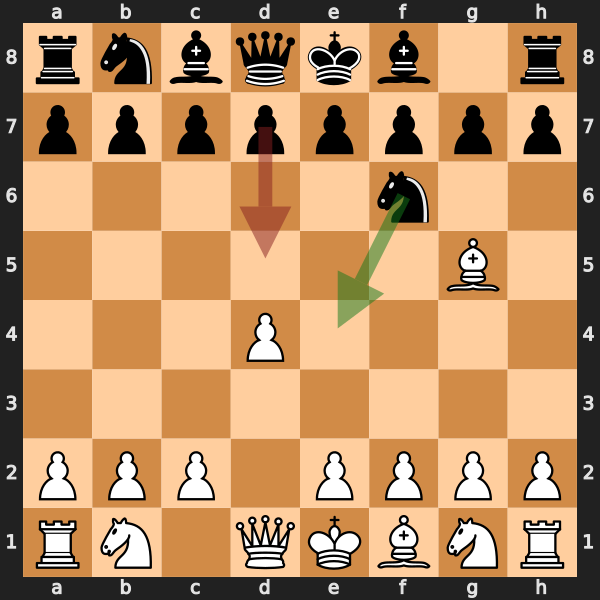
Position: After 1.d4 Nf6 2.Bg5. The green arrow shows Black's most challenging response: 2...Ne4, immediately confronting the bishop. The red arrow shows the more passive 2...d5, which allows the Trompowsky to achieve its strategic aims.
The Complete Opening Heatmap
The following heatmap displays the White win rate for the 15 most popular openings in Bullet chess across all six rating bands. Green cells indicate above-average performance for White; red cells indicate below-average performance.
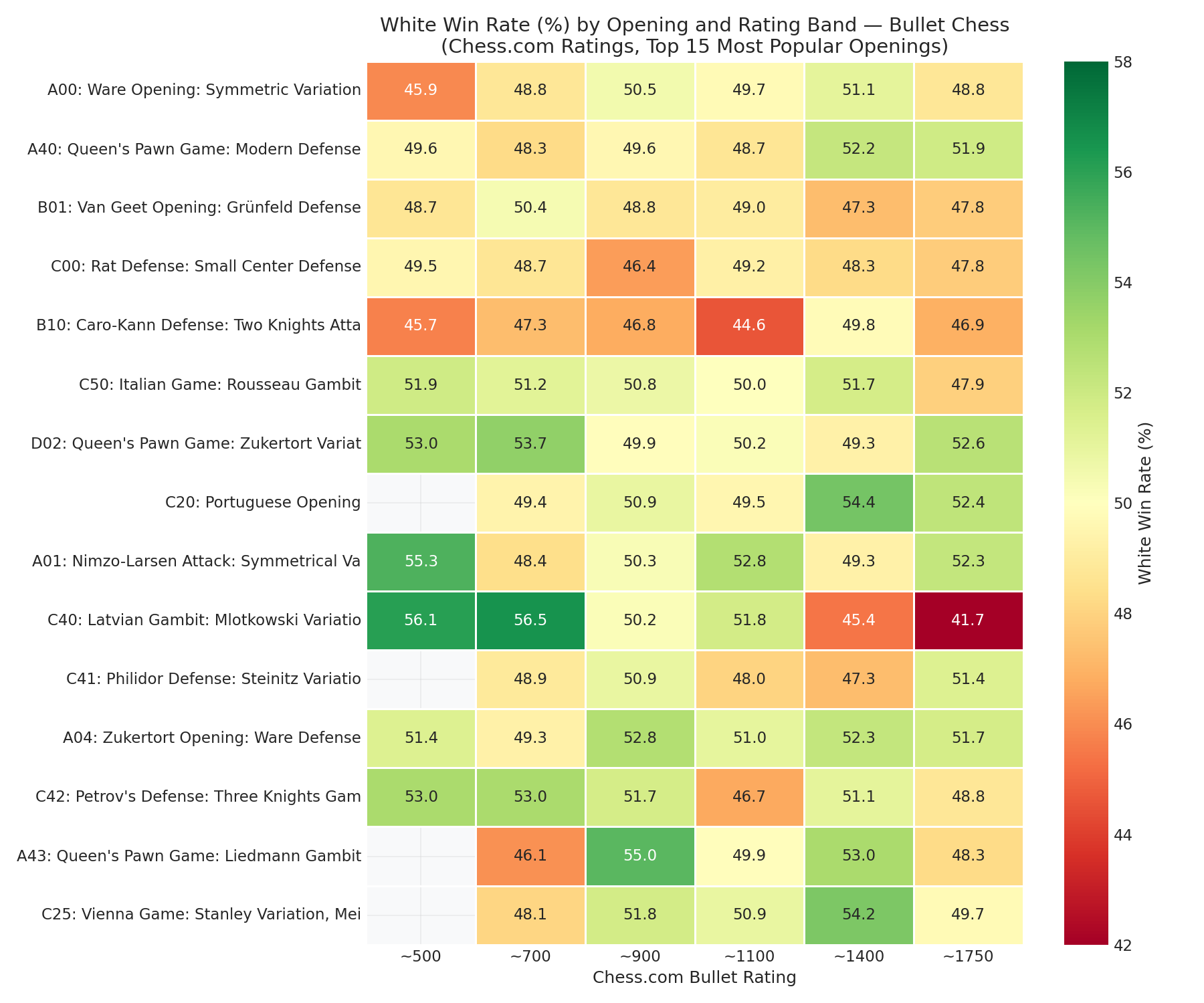
Several patterns are immediately visible. The Latvian Gambit (C40) shows a dramatic gradient from deep green at ~500 to deep red at ~1750. The Liedmann Gambit (A43) peaks sharply at ~900 (55.0%) before declining. The Portuguese Opening (C20) is a late bloomer, reaching its peak of 54.4% at ~1400. The Caro-Kann Defense: Two Knights Attack (B10) is consistently below 50% for White across nearly every band, making it one of the best defensive choices for Black.
Rating Band Roadmap: Actionable Advice for Every Level
This section provides specific, data-backed opening recommendations for each rating segment, organized as a progression roadmap.
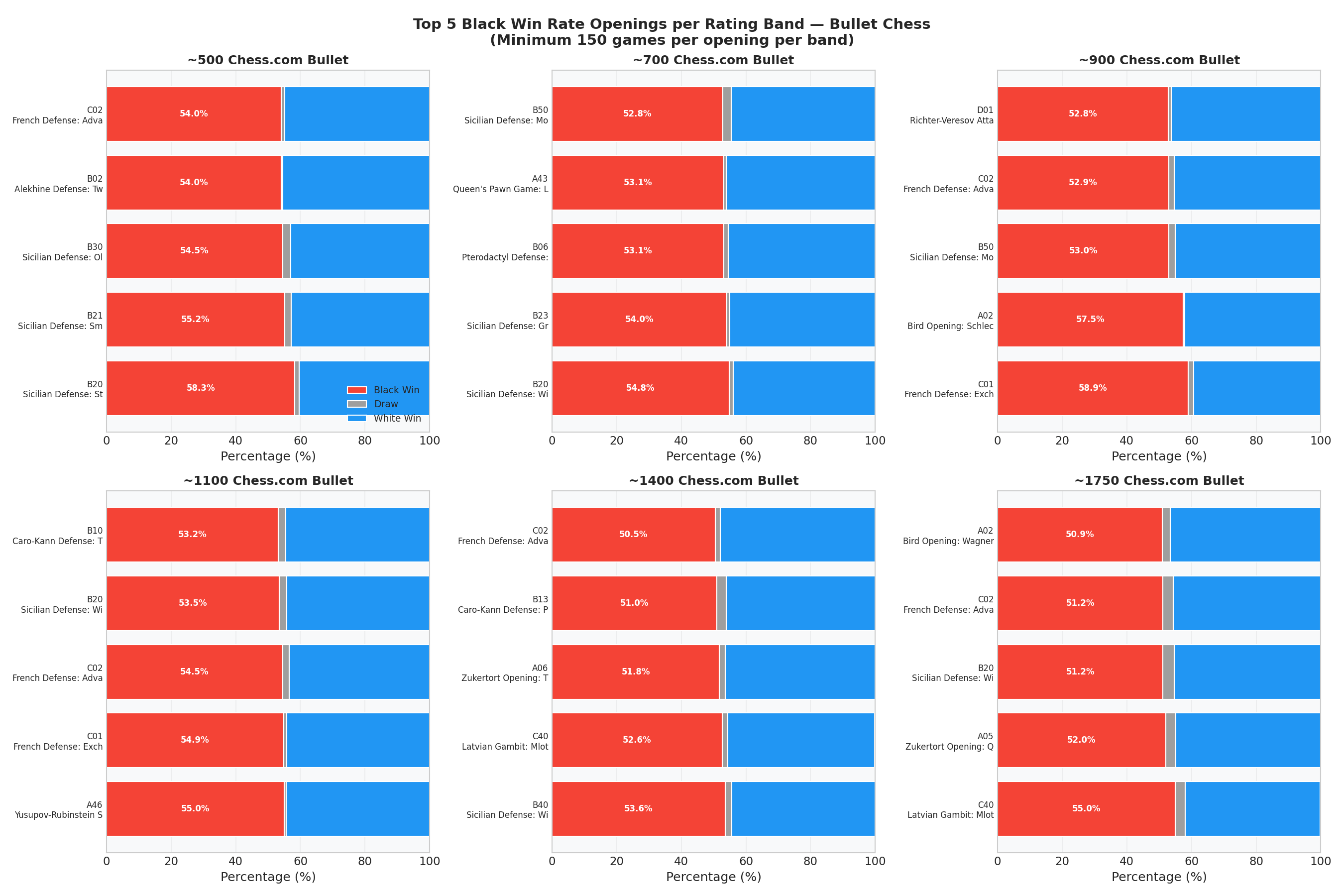
Band 1: The Beginner Phase (~500 to ~700 Chess.com Bullet)
At this level, games are decided by raw tactics, immediate blunders, and whoever makes the last mistake. Complex positional openings are counterproductive. You need openings that immediately create tactical tension and punish passive play.
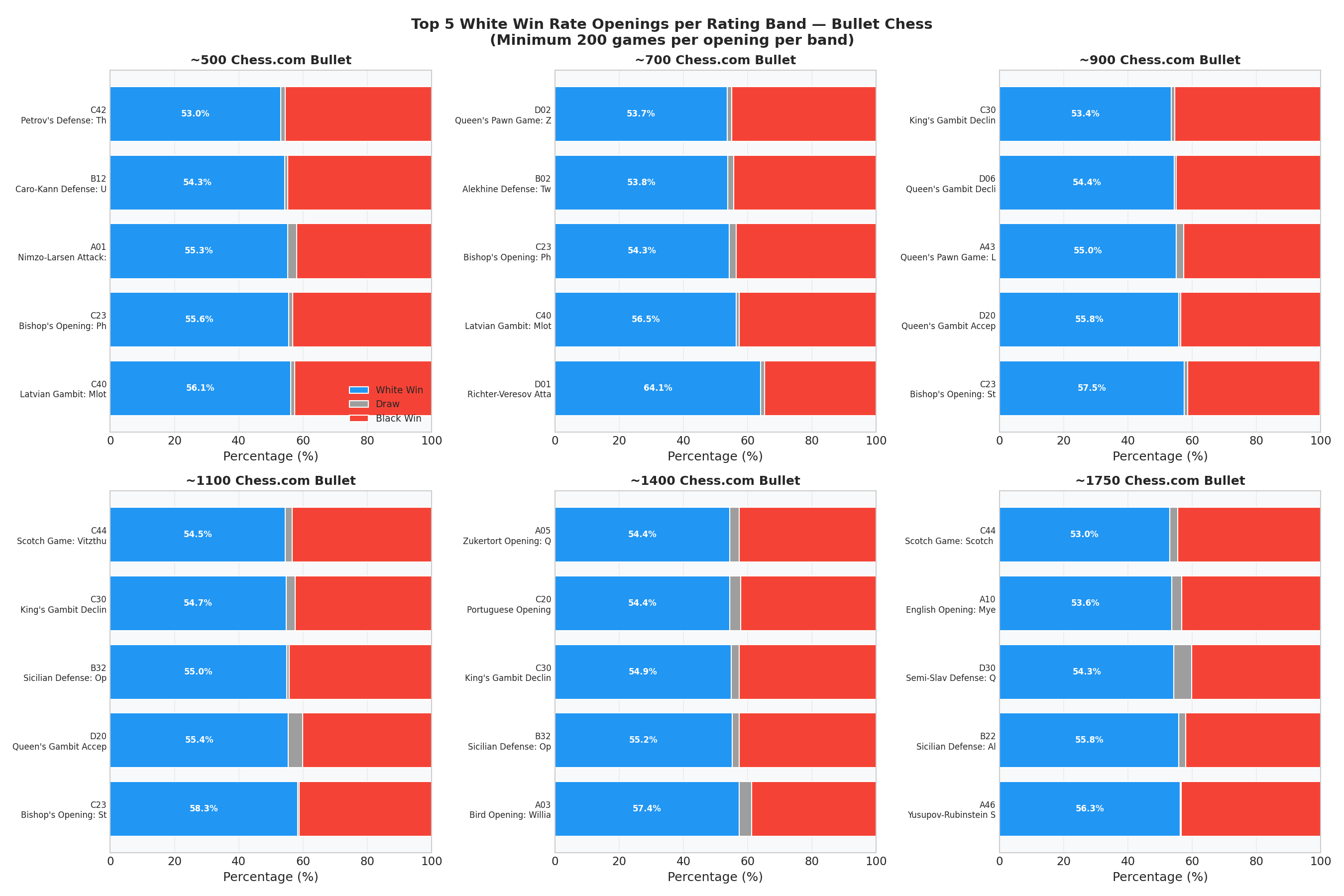
Recommended White Openings:
| Opening | ECO | Win Rate | Games | Why It Works |
|---|---|---|---|---|
| Latvian Gambit (as White) | C40 | 56.1% | 1,279 | Opponents mishandle the chaos |
| Bishop's Opening: Philidor | C23 | 55.6% | 882 | Quick development, open lines |
| Nimzo-Larsen Attack | A01 | 55.3% | 376 | Unusual, throws opponents off |
| Petrov's Three Knights | C42 | 53.0% | 1,008 | Solid with tactical chances |
Recommended Black Openings:
| Opening | ECO | Black Win Rate | Games | Why It Works |
|---|---|---|---|---|
| Sicilian Staunton-Cochrane | B20 | 58.3% | 386 | White rarely knows the theory |
| Bird Williams Gambit | A03 | 56.5% | 124 | Punishes the Bird Opening |
| Sicilian Old Sicilian | B30 | 54.5% | 198 | Solid and counterattacking |
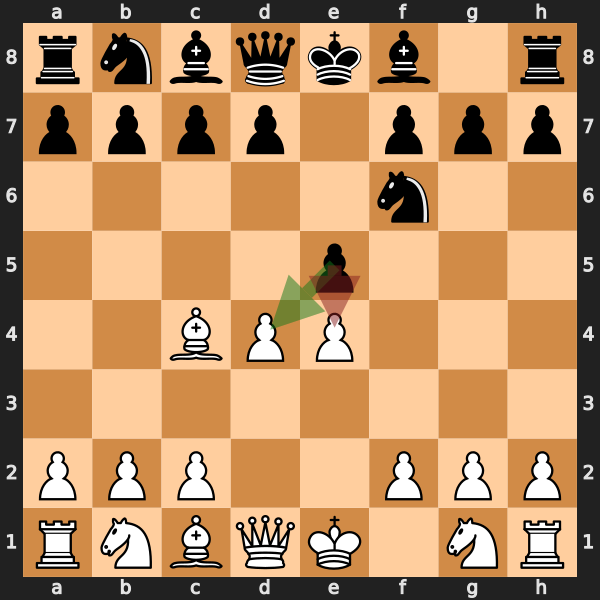
Position: Bishop's Opening: Stein Gambit (1.e4 e5 2.Bc4 Nf6 3.d4). The green arrow shows Black's best response: 3...exd4, capturing the central pawn. The red arrow shows the common mistake of pushing 3...e4, which weakens Black's center.
Actionable Advice: At this level, do not worry about opening theory. Focus on developing all your pieces, castling early, and looking for one-move tactics. If your opponent plays a gambit, prioritize king safety over grabbing material.
Band 2: The Developing Phase (~700 to ~900 Chess.com Bullet)
Players here begin to recognize basic tactical patterns but still fall for two-move combinations. The strongest decayers (Latvian Gambit, Italian Ulvestad) are still effective but beginning to weaken.
Recommended White Openings:
| Opening | ECO | Win Rate | Games | Why It Works |
|---|---|---|---|---|
| Bishop's Opening: Stein Gambit | C23 | 57.5% | 763 | Consistent performer across bands |
| QGA: Schwartz Defense | D20 | 55.8% | 312 | Solid central advantage |
| Liedmann Gambit | A43 | 55.0% | 300 | Surprising and aggressive |
| Scotch: Vitzthum Attack | C44 | 53.3% | 1,233 | Open game with clear plans |
Recommended Black Openings:
| Opening | ECO | Black Win Rate | Games | Why It Works |
|---|---|---|---|---|
| French Exchange: Svenonius | C01 | 58.9% | 175 | Simplifies and frustrates White |
| Bird: Schlechter Gambit | A02 | 57.5% | 233 | Punishes the Bird aggressively |
| Sicilian: Tartakower | B50 | 53.0% | 270 | Flexible Sicilian setup |
Actionable Advice: Begin paying attention to pawn structure. The Bishop's Opening: Stein Gambit (scoring 57.5% at this level) works because it immediately opens the center, creating the kind of tactical positions where you can exploit your opponent's mistakes. Start learning one opening deeply rather than playing random moves.
Band 3: The Intermediate Phase (~900 to ~1100 Chess.com Bullet)
This is the critical transition zone. The "trick" openings are losing their edge, and players who relied on them start to plateau. You need to shift toward openings that are fundamentally sound while still offering practical winning chances.
Recommended White Openings:
| Opening | ECO | Win Rate | Games | Why It Works |
|---|---|---|---|---|
| Bishop's Opening: Stein Gambit | C23 | 58.3% | 628 | Still the strongest performer |
| QGA: Saduleto Variation | D20 | 55.4% | 314 | Solid and principled |
| Scotch: Vitzthum Attack | C44 | 54.5% | 1,105 | Open, tactical, sound |
| Four Knights: Krause Gambit | C47 | 53.8% | 439 | Balanced with initiative |
Recommended Black Openings:
| Opening | ECO | Black Win Rate | Games | Why It Works |
|---|---|---|---|---|
| Yusupov-Rubinstein System | A46 | 55.0% | 180 | Solid and underestimated |
| French Exchange: Svenonius | C01 | 54.9% | 233 | Still strong at this level |
| French Advance: Wade | C02 | 54.5% | 347 | Active counterplay for Black |
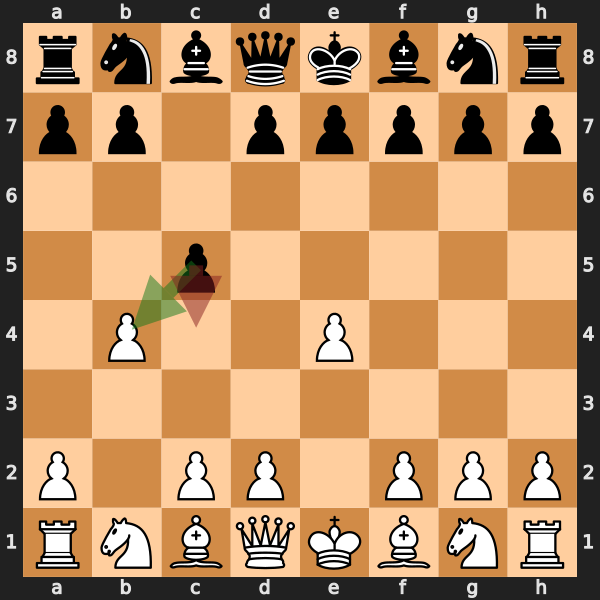
Position: Sicilian Wing Gambit (1.e4 c5 2.b4). The green arrow shows the correct response: 2...cxb4, accepting the gambit. The red arrow shows the mistake of pushing 2...c4, which gives White a strong center.
Actionable Advice: This is the point where you should audit your opening repertoire. If you are still playing the Latvian Gambit or other "hope chess" lines, the data shows they are actively costing you rating points. Replace them with the Bishop's Opening or Scotch Game, which maintain tactical richness while being objectively sound.
Band 4: The Advanced Phase (~1100 to ~1400 Chess.com Bullet)
Opening knowledge improves significantly at this level. Players begin to recognize common structures and have some theoretical preparation. The improver openings (Trompowsky, Vienna, Zukertort) are now reaching their peak effectiveness.
Recommended White Openings:
| Opening | ECO | Win Rate | Games | Why It Works |
|---|---|---|---|---|
| QGA: Saduleto Variation | D20 | 60.1% | 198 | Dominant at this level |
| Bird: Williams-Zilbermints | A03 | 57.4% | 235 | Aggressive and surprising |
| Sicilian: Open | B32 | 55.2% | 290 | Tactical complexity favors prep |
| Vienna Gambit | C25 | 54.2% | 546 | Scales beautifully |
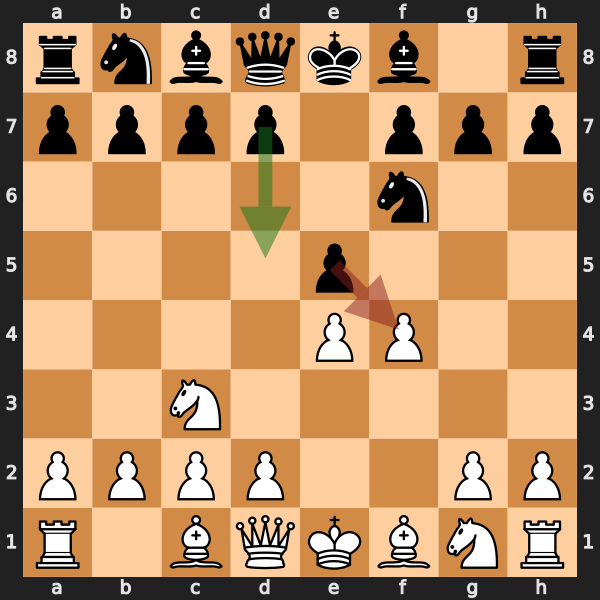
Position: Vienna Game: Vienna Gambit (1.e4 e5 2.Nc3 Nf6 3.f4). The green arrow shows Black's best response: 3...d5, striking back in the center immediately. The red arrow shows the weaker 3...exf4, which gives White a strong center after 4.e5.
Recommended Black Openings:
| Opening | ECO | Black Win Rate | Games | Why It Works |
|---|---|---|---|---|
| Sicilian Wing Gambit Deferred | B40 | 53.6% | 442 | Punishes White's aggression |
| Latvian Gambit (as Black) | C40 | 52.6% | 487 | Ironic: now favors Black |
| Caro-Kann: Panov Attack | B13 | 51.0% | 418 | Solid and reliable |
Actionable Advice: At this level, the data reveals a fascinating inversion. The Latvian Gambit, which was a weapon for White at ~500-700, now actually favors Black at ~1400 (Black wins 52.6% of the time). This is because Black players who still choose the Latvian at this level know the theory, while White players often do not know the refutation. The lesson: if you know an opening deeply, it can work even if it is "theoretically dubious."
Band 5: The Expert Phase (~1400 to ~1750+ Chess.com Bullet)
At the highest levels in our dataset, opening selection becomes more nuanced. The best openings are those that create complex middlegames where superior understanding can be leveraged.
Recommended White Openings:
| Opening | ECO | Win Rate | Games | Why It Works |
|---|---|---|---|---|
| Yusupov-Rubinstein System | A46 | 56.3% | 375 | Sophisticated and flexible |
| Sicilian Alapin: Smith-Morra | B22 | 55.8% | 328 | Avoids heavy Sicilian theory |
| Semi-Slav: Quiet Variation | D30 | 54.3% | 293 | Positional pressure |
| Portuguese Opening | C20 | 52.4% | 765 | Late bloomer, peaks here |
Recommended Black Openings:
| Opening | ECO | Black Win Rate | Games | Why It Works |
|---|---|---|---|---|
| Latvian Gambit (as Black) | C40 | 55.0% | 578 | Strongest Black opening here |
| Zukertort: Quiet System | A05 | 52.0% | 321 | Neutralizes White's initiative |
| Sicilian Wing Gambit | B20 | 51.2% | 893 | Consistent performer |
Actionable Advice: Your repertoire should now be diverse and flexible. The data shows that opening diversity increases dramatically at higher ratings (see the next section). Do not become predictable. Have at least two responses to 1.e4 and two responses to 1.d4.
Opening Diversity and Repertoire Width
One of the most underappreciated aspects of chess improvement is opening diversity. Our data reveals a clear and consistent trend: stronger players play a wider variety of openings.
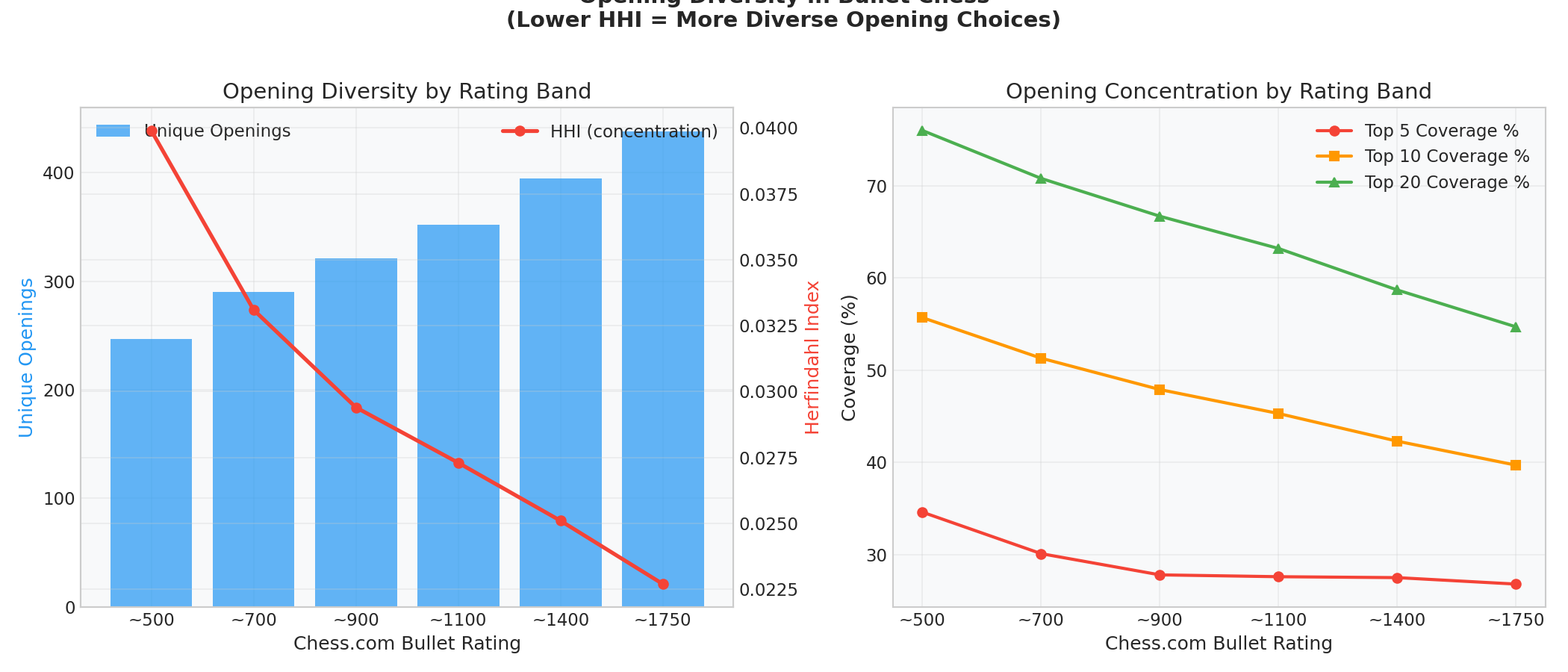
| Chess.com Bullet Rating | Unique Openings | Top 5 Coverage | Top 20 Coverage | HHI (Concentration) |
|---|---|---|---|---|
| ~500 | 247 | 34.6% | 76.0% | 0.0399 |
| ~700 | 290 | 30.1% | 70.8% | 0.0331 |
| ~900 | 321 | 27.8% | 66.7% | 0.0294 |
| ~1100 | 352 | 27.6% | 63.2% | 0.0273 |
| ~1400 | 395 | 27.5% | 58.7% | 0.0251 |
| ~1750 | 438 | 26.8% | 54.7% | 0.0227 |
At the ~500 level, the top 5 openings account for 34.6% of all games, and the top 20 cover 76%. By ~1750, the top 5 cover only 26.8%, and the top 20 cover just 54.7%. The Herfindahl-Hirschman Index (HHI), a standard measure of market concentration, drops from 0.0399 to 0.0227, indicating a steady increase in diversity.
This has a direct practical implication: if you are playing the same opening in every game, you are making yourself predictable. Stronger opponents will prepare against your pet line. The data suggests that expanding your repertoire is not just a sign of improvement, it is a cause of improvement.
Bullet in Context: How Time Controls Compare
To put our Bullet findings in perspective, we compared key metrics across all four time controls available in the dataset.
| Metric | Bullet | Blitz | Rapid | Classical |
|---|---|---|---|---|
| Draw Rate (~1100) | 1.9% | 3.5% | 4.1% | 3.8% |
| Avg Game Length (~1100) | 29 moves | 32 moves | 32 moves | 29 moves |
| CPL (~1100) | 150.7 | 146.1 | 134.0 | 116.7 |
| CPL (~1750) | 152.8 | 138.0 | 121.4 | 69.6 |
The most revealing comparison is CPL. In Bullet, CPL barely changes between ~500 (154) and ~1750 (153), a difference of just 1 point. In Classical chess, the same rating range sees CPL drop from 105 to 70, a difference of 35 points. This confirms that in Bullet, time pressure dominates skill differences in move quality. The implication for opening choice is profound: in Bullet, practical considerations (familiarity, speed of play, tricky positions) matter far more than theoretical soundness.
Key Takeaways
The following table summarizes the core findings of this study:
| Finding | Data Point | Implication |
|---|---|---|
| Draws are nearly nonexistent in Bullet | 1.4% at ~500, 3.0% at ~1750 | Every opening choice directly affects your win rate |
| CPL is flat across Bullet ratings | 154 at ~500 vs 153 at ~1750 | Practical, tricky openings outperform "correct" ones |
| The Latvian Gambit is the biggest decayer | 56.4% at ~700 → 46.7% at ~1750 | Drop gambits that rely on opponent mistakes |
| The Zukertort is the biggest improver | 44.5% at ~500 → 51.7% at ~1750 | Positional openings reward understanding |
| 1.d4 d5 outperforms 1.e4 e5 | 52.0% vs 50.5% at ~1100 | Consider adding Queen's Pawn openings |
| Opening diversity increases with rating | HHI drops from 0.040 to 0.023 | Expand your repertoire as you improve |
| Bishop's Opening: Stein Gambit is the most consistent | 55-58% across ~500 to ~1100 | Best single opening for beginners |
Data and Methodology
Dataset: 282,998 Bullet games from the Lichess March 2025 database, part of a larger corpus of 952,157 games across all time controls.
Rating Bands: Games were grouped into six Lichess rating bands (700-900, 900-1100, 1100-1300, 1300-1500, 1500-1800, 1800-2000) and mapped to approximate Chess.com Bullet equivalents using the following calibration:
| Lichess Bullet Band | Midpoint | Chess.com Bullet Equivalent |
|---|---|---|
| 700-900 | ~800 | ~500 |
| 900-1100 | ~1000 | ~700 |
| 1100-1300 | ~1200 | ~900 |
| 1300-1500 | ~1400 | ~1100 |
| 1500-1800 | ~1650 | ~1400 |
| 1800-2000 | ~1900 | ~1750 |
Analysis Tools: All data was extracted and analyzed using the Grandmaster Guide MCP server, which provides pre-computed analytics over the Lichess game database including win/draw/loss rates, centipawn loss (CPL) from Stockfish 17 evaluations, opening classification by ECO code, and opening diversity metrics (Herfindahl-Hirschman Index).
Visualization: All charts were created using Python (Matplotlib and Seaborn). Board diagrams were rendered using the python-chess library with custom arrow annotations.
Underlying Data Files: The following CSV files contain the raw data used in this analysis:
bullet_opening_winrates.csv— Win/draw/loss rates for all 101 openings across all rating bands in Bulletdecay_curves.csv— Win rate trajectories for 25 key openings across all rating bandsdecay_summary.csv— Summary of peak/trough win rates and decay magnitude for each openingdeep_stats_by_band.csv— Detailed statistics (CPL, game length, blunder rates) for 15 openingsfirst_move_stats.csv— 1.e4 vs 1.d4 aggregate performance by rating banddraw_rates_bullet.csv— Draw rates across all Bullet rating bandstime_control_comparison.csv— Cross-time-control comparison of CPL, draw rates, and game lengthall_openings_by_popularity.csv— Complete list of 250 openings ranked by total games
Chess Coach April 13, 2026