Every chess player has asked the question at some point: Am I playing the right opening for my rating? While grandmasters debate the theoretical nuances of the Berlin Defense or the Najdorf Sicilian, the reality for most club players is entirely different. An opening that crushes opponents at 800 rating might become a liability by the time you reach 1500. The "tricks" stop working. The gambits get refuted. The traps get avoided.
To answer this question with hard data rather than anecdote, we analyzed 954,617 Lichess games with full Stockfish 17 evaluations, tracking the win, draw, and loss rates for the most popular openings across six distinct rating bands [1]. We then identified which openings decay in effectiveness as players improve, which remain stable across all levels, and what the statistically best responses are for the defending side at each rating bracket.
A Note on Ratings: All ratings in this article have been converted to approximate Chess.com Blitz ratings using established community conversion tables [2]. Lichess Blitz ratings run approximately 200-400 points higher in the range we study. For example, a Chess.com 1200 player corresponds roughly to a Lichess 1565 player. Where helpful, we note the Lichess equivalent in parentheses.
Table of Contents
- The Big Picture: What Actually Wins?
- The Beginner Phase (Chess.com 600-1000)
- The Intermediate Phase (Chess.com 1000-1400)
- The Advanced Club Phase (Chess.com 1400-1800)
- The Decay Curve: Why Openings Stop Working
- 1.e4 vs 1.d4: The Eternal Debate, Settled by Data
- Blitz vs. Rapid: Does Time Control Change the Answer?
- Opening Diversity: When Should You Expand Your Repertoire?
- The Complete Recommendation Roadmap
- Data and Methodology
The Big Picture: What Actually Wins?
Before diving into specific rating bands, let us examine the overall landscape. The heatmap below shows the White win rate for the fifteen most popular openings across all rating levels. Values above 50% indicate White is winning more often; values below 50% indicate Black is performing well.
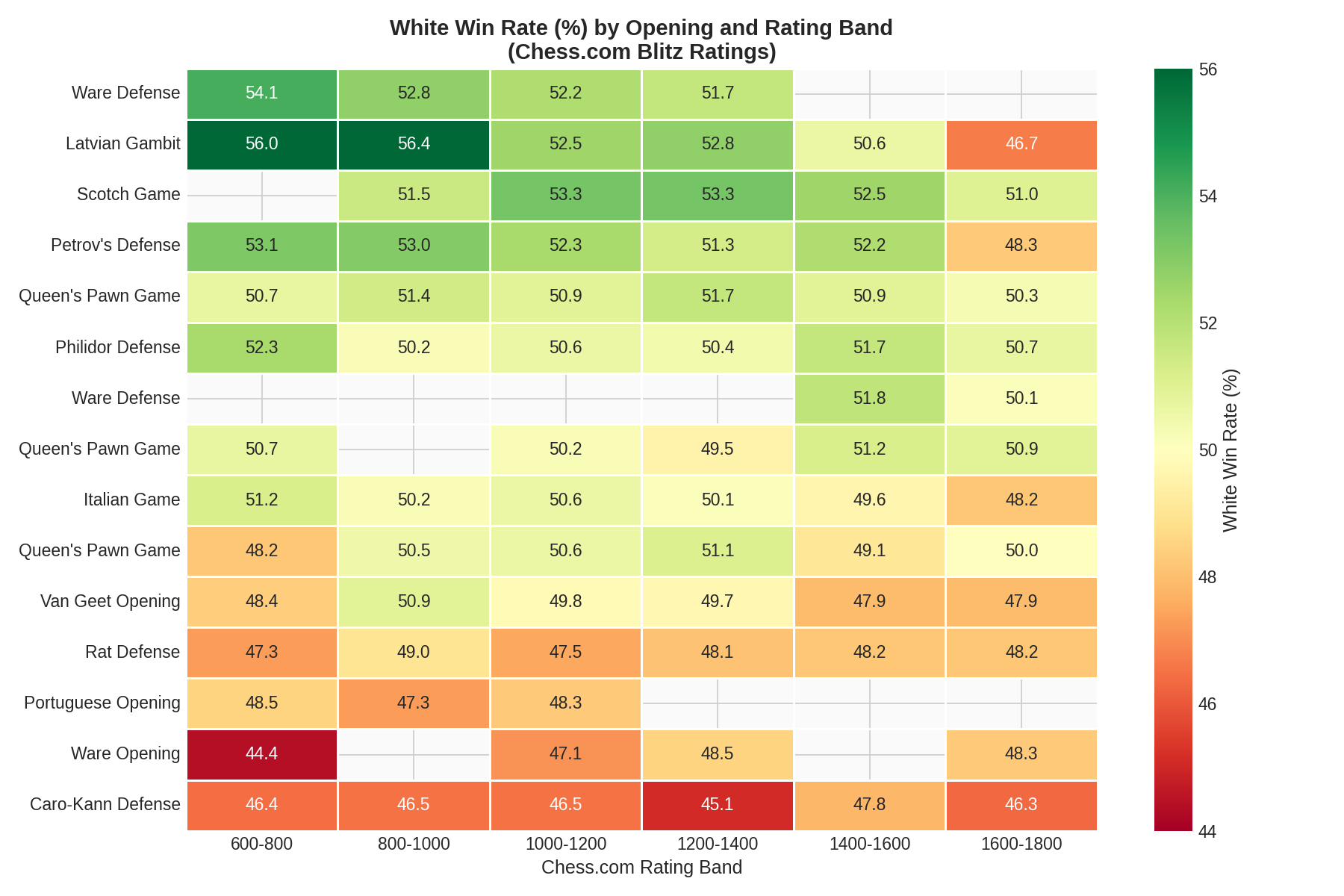
Two trends are immediately apparent from this visualization. First, there is a clear "Trap Decay" pattern: openings that rely on early tricks and tactical complications (such as the Latvian Gambit at 56.0% for White at 600-800) show dramatically declining win rates as players improve. Second, there is a "Positional Stability" pattern: solid, principled openings (such as the Queen's Pawn Game or the Scotch Game) maintain a remarkably consistent win rate across all rating bands, rarely deviating more than 2-3 percentage points.
The following chart shows the full Win/Draw/Loss breakdown for the eight most popular openings at each rating band, making it clear how the balance of outcomes shifts as ratings rise.
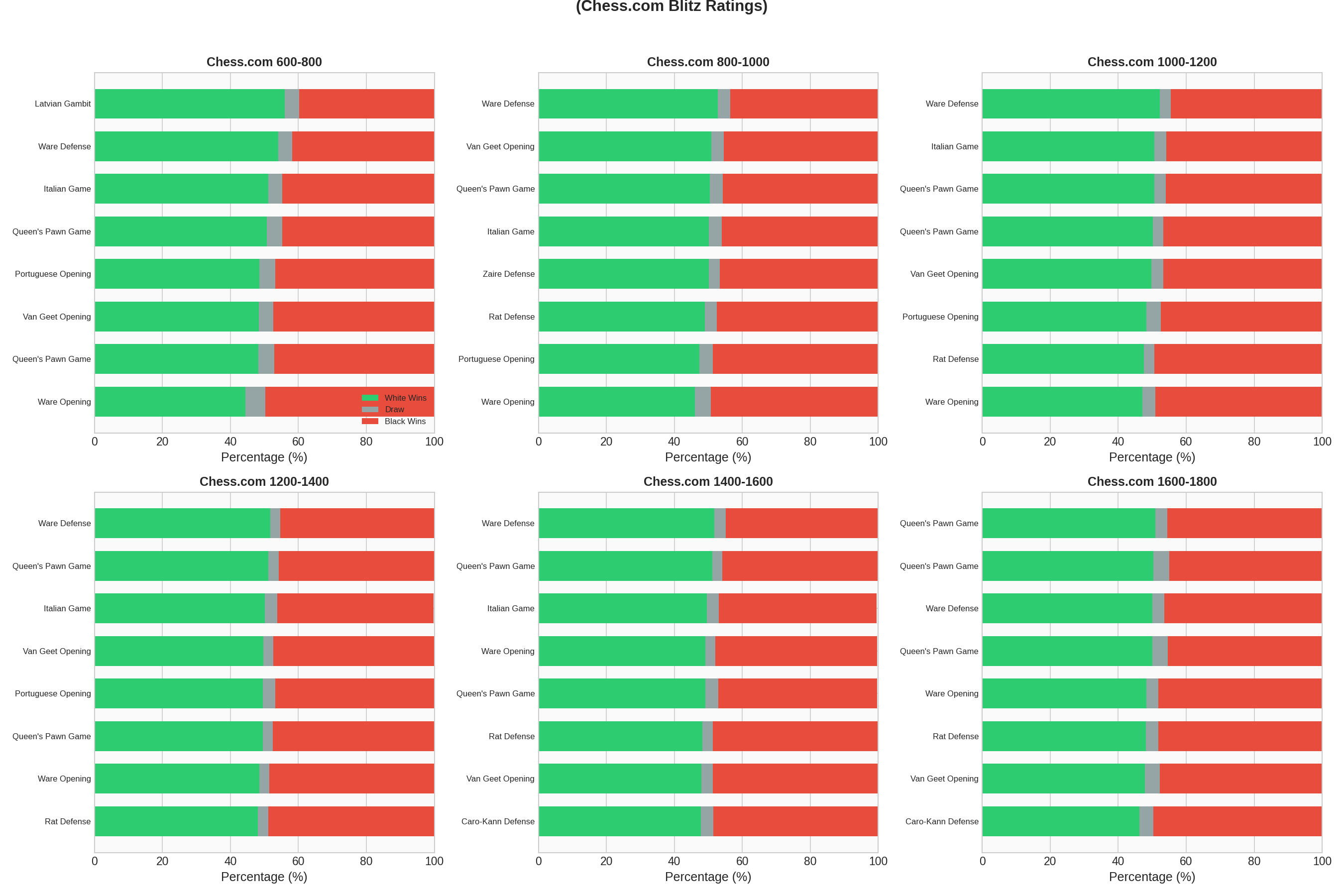
One of the most striking observations is how thin the gray "Draw" band remains across all levels. At the 600-800 level, draws account for only about 4-5% of games. Even at 1600-1800, draws remain below 5%. This is a defining characteristic of online Blitz chess: games are almost always decisive.
The Beginner Phase (Chess.com 600-1000)
At this level, games are rarely decided by deep strategic maneuvering. They are decided by tactics, immediate threats, and blunders. The data shows that aggressive, attacking openings yield the highest returns because opponents at this level frequently fail to find the correct defensive resources.
Top 5 Openings for White: Chess.com 600-800
| Rank | ECO | Opening | White Win % | Draw % | Black Win % | Games |
|---|---|---|---|---|---|---|
| 1 | C57 | Italian Game: Two Knights Defense, Ulvestad | 60.0 | 3.4 | 36.6 | 1,335 |
| 2 | C40 | Latvian Gambit: Mlotkowski Variation | 56.0 | 4.2 | 39.8 | 7,319 |
| 3 | B00 | Ware Defense: Snagglepuss Defense | 54.1 | 4.1 | 41.7 | 8,870 |
| 4 | C23 | Bishop's Opening: del Rio Variation | 53.5 | 4.1 | 42.4 | 5,174 |
| 5 | C42 | Petrov's Defense: Three Knights Game | 53.1 | 4.0 | 42.9 | 5,660 |
Top 5 Openings for White: Chess.com 800-1000
| Rank | ECO | Opening | White Win % | Draw % | Black Win % | Games |
|---|---|---|---|---|---|---|
| 1 | C57 | Italian Game: Two Knights Defense, Ulvestad | 57.5 | 3.0 | 39.5 | 1,508 |
| 2 | C40 | Latvian Gambit: Mlotkowski Variation | 56.4 | 3.5 | 40.1 | 5,676 |
| 3 | D01 | Richter-Veresov Attack | 56.4 | 1.9 | 41.7 | 1,011 |
| 4 | D20 | Queen's Gambit Accepted: Schwartz Defense | 54.3 | 3.5 | 42.3 | 1,270 |
| 5 | C23 | Bishop's Opening: Stein Gambit | 53.2 | 3.5 | 43.3 | 3,771 |
The King of the Lower Ratings: The Latvian Gambit
The most dramatic finding at this level is the dominance of the Latvian Gambit (1.e4 e5 2.Nf3 f5). At the 600-800 Chess.com band, it achieves a 56.0% win rate for White, and at 800-1000, it actually increases to 56.4%. This is an extraordinary figure, representing a full 6 percentage points above the expected 50% baseline.
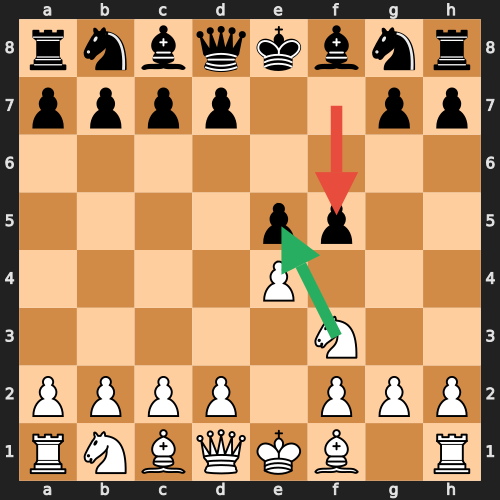 The Latvian Gambit after 1.e4 e5 2.Nf3 f5. The red arrow shows Black's risky pawn push. The green arrow shows White's best response: simply capturing the pawn with Nxe5.
Why does the Latvian Gambit score so well at low ratings? The answer lies in the nature of the position it creates. After 2...f5, the board immediately becomes sharp and tactical. Lower-rated players facing this gambit often panic, make sub-optimal developing moves, and fall into early tactical traps. The position demands precise calculation from both sides, and at this level, the side creating the complications (White, facing the gambit) tends to benefit from the chaos.
Best Responses for Black: Chess.com 600-800
For Black players at this level, the data reveals some surprising choices that perform well.
| Rank | ECO | Opening | Black Win % | Draw % | White Win % | Games |
|---|---|---|---|---|---|---|
| 1 | B20 | Sicilian Defense: Wing Gambit | 51.9 | 3.8 | 44.3 | 1,651 |
| 2 | A45 | Trompowsky Attack: Raptor Variation | 51.8 | 4.8 | 43.4 | 1,942 |
| 3 | A06 | Zukertort Opening: The Potato | 51.6 | 3.9 | 44.5 | 2,169 |
| 4 | B10 | Caro-Kann Defense: Two Knights Attack | 50.0 | 3.5 | 46.4 | 3,097 |
| 5 | A00 | Ware Opening: Symmetric Variation | 49.8 | 5.8 | 44.4 | 11,437 |
The Caro-Kann Defense stands out as a particularly strong choice for Black at all levels. At 600-800, Black scores 50.0% in the Two Knights Attack variation, and this performance remains consistent as ratings rise. The Caro-Kann is a principled, solid defense that does not require memorization of long tactical lines, making it ideal for developing players.
Actionable Advice for 600-1000 Players
As White: Play openings that fight for the center and create immediate tactical threats. The Italian Game (C50-C57 family) and the Bishop's Opening (C23) are excellent choices. They teach fundamental principles while still offering strong attacking chances. Avoid passive setups.
As Black: Learn the Caro-Kann Defense (1.e4 c6). It is solid, principled, and scores well at every level. Against 1.d4, the Modern Defense (1...g6) is a flexible choice that avoids heavy theory.
General: At this level, opening choice matters less than tactical awareness. Focus on not hanging pieces, and you will outperform most opponents regardless of the opening.
The Intermediate Phase (Chess.com 1000-1400)
As you cross the 1000 threshold, opponents stop falling for simple one-move blunders. They know basic opening principles, develop their pieces, and will punish overly aggressive, unsound gambits. This is where the "Trap Decay" becomes starkly evident in the data.
Top 5 Openings for White: Chess.com 1000-1200
| Rank | ECO | Opening | White Win % | Draw % | Black Win % | Games |
|---|---|---|---|---|---|---|
| 1 | C57 | Italian Game: Two Knights Defense, Ulvestad | 56.2 | 2.7 | 41.1 | 1,170 |
| 2 | D06 | Queen's Gambit Declined: Zilbermints Gambit | 55.3 | 2.8 | 41.9 | 1,041 |
| 3 | D20 | Queen's Gambit Accepted: Schwartz Defense | 54.6 | 4.0 | 41.4 | 1,392 |
| 4 | C44 | Scotch Game: Vitzthum Attack | 53.3 | 3.5 | 43.1 | 5,252 |
| 5 | C23 | Bishop's Opening: Stein Gambit | 52.8 | 3.8 | 43.3 | 3,194 |
Top 5 Openings for White: Chess.com 1200-1400
| Rank | ECO | Opening | White Win % | Draw % | Black Win % | Games |
|---|---|---|---|---|---|---|
| 1 | D20 | Queen's Gambit Accepted: Schwartz Defense | 55.7 | 4.0 | 40.2 | 1,360 |
| 2 | D06 | Queen's Gambit Declined: Marshall Defense | 54.9 | 3.0 | 42.0 | 1,214 |
| 3 | C44 | Scotch Game: Vitzthum Attack | 53.3 | 2.9 | 43.6 | 4,734 |
| 4 | C40 | Latvian Gambit: Mlotkowski Variation | 52.8 | 2.6 | 44.5 | 2,978 |
| 5 | C23 | Bishop's Opening: Stein Gambit | 52.8 | 2.5 | 44.6 | 2,796 |
The Rise of the Scotch Game
In this rating band, the Scotch Game (1.e4 e5 2.Nf3 Nc6 3.d4) emerges as a consistent powerhouse, particularly the Vitzthum Attack variation. It maintains a robust 53.3% win rate for White across both the 1000-1200 and 1200-1400 bands. Unlike the Latvian Gambit, which is already showing signs of decay, the Scotch Game's effectiveness is remarkably stable.
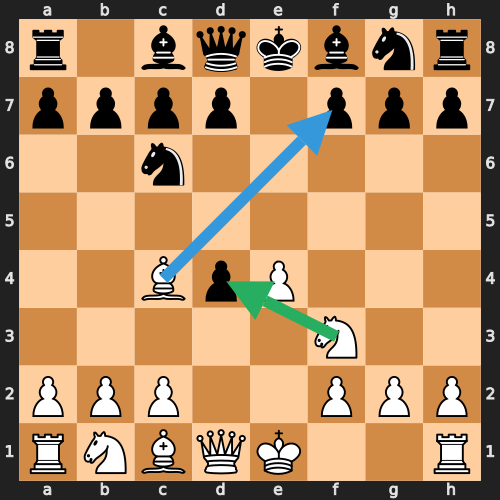 The Scotch Game: Vitzthum Attack after 1.e4 e5 2.Nf3 Nc6 3.d4 exd4 4.Bc4. White immediately challenges the center and develops the bishop to an aggressive square. The blue arrow shows the pressure on f7, while the green arrow shows the option to recapture on d4.
The Scotch is effective at this level because it forces Black to make critical decisions early. Unlike the Italian Game, where Black can often play natural developing moves and reach a comfortable position, the Scotch requires specific theoretical knowledge. If Black misplays the opening, White gains a massive space advantage and easy piece development.
The Queen's Gambit Emerges
A fascinating development at the 1200-1400 level is the emergence of Queen's Gambit lines as top performers. The Queen's Gambit Accepted (D20) scores an impressive 55.7% for White, and the Queen's Gambit Declined (D06) scores 54.9%. These are not trick openings; they are fundamentally sound systems that reward understanding of pawn structures and piece activity.
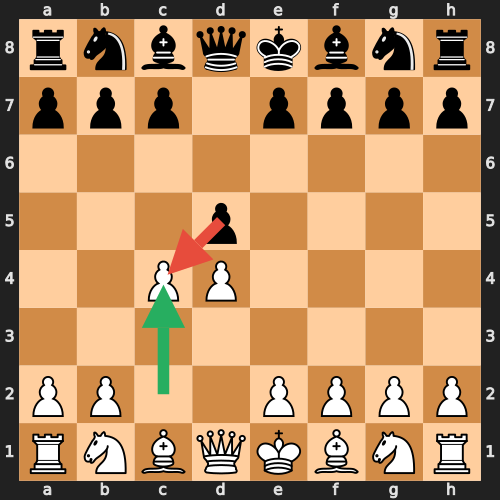 The Queen's Gambit position after 1.d4 d5 2.c4. The green arrow shows White's gambit pawn on c4. The red arrow shows Black's option to capture, which is playable but requires precise follow-up.
Best Responses for Black: Chess.com 1200-1400
| Rank | ECO | Opening | Black Win % | Draw % | White Win % | Games |
|---|---|---|---|---|---|---|
| 1 | C02 | French Defense: Advance Variation | 51.8 | 3.2 | 45.0 | 1,601 |
| 2 | B10 | Caro-Kann Defense: Two Knights Attack | 51.7 | 3.1 | 45.1 | 4,020 |
| 3 | B20 | Sicilian Defense: Wing Gambit | 50.8 | 3.1 | 46.0 | 2,913 |
| 4 | B40 | Sicilian Defense: Wing Gambit Deferred | 50.2 | 3.1 | 46.6 | 1,125 |
| 5 | B30 | Sicilian Defense: Rossolimo Variation | 50.1 | 3.2 | 46.6 | 1,675 |
At this level, the French Defense (1.e4 e6) and the Caro-Kann Defense (1.e4 c6) become the strongest weapons for Black. The French Defense's Advance Variation scores an outstanding 51.8% for Black at the 1200-1400 level. These defenses are solid, well-structured, and lead to positions where Black has clear plans.
Actionable Advice for 1000-1400 Players
As White: The Scotch Game is your best friend. It scores consistently above 53% and does not require memorizing 20 moves of theory. If you prefer 1.d4, the Queen's Gambit lines are performing exceptionally well at this level.
As Black: Transition to the French Defense or the Caro-Kann. Both score above 50% for Black at this level, which is remarkable given White's inherent first-move advantage. The Sicilian Defense also begins to show its strength here.
General: This is the critical transition zone. If you have been relying on tricky gambits, the data shows they are losing their edge. Focus on understanding pawn structures and piece activity rather than memorizing traps.
The Advanced Club Phase (Chess.com 1400-1800)
Welcome to the advanced club level. Here, players know their opening theory, understand pawn structures, and rarely blunder pieces in the first 15 moves. The data reflects this maturity: win rates compress toward 50%, draw rates increase, and opening diversity explodes.
Top 5 Openings for White: Chess.com 1400-1600
| Rank | ECO | Opening | White Win % | Draw % | Black Win % | Games |
|---|---|---|---|---|---|---|
| 1 | D06 | Queen's Gambit Declined: Marshall Defense | 53.6 | 3.6 | 42.8 | 1,338 |
| 2 | C25 | Vienna Game: Stanley Variation | 52.9 | 2.9 | 44.1 | 1,443 |
| 3 | A10 | English Opening: Myers Gambit | 52.9 | 3.3 | 43.8 | 1,034 |
| 4 | C44 | Scotch Game: Vitzthum Attack | 52.5 | 3.7 | 43.5 | 3,275 |
| 5 | C42 | Petrov's Defense: Three Knights Game | 52.2 | 3.9 | 43.8 | 1,574 |
Top 5 Openings for White: Chess.com 1600-1800
| Rank | ECO | Opening | White Win % | Draw % | Black Win % | Games |
|---|---|---|---|---|---|---|
| 1 | A10 | English Opening: Wade Gambit | 53.0 | 4.0 | 42.9 | 1,479 |
| 2 | A01 | Nimzo-Larsen Attack: Symmetrical Variation | 52.2 | 3.5 | 44.3 | 3,300 |
| 3 | B22 | Sicilian Defense: Alapin Variation | 52.1 | 5.4 | 42.3 | 1,341 |
| 4 | C25 | Vienna Game: Stanley Variation | 51.9 | 3.7 | 44.2 | 1,272 |
| 5 | A04 | Zukertort Opening: Ware Defense | 51.8 | 3.4 | 44.7 | 2,419 |
The Era of Stability and Sophistication
At this level, the most successful openings are those that offer long-term positional pressure rather than quick tactical tricks. Notice how the top performers have shifted: the Latvian Gambit has completely disappeared from the top 5, replaced by the English Opening, the Nimzo-Larsen Attack, and the Vienna Game. These are sophisticated systems that reward deep understanding over memorized traps.
The Scotch Game remains a reliable performer at 52.5% in the 1400-1600 band, demonstrating its remarkable stability across all levels. However, its advantage has narrowed considerably from the 53.3% it achieved at lower ratings.
Best Responses for Black: Chess.com 1400-1600
| Rank | ECO | Opening | Black Win % | Draw % | White Win % | Games |
|---|---|---|---|---|---|---|
| 1 | C02 | French Defense: Advance Variation | 51.2 | 3.3 | 45.4 | 1,544 |
| 2 | A06 | Zukertort Opening: The Potato | 50.5 | 2.7 | 46.4 | 1,512 |
| 3 | B40 | Sicilian Defense: Wing Gambit Deferred | 49.4 | 3.9 | 46.7 | 1,299 |
| 4 | B20 | Sicilian Defense: Wing Gambit | 49.1 | 3.7 | 47.0 | 2,909 |
| 5 | B13 | Caro-Kann Defense: Panov Attack | 49.0 | 3.7 | 47.0 | 1,352 |
Best Responses for Black: Chess.com 1600-1800
| Rank | ECO | Opening | Black Win % | Draw % | White Win % | Games |
|---|---|---|---|---|---|---|
| 1 | B20 | Sicilian Defense: Wing Gambit | 50.7 | 3.6 | 45.7 | 3,095 |
| 2 | B10 | Caro-Kann Defense: Two Knights Attack | 49.6 | 4.0 | 46.3 | 4,145 |
| 3 | C40 | Latvian Gambit (as Black) | 49.5 | 3.6 | 46.7 | 1,609 |
| 4 | C02 | French Defense: Advance Variation | 48.9 | 4.4 | 46.6 | 1,576 |
| 5 | C01 | French Defense: Exchange Variation | 48.9 | 5.1 | 45.9 | 1,538 |
At the highest levels in our study, the Sicilian Defense emerges as the single best weapon for Black, scoring 50.7% at 1600-1800. This aligns perfectly with what we see at the professional level: the Sicilian is the most popular and successful defense against 1.e4 for a reason. The Caro-Kann and French Defense continue to perform well, forming a reliable trio of defenses for the serious Black player.
Actionable Advice for 1400-1800 Players
As White: Consider the English Opening (1.c4) or the Nimzo-Larsen Attack (1.b3). These systems take opponents out of their preparation and lead to rich, complex middlegames. If you prefer 1.e4, the Vienna Game offers excellent results.
As Black: Master the Sicilian Defense. At this level, it is the single highest-performing defense. Supplement it with the Caro-Kann or French Defense for variety.
General: At this stage, games are decided by accumulated small advantages, not massive blunders. Focus on understanding the middlegame plans that arise from your openings, not just the first 10 moves.
The Decay Curve: Why Openings Stop Working
One of the most original findings of this study is the quantification of opening decay: the rate at which an opening's win rate drops as players improve. The chart below tracks the ten openings with the steepest decay curves.
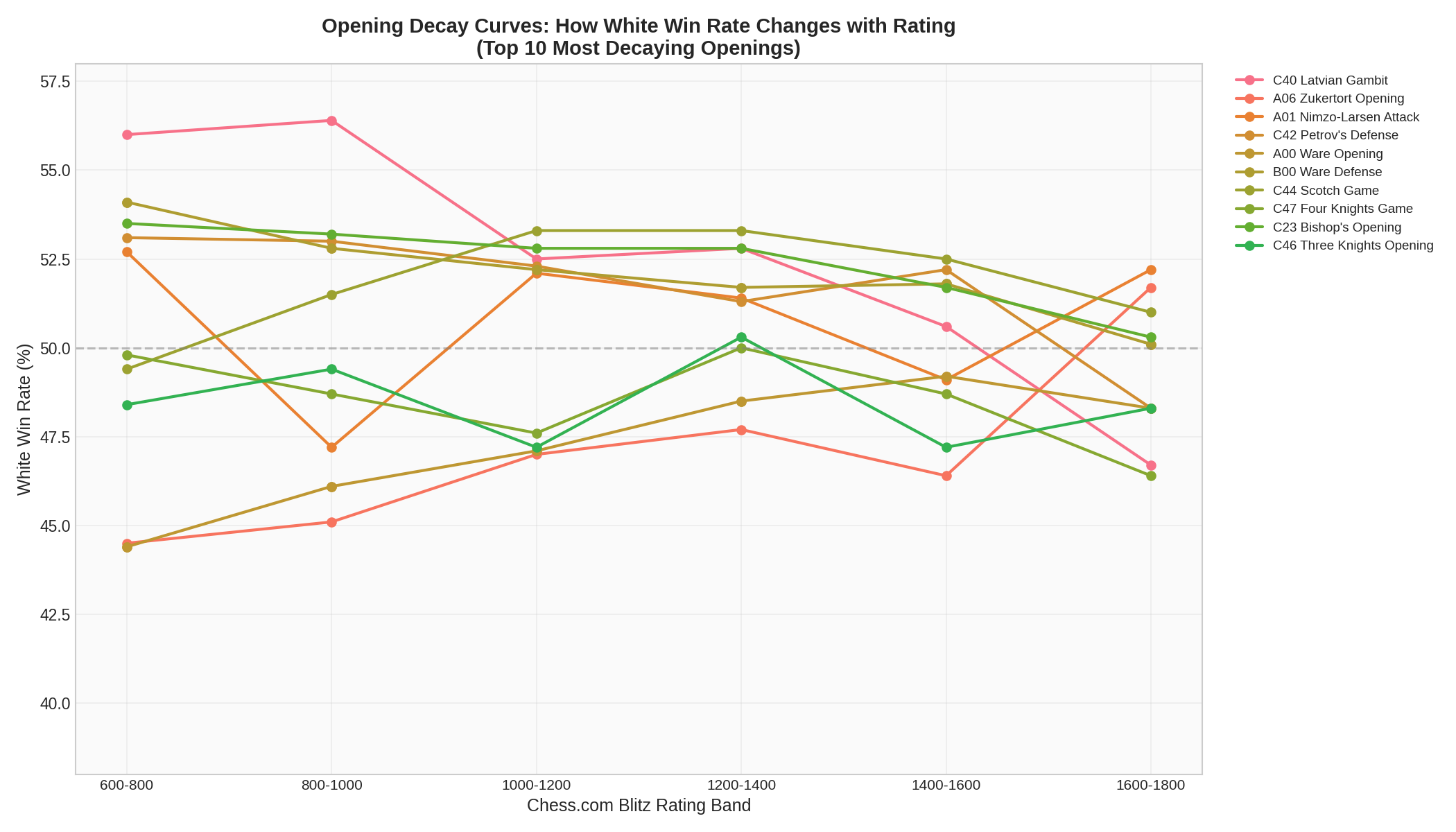
The Latvian Gambit (C40) stands out dramatically, dropping from a peak of 56.4% at 800-1000 to just 46.7% at 1600-1800, a decay of 9.7 percentage points. This is the largest decay in our entire dataset. By contrast, the most stable openings barely fluctuate.
Complete Decay Summary
The table below ranks all analyzed openings by their total decay, defined as the difference between their peak and lowest White win rates across all rating bands.
| ECO | Opening | Peak WR% | Peak Band (CC) | Low WR% | Low Band (CC) | Decay (pp) | Games |
|---|---|---|---|---|---|---|---|
| C40 | Latvian Gambit | 56.4 | 800-1000 | 46.7 | 1600-1800 | 9.7 | 23,588 |
| A06 | Zukertort Opening: The Potato | 51.7 | 1600-1800 | 44.5 | 600-800 | 7.2 | 10,393 |
| A01 | Nimzo-Larsen Attack | 52.7 | 600-800 | 47.2 | 800-1000 | 5.5 | 11,641 |
| C42 | Petrov's Defense: Three Knights | 53.1 | 600-800 | 48.3 | 1600-1800 | 4.8 | 17,990 |
| A00 | Ware Opening: Symmetric | 49.2 | 1400-1600 | 44.4 | 600-800 | 4.8 | 119,202 |
| B00 | Ware Defense: Snagglepuss | 54.1 | 600-800 | 50.1 | 1600-1800 | 4.0 | 98,208 |
| C44 | Scotch Gambit: Sarratt | 53.3 | 800-1000 | 49.4 | 600-800 | 3.9 | 26,089 |
| C47 | Four Knights: Scotch Variation | 50.0 | 1000-1200 | 46.4 | 1600-1800 | 3.6 | 13,476 |
| C23 | Bishop's Opening: del Rio | 53.5 | 600-800 | 50.3 | 1600-1800 | 3.2 | 17,964 |
| D00 | Queen's Pawn: Zurich Gambit | 51.1 | 1200-1400 | 48.2 | 600-800 | 2.9 | 49,376 |
| C50 | Italian Game: Rousseau Gambit | 51.2 | 600-800 | 48.2 | 1600-1800 | 3.0 | 36,775 |
| A40 | Queen's Pawn: Modern Defense | 51.2 | 1400-1600 | 49.5 | 1200-1400 | 1.7 | 53,967 |
| D02 | Queen's Pawn: Zukertort | 51.7 | 1200-1400 | 50.3 | 1600-1800 | 1.4 | 22,219 |
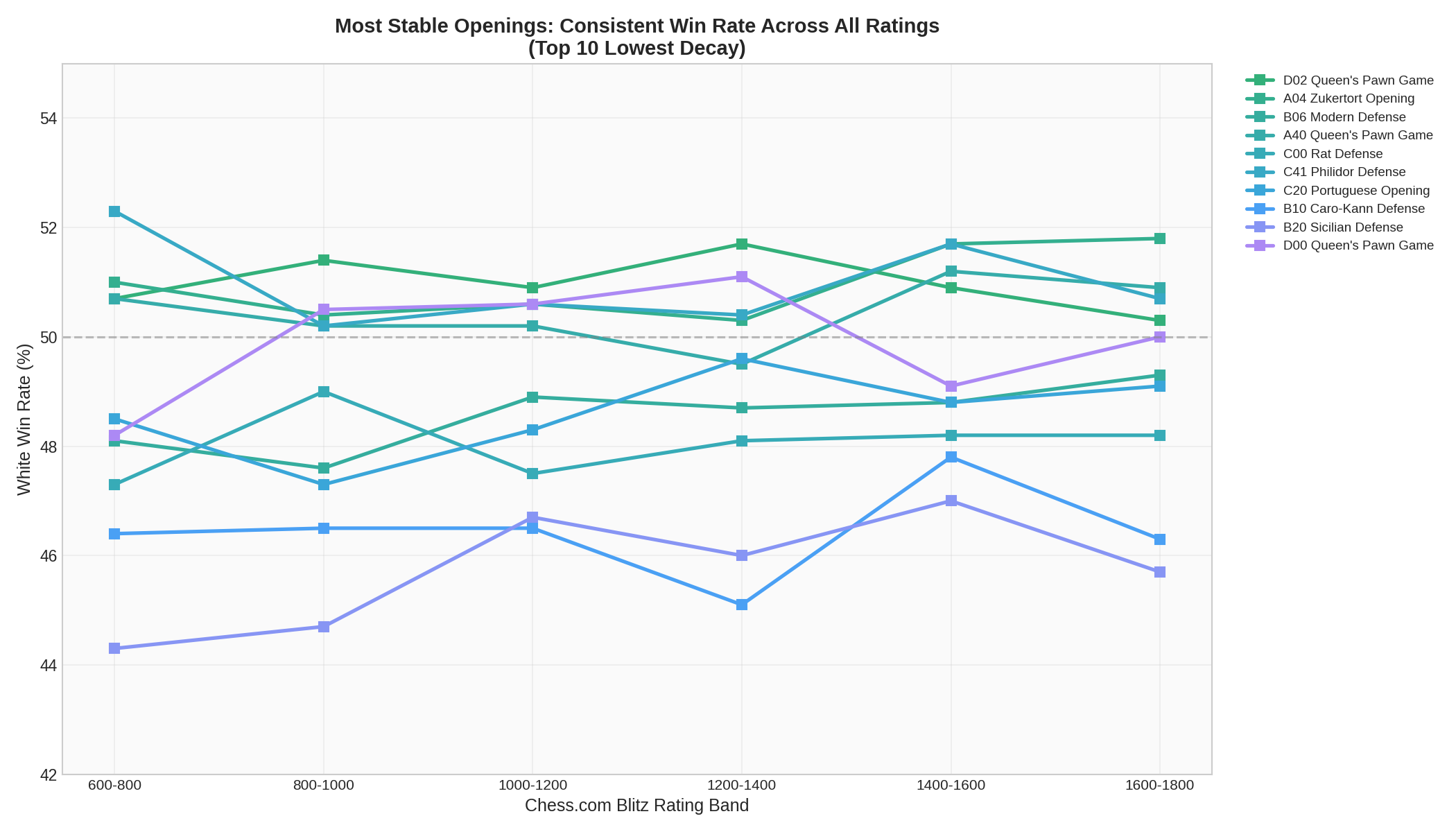
The most stable openings in the dataset are the Queen's Pawn Game: Zukertort Variation (D02) with only 1.4pp of decay, and the Queen's Pawn Game: Modern Defense (A40) with 1.7pp. These openings do not rely on the opponent making a mistake; they rely on playing sound, principled chess.
Where Does Each Opening Peak?
The bubble chart below provides a visual summary of where each opening reaches its maximum effectiveness. The x-axis shows the rating band where the opening peaks, the y-axis shows the peak White win rate, bubble size represents the total number of games, and color indicates the severity of decay.
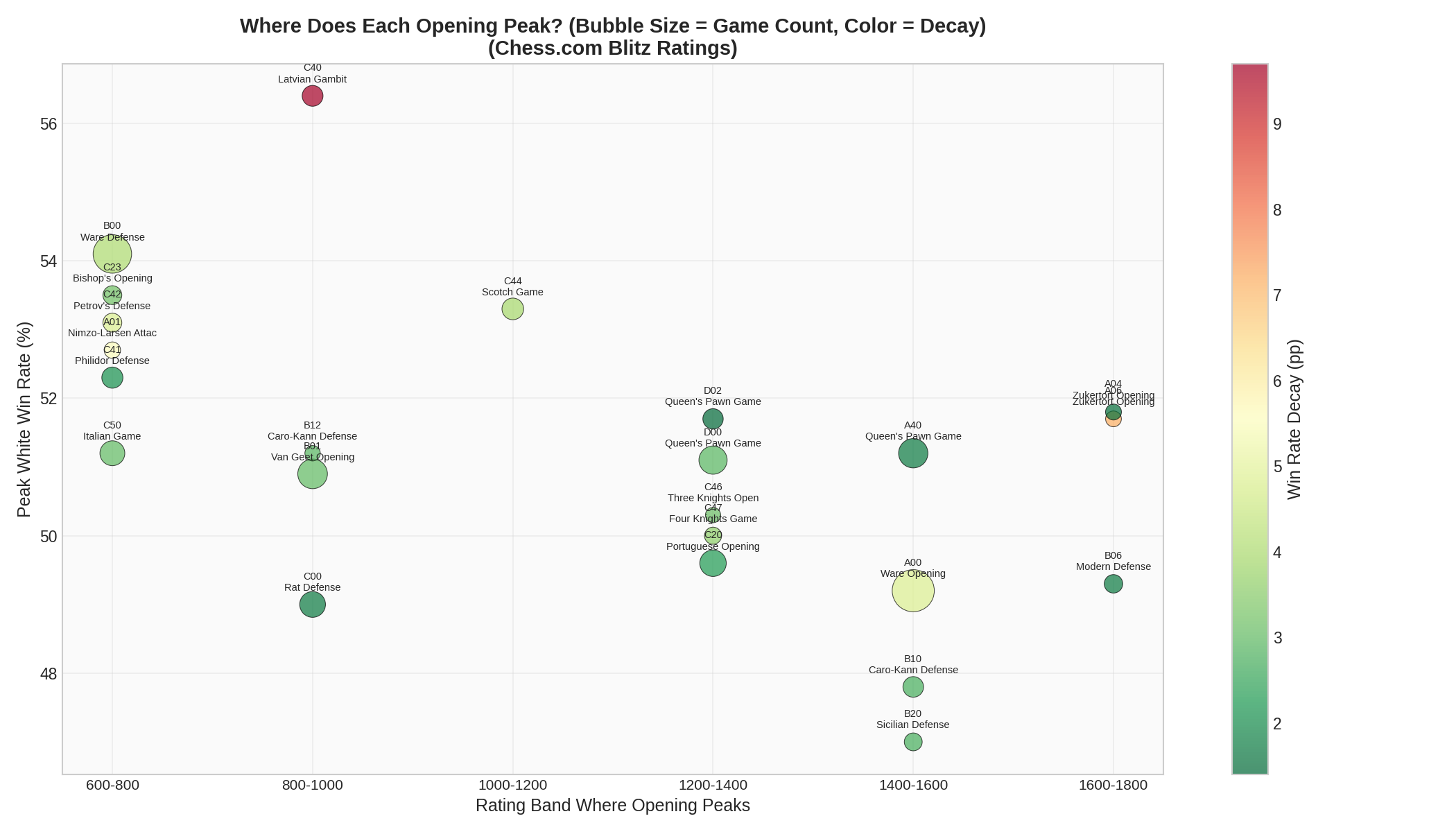
A clear pattern emerges: tactical, aggressive openings cluster on the left (peaking at 600-1000), while positional, strategic openings cluster on the right (peaking at 1400-1800). This is the single most important insight for players planning their opening repertoire: your opening choices should evolve as your rating improves.
1.e4 vs 1.d4: The Eternal Debate, Settled by Data
One of the most common questions in chess is whether to play 1.e4 or 1.d4. Our data provides a nuanced answer that depends heavily on your rating.
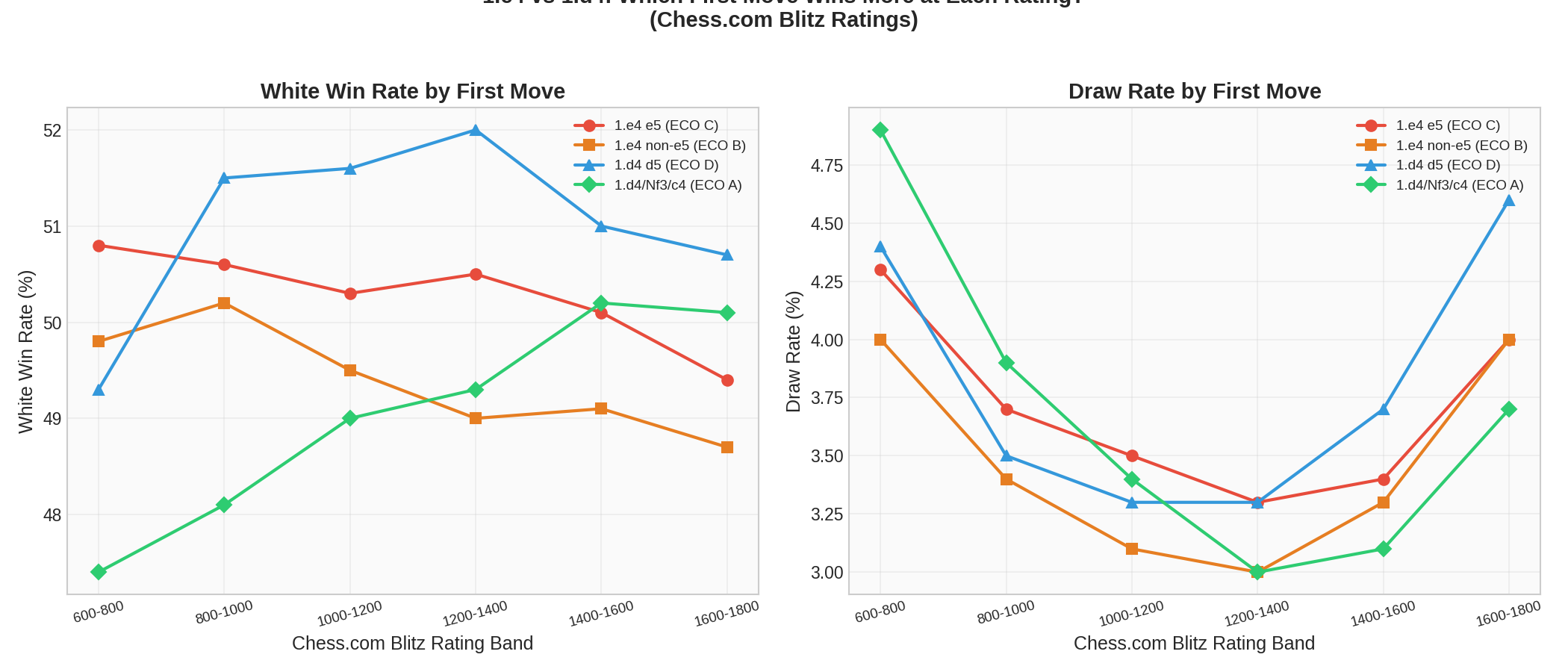
The data reveals a fascinating crossover pattern:
At 600-1000 (Chess.com): 1.e4 e5 (ECO C) is the strongest choice, with White scoring around 50.6-50.8%. The positions are tactical, and lower-rated players benefit from the open, attacking nature of these games.
At 1000-1400 (Chess.com): 1.d4 d5 (ECO D) overtakes 1.e4 and becomes the highest-performing first move, peaking at 52.0% at 1200-1400. This is a significant finding. Intermediate players are often well-prepared for the tactical melees of 1.e4 e5, but they struggle to navigate the positional nuances of Queen's Pawn openings.
At 1400-1800 (Chess.com): The advantage of 1.d4 narrows but remains. Flank openings (ECO A: 1.c4, 1.Nf3, 1.b3) begin to show their strength, reaching parity with 1.e4 by the 1600-1800 band.
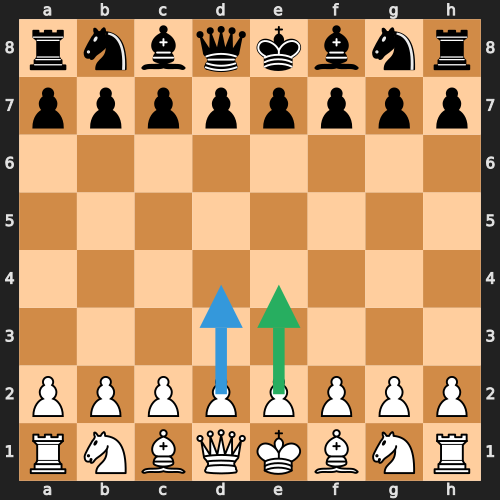 The eternal question: 1.e4 (green arrow) or 1.d4 (blue arrow)? The data suggests the answer changes as you improve.
Key Takeaway
If you are below 1000, play 1.e4. If you are between 1000 and 1600, seriously consider switching to 1.d4. Above 1600, the choice matters less than your understanding of the resulting positions.
Blitz vs. Rapid: Does Time Control Change the Answer?
A common question is whether opening choices should change based on the time control. We compared the performance of key openings in Blitz (3-5 minutes) versus Rapid (10+ minutes).
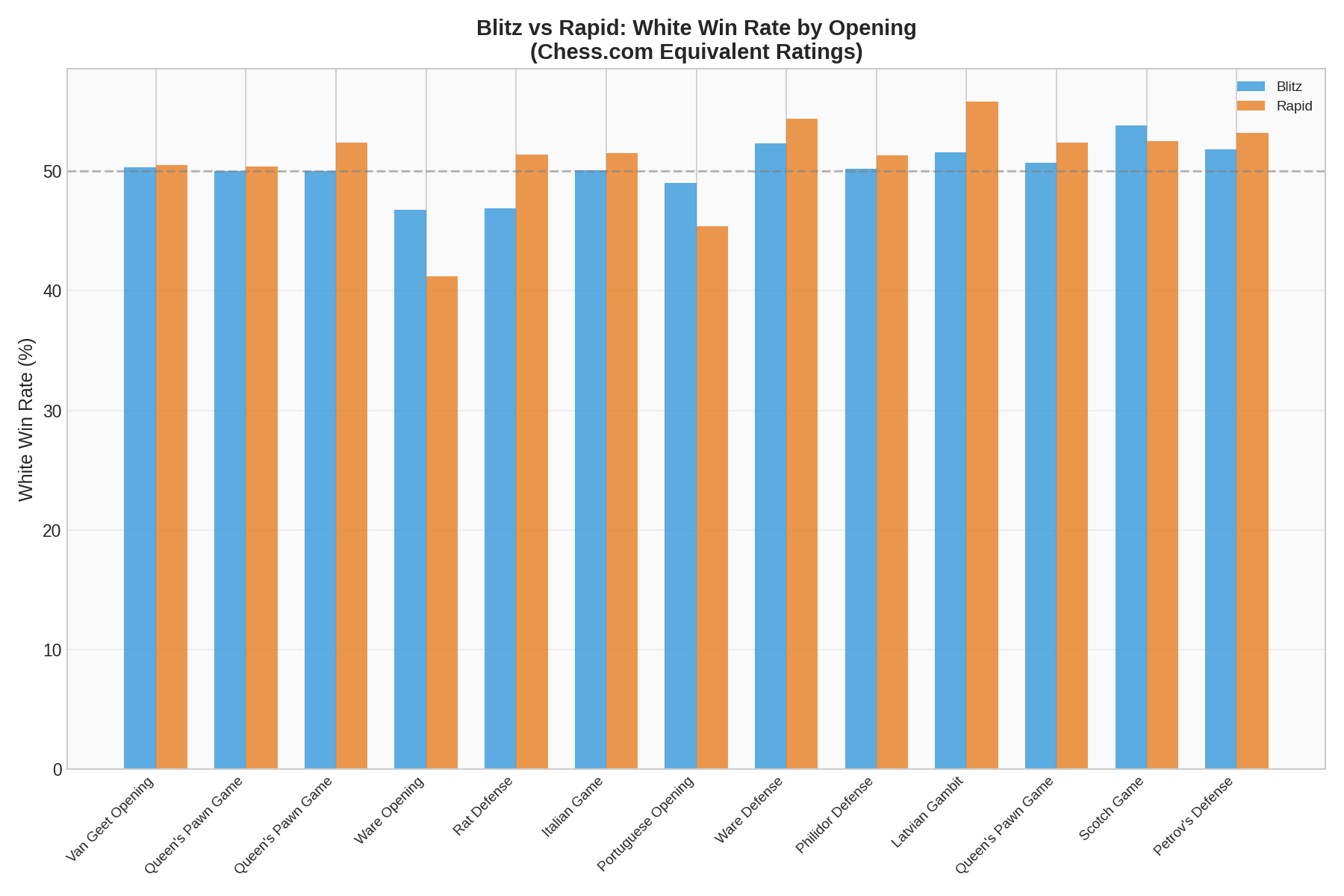
The data reveals a consistent trend: aggressive, tactical openings perform slightly better in Blitz, where time pressure forces quick, often inaccurate decisions. Conversely, solid, positional openings perform slightly better in Rapid, where players have the time to navigate complex strategic structures.
However, the differences are relatively small (typically 1-3 percentage points). The most important factor remains your understanding of the opening, not the time control. If you know the Italian Game deeply, play it in both Blitz and Rapid.
Opening Diversity: When Should You Expand Your Repertoire?
Our data on opening diversity reveals a clear trend: as players improve, they play a wider variety of openings.
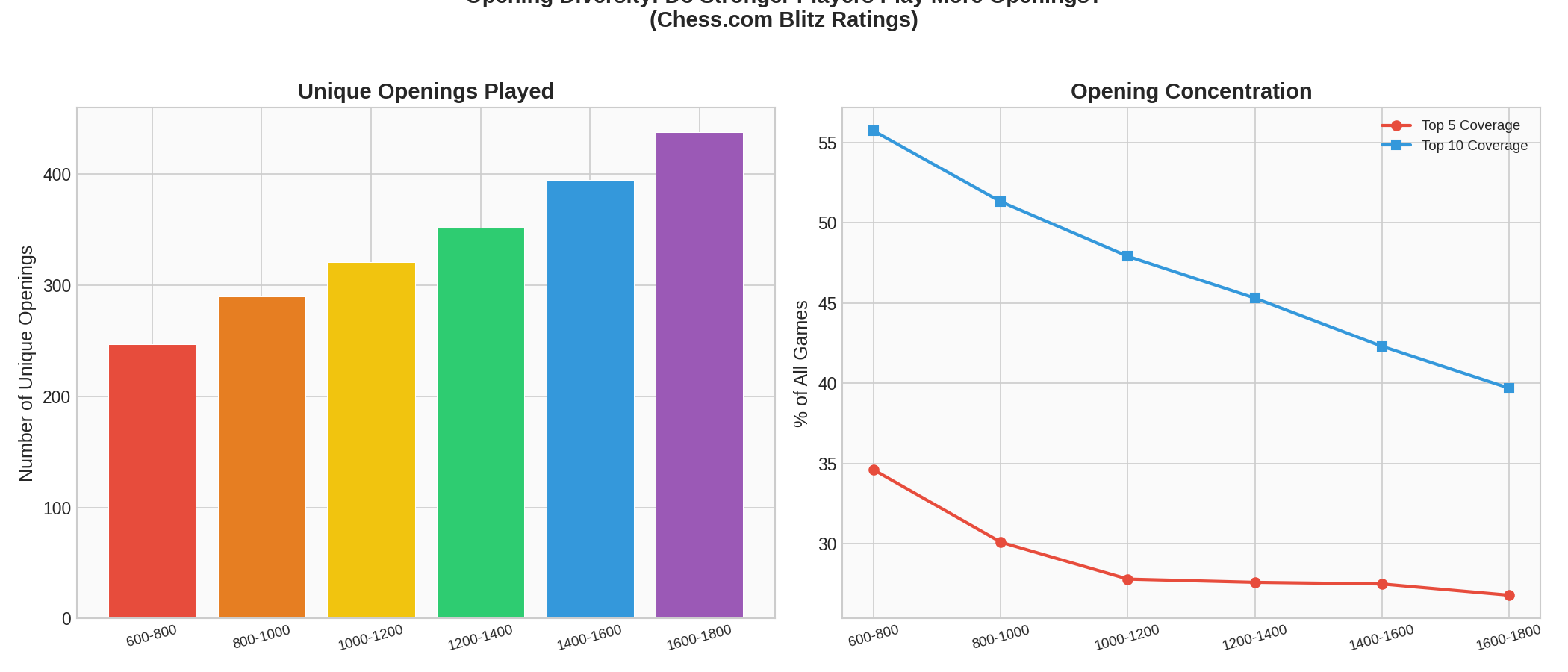
| Rating Band (CC) | Unique Openings | Top 5 Coverage (%) | Top 10 Coverage (%) |
|---|---|---|---|
| 600-800 | 247 | 34.6 | 55.7 |
| 800-1000 | 290 | 30.1 | 51.3 |
| 1000-1200 | 321 | 27.8 | 47.9 |
| 1200-1400 | 352 | 27.6 | 45.3 |
| 1400-1600 | 395 | 27.5 | 42.3 |
| 1600-1800 | 438 | 26.8 | 39.7 |
At 600-800, the top 5 openings account for 34.6% of all games, and the top 10 account for over half. By 1600-1800, the top 5 openings cover only 26.8% of games, and the number of unique openings played nearly doubles from 247 to 438.
This has a clear implication: as you improve, you need a broader repertoire. At 800 rating, knowing one opening for White and one for Black is sufficient. By 1400, you need to be prepared for a much wider range of positions.
The Complete Recommendation Roadmap
Based on our analysis of 954,617 games, here is a comprehensive roadmap for opening choices at each rating level.
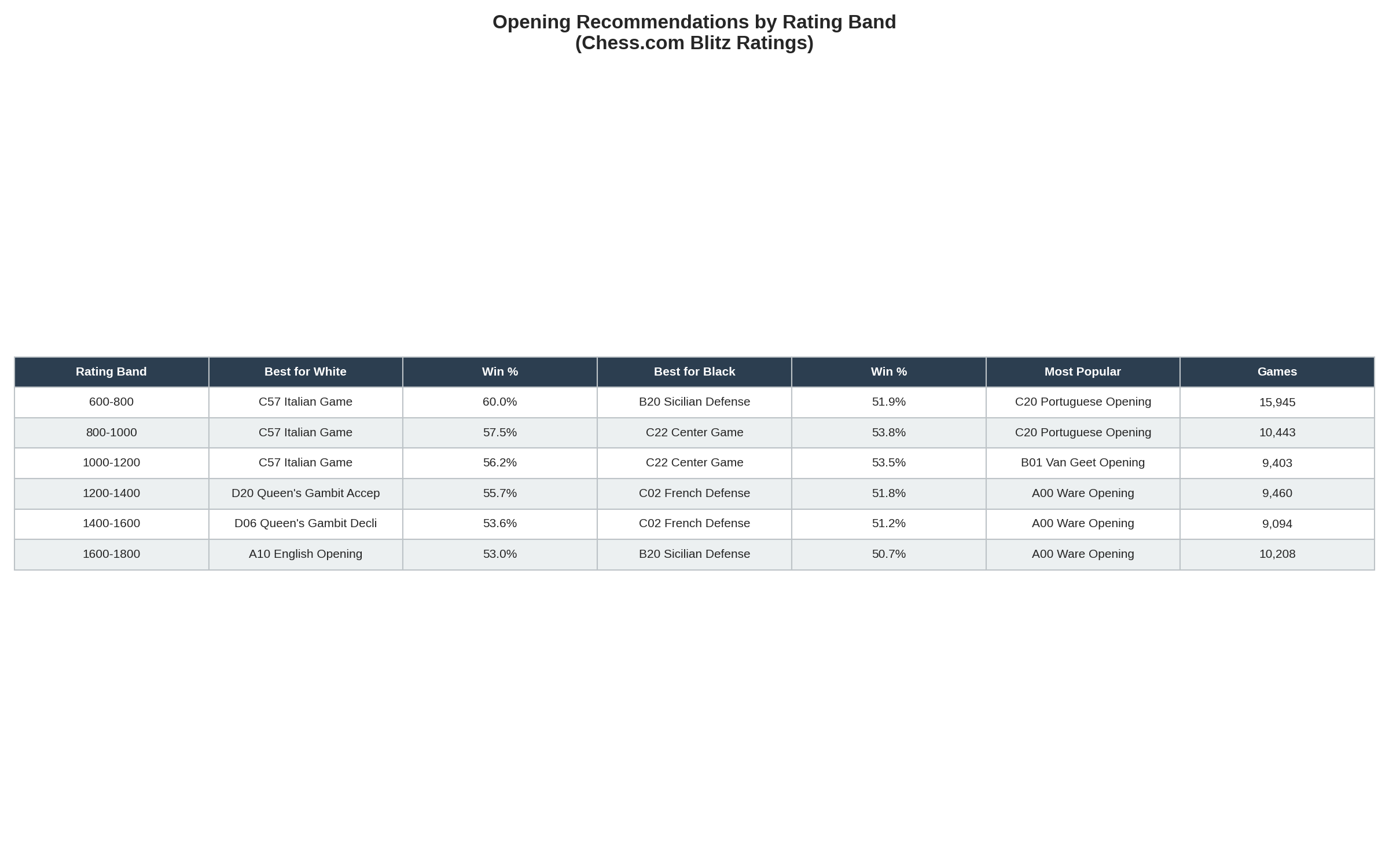
Summary by Rating Band
Chess.com 600-800: Play 1.e4 as White. Learn the Italian Game or Bishop's Opening. As Black, learn the Caro-Kann. Focus on not hanging pieces.
Chess.com 800-1000: Continue with 1.e4 but begin learning the Scotch Game. As Black, the Caro-Kann remains your best weapon. Start paying attention to pawn structure.
Chess.com 1000-1200: The Scotch Game should be your primary weapon as White. Consider adding 1.d4 to your repertoire. As Black, the French Defense becomes a powerful option alongside the Caro-Kann.
Chess.com 1200-1400: Transition fully to the Queen's Gambit (1.d4 d5 2.c4) as White. The data shows it outperforms 1.e4 at this level. As Black, master the Sicilian Defense.
Chess.com 1400-1600: Diversify your White repertoire with the English Opening or Vienna Game. As Black, the Sicilian and French Defense are your strongest weapons. Begin studying middlegame plans, not just opening moves.
Chess.com 1600-1800: At this level, understanding trumps memorization. The English Opening, Nimzo-Larsen Attack, and Sicilian Defense (as Black) are the top statistical performers. Build a diverse repertoire and focus on positional understanding.
Data and Methodology
This analysis was conducted using a dataset of 954,617 Lichess games accessed via the Grandmaster Guide analytics database [1]. The dataset includes games from all major time controls (Blitz: 465,320; Bullet: 283,263; Rapid: 200,561; Classical: 4,936), with full Stockfish 17 evaluations (100% coverage) and clock annotations (99.7% coverage).
Rating Conversion
All Lichess ratings were mapped to Chess.com Blitz equivalents using the established community conversion table [2]. The six Lichess rating bands (700-900, 900-1100, 1100-1300, 1300-1500, 1500-1800, 1800-2000) were mapped to approximate Chess.com Blitz bands (600-800, 800-1000, 1000-1200, 1200-1400, 1400-1600, 1600-1800).
Statistical Methods
Win rates were calculated as simple percentages of games won by White, drawn, or won by Black within each opening-rating band combination. Only openings with a minimum of 50 games per rating band were included in the general analysis, and a minimum of 1,000 games was required for the "Top 5" recommendation tables. Decay was calculated as the difference between the peak and lowest White win rate across all six rating bands.
Tools
Data extraction was performed via the Grandmaster Guide MCP server's analytics API. Analysis was conducted in Python using Pandas, with visualizations created via Matplotlib and Seaborn. Board renders were generated using the python-chess library.
Download the Raw Data
The underlying CSV data files are attached to this article for independent verification and further analysis:
- opening_winrates_all.csv — Full win/draw/loss data for all 79 analyzed openings across 6 rating bands (300 rows).
- opening_decay_curves.csv — Decay curve data tracking the performance of the top 25 openings across all rating bands (150 rows).
- first_move_stats.csv — Win rates grouped by first move (ECO families A-E) across all rating bands (30 rows).
- opening_diversity.csv — Opening diversity metrics (HHI, coverage percentages, unique opening counts) by rating band.
- time_control_comparison.csv — Blitz vs. Rapid vs. Bullet comparison data.
- deep_stats_by_band.csv — Detailed per-opening statistics including CPL, blunder rates, and quick-finish percentages.
References
[1] Grandmaster Guide MCP Server, Lichess Analytics Database. 954,617 games with Stockfish 17 evaluations. Accessed April 2026.
[2] Chess Rating Comparison: Community Consensus Mapping, Lichess Blitz to Chess.com Blitz. Based on cross-platform player data.
Chess Coach, April 13, 2026