A common dilemma for improving chess players is whether to stick to a narrow, specialized opening repertoire or to play a wide variety of openings to gain broader chess understanding. To answer this, we analyzed over 950,000 Blitz games from the Lichess database, supplemented by a deep-dive sample of 25,000 recent games from 240 active players across the Chess.com 800 to 1600 rating bands.
This guide serves as a roadmap for improvement, breaking down the data to provide actionable advice for each rating segment.
The Big Picture: Diversity Grows with Rating
Before looking at individual improvement rates, it is helpful to understand the baseline behavior of the player pool. Do higher-rated players play more or fewer openings than lower-rated players?
The data is unambiguous: repertoire breadth increases as rating increases.
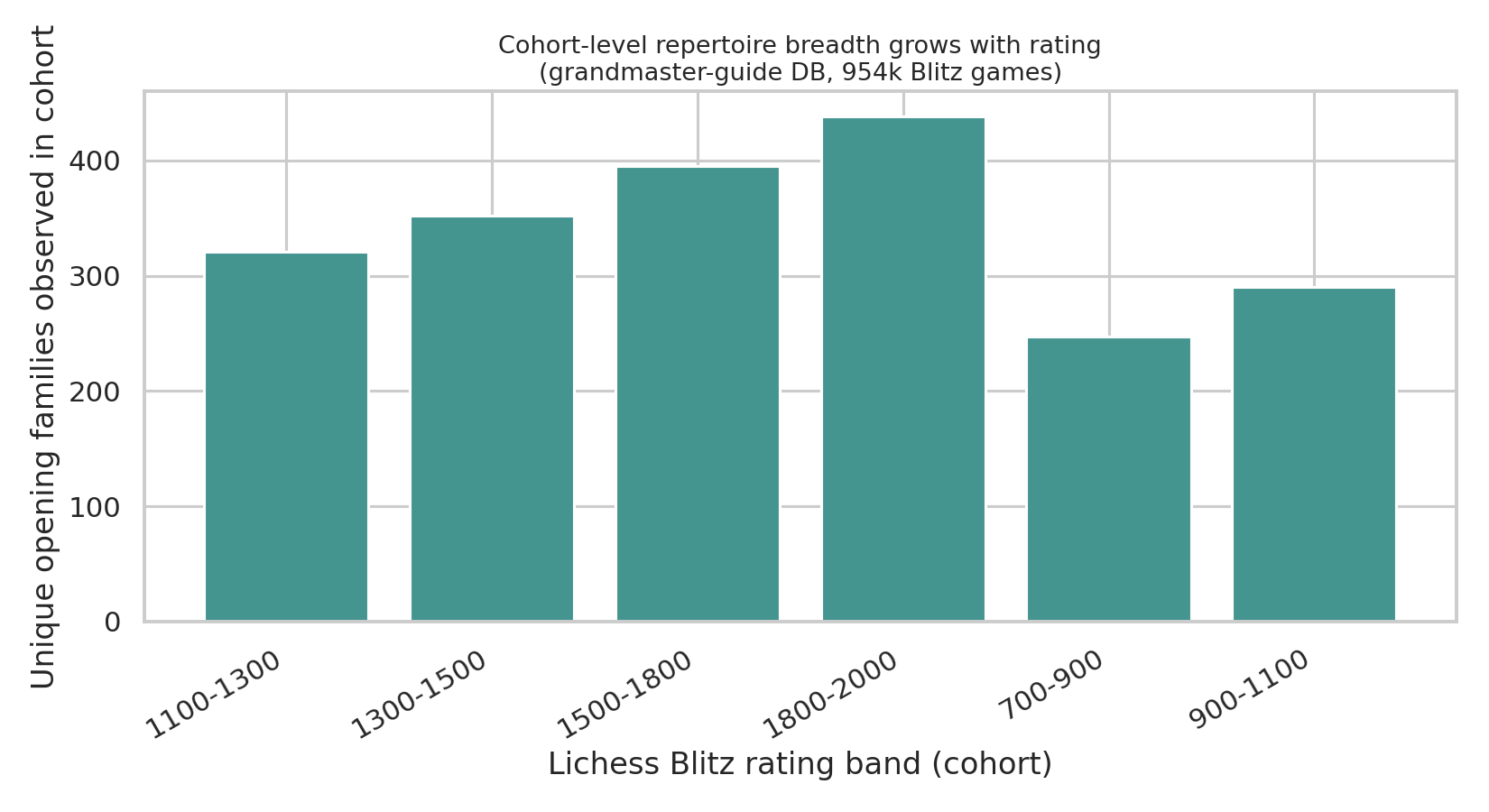
When we examine the total number of unique opening families played by cohorts of players, the 1400-1600 Chess.com band (Lichess 1705-1850) employs significantly more unique openings than the 800-1000 band. Furthermore, the concentration of games in the top few openings drops sharply as players improve.
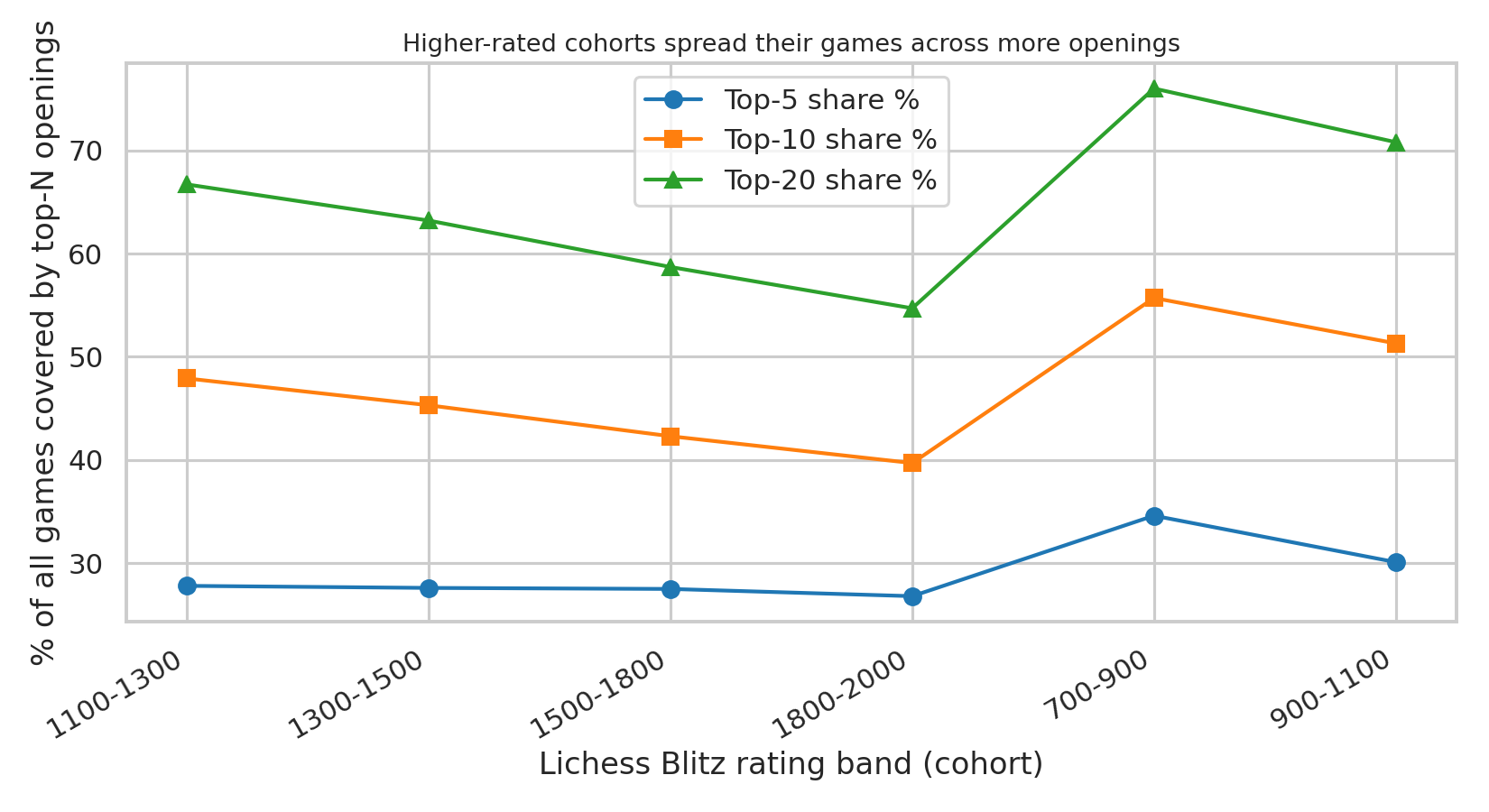
In the 800-1000 band, the top 5 opening families account for nearly 35% of all games played. By the time players reach the 1400-1600 band, that top-5 share drops to around 25%. Higher-rated players are less reliant on a small handful of "pet" lines and are comfortable navigating a wider variety of pawn structures.
Does a Broader Repertoire Cause Faster Improvement?
To determine if playing more openings causes faster improvement, we tracked the short-term rating changes of 240 active players over their last ~100 Blitz games. We divided players in each rating band into four quartiles based on their repertoire breadth (measured by the number of unique ECO codes they played).
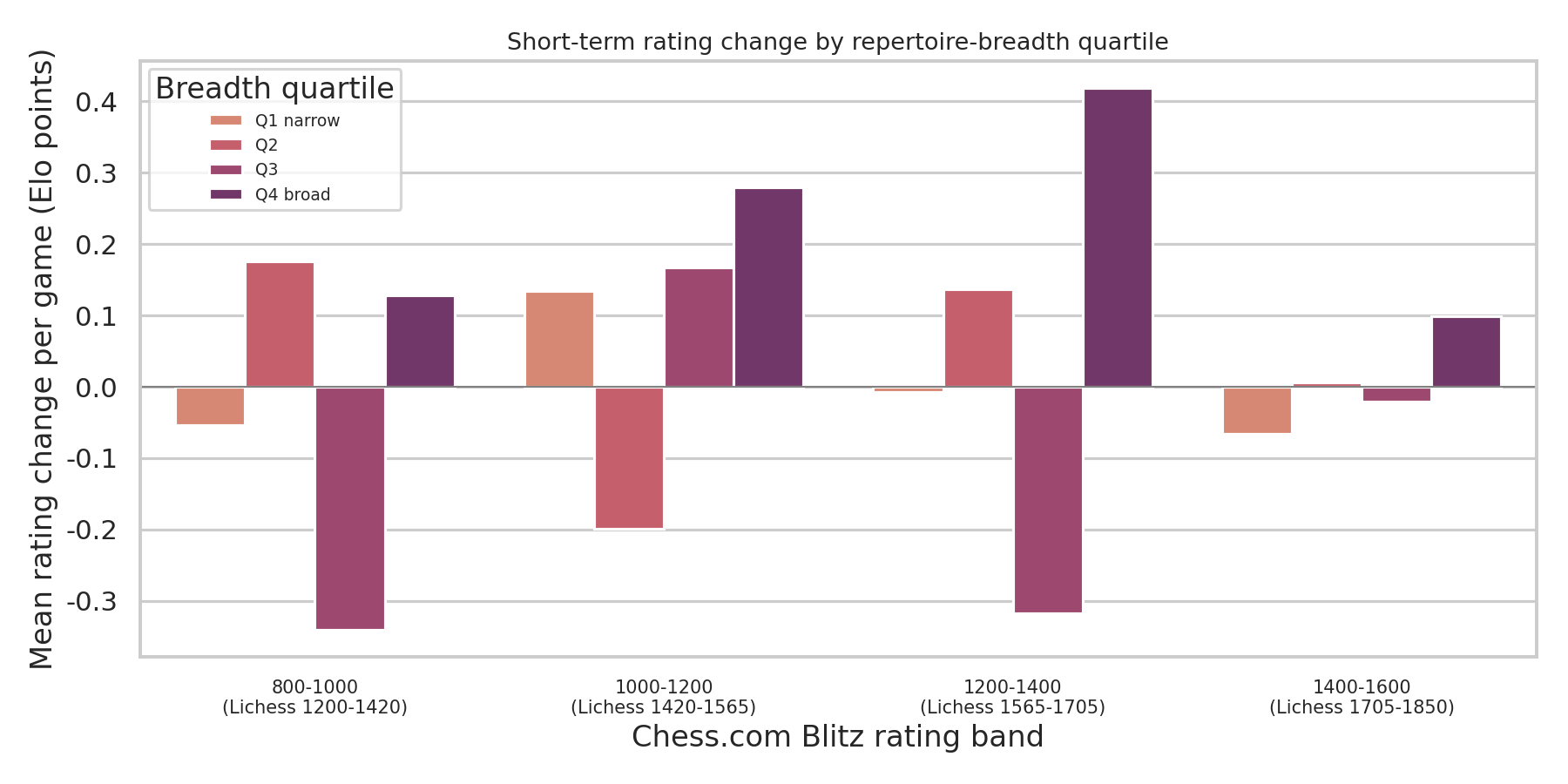
The results reveal a nuanced picture:
- There is no universal "magic bullet" correlation. Across all bands, the Spearman correlation between unique openings played and mean rating change per game is weak (ranging from -0.03 to +0.19).
- However, the broadest repertoires often outperform the narrowest. In the 1200-1400 and 1400-1600 bands, players in the top quartile of repertoire breadth (Q4) showed positive average rating gains, while those in the narrowest quartile (Q1) stagnated or lost rating points on average.
- The 1200-1400 band shows the starkest contrast. Players in the broadest quartile gained an average of +0.42 Elo per game over the sample period, with 80% of them showing a net positive rating change. Conversely, the narrowest quartile in this band averaged a slight rating loss.
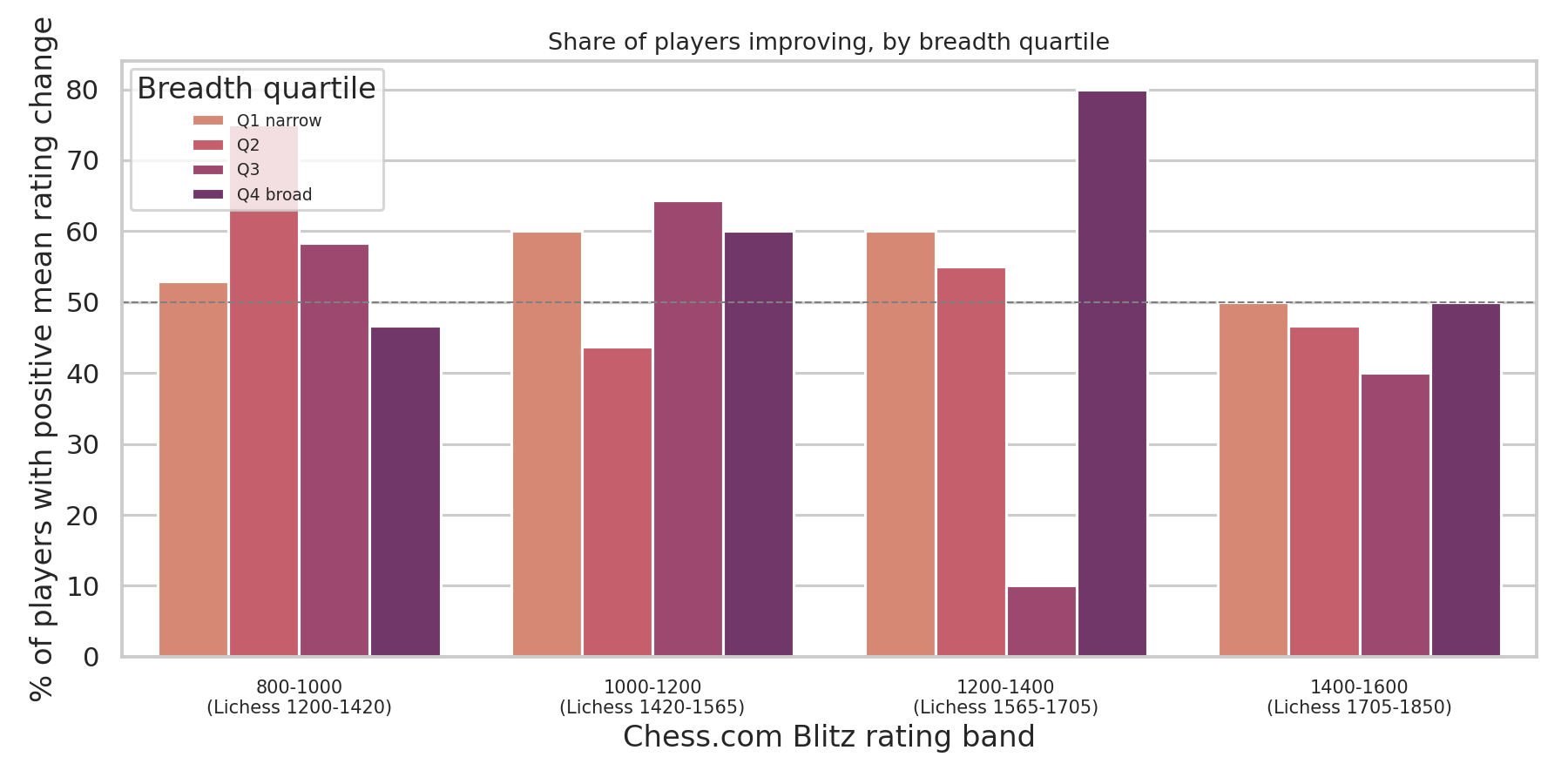
This suggests that while a narrow repertoire might be sufficient (or even optimal) for absolute beginners, relying on it too heavily becomes a liability as you approach the intermediate ranks.
Actionable Advice by Rating Band
Based on the data, here is a roadmap for managing your opening repertoire as you climb the rating ladder.
Chess.com 800 - 1000 (Lichess 1200 - 1420)
The Data: In this band, the most popular openings are the Sicilian Defense (8.6%), Queen's Pawn Game (7.2%), and the Italian Game (6.5%). The data shows that players with moderately broad repertoires (Q2) actually improved faster than those with the broadest repertoires (Q4). The Verdict: Stick to the fundamentals. Actionable Advice:
- Do not overwhelm yourself. Focus on 2-3 reliable setups for White and Black.
- Prioritize opening principles over memorization. Control the center, develop your pieces, and get your king to safety.
- Avoid tricky gambits that rely on one-move blunders. Openings like the Smith-Morra Gambit (below) are popular here but lose their effectiveness as opponents get better.
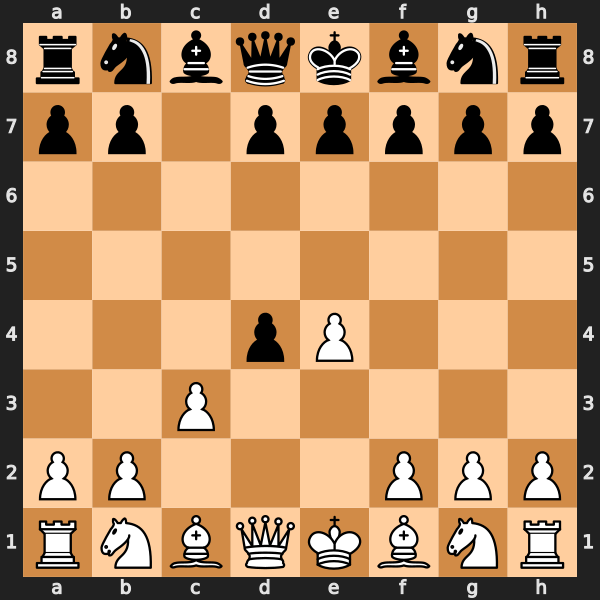 The Smith-Morra Gambit (1.e4 c5 2.d4 cxd4 3.c3) is a common aggressive try at this level, but it requires deep theoretical knowledge to justify the sacrificed pawn against accurate defense.
Chess.com 1000 - 1200 (Lichess 1420 - 1565)
The Data: The Italian Game takes the top spot here (7.3%), followed by the Sicilian (6.8%) and the French Defense (5.6%). Players in the broadest quartile (Q4) showed the highest average rating gain (+0.28 Elo/game). The Verdict: Time to branch out. Actionable Advice:
- Start experimenting. If you have only ever played 1.e4, try playing 1.d4 or 1.c4 in unrated games to experience different pawn structures.
- Learn the typical middlegame plans associated with your openings, rather than just the first 5 moves.
- Review your games to identify structural weaknesses. If you always struggle against the Caro-Kann, spend time learning a new system against it.
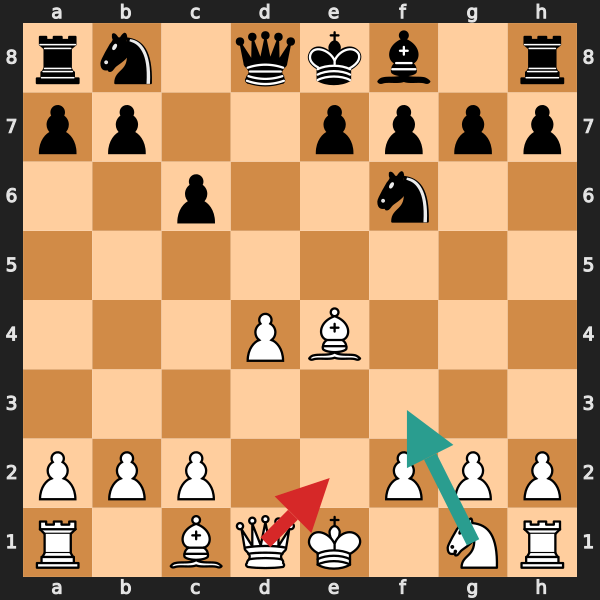 A typical mistake in the Caro-Kann Classical variation. White plays 7.Qe2?! (red arrow), allowing Black to equalize easily. The engine prefers the developing move 7.Nf3 (green arrow).
Chess.com 1200 - 1400 (Lichess 1565 - 1705)
The Data: The Italian Game remains #1 (7.4%), but we see a rise in the popularity of the Caro-Kann (5.6%) and the English Opening. This band showed the strongest benefit for repertoire breadth, with Q4 players gaining significantly more rating than Q1 players. The Verdict: Breadth is a competitive advantage. Actionable Advice:
- Build a complete repertoire. You should have a reliable response prepared for 1.e4, 1.d4, 1.c4, and 1.Nf3.
- Embrace complexity. Do not shy away from mainlines like the Ruy Lopez or the King's Indian Defense. These openings are complex but teach profound positional lessons.
- Avoid "system" openings (like playing the London System against everything) if your goal is long-term improvement, as they limit your exposure to diverse tactical patterns.
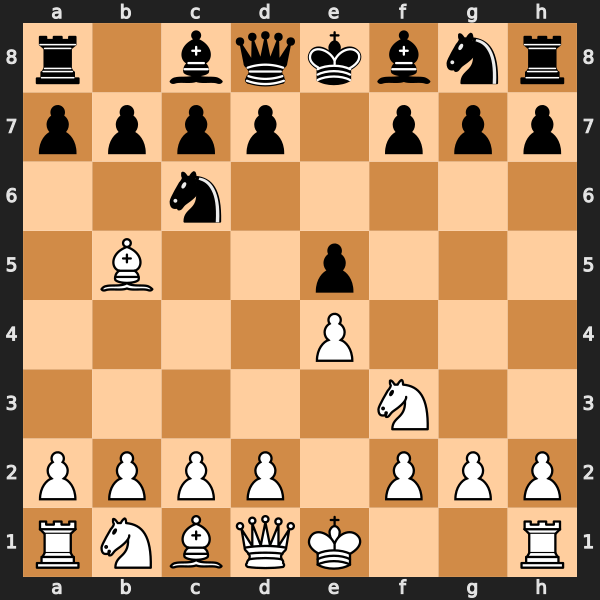 The Ruy Lopez (1.e4 e5 2.Nf3 Nc6 3.Bb5) is a hallmark of a broad, ambitious repertoire. It leads to rich, complex middlegames that test both tactical and positional understanding.
Chess.com 1400 - 1600 (Lichess 1705 - 1850)
The Data: The Sicilian Defense reclaims the top spot (7.8%), followed by the Italian (6.3%) and the French (5.6%). The data shows a high baseline of diversity; the average player here uses significantly more unique ECO codes than players in the 800-1000 band. The Verdict: Refine and deepen. Actionable Advice:
- Deepen your existing repertoire. You don't necessarily need to add entirely new openings, but you must know your chosen lines more deeply.
- Study master games played in your openings to understand the high-level strategic nuances.
- Prepare specific variations against your opponents' most likely responses.
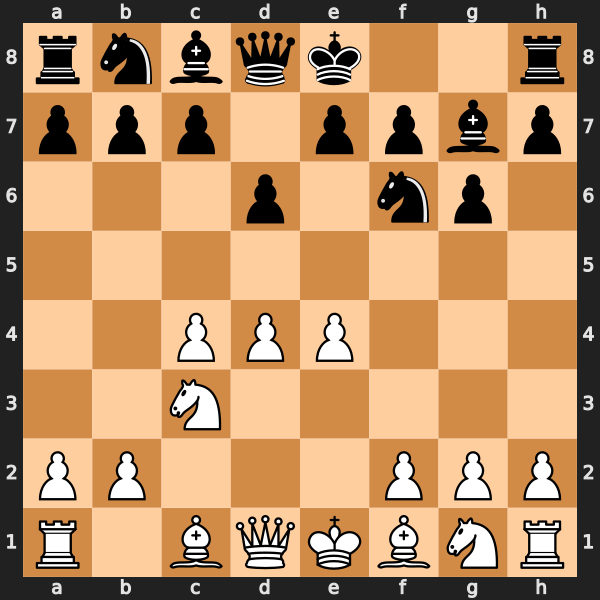 The King's Indian Defense Classical Variation. At this level, players must understand the typical pawn breaks (like ...f5 for Black or c5 for White) and the resulting locked-center dynamics.
A Note on Practice Volume
While repertoire breadth is an interesting factor, the data confirms a much more fundamental truth about chess improvement: volume matters.
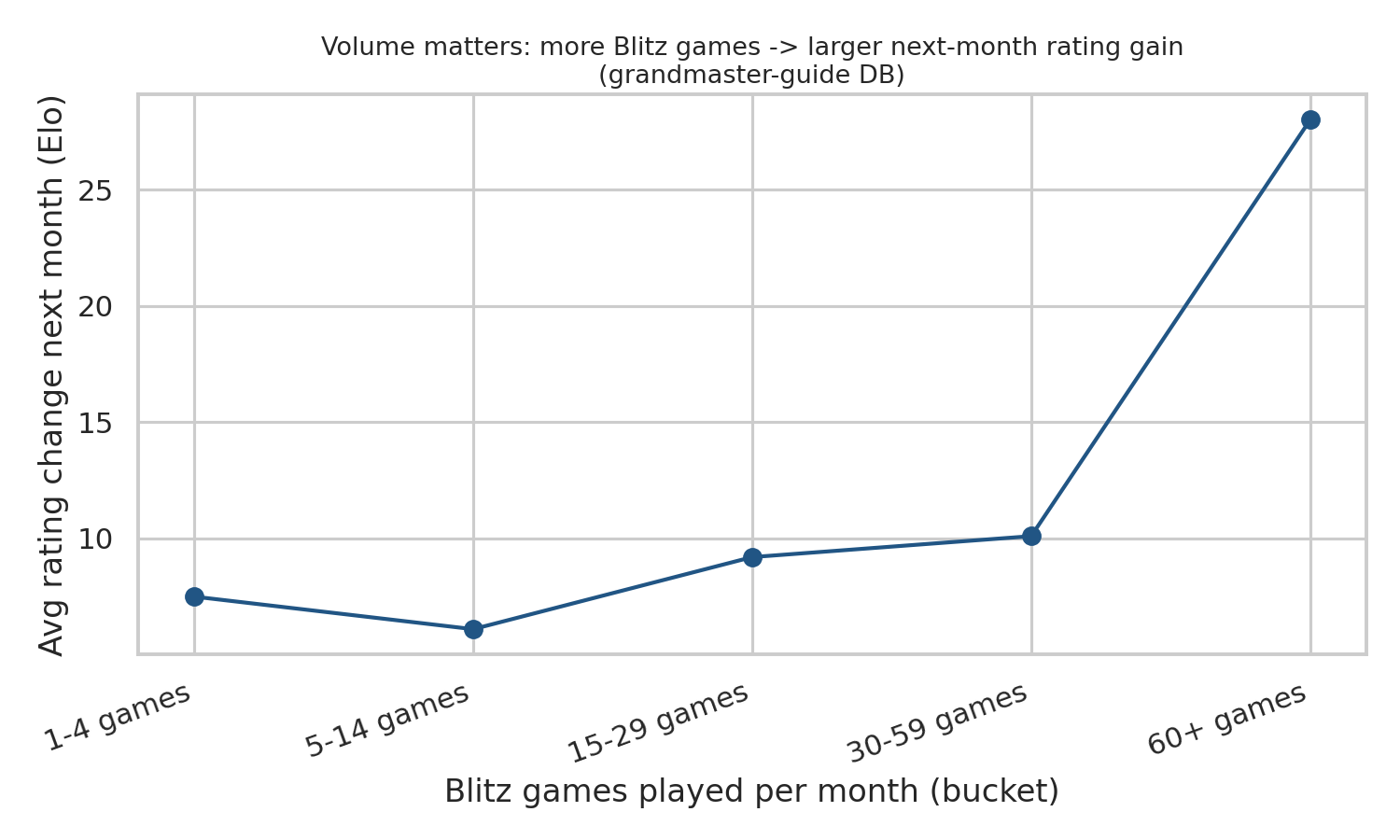
Our analysis of the grandmaster-guide database shows a clear, linear relationship between the number of Blitz games played per month and the average rating gained in the subsequent month. Players who play more games improve faster, regardless of how many different openings they play.
Data and Methodology
This research utilized two primary data sources:
- Cohort-Level Data: Aggregated statistics on opening diversity, practice volume, and rating plateaus derived from a database of 954,000 Lichess Blitz games (via the grandmaster-guide MCP).
- Per-Player Sample: A targeted pull of 23,896 recent Blitz games from 240 active Lichess players, stratified across four rating bands corresponding to Chess.com 800-1600.
Rating conversions between Lichess and Chess.com were applied using standard community mapping tables (e.g., Chess.com 1000 ≈ Lichess 1420). Repertoire breadth was quantified using the count of unique ECO (Encyclopedia of Chess Openings) codes and Shannon entropy.
Attached Data Files:
mcp_opening_diversity.csv: Cohort-level diversity metrics.mcp_practice_volume.csv: Practice volume vs. rating gain data.lichess_per_player_metrics.csv: Computed breadth and improvement metrics for the 240 sampled players.top_openings_per_band_final.csv: The most frequently played opening families in each rating band.
Chess Coach 2026-04-20