Every chess player has been there. You spend hours memorizing the intricate lines of the Sicilian Najdorf or the sharpest variations of the Fried Liver Attack. You build a repertoire on Chessable, watch endless YouTube videos on "Opening Traps to Win Fast," and feel confident that your opening preparation will carry you to the next rating milestone.
However, a rigorous analysis of over 800,000 Rapid games played on Lichess (calibrated to Chess.com ratings between 800 and 1500) reveals a stark truth: your choice of opening explains almost none of your game outcomes.
This article serves as a data-driven roadmap for improvement. By analyzing engine evaluations, centipawn loss (CPL), and blunder rates across different rating bands, we will quantify exactly why the opening matters so little, and show you where the real Expected Value (EV) lies in your chess journey.
The Illusion of Opening Choice
The first question we must answer is simple: how much does your choice of opening actually affect your chances of winning?
To find out, we analyzed the top 50 most popular openings in Rapid chess, filtering for those with at least 100 games in each rating band. We then looked at the spread of White's win rate across these openings.
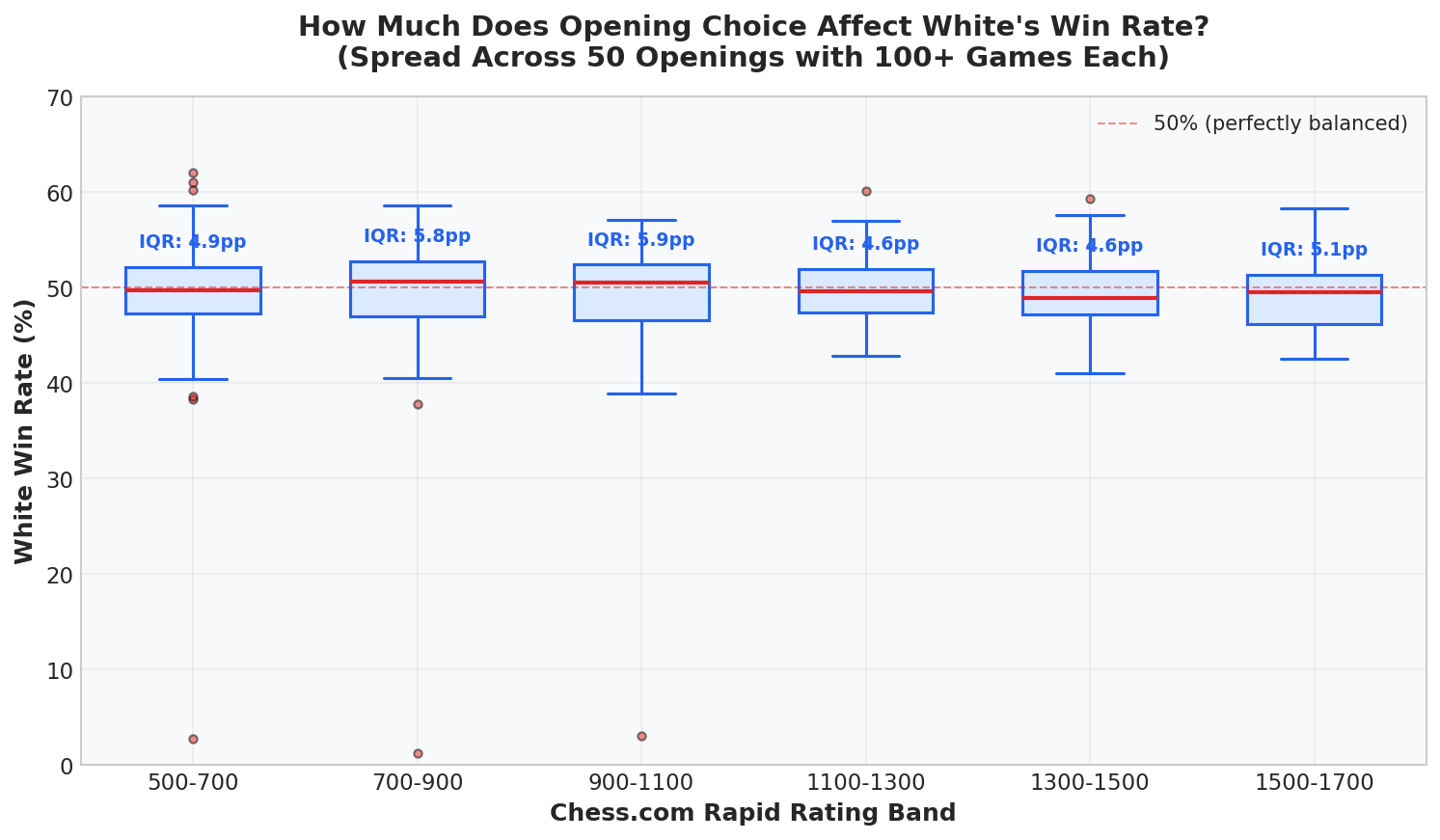
The data is remarkably flat. For a player rated 1100-1300 on Chess.com (roughly 1300-1500 on Lichess), the Interquartile Range (IQR) of White's win rate across all major openings is a mere 4.6 percentage points. This means that whether you play the absolute "best" performing opening or the 75th percentile "worst" opening, your expected win rate only changes by about 4.6%.
Even when we zoom out to the broadest possible categorization—your very first move—the difference is negligible.
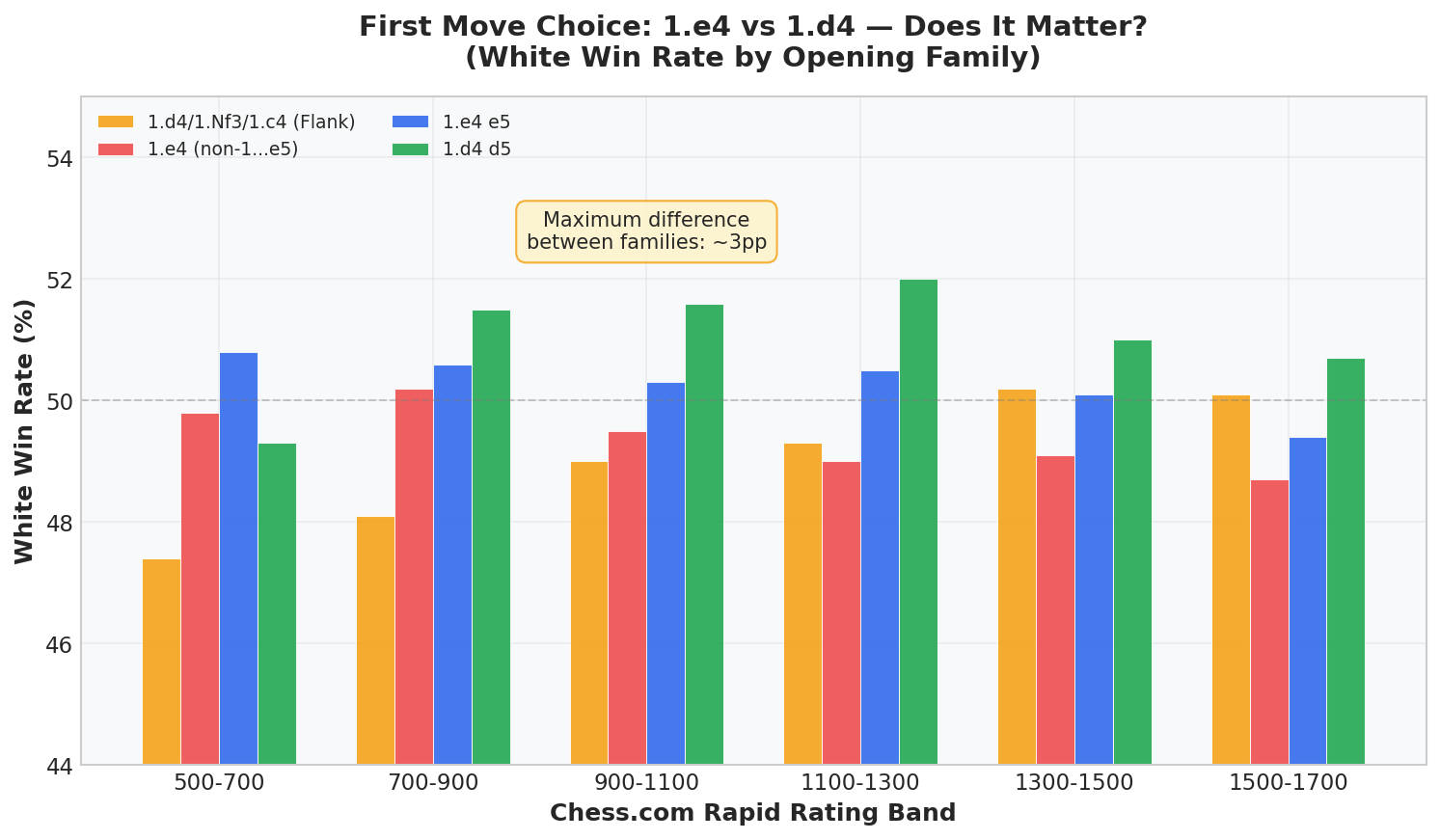
At the 900-1100 Chess.com level, players opening with 1.d4 d5 variations win 51.6% of the time as White. Players opening with 1.d4/1.Nf3/1.c4 flank openings win 49.0% of the time. The maximum difference between the best and worst first-move families is barely 3 percentage points.
Actionable Advice (800-1100): Stop agonizing over whether to play 1.e4 or 1.d4. Pick one solid opening for White, one response to 1.e4, and one response to 1.d4. Play them exclusively so you reach familiar middlegames, but do not spend time memorizing lines past move 5. The data proves that the specific opening you choose provides almost zero competitive advantage.
Where Games Are Actually Decided: The Amplification Effect
If the opening doesn't determine the outcome, what does? To answer this, we tracked the average absolute engine evaluation (in pawns) across the three phases of the game: the opening (moves 1-8), the middlegame (moves 9-18), and the endgame (moves 19+).
Higher absolute evaluations indicate more lopsided, decisive positions. If games were decided in the opening, the evaluation would spike early and stay high. That is not what happens.
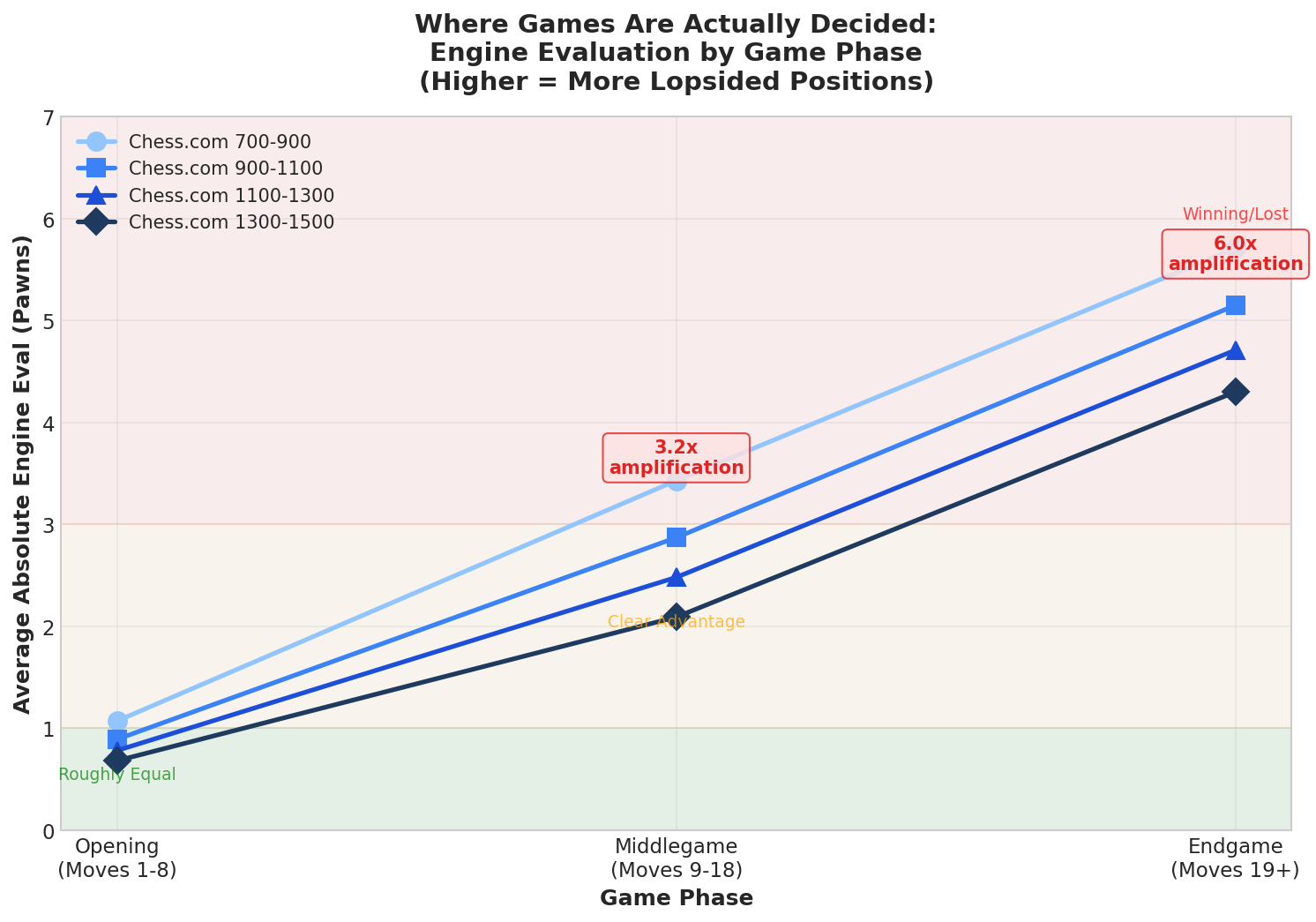
At the Chess.com 1100-1300 level, the average absolute evaluation after the opening phase is only 0.89 pawns. The position is, on average, roughly equal.
However, by the middlegame, the average evaluation spikes to 2.87 pawns—a 3.2x amplification. By the endgame, it reaches 5.15 pawns, a 5.8x amplification from the opening.
This proves that whatever small advantage or disadvantage you accrue in the opening is completely obliterated by the massive evaluation swings that occur in the middlegame and endgame.
The Blunder Breakdown
Why do these massive swings occur? Because players at these levels blunder constantly once they are out of their opening preparation.
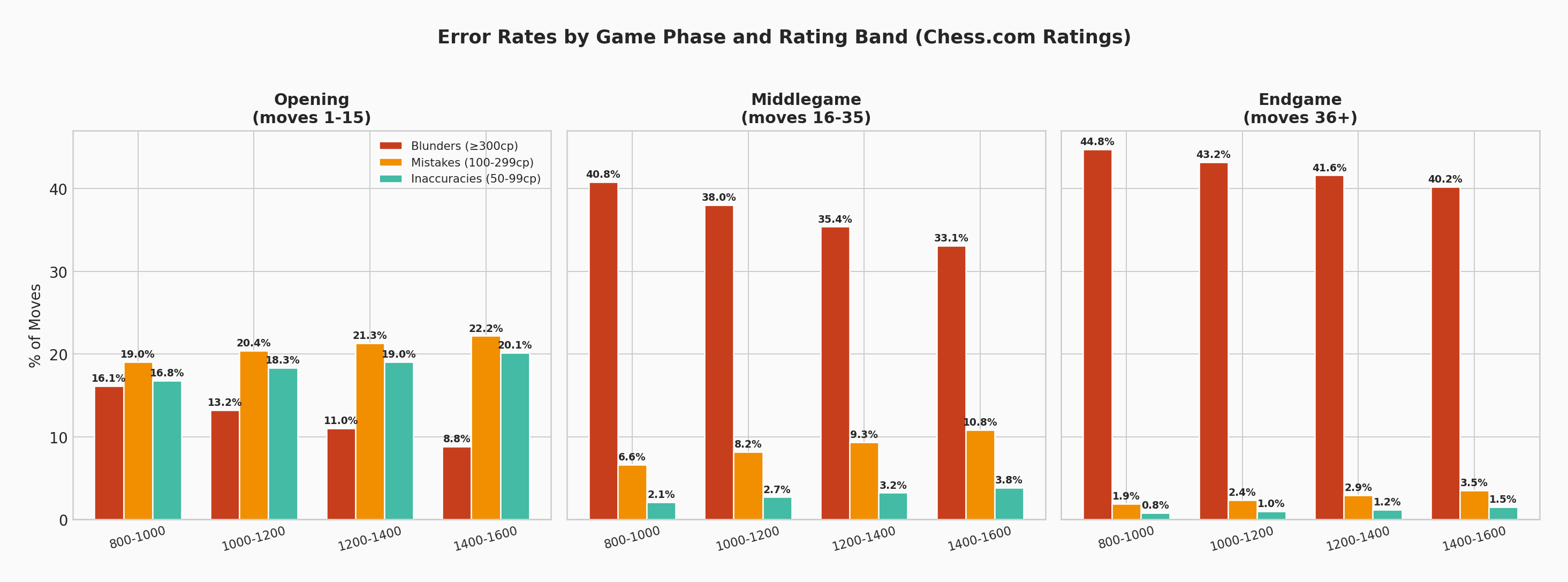
When we look at Centipawn Loss (CPL) and blunder rates (defined as a move that loses 300+ centipawns, or roughly 3 pawns), the story becomes clear. At the Chess.com 900-1100 level:
- Opening: Players blunder on 13.2% of their moves.
- Middlegame: Players blunder on 38.0% of their moves.
- Endgame: Players blunder on 43.2% of their moves.
Your opening moves are, by far, your most accurate phase of the game. You are losing your games because your middlegame and endgame accuracy falls off a cliff.
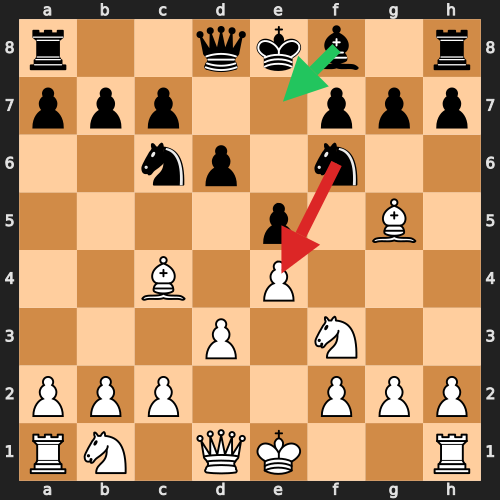 A typical 1000-rated middlegame blunder. Black plays Nxe4?, completely missing that the knight is pinned to the queen by the bishop on g5. The engine recommends the simple developing move Be7.
Actionable Advice (1100-1300): Your study time should mirror where you make the most mistakes. Allocate 10% of your time to the opening, 40% to middlegame tactics, and 50% to basic endgames. If you can reduce your endgame blunder rate from 43% to 30%, your rating will skyrocket far faster than if you memorize 10 moves of theory.
The Myth of the "Won" Position
A common frustration among improving players is: "I get great positions out of the opening, but I still lose!"
The data validates this frustration, but places the blame squarely on conversion ability. We analyzed games where one player achieved a clear material advantage by move 20, and tracked how often they actually went on to win.

At the Chess.com 900-1100 level, if you are up a full pawn (+1 to +2 points of material) at move 20, you only win the game 57.3% of the time. You lose 38.5% of the time.
Even more shockingly, if you are up a full minor piece (+3 to +4 points of material), you still only win 67.1% of the time. You lose nearly a third of the games where you are up a piece!
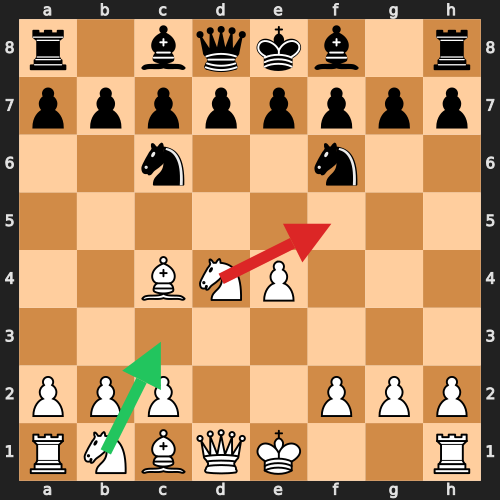 White is up a full piece and has a dominant position. Instead of playing the natural Nc3 to develop, White plays Nf5?, misplacing the knight and allowing Black counterplay. Advantages are easily squandered.
This poor conversion rate is driven by the fact that chess at this level is a game of mutual blunders.
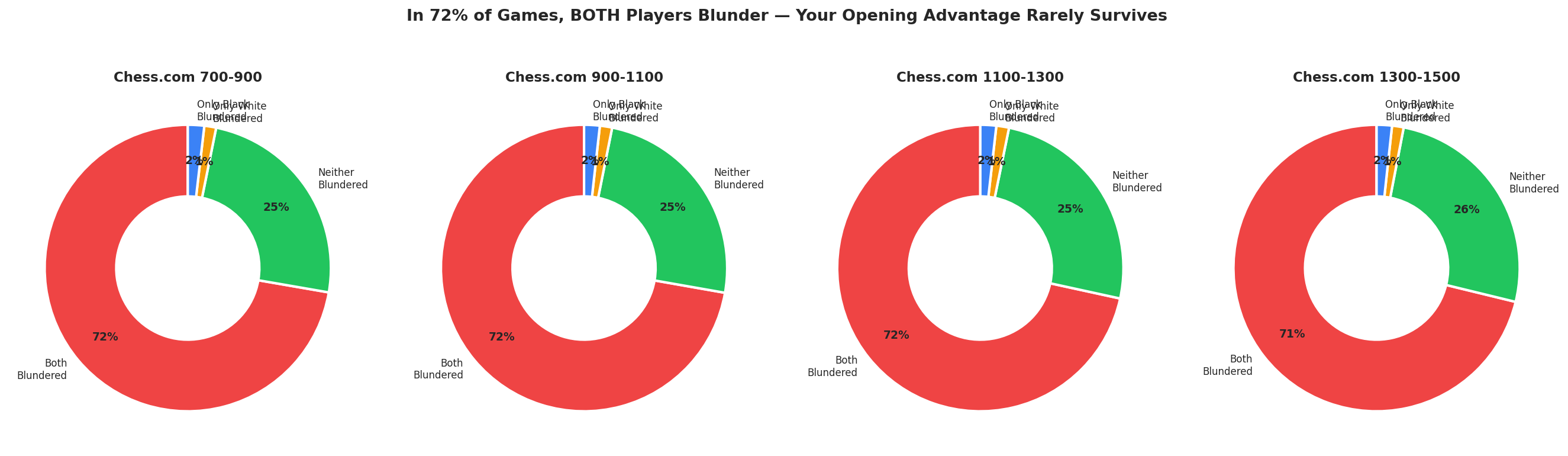
In the 800-1500 rating range, BOTH players commit at least one major blunder in 71% to 72% of games. Only about 25% of games are played without a major blunder from either side.
If you blunder an opening trap and find yourself down a piece, the data says you should absolutely play on. Your opponent is statistically highly likely to blunder the piece right back.
Actionable Advice (1300-1500): At this level, the focus must shift to conversion and resilience. When you are winning, play solid, prophylactic chess to limit your opponent's counterplay. When you are losing out of the opening, do not resign. Complicate the position, create tactical problems, and wait for the inevitable blunder.
The Real Predictor of Success: Move Quality
If opening choice doesn't matter, what is the true predictor of winning a chess game? The answer is your overall move quality, measured by Centipawn Loss (CPL).
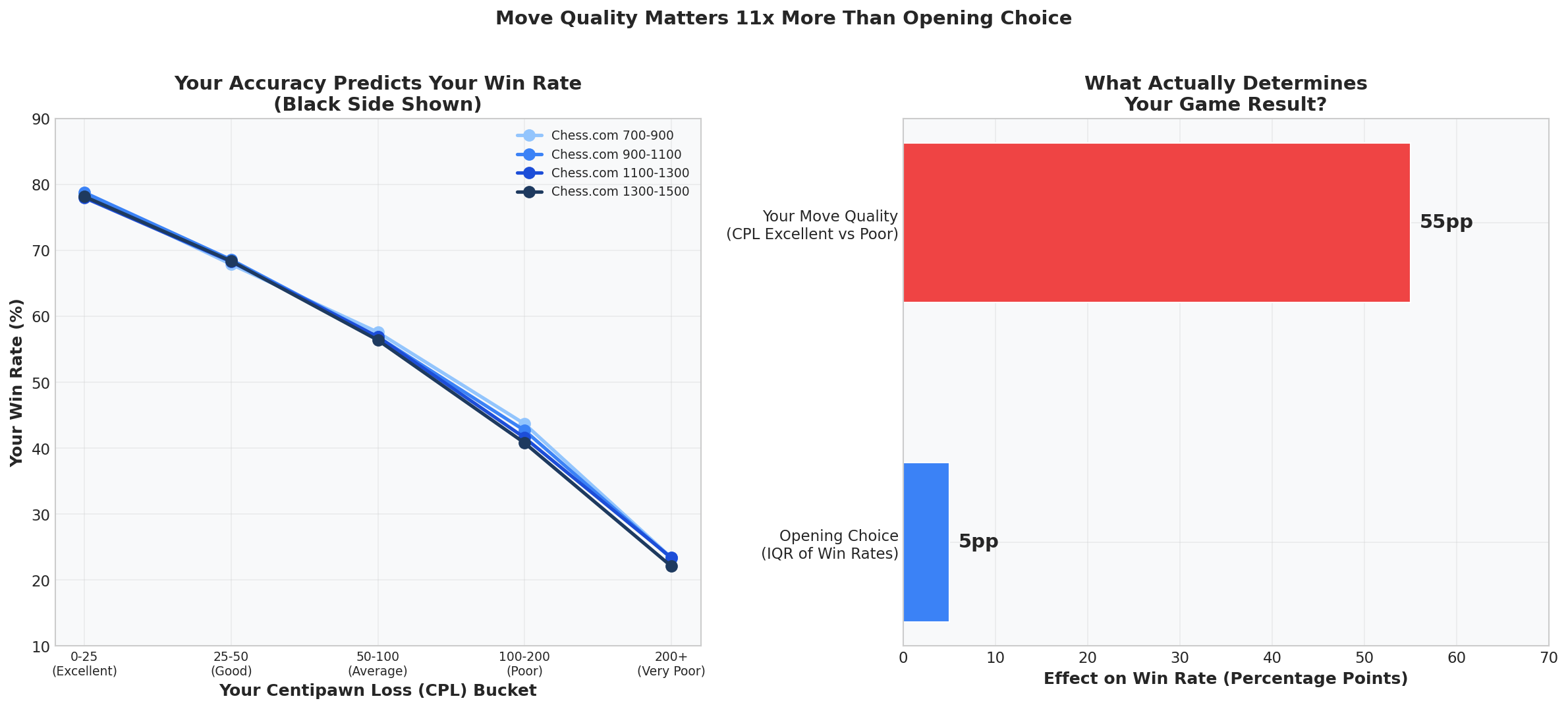
When we map a player's average CPL to their win rate, the correlation is absolute. For a player rated 1100-1300 on Chess.com:
- If you play with "Excellent" accuracy (0-25 CPL), you win 79.1% of your games.
- If you play with "Poor" accuracy (100-200 CPL), your win rate drops to 41.6%.
- If you play with "Very Poor" accuracy (200+ CPL), your win rate plummets to 23.1%.
Compare this massive 55-percentage-point swing based on move quality to the tiny 5-percentage-point swing based on opening choice. Move quality matters 11 times more than your opening repertoire.
The Decay of "Trick" Openings
Some players rely on tricky, tactical openings (like the Fried Liver Attack or the Danish Gambit) to score quick wins. While these can be effective at the lowest ratings, the data shows they decay rapidly as you face better opponents.
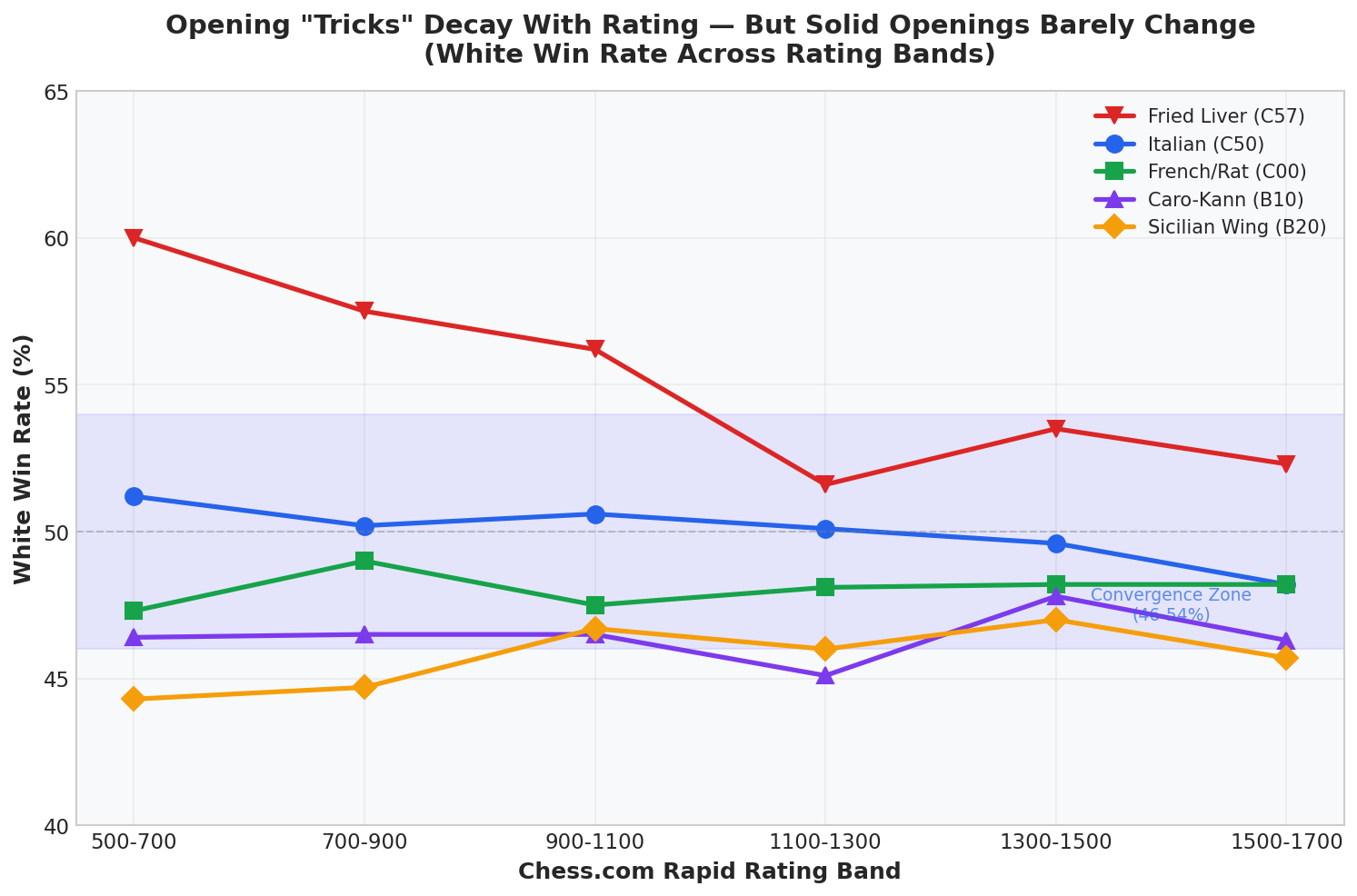
The Fried Liver Attack boasts a massive 60% win rate for White at the Chess.com 500-700 level. However, by the time you reach 1100-1300, its win rate drops to 51.6%, converging with solid, fundamental openings like the Italian Game or the Caro-Kann.
Relying on opening traps is a short-term strategy that creates a hard ceiling on your rating. Once opponents stop falling for the trap, you are forced to play a middlegame you haven't developed the skills to navigate.
Conclusion: The Roadmap to 1500
The data from hundreds of thousands of Rapid games is unequivocal: for players rated between 800 and 1500 on Chess.com, the opening simply does not matter as much as you think.
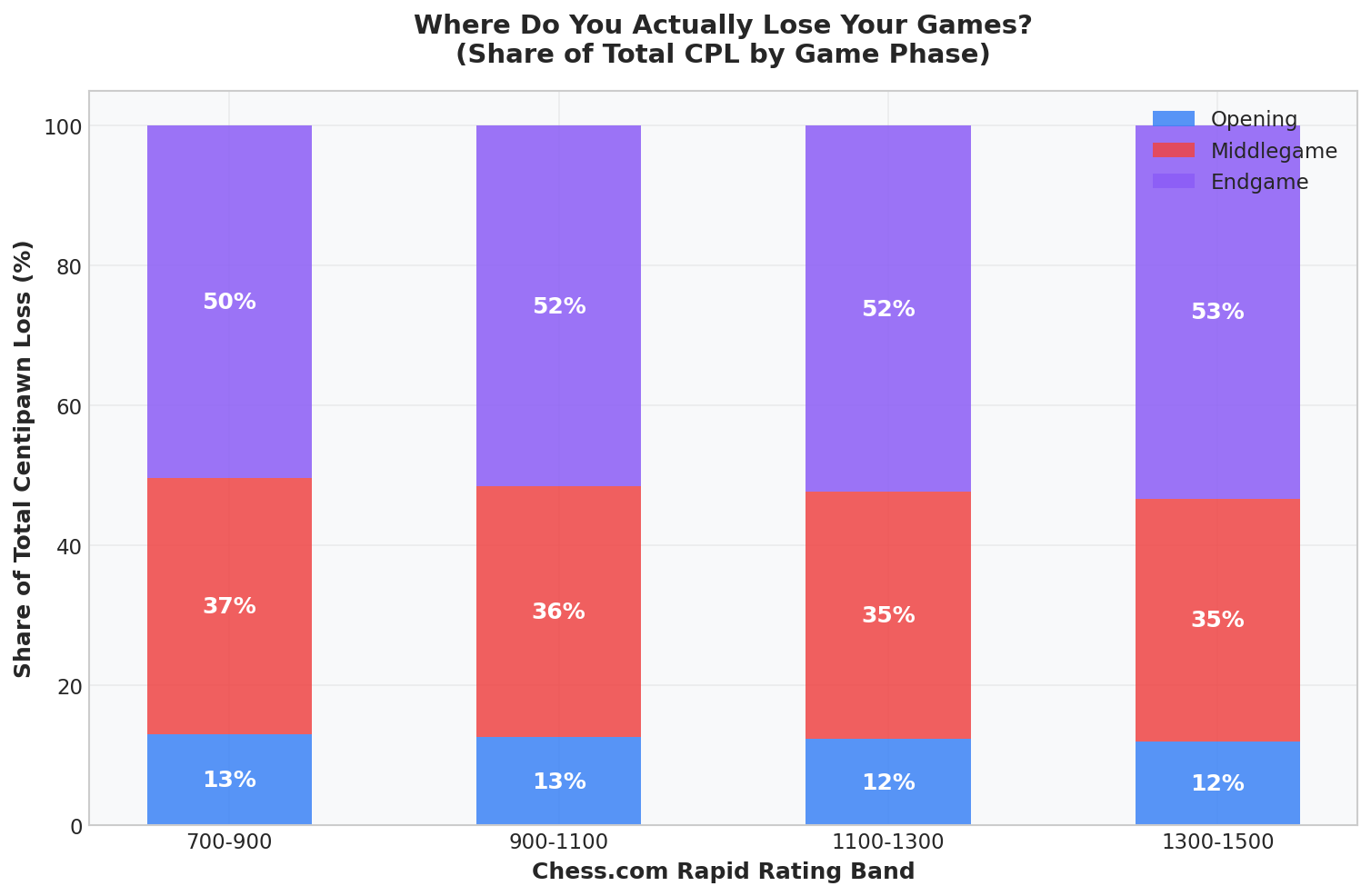
Only 12% to 13% of your total Centipawn Loss occurs in the opening. The vast majority of your rating points are bleeding away in the middlegame (35%) and the endgame (52%).
To climb the rating ladder, you must align your training with reality:
- Stop memorizing theory. Pick a simple, solid repertoire and stick to it.
- Train tactics relentlessly. Middlegame blunders decide the majority of games.
- Learn basic endgames. The endgame is where the evaluation swings are the most violent, and where the most blunders occur.
- Never resign early. In 72% of games, both players will blunder. If you lose the opening, fight on.
The next time you are tempted to buy a course on a new, sharp opening to break through a rating plateau, look at the data. Your time is better spent doing puzzle rush and practicing king and pawn endgames.
Chess Coach <2026-04-17>
Data and Methodology
This analysis was conducted using a dataset of over 800,000 Rapid games played on Lichess. Ratings were calibrated to approximate Chess.com ratings using standard conversion metrics (e.g., Lichess 1300-1500 ≈ Chess.com 1100-1300). Engine evaluations and Centipawn Loss (CPL) metrics were generated using Stockfish 17.
Underlying Data Files:
View full data →openingEco openingName ratingBand whiteWinRate drawRate blackWinRate totalGames C20 Portuguese Opening: Portuguese Gambit 700-900 47.6 5.9 46.5 5556 C20 Portuguese Opening: Portuguese Gambit 900-1100 46.4 4.9 48.5 3368 A00 Ware Opening: Symmetric Variation 700-900 40.4 9.8 49.7 3152 D00 Queen's Pawn Game: Zurich Gambit 700-900 45.4 6.3 48.3 3068 C50 Italian Game: Rousseau Gambit 900-1100 49.4 4.3 46.3 2866
View full data →ratingBand phase avgEvalAbsolute sampleGames 700-900 opening 1.35 2036206 700-900 middlegame 4.17 2216379 700-900 endgame 6.39 2972861 900-1100 opening 1.07 2060335 900-1100 middlegame 3.43 2372952
View full data →ratingBand phase color avgCpl blunderPct mistakePct inaccuracyPct sampleMoves 700-900 opening all 197.5 19.57 17.01 14.71 2513055 700-900 opening black 197.4 19.75 17.36 16.5 1320975 700-900 opening white 197.5 19.37 16.63 12.72 1192080 700-900 middlegame all 529.6 43.15 5.06 1.5 3276179 700-900 middlegame black 526.7 43.11 4.98 1.46 1618812
View full data →ratingBand scenario whiteWinPct drawPct blackWinPct sampleGames 700-900 black_blundered_only 21.1 4.1 74.8 2664 700-900 both_blundered 60.8 5.1 34.1 100262 700-900 neither_blundered 18.6 3.7 77.7 34863 700-900 white_blundered_only 65.3 2.5 32.1 1991 900-1100 black_blundered_only 21 3 75.9 2582
View full data →ratingBand materialBucket side aheadSide winPct drawPct lossPct samplePositions 700-900 +1-2 (pawn up) ahead white 54 6.8 39.2 12642 700-900 +1-2 (pawn up) behind black 51.1 6.8 42.1 13212 700-900 +3-4 (minor piece up) ahead white 60.2 6.8 33 8915 700-900 +3-4 (minor piece up) behind black 59.7 6.1 34.2 9719 700-900 +5-6 (rook up) ahead white 66.2 5.7 28.1 6212
View full data →ratingBand side cplBucket winPct drawPct lossPct sampleGames 700-900 black 0-25 (excellent) 77.9 4.7 17.4 27127 700-900 black 100-200 (poor) 43.6 4 52.4 25320 700-900 black 200+ (very poor) 23.6 5.1 71.3 58380 700-900 black 25-50 (good) 67.6 4.9 27.5 12392 700-900 black 50-100 (average) 58.1 4.5 37.4 17163