For Beginner to Intermediate chess players, the opening phase often feels like the most critical part of the game. Countless hours are spent memorizing theory, watching YouTube videos on "trappy" lines, and searching for the perfect repertoire to gain an early advantage. However, when we look at the data—specifically in the fast-paced world of Bullet chess—a different reality emerges.
This article analyzes a massive dataset of Lichess Bullet games, mapped to Chess.com ratings between 800 and 1500, to answer a fundamental question: How much does your opening choice actually matter? The data reveals that outcome variance is driven far more by middlegame chaos, endgame blunders, and clock management than by the first few moves on the board.
1. The Illusion of the "Winning" Opening
A common misconception is that choosing the "right" opening will significantly boost your win rate. While certain openings do perform slightly better than others at specific rating levels, the overall spread is surprisingly narrow.
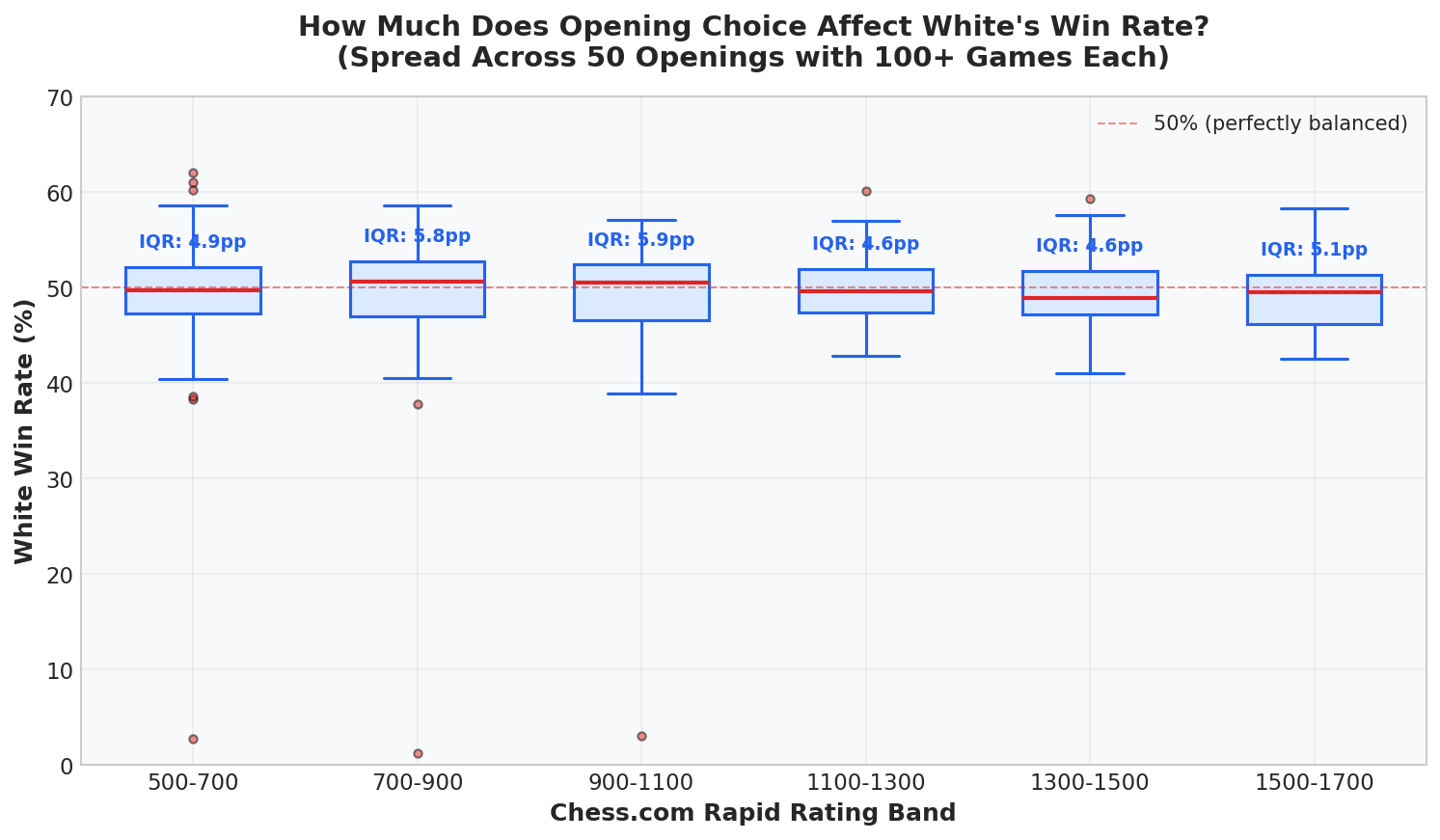
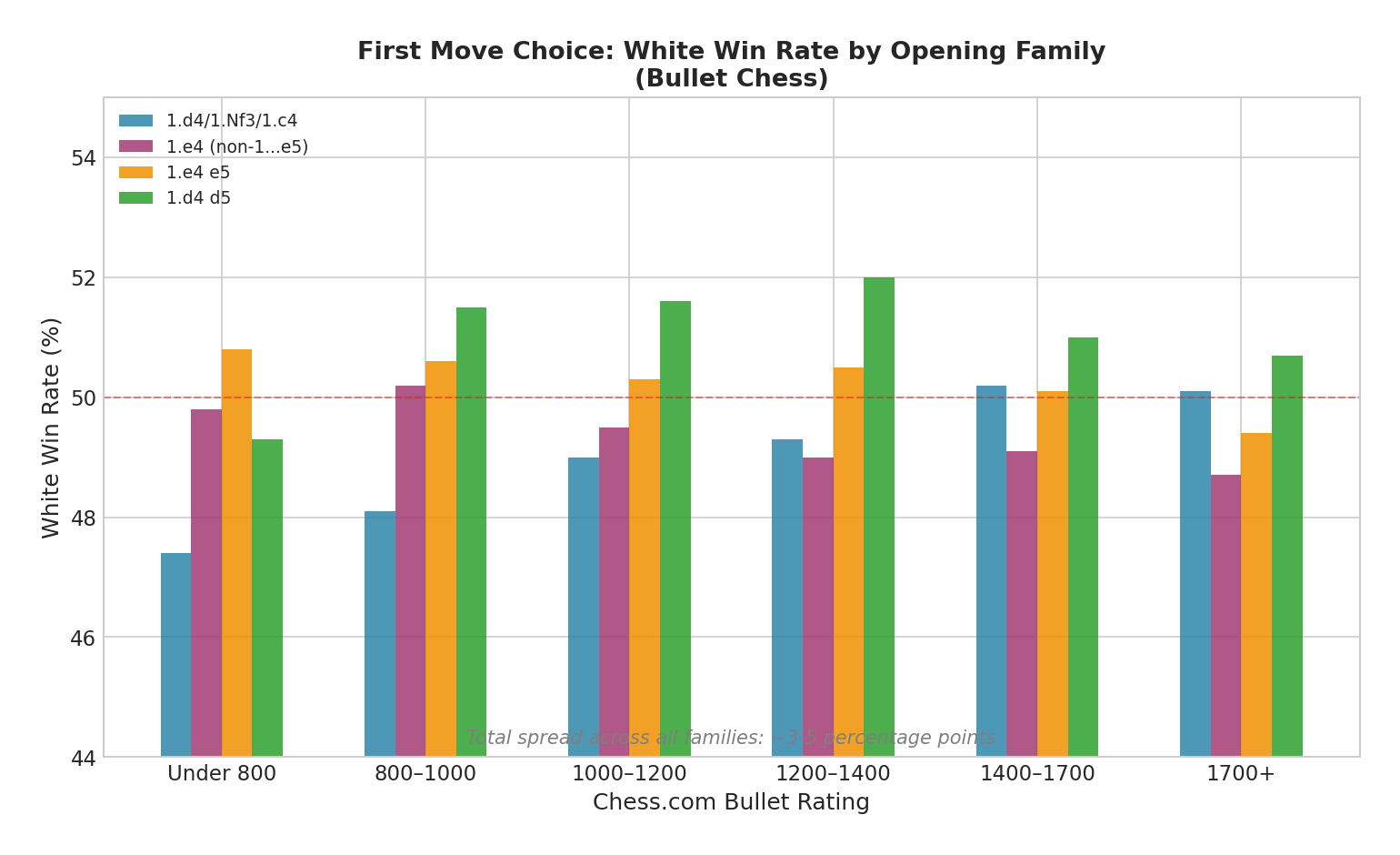
When we examine the win rates of various first-move families (e.g., 1.e4 vs. 1.d4), the differences are marginal. Across all rating bands from 800 to 1500, the white win rate for major opening families clusters tightly between 47% and 52%.
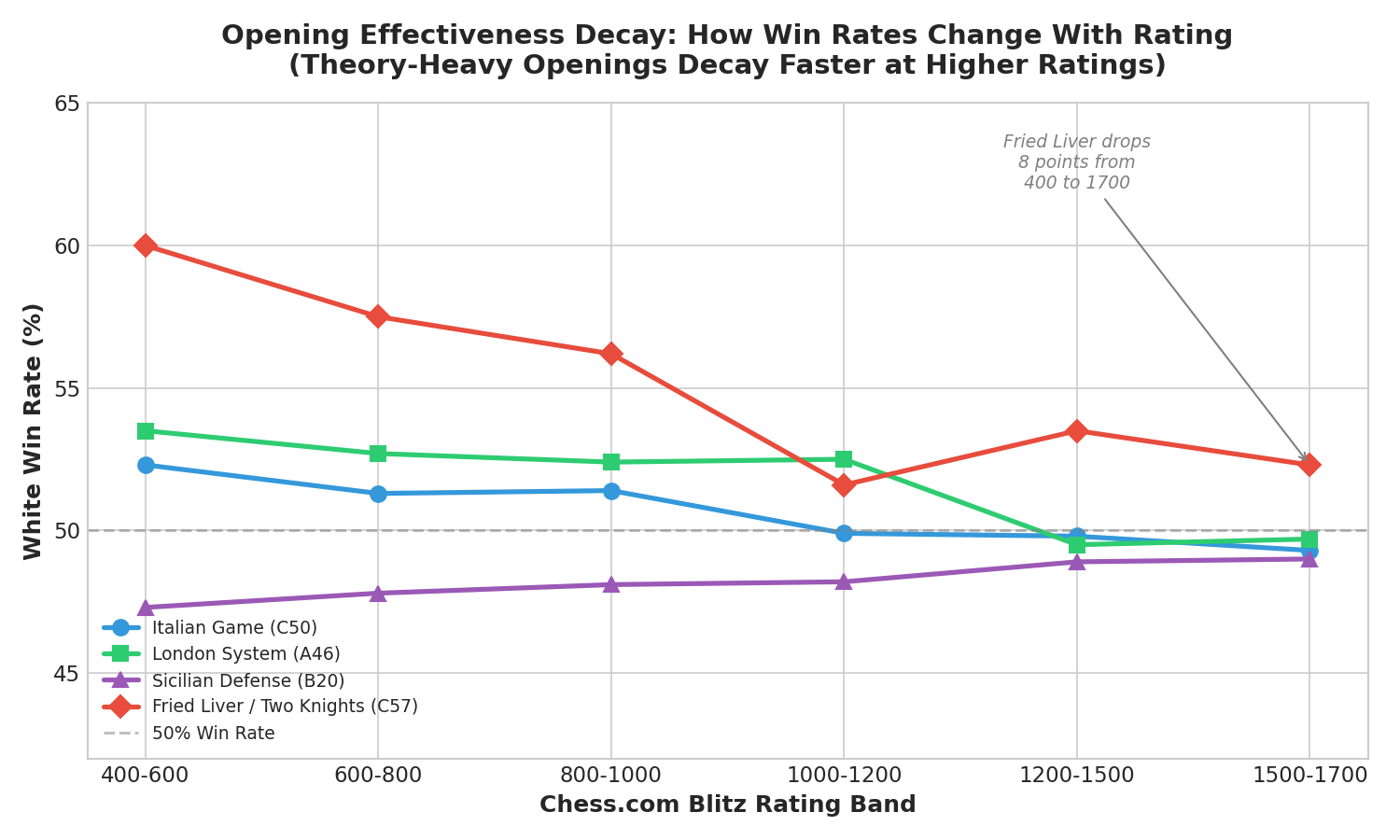
Even when we look at specific, highly tactical openings known for early traps (like the Fried Liver Attack or the Ulvestad Variation of the Two Knights Defense), their effectiveness decays rapidly as players improve. By the time players reach the 1200-1400 range, almost all openings converge toward a ~50% win rate.
Actionable Advice (Under 1000): Stop worrying about finding a "secret weapon" opening. Pick one or two solid setups for White and Black, learn the basic principles (control the center, develop pieces, castle early), and stick with them. Your time is better spent practicing basic tactics.
2. Where Games Actually Go Wrong
If the opening isn't deciding the game, what is? The data points clearly to the middlegame and endgame.
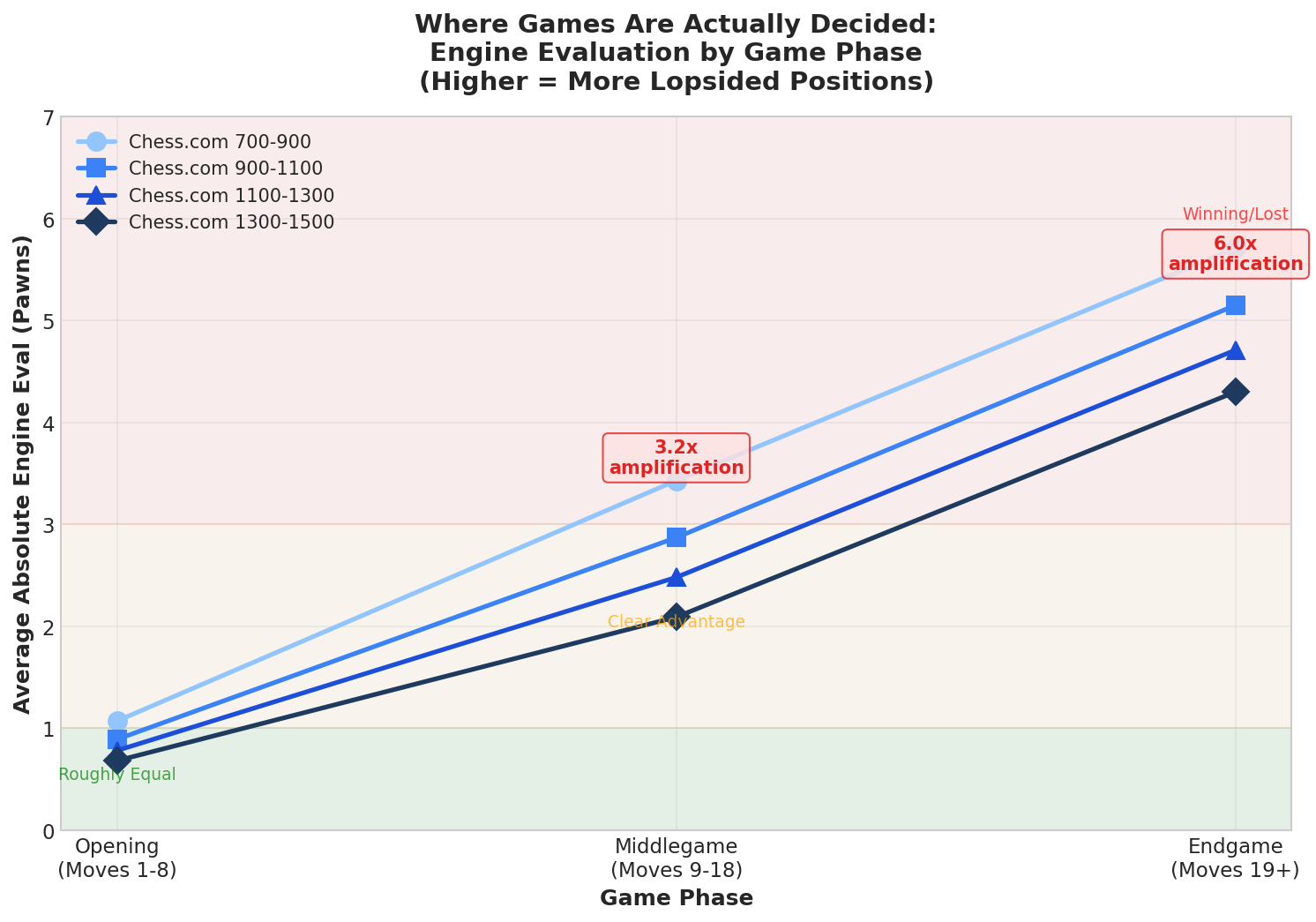
By tracking the average absolute engine evaluation (measured in pawns) across different phases of the game, we can see exactly where the position becomes imbalanced. In the opening (moves 1-7), the average evaluation stays below 1.5 pawns across all rating levels. It is only in the middlegame (moves 8-17) and endgame (move 18+) that the evaluation swings wildly.
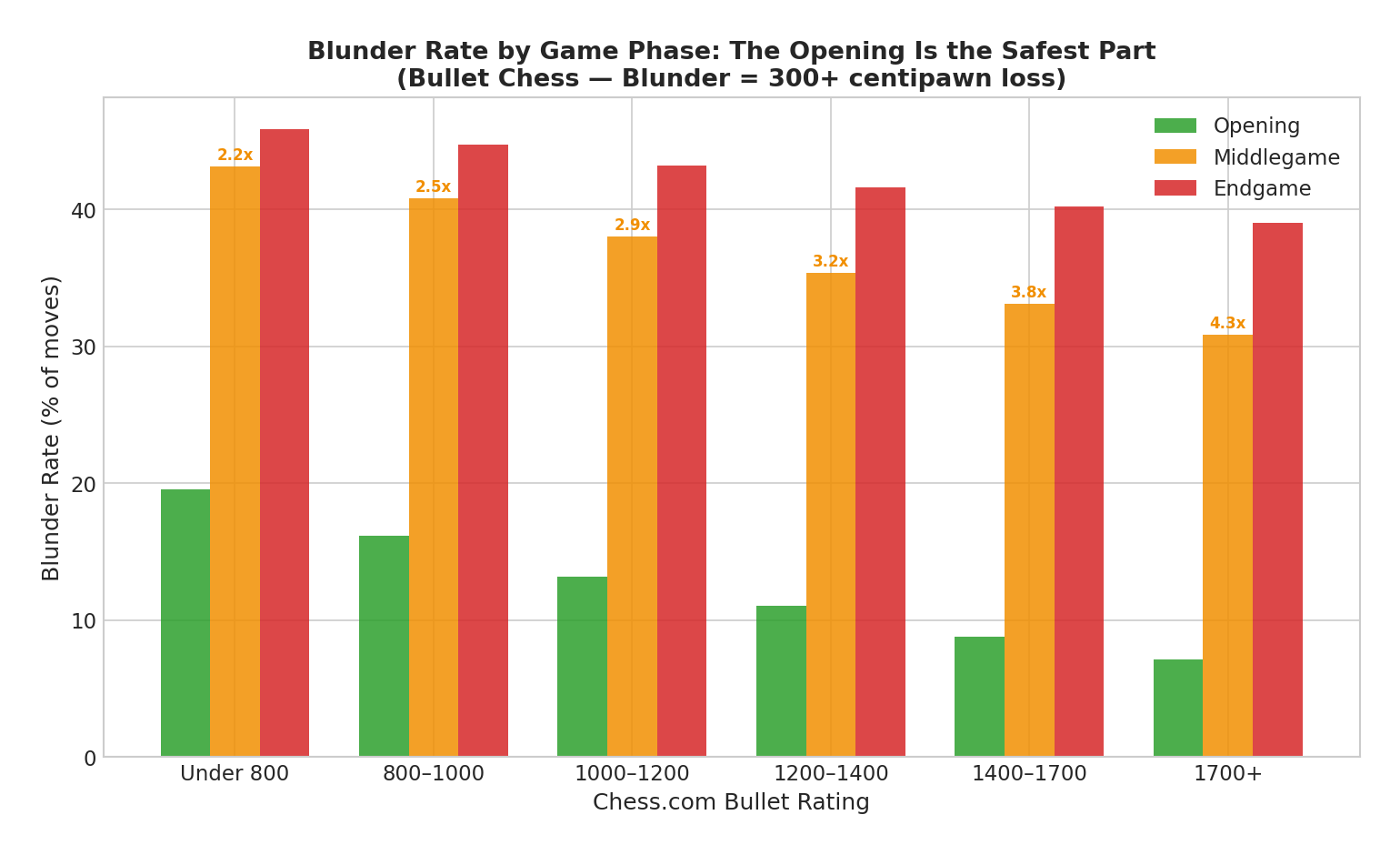
This is further supported by analyzing blunder rates. A blunder is defined as a move that worsens the position by 300 centipawns (3 pawns) or more. The opening is, statistically, the safest part of the game. Blunder rates explode in the middlegame and remain high in the endgame.
In fact, the average move number for the first blunder in a game occurs well after the opening phase has concluded. For players in the 1000-1200 range, the first blunder happens, on average, around move 22.
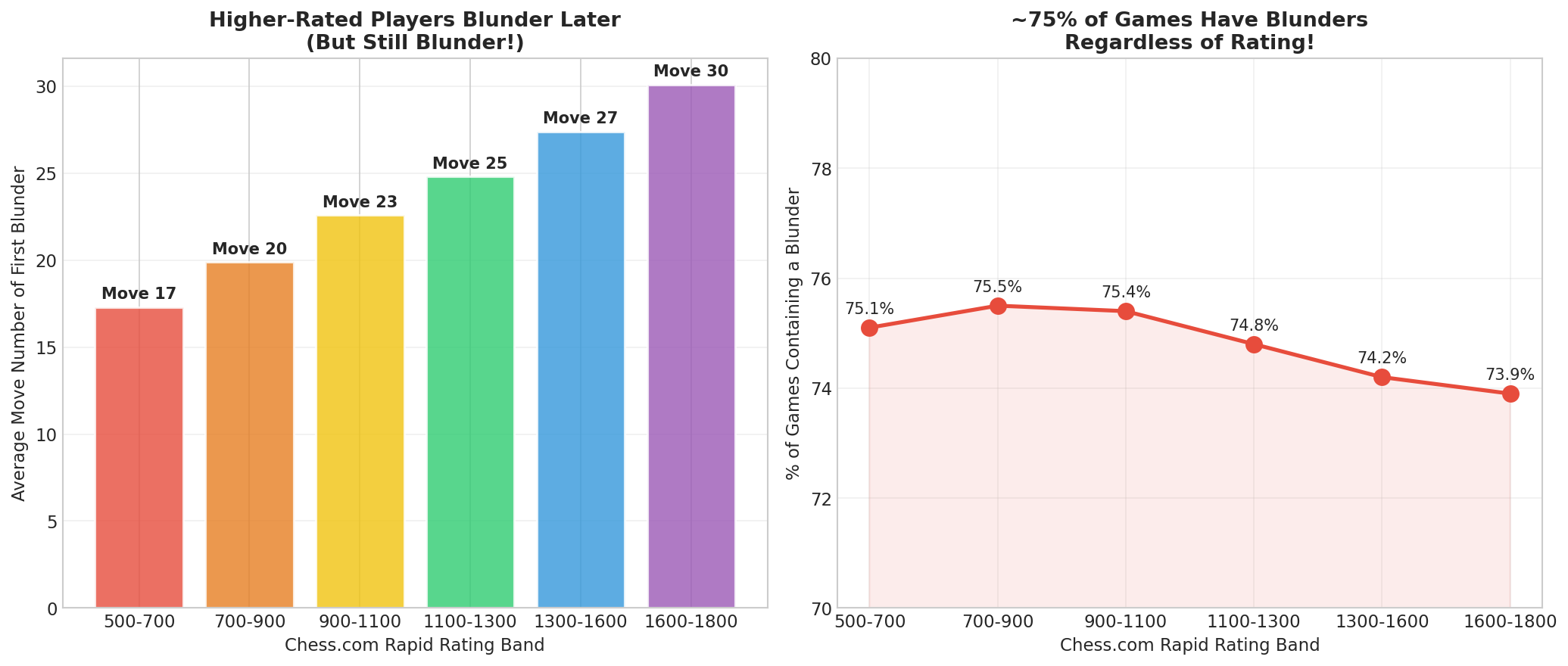
Actionable Advice (1000-1200): You are likely surviving the opening just fine. The real EV (Expected Value) lies in improving your middlegame calculation and board vision. Focus on identifying hanging pieces, simple two-move tactics, and maintaining king safety after the opening phase ends.
3. The Myth of the +1.0 Advantage
Many players obsess over achieving a +1.0 or +1.5 engine evaluation out of the opening, believing it guarantees a smooth path to victory. In Bullet chess, this is simply not true.
Let's look at the conversion rates for material advantages at move 20. Being up a full pawn (+1 to +2 material advantage) only translates to a win rate of roughly 54% to 57% in the 800-1500 rating range. Even being up a minor piece (+3 to +4) only wins about 63% to 67% of the time.
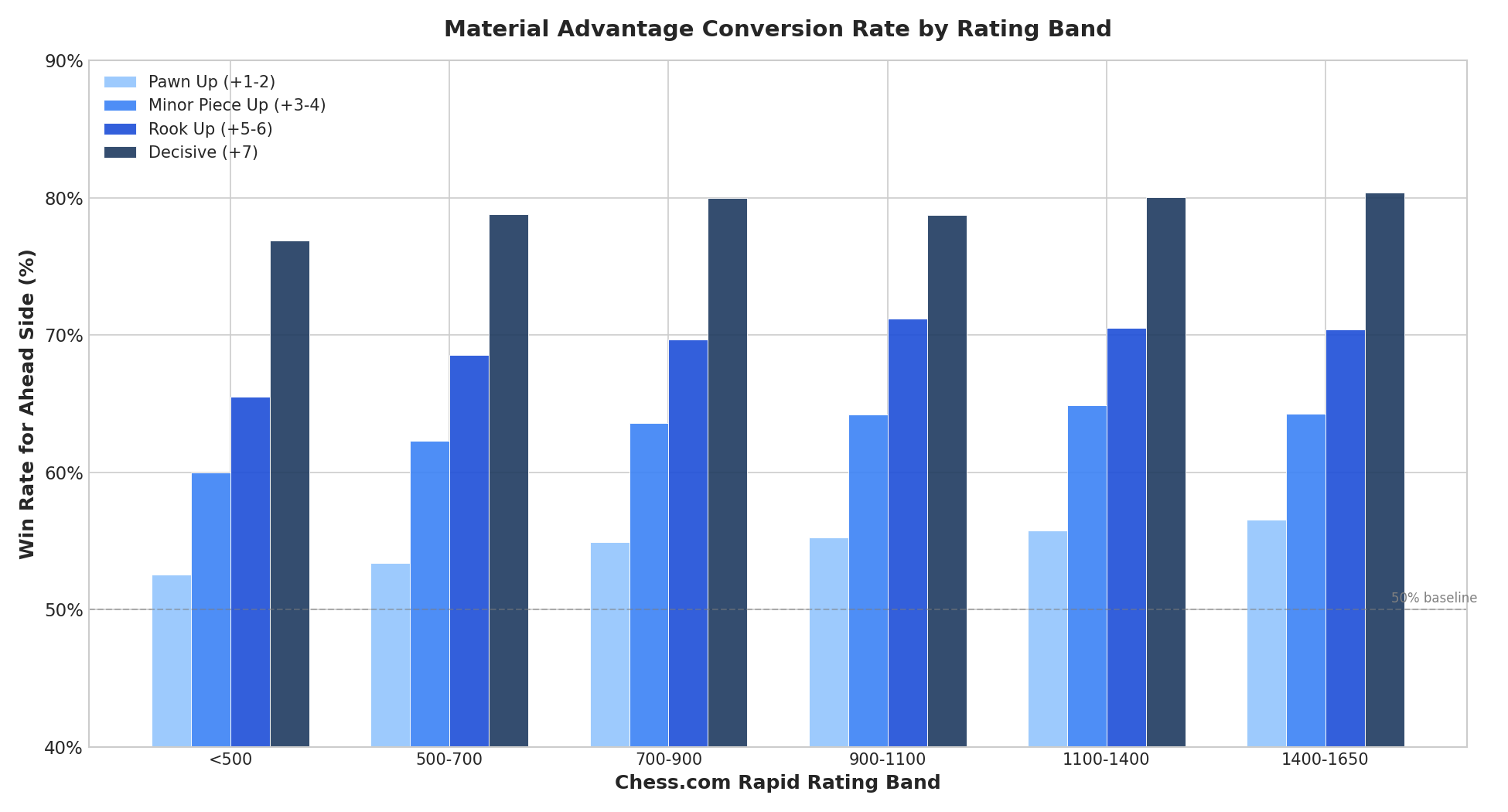
Why is this the case? Because Bullet chess is chaotic. A +1.0 advantage means nothing if you blunder a full piece three moves later under time pressure.
Consider this typical scenario: White plays a slightly dubious opening move, attempting a premature attack. The engine might evaluate the position as -1.0 in favor of Black. However, the position remains highly complex and playable.
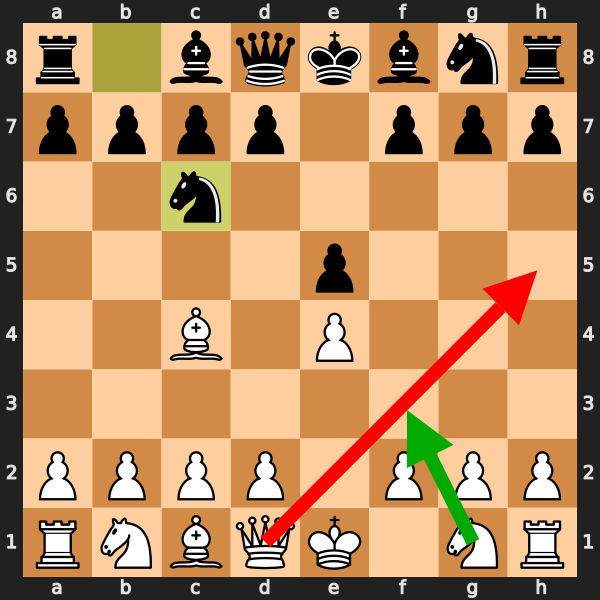 White plays 3.Qh5 (red arrow), a premature attack. The engine prefers 3.Nf3 (green arrow). Despite the inaccuracy, the game is far from decided.
The real deciding moments look more like this:
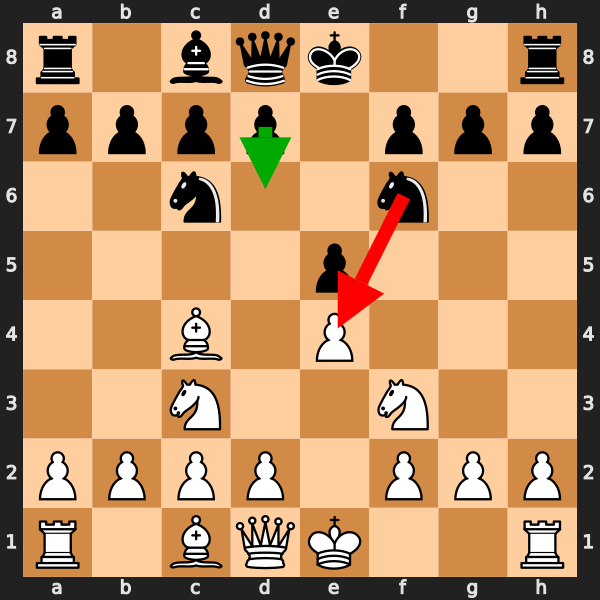 A typical middlegame blunder. Black plays Nxe4 (red arrow), hanging the knight. Solid development with d6 (green arrow) was required.
Actionable Advice (1200-1400): Do not resign or tilt if you feel you've "lost" the opening. A -1.0 or even -2.0 evaluation is highly recoverable in Bullet. Play practically, create complications, and wait for your opponent to make a mistake. Conversely, if you are up a pawn, do not relax; the game is still very much in the balance.
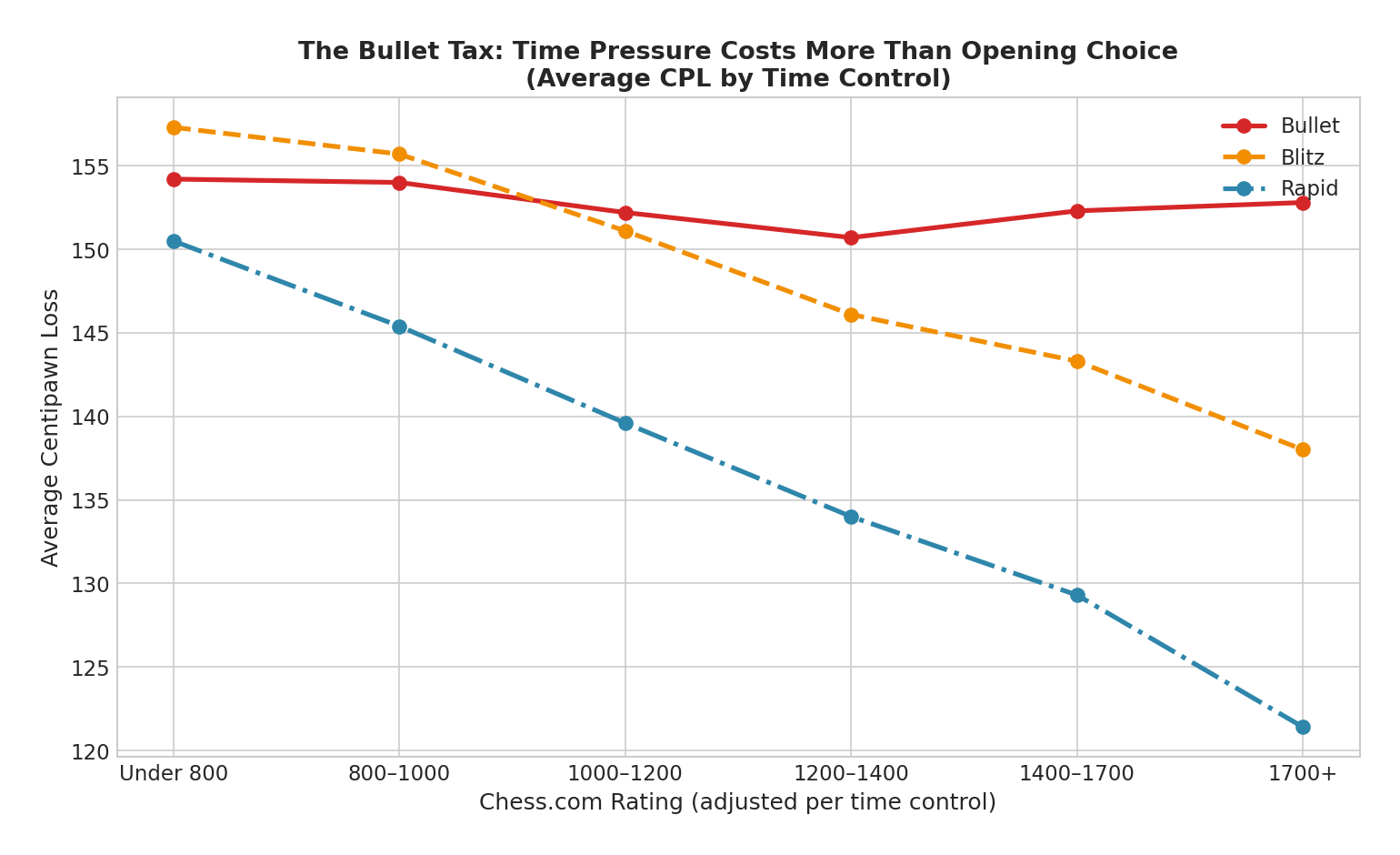
4. The Bullet Tax: Time Pressure is the Ultimate Equalizer
Finally, we must acknowledge the format itself. Bullet chess introduces a massive variable that overshadows opening preparation: the clock.
When we compare the average Centipawn Loss (CPL) across different time controls, Bullet consistently shows the highest error rates. The "Bullet Tax" is real—players make significantly worse moves when they have less than a second to think.
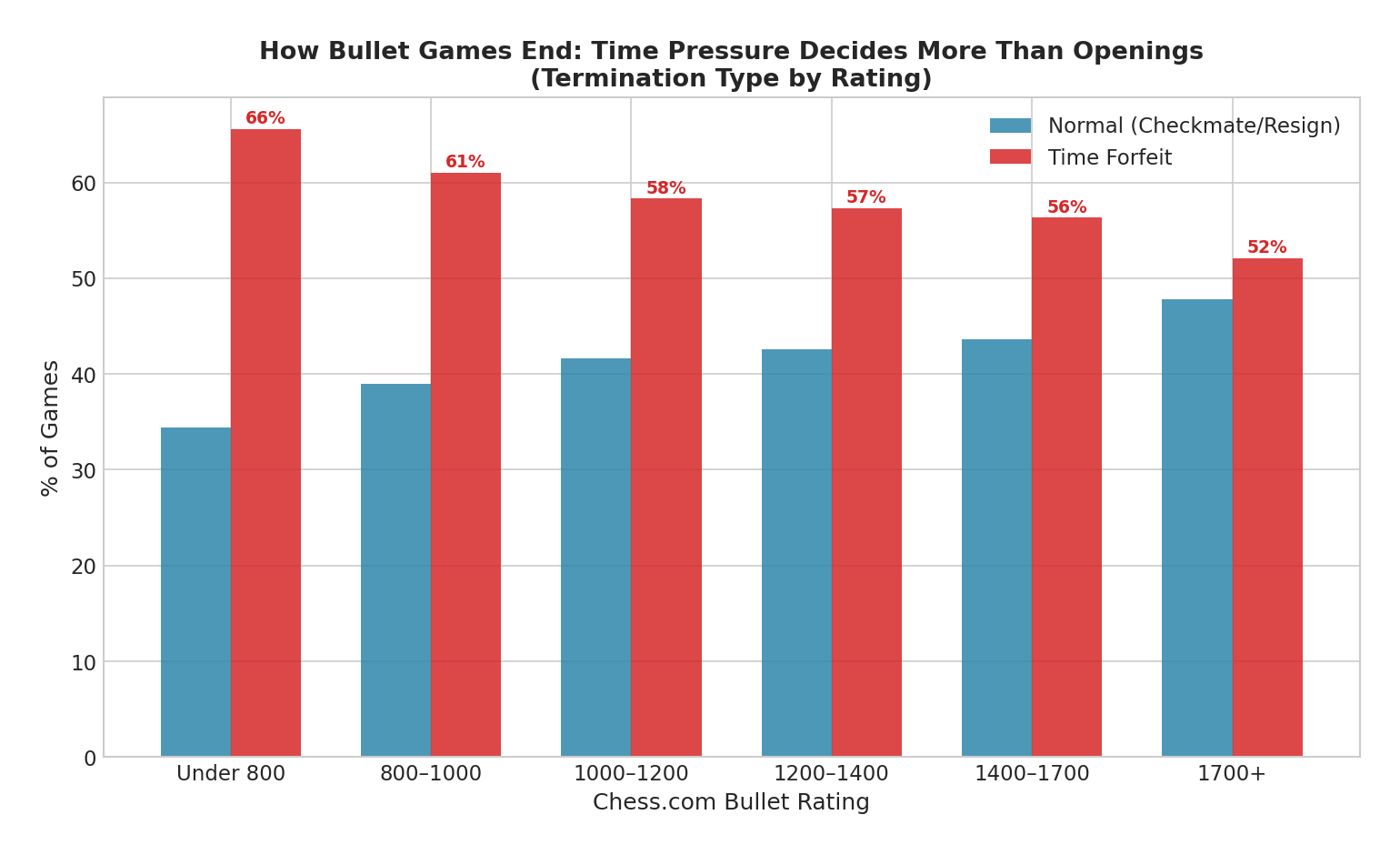
This time pressure leads to a staggering number of games being decided not by checkmate or resignation, but by the clock running out. In the 800-1500 range, roughly 57% to 61% of all Bullet games end in a time forfeit.
Under severe time pressure, even completely winning positions can be thrown away in an instant.
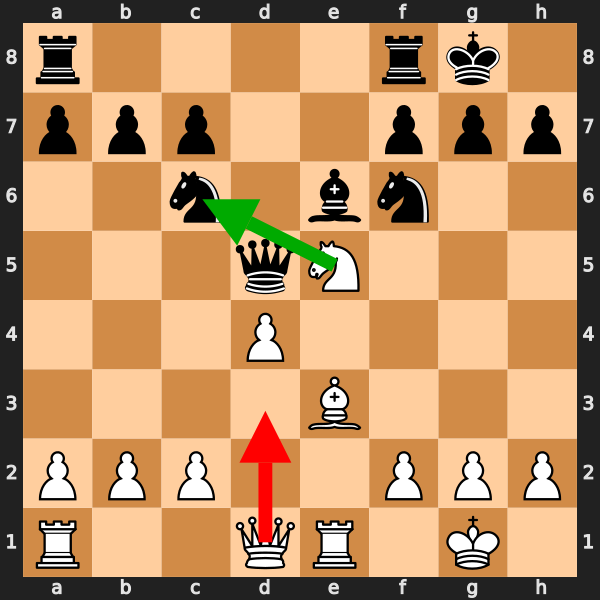 White is completely winning but plays Qd3 (red arrow) under time pressure, allowing Black back into the game. Nxc6 (green arrow) would have secured the win.
Actionable Advice (1400-1500): At this level, clock management is a primary skill. Playing a slightly sub-optimal opening move quickly is often better than spending 10 seconds finding the engine-approved best move. Practice playing "good enough" moves rapidly to maintain a time advantage for the complex middlegame and endgame phases.
Conclusion: Where to Focus Your Energy
The data is clear: for players between 800 and 1500, the opening explains very little of the variance in game outcomes.
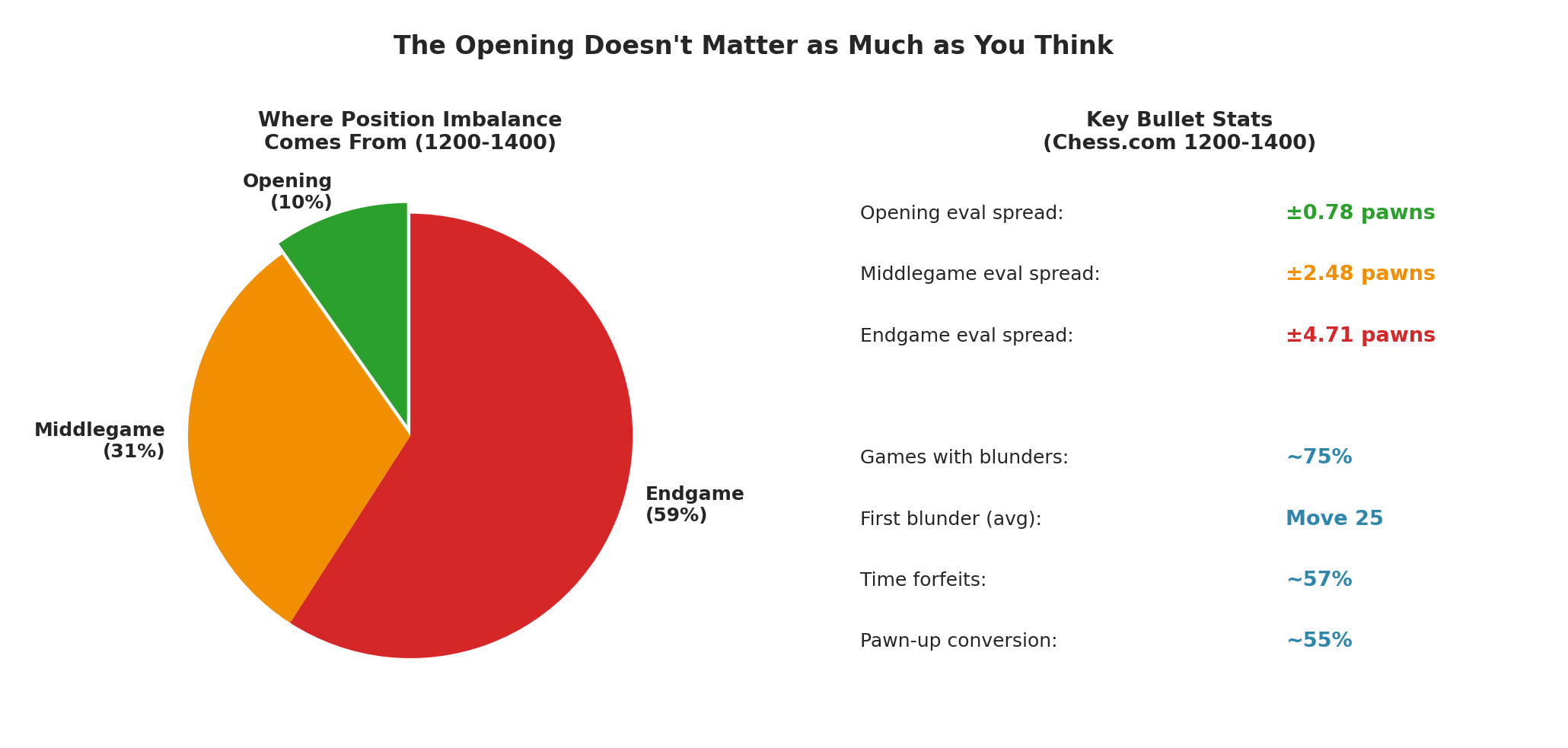
To climb the rating ladder, shift your focus away from memorizing deep opening theory and toward the areas where the real EV lies:
- Tactics and Board Vision: The vast majority of games are decided by middlegame blunders.
- Practical Play: Learn to fight back from worse positions and convert advantages cleanly.
- Clock Management: In Bullet, time is a piece. Don't waste it in the first 10 moves.
Data and Methodology
This analysis is based on a large sample of Lichess Bullet games. Because Lichess ratings are generally higher than Chess.com ratings for the same skill level, we applied a conversion mapping to align the data with Chess.com rating bands (e.g., Chess.com 1200 Bullet roughly corresponds to Lichess 1475 Bullet).
The raw data was extracted using the Grandmaster Guide MCP server, which processes millions of games with Stockfish 12/17 evaluations to compute metrics like Centipawn Loss (CPL), blunder rates, and phase-specific evaluations.
The underlying datasets used to generate the charts in this article are available for download below:
View full data →openingEco openingName ratingBand whiteWinRate drawRate blackWinRate totalGames A00 Ware Opening: Symmetric Variation 1800-2000 48.8 2.8 48.4 6124 A40 Queen's Pawn Game: Modern Defense 1800-2000 51.9 2.8 45.3 5122 A00 Ware Opening: Symmetric Variation 1500-1800 51.1 2.2 46.7 4719 B01 Van Geet Opening: Grünfeld Defense 1800-2000 47.8 3.7 48.4 4188 A00 Ware Opening: Symmetric Variation 1300-1500 49.7 1.8 48.5 3926
View full data →ecoFamily firstMoveSummary ratingBand whiteWinRate drawRate blackWinRate totalGames A 1.d4/1.Nf3/1.c4/flank 700-900 47.4 4.9 47.7 33899 A 1.d4/1.Nf3/1.c4/flank 900-1100 48.1 3.9 47.9 31929 A 1.d4/1.Nf3/1.c4/flank 1100-1300 49 3.4 47.5 32242 A 1.d4/1.Nf3/1.c4/flank 1300-1500 49.3 3 47.6 35356 A 1.d4/1.Nf3/1.c4/flank 1500-1800 50.2 3.1 46.5 37110
View full data →ratingBand phase avgEvalAbsolute sampleGames 700-900 opening 1.35 2036206 700-900 middlegame 4.17 2216379 700-900 endgame 6.39 2972861 900-1100 opening 1.07 2060335 900-1100 middlegame 3.43 2372952
View full data →ratingBand phase avgCpl blunderPct mistakePct inaccuracyPct sampleMoves avgTimeSpentSec 700-900 opening 197.5 19.57 17.01 14.71 2513055 5.47 700-900 middlegame 529.6 43.15 5.06 1.5 3276179 7.03 700-900 endgame 686.5 45.89 1.54 0.66 1295246 3.86 900-1100 opening 164.9 16.15 19.03 16.77 2565446 4.61 900-1100 middlegame 461.1 40.79 6.63 2.11 3656537 6.48
View full data →ratingBand materialBucket side aheadSide winPct drawPct lossPct samplePositions 700-900 +1-2 (pawn up) ahead white 54 6.8 39.2 12642 700-900 +1-2 (pawn up) behind black 51.1 6.8 42.1 13212 700-900 +3-4 (minor piece up) ahead white 60.2 6.8 33 8915 700-900 +3-4 (minor piece up) behind black 59.7 6.1 34.2 9719 700-900 +5-6 (rook up) ahead white 66.2 5.7 28.1 6212
Chess Coach <2026-04-17>